

What Is a Shoe Last? How Lasts Shape Fit and Sizing
Summarise This Guide with AI
Open an assistant below and submit the prefilled request. The assistant reads this page only after you submit it. The guide covers what a shoe last is, how lasts shape fit, the main sizing systems, and why brands fit differently.
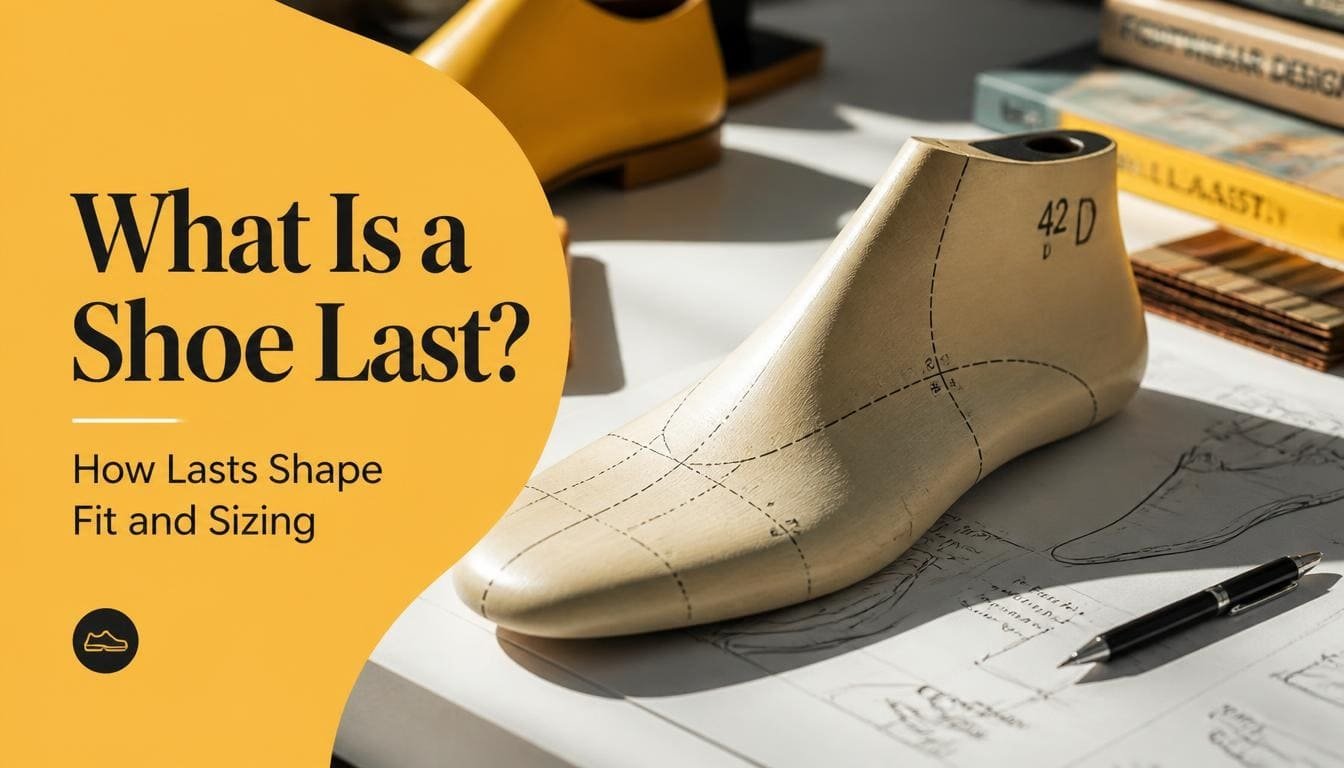
A shoe last is the three-dimensional form a shoe is built around. It is shaped like a foot, and its length, width, and toe and heel profile determine how the finished shoe fits. Lasts come in pairs for left and right feet and are made from wood, metal, or high-density plastic. Sizing systems such as the Paris point and barleycorn measure the last, not your foot directly, which is why sizes differ between brands and regions.
Key Takeaways
- A last is a mechanical foot-shaped form that a shoe is built around. Its shape sets the toe box, heel, and overall volume of the finished shoe.
- Lasts are usually made in matched pairs, one for each foot, and modern lasts are commonly designed with CAD software.
- Common sizing systems, including the Paris point and barleycorn, measure the last’s length. A last is typically longer than the foot it is designed for, so the labelled size is not a simple copy of foot length.
- Two shoes in the same size can fit differently because their lasts differ in width, volume, and toe shape.
- Lasts shape the fit, but they do not diagnose or treat foot conditions. A clinician or fitter can assess foot-specific needs.
What a Shoe Last Is
Most shoppers never see a last, yet it governs nearly everything about how a shoe fits. Wikipedia’s entry on lasts describes a last as a mechanical form used by shoemakers and cordwainers in the manufacture and repair of shoes, and notes that it is shaped like a human foot. The exact shape is tailored to the kind of footwear being made. Boot lasts, for example, typically hug the instep more closely than a sneaker last does. You can read the Wikipedia article on lasts for the historical and technical background.
The word itself is older than the shoe industry. The English word “last” is thought to derive from a Proto-Germanic term that meant a track, a trace, or a footprint. That origin fits the job: the last holds the shape of a foot so the shoe can be built around it.
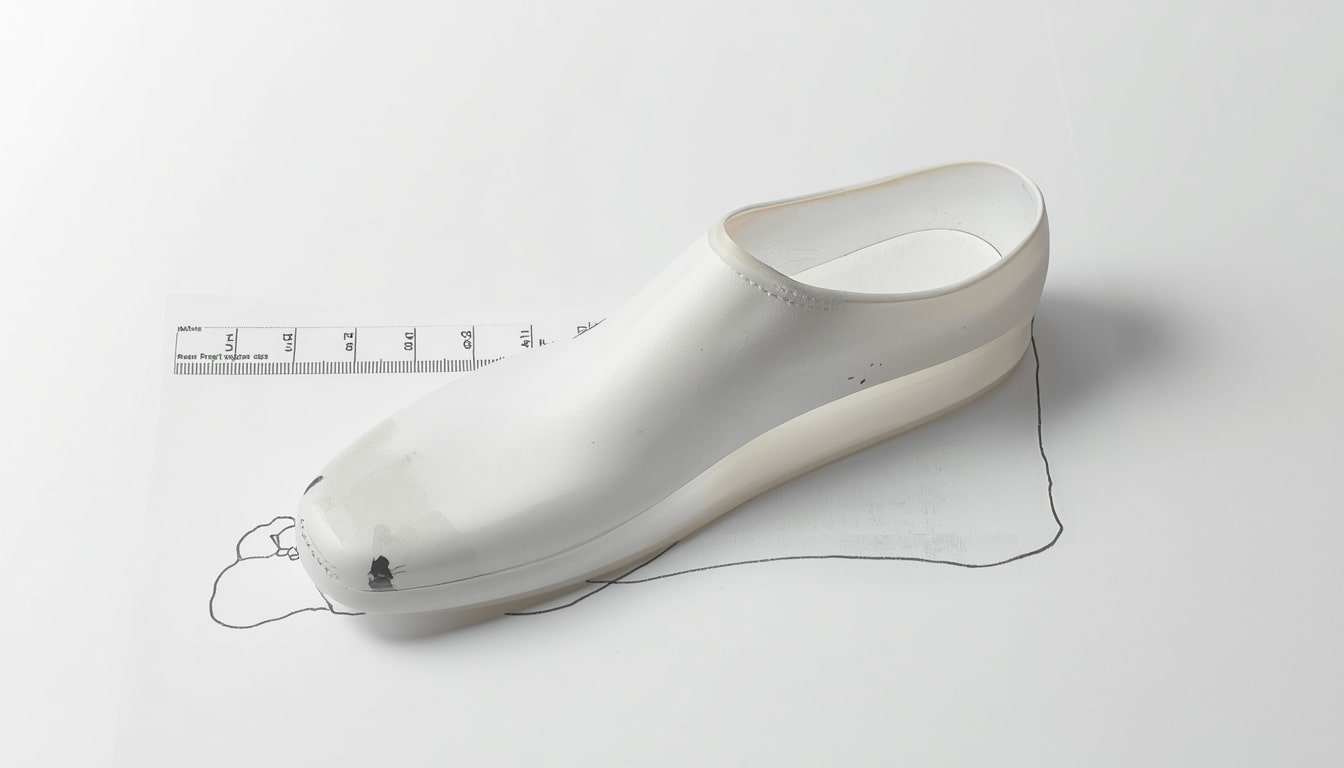
In practice, a last is the mould for the shoe. The upper is stretched over it, the sole is attached below, and the finished shoe keeps the last’s outline. When you try on a shoe, you are experiencing the shape of the last that built it, not your foot’s shape exactly.
If you are new to shoe anatomy, the anatomy of a shoe guide explains the main parts that a last supports, from the upper to the sole.
A Short History of the Last
For centuries, shoemakers worked with lasts that were not always matched. Wikipedia notes that Roman cordwainers sometimes shaped footwear separately for each foot, but the distinction was mostly lost after the barbarian invasions in late antiquity. In the High Middle Ages, commercial shoemaking often used a single last for either foot, with the expectation that wear would gradually reshape the shoe.
Matched pairs returned with industrial production and mass marketing in the early nineteenth century. Since then, lasts have generally been made and used in pairs to match the separate shapes of the left and right foot. Wikipedia describes this shift as a key step toward better-fitting mass-produced shoes.
The biggest change came in the 1880s, when Jan Ernst Matzeliger, a Surinamese-American inventor, patented an automated lasting machine. Wikipedia reports that the machine centralized production, increased output as much as fourteen times, improved quality, and halved prices. Lasting is the step where the upper is pulled over the last and fixed to the insole, so automating it changed the whole industry.
What Lasts Are Made Of
A last must hold its shape while leather is stretched and tacked over it, which takes considerable force. Wikipedia lists hardwoods, cast iron, and high-density plastics as the traditional materials. Wooden lasts are now mostly used for repair work and bespoke shoemaking, particularly in Europe and North America.
Factory lasts face a tougher job. They must hold the lasting tacks that position the shoe’s parts and withstand the force of the machines that attach the sole. The usual material today is high-density polyethylene plastic, which can be shaped precisely and cheaply, tolerates tack damage better than many alternatives, and can be recycled when worn out. Wikipedia describes this as the usual material now for factory lasts.
Modern last shapes are often designed on computers. Wikipedia notes that they are now usually designed with dedicated CAD software, which allows designers to adjust the shape digitally before a physical last is made. That means the last you never see can still be tuned carefully to the target fit.
How a Last Shapes a Shoe
Think of a last as the shoe’s internal blueprint. Its outline sets the length of the toe box, its width sets how much room the forefoot has, and its heel and instep profile determine how the shoe grips the back of the foot and the top of the foot.
The same principle explains why a last can be designed for a specific purpose. Wikipedia notes that the shape is tailored to the footwear being made. A running shoe last might have a different toe spring, heel height, and volume than a formal leather shoe last, even when both are labelled with the same size.
Lasts also affect how the sole is attached. The last’s bottom contour defines the sole’s footprint, and that footprint influences how the shoe contacts the ground. Designers balance this with the midsole and outsole, so the last is one part of a larger system. Our guide to insoles, midsoles, and outsoles explains how those layers stack above and below the last’s shape.
Reading a Shoe’s Construction: Toe, Heel and Support
Shoe fit depends on several features that the last shapes indirectly. The toe box is the front of the shoe where your toes sit. Its height, width, and length decide how much room your toes have and whether they can spread during a stride. A last with a narrow toe profile can feel restrictive even if the length is correct.
The heel counter is the firm stiffener around the back of the shoe that holds the heel in place. It is shaped by the last’s heel profile and by the materials added on top. If the heel counter does not match the last’s back curve, the heel can slip or feel loose. Our separate guide on what a heel counter is covers this part in more detail.
The shank is the supportive element in the midsole that sits under the arch area. It stiffens the shoe through the middle, and its placement is related to how the last’s bottom contour supports the arch. The guide to what a shoe shank does explains how this support works.
The sole is shaped around the last’s underside, and the upper is pulled over the last’s top. Together, these choices set the shoe’s overall volume and the height of the instep. Two shoes in the same size can differ in every one of these features.
Sizing Systems: Paris Point, Barleycorn and Mondopoint
Shoe size is a number that points to a length, and the number means different things depending on the system. The measurements below are the ones most readers encounter.
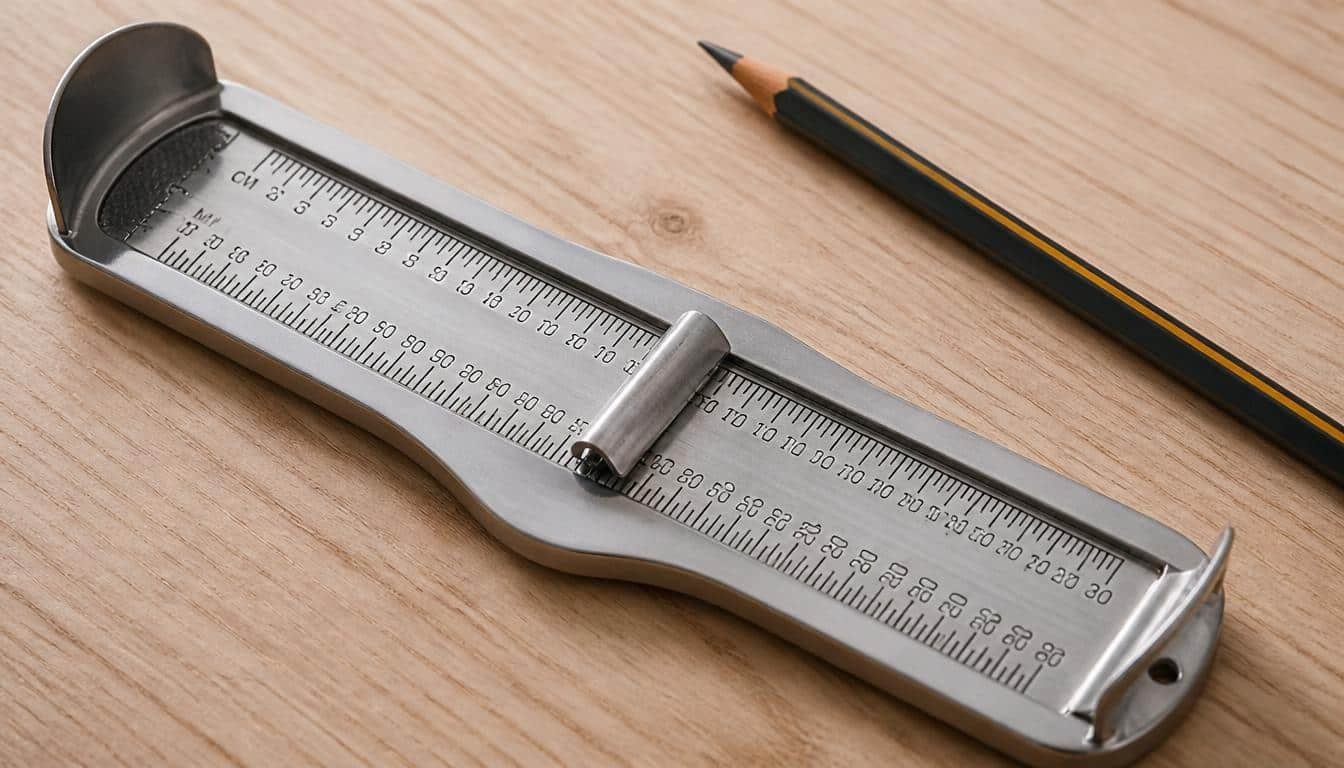
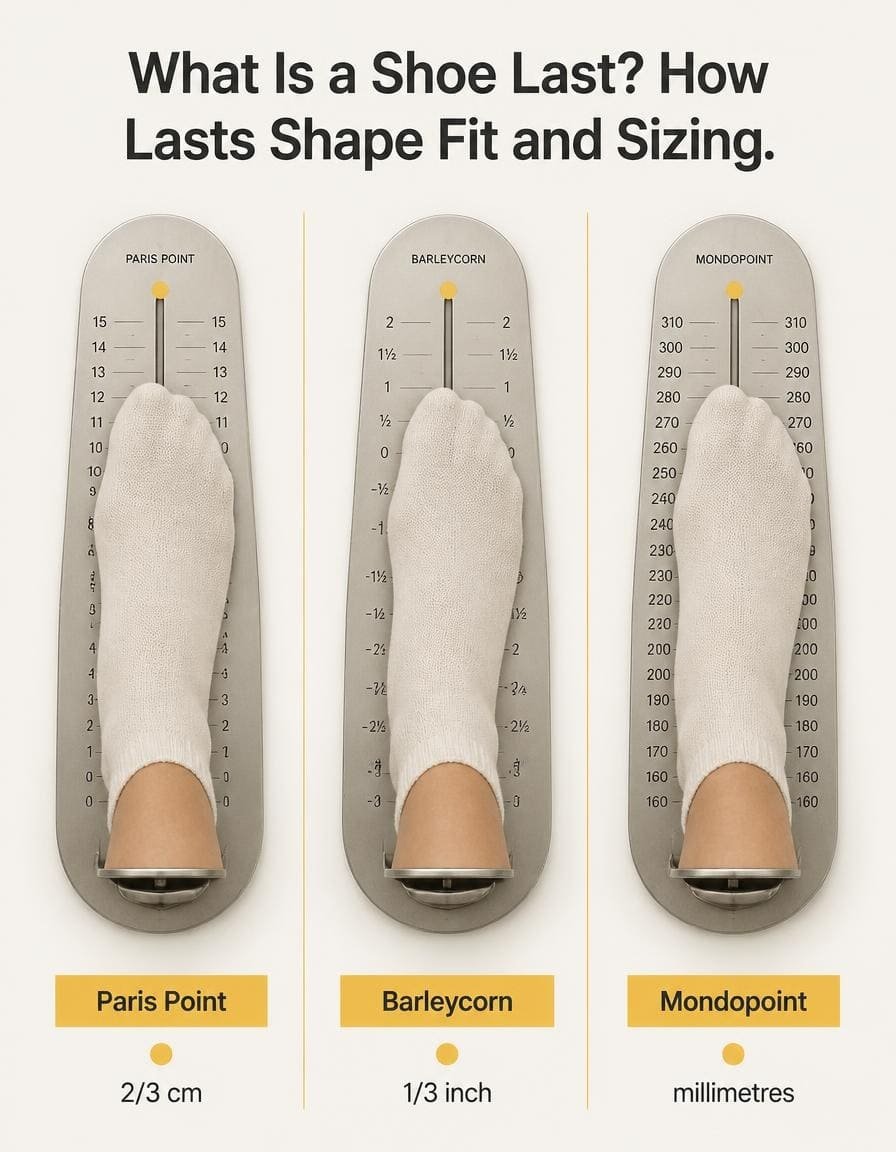
The Paris point is a unit of length defined as two-thirds of a centimetre, or about 6.67 millimetres. It is commonly used for shoe sizes in Continental Europe. Wikipedia’s shoe size entry notes that whole sizes increase by one Paris point, which means each half size adds about 3.33 millimetres. An AMSTZone sizing reference gives a conversion for the Paris point in terms of the last’s length in centimetres, using the relationship that the Paris point size equals the last length in centimetres multiplied by 1.5. You can read AMSTZone’s shoe size conversion tables for the full chart.
The barleycorn is one-third of an inch, about 8.5 millimetres. The UK sizing system is based on the length of the last measured in barleycorns from a starting point, although Wikipedia notes that UK sizing is not formally standardised. US sizing uses its own barleycorn offsets, and women’s sizes often differ from men’s sizes by a set amount in the standard scale.
Mondopoint is a metric system that expresses size as the foot length in millimetres, with an optional width. ISO 9407:2019 is the international standard that sets out how footwear sizing should be expressed in that style. You can read a summary of the standard on the ANSI blog’s coverage of ISO 9407.
| Sizing system | Unit used | Main region | What the number refers to |
|---|---|---|---|
| Paris point | 2/3 cm (about 6.67 mm) | Continental Europe | Length of the inside of the shoe or last |
| Barleycorn (UK) | 1/3 inch (about 8.5 mm) | UK and Ireland | Length of the last, from a starting point |
| Barleycorn (US) | 1/3 inch, with US offsets | United States and Canada | Length of the last, with separate men’s and women’s scales |
| Mondopoint | Millimetres | International, metric systems | Foot length in millimetres, sometimes with width |
| Centimetre scale | 1/2 cm steps for many athletic shoes | Common in modern sneakers | Last length in centimetres |
A key point is that the labelled size usually refers to the last, and the last is typically longer than the foot it is designed for. Wikipedia’s shoe size entry notes that the last is typically longer than heel-to-toe foot length by about a half to two-thirds of an inch, so using a shoe size to find your foot length requires an allowance.
Why Two Brands Fit Differently
If you wear a size 42 in one brand and a size 43 in another, the difference is not always a mistake. Each brand designs its own last, and the labelled size reflects that brand’s last measurements and allowances. A brand that uses a narrower last will often feel tighter in a width that matches another brand’s standard.
Width is a separate issue. Some systems include width in the size, while others leave it to a separate letter or a width name. Wikipedia notes that width is included in various ways across systems and is not always standardized. The same length can feel very different if the forefoot volume changes.
Last shape also changes toe room. Some lasts are rounder at the toe, others are more tapered. A tapered last can feel roomy at the toe but tight across the forefoot for some foot shapes. This is why it helps to try a shoe on rather than relying on the number alone.
Because of these differences, a fit guide or size chart is most useful when you check it against your own foot measurements and the brand’s own notes. Our shoe finder can help narrow styles by purpose before you compare fits.
How Lasts Affect Comfort
Comfort depends on how well the shoe’s internal shape matches the foot. The last sets much of that shape, so it affects toe room, heel hold, instep height, and forefoot width. When these are right, the shoe can feel stable without pressure points. When they are wrong, the shoe can rub, pinch, or allow the foot to slide.
Some readers ask about shoes for diabetes, neuropathy, or other foot conditions. This guide does not provide medical foot advice. People with conditions affecting sensation, circulation, or skin integrity should seek individual assessment from a clinician or podiatrist before choosing footwear. A fitter who understands lasts can also help, but a clinical assessment is the right route for medical needs.
For general comfort, check three things. Make sure your longest toe has room without the shoe feeling loose. Make sure the heel stays put when you walk. Make sure the forefoot is not squeezed across the widest part of the foot. Try shoes later in the day, when feet are slightly larger.
Who Should Care About Lasts
Lasts matter most to readers who buy shoes often, who struggle with fit, or who need a reliable way to compare sizes across brands. Runners who switch between brands may find the last knowledge especially useful, because the same number can mean different lengths and volumes.
Shoe repairers, shoemakers, and fitters use lasts directly. A repairer may replace a sole on a last that matches the original shape, and a bespoke maker may build a custom last from measurements. For these readers, the last is a working tool, not just a background idea.
Parents buying children’s shoes should also understand that children’s sizing uses its own scale, and that a child’s foot grows quickly. Measure the foot regularly and check the size system on the shoe, rather than assuming one brand’s size matches another’s.
If you buy from overseas retailers, the size system may be unfamiliar. Convert carefully, and read the brand’s size chart. A conversion chart helps, but it is still an estimate.
Custom and Bespoke Lasts
Some shoemakers create custom lasts based on a customer’s foot measurements. Wikipedia describes cordwainers who use lasts designed to the proportions of individual customers’ feet, made from wood or modern materials that can handle constant tacking and pinning and the wet environment of stretching and shaping leather.
Custom lasts can improve fit for people whose feet do not match standard shapes, but they are expensive and take time. They are also a different category from mass-produced shoes, which use a standard last family and standard sizing. Readers who need a custom solution should consult a qualified bespoke maker or a clinician, depending on their needs.
Customization in the mass market usually works differently. Some brands offer width options or insole adjustments, which change fit without a fully custom last. Check the product page for those options.
Trade-Offs and Limitations
Lasts are powerful tools, but they have limits.
The first limit is standardization. Shoe sizing is not formally standardized across all systems. Wikipedia notes that UK sizing, for example, is not formally standardized, and that size systems differ in what they measure and where the zero point sits. A size chart is a guide, not a guarantee.
The second limit is that the last is not the foot. A last is an idealized form, and even a well-designed last cannot match every foot shape. Two people with the same foot length can have different arch heights, widths, and toe shapes, and a standard last will fit some better than others.
The third limit is the difference between the last and the finished shoe. Materials, stitching, and the sole add or remove volume. A shoe can feel different from its last outline, which is why the finished product should always be tried on.
The fourth limit is that lasts do not solve medical problems. Fit can improve comfort, but it does not treat conditions. Professional assessment is the right route for those needs.
Myths Worth Dropping
Myth: The shoe size is the same as your foot length. The size usually refers to the last, which is typically longer than the foot. Allowances are built in.
Myth: All sizes in the same number are identical. Paris point, barleycorn, and mondopoint are different systems. A number on one scale does not match the same number on another.
Myth: A last is just a plastic shape. Lasts are engineered forms made from hardwood, cast iron, or high-density plastic, shaped to withstand the forces of lasting and the wet environment of leather.
Myth: Custom lasts are always better. Custom lasts can suit specific foot shapes, but they are not automatically better for every buyer. Mass-produced lasts are designed to fit a large population, and many people find them comfortable.
Practical Fitting Steps
Start by measuring your feet. Stand with your weight evenly distributed, measure from heel to longest toe, and repeat for both feet. Use the larger measurement. Measure width across the widest part of the forefoot if you can, and note whether your feet differ.
Next, read the brand’s size chart and check the system it uses. Note whether the chart refers to Paris point, barleycorn, mondopoint, or centimetres. Compare the chart against your measurements, and allow for the typical space between foot length and last length that the chart may already include.
Then try the shoe on in the afternoon, wearing the socks you plan to use. Stand, walk, and if possible jog or walk briskly on a hard surface. Check toe room, heel hold, and forefoot comfort. A thumb’s width of room at the toe is a common reference point, though the right amount depends on the shoe and your activity.
Finally, if fit issues persist, consult a fitter or clinician. For a broader view of how shoes are built, the how shoes are made guide shows where the last fits into the manufacturing process.

Frequently Asked Questions
What is a shoe last?
A shoe last is a foot-shaped form that shoes are built around. It sets the shape of the toe box, heel, and overall volume of the finished shoe. Lasts come in pairs for the left and right foot and are made from wood, cast iron, or high-density plastic.
Why do shoe sizes differ between brands?
Each brand designs its own last, and the size label reflects that last’s measurements and allowances. Different sizing systems also use different units, so the same number can mean different lengths.
What is the difference between Paris point and barleycorn?
A Paris point is two-thirds of a centimetre, about 6.67 millimetres, and is commonly used in Continental Europe. A barleycorn is one-third of an inch, about 8.5 millimetres, and is used in the UK and US systems, which have their own offsets.
Is the shoe size the same as my foot length?
Not exactly. The labelled size usually refers to the last, which is typically longer than the foot it is designed for. Size charts and fitting guides build in an allowance, so check the brand’s chart against your measurements.
Does a last affect comfort?
Yes. The last sets much of the internal shape, including toe room, heel hold, and forefoot width. A last that does not match your foot shape can feel tight or loose, even in the correct size.
Can a last help with foot conditions?
Lasts shape fit but do not treat medical conditions. If you have a condition that affects your feet, consult a clinician or podiatrist for individual assessment before choosing footwear.
What is a bespoke last?
A bespoke last is a custom form made to the proportions of an individual customer’s foot. It is used by bespoke shoemakers and is typically more expensive and slower to produce than a standard factory last.
Conclusion
A shoe last is the foot-shaped form that gives every shoe its fit, and it shapes the toe box, heel, and volume before you ever try the shoe on. Sizing systems such as the Paris point and barleycorn measure the last rather than your foot, which explains many of the differences between brands. Your next step is to measure your feet, check the brand’s size chart and system, and try the shoe on in the afternoon with the socks you plan to wear. For a broader foundation, start with the shoe materials hub or the footwear knowledge section.
Sources
- Wikipedia, “Last”: https://en.wikipedia.org/wiki/Last
- AMSTZone, “Shoe Size Conversion Tables” (Paris point and barleycorn reference): https://www.amstzone.org/Home/ShoeSizeConversionTables.pdf
- ANSI Blog, coverage of ISO 9407:2019 footwear sizing: https://blog.ansi.org/ansi/iso-9407-2019-footwear-sizing/


