
Counterfeit Shoes Statistics 2026: Fake Footwear Seizures, Trade and Buyers Worldwide
How many fake shoes are out there? Nobody can count the shoes that get through, but customs agencies count the ones they catch, and those records are surprisingly detailed. I went through the latest reports from the OECD, US Customs, the EU, the UK, Japan and Hong Kong, plus the surveys that ask people what fakes they buy. This page puts the footwear numbers side by side, explains why they look so different, and gives you the data to check every figure yourself.
Six headline numbers on fake shoes. Select one to see what it counts and where it comes from.
Select a place above, for example “United States”, to see what the number counts.
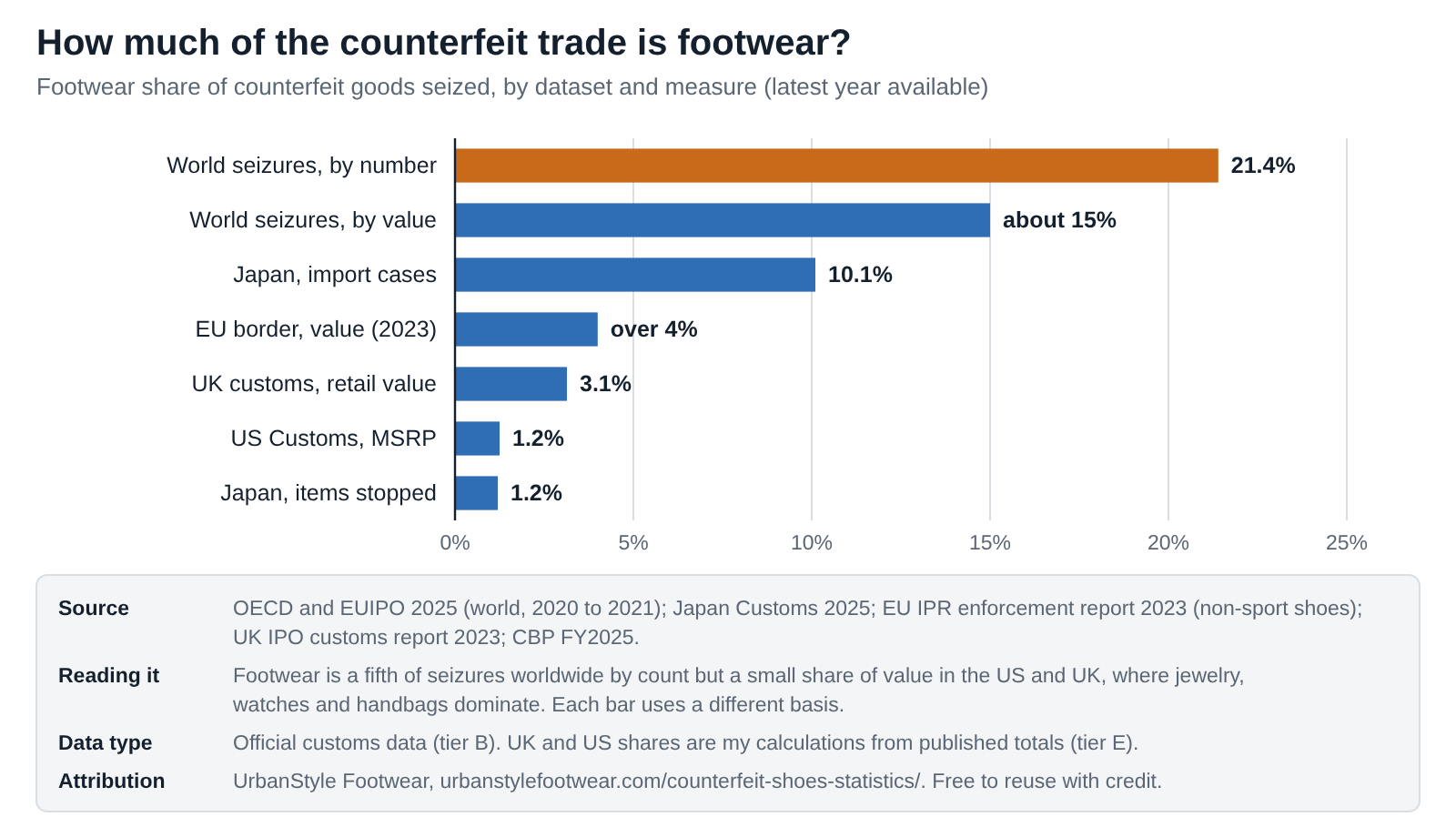
21.4%Footwear made up 21.4% of counterfeit seizures worldwide in 2020 to 2021, second only to clothing at 21.6%, and about 15% of the value seized (OECD and EUIPO, tier B).
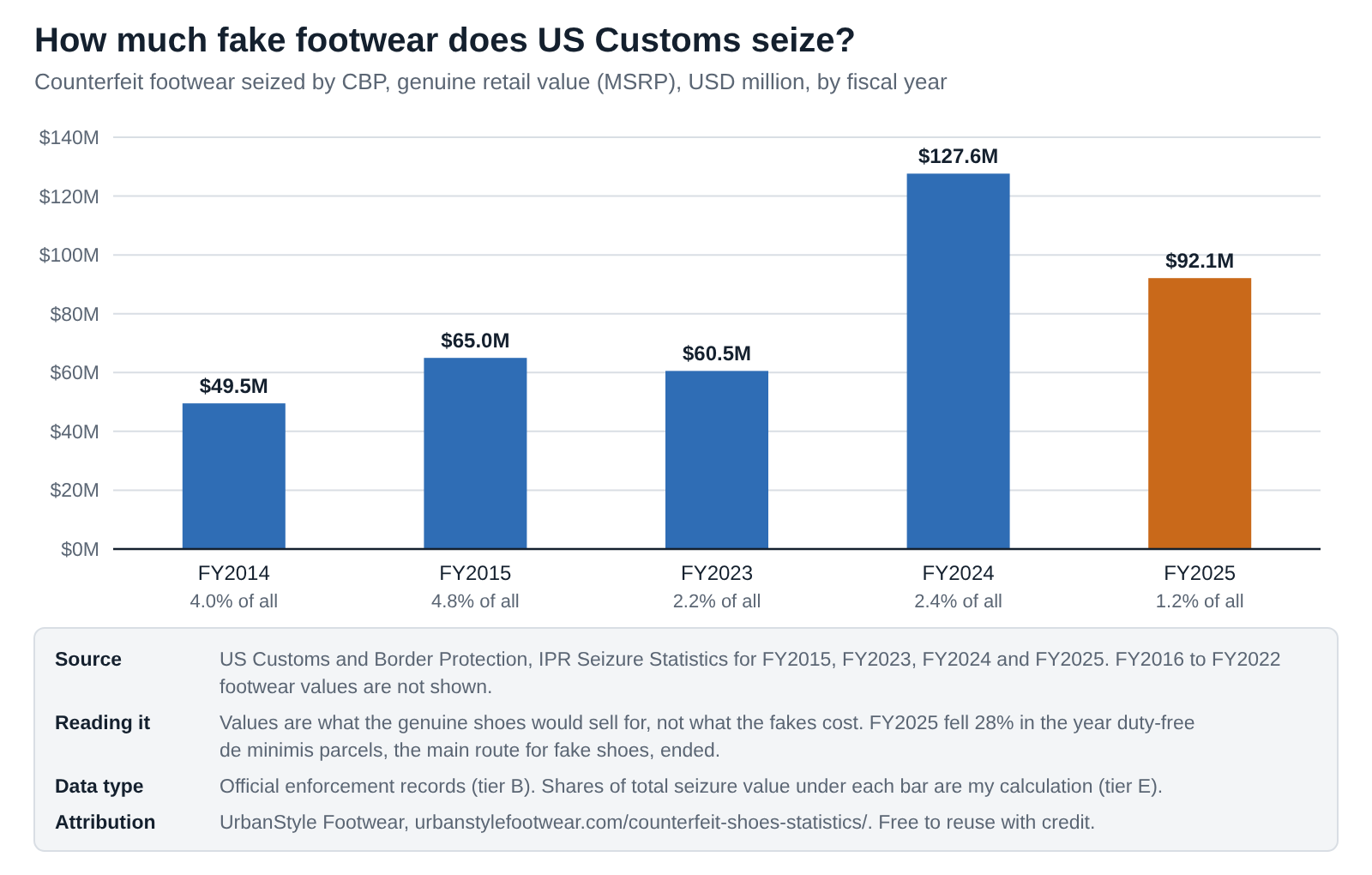
$92.1MUS Customs seized fake footwear worth $92.1 million at genuine retail prices in fiscal 2025, down 28% from $127.6 million in 2024, in the year duty-free small parcels ended (CBP, tier B; change my calculation).
196M itemsEU authorities detained a record 196 million fake items worth EUR 6.3 billion in 2025. The last EU year with a shoe figure, 2023, put non-sport shoes at over 4% of the value detained at the border (European Commission and EUIPO, tier B).
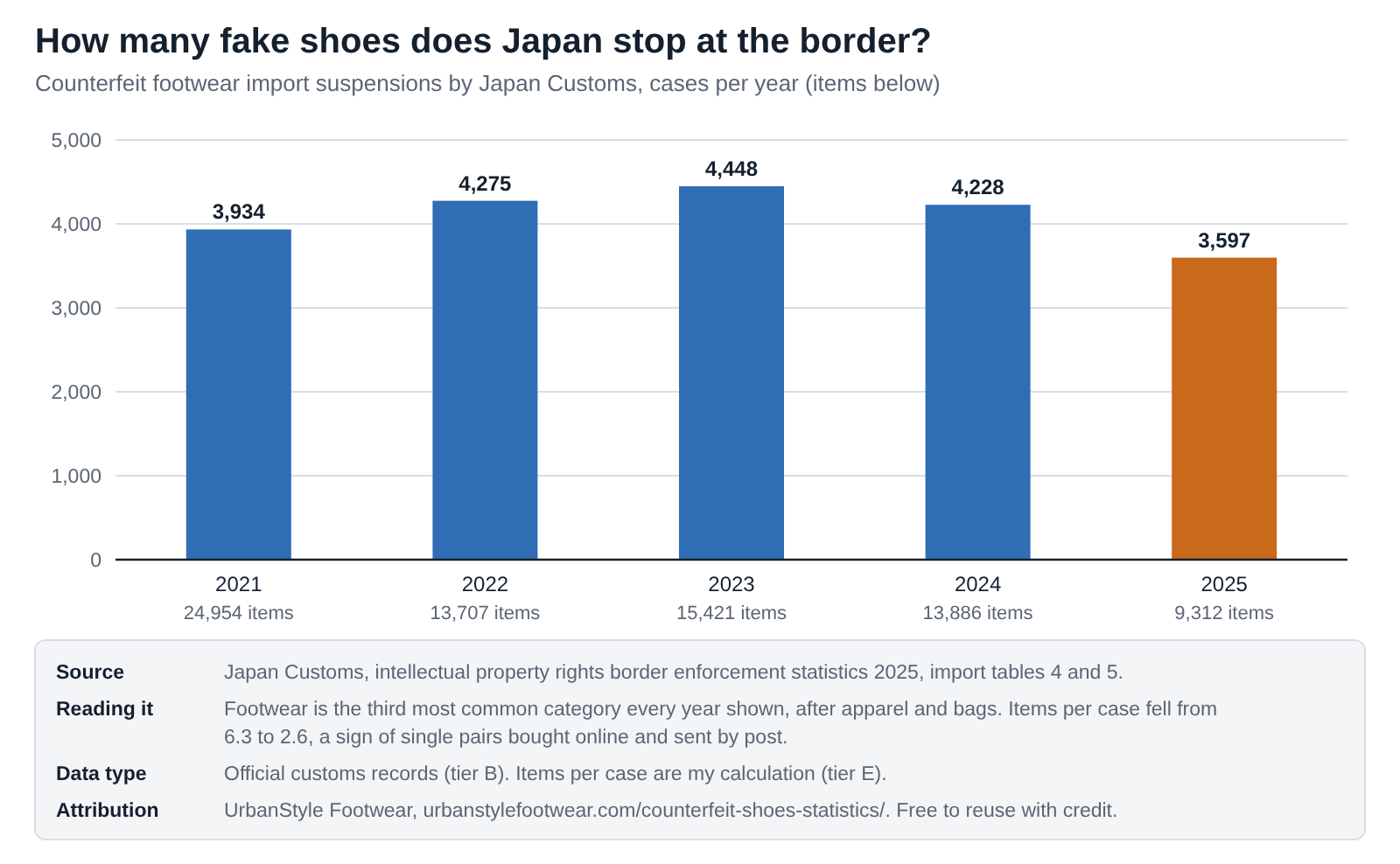
3,597 casesJapan Customs stopped fake footwear in 3,597 cases in 2025, the third most common category after apparel and bags (Japan Customs, tier B).
38,478UK customs detained 38,478 counterfeit shoe articles in 2023, more than double the 17,339 of 2022, with a retail value of GBP 6.28 million (UK IPO, tier B).
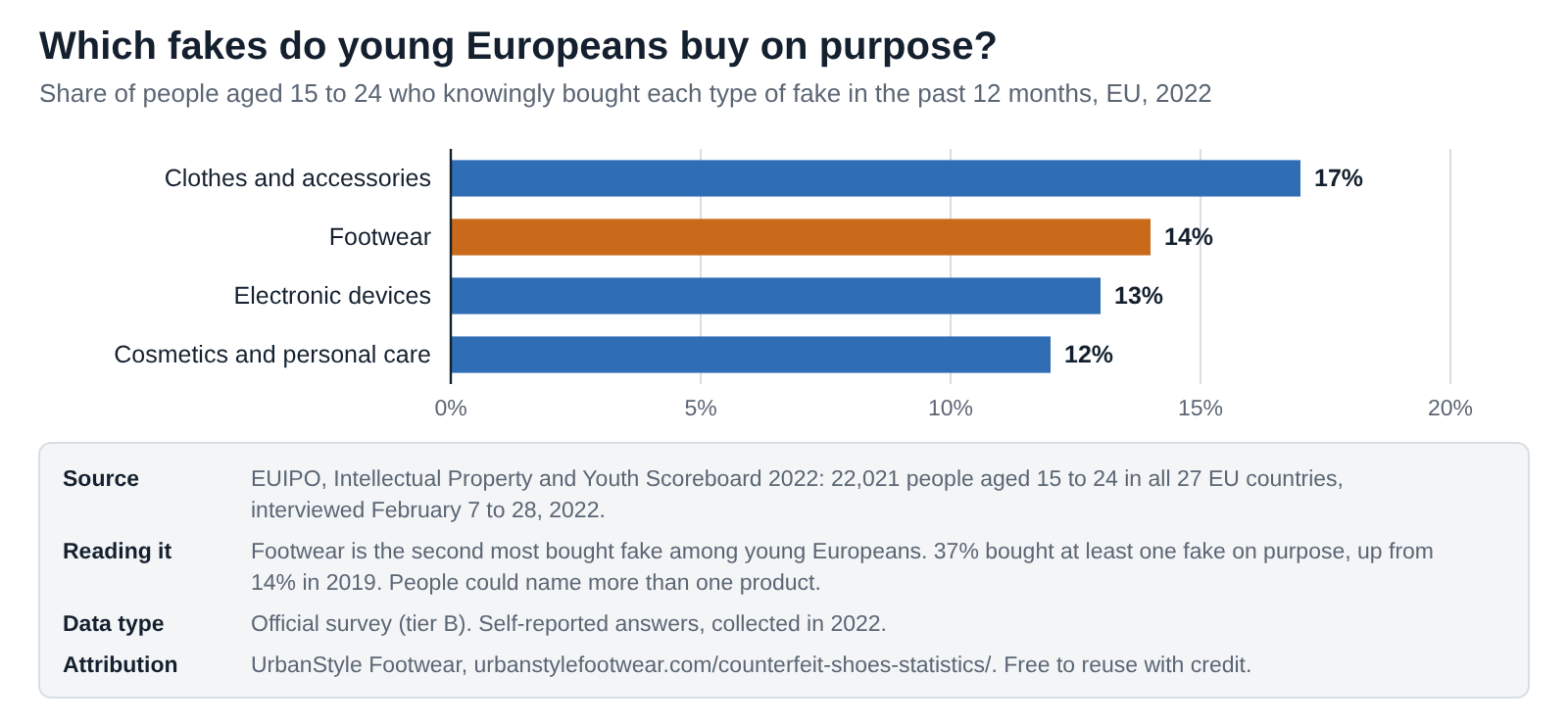
14%In 2022, 14% of Europeans aged 15 to 24 said they had bought fake footwear on purpose in the past year (EUIPO, tier B).
Each number names its source and evidence tier. All fifteen of my citable statistics are further down this page.
Counterfeit shoe statistics at a glance
Quick answer. Shoes are one of the two most counterfeited products in the world. Footwear made up 21.4% of all counterfeit seizures worldwide in 2020 to 2021, almost level with clothing, and about 15% of the value seized. Nearly 83% of seized fake shoes came from China, Türkiye and Hong Kong, and 70% were sent by post. In the US, customs seized fake footwear worth $92.1 million in fiscal 2025. The whole trade in fakes, every product, was about $467 billion in 2021, so any claim of a fake sneaker market bigger than that is wrong.
Key findings
- Shoes are a fifth of all fakes seized. Footwear was 21.4% of counterfeit seizures worldwide in 2020 to 2021, against 21.6% for clothing, and about 15% of the value, second to watches.
- Three places supply most fake shoes. China, Türkiye and Hong Kong account for nearly 83% of seized fake shoes and 94% of their value. About a quarter of the value seized went from China to the US.
- Fake shoes travel by post, one or two pairs at a time. About 70% went by post and 90% of footwear seizures held fewer than ten items. In Japan, items per case fell from 6.3 in 2021 to 2.6 in 2025.
- US seizures fell 28% in 2025 while all fakes rose 36%. Fake footwear seized by CBP dropped from $127.6 million to $92.1 million, the year duty-free small parcels ended. About 90% of earlier seizures had come in as those parcels.
- Shoes are a small slice of value in the US. Footwear was 1.2% of the $7.37 billion of fakes CBP seized in fiscal 2025, because jewelry, watches and handbags carry far higher retail prices.
- The UK doubled its catch in 2023. UK customs detained 38,478 fake shoe articles in 2023, against 17,339 in 2022.
- Europe loses about EUR 11.9 billion a year of clothing and footwear sales to fakes, 5.2% of sales, by EUIPO’s estimate for 2018 to 2021.
- Young buyers know what they’re buying. 14% of Europeans aged 15 to 24 bought fake footwear on purpose in 2022, and in 2023 half of that age group said buying fakes is acceptable when the original is too expensive.
What I noticed while putting this together
The first thing I checked was the number you see most often: a counterfeit sneaker market of $500 billion or $600 billion. The OECD and EUIPO put the entire trade in fakes, from handbags to medicines, at about $467 billion in 2021. A market for fake sneakers alone can’t be bigger than the market for every fake product combined, so I didn’t use any of those figures.
The second thing was how much depends on what you count. Worldwide, footwear is a fifth of seizures. In US Customs data it’s 1.2% of value, and in Japan it’s 10% of cases but 1.2% of items. None of these is wrong. They count different things, and I’ve put them in one chart so you can see the gap.
The third was timing. US seizures of fake shoes fell sharply in fiscal 2025, the same year the US ended duty-free entry for small parcels, which is how about 90% of fake shoes had been coming in. CBP says counterfeiters are moving to shipping containers. That’s a story the 2026 figures will tell properly; for now I flag it as a likely cause, not a proven one.
What counterfeit shoe data can and can’t tell you
Here is where the evidence stands as of October 2026.
| Question | Evidence status | Why |
|---|---|---|
| Fake shoes seized by customs | Official data | US, Japan, UK yearly; EU when shoes are a top category |
| Footwear share of world seizures | Official data | OECD and EUIPO, seizures from 2020 to 2021 |
| Where fake shoes come from and how they travel | Official data | Same OECD and EUIPO seizure records |
| Sales lost by legitimate brands | Official estimate | EUIPO model for EU clothing including footwear, 2018 to 2021 |
| Who buys fakes on purpose | Survey | EUIPO surveys; self-reported; shoe question from 2022 |
| Size of the fake shoe market | Not measured | No agency estimates it; seizures show only what gets caught |
| Injuries from fake shoes | Not measured | No report I used counts them |
Six kinds of source exist. Pick one to see what it counts and where it falls short.
See what each source of counterfeit data counts and where it falls short
Choose a source to see what it records and how I would read it.
Select a source above.
OECD and EUIPO model. 2020 to 2021 seizures. Pools customs seizures from around the world and scales them up to estimate the whole trade in fakes: $467 billion in 2021. How to read it: Official research (tier B) and the only global estimate. It is built on seizures from 2020 and 2021, so it is several years old by the time it is published.
US Customs (CBP). Fiscal 2014 to 2025. Counts what US Customs seizes, valued at the retail price of the genuine product (MSRP). How to read it: Official (tier B) and yearly, but it measures enforcement, not the market. A change in where officers look or how fakes are shipped moves the numbers.
EU and UK customs. 2021 to 2025. Count articles and estimated value detained at the border and, in the EU, inside the single market. How to read it: Official (tier B). Recent EU reports only break out the biggest categories, and shoes have not been among them, so the last EU shoe figure is for 2023.
Japan Customs. 2021 to 2025. Counts cases and items stopped at import, by product, every calendar year. How to read it: Official (tier B) and the cleanest five-year footwear series I found. A case can count in more than one category, so category shares are of category cases.
Buyer surveys. 2022 and 2023. EUIPO asks Europeans whether they bought fakes on purpose or by mistake, and what they bought. How to read it: Official surveys (tier B) with large samples and published methods, but they measure what people admit, and the footwear figure comes from the 2022 youth survey.
Resale platforms. 2024. Platforms such as StockX report what their own authenticators reject. How to read it: Company statements (tier C). Useful for which models are faked, but they only see shoes sent to them for checking.
15 counterfeit shoe statistics you can cite
Each card has one number, one sentence of context and its source. “Copy text” opens a box with the sentence, the source and a link back here. Please cite the original source for any single statistic. Cards marked E are my calculations.
Footwear made up 21.4% of counterfeit seizures worldwide in 2020 to 2021, second only to clothing at 21.6% (OECD and EUIPO, Mapping Global Trade in Fakes 2025).
Copy text
21.4% of fake goods seized worldwide are shoes: Footwear made up 21.4% of counterfeit seizures worldwide in 2020 to 2021, second only to clothing at 21.6% (OECD and EUIPO, Mapping Global Trade in Fakes 2025). Source: OECD and EUIPO, Mapping Global Trade in Fakes 2025 (Sections 2.2 and 3.2). Via UrbanStyle Footwear: https://urbanstylefootwear.com/counterfeit-shoes-statistics/
By value, footwear was about 15% of the counterfeit goods seized worldwide in 2020 to 2021, second to watches at 23% (OECD and EUIPO).
Copy text
15% of seized counterfeit value is footwear: By value, footwear was about 15% of the counterfeit goods seized worldwide in 2020 to 2021, second to watches at 23% (OECD and EUIPO). Source: OECD and EUIPO, Mapping Global Trade in Fakes 2025 (Sections 2.2 and 3.2). Via UrbanStyle Footwear: https://urbanstylefootwear.com/counterfeit-shoes-statistics/
Trade in counterfeit and pirated goods of all kinds was worth about $467 billion in 2021, or 2.3% of world imports (OECD and EUIPO).
Copy text
$467B world trade in fakes, all products, 2021: Trade in counterfeit and pirated goods of all kinds was worth about $467 billion in 2021, or 2.3% of world imports (OECD and EUIPO). Source: OECD and EUIPO, Mapping Global Trade in Fakes 2025 (Sections 2.2 and 3.2). Via UrbanStyle Footwear: https://urbanstylefootwear.com/counterfeit-shoes-statistics/
Nearly 83% of the counterfeit shoes seized worldwide in 2020 to 2021 came from China, Türkiye and Hong Kong, and 94% by value (OECD and EUIPO).
Copy text
83% of seized fake shoes from three places: Nearly 83% of the counterfeit shoes seized worldwide in 2020 to 2021 came from China, Türkiye and Hong Kong, and 94% by value (OECD and EUIPO). Source: OECD and EUIPO, Mapping Global Trade in Fakes 2025 (Sections 2.2 and 3.2). Via UrbanStyle Footwear: https://urbanstylefootwear.com/counterfeit-shoes-statistics/
Some 70% of the counterfeit footwear seized in 2020 to 2021 was sent by post, and 90% of footwear seizures held fewer than ten items (OECD and EUIPO).
Copy text
70% of fake shoes seized are sent by post: Some 70% of the counterfeit footwear seized in 2020 to 2021 was sent by post, and 90% of footwear seizures held fewer than ten items (OECD and EUIPO). Source: OECD and EUIPO, Mapping Global Trade in Fakes 2025 (Sections 2.2 and 3.2). Via UrbanStyle Footwear: https://urbanstylefootwear.com/counterfeit-shoes-statistics/
US Customs and Border Protection seized counterfeit footwear worth $92.1 million at genuine retail prices in fiscal 2025, the seventh largest category by value (CBP).
Copy text
$92.1M fake footwear seized by US Customs, FY2025: US Customs and Border Protection seized counterfeit footwear worth $92.1 million at genuine retail prices in fiscal 2025, the seventh largest category by value (CBP). Source: CBP IPR Seizure Statistics FY2025 (Publication 5471-0326). Via UrbanStyle Footwear: https://urbanstylefootwear.com/counterfeit-shoes-statistics/
The value of fake footwear seized by US Customs fell 28% in fiscal 2025, while total IPR seizures rose 36% to $7.37 billion (my calculation from CBP reports).
Copy text
-28% US fake shoe seizures, FY2025 vs FY2024: The value of fake footwear seized by US Customs fell 28% in fiscal 2025, while total IPR seizures rose 36% to $7.37 billion (my calculation from CBP reports). Source: UrbanStyle calculation. Via UrbanStyle Footwear: https://urbanstylefootwear.com/counterfeit-shoes-statistics/
About 90% of the counterfeit footwear seized by US Customs had entered as duty-free de minimis shipments, before the exemption was suspended in 2025 (US International Trade Commission).
Copy text
90% of US fake shoe seizures were de minimis parcels: About 90% of the counterfeit footwear seized by US Customs had entered as duty-free de minimis shipments, before the exemption was suspended in 2025 (US International Trade Commission). Source: USITC Executive Briefing, Nov 2025. Via UrbanStyle Footwear: https://urbanstylefootwear.com/counterfeit-shoes-statistics/
US Customs seized 604,553 counterfeit footwear items with a genuine retail value of $127.6 million in fiscal 2024, about $211 per item (CBP; per item my calculation).
Copy text
604,553 fake footwear items seized in the US, FY2024: US Customs seized 604,553 counterfeit footwear items with a genuine retail value of $127.6 million in fiscal 2024, about $211 per item (CBP; per item my calculation). Source: CBP IPR Seizure Statistics FY2024 (Publication 3964-0125). Via UrbanStyle Footwear: https://urbanstylefootwear.com/counterfeit-shoes-statistics/
Japan Customs stopped counterfeit footwear in 3,597 import cases in 2025, the third most common category after apparel and bags, down from 4,448 in 2023 (Japan Customs).
Copy text
3,597 fake footwear cases at Japanese customs, 2025: Japan Customs stopped counterfeit footwear in 3,597 import cases in 2025, the third most common category after apparel and bags, down from 4,448 in 2023 (Japan Customs). Source: Japan Customs IPR statistics 2025 (Import tables 4 and 5). Via UrbanStyle Footwear: https://urbanstylefootwear.com/counterfeit-shoes-statistics/
UK customs detained 38,478 counterfeit shoe articles in 2023 with an expected retail value of GBP 6.28 million, up from 17,339 articles in 2022 (UK IPO).
Copy text
38,478 fake shoe articles detained in the UK, 2023: UK customs detained 38,478 counterfeit shoe articles in 2023 with an expected retail value of GBP 6.28 million, up from 17,339 articles in 2022 (UK IPO). Source: UK Customs IP Enforcement Report 2021 to 2023 (Tables 3 and 4). Via UrbanStyle Footwear: https://urbanstylefootwear.com/counterfeit-shoes-statistics/
Counterfeits cost the EU clothing sector, including footwear, about EUR 11.9 billion of sales a year in 2018 to 2021, 5.2% of sales, and 160,000 jobs (EUIPO).
Copy text
EUR 11.9B lost each year by EU clothing and footwear makers: Counterfeits cost the EU clothing sector, including footwear, about EUR 11.9 billion of sales a year in 2018 to 2021, 5.2% of sales, and 160,000 jobs (EUIPO). Source: EUIPO economic impact study, Jan 2024 (Table 1). Via UrbanStyle Footwear: https://urbanstylefootwear.com/counterfeit-shoes-statistics/
In 2022, 14% of Europeans aged 15 to 24 said they had knowingly bought fake footwear in the past 12 months (EUIPO IP Youth Scoreboard 2022).
Copy text
14% of young Europeans bought fake shoes on purpose: In 2022, 14% of Europeans aged 15 to 24 said they had knowingly bought fake footwear in the past 12 months (EUIPO IP Youth Scoreboard 2022). Source: EUIPO IP Youth Scoreboard 2022. Via UrbanStyle Footwear: https://urbanstylefootwear.com/counterfeit-shoes-statistics/
Footwear was investigated by 37% of UK trading standards teams in 2024 to 2025, the third most common counterfeit category after tobacco and clothing (UK IPO).
Copy text
37% of UK trading standards teams chase fake footwear: Footwear was investigated by 37% of UK trading standards teams in 2024 to 2025, the third most common counterfeit category after tobacco and clothing (UK IPO). Source: UK Trading Standards survey 2024 to 2025 (Chart 1). Via UrbanStyle Footwear: https://urbanstylefootwear.com/counterfeit-shoes-statistics/
StockX flagged over 30,000 pairs of suspected counterfeit sneakers worth nearly $10 million in 2024; the adidas Campus 00s and Samba OG were the most faked (StockX).
Copy text
30,000+ suspected fake sneakers stopped by StockX, 2024: StockX flagged over 30,000 pairs of suspected counterfeit sneakers worth nearly $10 million in 2024; the adidas Campus 00s and Samba OG were the most faked (StockX). Source: StockX Brand Protection Report, Jun 2025. Via UrbanStyle Footwear: https://urbanstylefootwear.com/counterfeit-shoes-statistics/
How big is the counterfeit shoe trade?
Short answer. Nobody measures it directly. What is measured: the whole trade in fakes was about $467 billion in 2021, 2.3% of world imports, and footwear was 21.4% of seizures and about 15% of seized value. If footwear’s share of seizures held across all fake trade, fake shoes would be roughly $70 billion to $100 billion. That last range is my scale check, not a measurement. (OECD and EUIPO; my calculation)
The OECD and EUIPO estimate the trade in fakes from customs seizures around the world. Their latest report, published in May 2025, uses seizures from 2020 and 2021: fakes worth about $467 billion in 2021, against $464 billion and 2.5% of world trade in 2019. For the EU, fakes were up to $117 billion (EUR 98.9 billion), or 4.7% of imports.
Footwear was the second most seized product by number (21.4%, just behind clothing at 21.6%) and the second by value (about 15%, behind watches at 23%). The same report lists footwear among the industries most vulnerable to counterfeiting. An earlier OECD report put footwear at 22% of the value seized in 2016, the largest share that year, so shoes have been near the top for a decade.
My scale check. Multiplying $467 billion by footwear’s 15% value share gives about $70 billion; using its 21.4% share of seizures gives about $100 billion. This assumes the goods customs catch look like the goods that get through, which nobody can test. Treat it as a ceiling on wild claims, not as a market size. For context, I estimate the world’s legitimate footwear market at about $570 billion in my global footwear market size analysis, measured at consumer prices, so the two figures aren’t directly comparable.
Sources: OECD and EUIPO, Mapping Global Trade in Fakes 2025 (tier B); Just Style summary of the 2019 OECD and EUIPO report (tier D). The scale check is my calculation (tier E).Where do fake shoes come from?
Short answer. China, Türkiye and Hong Kong supplied nearly 83% of the counterfeit shoes seized worldwide in 2020 to 2021, and 94% by value. Colombia is an emerging supplier. About a quarter of the seized value went from China to the US. (OECD and EUIPO)
Customs data in each country tells the same story. In US fiscal 2025, seizures from China and Hong Kong accounted for about 67% of the quantity of all counterfeits seized, and $5.16 billion and $1.28 billion of the retail value. In Japan, 82.8% of all counterfeit cases in 2025 came from China. The EU names mainland China, Hong Kong and Türkiye as the main origins for 2025. The UK says the same three accounted for most of its seizures by value from 2021 to 2023.
None of these reports gives a country-by-country split for shoes alone apart from the OECD figure above. If you want to compare with where real shoes are made, China made 13.66 billion of the world’s 24.6 billion pairs in 2025; see my largest footwear-producing countries page.
Sources: OECD and EUIPO (tier B); CBP FY2025 (tier B); Japan Customs 2025 (tier B); European Commission, October 22, 2026 (tier B); UK IPO, November 2025 (tier B).How do fake shoes reach buyers?
Short answer. In small parcels, bought online. About 70% of seized fake footwear went by post and 90% of footwear seizures held fewer than ten items (OECD and EUIPO). In the US, about 90% of fake footwear seizures had entered as duty-free de minimis parcels (US International Trade Commission).
Fake shoes are one of the clearest examples of what customs agencies call the small-parcel problem. Across all products, almost 60% of seized items arrived by mail in 2020 to 2021, and 79% of seizures held fewer than ten items, up from 61% in 2017 to 2019. Shoes are even more concentrated in the post than the average fake.
That route changed in the US in 2025. Duty-free de minimis entry for parcels worth $800 or less was suspended for China and Hong Kong from May 2, 2025 and for every country from August 29, 2025. CBP says 62% of all its IPR seizures in fiscal 2025 happened in commercial vessels, a shift from earlier years when most were low-value parcels, and that counterfeiters are turning to containers. Japan shows the parcel pattern too: 86.5% of its 2025 counterfeit cases arrived by post, and fake footwear averaged 2.6 items per case, down from 6.3 in 2021.
If you buy shoes online, my footwear buying guide covers how to shop safely, and my online shoe shopping statistics show how much footwear is now bought online.
Sources: OECD and EUIPO (tier B); USITC Executive Briefing, November 2025 (tier B); CBP FY2025 (tier B); Japan Customs 2025 (tier B). Items per case are my calculation (tier E).How many fake shoes does US Customs seize?
Short answer. US Customs and Border Protection seized counterfeit footwear worth $92.1 million at genuine retail prices in fiscal 2025, the seventh largest category by value. That was down 28% from $127.6 million and 604,553 items in fiscal 2024, while all IPR seizures rose 36% to $7.37 billion. (CBP; changes my calculation)
Embed this chart
<figure style="margin:0"><a href="https://urbanstylefootwear.com/counterfeit-shoes-statistics/"><img src="https://urbanstylefootwear.com/wp-content/uploads/2026/10/usf-us-counterfeit-footwear-seizures-fy2014-fy2025.png" alt="Bar chart of fake footwear seized by US Customs: $65.0M in FY2015, $127.6M in FY2024 and $92.1M in FY2025" width="800" style="max-width:100%;height:auto"></a><figcaption>Source: UrbanStyle Footwear, based on US Customs and Border Protection IPR seizure statistics. <a href="https://urbanstylefootwear.com/counterfeit-shoes-statistics/">Counterfeit Shoes Statistics 2026</a></figcaption></figure>Click the code, press Ctrl+C (Cmd+C on Mac), and paste it into any web page. Please keep the attribution link.
View as table
| Fiscal year | Footwear MSRP, USD million | All IPR seizures MSRP, USD billion | Footwear share | Footwear items |
|---|---|---|---|---|
| FY2014 | 49.5 | 1.23 | 4.0% | not reported |
| FY2015 | 65.0 | 1.35 | 4.8% | not reported |
| FY2023 | 60.5 | 2.76 | 2.2% | 248,099 |
| FY2024 | 127.6 | 5.42 | 2.4% | 604,553 |
| FY2025 | 92.1 | 7.37 | 1.2% | not reported |
| Fiscal year | Footwear MSRP | Footwear items | Retail value per item | Share of all IPR seizure value |
|---|---|---|---|---|
| FY2014 | $49.5 million | not reported | n/a | 4.0% |
| FY2015 | $65.0 million | not reported | n/a | 4.8% |
| FY2023 | $60.5 million | 248,099 | about $244 | 2.2% |
| FY2024 | $127.6 million | 604,553 | about $211 | 2.4% |
| FY2025 | $92.1 million | below 490,454 | n/a | 1.2% |
CBP values seizures at the manufacturer’s suggested retail price of the genuine product, so “$92.1 million” is what real versions of the seized shoes would have cost, not what the fakes sold for. In fiscal 2025 footwear didn’t make CBP’s top ten by quantity, so its item count was below the tenth entry, 490,454. The US International Trade Commission puts the long-run change at about $65 million in 2015 to over $127 million in 2024, almost double.
Footwear is a small slice of US seizure value because the top categories carry far higher retail prices: jewelry ($3.23 billion), watches ($1.45 billion) and handbags and wallets ($978 million) in fiscal 2025. CBP also took 88,167 alternative enforcement actions, such as abandonment and destruction, on top of seizures.
Sources: CBP IPR Seizure Statistics FY2015, FY2023, FY2024 and FY2025 (tier B); USITC Executive Briefing, November 2025 (tier B). FY2016 to FY2022 footwear values are not in the reports I read. Shares, changes and value per item are my calculations (tier E).How many fake shoes are seized in Europe and the UK?
Short answer. The EU detained a record 196 million fake items worth EUR 6.3 billion in 2025, but recent EU reports don’t break out shoes. In 2023, non-sport shoes were over 4% of the value detained at the border and 4.2% in the internal market. UK customs detained 38,478 counterfeit shoe articles worth GBP 6.28 million in 2023.
European Union. The joint report from the European Commission and EUIPO, published on October 22, 2026, shows 196 million counterfeit items detained in 2025, 67% more than in 2024, with 42.1 million items worth almost EUR 2 billion stopped at the border. The categories it highlights for 2025 are CDs and DVDs, toys, labels and packaging, cigarettes, games and clothing; shoes are not among them. The last report that gives a shoe figure covers 2023.
What fakes cost European business. EUIPO estimates that counterfeits cost the EU clothing sector, which includes footwear, about EUR 11.9 billion of sales a year in 2018 to 2021, 5.2% of sales, and about 160,000 jobs. The loss ranged from 3.7% of sales in Spain, Italy and Latvia to 10.7% in Cyprus. EUIPO doesn’t give a figure for shoes alone.
| UK customs, category “Shoes” | 2021 | 2022 | 2023 |
|---|---|---|---|
| Articles detained | 17,783 | 17,339 | 38,478 |
| Expected retail value | GBP 6.58M | GBP 4.84M | GBP 6.28M |
| Retail value per article | about GBP 370 | about GBP 279 | about GBP 163 |
| Share of all detained value | 4.6% | 2.9% | 3.1% |
United Kingdom. The table shows the HMRC and Border Force figures. More pairs were caught in 2023 but each was worth less. My read is that this fits a shift toward cheaper copies sent in small parcels, but the report doesn’t say why. On the high street, 37% of the 132 trading standards teams that answered the UK survey for April 2024 to March 2025 investigated fake footwear, the third most common category after tobacco (85%) and clothing (67%).
Sources: European Commission, October 22, 2026 (tier B); EU IPR enforcement report 2023 (tier B); EUIPO economic impact study, January 2024 (tier B); UK IPO customs report, November 18, 2025, and Trading Standards survey, June 10, 2025 (tier B). Per-article values and shares are my calculations (tier E).How many fake shoes are stopped in Japan and Hong Kong?
Short answer. Japan Customs stopped counterfeit footwear in 3,597 cases in 2025 (9,312 items), the third most common category after apparel and bags. In Hong Kong, two operations in October 2025 seized about 18,000 suspected fake items and about 44,000 suspected fake footwear products.
Embed this chart
<figure style="margin:0"><a href="https://urbanstylefootwear.com/counterfeit-shoes-statistics/"><img src="https://urbanstylefootwear.com/wp-content/uploads/2026/10/usf-japan-counterfeit-footwear-cases-2021-2025.png" alt="Bar chart of fake footwear cases at Japanese customs: 3,934 in 2021, 4,448 in 2023, 4,228 in 2024 and 3,597 in 2025" width="800" style="max-width:100%;height:auto"></a><figcaption>Source: UrbanStyle Footwear, based on Japan Customs IPR border enforcement statistics. <a href="https://urbanstylefootwear.com/counterfeit-shoes-statistics/">Counterfeit Shoes Statistics 2026</a></figcaption></figure>Click the code, press Ctrl+C (Cmd+C on Mac), and paste it into any web page. Please keep the attribution link.
View as table
| Year | Footwear cases | Footwear items | All IPR cases | All IPR items | Footwear items per case |
|---|---|---|---|---|---|
| 2021 | 3,934 | 24,954 | 28,270 | 819,411 | 6.3 |
| 2022 | 4,275 | 13,707 | 26,942 | 882,647 | 3.2 |
| 2023 | 4,448 | 15,421 | 31,666 | 1,056,245 | 3.5 |
| 2024 | 4,228 | 13,886 | 33,019 | 1,297,113 | 3.3 |
| 2025 | 3,597 | 9,312 | 31,760 | 763,504 | 2.6 |
Japan publishes the cleanest five-year footwear series I found. Cases peaked at 4,448 in 2023 and fell to 3,597 in 2025, while items fell much faster, from 24,954 in 2021 to 9,312, as shipments shrank to one or two pairs. Japan Customs puts footwear at 10.1% of category cases and 1.2% of items in 2025. A single case can count in more than one category, so category cases add up to more than the 31,760 total.
Hong Kong Customs ran Operation “Hot Shoes” from October 6 to 17, 2025, seizing about 18,000 suspected counterfeit items worth over HK$10 million at logistics firms and the Hong Kong-Zhuhai-Macao Bridge port, with two arrests. On October 20 and 24 it seized about 44,000 more suspected fake footwear products worth about HK$8.8 million. Hong Kong is one of the three main origins of seized fake shoes in the OECD data.
Sources: Japan Customs 2025 (tier B); Hong Kong Customs, October 22, 2025, and Hong Kong Government, November 6, 2025 (tier B). Items per case are my calculation (tier E).Every counterfeit footwear figure, by country
All the footwear-specific figures on this page in one table. Filter by country or region.
| Place | Measure | Value | Period | Source |
|---|---|---|---|---|
| World | Footwear share of counterfeit seizures, by number | 21.4% (2nd) | 2020 to 2021 | OECD and EUIPO, Mapping Global Trade in Fakes 2025 |
| World | Footwear share of seized counterfeit value | about 15% (2nd) | 2020 to 2021 | OECD and EUIPO, Mapping Global Trade in Fakes 2025 |
| World | Seized fake shoes from China, Türkiye and Hong Kong | 83% by number, 94% by value | 2020 to 2021 | OECD and EUIPO, Mapping Global Trade in Fakes 2025 |
| World | Seized fake footwear sent by post | about 70% | 2020 to 2021 | OECD and EUIPO, Mapping Global Trade in Fakes 2025 |
| World | Footwear seizures with fewer than ten items | 90% | 2020 to 2021 | OECD and EUIPO, Mapping Global Trade in Fakes 2025 |
| United States | Fake footwear seized by CBP (retail value of genuine) | $92.1 million (7th) | FY2025 | CBP IPR Seizure Statistics FY2025 |
| United States | Fake footwear seized by CBP (retail value of genuine) | $127.6 million; 604,553 items | FY2024 | CBP IPR Seizure Statistics FY2024 |
| United States | Fake footwear seized by CBP (retail value of genuine) | $60.5 million; 248,099 items | FY2023 | CBP IPR Seizure Statistics FY2023 |
| United States | Footwear seizures entered as de minimis parcels | about 90% | to 2024 | USITC Executive Briefing, Nov 2025 |
| European Union | Non-sport shoes, share of value detained at the border | over 4% | 2023 | EU IPR enforcement report 2023 |
| European Union | Non-sport shoes, share of value detained in the internal market | 4.2% | 2023 | EU IPR enforcement report 2023 |
| European Union | Sales lost to fakes, clothing including footwear | EUR 11.9 billion a year (5.2%) | 2018 to 2021 | EUIPO economic impact study, Jan 2024 |
| European Union | Young people who bought fake footwear on purpose | 14% | 2022 | EUIPO IP Youth Scoreboard 2022 |
| United Kingdom | Counterfeit shoes detained by customs | 38,478 articles; GBP 6.28 million | 2023 | UK Customs IP Enforcement Report 2021 to 2023 |
| United Kingdom | Trading standards teams investigating fake footwear | 37% (3rd) | 2024 to 2025 | UK Trading Standards survey 2024 to 2025 |
| Japan | Footwear import suspensions | 3,597 cases (3rd); 9,312 items | 2025 | Japan Customs IPR statistics 2025 |
| Japan | Footwear import suspensions | 3,934 cases; 24,954 items | 2021 | Japan Customs IPR statistics 2025 |
| Hong Kong | Suspected counterfeit footwear seized | about 44,000 items; about HK$8.8 million | October 2025 | Hong Kong Government, Nov 6, 2025 |
| Hong Kong | Operation "Hot Shoes" seizure | about 18,000 items; over HK$10 million | October 2025 | Hong Kong Customs, Oct 22, 2025 |
Who buys fake shoes, and do they know?
Short answer. Many buy on purpose. In the EU, 13% of people bought some kind of fake on purpose in the year to early 2023, rising to 26% of 15 to 24 year olds, and 15% were misled into buying one. In 2022, 14% of young Europeans knowingly bought fake footwear, second only to clothes. (EUIPO)
Embed this chart
<figure style="margin:0"><a href="https://urbanstylefootwear.com/counterfeit-shoes-statistics/"><img src="https://urbanstylefootwear.com/wp-content/uploads/2026/10/usf-young-europeans-buying-fakes-by-product-2022.png" alt="Bar chart of fakes young Europeans bought on purpose in 2022: clothes 17%, footwear 14%, electronics 13%" width="800" style="max-width:100%;height:auto"></a><figcaption>Source: UrbanStyle Footwear, based on the EUIPO IP Youth Scoreboard 2022. <a href="https://urbanstylefootwear.com/counterfeit-shoes-statistics/">Counterfeit Shoes Statistics 2026</a></figcaption></figure>Click the code, press Ctrl+C (Cmd+C on Mac), and paste it into any web page. Please keep the attribution link.
View as table
| Fake product bought on purpose in the last 12 months | Share of people aged 15 to 24, EU, 2022 |
|---|---|
| Clothes and accessories | 17% |
| Footwear | 14% |
| Electronic devices | 13% |
| Hygiene, cosmetics, personal care and perfumes | 12% |
EUIPO’s 2023 perception study, with 25,824 interviews across all 27 EU countries, found that about 31% of Europeans think buying fakes is acceptable when the original is too expensive, and 50% of those aged 15 to 24. A separate 2023 EUIPO survey of 20,389 people in ten EU countries found 34% had knowingly bought a counterfeit at least once.
The 2022 youth survey, EUIPO’s third, asks about footwear specifically. It found 37% of young Europeans had bought at least one fake on purpose in the past year, up from 14% in 2019, and 37% had been misled into buying one. I couldn’t use any comparable survey for the US with a published method, so this section is Europe only.
Sources: EUIPO IP Perception Study 2023, IP Youth Scoreboard 2022 and Appetite for Fakes 2023 (tier B). Survey answers are self-reported.Which sneakers are counterfeited the most?
Short answer. On StockX in 2024, the most faked sneakers were the adidas Campus 00s Core Black and the adidas Samba OG Cloud White Core Black. StockX flagged over 30,000 pairs of suspected fakes worth nearly $10 million. (StockX)
| Rank | Most counterfeited sneaker on StockX, 2024 |
|---|---|
| 1 | adidas Campus 00s Core Black |
| 2 | adidas Samba OG Cloud White Core Black |
| 3 | Jordan 1 Retro Low OG SP Travis Scott Canary (Women’s) |
| 4 | New Balance 2002R Protection Pack Rain Cloud |
| 5 | Maison Mihara Yasuhiro Hank OG Sole Canvas Low Black |
StockX blocked nearly 250,000 pairs of sneakers in 2024 for any reason, such as wear or damage, and over 30,000 of them were suspected fakes, about 12% by my arithmetic on its rounded figures. Two of the top five are adidas terrace styles (my adidas Samba review covers the real thing). Keep in mind this only covers shoes sent to StockX for checking, and it’s a company statement, not an audit.
Source: StockX Brand Protection and Customer Trust Report, press release of June 5, 2025, covering 2024 (tier C). The share is my calculation (tier E).Why do counterfeit shoe statistics disagree so much?
Short answer. Because each source counts something different: seizures by number, seized value at genuine prices, cases, items, or what people say they bought. Footwear can be a fifth of one measure and a hundredth of another.
| Measure | What it counts | Footwear example | Watch out for |
|---|---|---|---|
| Seizures by number | How often customs catches a product | 21.4% of world seizures | Many small parcels push this up |
| Seized value | Retail price of the genuine item | $92.1 million in the US | Luxury goods dominate; not the fake’s price |
| Cases | Shipments stopped | 3,597 in Japan | One case can cover several products |
| Items or articles | Single pairs or pieces | 38,478 in the UK | One container can swamp a year |
| Surveys | What people admit buying | 14% of young Europeans | Self-reported; Europe only |
| Trade estimates | Seizures scaled to all trade | $467 billion, all products | Four years old when published |
Who measures counterfeit shoes?
Select a step to see each source and how I use it.
1Customs officersBorder checks in each country
Every figure starts with a seizure: a parcel or container opened and the goods found to infringe a trademark. What gets caught depends on where officers look.
2National reportsCBP, EU, UK IPO, Japan Customs
Each agency publishes its own yearly totals, by product, origin and transport. Values are usually the retail price of the genuine item.
3Global modelOECD and EUIPO
Pools seizures from around the world and scales them up to estimate all trade in fakes: $467 billion in 2021.
4Economic studiesEUIPO
Model the sales and jobs legitimate firms lose to fakes, such as EUR 11.9 billion a year for EU clothing and footwear.
5Buyers and platformsEUIPO surveys, StockX
Surveys ask people what fakes they bought; resale platforms report what their authenticators reject.
How good is the evidence behind counterfeit shoe statistics?
Short answer. Strong on seizures, weak on the size of the market. Of the 165 rows in this page’s dataset, 81% are official data (tier B), 5% company statements (tier C), 1% secondary reporting (tier D) and 14% my calculations (tier E).
| Evidence tier | Rows | Share |
|---|---|---|
| A Peer-reviewed research | 0 | 0% |
| B Official statistics | 133 | 81% |
| C Industry research | 8 | 5% |
| D Secondary reporting and polls | 1 | 1% |
| E UrbanStyle calculations | 23 | 14% |
| Total | 165 | 100% |
Where other counterfeit shoe articles go wrong
I read the pages that rank for counterfeit shoe and counterfeit goods statistics. These are problems I saw on them. This is not a complete audit of anyone’s work.
- Problem 1A “counterfeit sneaker market” of about $600 billion, bigger than the OECD’s $467 billion for all fake goods together.
- Problem 2Pages last updated in 2023, with forecasts written that year still shown next to actual figures.
- Problem 3Arithmetic that doesn’t add up, such as 22 of 25 described as 80%.
- Problem 4Price gaps between real and fake shoes worked out against the fake’s price without saying so.
- Problem 5US Customs figures attached to the wrong fiscal year.
- Problem 6Footwear called the single most seized category, when the OECD puts clothing just ahead by number and watches ahead by value.
- Problem 7A long source list at the bottom, but no way to tell which number came from which source, and no downloadable data.
Sources and evidence tiers
Evidence hierarchy
- APeer-reviewed research. Not used on this page.
- BOfficial data. OECD and EUIPO, US Customs and Border Protection, the US International Trade Commission, the European Commission, Japan Customs, the UK IPO and Hong Kong Customs.
- CCompany statements. StockX.
- DSecondary reporting. A trade press summary of the 2019 OECD and EUIPO report.
- EUrbanStyle calculations. Shares, changes, values per item and the scale check, with the method stated.
Source table
| Source | Year | Sample | Geography | Finding used | Tier | Series ID | Primary source |
|---|---|---|---|---|---|---|---|
| OECD and EUIPO, Mapping Global Trade in Fakes 2025 (May 2025), customs seizure data for 2020 and 2021 | 2025 | Customs seizure records reported to the WCO, EU and US, 2020 to 2021 | Global | Fakes worth about $467 billion in 2021, 2.3% of world imports; footwear 21.4% of seizures by number and about 15% by value; 83% of seized fake shoes from China, Türkiye and Hong Kong (94% by value); 70% sent by post; 90% of footwear seizures under ten items | B | Sections 2.2 and 3.2 | OECD publication |
| US Customs and Border Protection, Intellectual Property Rights Seizure Statistics, Fiscal Year 2025 (publication 5471-0326) | 2026 | All CBP IPR seizures, October 2024 to September 2025 | United States | Footwear MSRP $92,107,848, seventh by value; total MSRP $7.37 billion and 78.4 million items; 62% of seizures in commercial vessels after de minimis was suspended | B | Publication 5471-0326 | CBP report (PDF) |
| US Customs and Border Protection, Intellectual Property Rights Seizure Statistics, Fiscal Year 2024 (publication 3964-0125) | 2025 | All CBP IPR seizures, October 2023 to September 2024 | United States | Footwear MSRP $127,632,532 and 604,553 items; total MSRP about $5.42 billion | B | Publication 3964-0125 | CBP report (PDF) |
| US Customs and Border Protection, Intellectual Property Rights Seizure Statistics, Fiscal Year 2023 | 2024 | All CBP IPR seizures, October 2022 to September 2023 | United States | Footwear MSRP $60,529,247 and 248,099 items, ninth on both lists | B | FY2023 report | CBP report (PDF) |
| US Customs and Border Protection, Intellectual Property Rights Seizure Statistics, Fiscal Year 2015 | 2016 | All CBP IPR seizures, FY2014 and FY2015 | United States | Footwear MSRP $64,967,315 in FY2015 and $49,522,859 in FY2014; 2,818 footwear seizures in FY2015 | B | FY2015 report | CBP report (PDF) |
| US International Trade Commission, Executive Briefing on Trade, "The Impact of Counterfeit Shoes from China" by Cheng Yen and Katherine Stubblefield (November 2025) | 2025 | Government trade briefing | United States | CBP footwear seizures rose from about $65 million in 2015 to over $127 million in 2024; about 90% entered as de minimis shipments; de minimis suspended for China and Hong Kong from May 2, 2025 and for all countries from August 29, 2025 | B | n/a | USITC briefing (PDF) |
| European Commission (DG TAXUD) and EUIPO, EU enforcement of intellectual property rights: results at the EU border and in the EU internal market 2025 (October 22, 2026) | 2026 | Customs in 27 member states (COPIS) and internal market authorities in 24 | European Union | Record 196 million fake items worth EUR 6.3 billion detained in 2025, up 67%; 42.1 million items worth almost EUR 2 billion at the border; main origins China, Türkiye and Hong Kong | B | n/a | European Commission news |
| EUIPO and European Commission, EU enforcement of intellectual property rights: results at the EU border and in the EU internal market 2023 (2024) | 2024 | Customs and internal market detentions, 2023 | European Union | Non-sport shoes over 4% of the estimated value of goods detained at the border and 4.2% in the internal market | B | Sections 4.1 and 5.2 | EUIPO report (PDF) |
| EUIPO, Economic impact of counterfeiting in the clothing, cosmetics and toy sectors in the EU (January 2024) | 2024 | Econometric estimate, annual average 2018 to 2021 | European Union | Clothing including footwear lost EUR 11,944 million of sales a year (5.2%) and 160,352 jobs; from 3.7% of sales (Spain, Italy, Latvia) to 10.7% (Cyprus) | B | Table 1 | Executive summary (PDF) |
| EUIPO, European citizens and intellectual property: perception, awareness and behaviour 2023 | 2023 | 25,824 interviews, residents aged 15 and over, all 27 EU countries, January 30 to February 15, 2023 | European Union | 13% bought fakes on purpose in the last 12 months (26% of 15 to 24 year olds); 15% were misled into buying fakes; 31% think buying fakes is acceptable when the original is too expensive (50% of the young) | B | n/a | EUIPO study (PDF) |
| EUIPO, Intellectual Property and Youth Scoreboard 2022 (press release, June 8, 2022) | 2022 | 22,021 people aged 15 to 24, all 27 EU countries, February 7 to 28, 2022 | European Union | 37% bought at least one fake on purpose in the last 12 months (14% in 2019); footwear 14% of the young, behind clothes and accessories (17%) | B | n/a | EUIPO press release (PDF) |
| EUIPO, Appetite for fakes: what drives consumers' choice (2023) | 2023 | Online survey, 20,389 people aged 15 and over in 10 EU countries, April 21 to May 5, 2023 | European Union | 34% said they had knowingly bought a counterfeit at least once | B | n/a | EUIPO study (PDF) |
| Japan Customs, Intellectual property rights border enforcement statistics 2025 (data as of December 31, 2025) | 2026 | All import suspensions, 2021 to 2025 | Japan | Footwear 3,597 cases (10.1% of category cases, third after apparel and bags) and 9,312 items in 2025, down from 3,934 cases and 24,954 items in 2021; 31,760 cases in total, 82.8% from China, 86.5% by post | B | Import tables 4 and 5 | Japan Customs (PDF) |
| UK Intellectual Property Office, The UK Customs Intellectual Property Enforcement Report 2021 to 2023 (November 18, 2025) | 2025 | HMRC and Border Force detentions, 2021 to 2023 | United Kingdom | Shoes: 17,783 articles worth GBP 6.58 million in 2021, 17,339 worth GBP 4.84 million in 2022, 38,478 worth GBP 6.28 million in 2023 | B | Tables 3 and 4 | GOV.UK report |
| UK Intellectual Property Office, Trading Standards survey 2024 to 2025 (June 10, 2025) | 2025 | 132 of 189 local trading standards services, April 2024 to March 2025 | United Kingdom | Footwear investigated by 37% of responding teams, third after tobacco (85%) and clothing (67%) | B | Chart 1 | GOV.UK survey |
| Hong Kong Customs and Excise Department, press release on Operation "Hot Shoes" (October 22, 2025) | 2025 | Enforcement press release | Hong Kong | About 18,000 suspected counterfeit items worth over HK$10 million seized October 6 to 17, 2025; two arrests | B | n/a | Hong Kong Customs |
| Hong Kong Government press release on suspected counterfeit footwear seizures (November 6, 2025) | 2025 | Enforcement press release | Hong Kong | About 44,000 suspected counterfeit footwear products worth about HK$8.8 million seized on October 20 and 24, 2025 | B | n/a | Hong Kong Government |
| StockX, Brand Protection and Customer Trust Report (press release, June 5, 2025), 2024 data | 2025 | Company statement on its own verification centres | Global (StockX marketplace) | Nearly 250,000 pairs of sneakers blocked in 2024, over 30,000 of them suspected fakes worth nearly $10 million; most faked: adidas Campus 00s and Samba OG | C | n/a | StockX press release |
| Just Style, "OECD report shows footwear, clothing most pirated goods" (March 19, 2019), on OECD and EUIPO Trends in Trade in Counterfeit and Pirated Goods (2019) | 2019 | Trade press summary of an OECD report | Global | Footwear 22% of the value of goods seized in 2016, the largest share | D | n/a | Just Style article |
| UrbanStyle Footwear calculations on this page | 2026 | Arithmetic on figures from the sources above; method stated | Global | Footwear shares of seized value, value per seized item, items per case, year-on-year changes and the scale check on this page | E | n/a | Methodology |
Methodology and limitations
How I built this page. I read each figure in the original report: the OECD and EUIPO Mapping Global Trade in Fakes 2025; CBP’s IPR seizure statistics for fiscal 2015, 2023, 2024 and 2025; the USITC briefing of November 2025; the EU enforcement reports for 2023 and 2025; EUIPO’s economic and consumer studies; Japan Customs’ 2025 statistics; the UK IPO customs report and trading standards survey; two Hong Kong press releases; and StockX’s 2025 report. Everything was read between October 26 and October 28, 2026. Where a report gives only a picture, as with CBP’s annual chart, I used the rounded values printed on it.
My calculations. Footwear’s share of US and UK seizure value is footwear value divided by the published total. CBP’s fiscal 2025 total of $7,371,841,978 is the sum of its transport-mode table, and fiscal 2024’s $5,421,955,390 is the sum of its commodity table; fiscal 2023’s $2.76 billion is read from CBP’s chart. Value per item and items per case are simple division. The scale check multiplies the OECD’s $467 billion by footwear’s 15% and 21.4% shares.
Limitations you should know about
- Seizures are not the market. They show what customs caught, which depends on where officers look and how fakes are shipped.
- Value at genuine prices. US, UK and EU values use the price of the real product, so they overstate what the fakes sold for.
- Gaps. CBP footwear values for fiscal 2016 to 2022 and EU shoe figures after 2023 aren’t in the reports I used.
- Age. The OECD figures describe 2020 and 2021, and the youth survey with a footwear question is from 2022.
- Company data. StockX figures cover only shoes sent to StockX and are rounded.
Data freshness
| Date | Change |
|---|---|
| October 28, 2026 | First publication. EU 2025 enforcement results (published October 22, 2026), CBP fiscal 2025, Japan Customs 2025, UK customs 2021 to 2023, OECD and EUIPO 2025. |
| When CBP publishes fiscal 2026 seizure statistics | Planned update of the US figures, including the effect of the end of de minimis. |
| January 2027 | Next scheduled full review. |
Last full source review: October 28, 2026. Next scheduled review: January 2027.
Corrections. If you spot an error or know of a footwear seizure series I missed, email info@urbanstylefootwear.com with the subject “Data correction”. How we review products is explained in our methodology.
For journalists and researchers
You can use the statistics and charts on this page with credit to UrbanStyle Footwear. Wherever you can, please cite the original source printed with each statistic. My own calculations are marked tier E and can be cited to me.
A sentence you can use. “Footwear makes up about a fifth of all counterfeit goods seized worldwide, and 70% of fake shoes caught by customs were sent by post.” (Source: OECD and EUIPO, Mapping Global Trade in Fakes 2025, via UrbanStyle Footwear)
Media kit
All figures with value, unit, geography, segment, basis, period, source and evidence tier.
Four charts with source, scope and data type printed on each image. SVG versions are under each chart above.
The 15 citable statistics on one printable PDF.
Every source with year, sample, geography, tier, series ID and link.
Every footwear-specific figure by country or region, with period and source.
Ready-made citations below. Media and research enquiries go to info@urbanstylefootwear.com.
Cite this page
Suggested citation
UrbanStyle Footwear. “Counterfeit Shoes Statistics 2026: Fake Footwear Seizures, Trade and Buyers.” Updated October 28, 2026. https://urbanstylefootwear.com/counterfeit-shoes-statistics/
APA style
Vahith, A. (2026, October 28). Counterfeit shoes statistics 2026: Fake footwear seizures, trade and buyers. UrbanStyle Footwear. https://urbanstylefootwear.com/counterfeit-shoes-statistics/
Link (HTML)
<a href="https://urbanstylefootwear.com/counterfeit-shoes-statistics/">Counterfeit Shoes Statistics by UrbanStyle Footwear</a>Click any citation, then press Ctrl+C (Cmd+C on Mac) to copy it.
For individual statistics, UrbanStyle recommends citing the original source listed in the source table whenever possible.
Data requests. Data correction or dataset request: info@urbanstylefootwear.com
Frequently asked questions
How common are counterfeit shoes?
Very common among fakes. Footwear made up 21.4% of all counterfeit seizures worldwide in 2020 to 2021, almost level with clothing (21.6%), and about 15% of the value seized (OECD and EUIPO, Mapping Global Trade in Fakes 2025).
Are shoes the most counterfeited product in the world?
Nearly. By number of seizures, clothing (21.6%) edged out footwear (21.4%) in 2020 to 2021. By value, watches (23%) came first and footwear (15%) second. In 2016, footwear had the largest share of seized value at 22%.
How big is the counterfeit sneaker market?
Nobody measures it directly. The whole trade in fakes, every product, was about $467 billion in 2021. If footwear’s share of seizures held across that trade, fake shoes would be in the region of $70 billion to $100 billion, but that is a scale check, not a measurement. Claims of a fake sneaker market of $500 billion or more can’t be right. See how big the fake shoe trade is.
Where do most fake shoes come from?
China, Türkiye and Hong Kong supplied nearly 83% of the counterfeit shoes seized worldwide in 2020 to 2021, and 94% by value (OECD and EUIPO). Colombia is an emerging supplier. About a quarter of the seized value went from China to the United States.
How do fake shoes get to buyers?
Mostly by post, in small parcels bought online. About 70% of seized fake footwear went by post and 90% of footwear seizures held fewer than ten items (OECD and EUIPO). In the US, about 90% of footwear seizures had entered as duty-free de minimis parcels (USITC).
How many fake shoes does US Customs seize?
In fiscal 2025, CBP seized counterfeit footwear worth $92.1 million at genuine retail prices, the seventh largest category by value. In fiscal 2024 it was $127.6 million and 604,553 items. See US seizures.
Why did US fake shoe seizures fall in 2025?
The value fell 28% while total IPR seizures rose 36%. The likely reason is the end of the de minimis exemption, for China and Hong Kong in May 2025 and for all countries in August 2025. Fake shoes mostly came in small parcels; CBP says counterfeiters are moving to containers, where 62% of all seizures happened in fiscal 2025. That is my reading of the timing, not a CBP statement about shoes.
How many fake shoes are seized in Europe?
EU authorities detained a record 196 million fake items worth EUR 6.3 billion in 2025, but recent reports don’t publish a shoe figure. In 2023, non-sport shoes were over 4% of the value detained at the border and 4.2% in the internal market. UK customs detained 38,478 counterfeit shoe articles in 2023.
How much do fake shoes cost legitimate brands?
The best official estimate is for Europe: counterfeits cost the EU clothing sector, including footwear, about EUR 11.9 billion of sales a year in 2018 to 2021, 5.2% of sales, and about 160,000 jobs (EUIPO). There is no comparable official figure for shoes alone.
How many people buy fake shoes on purpose?
In the EU, 13% of people bought some kind of fake on purpose in the year to early 2023, and 26% of 15 to 24 year olds (EUIPO). In 2022, 14% of young Europeans said they had knowingly bought fake footwear.
What are the most counterfeited sneakers?
On StockX in 2024, the adidas Campus 00s Core Black and the adidas Samba OG Cloud White Core Black were the most faked, followed by a Travis Scott Jordan 1 Low, the New Balance 2002R Protection Pack Rain Cloud and a Maison Mihara Yasuhiro Hank. That ranking covers only shoes sent to StockX for checking.
Are fake shoes dangerous?
US Customs warns that counterfeit goods can pose risks such as illness and injury. None of the reports I used measures injuries or chemical failures in fake shoes specifically, so I can’t give you a number. What is measured is how many are seized.
Is it illegal to buy fake shoes?
It depends on where you live. Customs can seize fakes, including parcels sent to private buyers, as the seizure figures on this page show. Whether buying a pair for yourself is an offence varies by country, so check your local rules. This is not legal advice.
Where do these numbers come from?
From customs and government sources: the OECD and EUIPO, US Customs and Border Protection, the US International Trade Commission, the European Commission, Japan Customs, the UK Intellectual Property Office and Hong Kong Customs, plus StockX for sneaker models. Every figure has a source and tier in the source table.
Can I use these statistics and download the data?
Yes, with credit to UrbanStyle Footwear, and please cite the original source for any single statistic. The CSV, XLSX, charts and a printable list of key statistics are in the media kit, with citation formats.