
Baby Shoe Width Guide: Wide, Narrow & Standard Sizes (2026)
⚡ Quick Answer
- Most babies fit standard width shoes, but wide and narrow options exist for a reason.
- Red marks on the sides of the foot after wear are the clearest sign a wider fit is needed.
- A shoe that gaps at the sides or shifts sideways during wear often means the foot is narrower than standard.
- Width sizing isn’t standardized across brands the way length is, so always check a brand’s specific width chart.
- Use the interactive fit checker below to figure out which width your baby likely needs.
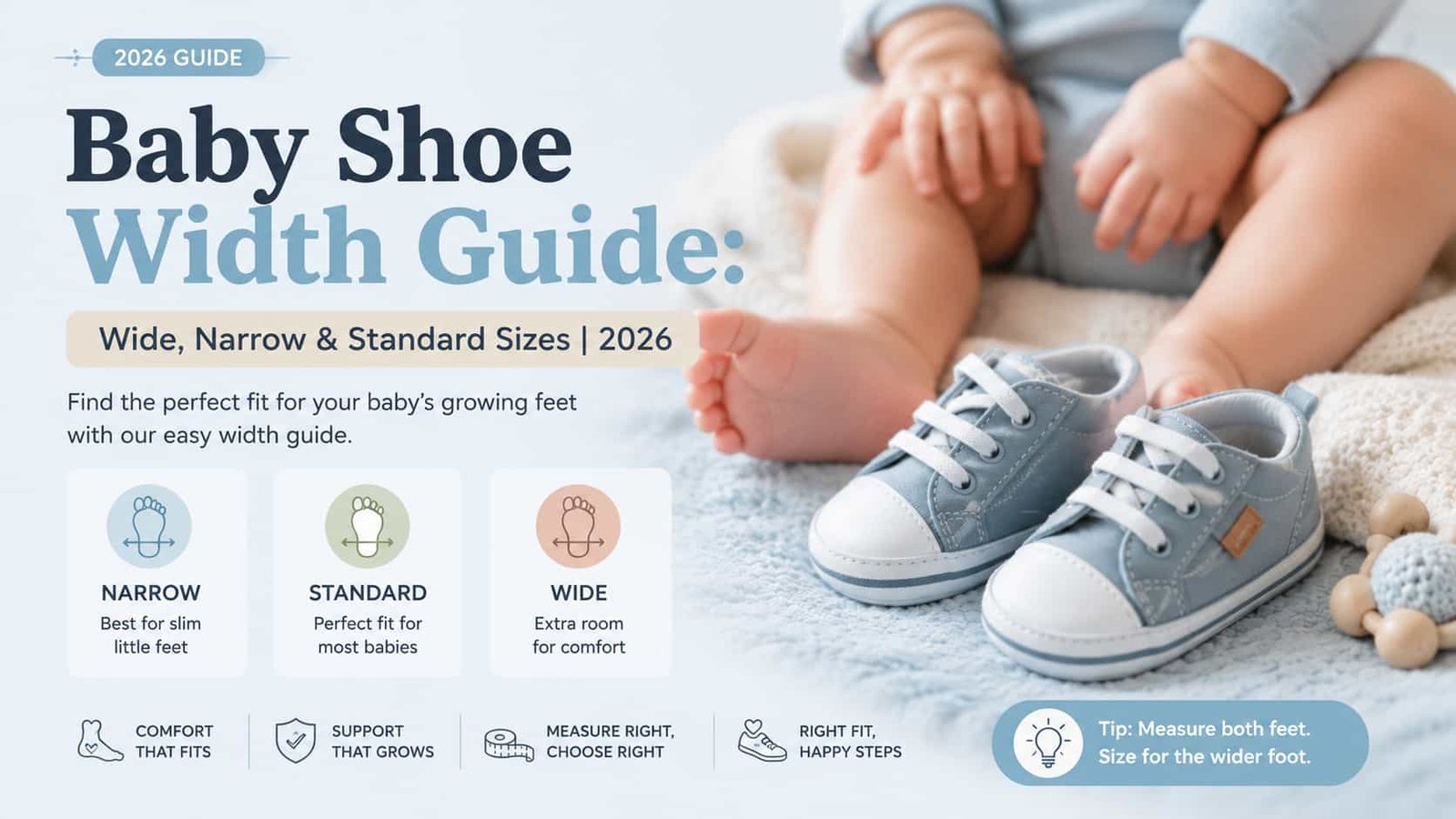
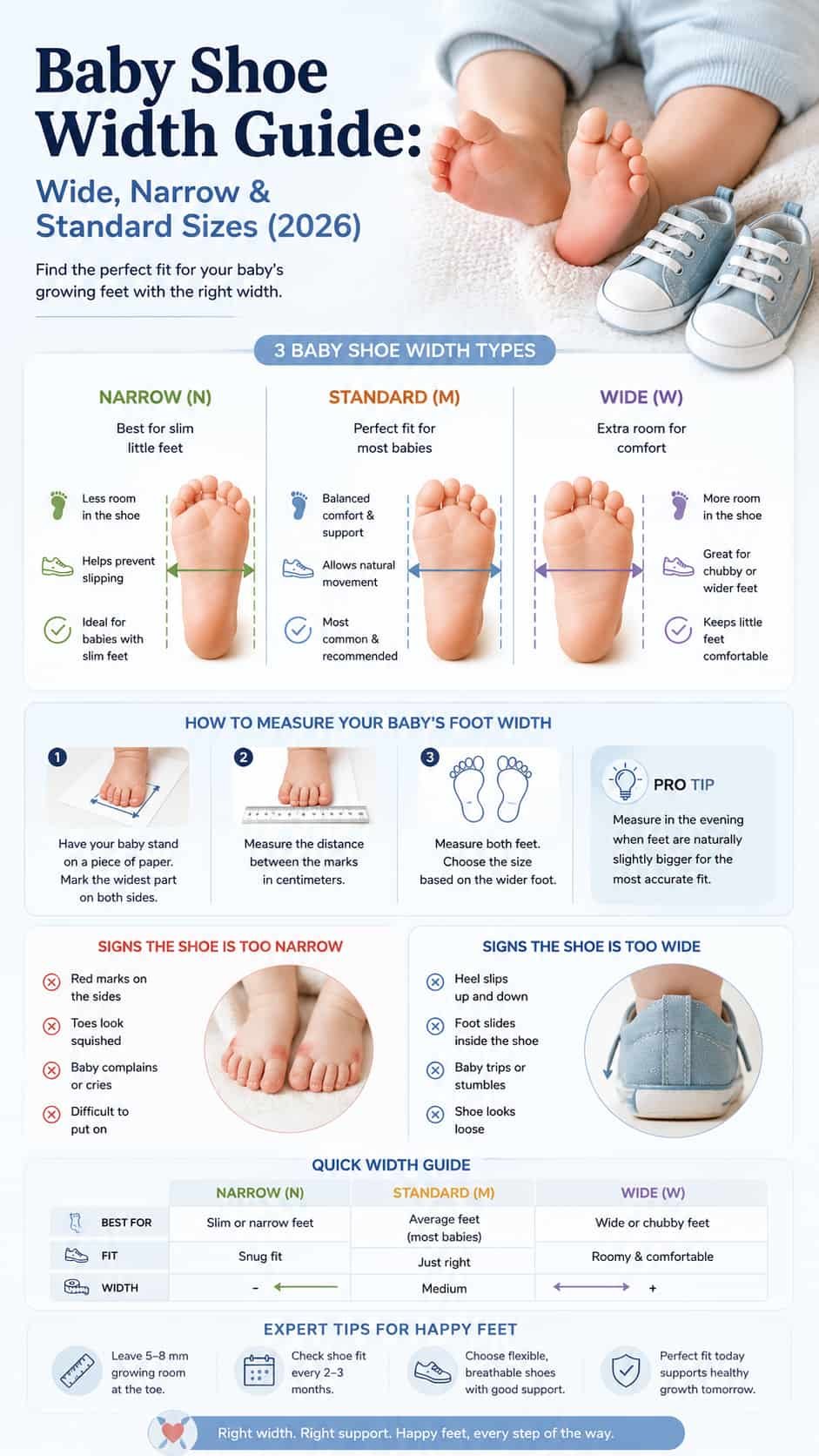
Most babies fit comfortably into standard width shoes, but some need a wide or narrow option to avoid discomfort. Width matters because a shoe can be the correct length and still fit poorly if it’s too tight or too loose across the foot. Signs your baby needs a wider shoe include red marks along the sides after wear, while a narrow fit is usually needed if the shoe gaps or shifts during movement. Since width sizing varies more between brands than length does, checking a brand’s specific width chart matters just as much as checking the length chart.
Baby Shoe Width Chart
This chart gives a general sense of how standard, wide, and narrow widths compare across common baby and toddler sizes. Exact measurements vary by brand, so treat this as a reference point rather than an exact match.
| US Size | Standard Width (in) | Wide Width (in) | Narrow Width (in) |
| 2 | 2.6 in | 2.9 in | 2.3 in |
| 4 | 2.8 in | 3.1 in | 2.5 in |
| 5 | 2.9 in | 3.2 in | 2.6 in |
| 6 | 3.0 in | 3.3 in | 2.7 in |
| 7 | 3.1 in | 3.4 in | 2.8 in |
A quick tip that saves a lot of guesswork: if your baby’s foot has always run wide in one brand, it will likely run wide across most brands, since foot shape doesn’t change much between shoe styles.
👶 Did You Know?
Baby feet are naturally wider and flatter than an adult’s, since the arch hasn’t fully formed yet. What looks like a “wide foot” at six months is often just typical baby foot shape, not a lasting width issue.
Why Width Matters as Much as Length
A shoe that’s the right length but the wrong width can still cause real discomfort. Too narrow, and the sides of the foot get squeezed with every step. Too wide, and the whole foot shifts around inside the shoe, which affects balance more than most parents expect.
Here’s the good news: most babies fall into a standard width and never need to think about this at all. But if you’ve noticed the same complaint across multiple pairs of shoes, whether that’s red marks, constant slipping, or a baby who seems oddly resistant to walking in certain shoes, width is worth ruling out.
Interactive Width Fit Checker
Answer a few quick questions about how your baby’s current shoes fit, and this tool will suggest which width to try next.
Baby Shoe Width Fit Checker
Answer these two quick questions about how your baby’s current shoes fit.
This is a general estimate. Always check a brand’s specific width chart before buying.
Once you’ve narrowed down the width, our Baby Shoe Size Conversion Chart can help if you’re comparing sizes across US, UK, and EU brands.
💡 Expert Tip
Check for wear patterns on the outside of an old pair of shoes. Stretched seams or a worn out shape on the sides is often a more reliable width clue than how the shoe feels brand new.
Signs Your Baby Needs a Wide Shoe
Watch for these signs across a few different pairs of shoes, not just one, before deciding a wide width is needed.
- Red marks or indentations along the sides of the foot after the shoe comes off.
- The shoe looks visibly stretched or bulging at the widest part of the foot.
- Your baby seems to resist certain shoes more than others, even in the correct length.
- Seams on the side of the shoe show unusual wear or stretching over time.
Signs Your Baby Needs a Narrow Shoe
A narrow fit shows up differently, usually through looseness rather than tightness.
- The shoe shifts side to side during walking or crawling.
- There’s visible gapping along the sides even when the length fits correctly.
- Your baby’s foot slides forward inside the shoe more than expected.
- The shoe looks baggy or loose around the middle of the foot despite the correct length.
⚠ Common Mistake
Assuming a shoe just “runs small” and sizing up in length when the real issue is width is a mistake we see often. Sizing up the length to fix a width problem usually just trades tight sides for a shoe that’s too long, which brings its own balance issues.
How to Measure Foot Width at Home
Measuring width at home follows a similar approach to measuring length.
Step 1: Trace the foot while standing, if possible: Feet spread out under weight, so a standing trace gives a more accurate width reading.
Step 2: Mark the widest points: Usually this is across the ball of the foot, just behind the toes.
Step 3: Measure straight across: Use a ruler to measure the distance between the two widest points, in inches.
Step 4: Compare against the width chart: Match your measurement to the closest column in the chart above for your baby’s current size.
Common Width Sizing Mistakes
A few habits show up again and again with parents dealing with width issues for the first time.
Judging width from a single pair of shoes: Fit can vary by brand and style, not just width label. Check the pattern across two or three different pairs before concluding.
Ignoring sock thickness: Thick socks can make a standard width shoe feel snug, while thin socks in winter can make a properly fitted shoe feel loose. Account for typical sock thickness when judging fit.
Assuming width issues are permanent: Baby feet change shape as they grow. A wide fit needed at nine months isn’t necessarily still needed at eighteen months.
✅ Parent Checklist
- Check for red marks or gapping after a full day of wear.
- Measure width while your baby is standing, if possible.
- Compare fit across at least two different shoe pairs.
- Check the brand’s specific width chart, not just a general one.
- Recheck width every few months, since foot shape changes with growth.
What to Look for When Buying Wide or Narrow Shoes
Once you’ve identified a width need, a few features make shopping easier.
Brands that explicitly label width options: Not every brand offers wide or narrow sizing, so checking before you shop saves time.
Adjustable closures: Velcro straps with multiple adjustment points can help fine-tune fit within a single width, especially for feet that fall between standard sizing.
Stretchy or soft upper materials: Knit or soft canvas uppers flex slightly to accommodate foot shape better than stiff materials, which can help with borderline width cases.
Return-friendly retailers: Since width fit is harder to judge from a size chart alone, shopping from a retailer with easy returns reduces the risk of a bad fit.
Common Parent Mistakes
A couple of habits are worth calling out separately from the sizing mistakes above.
Buying wide width preemptively without checking fit first: Not every baby with chubby-looking feet actually needs a wide shoe. Check for the specific signs above before assuming.
Sticking with one brand out of habit after a width issue starts: If a trusted brand’s fit no longer works well, it’s worth trying a different brand’s width options rather than forcing the same brand to work.
Expert Tips for Width Fitting
Tip 1. Shop in person when possible for the first pair in a new width, since trying before buying removes most of the guesswork.
Tip 2. Keep notes on which brands run wide, narrow, or true to standard for your baby, since this pattern often stays fairly consistent as they grow.
Tip 3. If a shoe fits well in length but shows any width signs above, try the same size in a different width before jumping to a different length entirely.
Tip 4. Check width again after any noticeable growth spurt, since foot shape can shift slightly along with length.
FAQs
How do I know if my baby needs wide shoes? Look for red marks or indentations along the sides of the foot after the shoe comes off, along with a shoe that looks visibly stretched at its widest point. These are the clearest signs a wider width would help.
How do I know if my baby needs narrow shoes? Watch for a shoe that shifts side to side during movement or gaps noticeably along the sides even when the length is correct. This usually points to a narrower fit being the better choice.
Is baby shoe width sizing the same across all brands? No. Width sizing is far less standardized than length sizing. A wide fit in one brand might feel closer to standard in another, so it’s worth checking each brand’s specific width chart.
Do all shoe brands offer wide and narrow widths? Not all of them. Many baby shoe brands only offer a standard width, while some specialize in wide or narrow fits. Checking before you shop saves time if width is a known issue.
Can a baby’s foot width change as they grow? Yes. Foot shape shifts along with length during growth. A width that fit well at one age isn’t guaranteed to still be the right choice several months later.
Should I size up in length to fix a width problem? Generally, no. Sizing up in length to compensate for a width issue usually creates a new problem, since the shoe becomes too long even if the width feels better.
What’s the best way to check width fit without buying multiple pairs? Shop in person for the first pair in a new width whenever possible. If shopping online, choose a retailer with an easy return policy in case the width doesn’t work out.
Do thick winter socks affect how I judge width? Yes. Thick socks can make a standard width feel snug, so it’s worth checking fit with the type of socks your baby will typically wear before deciding a different width is needed.
Is a wide baby foot always a sign of a wider adult foot later? Not necessarily. Baby feet are naturally wider and flatter than they’ll be as toddlers and children, since the arch is still developing. A wide fit now doesn’t guarantee a wide fit years down the road.
Can width issues cause walking delays? A poor width fit can make walking less comfortable, which sometimes shows up as a baby seeming reluctant in certain shoes. It’s not usually a direct cause of delayed walking, but comfort does affect how willing a baby is to practice.
Where can I find a specific brand’s width chart? Most brands that offer width options list a specific width chart on their product or sizing page. If it isn’t listed, reaching out to the brand’s customer service directly is usually the fastest way to get an accurate answer.
RELATED ARTICLES
- Baby Shoe Size Conversion Chart (US, UK, EU & CM)
- Shoe Size Conversion Calculator, US, UK, EU & CM (2026)
- UK 8 to US Shoe Size Guide
- 0-3 Month Baby Shoe Size Chart
- 3-6 Month Baby Shoe Size Chart (2026)
- 6-12 Month Baby Shoe Size Chart (2026)
- 12-24 Month Baby & Toddler Shoe Size Chart (2026)
- Kids Shoe Size Chart
CONCLUSION:
Getting the width right matters just as much as getting the length right, even though it gets far less attention. A quick check for red marks, gapping, or shifting after a day of wear will tell you almost everything you need to know.
Try the interactive fit checker above with your baby’s current shoes, and keep an eye on width again after their next growth spurt. For sizing across US, UK, and EU brands once you’ve settled on a width, our Baby Shoe Size Conversion Chart covers the rest.