
0-3 Month Baby Shoe Size Chart (US Sizes + Foot Length Guide)
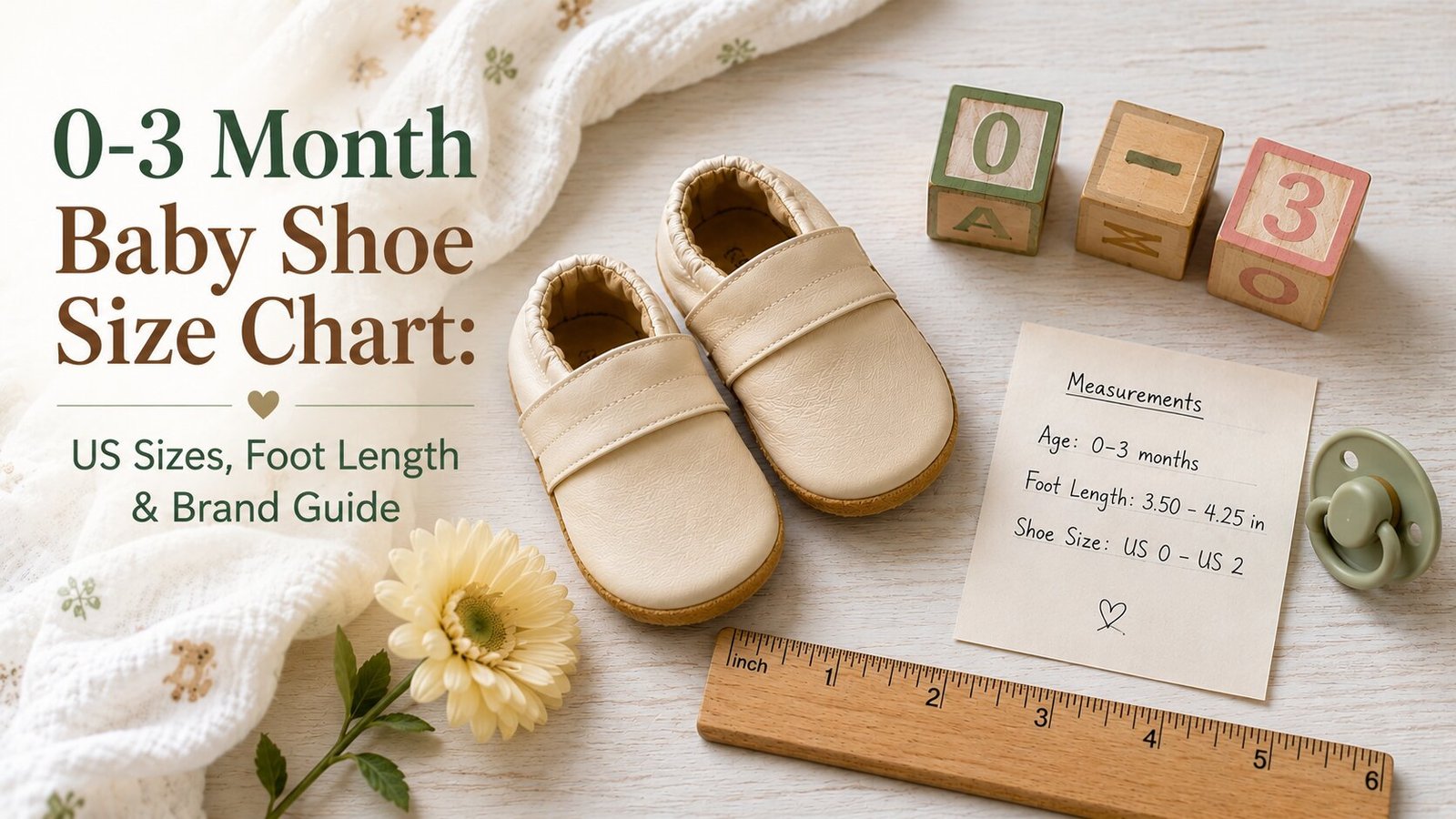
Most newborn shoes are sold in “0–3 months” sizing, but that label can mean different things depending on the brand. In the US, infant shoes typically start at size 0C (Newborn) and move to 1C or 2C by around 3 months. The actual foot length of a 0–3 month old baby generally falls between 3.5 inches (8.9 cm) and 4.0 inches (10.2 cm) — though every baby develops at a different pace.
This guide gives you the complete 0–3 month baby shoe size chart for the US market, brand-specific sizing comparisons, a home measurement tutorial, and honest advice on whether your newborn even needs shoes right now.
What shoe size does a 0–3 month old baby wear?
In the US, babies aged 0–3 months typically wear a Size 0C to Size 1C shoe. This corresponds to a foot length of approximately 3.5 to 4.0 inches (8.9 to 10.2 cm). Sizing varies slightly by brand. Newborns (0–1 month) generally fit Size 0C; babies aged 1–3 months typically fit Size 1C. Most shoes labeled “0–3 months” correspond to these two sizes.
Key Takeaways
- Babies aged 0–3 months typically wear US Size 0C (Newborn) to Size 1C
- The foot length range for this age group is roughly 3.5 to 4.0 inches (8.9–10.2 cm)
- Newborns do not need functional shoes — soft pre-walkers or booties are all that’s needed at this stage
- Brand sizing varies: Nike, Adidas, and Stride Rite all use slightly different internal measurements
- Never buy shoes that are too tight — a baby’s foot bones are still mostly cartilage and can be damaged by constricting footwear
- Sizing up slightly is safer than sizing down — aim for a 0.5-inch (1.3 cm) gap between the longest toe and the shoe’s end
- Babies tend to size up every 2–3 months in the first year of life
- Always measure both feet — one foot is often slightly larger than the other
Do 0–3 Month Old Babies Actually Need Shoes?
Before we get to sizing, let’s address the question most competitors skip entirely.
No. Newborns do not need shoes for any functional purpose.
At 0–3 months, babies cannot walk, crawl, or even stand. Their feet are primarily composed of cartilage that will gradually harden into bone over the first few years of life. Pediatric orthopedic specialists and organizations like the American Podiatric Medical Association (APMA) consistently advise that babies should go barefoot as much as possible in the early months. Bare feet allow normal muscle and bone development.
What parents often buy at this stage are:
- Soft knit booties — to keep feet warm
- Non-functional decorative shoes — for photos or dressing up
- Pre-walker shoes — soft-soled, very flexible shoes appropriate once babies begin pulling to stand (typically 9–12 months)
If you are buying shoes for a 0–3 month old, you are almost certainly buying for aesthetics, not function. That said, fit still matters — a tight shoe can restrict circulation and cause discomfort even in a non-walking infant.
Understanding the US Baby Shoe Sizing System
The US uses a “C” scale (Child) for infant and toddler shoes. The scale begins at 0C (Newborn) and runs through toddler sizes before transitioning to the standard youth scale.
Here is how the infant C-sizing system works:
| US Size | Common Label | Age Approx. | Foot Length (inches) | Foot Length (cm) |
|---|---|---|---|---|
| 0C | Newborn | 0–1 month | 3.5 in | 8.9 cm |
| 1C | Infant | 1–3 months | 3.75 in | 9.5 cm |
| 2C | Infant | 3–6 months | 4.0 in | 10.2 cm |
| 3C | Infant | 6–9 months | 4.25 in | 10.8 cm |
| 4C | Infant | 9–12 months | 4.5 in | 11.4 cm |
| 5C | Toddler | 12–18 months | 4.75 in | 12.1 cm |
Important: Age ranges are approximate guides only. Foot length is always the more accurate measurement. Two babies of the same age can differ by a full size or more.
0–3 Month Baby Shoe Size Chart (Detailed)
The following table is the core reference for parents buying shoes for a newborn or young infant in the US market.
| Baby Age | US Shoe Size | EU Size | UK Size | Foot Length (in) | Foot Length (cm) | Width Category |
|---|---|---|---|---|---|---|
| Newborn (0–1 mo) | 0C | 15–16 | 0 | 3.5 | 8.9 | Medium (M) or Wide (W) |
| 1–2 months | 1C | 16–17 | 0.5 | 3.75 | 9.5 | Medium (M) or Wide (W) |
| 2–3 months | 1C–2C | 17 | 1 | 3.75–4.0 | 9.5–10.2 | Medium (M) or Wide (W) |
Notes:
- EU and UK sizes at this stage are less standardized than US sizes — brands vary more
- Most shoes sold in “0–3 month” packaging correspond to US Size 0C and 1C
- Babies with naturally chubby feet may need wide-width options even at this age
Brand-Specific Size Charts for 0–3 Month Babies
Brand sizing is not always consistent with generic US sizing. Here is how major brands map their infant shoe sizes.
Nike Infant Shoe Size Chart (0–3 Months)
| Nike Size | US Size | Age Range | Foot Length (cm) |
|---|---|---|---|
| 1C | 1C | 0–2 months | 9.5 cm |
| 2C | 2C | 2–4 months | 10.2 cm |
Nike Sizing Notes:
- Nike tends to run slightly narrow in their infant line
- The Nike “Force 1” and “Air Max” infant styles are popular but are decorative, not functional pre-walkers
- If your baby has wider feet, consider sizing up one full size with Nike
Adidas Infant Shoe Size Chart (0–3 Months)
| Adidas Size | US Size | Age Range | Foot Length (cm) |
|---|---|---|---|
| 16 (EU) | 1C | 0–1.5 months | 9.5 cm |
| 17 (EU) | 1.5C | 1.5–3 months | 10.2 cm |
Adidas Sizing Notes:
- Adidas labels primarily by EU size in their infant range
- Adidas infant sizing tends to run slightly generous (true to size or slightly large)
- The Adidas “Superstar” and “Stan Smith” infant options are very popular for gifting
Stride Rite Infant Shoe Size Chart (0–3 Months)
| Stride Rite Size | Age Range | Foot Length (in) | Foot Length (cm) |
|---|---|---|---|
| 0 (Newborn) | 0–1 month | 3.5 | 8.9 |
| 1 | 1–3 months | 3.75 | 9.5 |
Stride Rite Sizing Notes:
- Stride Rite is one of the most podiatrist-recommended infant footwear brands in the US
- Their sizing is generally considered industry-accurate and a reliable reference point
- Stride Rite offers wide-width options in infant sizes — worth noting for babies with broader feet
Carter’s Baby Shoe Size Chart (0–3 Months)
| Carter’s Label | US Size | Age Range | Foot Length (cm) |
|---|---|---|---|
| Newborn | 0C | 0–3 months | 8.9–9.5 cm |
| 0–3 Months | 0C–1C | 0–3 months | 8.9–9.5 cm |
Carter’s Sizing Notes:
- Carter’s labels shoes by age range rather than US shoe size — which is common in mass-market baby brands
- Their soft-soled booties and crib shoes are designed purely for warmth and aesthetics, not walking
- Carter’s sizing tends to run slightly large, so a “0–3 month” label often fits up to 4 months
Quick Brand Comparison: 0–3 Month Sizing Tendencies
| Brand | Sizing Tendency | Width Availability | Best For |
|---|---|---|---|
| Nike | Slightly narrow | Standard only | Photo-ready look |
| Adidas | True to size / slightly large | Standard only | Casual gifting |
| Stride Rite | Accurate / true to size | Narrow, Medium, Wide | Best fit accuracy |
| Carter’s | Slightly large | Standard only | Budget-friendly softsoled |
| Robeez | True to size | Standard only | Soft-soled comfort |
| Pediped | Slightly generous | Adjustable | Pre-walker flexibility |
How to Measure a Newborn’s Foot at Home
Measuring a newborn’s foot accurately is simple but requires the right approach. A baby who squirms or has flexed toes will give you an incorrect measurement.
What You Need:
- A flat surface
- A piece of white paper
- A pencil or pen
- A ruler (metric and imperial)
Step-by-Step Measurement Guide:
- Place the paper on a hard, flat floor — not a carpet or mattress, which can compress and distort the measurement.
- Lay your baby on their back. Have another adult gently hold the baby’s leg upright if needed.
- Place the baby’s foot flat on the paper with the heel touching a straight edge (or a wall).
- Mark the tip of the longest toe — this is usually the big toe but not always.
- Measure from the heel mark to the toe mark with your ruler. Record in both inches and centimeters.
- Repeat for the other foot. Most people have one foot slightly larger — always size for the larger foot.
- Add 0.25 to 0.5 inches (6–12 mm) of growing room when selecting a shoe size.
Expert tip from Sole: I always recommend measuring a baby’s foot toward the end of the day when slight natural swelling has occurred — even in infants who are not yet walking. This ensures you don’t buy a shoe that fits perfectly first thing in the morning but feels tight by afternoon.
How to Tell If Baby Shoes Fit Correctly
Because infants cannot tell you if their shoes hurt, parents must rely on visual and tactile checks.
Signs of a Good Fit:
- You can slide one finger (adult pinky finger) between the heel and the back of the shoe
- There is roughly 0.5 inches (1.3 cm) of space between the longest toe and the shoe tip
- The shoe does not pinch or compress the sides of the foot
- The shoe stays on without excessive bulk or the heel slipping off
- The shoe’s sole is completely flat and flexible — it should bend easily with the hand
Red Flags of a Poor Fit:
- Red marks, creases, or pressure lines on the foot after removing the shoe
- Baby pulls at the shoe or seems irritable when shoes are on
- Toes appear pressed together or curled inside the shoe
- The heel pops out easily when the baby kicks (too large)
- The tongue or collar of the shoe digs into the ankle
How Fast Do Baby Feet Grow in the First Year?
Baby foot growth in the first year is extraordinarily rapid compared to any other life stage.
| Age Period | Average Growth Per Month | Expected Size Changes |
|---|---|---|
| 0–3 months | ~0.5 cm per month | 1–2 size increases |
| 3–6 months | ~0.5 cm per month | 1–2 size increases |
| 6–12 months | ~0.25–0.5 cm per month | 1–2 size increases |
How Often Do Babies Size Up Shoes?
Most babies size up roughly every 2–3 months in the first year. A baby who fit into Size 0C at birth will typically need Size 2C or 3C by the time they reach 6 months.
This rapid growth rate is one reason pediatric footwear specialists recommend not investing heavily in decorative infant shoes — the baby will outgrow them within weeks.
Should You Size Up in Baby Shoes?
This is one of the most common questions in baby shoe sizing — and the answer is nuanced.
Yes, sizing up is appropriate when:
- The shoe will be worn frequently for extended periods
- You are buying ahead (e.g., a gift for a future stage)
- The brand is known to run narrow or small
- The baby is close to the upper limit of their current size
No, do not size up when:
- The shoe is already at the very top of the next size range
- The shoe has a structured toe box that could cause the foot to slide forward and curl the toes
- The shoe is a hard-soled style (not appropriate for 0–3 months regardless)
The Goldilocks rule for infant shoe sizing: There should be no more than a thumb’s width of space at the toe. Too tight is harmful; too loose causes tripping and instability as babies begin to move.
Newborn vs. Infant vs. Pre-Walker: What’s the Difference?
Retailers and brands use different terminology that can confuse first-time parents.
| Term | Age Range | US Size Range | Sole Type | Walking? |
|---|---|---|---|---|
| Newborn | 0–1 month | 0C | Ultra-soft, knit | No |
| Infant | 0–12 months | 0C–4C | Soft to semi-structured | No |
| Pre-Walker | ~6–12 months | 3C–5C | Soft, flexible | Not yet |
| Cruiser | ~9–15 months | 4C–6C | Semi-flexible | Beginning to |
| First Walker | ~12–18 months | 4C–6C | Flexible structured | Yes |
Most shoes marketed as “0–3 months” fall into the Infant or Newborn category and should have ultra-soft, flexible soles. Any shoe with a rigid sole is inappropriate and potentially harmful for a pre-walking baby.
Common Baby Shoe Sizing Mistakes to Avoid
1. Buying based on age alone Age labels on packaging are averages. A large newborn may fit a Size 2C from birth. Always measure before purchasing.
2. Assuming all brands follow the same scale As shown in the brand table above, Nike, Adidas, Stride Rite, and Carter’s all size somewhat differently. The “1C” label is not an international standard.
3. Choosing aesthetics over fit Hard soles, pointed toe boxes, and rigid uppers may look stylish but are inappropriate for infant feet. Foot bones are soft cartilage at this stage and are vulnerable to deformation from constricting footwear.
4. Forgetting sock thickness If you plan to put socks under the shoes, measure the foot with a sock on. A thin sock can account for half a size difference in very small infant shoes.
5. Buying multiple pairs in the same size Infant feet grow fast. Buying three pairs of Size 1C shoes is a waste — chances are your baby will only wear the size for a few weeks before moving on.
6. Ignoring width Most baby shoes come in standard (medium) width, but some babies are born with naturally wide feet. Stride Rite, New Balance, and Pediped offer wider options in infant sizes and are worth seeking out for wider-footed babies.
US vs. EU vs. UK Baby Shoe Size Conversion (0–3 Months)
For parents buying from international brands or retailers, here is a full conversion reference covering the 0–3 month range.
| US Size | EU Size | UK Size | Foot Length (in) | Foot Length (cm) | Approx. Age |
|---|---|---|---|---|---|
| 0C | 15 | 0 | 3.5 | 8.9 | 0–1 month |
| 1C | 16–17 | 0.5–1 | 3.75 | 9.5 | 1–3 months |
| 2C | 17–18 | 1–1.5 | 4.0 | 10.2 | 3–6 months |
EU sizing for infant shoes is not fully standardized across brands. Some French and German brands begin their scale at EU 16; Italian brands may start at EU 17. Always cross-reference with the foot length measurement rather than relying on EU size alone.
FAQ Section
Q1: What shoe size does a 0–3 month old baby wear? A 0–3 month old baby typically wears a US Size 0C to 1C. Newborns (0–1 month) usually fit 0C, while babies aged 1–3 months generally fit 1C. Foot length at this stage ranges from about 3.5 to 3.75 inches (8.9 to 9.5 cm). Always measure the foot directly for the most accurate sizing.
Q2: Do newborn babies need shoes? No. Newborns aged 0–3 months do not need shoes for any functional purpose. They cannot walk, crawl, or stand. The American Podiatric Medical Association (APMA) and most pediatric orthopedists recommend bare feet or soft socks during the early months to allow normal foot development. Shoes at this stage are decorative only.
Q3: What does “0C” mean in baby shoe sizing? “0C” stands for Size 0 in the US Child (C) sizing scale. This is the smallest standard US infant shoe size, designed for newborns with a foot length of approximately 3.5 inches (8.9 cm). The C-scale begins at 0C and progresses through toddler sizes before transitioning to the standard youth scale.
Q4: How do I measure my newborn’s foot for shoes? Place the baby’s foot flat on a piece of paper with the heel against a straight edge. Mark the tip of the longest toe. Measure from the heel mark to the toe mark with a ruler. Record in both inches and centimeters. Add 0.25–0.5 inches of growing room when selecting a size. Always measure both feet and size for the larger one.
Q5: How often do babies size up in shoes? In the first year, most babies need a new shoe size approximately every 2–3 months. Baby feet grow very rapidly — an average of 0.25 to 0.5 cm per month in infancy. This is why it is not cost-effective to buy multiple pairs in the same size.
Q6: Should I size up in baby shoes? Slight sizing up is generally safer than sizing down. Aim for about a thumb’s width of space (0.5 inches / 1.3 cm) between the longest toe and the shoe’s end. Do not size up dramatically — a shoe that is too large can cause the baby’s foot to slide forward and push toes against the toe box, which is just as harmful as a too-tight shoe.
Q7: What is the difference between Nike and Adidas infant shoe sizing? Nike infant shoes tend to run slightly narrower than average, while Adidas infant shoes tend to run true to size or slightly generous. A baby who wears a standard US Size 1C may need a 2C in Nike if they have slightly wider feet, while the same baby would fit a 1C in Adidas comfortably. Always reference the brand-specific foot length chart rather than relying solely on the US size number.
Q8: Are Carter’s shoe sizes the same as US shoe sizes? Not exactly. Carter’s labels most of their infant shoes by age range (e.g., “0–3 months”) rather than traditional US shoe sizes. Their “Newborn / 0–3 month” label typically corresponds to US Size 0C–1C. Carter’s sizing tends to run slightly large, so the “0–3 month” label often continues to fit until 4 months.
Q9: What’s the difference between infant shoes and pre-walker shoes? Infant shoes (0–12 months) include soft-soled styles for non-walking babies. Pre-walker shoes are a subcategory designed for babies who are beginning to cruise and pull to stand (typically 9–15 months). Pre-walkers have slightly more structured (but still flexible) soles to provide mild support as babies begin bearing weight on their feet. Neither category is appropriate with a rigid sole.
Q10: Can tight baby shoes damage my baby’s feet? Yes. A baby’s foot at 0–3 months is mostly cartilage. Tight or constricting shoes can cause pressure on developing tissue, restrict circulation, and in severe or prolonged cases, contribute to foot deformity. Even for non-walking babies, shoes must fit without compressing the toes or sides of the foot.
Q11: What is the EU equivalent of a US Size 0C baby shoe? US Size 0C corresponds approximately to EU Size 15–16, depending on the brand. EU sizing for very small infant shoes is less standardized than US sizing, so cross-referencing with foot length in centimeters (approximately 8.9 cm for Size 0C) is the most reliable approach.
Q12: What shoe size is a 2-month-old baby? A 2-month-old baby typically wears a US Size 1C, corresponding to a foot length of approximately 3.75 inches (9.5 cm). However, some larger 2-month-olds may already be sizing into 2C. Measure the foot directly for accuracy rather than relying solely on age.
Q13: How do I know when my baby has outgrown their shoes? Signs include: visible toe pressing against the front of the shoe, red marks on the foot after removal, the baby seeming uncomfortable when shoes are put on, the shoe appearing stretched or deformed at the toe box, or a direct measurement confirming the foot has grown beyond the shoe’s designed length.
Q14: Are wide-fit baby shoes available in the 0–3 month range? Yes, though options are limited at this size. Stride Rite, New Balance, and Pediped offer wider fittings in infant sizes. Robeez soft-soled shoes naturally accommodate wider feet due to their stretchy construction. If your baby has wider-than-average feet, look for brands offering “W” (wide) designations in their infant sizing.
Q15: What sole type is appropriate for a 0–3 month old baby shoe? At 0–3 months, the only appropriate sole type is ultra-soft and completely flexible — ideally leather, knit, or thin fabric. A shoe sole should be flexible enough to fold in half with minimal resistance. Hard soles, rubber outsoles, or anything with a structured heel are not appropriate for pre-walking infants.