

What Is Cemented Shoe Construction? How Glued Soles Work
Summarise This Guide with AI
Open an assistant below and submit the prefilled request. The assistant reads this page only after you submit it. The guide covers what cemented construction is, how the bond is made, its strengths and limits, and how to spot it.
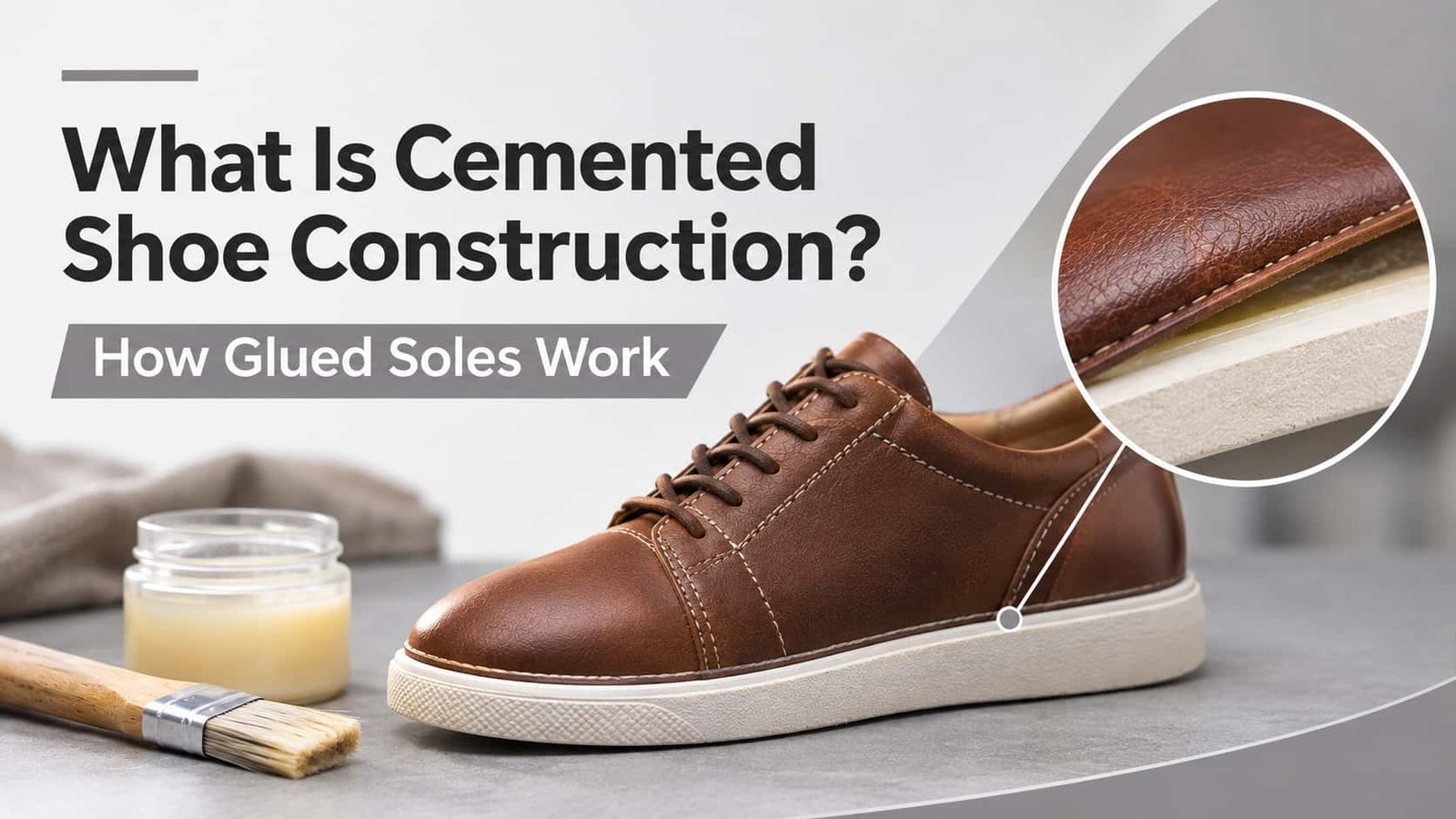
Cemented construction attaches a shoe’s sole to the upper with adhesive, not stitching. It is the most common method for casual and mass-produced footwear because it is quick and inexpensive to make, and it produces a light, flexible shoe. The bond depends heavily on how the sole is prepared and pressed, and once it fails, the sole usually cannot be re-stitched, so cemented shoes are generally replaced rather than repaired.
Key Takeaways
- Cemented construction uses adhesive to join the upper and outsole, with no stitch line between them.
- Its main strengths are low production cost, light weight, and flexibility from the first wear.
- The bond depends on process control, including roughing, cleaning, adhesive activation, and press pressure. Most failures are process-related.
- Cemented shoes are generally not designed to be resoled, so they suit occasional wear and shorter ownership more than long-term repair.
- You can usually spot a cemented shoe by a smooth, unbroken bond line at the sole edge with no visible stitching.
What Cemented Construction Means
Construction describes how the upper, the part that wraps the foot, is joined to the sole. Cemented construction uses adhesive to make that join. Ambrogio Shoes’ encyclopedia describes it as the simplest of the common methods: the outsole is bonded directly to the upper with strong industrial adhesive, with no stitching anywhere in the attachment. The entry describes cemented shoes as the lightest, cheapest, and least repairable of the common constructions. Ambrogio’s encyclopedia entry on cemented construction sets out that comparison, and it is written by a retailer, so treat its ranking as a retail view.
ProShoeLab, a shoe manufacturer, describes cemented construction as the most common method worldwide because it is efficient, versatile, and cost-effective. Both sources agree on the core idea: the sole is glued on rather than sewn on.
If you are new to shoe parts, the anatomy of a shoe guide explains the upper, insole, midsole, and outsole, which are the layers that cemented construction joins.
How a Cemented Shoe Is Built, Step by Step
The process matters because it determines how strong the bond will be. ProShoeLab describes the sequence in detail, and the summary below follows its outline.
The upper is first cut and closed. Leather or textile pieces are cut, then stitched into a three-dimensional upper with linings and reinforcements. A structural insole board, often made from cellulose fibre, is fixed to the bottom of the last. This rigid board gives cemented shoes a structured feel and is a key physical difference from Strobel construction.
The upper is then lasted, meaning pulled over the last under tension. Its edge, called the lasting margin, is wrapped and secured to the underside of the insole board, usually in stages at the toe, sides, and heel.
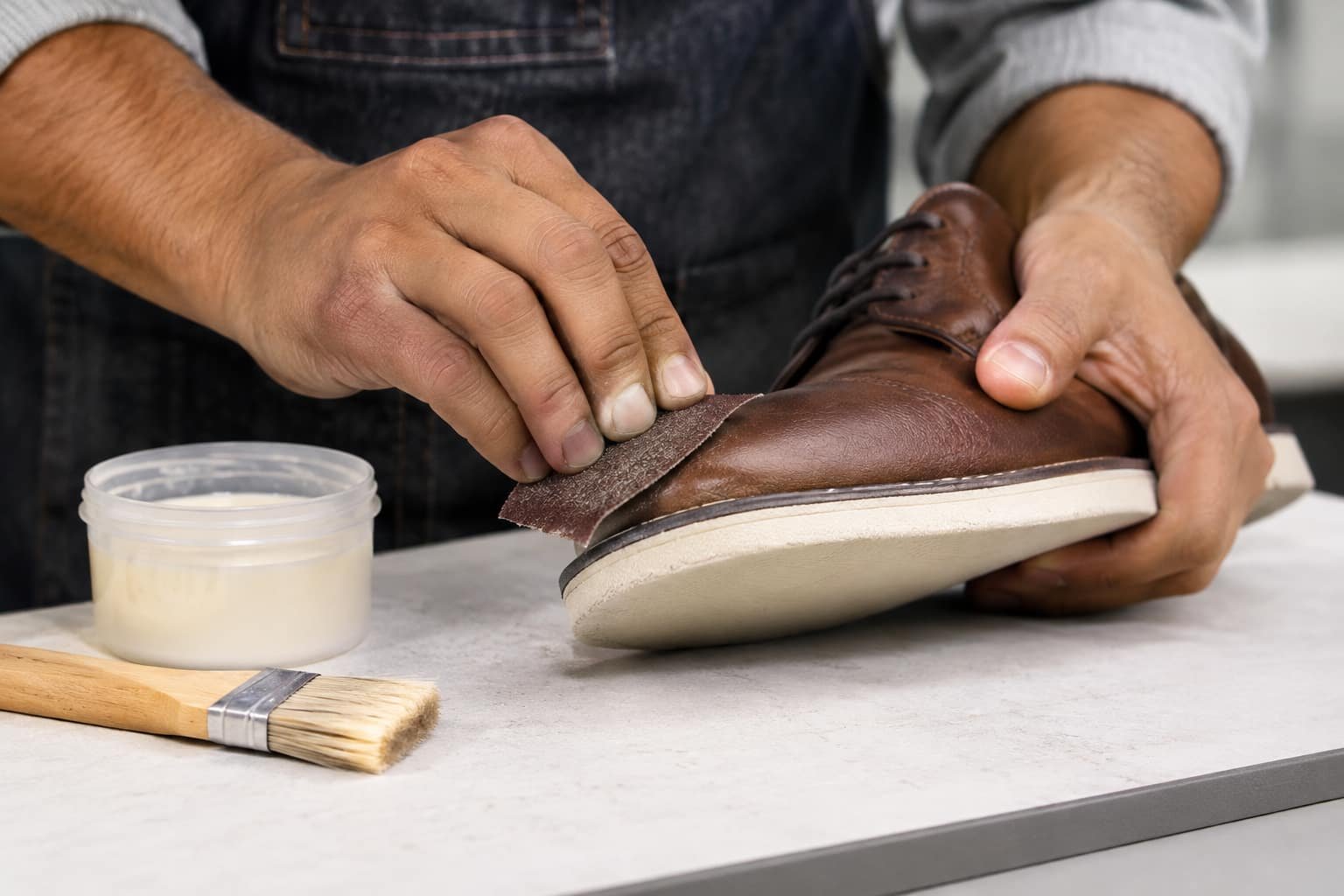
Next comes preparation of the bonding surfaces. The lasting margin is roughed, which means lightly abraded to open up the surface, and both surfaces are cleaned and sometimes primed. An adhesive, commonly polyurethane-based according to ProShoeLab, is applied to the lasting margin and the outsole, then heat-activated so it becomes tacky.
Finally, the sole is pressed onto the upper under controlled pressure for a set time. The bond is cooled, the last is removed, and the shoe is cleaned and finished.
Each step matters, and a factory that controls them can explain its adhesive system, activation temperature, and press time. A shoe that is well made in the upper but poorly bonded at the sole will still fail early.
Why Roughing and Adhesive Decide the Bond
Cemented construction relies on the adhesive gripping both surfaces, and the preparation of those surfaces decides how well that happens. ProShoeLab calls roughing a quietly decisive step. Adhesive bonds to a roughened surface much better than a smooth one, and under-roughing is a common root cause of failure.
Cleaning and priming follow. Dust, oil, or residue on the surface can prevent the adhesive from keying in. Priming can help the adhesive bond to materials that resist it.
The adhesive itself must be applied evenly and activated at the right temperature. ProShoeLab notes that adhesive applied too thinly or unevenly, or activated at too low a temperature, can lead to separation. Press dwell time, meaning how long the sole is held under pressure, also affects the bond.
For buyers, the practical point is that you cannot see most of this process in a finished shoe. A smooth bond line can look neat, but the strength behind it depends on the factory’s controls. Asking a brand how it controls roughing, adhesive, and pressing is one way to judge quality, though most consumers will not have access to those answers.
Cemented vs Stitched: The Core Difference
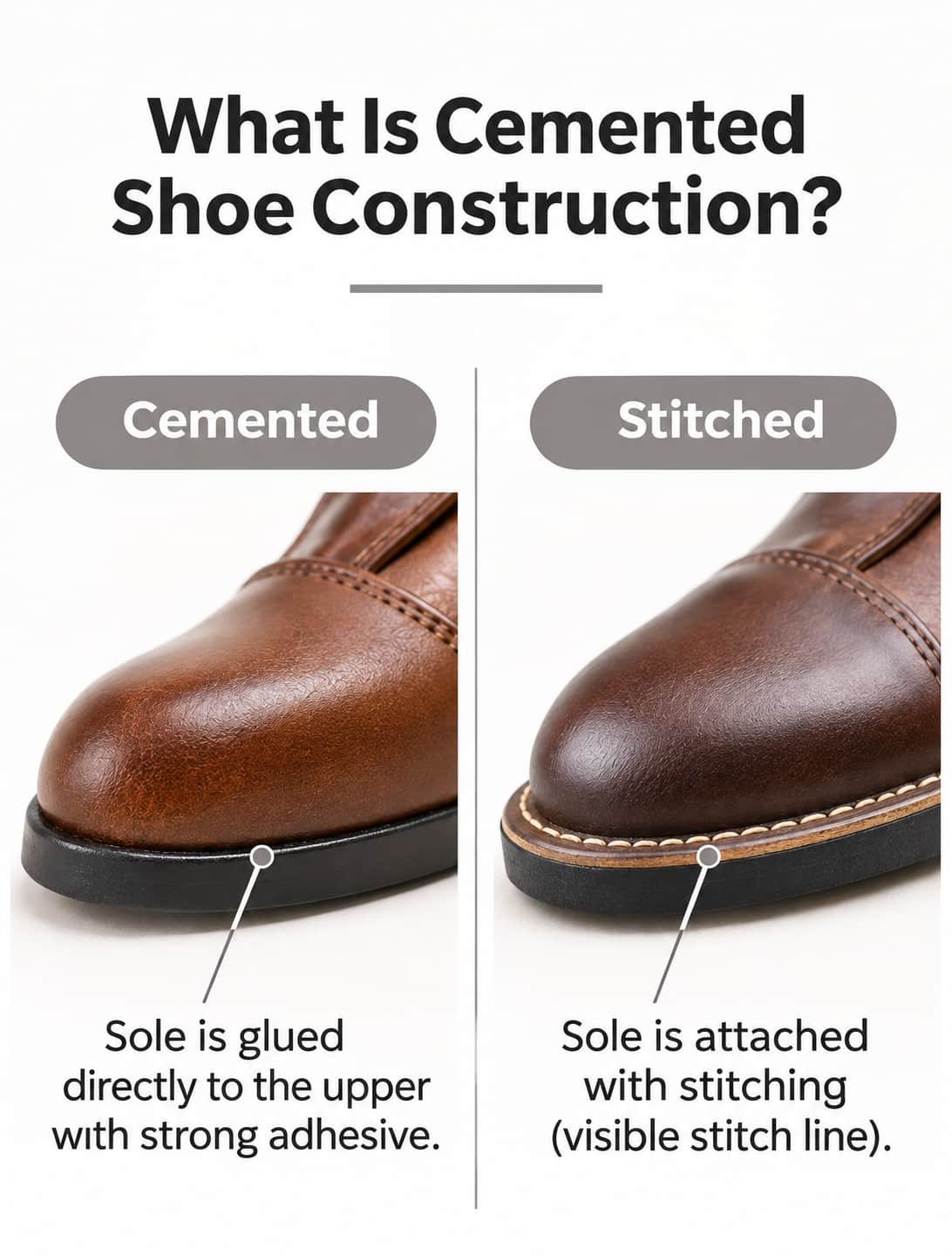
The most important difference between cemented and stitched construction is what holds the sole. In a cemented shoe, adhesive holds it. In a stitched shoe, thread holds it, and the stitch line can often be re-run during repair. The table below sets out the main differences in general terms.
| Feature | Cemented | Stitched (for example Goodyear welt or Blake) |
|---|---|---|
| What holds the sole | Adhesive bond | Stitch line through the upper and sole |
| Visible seam at sole edge | Smooth bond line, no stitching | Stitch line or welt strip visible |
| Production cost | Lower | Higher |
| Weight and flexibility | Lighter, flexible from the start | Heavier or stiffer, often needs break-in |
| Repairability | Usually not practical | Often possible with a cobbler |
| Failure pattern | Sudden separation at the bond | Gradual loosening or wear of the stitch |
The difference explains most of the trade-offs in this guide. A stitched shoe can be taken apart and re-sewn, but a cemented bond is generally a one-time join.
Why Cemented Shoes Are Light, Flexible and Affordable
Cemented construction has real advantages. The first is cost. Ambrogio’s entry says it is the fastest and cheapest construction to produce at scale, requiring less skilled labour and specialised machinery than stitched alternatives. ProShoeLab similarly notes that cementing is efficient and cost-effective, which is why it dominates mass-market footwear.
The second advantage is weight. Without a welt or a second stitch line, the sole can be thinner and the shoe can be lighter. Ambrogio describes cemented shoes as light and flexible out of the box.
The third advantage is comfort from the start. A cemented shoe usually does not require the break-in period that a structured, stitched shoe can need. For casual wear, that can be a real benefit, especially for people who want to wear a shoe the day they buy it.
The fourth is a clean look. A cemented shoe has a low, uninterrupted sole edge, which suits many casual and fashion styles. ProShoeLab describes the result as a clean, low-profile silhouette.
Where Cemented Construction Falls Short
The main limitation is durability over time. Ambrogio’s entry states that adhesive bonds degrade with heat, age, and repeated flexing in a way that stitching does not. This is a manufacturer-neutral claim about how adhesives behave, and it matches general material experience, though the rate of degradation depends on the adhesive and the conditions.
Once the bond fails, the sole is usually detached for good. Ambrogio puts it bluntly: once the bond starts to fail, there is no secondary attachment holding the sole to the upper. The shoe is, structurally, done. This is the single biggest functional difference between cemented shoes and stitched ones.
Water can also be a weakness. A glued seam is the only barrier at the sole edge, so wet conditions and standing water can reach the bond over time. Our guide to how waterproof shoes work explains how seams and membranes contribute to water protection.
Cemented shoes are also less suited to heavy resoling plans. If you expect to wear a shoe for many years and replace the sole several times, a cemented construction is usually a poor fit.
Can Cemented Shoes Be Resoled?
In most cases, cemented shoes cannot be resoled in a meaningful way. Ambrogio says that, rarely, a cobbler can re-cement a new sole, but there is no welt or stitched seam to work with, and the new bond is generally weaker and less durable than the factory bond. Most cemented shoes are replaced once the sole fails.
ProShoeLab states that, generally, both cemented and Strobel shoes bond the sole to the upper. A repair therefore means removing the old sole and cementing a new one, which is possible for a skilled cobbler on some styles but is not a designed-in feature.
If resoleability matters to you, look for a stitched construction. Our guide to how to resole shoes explains what a resole involves and what to ask a cobbler, and our comparison of shoe construction methods sets out how the options differ.
Cemented Boots: Where the Method Fits
Cemented construction is used on boots as well as shoes. ProShoeLab explains that cemented boots are built the same way as cemented shoes, with the upper extending above the ankle and usually needing a stiffer shaft reinforcement. The alternative for boots is a stitched construction such as Goodyear welt, which allows resoling but costs considerably more and adds weight and stiffness.
ProShoeLab’s view is that for many contemporary boot categories, including casual, fashion, and lightweight work-inspired styles, cemented is a sensible choice because it offers a lower unit cost, lighter weight, and a cleaner silhouette. Welted construction is better suited to heritage dress boots and footwear that the wearer expects to keep for a long time.
For a practical boot choice, consider how you will use the boot. A lighter, cemented boot may suit occasional wear, while a boot you plan to wear hard for years may be better served by a stitched construction. Our guide to the shoe last explains why fit matters as much as construction for boots.
Cemented vs Strobel
Readers often compare cemented construction with Strobel, a different method used widely in sneakers. ProShoeLab explains that in Strobel construction, the upper is stitched to a flexible textile insole board, called the Strobel board, and the sole unit is then attached. The result is a shoe that flexes with the foot from the first wear.
The core structural difference is the insole board. A cemented shoe is built on a rigid cellulose board, while a Strobel shoe is built on a flexible textile one. ProShoeLab describes that single difference as driving almost everything else people notice about the two constructions.
Strobel is common in sneakers and comfort-led casual footwear, while cemented suits formal, casual, and many boot styles. Neither is better in the abstract. The right choice depends on the shoe’s design and how it will be worn.
How to Spot Cemented Construction
The clearest sign of a cemented shoe is at the edge where the upper meets the sole. Ambrogio describes a smooth, unbroken bond line with no stitching visible anywhere, in contrast to the stitched seam of a Blake shoe or the raised, stitched welt strip of a Goodyear-welted shoe. If you cannot find any stitching at the sole edge, you are probably looking at a cemented shoe.
A few other checks help. Look inside the shoe for a stitch line around the insole, which would suggest a stitched method. Look at the sole’s profile. Cemented soles often sit close to the upper with a clean join, though some stitched shoes also have close-trimmed edges, so the stitch check is more reliable.
Product descriptions sometimes say “cemented,” but not always. If the description is unclear, ask the seller directly. Specialist retailers often know the construction of the shoes they sell.
How Cemented Shoes Fail
Understanding failure helps you inspect a shoe before buying or check it during wear. ProShoeLab describes cemented failure as sole separation, which is usually a process failure rather than a material failure. Causes include insufficient roughing, contaminated surfaces, adhesive applied too thinly or unevenly, low activation temperature, or press time cut short.
Separation often begins at the toe and along the outside edge of the forepart, where the shoe flexes most. Watch for a gap or lifting at those points. A small separation can grow with each step, so it is worth addressing early.
The advice for buyers is to check the sole edge closely, especially at the toe and forepart, and to test the shoe’s flex by hand. If the sole already lifts or feels loose in the shop, a shoe will not improve with wear.

A Practical Decision Guide
Choose a cemented shoe if you want a light, flexible, inexpensive shoe for casual wear, occasional use, or a fashion-led look. Expect a shorter life and limited repair options, and plan to replace the shoe when the sole fails.
Consider a stitched construction if you plan to keep the shoe for years, wear it in wet weather, or want to resole it. Expect a higher price, more weight, and possibly a break-in period.
Consider Strobel if you want a sneaker or athletic-style shoe that flexes from the first wear. Expect a different feel from a cemented dress shoe.
For a budget shoe worn occasionally, cemented can be a reasonable choice. For a shoe you plan to wear hard for years, a stitched method is usually a better investment. Our shoe finder can help you narrow options by use before you look at construction.

Trade-Offs and Limitations
Cemented construction involves a clear trade-off between upfront cost and long-term life. It is light and affordable, but it is usually not repairable and can lose its bond over time.
Quality also depends on the factory. ProShoeLab notes that bond quality is the single most common cause of sole separation, and that how a manufacturer controls adhesive application, curing time, and temperature matters more than the method name. Ambrogio’s entry also states that cementing is used across a wide range of price points, so a cemented shoe is not automatically low quality, though within dress shoes, cementing is often associated with a lower price tier.
Lifespan estimates for cemented shoes vary by source and by use. Treat any year range as an estimate rather than a measured result.
Myths Worth Dropping
Myth: Cemented shoes are always cheap and low quality.
Cementing is used across many price points. Build control matters more than the method name.
Myth: A glued sole is as strong as a stitched sole.
The strength of a glued bond depends on the process and the adhesive. Over time, adhesive bonds can degrade in ways stitching does not.
Myth: Cemented shoes can be resoled like welted shoes.
In most cases they cannot, because there is no stitch line to re-run.
Myth: A smooth sole edge always means a good bond.
The bond depends on preparation and pressing inside the shoe. The edge only shows the result, not the process.
Myth: Cemented means the same as Strobel.
They are different methods. Cemented uses a rigid insole board and an adhesive bond, while Strobel stitches a flexible textile board to the upper.
Caring for Cemented Shoes
Protecting the bond is the most important part of caring for a cemented shoe. Avoid leaving shoes in very hot places, such as a car on a summer day, since heat can weaken adhesives over time. Let wet shoes dry at room temperature, and avoid direct heat sources.
Avoid soaking cemented shoes. Water can work into the sole edge, and repeated wetting can weaken the bond. Clean the upper gently with a soft brush and lukewarm water, and wipe the sole edge with a damp cloth rather than submerging the shoe.
Rotate pairs where you can, so each shoe has time to dry and recover between wears. Check the sole edge regularly for lifting or gaps, especially at the toe and forepart. If you notice separation early, a cobbler may be able to assess whether a repair is practical, though results vary.
Our guide on how to clean shoes and maintain them covers safe methods for common materials. If a sole has already separated, our guide to repairing a separated shoe sole explains the options.
Frequently Asked Questions
What is cemented construction in shoes?
Cemented construction attaches the outsole to the upper with adhesive, with no stitching between them. It is the most common and least expensive method for many casual and mass-produced shoes.
Can cemented shoes be resoled?
Generally, no, not in a practical way. Some cobblers can remove and replace a glued sole, but there is no stitch line to re-run, and the new bond is usually weaker than the factory bond.
Are cemented shoes good quality?
Cemented construction is used across a wide range of prices, and the quality of the bond depends on how the factory controls its process. The method alone does not determine quality.
How do I tell if a shoe is cemented?
Look at the edge where the upper meets the sole. A cemented shoe shows a smooth bond line with no visible stitching. Check inside the shoe for a stitch line around the insole, which would suggest a stitched method.
Is cemented construction waterproof?
Not in the way a welted shoe is. The glued seam is the only barrier at the sole edge, so water can reach the bond over time, especially with standing water or repeated wetting.
How long do cemented shoes last?
Lifespan varies widely with use, surface, and care. Some specialist sellers give rough year ranges, but these are estimates rather than measured results.
Why do brands still use cemented construction on expensive shoes?
Cementing is quick and efficient to produce, and it gives a light, flexible shoe with a clean look. Some higher-priced casual and fashion shoes use it for those reasons, though within dress shoes it is generally associated with lower price tiers.
Conclusion
Cemented construction joins the sole to the upper with adhesive. It is light, flexible, quick to make, and inexpensive, which is why it dominates casual and mass-produced footwear. Its weak points are repairability and the long-term durability of the bond, which depends heavily on how the shoe was made. Your next step is to check the sole edge of any shoe you are considering, match the construction to how long you plan to keep it, and inspect the bond at the toe and forepart before buying. For a broader foundation, start with the shoe materials hub or browse the footwear knowledge section.
Sources
- Ambrogio Shoes, “Cemented Construction Explained,” encyclopedia entry (updated July 8, 2026; retailer): https://www.ambrogioshoes.com/pages/encyclopedia/cemented-construction
- PRO.SHOE.LAB, “Cemented vs Strobel Construction: Which Is Right for Your Shoe?” (updated July 2026; manufacturer): https://www.proshoelab.com/blog/cemented-vs-strobel-construction


