

How Midsoles Are Made: Injection vs Compression Molding Shoes
Summarise This Guide with AI
Open an assistant below and submit the prefilled request. The assistant reads this page only after you submit it. The guide compares compression and injection molding for midsoles, covering the process, waste, cycle time, feel, and visual clues.
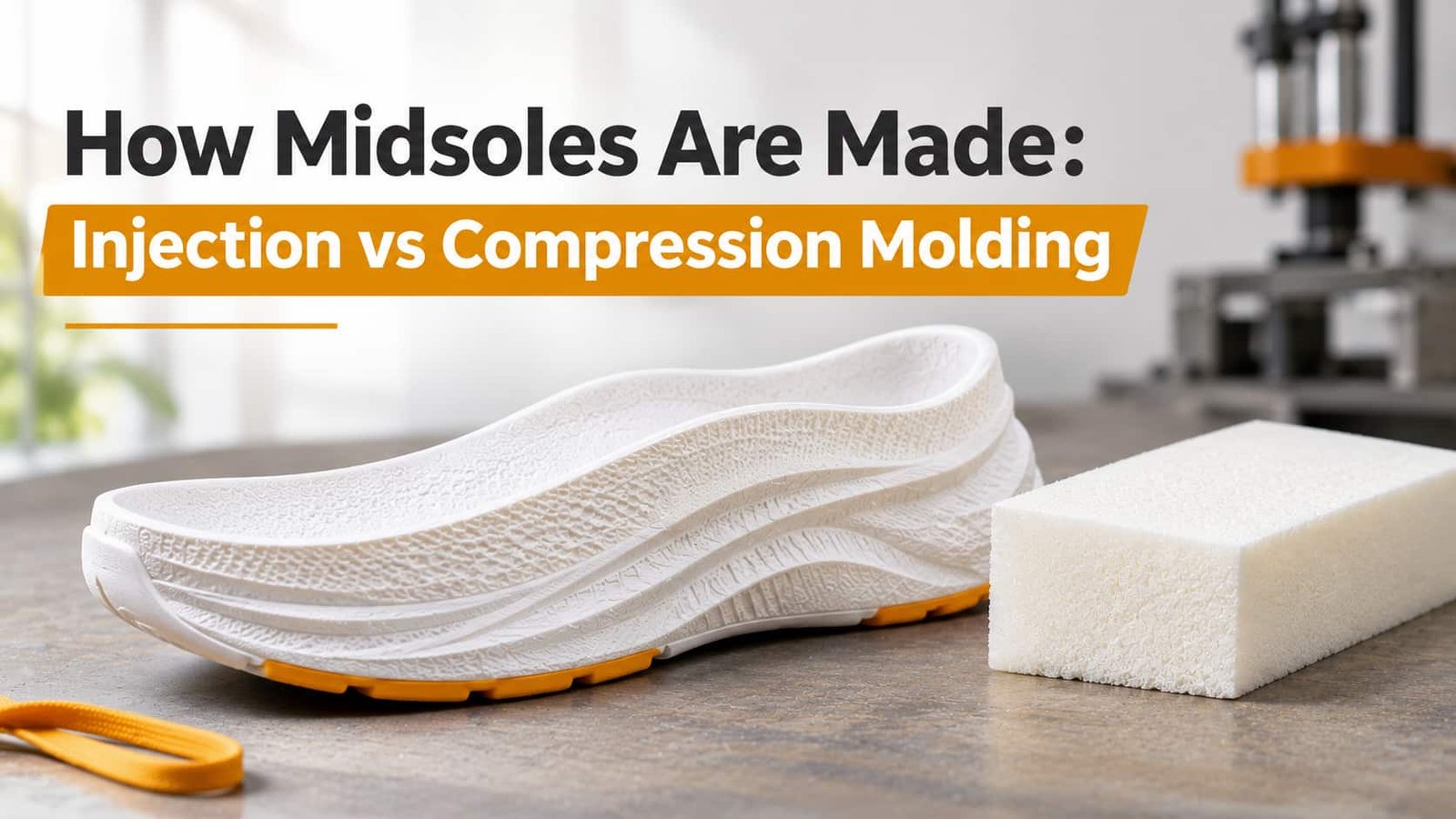
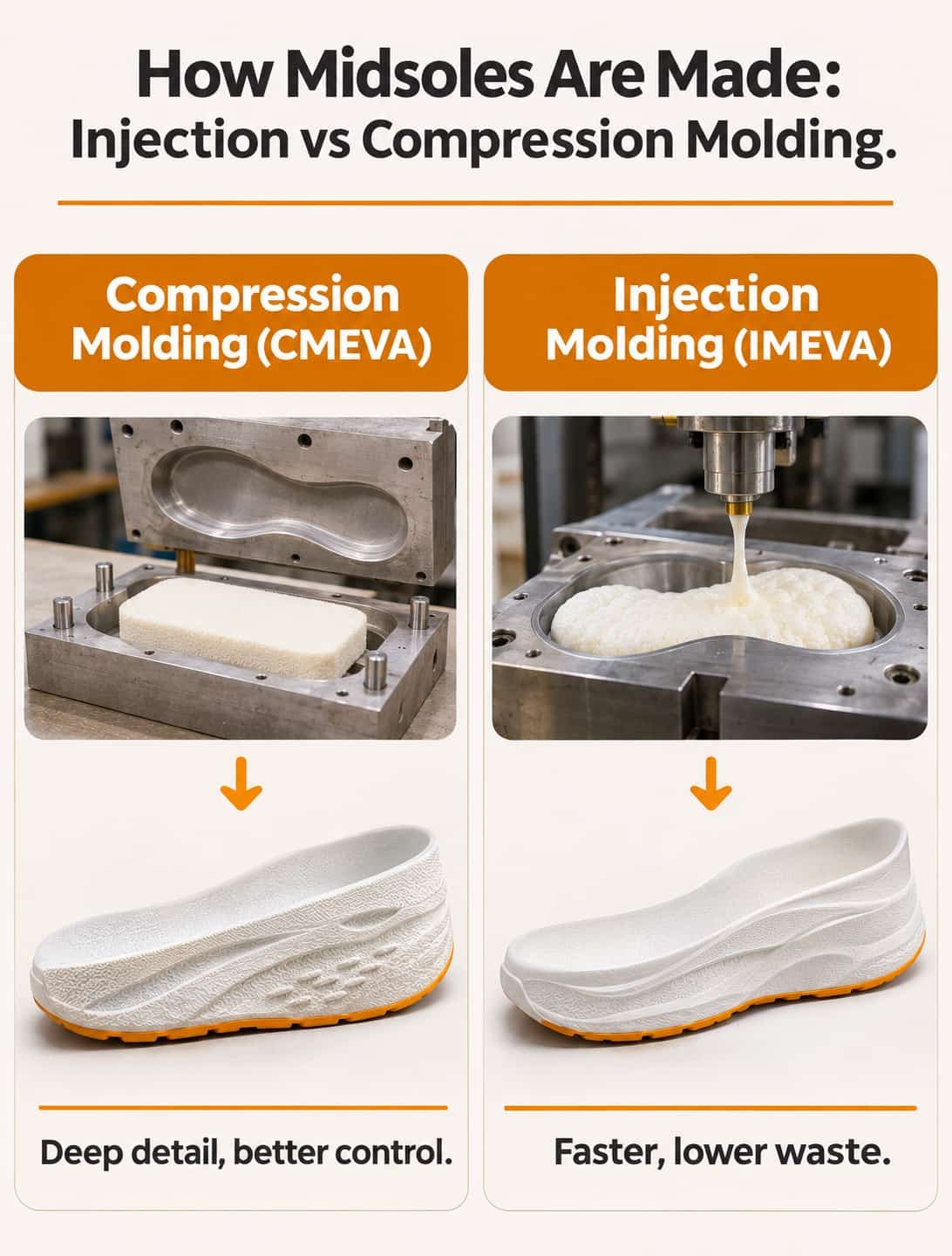
Most running and athletic midsoles are made by one of two molding methods. Compression molding presses a measured block of foam into a heated metal mold, which is strong for design detail and tight tolerances. Injection molding forces a molten foam mix into a smaller mold, and the foam expands as it leaves, which gives a fast, low-waste process with a bouncier, smoother finish. Both are widely used, and the right choice depends on the design, the foam, and the volume.
Key Takeaways
- Compression molding, often written CMEVA in the trade, puts a foam block into an open mold, then applies heat and pressure to shape it.
- Injection molding, often written IMEVA, injects foam into a mold smaller than the finished midsole, and the part expands when released.
- Compression molding is strong for surface design and dimensional control. Injection molding is strong for speed, low waste, and a smooth, springy feel.
- Cycle times and tooling costs differ sharply. Compression tools are cheaper but slower, while injection tools cost more and run faster.
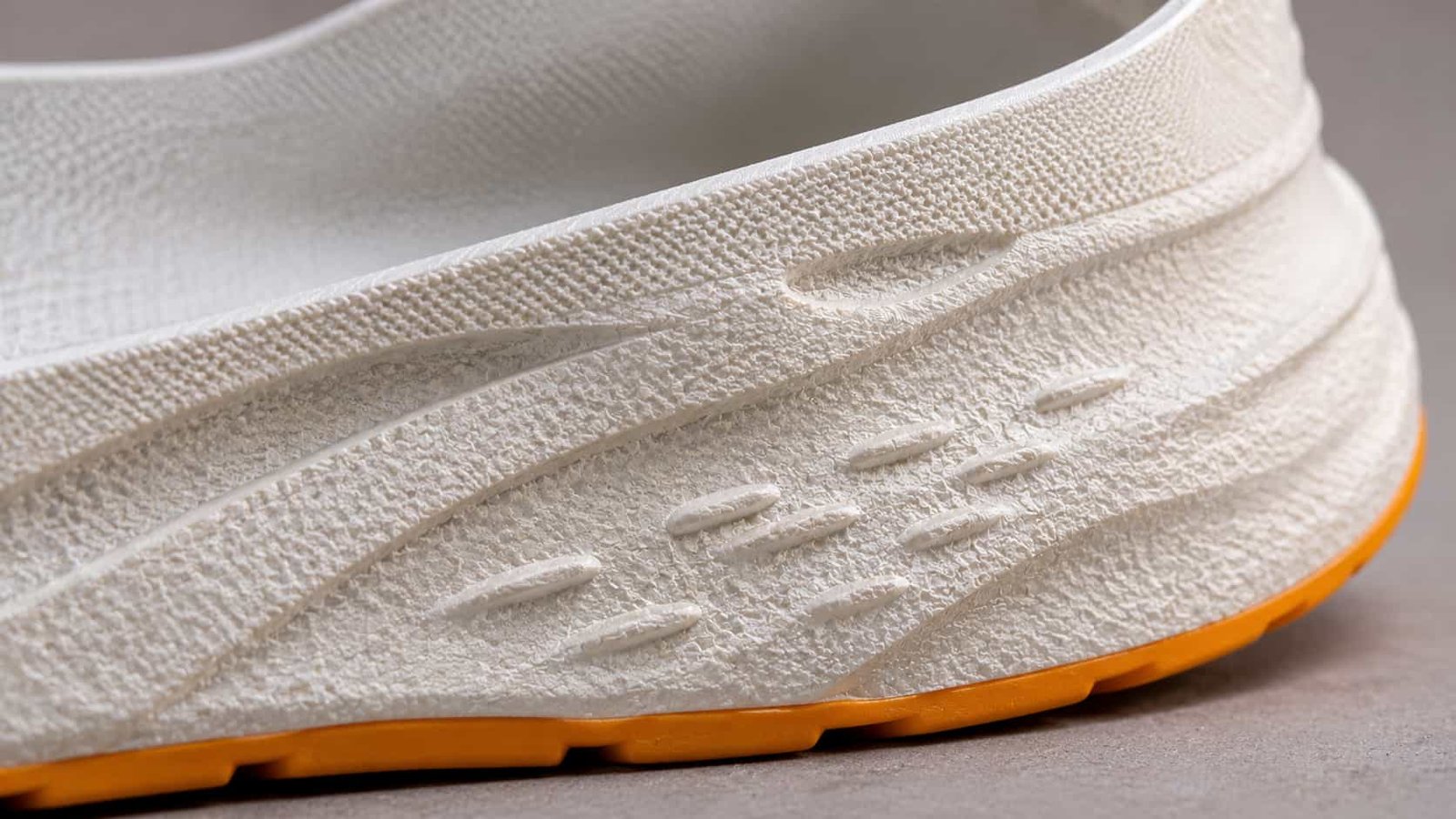
- Visual clues help you identify the process. Compression midsoles often show small raised marks and deep sidewall detail, while injection midsoles tend to look smoother with a sheen.
Why Midsole Making Matters
The midsole sits between the upper and the outsole, and it does most of the work of absorbing impact and returning energy. Two midsoles made from the same foam can feel quite different because of how they were molded. The process affects density, bounce, surface detail, weight, and how consistent each pair is from one batch to the next.
If you are new to shoe layers, our guide to the insole, midsole and outsole explains where the midsole fits. The anatomy of a shoe guide places it alongside the upper and sole.
What Molding Means in Midsole Production
Molding shapes a material by forming it inside a cavity. Solereview, a running-shoe review site, describes molding as the basic principle behind every midsole, comparing it to a waffle iron or a cupcake tin. The difference is scale. Footwear molding produces hundreds of thousands of midsoles a week so that finished shoes can ship on time.
Solereview also notes that compression and injection molding, alone or in combination, account for most running-shoe midsoles. Its figure is a reviewer’s estimate from 2016, so treat it as a general picture rather than a current market statistic. Other methods, such as poured polyurethane and 3D printing, appear in some models but are exceptions.
The two main processes share one idea: the mold gives the midsole its outer shape and surface design. They differ in how the material gets into the mold, and that single difference drives most of the trade-offs.
Compression Molding: Pressing a Foam Block in a Mold
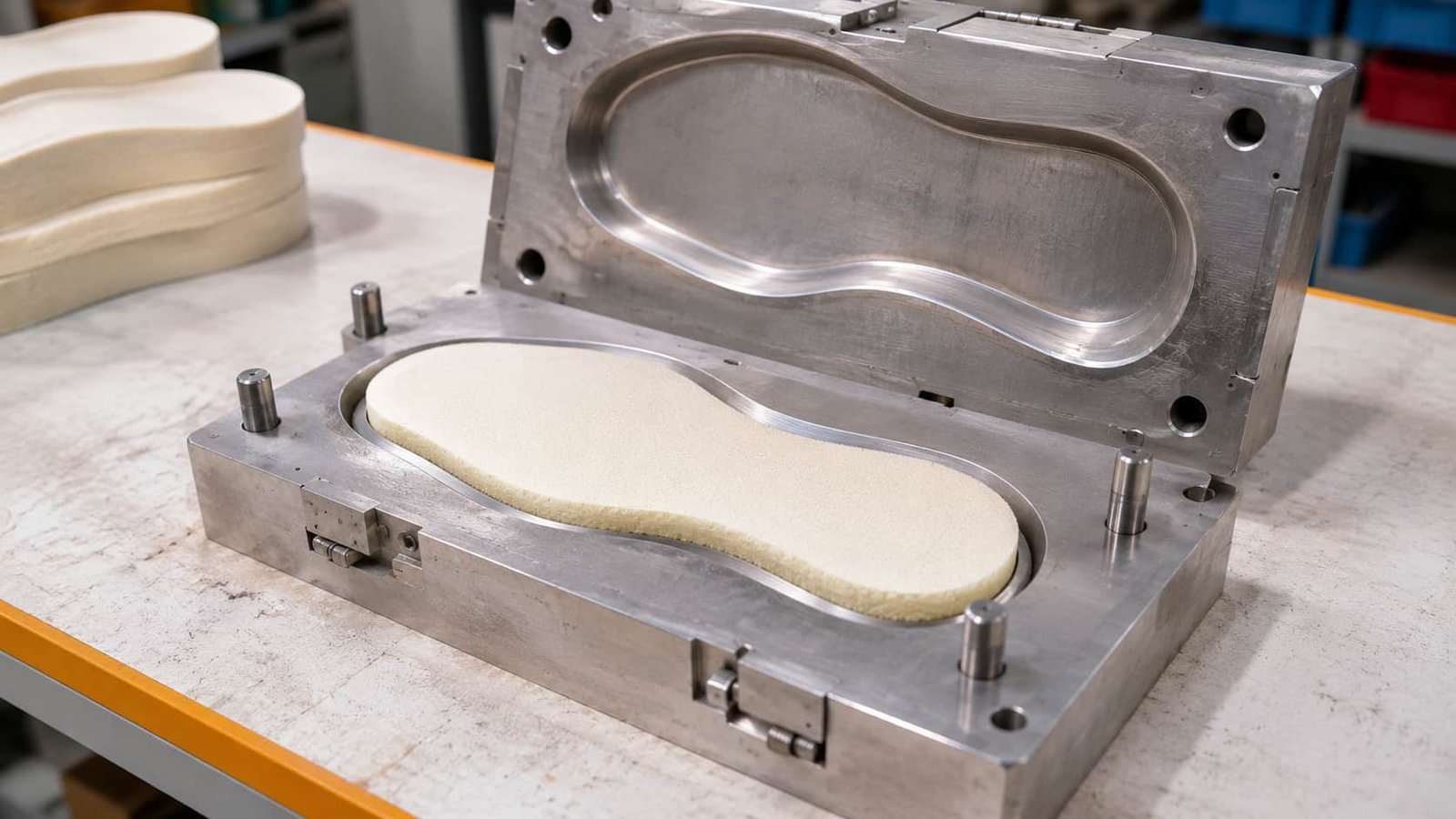
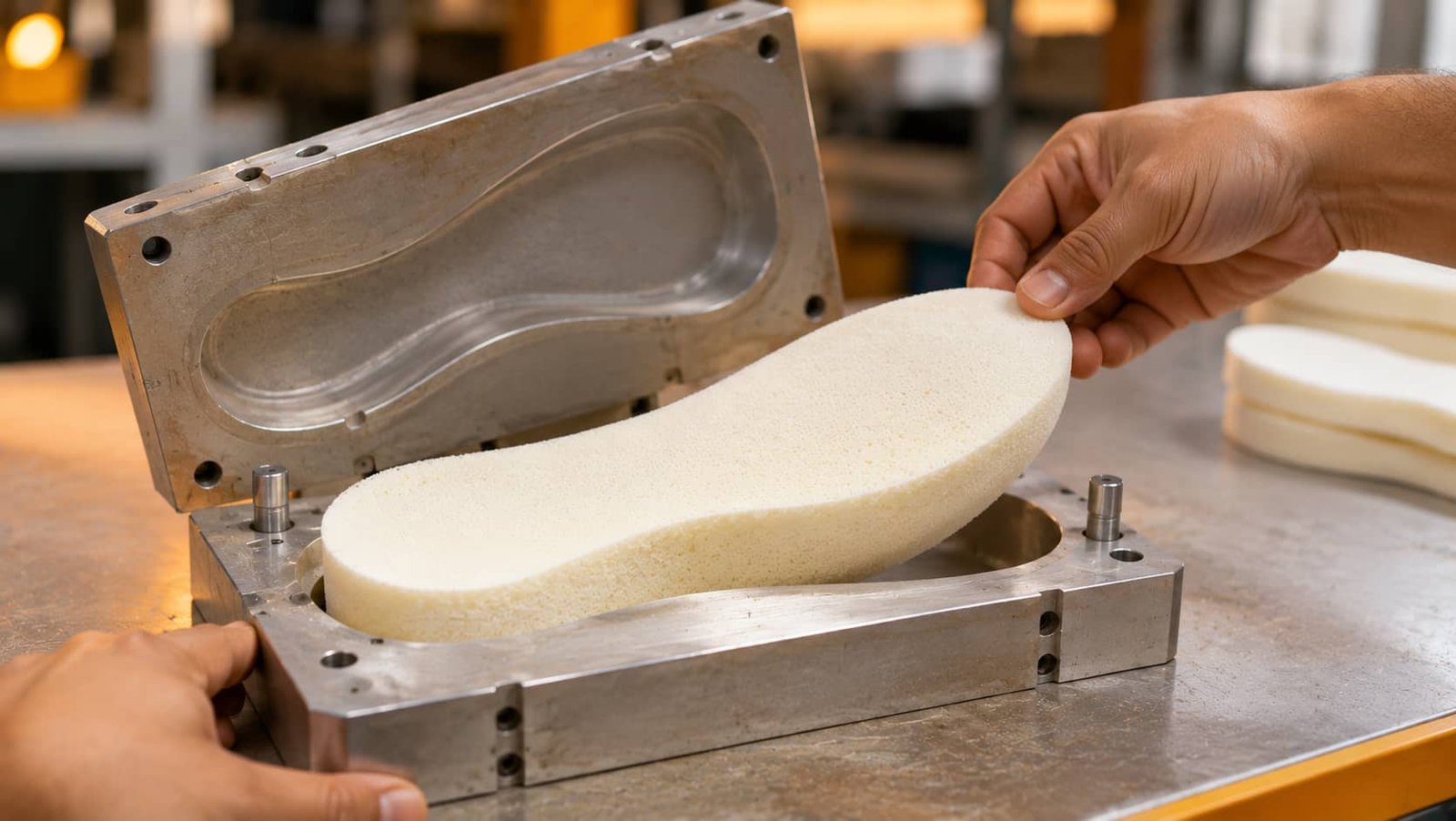
In compression molding, a block of EVA foam, a common midsole foam, is placed inside a metal mold. Solereview explains that the block is compressed inside the mold, and when heat and pressure are applied, the foam expands and fills the cavity. The foam takes on the shape of the mold, including any design etched into its walls.
The steps are straightforward. The foam block is placed in the mold, the mold closes, heat and pressure are applied, and the foam takes its shape. The mold opens, the midsole is removed, and the mold is cleaned with a release agent before the next cycle. Solereview compares the release agent to spray oil on a frying pan, because it stops the foam sticking to the metal.
The traditional method has a waste problem. Solereview notes that curved midsole shapes are cut from a rectangular sheet of EVA, which leaves offcuts between shapes, much like cutting gingerbread men from a square of dough. The finished midsole is the same size as the mold, which makes the result predictable.
Compression molding gives strong surface detail. The sidewall designs inherited from the mold are visible and often deep. Solereview argues that this is why brands choose compression molding for shoes with textured midsoles, and it cites the midsole texture on a Brooks model as an example that it says is achieved with CMEVA.
Injection Molding: Expanding Foam From a Smaller Mold
Injection molding works differently. Solereview describes a heated liquid mix of EVA and a blowing agent, which creates gas bubbles, injected into a mold that holds less than half the finished midsole volume. The mold has etched markings like a compression mold, which transfer to the midsole surface.
The key step happens when the mold opens. The compressed material expands suddenly to fill its full size, and then it contracts slightly as it cools. Solereview likens this to squeezing a large block of foam in your hand and then letting go, so it expands to several times its compressed size. Managing that expansion and contraction is more complex than compression molding.
Injection molding produces almost no waste, because the mold is filled with the amount of foam the midsole needs. That is one of its main advantages. Solereview also says injection molding often gives a bouncier, more responsive midsole, and that injection midsoles are often slightly lighter than compression versions of the same size.
Injection molding has trade-offs. Solereview notes that injection midsoles can be less consistent in exact dimensions, which makes them a poor choice when several separate pieces must fit together with no gaps. Softer injection foam can also show creases more quickly with use.
Injection vs Compression: The Core Difference
The table below summarises the main differences. It draws on Solereview’s review of midsole molding and on Jiga’s general comparison of molding processes. Jiga is a supplier, so its ranges are estimates from a manufacturing perspective, not measured results.
| Factor | Compression molding (CMEVA) | Injection molding (IMEVA) |
|---|---|---|
| How foam enters the mold | A pre-cut foam block is placed in an open mold, then compressed | A heated foam mix is injected into a closed mold |
| Mold size | The mold matches the finished midsole | The mold holds less than the finished midsole |
| What happens on release | Little change after molding | The foam expands, then contracts as it cools |
| Waste | Higher, due to cutting from sheets | Very low, since the mold uses the needed amount |
| Surface detail | Deep, sharp sidewall detail | Smoother, softer detail, often with a sheen |
| Dimensional control | Better for parts that must fit together | More variation, so less suited to multi-piece builds |
| Typical feel | Firmer, more controlled | Bouncier and more responsive, per Solereview |
| Tooling cost (estimate) | Lower | Higher |
| Cycle time (estimate) | Longer, often minutes for thermosets | Shorter, often seconds to about a minute |
Waste, Cycle Time and Tooling Cost
Three practical factors often decide which method a brand uses: waste, speed, and the cost of the tools.
Waste is the clearest difference. Compression molding leaves offcuts from the foam sheet, while injection molding uses the amount of foam the midsole needs. Solereview calls the injection approach zero waste, which is an intentional simplification of a process that still produces some trim and scrap in practice.
Cycle time matters for volume. Jiga’s general guide gives injection molding cycles of roughly 10 to 60 seconds for many parts, while compression molding of thermosets and rubbers often runs several minutes. Jiga notes that these ranges come from its general supply experience, and that midsole foams differ from the thermoplastics and rubbers it describes. For midsole foam, the principle still holds: injection is faster per part.
Tooling cost is the upfront question. Jiga’s estimates place injection molding tooling in the range of US$5,000 to over US$100,000 for typical parts, and compression molding tooling from about US$1,000 to over US$30,000. Jiga also notes that injection molding often becomes cost-effective above around 50,000 to 100,000 parts. These are supplier estimates for general molding, so use them as orders of magnitude, not quotes for midsoles.
Solereview adds one point about cost: compression metal molds are cheaper to make than injection molds, but it says cost is not the primary factor in choosing a process.
How Each Process Tends to Feel Underfoot
Feel depends on the foam formulation, the midsole design, and the shoe as a whole. Solereview says that, with adjustments to the formula and process, both methods can be made to feel similar. Its general observation is that injection midsoles tend to offer more bounce and responsiveness, while compression midsoles can be made extra firm in specific areas, such as a firm medial post.
Solereview also notes that softer injection foam can crease sooner, and that compression lines can appear on the sidewalls after use. These are observations from reviews rather than controlled durability tests.
For a runner, the practical message is that a midsole’s feel comes from the whole design. Try the shoe, run in it, and compare the cushioning and bounce for yourself. Our guide to running shoe foam explains the wider family of midsole foams, and our guide to EVA foam covers the material most often molded in these two ways.
How to Tell Them Apart on a Shoe
Solereview offers visual clues that can help identify the process, though none is definitive without the manufacturer’s information.
Compression-molded midsoles often show small raised marks, sometimes called nipples, on the surface. These come from the mold and the way the foam is pressed. Compression midsoles also tend to have deep, clear sidewall texture, sometimes with sharp lettering.
Injection-molded midsoles often look smoother and softer in detail, with a slight shine. They lack the deep sidewall texture and the raised marks, according to Solereview.
Poured polyurethane midsoles, a less common method, can show small pores or air bubbles on the surface from the pouring process.
These clues are useful but not reliable on their own. Hybrid methods and finishing treatments can blur them, so check the manufacturer’s technical information if the process matters to you.
Hybrid Methods: Compression With an Injection Preform
Solereview describes a hybrid approach that avoids much of the waste from traditional compression molding. Instead of cutting a block from a sheet of EVA, the manufacturer places an injection-molded block, called a preform, inside the compression mold. The result blends properties of both processes.
Solereview suggests that Hoka uses this technique in some shoes. The site presents it as a suspicion from its reviewers rather than a confirmed manufacturing fact, so treat that point as unconfirmed.
The hybrid approach shows that the two processes are not always rivals. Brands can combine them to balance design detail, waste, and feel.
Other Midsole Methods Worth Knowing
Solereview describes two other methods briefly.
Poured polyurethane, where molten polyurethane is poured into a mold and the top is clamped shut, was common until the early 2000s, according to the site. It is now rare in running shoes.
3D printing, specifically selective laser sintering, is used in some midsoles, but Solereview says the process is not currently viable at mass-production scale. Its reviewers describe most consumer 3D printing hype as relating to a method that cannot produce a running midsole you can wear comfortably.
Where Molding Sits in the Whole Shoe
Molding is one stage in making a shoe. Midsoles are molded separately, then joined to the upper and outsole during bottoming. Our guide to how shoes are made walks through the wider sequence from cutting to packing.
Because the midsole is a separate part, its quality can vary by batch and by factory. Testing the finished shoe, rather than assuming a process guarantees a result, is one way to check performance. Our article on how shoes are lab tested explains how testing is typically approached, and our guide to how long running shoes last covers the wear signs that show when a midsole has lost its feel.
A Practical Decision Guide
For a buyer, the process is one clue among many. Use it alongside the foam name, the shoe’s intended use, and your own feel.
If you want a shoe with a bouncy, responsive feel for faster running, look for a design where the foam is described as responsive or springy, and try it on a short run. Injection-molded foams are often marketed this way, though the exact process may not be stated.
If you want a shoe with strong, well-defined stability features, or a midsole with a textured design, a compression-molded design may suit you. Firmer zones are easier to build with compression molding, according to Solereview.
If you are a brand or product developer, the choice depends on volume, design detail, and budget. Compression tools are cheaper to make, but injection molding can be more economical at high volume. Jiga’s general estimates suggest the break-even point is often in the tens of thousands of parts, but midsole economics depend on many factors.
Trade-Offs and Limitations
Neither process is best in every case. Compression molding offers design detail and dimensional control, but it produces more waste and runs more slowly. Injection molding is fast and efficient, but it can vary more in exact dimensions and may crease sooner in softer foams.
Process names also say less than you might expect. A compression-molded midsole can be well made or poorly made, and the same is true of injection molding. The foam formulation, the mold quality, and the process control matter as much as the method.
Many of the claims about feel come from reviews and manufacturers. They describe typical differences, not guaranteed outcomes, and reviewers’ experiences vary with the runner and the surface.
Myths Worth Dropping
Myth: Injection molding is always bouncier.
It is often described that way, but feel depends on the formula and the design. Compression midsoles can also be responsive.
Myth: Compression-molded midsoles are always stiffer. T
hey can be made firm, but they can also be made soft, and the design matters more than the process name.
Myth: Injection molding produces no waste.
Solereview uses zero-waste language as a general comparison, but trimming and scrap can still occur in practice.
Myth: The little marks on a midsole are a defect.
Raised marks on compression midsoles are a normal result of the molding process, not a sign of a fault.
Myth: Molding method tells you the shoe’s quality.
The process is one factor. Foam, design, fit, and construction all shape how a shoe performs and lasts.
Frequently Asked Questions
What is the difference between injection molding and compression molding for shoes?
Compression molding presses a foam block into a mold that matches the finished midsole, while injection molding injects foam into a smaller mold and the part expands on release. Compression gives strong surface detail, and injection gives faster production and lower waste.
Which is better for running shoes?
Neither is better in every case. Injection-molded midsoles are often described as bouncier and lighter, while compression-molded midsoles offer design detail and control. The right choice depends on the shoe’s design and the feel you want.
What does CMEVA mean?
CMEVA stands for compression-molded EVA. It describes EVA foam made by compression molding, and it is often used in shoe specifications.
What does IMEVA mean?
IMEVA stands for injection-molded EVA. It describes EVA foam made by injection molding.
How can I tell if a midsole is compression molded?
Solereview suggests looking for small raised marks on the surface and deep, clear sidewall texture. These clues are useful but not conclusive, so check the manufacturer’s information if you need certainty.
Is molding spelled molding or moulding?
Both spellings are used. This article uses “molding” to match the keyword, which is common in North American usage. UK writers often use “moulding.”
Are midsoles made by 3D printing?
Some are, but Solereview says the process is not currently viable at mass-production scale for running shoes. Most consumer 3D printing hype relates to other methods that cannot produce a wearable running midsole.
Conclusion
Midsoles are made mainly by compression molding or injection molding. Compression molding offers design detail and dimensional control, while injection molding is faster, lower in waste, and often described as bouncier. Neither is automatically better, and the foam, the design, and the quality of the process matter as much as the method name. Your next step is to try shoes with different midsole designs, notice how each feels, and look for the manufacturer’s technical information when the process matters to you. For a broader foundation, start with the shoe materials hub or browse the footwear knowledge section.
Sources
- Solereview, “Compression vs. injection molded EVA midsoles: What’s the difference?” (running-shoe review site; comments dated 2016): https://www.solereview.com/difference-between-compression-and-injection-molded-eva-midsoles/
- Jiga, “Compression Molding vs Injection Molding: Key differences and when to use each” (supplier resource; published February 25, 2026, updated March 5, 2026): https://jiga.io/articles/compression-molding-vs-injection-molding/


