

PU vs PVC Shoes: Which Synthetic Is Better?
Editorial Guide | Footwear Materials |
Summarise this PU vs PVC guide with AI
Open an assistant and submit the prefilled request. The assistant reads the page only after you submit it.
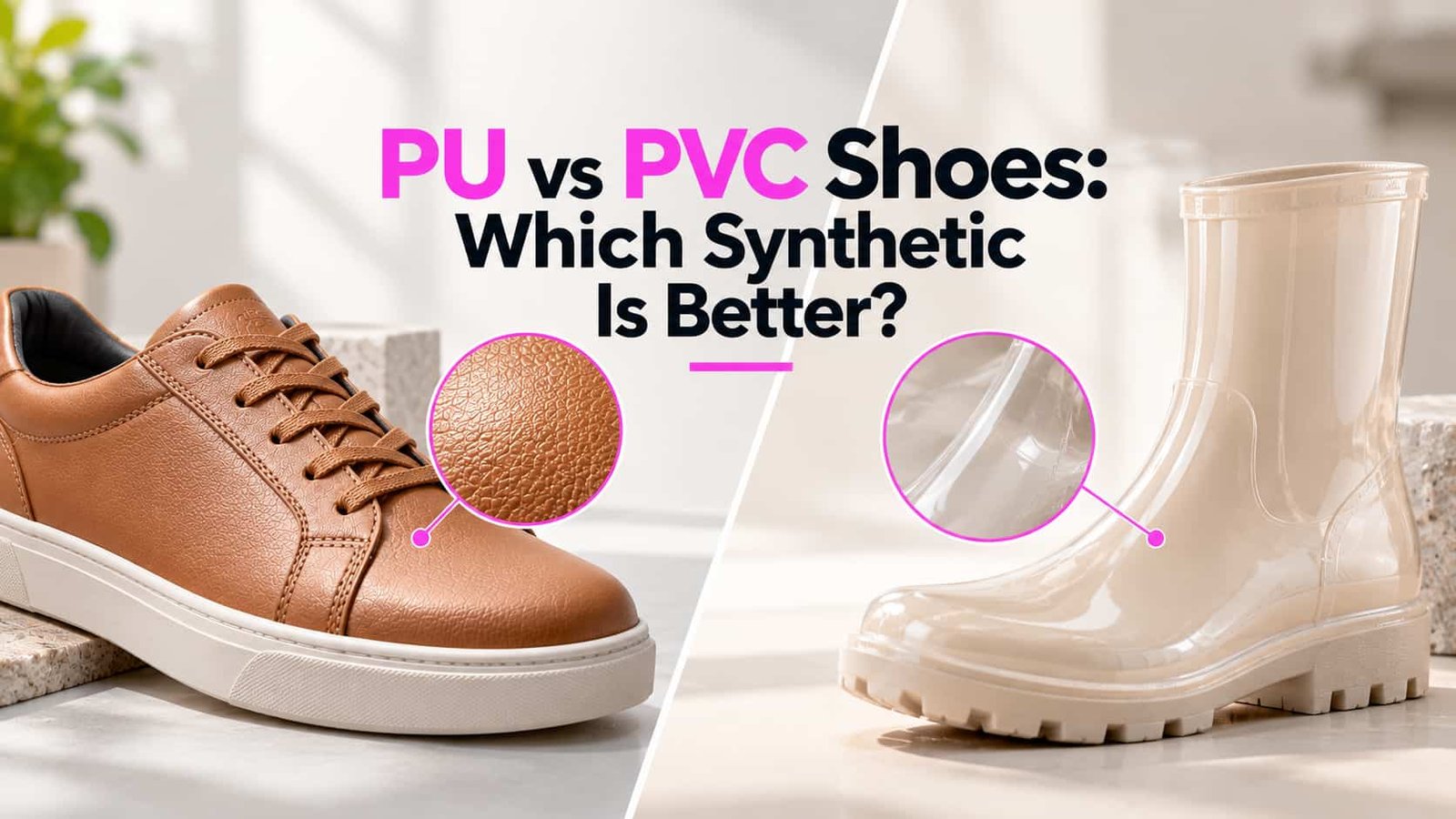
PU and PVC are both synthetic materials, but they are built differently. PU is a polyurethane coating on a fabric base, used mainly for leather-look uppers. PVC is a solid plastic, used mainly for waterproof soles, rain boots and jelly shoes. PU usually feels more like leather and breathes a little better. PVC is more water-proof and simpler to clean. Choose by where the material is used and what you need from the shoe.
Key Takeaways
- PU and PVC are different materials. PU is a coating on fabric. PVC is a solid plastic.
- Use decides the better choice. PU suits leather-look uppers and everyday fashion. PVC suits rain and wet-weather shoes.
- PU breathes a little better. PVC is sealed and traps heat and sweat.
- PVC handles standing water better. PU resists light wet but is less reliable in heavy rain.
- Check the sole as well as the upper. Many shoes use PVC soles with PU uppers, so the label matters.
PU vs PVC at a Glance
| Feature | PU | PVC |
| What it is | Polyurethane coating on fabric | Solid plastic (polyvinyl chloride) |
| Common use | Leather-look uppers, fashion shoes | Rain boots, jelly shoes, soles |
| Look and feel | Soft, leather-like, can be textured | Smooth, glossy, often rubbery |
| Breathability | Lower, but better than PVC | Poor, sealed |
| Water | Resists light wet, not fully waterproof | Excellent water resistance |
| Flexibility | Usually flexible | Can be stiff, varies by formulation |
| Durability | Coating can crack or peel | Can harden or crack with heat and age |
| Repair | Limited | Limited |
| Care | Wipe, gentle clean | Rinse, gentle clean |
These are general tendencies, not guarantees. Both materials vary a lot by product, so check each pair’s material details.
What PU Is
PU stands for polyurethane. In shoes, PU is usually a coating spread over a fabric or textile base, then embossed to look like leather. Because the surface is a coating, PU is often described as synthetic or faux leather. The fabric base gives the material some stretch and flex, and the coating gives it a smooth, leather-like finish.
For a fuller definition, see what is synthetic leather. That article covers PU’s uses and limits in more depth.
What PVC Is
PVC stands for polyvinyl chloride. It is a solid plastic made by polymerising vinyl chloride, then mixed with additives that control how soft or stiff it is. In shoes, PVC is moulded or formed into whole parts, such as a rain boot, a jelly shoe or a sole.
Unlike PU, PVC is not a coating on fabric. It is usually one solid layer, which makes it tough and very water-resistant but less breathable. For a fuller look at PVC in footwear, read PVC in shoes.
For the wider picture of shoe materials, the shoe materials guide covers leather, textiles and synthetics side by side.
How Each Is Made
PU. A textile base is coated with polyurethane, spread as one or more layers, cured, and embossed to create a grain pattern. Colour is added in the finishing stage. The coating and base bond together, and the strength of that bond strongly affects how long the material lasts.
PVC. Vinyl chloride is polymerised into a resin, then mixed with plasticisers and stabilisers. The mix is moulded, injected or formed into shoe parts. The plasticisers control softness, and the stabilisers help the material resist heat and light.
The key difference is structure. PU is layered over fabric. PVC is one solid material shaped into the part.
Where Each Is Used in Shoes
PU is most often seen in:
- Leather-look uppers on fashion shoes and boots
- Vegan-style shoes that imitate leather
- Some budget formal shoes and loafers
PVC is most often seen in:
- Rain boots and wellingtons
- Jelly shoes and clear slip-ons
- Moulded soles and some trims
- Budget work or wet-environment footwear
One practical note: a shoe can use PU on the upper and PVC or rubber on the sole. Check each part separately rather than assuming the whole shoe is one material.
Comfort and Breathability
Here PU usually wins. The coating is thinner and more flexible than solid PVC, and the fabric base lets some air move. PU shoes often feel softer and less stiff in the upper.
PVC is sealed and stiff. It holds heat and sweat, so feet can feel warm and damp, especially in warm weather or on long walks. A soft insole and a breathable sock help, but they do not change the basic structure.
Neither is a breathable material in the way open knit or leather can be. PU is the more comfortable choice for an upper, while PVC is better kept for short wet-weather use.
This is an editorial judgment based on how coated and solid plastics behave. It is not a standardised laboratory result.
Water and Weather
PVC is the stronger choice for water. It resists rain and standing water well, and it is often used for rain boots for that reason.
PU resists light wet and cleans easily, but it is not reliably waterproof. Water can soak through the fabric base if the coating is damaged, and seams and stitching can let water in. For heavy rain, PU is less suitable than PVC.
Neither material is a substitute for a shoe built for wet weather. If you need protection in heavy rain, check the construction, seams and any membrane. For background, see how waterproof shoes work and waterproof vs water resistant shoes.
Durability and Lifespan
There is no reliable fixed lifespan for either material. Durability depends on the coating thickness or the PVC formulation, the bonding, the shoe’s construction and how it is used and stored.
PU’s main weakness is the coating. It can crack at flex points, peel from the base and break down with heat, humidity and age. Once the coating fails, repair is limited.
PVC’s main weakness is hardening. It can become stiff, brittle or cracked with heat, long sun exposure and age. Plasticisers can migrate out over time, making the material less flexible. PVC is tough in the short term, but it does not repair easily either.
Both materials are most vulnerable when stored in hot cars, damp cupboards or direct sun. Storing them cool, dry and out of direct light helps keep them in better shape.
Peeling, Cracking and Ageing
Peeling is a PU problem. The coating can separate from the fabric base, most often at the flex points of the vamp and toe. It is one of the most common complaints about PU shoes.
Cracking affects both, but in different ways. PU cracks in the surface coating, while PVC can harden and then crack in the solid material, especially if it is cold, exposed to sun or left to age.
If a PU surface has begun to peel, light repairs may help in some cases. Our guide on how to fix peeling shoes explains what can and cannot be saved. Once PVC has hardened or cracked through, it usually cannot be restored.
Care and Cleaning
Both materials clean easily, but harsh products can damage either one.
For PU:
- Wipe with a soft, dry cloth to remove dust.
- Clean marks with a damp cloth and a little mild soap.
- Wipe dry and let the shoes air dry away from heat.
- Avoid alcohol, acetone and strong solvents, which can strip the coating.
For PVC:
- Rinse off mud with cool water and a soft cloth.
- Use a little mild soap for stubborn marks, then rinse.
- Dry at room temperature, away from radiators and direct sun.
- Avoid petrol, paint thinners and strong solvents, which can soften or stain the plastic.
For wider routines, see how to clean shoes and maintain them. For rain footwear specifically, see how to clean rain boots.
PU or PVC: Which to Choose?
| Your situation | PU may suit you if | PVC may suit you if |
| Use | You want a leather-look everyday or fashion shoe | You need rain boots or wet-day shoes |
| Comfort | You want a softer, more flexible upper | You accept a stiffer, sealed feel |
| Weather | You face mostly dry or light wet conditions | You face frequent rain or standing water |
| Breathability | You want the better-breathing of the two | You need only short wet-weather use |
| Appearance | You want a leather-like finish | You like a glossy, clean look |
| Budget | You want a lower-cost leather look | You want a very cheap waterproof option |
For help narrowing options by use and style, the shoe finder is a practical next step.
A practical rule: Choose PU for an upper that looks and feels closer to leather in everyday use. Choose PVC for rain, puddles and jelly-style shoes. If you need cushioning for walking or running, look at the sole, since neither PU nor PVC is the best cushioning material. For sole comparisons, see what is TPU in shoes.
Myths Worth Dropping
- “PU and PVC are the same thing.” PU is a coating on fabric. PVC is a solid plastic.
- “PU is fully waterproof.” It resists light wet, but it is not reliably waterproof.
- “PVC is always cheap and unsafe.” Quality and safety depend on the product’s formulation and construction. Check the material details.
- “Breathable means the same as leather.” PU breathes better than PVC, but neither is as breathable as real leather or open knit.
- “PU and PVC last the same.” Both can fail, but they fail differently, with PU usually peeling and PVC usually hardening or cracking.
Frequently Asked Questions
What is the main difference between PU and PVC shoes?
PU is a polyurethane coating on a fabric base, used mainly for leather-look uppers. PVC is a solid plastic, used mainly for rain boots, jelly shoes and soles. PU is more breathable and flexible, and PVC is more waterproof.
Is PU or PVC better?
It depends on the job. PU is better for a leather-look upper that breathes a little more. PVC is better for rain and standing water. Neither is best for cushioned walking or running.
Is PU leather waterproof?
Not reliably. PU resists light wet and cleans easily, but water can get through a damaged coating or at seams. For heavy rain, look for a shoe built for water.
How long do PU and PVC shoes last?
There is no fixed lifespan. PU often fails through peeling or cracking of the coating. PVC often fails by hardening or cracking. Both last longer with cool, dry storage and gentle care.
Is PVC bad for your feet?
PVC is sealed and does not breathe well, so feet can feel hot and damp, especially on long walks. Whether a particular PVC shoe is safe depends on its formulation. If you have specific health concerns, speak to a qualified medical professional.
Which is better for a sole, PU or PVC?
PVC is often used for moulded or waterproof soles, while PU is more often used as an upper coating. For cushioned soles, EVA, rubber or TPU are usually more comfortable than either PU or PVC.
Is PU vegan?
PU is synthetic and contains no animal hide, so it is widely used in vegan footwear. Check the product’s full material details, because other parts of a shoe, such as glues or linings, may not be vegan.
Final Thoughts
PU and PVC are both synthetic, but they serve different jobs. PU is a coating on fabric, used for leather-look uppers that breathe a little better. PVC is a solid plastic, used for rain boots and waterproof soles, but it is stiff and sealed. Check where each material is used in the shoe, then choose by weather, comfort and how long you want the pair to last.
For the wider picture, start with the shoe materials guide, then read PVC in shoes and what is synthetic leather for the detail on each.
External References
- Wikipedia, “Polyurethane” (the polymer used in PU coatings): en.wikipedia.org/wiki/Polyurethane
- Wikipedia, “Polyvinyl chloride” (the PVC polymer and its additives): en.wikipedia.org/wiki/Polyvinyl_chloride
- Wikipedia, “Artificial leather” (definition of synthetic leather): en.wikipedia.org/wiki/Artificial_leather


