
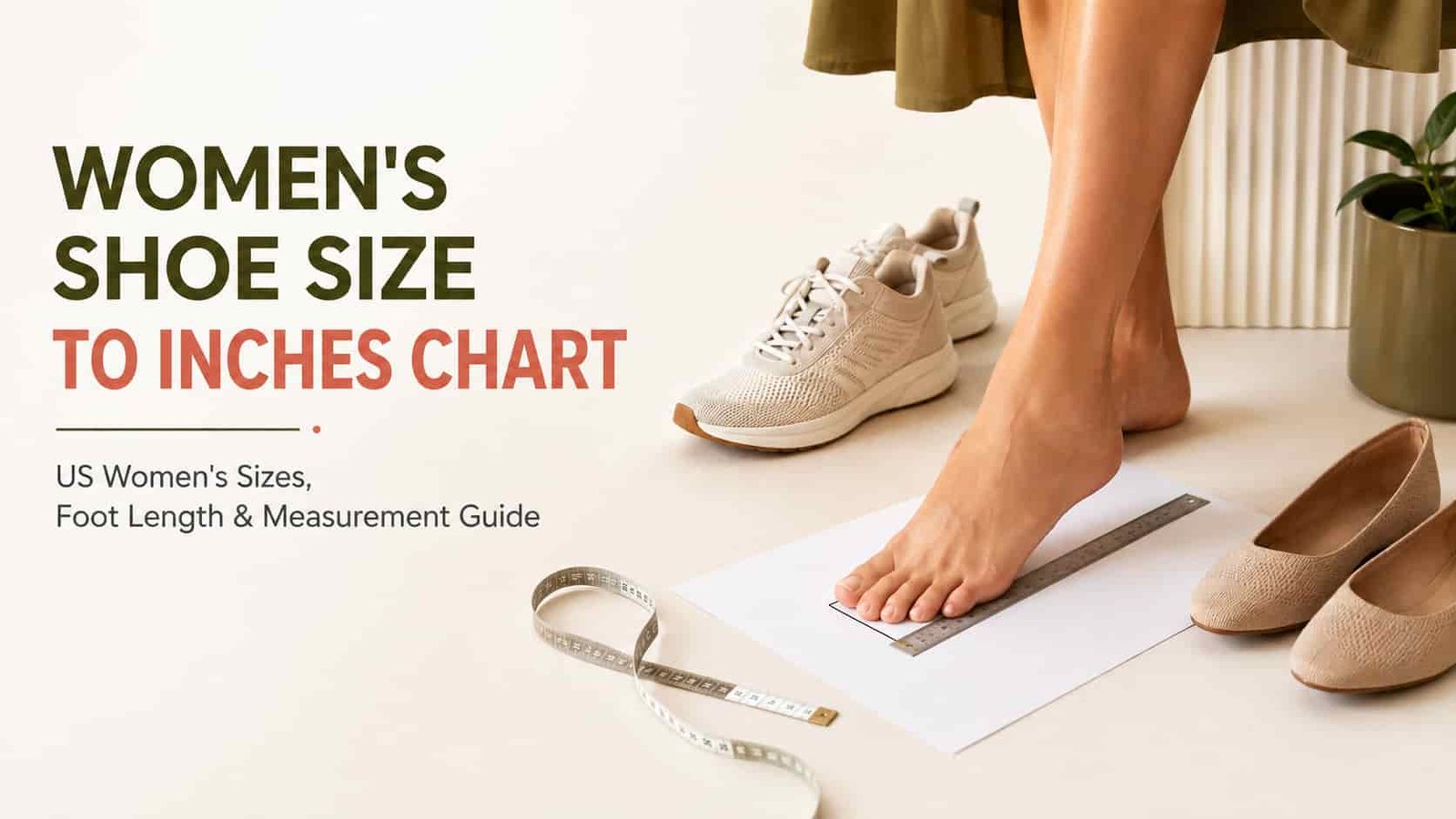
Women’s Shoe Size to Inches Chart: US Sizes & Foot Length
Quick Answer
- A women’s shoe size is based on a sizing system, while inches describe your actual foot length.
- Your foot length should be measured from the back of your heel to the tip of your longest toe.
- Measure both feet because one foot can be slightly longer than the other.
- Use the longer measurement when comparing your feet with a brand’s size chart.
- Always check the individual shoe brand’s chart because sizing can vary between manufacturers.
If you want to know your women’s shoe size to inches, start with your actual foot measurement rather than trying to guess from your usual shoe size.
Your foot length is the distance from the back of your heel to the tip of your longest toe. A shoe size is a label used by a particular sizing system. These two measurements are related, but they are not exactly the same thing.
That is why measuring your feet before buying shoes online can give you a better starting point than simply choosing the size you normally wear.
For a broader women’s sizing reference, see the Women’s Shoe Size Chart.
Women’s Shoe Size to Inches Finder
Enter your foot length to find the closest general US women’s shoe size.
Women’s Shoe Size to Inches Chart
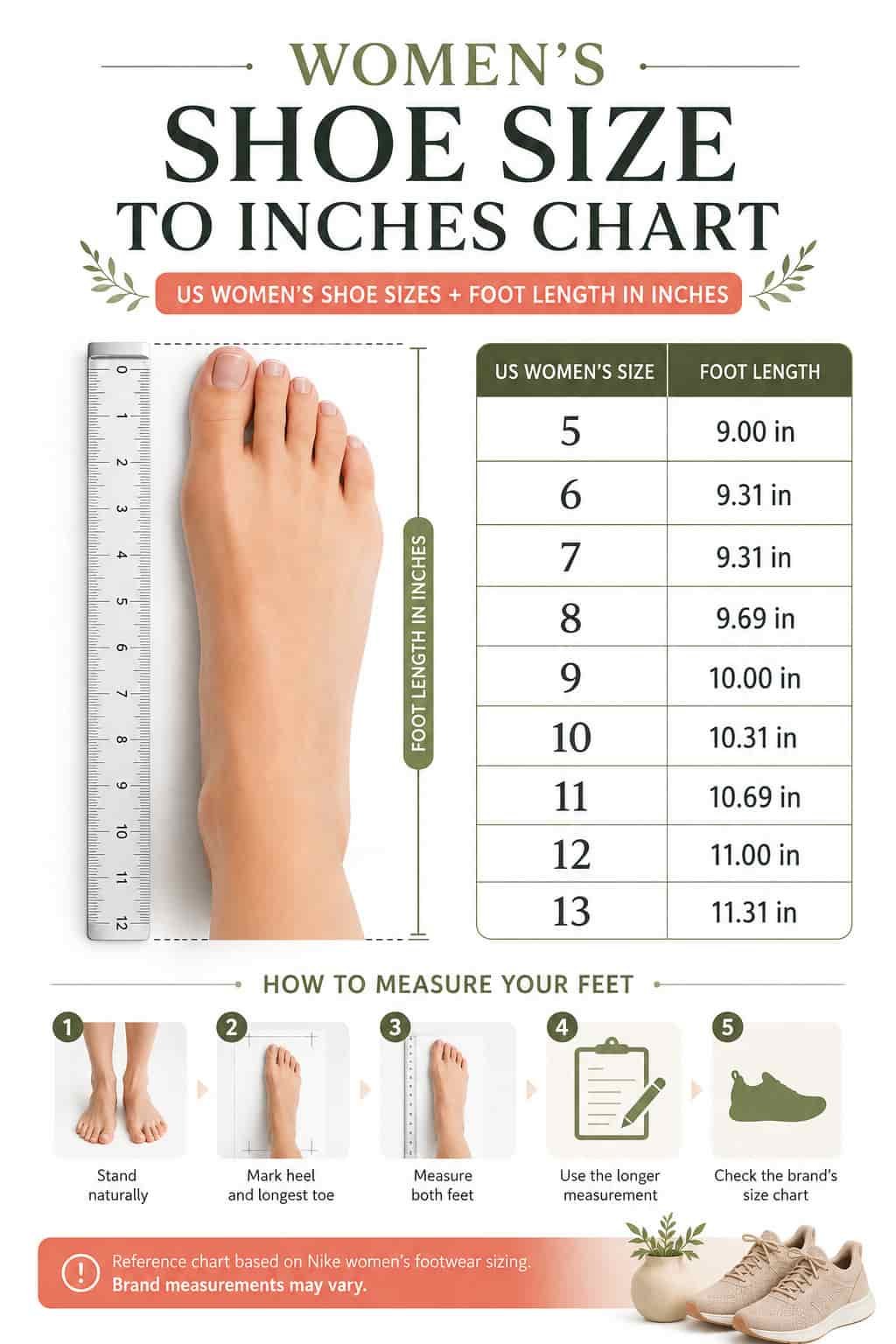
A women’s shoe size to inches chart helps you compare a US women’s shoe size with an approximate foot-length measurement.
Because shoe sizing can vary between brands, use any general chart as a reference and then confirm your measurement against the manufacturer’s own chart.
| US Women’s Size | Approximate Foot Length |
| 5 | 8.5 to 8.9 in |
| 5.5 | 8.9 to 9.1 in |
| 6 | 9.1 to 9.3 in |
| 6.5 | 9.3 to 9.5 in |
| 7 | 9.5 to 9.7 in |
| 7.5 | 9.7 to 9.9 in |
| 8 | 9.9 to 10.1 in |
| 8.5 | 10.1 to 10.3 in |
| 9 | 10.3 to 10.5 in |
| 9.5 | 10.5 to 10.7 in |
| 10 | 10.7 to 10.9 in |
| 10.5 | 10.9 to 11.1 in |
| 11 | 11.1 to 11.3 in |
| 11.5 | 11.3 to 11.5 in |
| 12 | 11.5 to 11.7 in |
| 12.5 | 11.7 to 11.9 in |
| 13 | 11.9 to 12.1 in |
Important: These ranges are general references rather than a universal conversion. Individual brands can assign different foot-length measurements to the same US shoe size.
If you are buying from a specific brand, its current sizing chart should be your final reference.
What Does a Shoe Size in Inches Mean?
A shoe size in inches generally refers to the foot length associated with a particular size chart, not necessarily the inside length of the shoe.
For example, if your foot measures 10 inches, you should not assume that every shoe with a 10-inch internal length will fit correctly.
Shoes need appropriate room around the foot, and their construction differs by style.
A sneaker, boot, sandal and dress shoe can all fit differently even when they have the same labeled size.
That is why the best approach is:
- Measure your foot.
- Record the measurement in inches.
- Check the brand’s size chart.
- Check the available width.
- Consider the shape and purpose of the shoe.
How Do You Convert Women’s Shoe Size to Inches?
There is no single formula that accurately converts every women’s shoe size into inches across all brands.
The reason is simple: footwear manufacturers can use different sizing standards and shoe constructions.
Instead of using a mathematical formula, compare your measured foot length with the shoe brand’s size chart.
If you are comparing US, UK and EU sizes, you can also use the Shoe Size Conversion Chart & Calculator to make international size comparisons easier.
What Foot Length Is a Women’s Size 6?
A women’s size 6 generally corresponds to a foot length of roughly 9 to 9.3 inches, depending on the brand’s sizing system.
This is a reference rather than an exact universal measurement.
If you normally wear a women’s size 6 but are ordering from a new brand, measure your foot before choosing the size.
A small difference in the shape or sizing system can make a noticeable difference in how the shoe fits.
What Foot Length Is a Women’s Size 7?
A women’s size 7 generally corresponds to a foot length of roughly 9.5 to 9.7 inches in many US sizing references.
Your actual measurement should take priority over your previous shoe size.
If your foot measures differently from the range shown on a particular brand’s chart, follow that brand’s recommendation.
What Foot Length Is a Women’s Size 8?
A women’s size 8 generally corresponds to a foot length of around 9.9 to 10.1 inches in general sizing references.
This is one of the most commonly searched women’s shoe sizes, but the exact fit can vary considerably between brands.
If your foot measures close to 10 inches, compare that measurement directly with the size chart for the shoe you plan to purchase.
What Foot Length Is a Women’s Size 9?
A women’s size 9 generally corresponds to a foot length of approximately 10.3 to 10.5 inches.
However, do not assume that every size 9 shoe will fit the same way.
The shoe’s width, toe box, heel construction and materials can all change the way the shoe feels.
What Foot Length Is a Women’s Size 10?
A women’s size 10 generally corresponds to a foot length of around 10.7 to 10.9 inches in common US sizing references.
If your foot measures close to this range, use your measurement as the starting point and then check the specific manufacturer’s chart.
What Foot Length Is a Women’s Size 11?
A women’s size 11 generally corresponds to a foot length of approximately 11.1 to 11.3 inches.
Women with longer feet should pay particular attention to both length and width.
A shoe can have enough length but still feel uncomfortable if the width or toe-box shape does not match your foot.
What Foot Length Is a Women’s Size 12?
A women’s size 12 generally corresponds to a foot length of approximately 11.5 to 11.7 inches in general sizing references.
Because larger sizes can vary between manufacturers, measuring your feet becomes especially useful when purchasing from an unfamiliar brand.
What Foot Length Is a Women’s Size 13?
A women’s size 13 generally corresponds to a foot length of around 11.9 to 12.1 inches in general references.
Not every women’s shoe model is produced in size 13, and available width options can also vary.
If you need a larger women’s size, check both the length and width options before ordering.
How Do You Measure Women’s Foot Length in Inches?
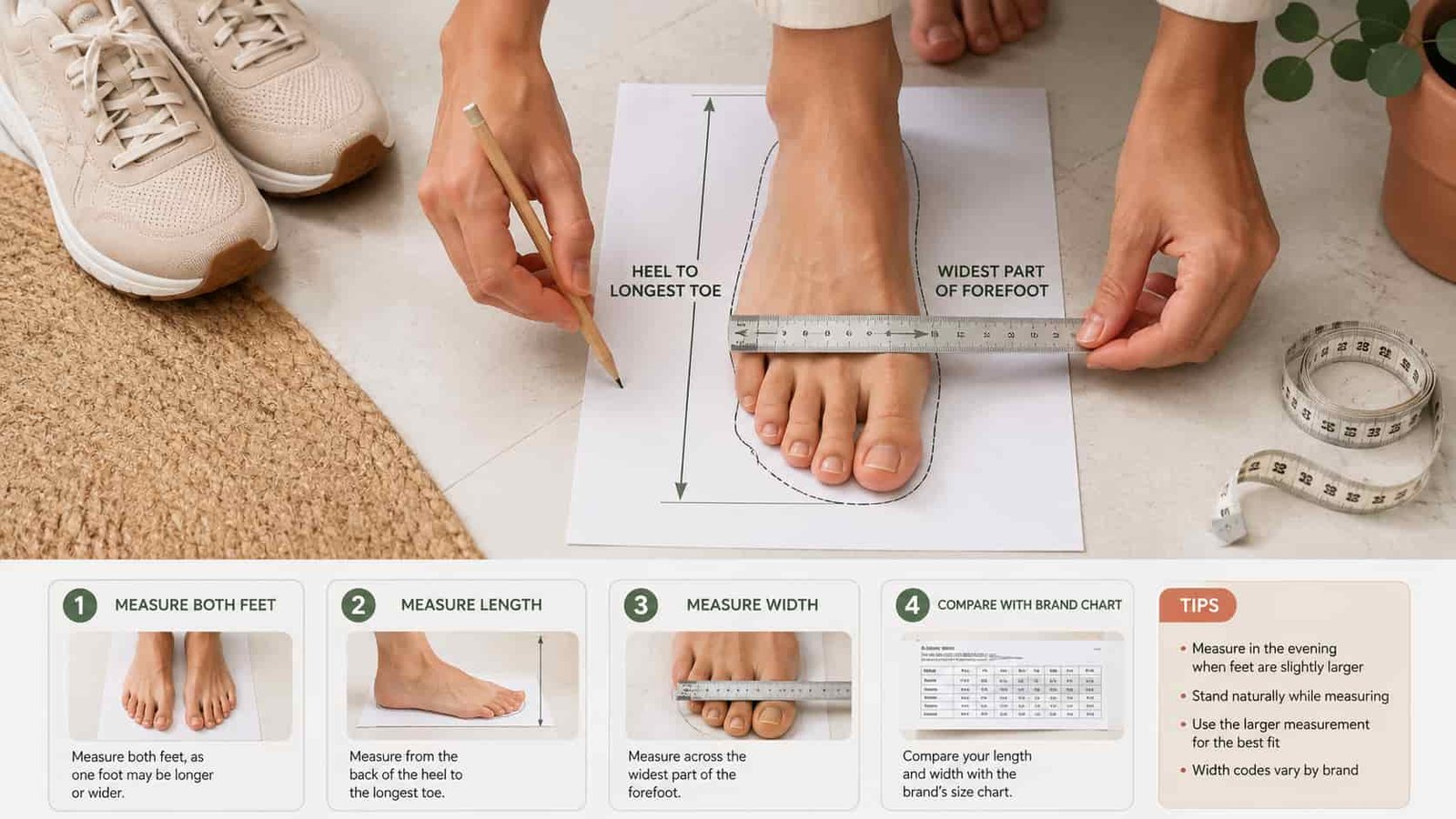
Measuring your foot at home is simple and only takes a few minutes.
For the most useful result, measure while standing because your foot carries your normal body weight.
Step 1: Place a sheet of paper on the floor
Use a hard, flat surface rather than a thick carpet.
Secure the paper so it does not move.
Step 2: Stand naturally
Place one foot on the paper.
Keep your weight distributed naturally instead of leaning heavily to one side.
Step 3: Mark your heel
Use a pencil to mark the point at the very back of your heel.
Keep the pencil vertical rather than angled inward.
Step 4: Mark your longest toe
Mark the end of your longest toe.
For some people, this will be the big toe. For others, another toe may extend farther.
Step 5: Measure the distance
Measure from the heel mark to the longest-toe mark.
Record the result in inches.
Step 6: Repeat with your other foot
Measure both feet.
It is normal for one foot to be slightly longer than the other.
Step 7: Use the longer measurement
Use the measurement of your longer foot when comparing your result with a shoe brand’s chart.
For a more detailed step-by-step guide, visit How to Measure Foot Size at Home.
Common Mistake
Do not measure the outside of an old shoe and use that number as your foot length. Shoe construction, cushioning and materials make the outside dimensions different from the actual length of your foot.
When Is the Best Time to Measure Your Feet?
The end of the day is often a practical time to measure your feet.
Feet can become slightly larger throughout the day as you stand and walk.
If you normally wear socks with the shoes you are buying, wear the same type of socks while measuring.
This gives you a more realistic measurement for everyday footwear.
Should You Measure Both Feet?
Yes.
Both feet should be measured before choosing your shoe size.
It is common for one foot to be slightly longer or wider than the other.
If your left foot measures 9.8 inches and your right foot measures 10 inches, use the 10-inch measurement when checking the size chart.
The larger foot should have enough room.
Expert Tip
Keep your foot measurements saved in your phone. Having your length in both inches and centimeters makes it easier to compare sizing charts when shopping from different footwear brands.
Women’s Foot Length in Inches vs Centimeters
Foot length can be measured in either inches or centimeters.
The basic conversion is:
1 inch = 2.54 centimeters
For example:
| Foot Length | Approximate Centimeters |
| 9 inches | 22.86 cm |
| 9.5 inches | 24.13 cm |
| 10 inches | 25.40 cm |
| 10.5 inches | 26.67 cm |
| 11 inches | 27.94 cm |
| 11.5 inches | 29.21 cm |
| 12 inches | 30.48 cm |
However, a centimeter value shown on a shoe label should not automatically be assumed to represent your exact measured foot length.
For a dedicated women’s shoe size to centimeter guide, see Women’s Shoe Size to CM.
Is a Women’s Shoe Size the Same as Foot Length?
No.
Foot length is a physical measurement.
Shoe size is a label within a particular sizing system.
For example, a woman may have a 10-inch foot, but the correct shoe size can vary depending on the brand and shoe style.
This is why simply memorizing that a particular size equals a particular number of inches is not always enough.
The better method is to measure your foot and compare the measurement with the manufacturer’s chart.
Does Foot Width Matter?
Yes.
Foot length is only one part of shoe fit.
Two women can have exactly the same foot length but require different widths.
One may have narrow feet, while another may need a wider shoe.
Signs that the shoe may be too narrow include:
- Pressure along the sides of the foot
- Toes feeling squeezed
- Little room around the forefoot
- The foot spilling over the sole
- Discomfort after walking
Signs that the shoe may be too wide include:
- Excessive side-to-side movement
- Heel slipping
- Foot sliding forward
- Excess space around the sides
- Needing to tighten laces excessively
For a complete reference, see the Women’s Shoe Size Chart.
What If Your Foot Measurement Falls Between Two Sizes?
If your measurement falls between two sizes, do not automatically choose the smaller size.
Start by checking the manufacturer’s recommendation.
The correct choice can depend on:
- Shoe style
- Toe-box shape
- Width
- Socks
- Intended activity
- Your preferred fit
- Brand sizing
For example, a running shoe may need a different fit from a fitted dress shoe.
If you are comparing half sizes, the Women’s Half Size Guide can help explain how a half-size change affects length and fit.
How Much Extra Room Should Women’s Shoes Have?
Your toes should not press against the front of the shoe.
At the same time, buying a shoe that is significantly too large can cause unnecessary movement.
The ideal fit should allow your toes to move naturally while keeping the heel and midfoot reasonably secure.
Instead of focusing on a specific amount of extra space alone, check how the entire shoe fits while standing and walking.
Can You Use Foot Length to Buy Shoes Online?
Yes.
Measuring your foot before ordering online is one of the simplest ways to reduce sizing mistakes.
Use this process:
- Measure both feet.
- Record the longer foot.
- Write the measurement in inches.
- Convert it to centimeters if useful.
- Check the manufacturer’s size chart.
- Check the available width.
- Read the retailer’s return policy.
This is more reliable than automatically ordering the same size you bought from another brand.
Women’s Shoe Size to Inches Quick Reference
Use this table as a starting reference:
| US Women’s Size | General Foot Length Reference |
| 5 | 8.5 to 8.9 inches |
| 6 | 9.1 to 9.3 inches |
| 7 | 9.5 to 9.7 inches |
| 8 | 9.9 to 10.1 inches |
| 9 | 10.3 to 10.5 inches |
| 10 | 10.7 to 10.9 inches |
| 11 | 11.1 to 11.3 inches |
| 12 | 11.5 to 11.7 inches |
| 13 | 11.9 to 12.1 inches |
Use this as a general reference, then compare your measurement with the specific brand’s current sizing chart.
What Are the Most Common Women’s Shoe Sizing Mistakes?
Choosing your usual size without measuring
Your usual size is useful as a starting point, but it does not guarantee the same fit in another brand.
Measuring only one foot
One foot can be slightly larger than the other.
Measure both.
Measuring while sitting
Your feet behave differently when they are not carrying your normal body weight.
Stand naturally while measuring.
Ignoring shoe width
A shoe can have the correct length and still feel uncomfortable because it is too narrow or too wide.
Assuming every brand uses identical sizing
Different manufacturers can use different sizing standards.
Buying a larger size just for extra room
Too much room can cause unnecessary foot movement.
Choose the size based on your measurement and the brand’s fit guidance.
Before You Order
- Measure both feet.
- Use the longer foot measurement.
- Record your length in inches.
- Keep the centimeter measurement too.
- Check the manufacturer’s size chart.
- Check width options.
- Check the return policy.
Women’s Shoe Size to Inches FAQs
What is a women’s shoe size to inches chart?
A women’s shoe size to inches chart compares US women’s shoe sizes with approximate foot-length measurements. Because brands can use different sizing systems, the chart should be treated as a reference. Your actual foot measurement and the manufacturer’s current size chart should guide the final choice.
How many inches is a women’s size 8?
A women’s size 8 generally corresponds to a foot length around 9.9 to 10.1 inches in general US sizing references. The exact measurement can vary between brands, so measure your foot and check the specific manufacturer’s chart before ordering.
What foot length is a women’s size 9?
A women’s size 9 generally corresponds to approximately 10.3 to 10.5 inches of foot length. This is a general reference rather than a universal conversion. Brand-specific sizing should always take priority when purchasing shoes.
What foot length is a women’s size 10?
A women’s size 10 generally corresponds to approximately 10.7 to 10.9 inches of foot length in general US sizing references. Your actual foot measurement is more useful than the number printed on an older pair of shoes.
How do I measure my foot in inches?
Place your foot on paper while standing, mark the back of your heel and the tip of your longest toe, then measure the distance between the two marks. Repeat the process for both feet and use the longer measurement when checking a shoe size chart.
Should I measure both feet?
Yes. Your feet can differ slightly in length and width. Measure both feet and use the larger measurement when comparing your foot with a manufacturer’s sizing chart.
Is shoe size the same as foot length?
No. Foot length is the physical measurement of your foot, while shoe size is a label used within a particular sizing system. A size-to-inches chart connects these two references but does not mean that every shoe has the same internal length.
Can I calculate my shoe size from inches?
You can use a shoe size chart to estimate your size from foot length, but there is no single formula that works perfectly across all brands. Measuring your foot and checking the manufacturer’s current chart is the safer approach.
Should I size up if my foot is between sizes?
Check the manufacturer’s guidance first. The correct choice can depend on the shoe style, width, materials and intended use. If you are between sizes, compare the brand’s half-size recommendations before ordering.
Does foot width affect women’s shoe size?
Yes. Length and width both affect fit. Two people can have the same foot length but need different shoe widths. If your shoe feels tight across the sides or loose around the foot, width may be part of the problem.
Is 10 inches a women’s size 9?
A 10-inch foot can correspond to around a US women’s size 9 in some sizing charts, but this is not universal. Always compare your actual measurement with the specific brand’s chart.
Is 11 inches a women’s size 11?
An 11-inch foot can correspond to around a US women’s size 11 in some general sizing references. However, the exact recommendation varies by brand, so use the manufacturer’s chart for the final decision.
Final Guide to Women’s Shoe Size to Inches
The easiest way to understand your women’s shoe size to inches is to start with your feet, not your old shoes.
Measure both feet while standing, record the longer measurement and compare it with the current sizing chart for the brand you want to buy.
Remember that shoe size is a label, while inches describe your actual foot length. Width, shoe construction and the shape of the toe box also affect the final fit.
- For a complete women’s sizing reference, visit the Women’s Shoe Size Chart.
- If you need help measuring your feet, follow the How to Measure Foot Size at Home guide.
- For US, UK and EU sizing comparisons, use the Shoe Size Conversion Chart & Calculator.
- If you need the centimeter equivalent, see the Women’s Shoe Size to CM guide.
- And if you are deciding between full and half sizes, use the Women’s Half Size Guide.
Measure first, compare the brand chart second, and then choose the shoe that gives your feet the right combination of length, width and comfortable room.