
Wide Men’s Shoe Size Chart: Widths, Sizes & Fit Guide
⚡ Quick Answer
- A wide men’s shoe is designed with more room across the forefoot than a standard-width shoe.
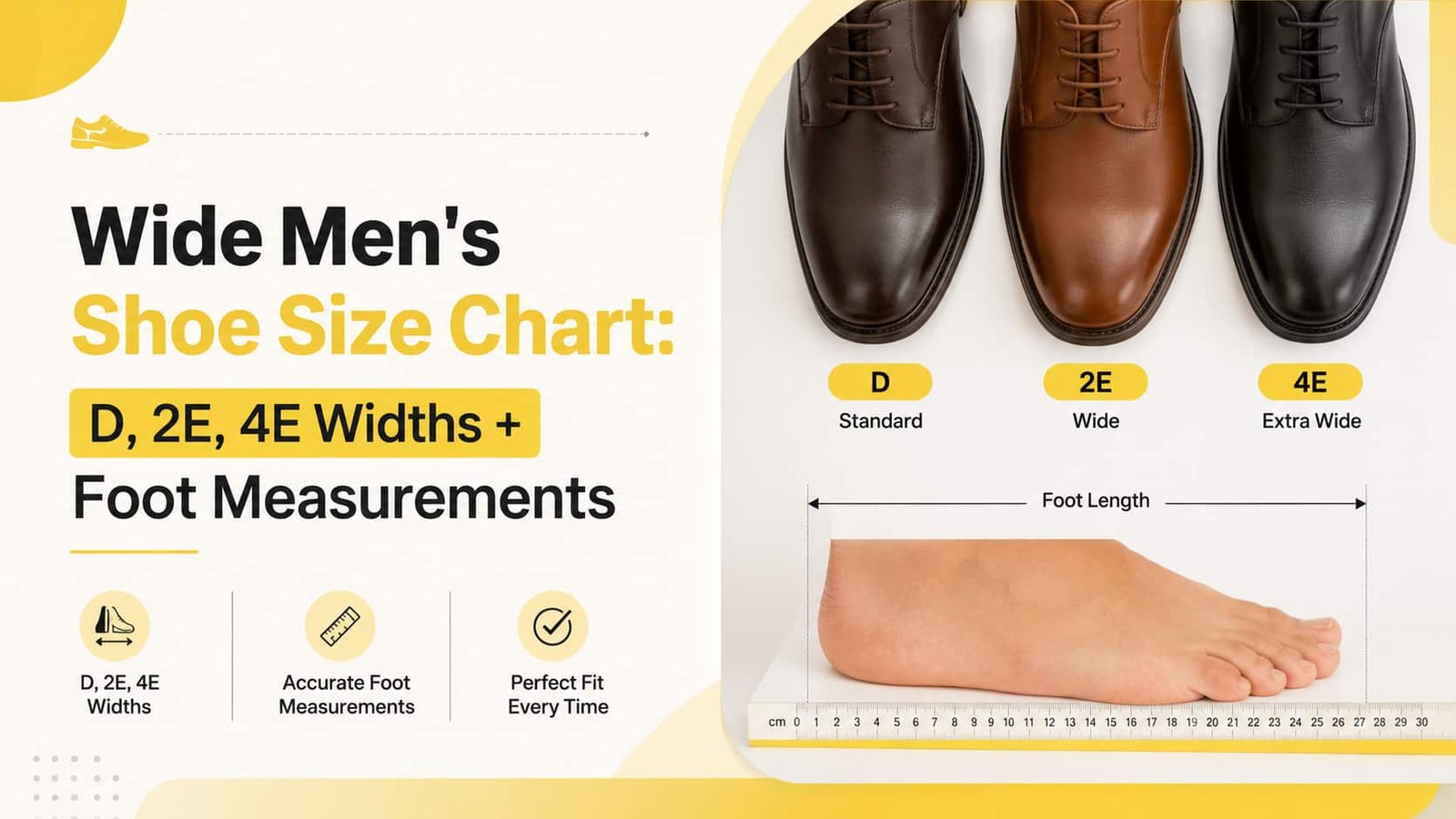
- In many US men’s sizing systems, D is standard width, while 2E or EE is commonly used for wide.
- 4E or EEEE is commonly used for extra-wide footwear, although width labels vary by brand.
- Your shoe size determines length, while the width designation determines how much room you get across the foot.
- The best fit comes from measuring both foot length and foot width rather than choosing a width based only on your usual shoe size.
Finding the right wide men’s shoe size requires checking two measurements: foot length and foot width. In common US men’s sizing, D is generally standard width, 2E or EE is commonly considered wide, and 4E or EEEE is commonly used for extra-wide shoes. However, width labels are not completely standardized across brands, so a 2E in one brand may not feel exactly like a 2E in another. Measure both feet, compare the measurements with the brand’s size chart, and look for enough room across the ball of the foot without excessive heel movement.
What Is a Wide Men’s Shoe Size?
A wide men’s shoe size provides additional room across the foot, especially around the forefoot and ball of the foot, compared with a standard-width shoe of the same length.
Your shoe size has two important dimensions: length and width. For example, a man may wear a US 10 in length but need a 10 2E if his feet are wider than the standard fit.
This is why simply going up from a US 10 to a US 11 is not always the right solution.
A larger size gives you more length, but it does not necessarily provide the correct shape or proportion across the forefoot.
If you regularly feel pressure along the sides of your feet, your toes feel squeezed together, or the widest part of your foot sits outside the shoe’s natural shape, the problem may be width rather than length.
For a general men’s size reference, you can also use our Men’s Shoe Size Chart.
Men’s Shoe Width Chart
Letters or combinations of letters and numbers usually represent men’s shoe widths. The exact naming system can vary between manufacturers, so always check the individual brand’s chart before ordering.
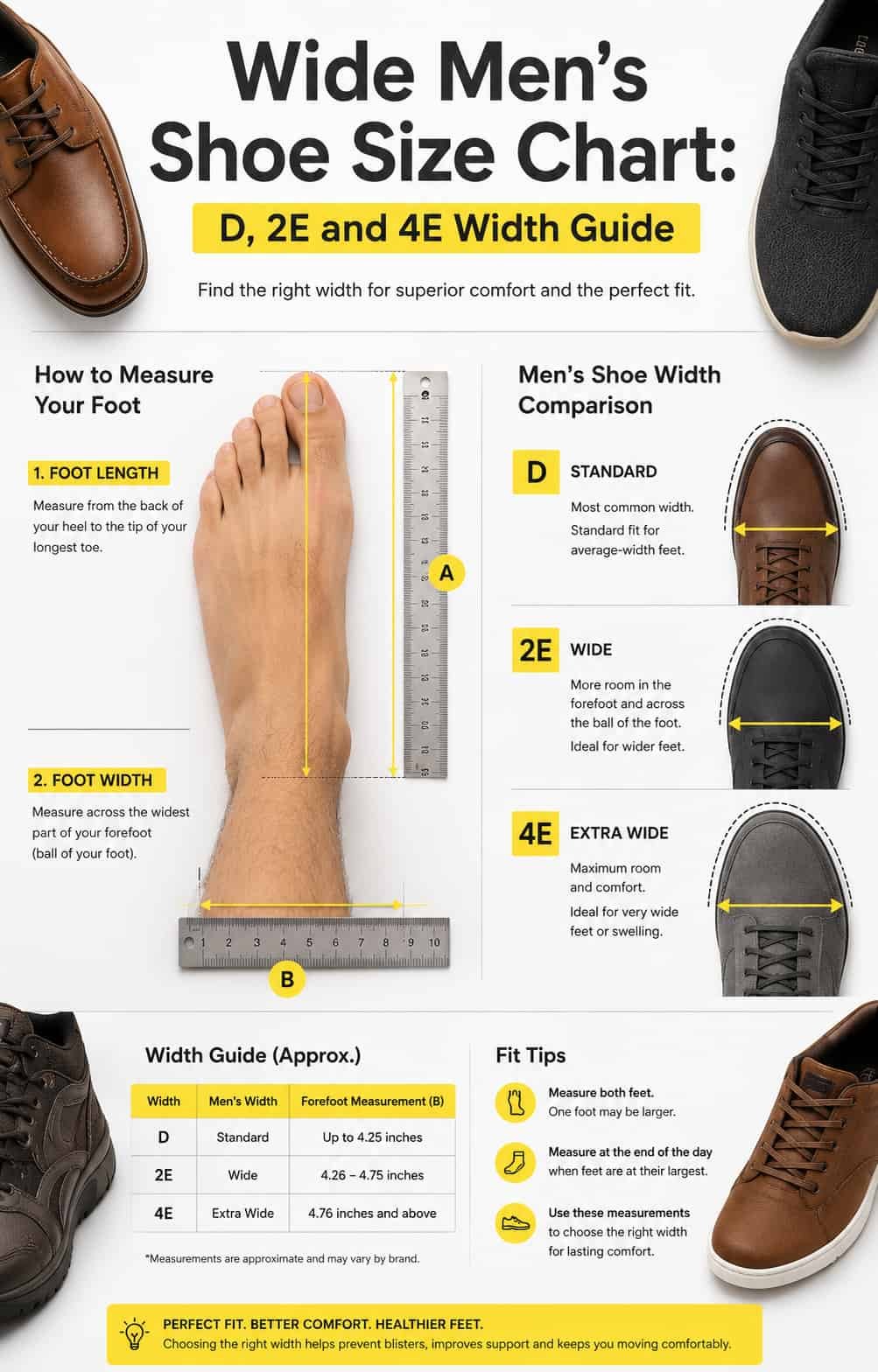
| Width | Common Label | General Meaning |
| Narrow | B | Narrow men’s fit in some sizing systems |
| Standard | D | Common standard men’s width |
| Wide | 2E / EE | Common wide men’s fit |
| Extra Wide | 4E / EEEE | Extra-wide fit |
| Very Extra Wide | 6E | Available in selected footwear |
| Very Wide | 8E | Available only from some brands |
Important: Width terminology is not perfectly standardized. Some brands use W, XW or other abbreviations instead of the traditional E-based system.
What does D width mean for men’s shoes?
D is commonly the standard width for men’s shoes in US sizing.
If a regular D-width shoe feels comfortable around your heel and midfoot but consistently tight across your forefoot, you may need a wider width rather than a longer shoe.
What does 2E mean in men’s shoes?
2E, often written as EE, commonly indicates a wide men’s shoe.
A 2E shoe provides additional width compared with a standard D shoe while maintaining a similar length designation.
For example, a US 10 D and US 10 2E are intended to have the same length category but different widths.
What does 4E mean in men’s shoes?
4E, often written as EEEE, commonly indicates an extra-wide men’s shoe.
This option is designed for feet that need substantially more room than a standard or wide shoe provides.
Some footwear brands offer 4E in athletic shoes, walking shoes, work shoes and comfort footwear.
Wide Men’s Shoe Size Chart: Quick Reference
The following chart explains common width labels rather than promising an identical physical width across every brand.
| US Men’s Width | Common Label | General Fit |
| D | Standard | Average men’s width |
| 2E | EE | Wide |
| 4E | EEEE | Extra wide |
| 6E | 6E | Very extra wide |
| 8E | 8E | Extremely wide, selected brands |
The most important point is that width codes are not universal measurements. A manufacturer’s 2E may have a different internal shape from another manufacturer’s 2E.
What Is the Difference Between Standard and Wide Men’s Shoes?
The main difference is the amount of usable space across the foot.
A standard men’s shoe generally provides less forefoot width, while a wide shoe is built with additional room through the areas where the foot naturally expands.
| Feature | Standard Width | Wide Width |
| Forefoot space | Standard | More spacious |
| Toe box | Standard | Usually roomier |
| Ball-of-foot area | Standard | Wider |
| Overall length | Depends on size | Depends on size |
| Best for | Average-width feet | Wider feet |
A wide shoe should not feel loose everywhere.
The heel should remain reasonably secure while the forefoot has enough room to spread naturally.
That distinction is important because many people assume a wide shoe should feel loose from heel to toe. It should not.
Does Going Up a Shoe Size Make the Shoe Wider?
Going up in size can increase the shoe’s overall dimensions, but it is not the same as selecting a wider width.
If your current shoe is too tight around the sides but has the correct toe length, moving to a longer size may create unnecessary space in front of your toes.
For example, if a US 10 D fits your foot length but feels narrow, a US 11 D may give you more length without providing the width you actually need.
A US 10 2E may be a more appropriate starting point.
How to Measure Men’s Foot Width at Home
Measuring foot width at home is straightforward and can help you decide whether you should investigate men’s wide fit shoes.
For a more complete measurement process, follow our How to Measure Men’s Feet guide.
What you need
- A blank sheet of paper
- Pencil
- Ruler or measuring tape
- Socks you normally wear with the shoes
- A flat floor
Measure your feet
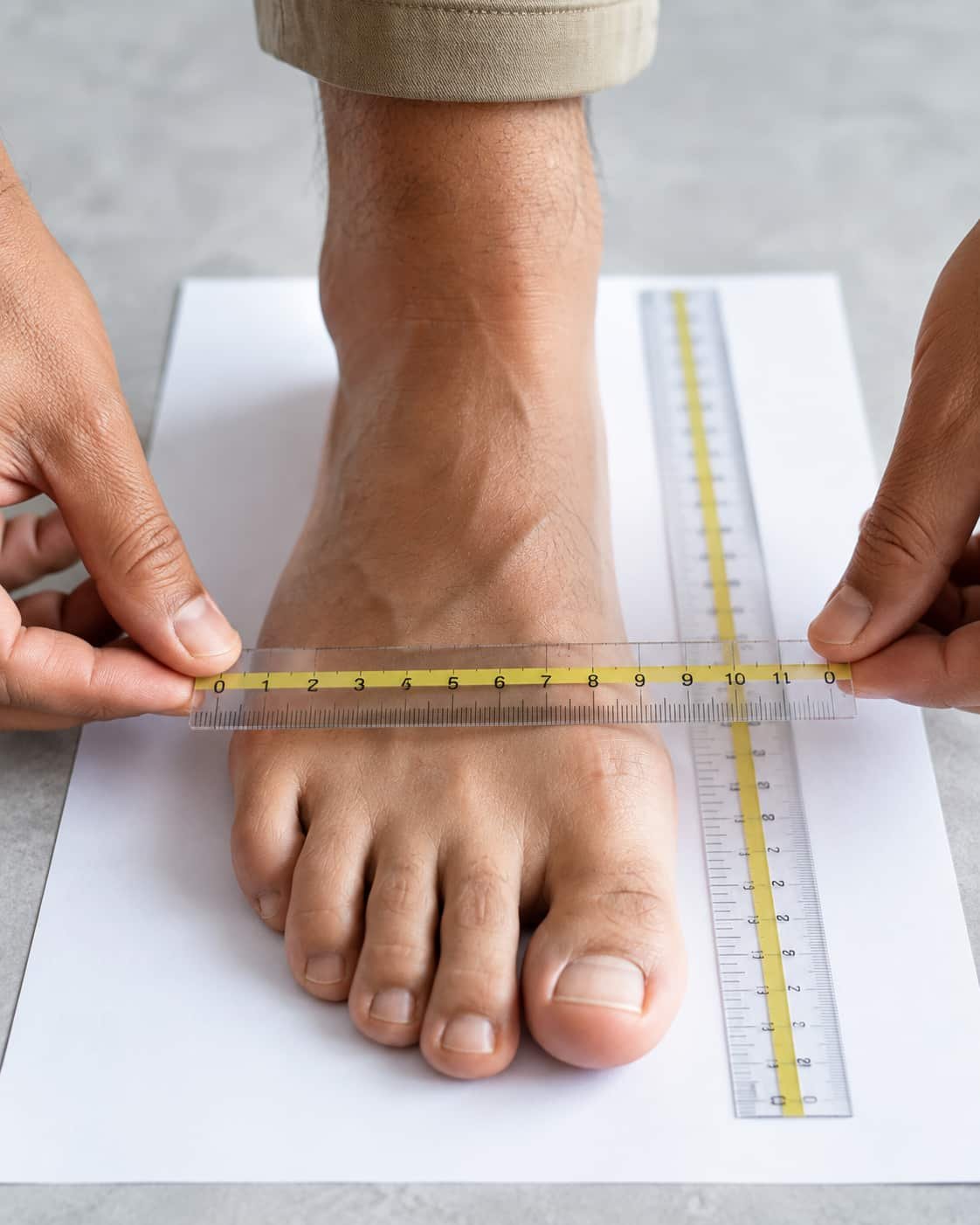
Place the paper on a hard, flat surface.
Stand naturally on the paper with your full weight on the foot. This matters because the foot can spread slightly when you stand.
Trace or mark the widest points of your foot.
The widest part is generally around the ball of the foot, rather than around the toes.
Measure from the widest point on one side to the widest point on the other side.
Repeat the process for the other foot.
Why should you measure both feet?
Most people do not have perfectly identical feet.
One foot may be slightly longer or wider than the other.
When buying shoes, use the larger measurement as your primary reference.
Should you measure with socks?
If you normally wear your shoes with socks, measure while wearing the type of socks you expect to use.
Thick winter socks can require more internal shoe space than thin dress socks.
Foot Length Matters Too
Width cannot be evaluated properly without knowing length.
First determine your foot length, then determine whether the width is appropriate.
Our Men’s Shoe Size to Inches guide can help you compare common men’s shoe sizes with approximate foot-length measurements.
You can also use the Shoe Size Conversion Chart & Calculator when comparing US, UK and EU sizing.
Wide Men’s Shoe Size Tool
The following interactive tool gives you a practical starting point for understanding men’s shoe length and width.
Important: This is an informational sizing tool. Width availability and exact measurements vary between brands.
Men’s US, UK & EU Shoe Size Converter
Convert men’s US shoe sizes into UK and EU sizes and check the standard width options.
Shoe size conversions are approximate because sizing can vary between brands, styles and manufacturing standards. Always check the manufacturer’s size chart before ordering.
💡 Expert Tip
Do not assume that a wider foot automatically needs a longer shoe. If your toes have enough length but the sides of your foot feel compressed, investigate width options first.
How Do You Know If You Need Wide Width Men’s Shoes?
You may need wide width men’s shoes if your foot consistently feels compressed across the forefoot even when the shoe has sufficient length.
Common clues include:
- Pressure along the outside edge of your foot
- Toes being squeezed together
- The little toe rubbing against the shoe
- The widest part of your foot sitting over the edge of the sole
- Red marks on the sides of your feet after wearing shoes
- Frequent discomfort in otherwise correctly sized shoes
- Feeling better when you remove your shoes
- Difficulty finding comfortable shoes despite choosing the correct length
One common issue we notice is that people interpret side pressure as a length problem.
If the toe has enough room but the forefoot is uncomfortable, width deserves attention.
How Should Wide Men’s Shoes Fit?
A properly fitting wide shoe should feel secure without squeezing the foot.
Your heel should remain relatively stable while walking.
The widest part of your foot should sit comfortably within the widest part of the shoe.
Your toes should have enough space to move naturally.
A good fit generally includes:
- Comfortable forefoot width
- No painful side pressure
- No toe rubbing
- Secure heel
- Natural toe movement
- No excessive sliding
- Enough space for normal foot expansion
The shoe should feel comfortable when standing and walking, not only when sitting.
How Much Room Should Be in the Toe Area?
There should be enough space between your longest toe and the front of the shoe for comfortable movement.
Do not rely exclusively on a thumb-width test because thumb sizes vary.
Instead, compare your measured foot length with the shoe manufacturer’s recommended foot-length range.
This is especially useful when buying online.
What Are the Signs Your Shoes Are Too Narrow?
A shoe may be too narrow even if the length is correct.
Watch for these warning signs:
Side pressure
If the shoe presses firmly against the widest part of your foot, the width may be insufficient.
Little toe rubbing
Persistent rubbing around the little toe can indicate that the forefoot does not have enough room.
Toe crowding
Your toes should not feel compressed together simply because the shoe is correctly sized in length.
Red marks
Visible pressure marks after removing your shoes can indicate that the upper is pressing too strongly against your foot.
The foot hangs over the sole
If your foot extends beyond the shoe’s platform around the widest area, the shoe may not be wide enough.
⚠ Common Mistake
Buying a longer shoe because your current shoe feels narrow can create a new problem. Extra length may cause your foot to slide forward or leave too much space in front of the toes. When length is correct but the forefoot is tight, check width first.
What Are the Signs Your Shoes Are Too Wide?
Wide shoes are not automatically better for every foot.
If the shoe is significantly wider than your foot, you may notice:
- Excessive side-to-side movement
- Heel slipping
- Foot sliding inside the shoe
- Creasing in unusual areas
- Difficulty keeping the shoe secure
- Needing to tighten the laces excessively
- Blisters caused by repeated movement
A wide shoe should provide room where you need it while remaining secure around the heel and midfoot.
Wide vs Extra-Wide Men’s Shoes
The difference between wide and extra-wide footwear can be significant.
A 2E or EE shoe is commonly used as a wide option.
A 4E or EEEE shoe generally provides considerably more room.
For some people, a 2E shoe solves the problem. Others may need 4E or an even wider option.
| Width | Typical Label | Best Starting Point |
| Standard | D | Average-width feet |
| Wide | 2E / EE | Wider-than-average feet |
| Extra Wide | 4E / EEEE | Significantly wider feet |
| Very Extra Wide | 6E | Feet requiring substantial additional width |
Because brands construct shoes differently, treat this as a sizing framework rather than a universal measurement.
Does Shoe Width Change With Shoe Size?
Yes, shoe construction generally scales as shoe sizes increase, but the relationship is not simply “one size bigger equals one fixed amount wider.”
Manufacturers use sizing systems and shoe lasts to create different proportions.
This is another reason why a US 10 2E cannot be assumed to have exactly the same physical width as every other brand’s US 10 2E.
The width designation is useful, but your actual foot measurements and the manufacturer’s chart are more reliable.
Why Is the Toe Box Important for Wide Feet?
The toe box is the front portion of the shoe surrounding your toes.
A shoe can technically be labeled wide but still have a shape that does not suit your foot.
This is why looking only at the width label is not enough.
A comfortable toe box should allow your toes to sit naturally without being compressed from the sides.
For people with broad forefeet, a shoe with a naturally roomy toe box can sometimes feel more comfortable than a shoe that simply uses a wider overall last.
Can You Wear Wide Shoes With Orthotics?
Many people use orthotics or insoles that take up additional internal space.
If you use an insert, check the shoe’s removable-insole design and internal volume.
A shoe that fits perfectly without an orthotic may feel considerably tighter once an insert is added.
When choosing men’s wide fit shoes, consider:
- Foot width
- Foot length
- Insole thickness
- Orthotic thickness
- Heel security
- Toe-box height
Width and volume are related, but they are not exactly the same thing.
How to Choose Men’s Wide Fit Shoes
Choosing the right pair involves more than finding a shoe marked “wide.”
Start with your measurements.
Know the length of your larger foot and the width of your larger foot.
Then compare those measurements against the shoe manufacturer’s sizing information.
Look at the construction
Different types of shoes can fit differently.
Running shoes often have flexible uppers and more forgiving forefoot designs.
Dress shoes may have more structured uppers.
Work boots may have thicker materials and different internal shapes.
Casual shoes can vary significantly from one model to another.
Check the upper material
Flexible materials may accommodate foot expansion better than rigid materials.
However, a flexible upper should not be used as an excuse to tolerate an incorrectly sized shoe.
Look at the sole shape
The sole should support the natural shape of your foot.
If the foot is wider than the platform, simply stretching the upper may not solve the problem.
Check return policies
When ordering online, a good return or exchange policy is useful because width can vary between brands and models.
📌 Quick Reminder
A shoe labeled “wide” is a starting point, not a guarantee of fit. Your foot shape, the shoe’s construction, toe-box design and the brand’s sizing system all affect comfort.
When Is the Best Time to Measure Your Feet?
For the most realistic everyday measurement, measure your feet later in the day.
Feet can change slightly in size and shape throughout the day.
If you plan to wear the shoes with socks, measure with those socks.
Stand naturally rather than sitting down.
This produces a more useful measurement because your feet carry your normal body weight when standing.
Should You Buy Wide Shoes for Both Feet?
If one foot needs more width, the larger foot should generally guide your shoe selection.
Do not choose a shoe that fits the smaller foot perfectly if it causes discomfort on the larger foot.
You can fine-tune the fit of the smaller foot with appropriate socks or an insole if necessary, but you cannot comfortably compensate for a shoe that is fundamentally too narrow for your larger foot.
Common Wide Shoe Sizing Mistakes
Choosing length instead of width
This is one of the most common mistakes.
If a shoe feels tight across the sides, moving to a longer size may create excessive toe room without solving the actual width issue.
Assuming every 2E is identical
Different brands use different lasts and construction methods.
A 2E in one model can feel different from a 2E in another.
Measuring only one foot
Always measure both feet.
Your larger foot should guide your final size decision.
Measuring while sitting
Your foot can spread when you stand.
For everyday footwear, measure while standing naturally.
Ignoring socks
The socks you wear can affect how a shoe feels.
Measure with the type of socks you expect to use.
Buying based only on the label
“Wide” is useful information, but it does not replace checking the actual fit.
Assuming wider is always better
Too much width can cause movement and instability.
The objective is the correct width, not the widest shoe available.
Expert Tips for Finding the Right Wide Men’s Shoe Size
💡 Expert Tips
Measure before shopping. Your old shoe size is a useful reference, but it should not replace a current measurement.
Check the widest point. Your forefoot width matters more than simply measuring the distance around your toes.
Compare brands carefully. Use the brand’s own measurement chart whenever possible because width terminology is not completely standardized.
Do not ignore heel fit. A wide forefoot does not mean your heel should slide around inside the shoe.
A Simple Wide Shoe Fit Checklist
👞 Wide Shoe Fit Checklist
- ☐ Measured both feet
- ☐ Used the larger foot for sizing
- ☐ Checked foot length
- ☐ Checked foot width
- ☐ Compared measurements with the brand chart
- ☐ Confirmed the width designation
- ☐ Checked forefoot comfort
- ☐ Checked heel security
- ☐ Checked toe movement
- ☐ Considered socks or orthotics
Frequently Asked Questions
What is considered a wide men’s shoe?
In many US men’s shoe sizing systems, 2E or EE is commonly considered wide. D is generally standard width, while 4E or EEEE is commonly considered extra wide. However, manufacturers can use different labels and construction methods, so the width designation should always be checked against the individual brand’s sizing information.
Is 2E considered wide for men’s shoes?
Yes. 2E, also written as EE, is commonly used to represent a wide men’s shoe. It provides more room across the forefoot than a standard D-width shoe. The actual fit can still vary by manufacturer, shoe model and construction, so your foot measurements remain important.
Is 4E wider than 2E?
Yes. In common US men’s width systems, 4E or EEEE is wider than 2E or EE. It is generally intended for feet that need substantially more forefoot room. Not every brand or shoe model offers 4E, so availability can be limited.
Should I buy a bigger shoe if my feet are wide?
Not necessarily. If the shoe has enough length but feels tight across the sides, choosing a wider width is usually a better starting point than simply increasing the length. A longer shoe can leave excessive space in front of your toes while still failing to provide the correct shape across your forefoot.
How do I know if I need wide width shoes?
Measure the length and width of both feet and compare them with the manufacturer’s chart. You may also need a wider shoe if standard footwear consistently creates side pressure, little-toe rubbing, toe crowding or visible pressure marks along the sides of your feet.
Can a shoe be wide but still have a narrow toe box?
Yes. Width labels do not completely describe the shape of a shoe. A particular model may have additional room through one area while remaining relatively tapered around the toes. If you have a broad forefoot, look at the overall shape and toe-box design as well as the width label.
Are men’s wide shoe sizes the same across brands?
No. Width labels provide a useful general reference, but shoe manufacturers can use different lasts, materials and sizing systems. A 2E shoe from one brand may not feel identical to a 2E shoe from another brand. Always check the brand’s measurements and fit information when available.
Should I measure my feet before buying wide shoes online?
Yes. Measuring before ordering is especially useful when buying online because you cannot try the shoe on beforehand. Measure both feet while standing, record the larger measurements and compare them with the manufacturer’s size chart before selecting your size and width.
Do wide shoes need more toe room?
Wide shoes need appropriate toe-box space, but width and length are separate considerations. A wider foot does not automatically require a longer shoe. Your longest toe should have comfortable clearance at the front while the widest part of your foot should fit naturally inside the shoe.
Can wide shoes prevent foot discomfort?
A correctly fitted shoe can help avoid discomfort caused by excessive pressure or inadequate space. However, not every foot problem is caused by shoe width. If you experience persistent pain or significant discomfort, consider getting professional footwear or medical advice rather than relying only on a different shoe size.
Can I stretch a regular shoe instead of buying wide shoes?
Some shoe materials can stretch slightly, but stretching should not be treated as a replacement for proper sizing. If a shoe is substantially too narrow, stretching may not provide the correct internal shape or sole width. Starting with the appropriate width is usually a better approach.
Conclusion
Finding the right wide men’s shoe size is not simply about choosing a larger number.
The best starting point is to measure both foot length and width, identify whether you need standard, wide or extra-wide footwear, and then compare your measurements with the specific manufacturer’s chart.
A US 10 2E, for example, is intended to provide more width than a US 10 D without simply adding unnecessary length.
Remember that width labels can vary between brands. The most reliable combination is your actual foot measurement, the manufacturer’s sizing information and the way the shoe feels when you stand and walk.
Before your next purchase, measure your feet and compare your results with the correct size chart. You can also use our Men’s Shoe Size Chart and Shoe Size Conversion Chart & Calculator for additional sizing guidance.