
Men’s Shoe Size to Inches Chart: Convert Foot Length to US, UK & EU Sizes
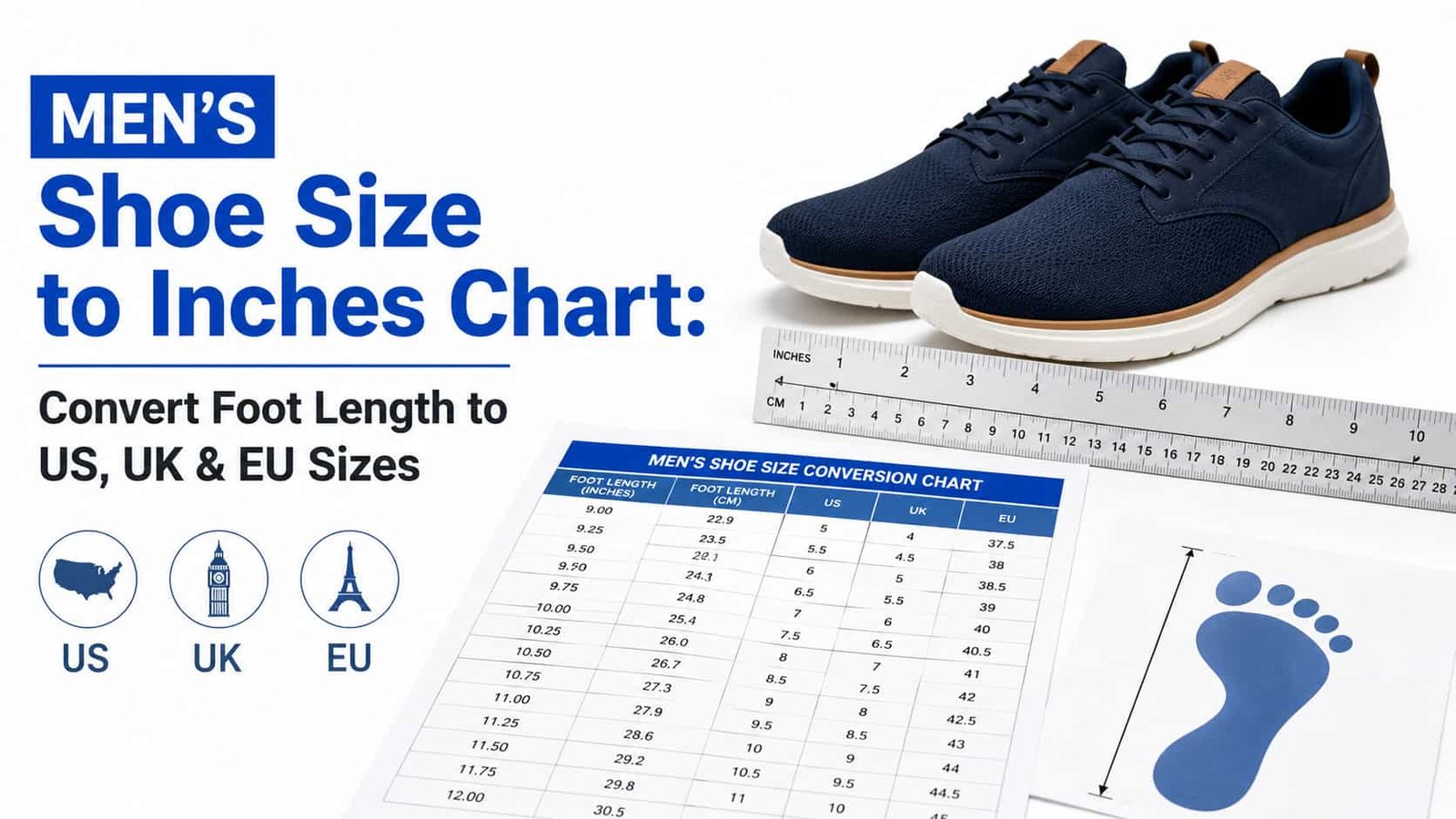
Men’s shoe sizes are based on foot length in inches, measured from heel to the tip of the longest toe. A US men’s size 9 corresponds to about 10.25 inches (26 cm), size 10 to about 10.5 inches (27 cm), and size 11 to about 10.9 inches (27.9 cm). Because sizing is not standardized across brands, foot length in inches is a far more reliable reference point than the printed number on a box. Measuring both feet, standing rather than seated, gives the most accurate result. If your foot falls between two sizes, size up rather than down.
⚡ Quick Answer
- US men’s size 9 is about 10.25 inches (26 cm) of foot length.
- Foot length in inches is more reliable than the size printed on the box.
- Measure both feet standing up, at the end of the day.
- If you fall between two sizes, choose the larger one.
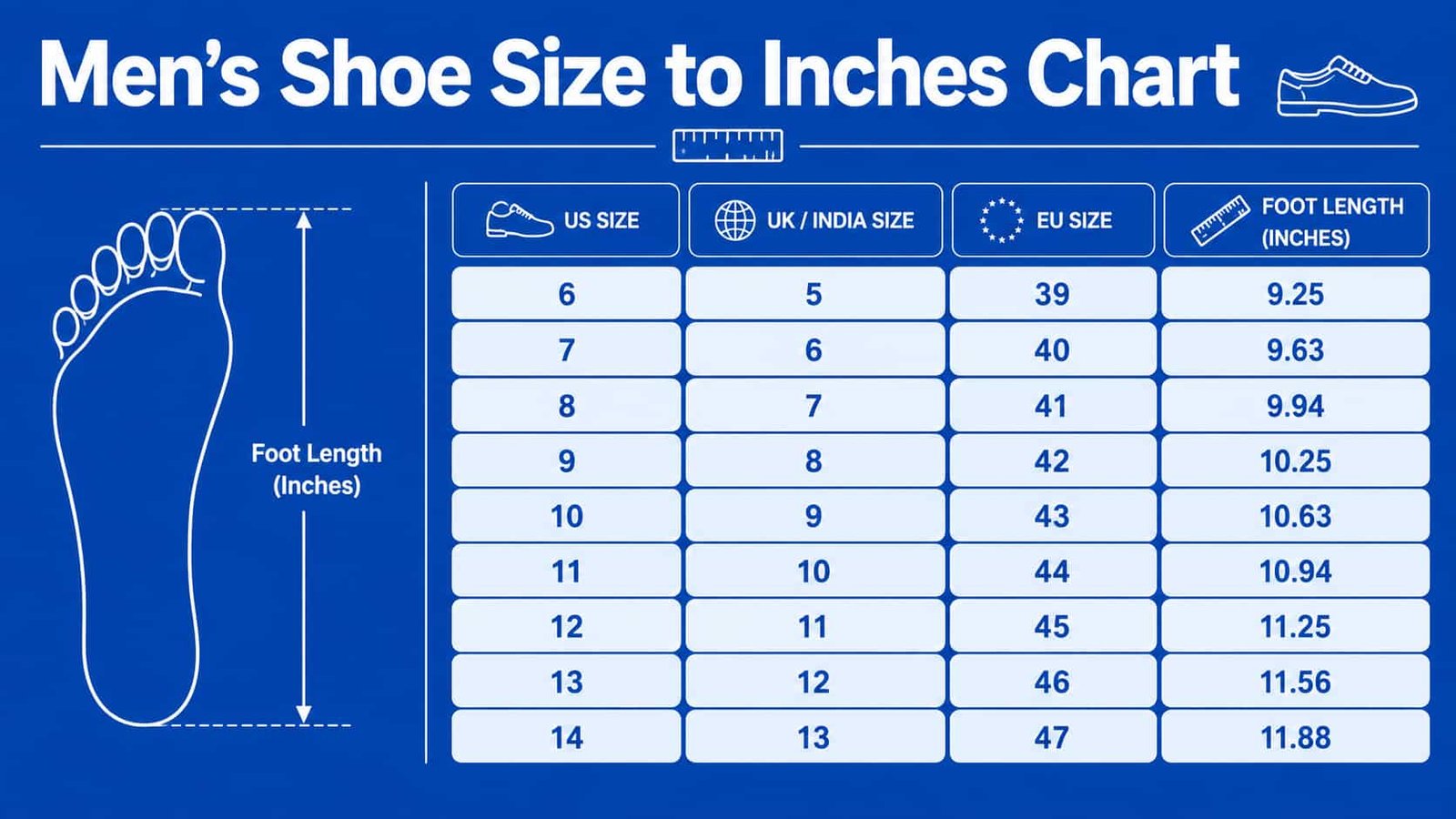
Men’s Shoe Size to Inches Chart
Foot length is the single most reliable number when converting between sizing systems. This table lines up foot length in inches with US, UK/India, and EU sizes, since India follows the UK scale.
| Foot Length (in) | Foot Length (cm) | US Size | UK/India Size | EU Size |
| 9.5 | 24.1 | 6 | 5.5 | 39 |
| 9.75 | 24.8 | 7 | 6.5 | 40 |
| 10 | 25.4 | 8 | 7.5 | 41 |
| 10.25 | 26 | 9 | 8.5 | 42 |
| 10.625 | 27 | 10 | 9.5 | 43 |
| 11 | 27.9 | 11 | 10.5 | 44 |
| 11.25 | 28.6 | 12 | 11.5 | 45 |
| 11.5 | 29.4 | 13 | 12.5 | 46 |
| 11.875 | 30.2 | 14 | 13.5 | 47 |
These figures are averages across major brands. A brand running narrow or wide can shift you half a size in either direction, which is why foot length stays the more dependable reference.
👟 Did You Know?
A half size difference is only about 1/6 of an inch of foot length. That small margin is why two shoes labeled the same size from different brands can fit completely differently.
How to Measure Your Foot in Inches
What is the easiest way to measure foot length at home?
Stand on a sheet of paper against a wall, mark your heel and longest toe, then measure the distance between the marks in inches.
- Place a blank sheet of paper on a hard floor, against a wall.
- Stand on the paper with your heel touching the wall.
- Mark the tip of your longest toe with a pencil held straight down.
- Measure the distance from the wall edge to the mark in inches.
- Repeat for the other foot. Most people have one foot slightly longer.
- Use the larger measurement when checking the chart above.
In our experience fitting thousands of customers, the biggest source of error is measuring while seated. Feet spread and lengthen slightly under body weight, so a seated measurement can read up to a quarter inch short.
💡 Expert Tip
Measure your feet in the evening rather than first thing in the morning. Feet swell slightly through the day, and an evening measurement gives you a size that stays comfortable at any hour.
Try the Foot Length to Shoe Size Converter
📏 Foot Length to Shoe Size Converter
Enter your foot length to find your US, UK/India, and EU size.
Signs Your Shoe Size Is Correct
✅ Fit Checklist
- About a thumb's width of space between your longest toe and the front of the shoe.
- Heel stays in place without lifting when you walk.
- No pinching across the widest part of the foot.
- Toes can wiggle freely without touching the top of the shoe.
- No pressure points after wearing the shoe for 20 to 30 minutes.
Signs Your Shoes Are Too Small
Tight shoes rarely announce themselves immediately. Watch for redness across the toes, a burning sensation after an hour of wear, or toenails that darken over time. In our experience, men often stay in a size they have worn for years even after their feet have changed shape slightly with age or weight changes.
Signs Your Shoes Are Too Big
Heel slipping, excess material bunching near the arch, and needing an extra pair of socks just to keep the shoe on are the clearest signs a shoe runs large. A shoe that is too big also throws off balance and causes blisters from constant rubbing.
⚠ Common Mistake
Buying a half size up "to be safe" is one of the most frequent mistakes we see. It creates heel slip, throws off lacing tension, and can actually cause more blisters than a properly fitted shoe.
What to Look For When Buying
- Width, not just length. Two people with the same foot length can need different widths.
- Material stretch. Leather stretches slightly over weeks; canvas and mesh do not.
- Insole thickness. Some shoes run smaller because of a thick footbed.
- Time of purchase. Try shoes on later in the day when feet are at their largest.
- Both feet checked. Fit to the larger foot, always.
Common Sizing Mistakes
One issue we notice constantly is customers relying only on the size from a different brand's shoe. A size 9 in one brand can measure closer to a size 8.5 or 9.5 in another, because there is no single global manufacturing standard. Foot length in inches is the only number that stays consistent brand to brand.
Expert Tips
📝 Checklist Before You Buy
- Measure both feet in inches, standing.
- Check the chart above for your US, UK/India, and EU size.
- Confirm the brand's specific size guide if available.
- Walk around in the shoe for a few minutes before deciding.
- Re-measure every year or two, since foot size can shift.
After 20-plus years in footwear retail, the single habit that prevents the most returns is measuring before buying rather than guessing from a past purchase.
FAQs
How do I convert my foot length in inches to a shoe size?
Measure your foot length from heel to longest toe in inches, then match that number to the closest value on a men's size chart. A foot of about 10.25 inches typically lines up with a US size 9.
Is US size 9 the same as UK size 9?
No. UK sizing runs about a full size smaller than US sizing for the same foot length. A US 9 is closer to a UK 8.5.
Why do my feet measure different sizes in each foot?
It is completely normal to have one foot slightly longer than the other. Always size your shoes to the larger foot.
Should I measure my foot while sitting or standing?
Standing. Body weight spreads and slightly lengthens the foot, giving a more accurate real-world measurement than a seated one.
How much room should be left at the toe?
About a thumb's width, roughly 0.4 to 0.5 inches, between the longest toe and the front of the shoe.
Does shoe size change with age?
Yes. Feet can lengthen or widen over years due to weight changes, pregnancy in partners' cases affecting household shopping habits, or natural loss of arch support. Re-measuring every couple of years is a good habit.
Why do different brands fit differently at the same size?
There is no single global manufacturing standard for shoe sizing. Lasts, the mold a shoe is built on, vary by brand, which changes fit even at an identical labeled size.
What if my foot length falls between two sizes on the chart?
Choose the larger size. A slightly roomy shoe is more comfortable and safer than a tight one.
Is EU sizing based on foot length in centimeters?
Yes. EU sizing is derived from foot length in centimeters using a Paris point system, which is part of why it does not translate to a clean one-to-one match with US or UK sizes.
Can I use my old shoe's insole to measure foot length?
It works as a rough estimate, but insoles compress and stretch over time. A fresh measurement on paper gives a more accurate result.
How often should I re-measure my feet?
Roughly every one to two years, or any time a new pair feels off despite buying your usual size.
Does width matter as much as length?
Yes, and it is often overlooked. Two men with identical foot length can need different width shoes entirely.
CONCLUSION
The right shoe size comes down to one number: your actual foot length in inches. Once you know that measurement, converting between US, UK/India, and EU sizing becomes straightforward, and guesswork disappears. Take a few minutes to measure both feet using the steps above, then check the chart or use the converter tool to find your size across every major sizing system.
For a deeper walkthrough of the measuring process, see our How to Measure Foot Size at Home guide, or head to our full men's shoe size chart for size ranges beyond what is covered here.