
Average Women’s Shoe Size: Global Guide to Sizes & Foot Length
Quick Answer
- There is no single worldwide average women’s shoe size because foot dimensions and shoe sizing vary between countries and populations.
- Research involving more than 1.2 million foot scans found clear regional differences in women’s foot dimensions across North America, Europe and Asia.
- A separate study of healthy adults reported an average female European shoe size of approximately EU 39.8 within that study population.
- Foot length is a more useful personal measurement than comparing yourself with an average.
- When shopping internationally, always check the specific brand’s size chart because US, UK, EU and other sizing systems are not directly interchangeable.
The average women’s shoe size is not one universal number. Women’s feet vary across countries, regions, age groups and individuals, while shoe sizes are also labeled differently around the world.
Large-scale 3D foot-scan research found meaningful differences in foot dimensions between North American, European and Asian populations. In that study, the most frequently occurring female foot-length class was 245 mm in North America and Europe and 235 mm in Asia.
Another study of healthy adults reported an average female shoe size of about EU 39.8, with an average Mondopoint measurement of 246 mm for the study group. That result describes the people included in that research and should not be treated as a worldwide average.
So the best answer is not “every woman wears size X.”
The better answer is that average women’s shoe size depends on the population being studied, the sizing system being used, and the way the feet are measured.
If you want to find your own size rather than compare yourself with an average, start with our Women’s Shoe Size Chart.
Compare Women’s Shoe Sizes
Enter a foot length and choose a sizing system to get a general reference.
Is There a Worldwide Average Women’s Shoe Size?
There is no scientifically established single shoe size that represents women worldwide.
This is because populations have different average foot dimensions, and international shoe-sizing systems do not use one universal scale.
A major study analyzing more than 1.2 million foot scans from North America, Europe and Asia found significant regional differences in foot dimensions. The researchers also found considerable variation within each region.
This is an important distinction.
A number that represents one population may not represent another population accurately.
| Region in Large Foot-Scan Study | Most Frequent Female Foot-Length Class |
| North America | 245 mm |
| Europe | 245 mm |
| Asia | 235 mm |
These figures refer to foot-length classes in a particular large research dataset. They are not universal shoe-size recommendations.
This is why a global article about average women’s shoe size should focus on foot measurements and regional variation, rather than presenting one number as the answer for every woman.
What Is the Average Women’s Shoe Size?
The answer depends on the country and the study.
For example, one research study of healthy adults reported an average female European shoe size of approximately EU 39.8. The same study reported an average female Mondopoint measurement of 246 mm.
Consumer references often report different averages for individual countries, but these figures should be treated carefully because there is no single global database that measures every woman’s shoe size using the same method.
This means “average women’s shoe size” is best understood as a statistical reference rather than a personal sizing rule.
Average Does Not Mean Standard
An average describes a group of people. It does not tell you what shoe size you should wear.
Your own foot length, width, shape and the construction of the shoe are much more useful when choosing footwear.
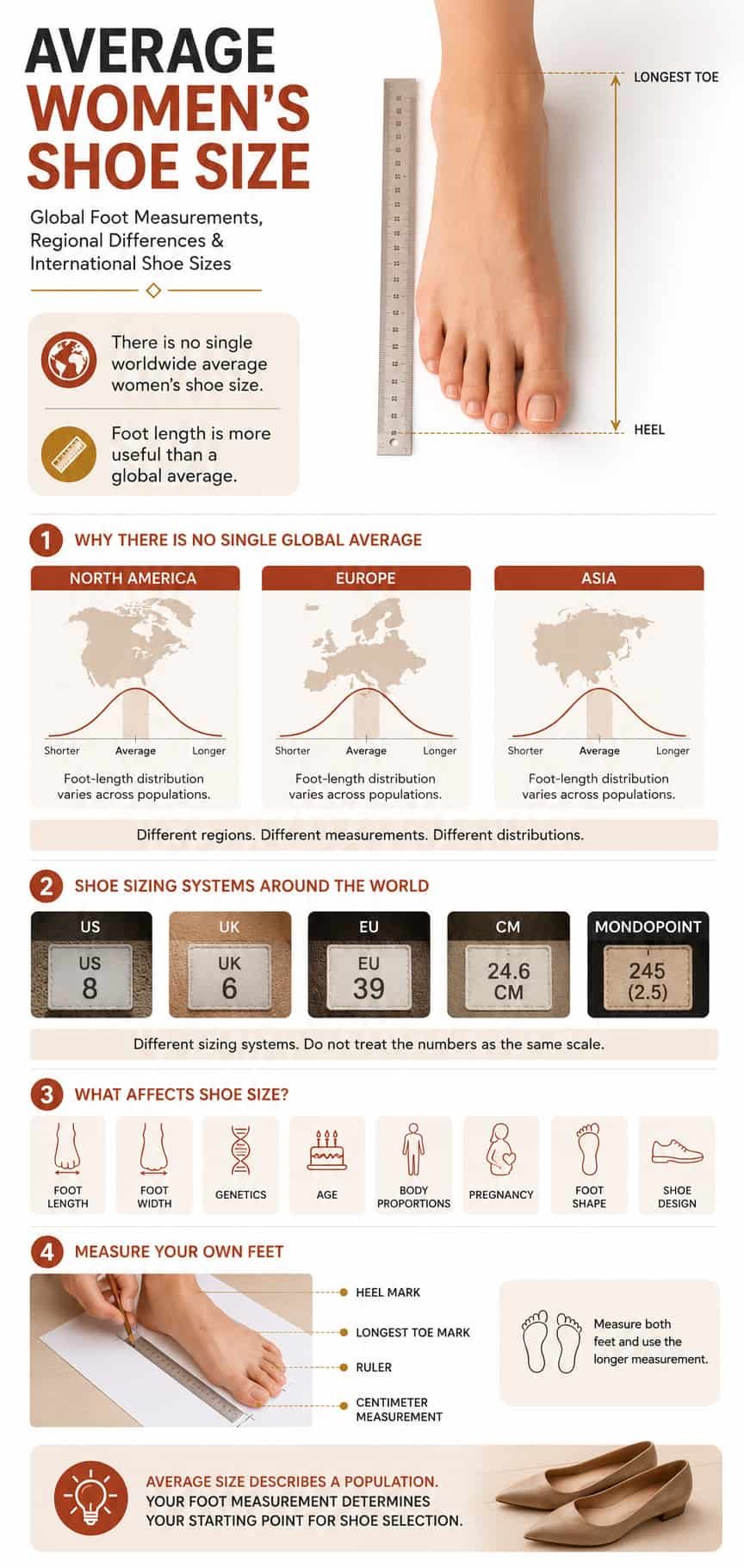
Why Is There No Single Average Women’s Shoe Size?
There are several reasons.
Different populations have different foot dimensions
Foot dimensions vary between geographic regions.
The large foot-scan study found significant differences between North American, European and Asian customers, including differences in foot length, width and instep height.
Shoe sizing systems are different
A US women’s size is not the same numerical scale as a UK or EU size.
European sizing uses a different system from US and UK sizing, while Mondopoint is based on foot measurements in millimeters.
Feet vary within the same population
Even women living in the same city can have very different foot lengths and widths.
The large-scale foot-scan research found substantial dispersion in foot dimensions within the same regional and sex groups.
Shoe construction affects fit
Two shoes with the same size printed on the label can feel different.
The shoe’s last, toe-box shape, width, heel design and materials all influence the internal fit.
What Is the Most Common Women’s Shoe Size?
There is no universally verified most common women’s shoe size worldwide.
The most common size depends on the population, country, retailer and dataset being examined.
A large foot-scan study is particularly useful because it demonstrates that even the most frequently occurring foot length can differ by region. In its dataset, female customers in North America and Europe most frequently fell into the 245 mm foot-length class, while the Asian group most frequently fell into the 235 mm class.
This is a better way to think about “most common size”:
Most common size = the size or measurement that appears most frequently in a particular dataset.
It does not mean that most women everywhere wear that size.
What Is the Average Women’s Foot Length?
There is no single worldwide average women’s foot length.
Research provides useful examples, but each study represents a specific population.
A large database of more than 1.2 million foot scans found the most frequently occurring female foot-length class was 245 mm in North America and Europe and 235 mm in Asia.
Another study reported an average female Mondopoint size of 246 mm in its own healthy adult study population.
These findings are close in one population but should not be combined into a universal global average.
The practical lesson is simple:
Measure your own feet instead of relying on a population average.
How Does Foot Length Relate to Women’s Shoe Size?
Foot length is one of the most important measurements used to determine shoe size.
However, foot length and shoe size are not identical.
Your foot is measured from the back of the heel to the longest toe. A shoe needs additional internal space because it has to accommodate the foot comfortably.
The exact relationship between foot length and shoe size also depends on the sizing system.
For example:
| Sizing System | What It Represents |
| US | Numerical shoe-size scale |
| UK | Separate numerical shoe-size scale |
| EU | European sizing scale |
| Mondopoint | Foot length and width measured in millimeters |
| CM or JP | Metric-based sizing references used in some markets |
For an international comparison, use our Shoe Size Conversion Chart & Calculator.
How Do US, UK and EU Women’s Shoe Sizes Compare?
US, UK and EU women’s shoe sizes use different sizing systems.
A conversion chart can provide an approximate equivalent, but it should not be treated as an exact physical measurement.
For example, a US size converted to an EU size may produce a number that looks precise, but individual brands can still fit differently.
| Sizing System | General Use |
| US Women’s | Commonly used in the United States and some North American markets |
| UK Women’s | Used in the United Kingdom and some international markets |
| EU | Widely used across Europe and many other countries |
| Mondopoint | Measurement-based system using millimeters |
| CM / JP | Metric-based sizing references |
Before ordering internationally, compare the brand’s own chart with your foot measurement.
Our Women’s Shoe Size Conversion Chart can help you understand the relationship between major sizing systems.
Does Country Affect Average Women’s Shoe Size?
Yes.
Country and region can be associated with differences in average foot dimensions.
The large-scale foot-scan study found differences between North American, European and Asian populations. Asian female feet in the dataset were shifted toward shorter length classes compared with North American and European female feet.
The researchers also found regional differences in width and instep dimensions.
This matters because shoe manufacturers cannot assume that a single “average foot” will fit every population equally well.
The study concluded that footwear should account for regional and sex-related differences in foot dimensions and that multiple widths can be important for achieving good fit.
Does Height Affect Women’s Shoe Size?
Height and foot size can be related, but height cannot accurately predict your shoe size.
Research has found relationships between stature and foot dimensions, but individual variation remains substantial. One study of 569 adults found a significant relationship between stature and foot length, including within the female group.
This means taller women may often have longer feet on average, but you cannot determine an individual’s shoe size from height alone.
For example, two women of the same height may have different foot lengths and widths.
Quick Tip
Do not estimate your shoe size from your height. Measure your feet and compare the result with the footwear brand’s sizing information.
Does Age Affect Women’s Shoe Size?
Foot size can change over a person’s lifetime.
Age-related changes, weight changes, pregnancy and changes in foot structure can affect how footwear fits.
This does not mean that every woman’s shoe size changes with age.
It simply means that an old shoe size should not always be treated as a permanent measurement.
If your usual footwear suddenly feels tight or loose, measuring your feet again is worthwhile.
Can Pregnancy Change Women’s Shoe Size?
Pregnancy can affect foot shape and footwear fit for some women.
Changes can include increased width or a flatter foot shape. Some women may continue to notice changes after pregnancy.
However, the effect varies from person to person.
The important point is that your current foot measurements are more useful than assuming you should return to a previous shoe size.
Does Weight Affect Women’s Shoe Size?
Weight can influence the way feet interact with the ground and may affect how some shoes feel.
However, weight alone cannot be used to predict shoe size.
Foot length, width, shape and structure remain more useful when selecting footwear.
A woman can have the same weight as someone else and still have a completely different shoe size.
Why Do Women With the Same Shoe Size Have Different Foot Shapes?
Because shoe size mainly communicates length, while feet have many other dimensions.
Two women can have similar foot lengths but different:
- Forefoot widths
- Heel widths
- Instep heights
- Toe shapes
- Arch shapes
- Ball-of-foot dimensions
Large-scale foot-scan research found considerable variation in foot width, instep height and heel width even among people within the same foot-length categories.
Other research has also shown that women’s feet are not simply scaled-down versions of men’s feet and that foot shape characteristics can vary considerably.
This is why choosing footwear based only on length can sometimes result in a poor fit.
Is Women’s Shoe Width as Important as Length?
Yes.
Length is important, but width also affects comfort and fit.
A shoe may have enough length but still feel uncomfortable if the forefoot is too narrow.
The opposite can also happen. A shoe may feel wide enough but have excessive length.
Large-scale research found that multiple width options can improve the likelihood of a good fit across different foot populations.
When shopping, pay attention to width labels when the brand provides them.
For a more detailed comparison, see our Women’s Wide Shoe Size Chart.
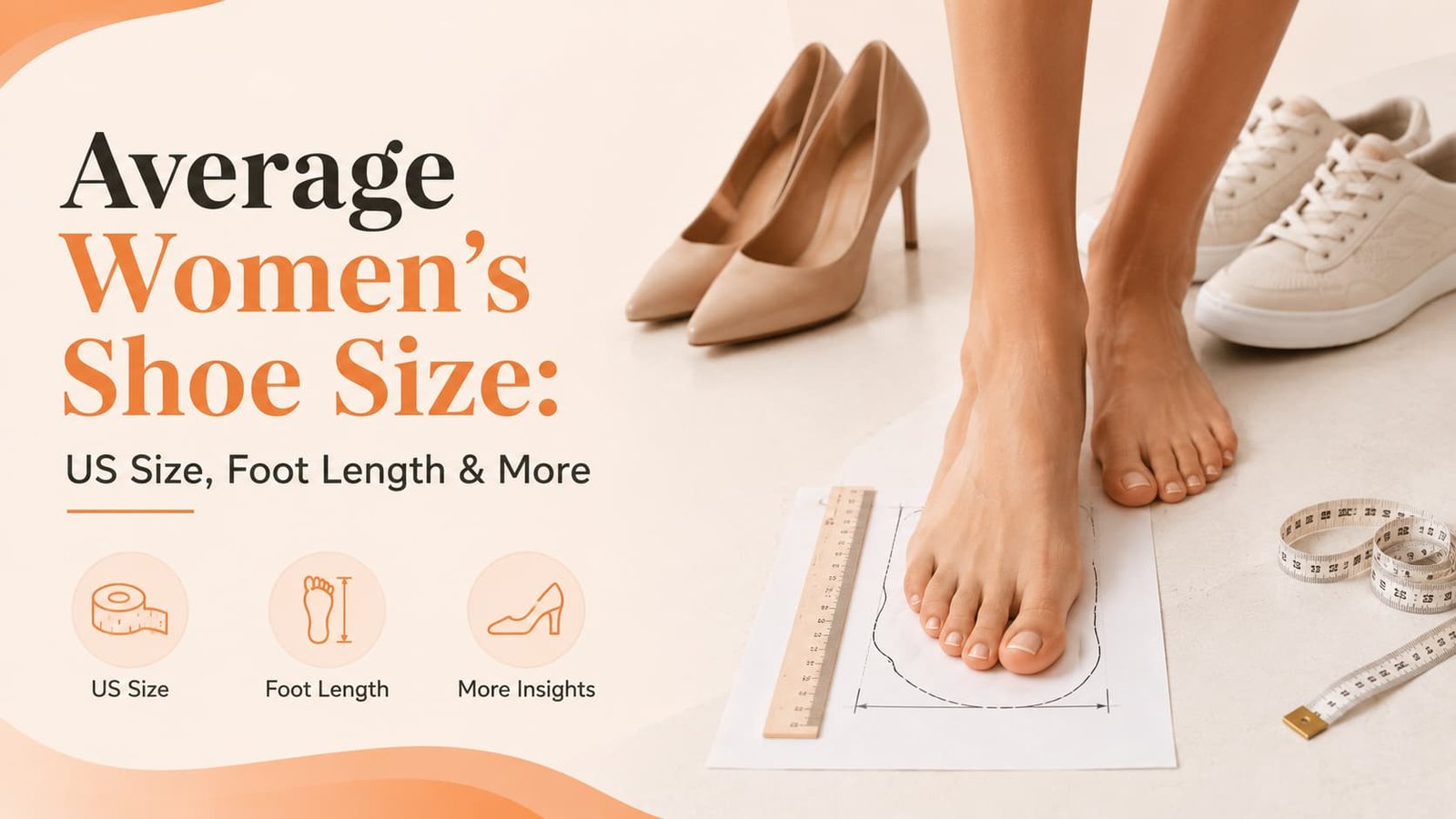
How to Measure Women’s Foot Size at Home
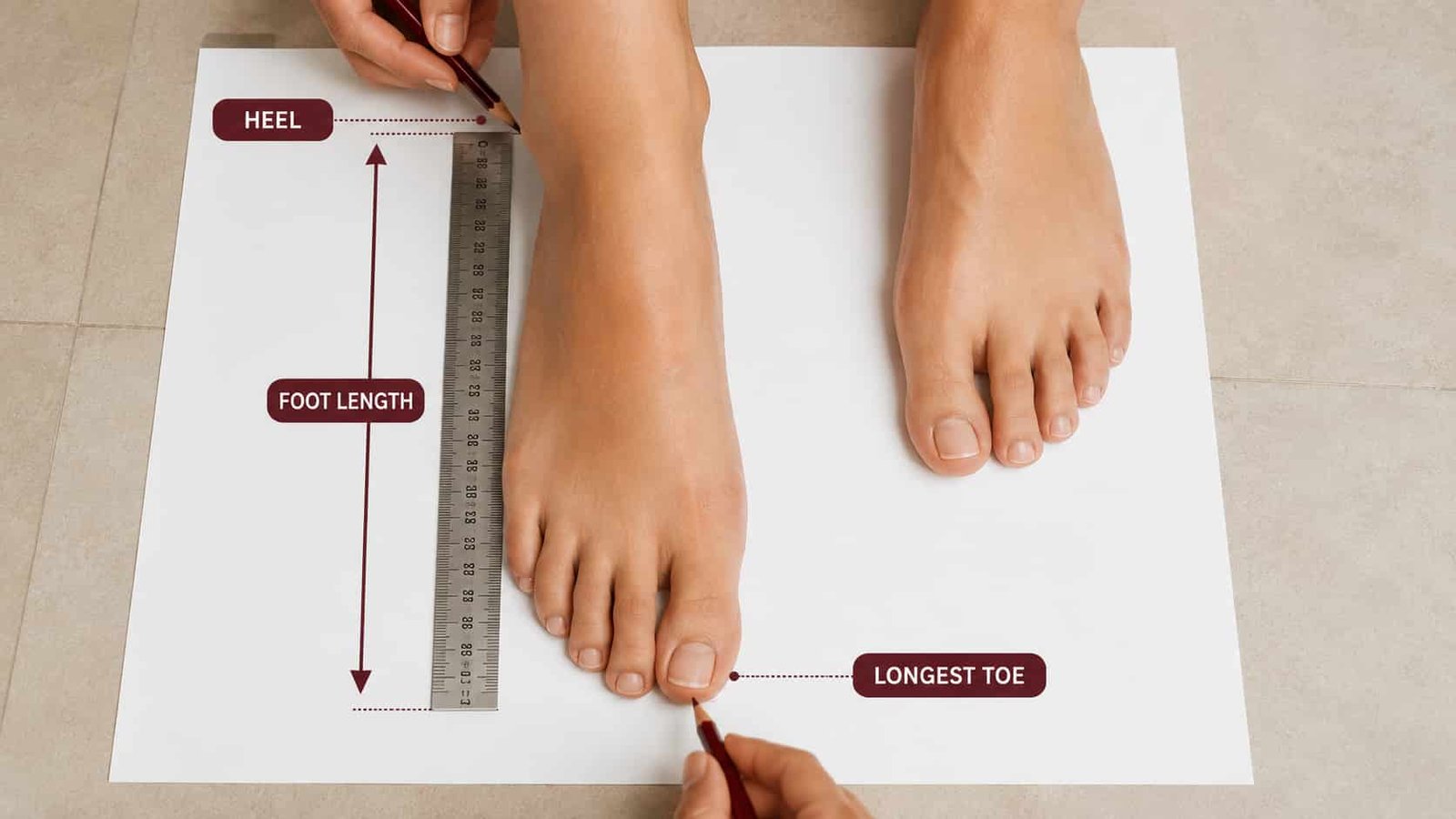
You do not need specialized equipment to measure your feet.
You can use:
- A sheet of paper
- A pencil
- A ruler or measuring tape
- A flat floor
Step 1: Place the paper on the floor
Use a hard, flat surface.
Avoid thick carpet because it can affect the measurement.
Step 2: Stand naturally
Place one foot on the paper while standing normally.
Standing helps account for the way your foot bears weight.
Step 3: Mark the heel
Place a small mark at the back of your heel.
Step 4: Mark the longest toe
Mark the end of your longest toe.
The longest toe is not necessarily the big toe.
Step 5: Measure the distance
Measure from the heel mark to the longest-toe mark.
Record the result in centimeters and inches.
Step 6: Repeat for the other foot
Measure both feet.
It is common for one foot to be slightly longer than the other.
Step 7: Use the longer measurement
Use the longer foot when comparing your measurements with a shoe chart.
For a complete visual guide, see How to Measure Foot Size at Home.
Measurement Tip
Measure both feet and keep the measurements saved. Having your foot length in centimeters and inches makes international shoe shopping much easier.
Should You Measure Your Feet in Inches or Centimeters?
Either measurement can be useful.
Centimeters are particularly convenient when comparing international footwear because metric measurements are used by several sizing systems.
Inches are also useful when a US-based size chart provides measurements in inches.
The important thing is to measure accurately and use the measurement with the shoe brand’s own sizing information.
Our Women’s Shoe Size to CM guide can help you compare foot length with women’s shoe sizing.
Why Can the Same Shoe Size Fit Differently?
The number printed inside a shoe does not tell the entire fit story.
The shoe’s last determines much of its internal shape.
The toe box may be rounded, pointed or square.
The heel may be narrow or wide.
The upper may stretch differently depending on the material.
The outsole and midsole can also influence how the shoe feels while walking.
Large-scale research explains that the shoe last is a major determinant of the internal shape of footwear.
This is why your normal size can sometimes change between brands or even between different styles from the same brand.
Is an Average Women’s Shoe Size Useful?
Yes, but only as a reference.
Average shoe-size information can help people understand population trends.
It can also help footwear businesses understand the market they are designing for.
But an average cannot tell you whether a particular shoe will fit your foot.
Your own measurement is more useful.
Think of it this way:
Average size = population information
Foot measurement = personal sizing information
Common Mistakes When Using Average Shoe Size Information
Mistake 1: Assuming the average is your size
An average is not a personal recommendation.
Mistake 2: Treating one country’s size as a global standard
US, UK, EU and metric sizing systems are different.
Mistake 3: Ignoring width
Two feet with the same length can have very different widths.
Mistake 4: Measuring only one foot
Your feet may not be identical.
Mistake 5: Assuming every brand fits the same
Different lasts and construction methods affect fit.
Mistake 6: Using an old shoe size without checking
Your feet and footwear preferences can change.
Mistake 7: Converting sizes without checking the brand
A conversion chart is a starting point, not a guarantee of fit.
How to Choose the Right Women’s Shoe Size
Use this simple process:
- Measure both feet.
- Record the longer foot measurement.
- Measure in centimeters and inches.
- Check the brand’s official size chart.
- Check the width options.
- Consider the shoe style.
- Consider whether you will wear socks.
- Try the shoes on when possible.
- Walk around before making your final decision.
A good fit should feel comfortable without excessive pressure, slipping or crowding.
Average Women’s Shoe Size: Key Facts at a Glance
| Question | Best General Answer |
| Is there one global average? | No |
| Does average size vary by region? | Yes |
| Does foot length matter? | Yes |
| Does foot width matter? | Yes |
| Are US and UK sizes identical? | No |
| Are EU sizes directly interchangeable with US sizes? | No |
| Can height predict shoe size? | Not accurately |
| Should you measure both feet? | Yes |
| Should you check the brand’s size chart? | Yes |
| Is average size a personal recommendation? | No |
Expert Tips for Understanding Women’s Shoe Size
Tip 1: Think in Measurements
When shopping internationally, your foot length in centimeters can be more useful than remembering one numerical shoe size.
Tip 2: Check Width
Length alone does not describe your entire foot. Check width and overall shoe shape whenever the brand provides those measurements.
Tip 3: Compare the Brand Chart
Use general conversion charts for orientation, then use the manufacturer’s own chart before ordering.
Tip 4: Do Not Chase the Average
There is nothing wrong with having feet that are smaller or larger than an average. Comfort and correct fit matter more than matching a population statistic.
Average Women’s Shoe Size FAQs
What is the average women’s shoe size worldwide?
There is no reliable single worldwide average women’s shoe size. Foot dimensions vary between populations, and shoe-size systems differ between countries. Large-scale research has found regional differences in women’s foot lengths across North America, Europe and Asia.
What is the most common women’s shoe size?
There is no universally confirmed most common women’s shoe size worldwide. The answer changes depending on the country, population and dataset being studied. It is more accurate to discuss the most frequent size within a particular dataset rather than claim one global number.
What is the average women’s shoe size in Europe?
The answer varies by country and study. One study of healthy adults reported an average female European shoe size of approximately EU 39.8 within its study population. This should be treated as a research result for that population rather than a universal European average.
What is the average women’s foot length?
There is no single worldwide average. A large foot-scan study found that the most frequent female foot-length class was 245 mm in North America and Europe and 235 mm in Asia.
Does women’s shoe size vary by country?
Yes. Research shows regional differences in foot dimensions, and countries also use different shoe-sizing systems. This means a shoe size cannot always be compared directly between countries without using an appropriate conversion chart.
Does height determine women’s shoe size?
No. Height and foot length can be related statistically, but height cannot accurately predict an individual’s shoe size. Women with the same height can have different foot lengths and widths.
Does foot width matter when choosing women’s shoes?
Yes. Width can have a major effect on comfort. Research involving large numbers of foot scans found substantial variation in foot width, instep height and heel width even within the same foot-length groups.
Why is my shoe size different between brands?
Brands can use different lasts, materials, toe-box shapes and sizing practices. A size that fits comfortably in one brand may feel different in another brand, which is why checking the manufacturer’s size chart is important.
Should I use my usual shoe size when shopping online?
Use your usual size as a starting point, but do not rely on it alone. Measure both feet and compare the longer measurement with the specific brand’s current sizing chart.
Is EU shoe size the same as US shoe size?
No. EU and US sizing systems use different scales. A conversion chart can provide an approximate equivalent, but individual brands can still differ in fit.
Should I measure both feet?
Yes. It is normal for one foot to be slightly longer or wider than the other. Use the longer foot as your main reference when checking shoe size.
Can women’s shoe size change over time?
Yes. Foot shape and shoe fit can change with age, pregnancy, weight changes and other factors. If your usual footwear no longer feels comfortable, measuring your feet again can help.
Final Takeaway
The average women’s shoe size is not one universal number.
Women’s foot dimensions vary across countries and populations, and different sizing systems make international comparisons even more complicated. Research involving more than 1.2 million foot scans demonstrates meaningful regional differences in female foot dimensions, while other studies show that average shoe size can vary depending on the population being measured.
That is why the most useful number is not the global average.
It is your own foot measurement.
Measure both feet, record the longer measurement, check the width when available, and compare your measurements with the specific brand’s sizing chart.
- For a complete reference, start with our Women’s Shoe Size Chart.
- If you are shopping internationally, use our Shoe Size Conversion Chart & Calculator.
- To learn how to measure accurately, follow our How to Measure Foot Size at Home guide.
- You can also compare metric measurements using our Women’s Shoe Size to CM guide.
The best shoe size is not the one that matches an average. It is the one that fits your feet properly and comfortably.