
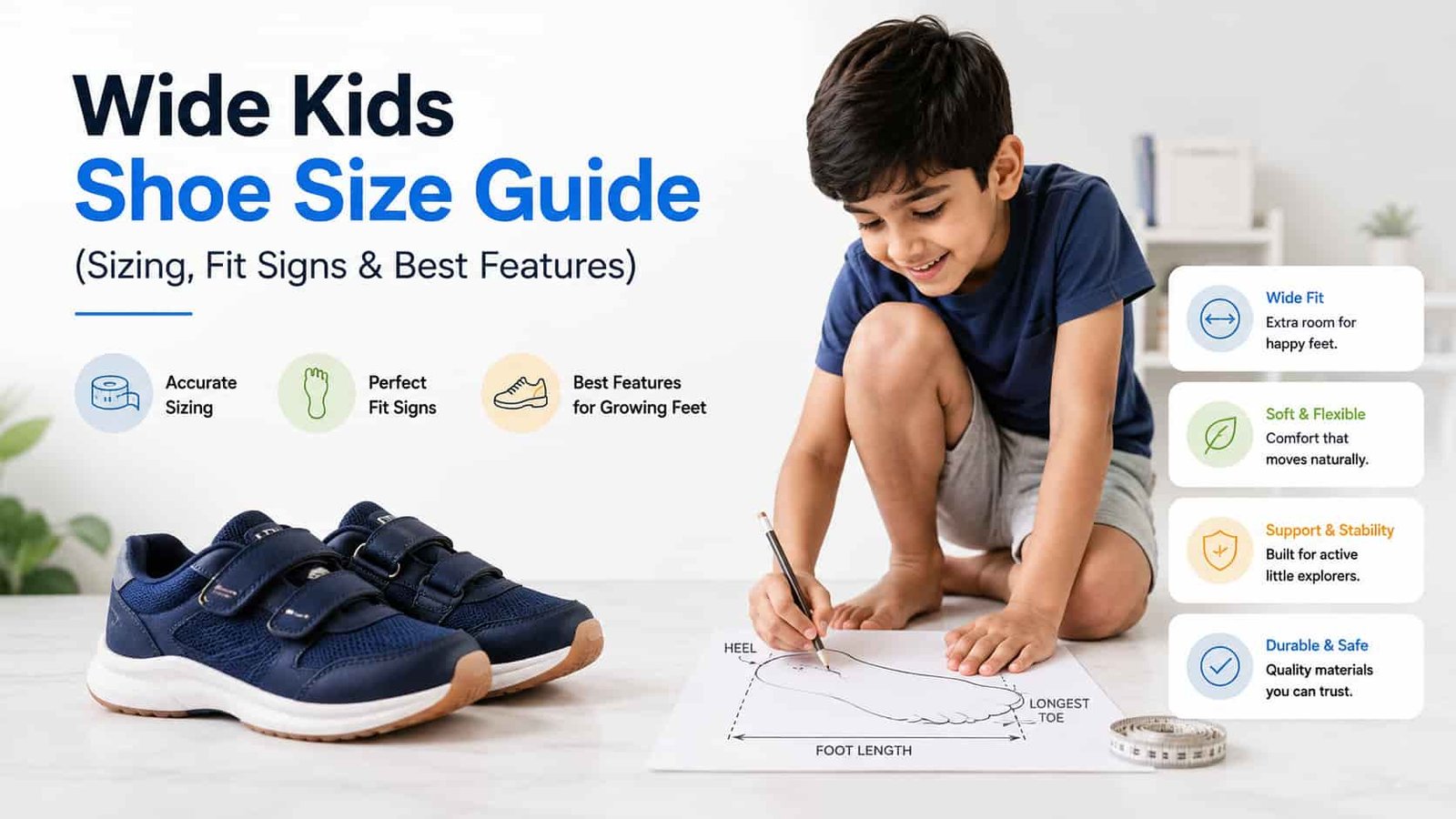
Wide Kids Shoe Size Guide (Sizing, Fit Signs & Best Features)
⚡ Quick Answer
- A wide kids shoe size uses the same length numbers as standard sizing, just built with more room across the ball of the foot.
- Red marks or indentations on the sides of the foot after wear are the clearest sign a wide fit is needed.
- Not every brand offers wide sizing, so checking availability matters as much as checking the chart.
- Width sizing is far less standardized across brands than length, so always check a brand’s specific width chart.
- Use the interactive fit checker below to see if a wide width is likely the right move.
A wide kids shoe size keeps the same length numbering as a standard size, but adds extra room across the widest part of the foot, usually near the ball. Kids need a wide fit when the standard width leaves red marks, feels tight across the middle of the foot, or causes visible bulging at the sides even though the length is correct. Age doesn’t determine width the way it does length, since foot shape varies by child rather than by growth stage. Checking a specific brand’s width chart, alongside a simple at-home fit check, is the most reliable way to confirm whether a wide size is actually needed.
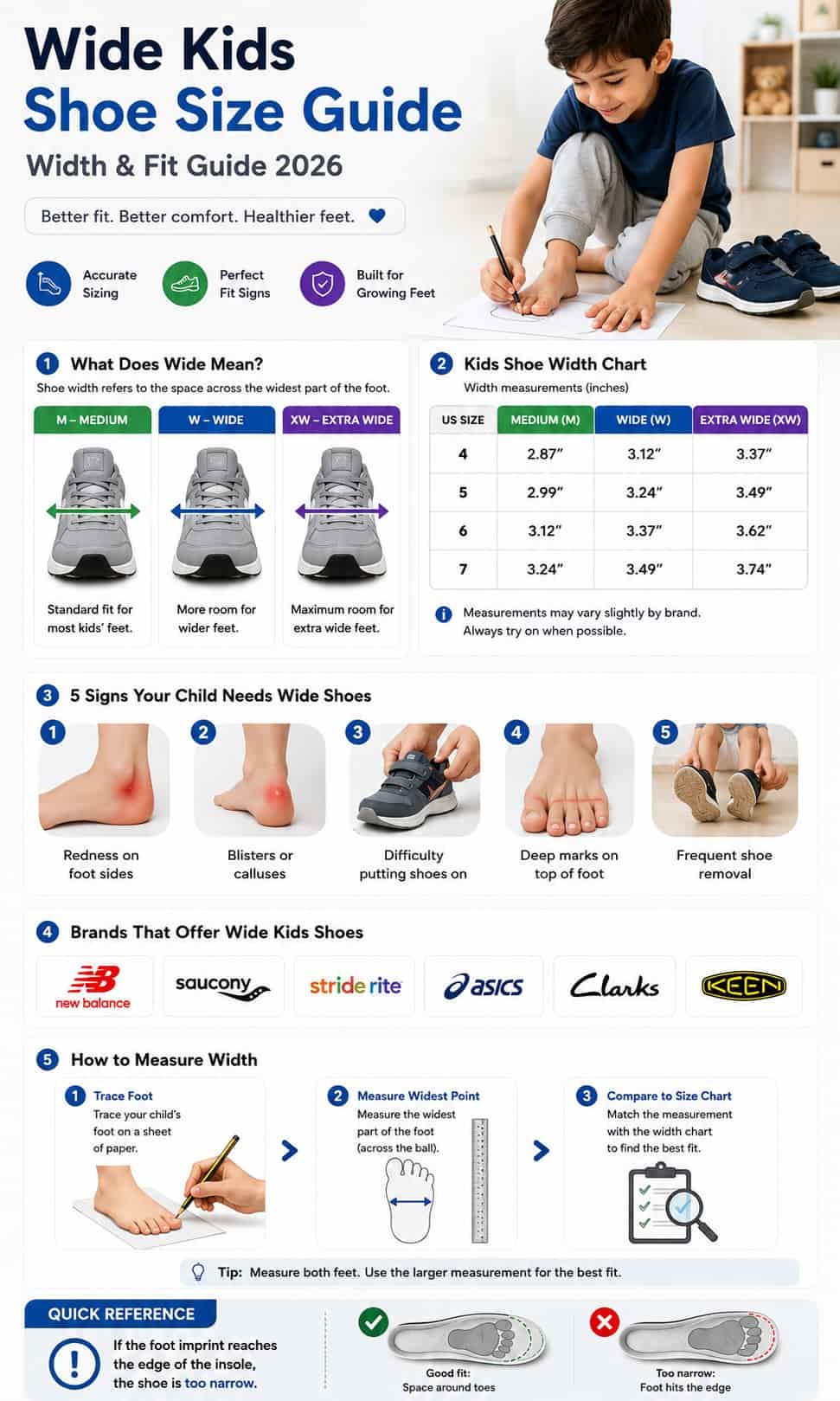
Kids Shoe Width Chart (With Measurements)
This chart shows approximate width measurements for children’s shoes. Remember that width measurements vary slightly between brands.
| US Kids Size | Medium Width (M) | Wide Width (W) | Extra Wide (XW) |
|---|---|---|---|
| 4 (Toddler) | 2.75 inches | 3.13 inches | 3.50 inches |
| 5 (Toddler) | 2.88 inches | 3.25 inches | 3.63 inches |
| 6 (Toddler) | 3.00 inches | 3.38 inches | 3.75 inches |
| 7 (Toddler) | 3.13 inches | 3.50 inches | 3.88 inches |
| 8 (Toddler) | 3.25 inches | 3.63 inches | 4.00 inches |
| 9 (Toddler) | 3.38 inches | 3.75 inches | 4.13 inches |
| 10 (Little Kid) | 3.50 inches | 3.88 inches | 4.25 inches |
| 11 (Little Kid) | 3.63 inches | 4.00 inches | 4.38 inches |
| 12 (Little Kid) | 3.75 inches | 4.13 inches | 4.50 inches |
| 13 (Little Kid) | 3.88 inches | 4.25 inches | 4.63 inches |
| 1 (Little Kid) | 4.00 inches | 4.38 inches | 4.75 inches |
| 2 (Little Kid) | 4.13 inches | 4.50 inches | 4.88 inches |
| 3 (Little Kid) | 4.25 inches | 4.63 inches | 5.00 inches |
| 3.5 (Youth) | 4.31 inches | 4.69 inches | 5.06 inches |
| 4 (Youth) | 4.38 inches | 4.75 inches | 5.13 inches |
| 5 (Youth) | 4.50 inches | 4.88 inches | 5.25 inches |
| 6 (Youth) | 4.63 inches | 5.00 inches | 5.38 inches |
| 7 (Youth) | 4.75 inches | 5.13 inches | 5.50 inches |
Tip: Width measurements are approximate and vary by brand. Always measure your child’s feet and check the brand’s specific size guide.
Parent Checklist for Wide Shoes
- Measure both feet (one is often wider).
- Use the larger foot measurement for sizing.
- Measure width in the evening when feet are slightly swollen.
- Check the brand’s specific width guide.
- Allow 0.4-0.5 inches of growing room in length.
What Counts as a Wide Kids Shoe Size
A wide kids shoe size isn’t a different length scale. It’s the same US, UK, or EU size number as a standard shoe, just built with extra room across the widest part of the foot, typically near the toes and the ball of the foot.
Most brands label wide sizing with a “W” after the size number, though some use their own labeling like “wide fit” or “extra room” in the product description. In our experience fitting thousands of kids, width gets overlooked far more often than length, mostly because parents assume a shoe that fits lengthwise must be the right size overall.
👟 Did You Know?
Foot width doesn’t scale evenly with age the way length does. A toddler and a school age child can both need a wide fit for completely different reasons, one from naturally broader baby foot shape, the other from genetics or foot structure that stays consistent through childhood.
Signs Your Child Needs a Wide Shoe
Watch for these signs across more than one pair of shoes before concluding a wide width is needed.
- Red marks or indentations along the sides of the foot after the shoe comes off.
- The shoe looks stretched or bulges outward at its widest point.
- Your child complains about tightness across the middle of the foot, even though the toe area feels fine.
- Seams on the sides of the shoe show unusual wear or stretching over time.
- Your child seems to avoid certain shoes more than others, despite being the correct length.
💡 Expert Tip
Check an old, worn pair of shoes for stretching or bulging at the sides. Wear patterns on a shoe that’s already been through daily use are often a more reliable width clue than how a brand new pair feels on day one.
Interactive Wide Fit Checker
Wide Fit Decision Guide
Use this guide to determine if your child needs wide shoes.
Once you’ve confirmed a width, our Kids Shoe Size Chart covers the standard length ranges to pair with it.
How to Measure Foot Width at Home
Measuring width at home takes just a couple extra minutes beyond a standard length measurement.
Step 1: Trace the foot while standing. Weight-bearing widens the foot slightly, so a standing trace gives a more accurate width reading than a seated one.
Step 2: Mark the widest points. This is usually across the ball of the foot, just behind the toes.
Step 3: Measure straight across. Use a ruler to measure the distance between the two widest points, in inches or centimeters.
Step 4: Compare against a brand’s width chart. Since width sizing varies more between brands than length does, check the specific retailer’s chart rather than relying on a single universal number.
✅ Parent Checklist
- Check for red marks or bulging after a full day of wear.
- Measure width while your child is standing, not sitting.
- Compare fit across at least two different shoe pairs.
- Check the specific brand’s width chart before ordering.
- Recheck width every few months, since foot shape can shift with growth.
Wide vs Standard Width Reference Chart
This chart gives a general sense of how standard and wide widths compare across common kids sizes. Exact measurements still vary by brand, so treat this as a starting reference rather than an exact match.
| US Size | Standard Width (in) | Wide Width (in) |
| 8 | 3.0 in | 3.3 in |
| 10 | 3.2 in | 3.5 in |
| 12 | 3.4 in | 3.7 in |
| 1 (youth) | 3.6 in | 3.9 in |
| 3 (youth) | 3.8 in | 4.1 in |
A quick tip that saves guesswork: if your child has consistently run wide in one brand, they’ll very likely run wide in most other brands too, since foot shape doesn’t change based on which shoe company made the shoe.
Signs a Wide Shoe Fits Correctly
Once you’ve moved to a wide width, check for these signs to confirm it’s the right call.
- No red marks or indentations after a full day of wear.
- The shoe no longer looks stretched or bulging at the sides.
- Your child stops complaining about tightness across the middle of the foot.
- The shoe still holds the heel in place without slipping, since width shouldn’t come at the cost of overall security.
⚠ Common Mistake
Sizing up in length to work around a width problem is one of the most common mistakes we see. A longer shoe with the wrong width usually just trades a tight fit for a loose heel and reduced stability, without actually solving the original complaint.
Common Buying Mistakes with Wide Sizing
A handful of habits show up repeatedly with parents shopping for wide kids shoes for the first time.
Assuming every brand carries wide sizing. Not all brands offer a wide option, so checking availability before falling in love with a specific style saves a wasted search.
Judging width from a single pair. Fit varies by brand and style, not just the width label itself. Checking the pattern across two or three pairs gives a clearer picture.
Ignoring sock thickness. Thick socks can make a standard width feel snug, while thin socks can make a properly fitted wide shoe feel a bit loose. Account for typical sock thickness before judging fit.
What to Look for in Wide Kids Shoes
A few features make a real difference once you’ve confirmed a wide fit is needed.
Brands with an explicit wide option. Look for sizing clearly labeled “W” or “wide” rather than guessing based on a brand’s general reputation for running roomy.
Adjustable closures. Velcro straps with multiple adjustment points, or laces with extra eyelets, help fine tune fit within a wide size.
Soft, stretchy upper materials. Knit or soft canvas uppers flex slightly to accommodate foot shape, which can help even within a wide sizing category.
Return-friendly retailers. Since width is harder to judge from a chart alone than length, shopping somewhere with easy returns reduces the risk of an uncomfortable first pair.
Common Parent Mistakes
A couple of habits are worth calling out separately from the buying mistakes above.
Assuming a wide-looking foot always needs a wide shoe. Not every child with a fuller looking foot actually needs wide sizing. Check for the specific signs above before assuming.
Sticking with one brand out of habit after a fit issue starts. If a trusted brand’s regular width no longer works well, it’s worth trying their wide option or a different brand entirely rather than forcing an uncomfortable fit.
Expert Tips for Wide Fit Shopping
Tip 1. Shop in person for the first pair in a new width whenever possible, since trying before buying removes most of the guesswork.
Tip 2. Keep notes on which brands run wide, narrow, or true to standard for your child, since this pattern tends to stay fairly consistent as they grow.
Tip 3. If a shoe fits well in length but shows any of the width signs above, try the same length in a wide width before jumping to a larger overall size.
Tip 4. Check width again after any noticeable growth spurt, since foot shape can shift slightly along with length.
FAQs
How do I know if my child needs wide shoes? Look for red marks or indentations along the sides of the foot after the shoe comes off, along with a shoe that looks stretched or bulging at its widest point. These are the clearest signs a wider width would help.
Is wide kids shoe sizing the same across all brands? No. Width sizing is far less standardized than length sizing. A wide fit in one brand might feel closer to standard in another, so it’s worth checking each brand’s specific width chart.
Do all shoe brands offer wide sizing for kids? Not all of them. Some brands specialize in wide fit options, while others only offer a standard width. Checking availability before shopping saves time if a wide fit is a known need.
Can a child’s foot width change as they grow? Yes, though width tends to be more consistent over time than length. A child who needs a wide fit at age four is likely to still need one at age eight, but it’s still worth rechecking periodically.
Should I size up in length instead of buying a wide width? Generally, no. Sizing up in length to compensate for a width issue usually creates a new problem, since the shoe becomes too long even if the width feels better across the foot.
What’s the best way to check width fit without buying multiple pairs? Shop in person for the first pair in a new width whenever possible. If shopping online, choose a retailer with an easy return policy in case the width doesn’t work out as expected.
Do thick socks affect how I judge width? Yes. Thick socks can make a standard width feel snug, so it’s worth checking fit with the type of socks your child will typically wear before deciding a wide width is needed.
Is a wide foot a sign of a specific foot condition? Not usually. Foot width varies naturally between children the same way height and shoe length do. A wide foot on its own generally isn’t a medical concern, though a doctor or pediatric specialist can help if you have specific concerns.
Can width issues affect how a child walks or runs? A poor width fit can make walking or running less comfortable, which sometimes shows up as reluctance to wear certain shoes or complaints during active play. Getting the width right often resolves these complaints without any other changes needed.
Where can I find a specific brand’s width chart? Most brands that offer wide sizing list a specific width chart on their product or sizing page. If it isn’t listed, contacting the brand’s customer service directly is usually the fastest way to get an accurate answer.
Do wide kids shoes cost more than standard width shoes? Sometimes, though the difference is usually small. Wide sizing is often treated as a standard size variant rather than a premium option, so pricing tends to stay close to the regular width version of the same shoe.
RELATED ARTICLES
CONCLUSION
Getting width right matters just as much as getting length right, even though it gets far less attention from most parents shopping for kids shoes. A quick check for red marks, bulging, or complaints of tightness across the middle of the foot tells you almost everything you need to know.
Try the interactive fit checker above with your child’s current shoes, and keep width in mind again after their next growth spurt. For length sizing to pair with your confirmed width, our Kids Shoe Size Chart and our How to Measure Kids Feet guide cover the rest.