
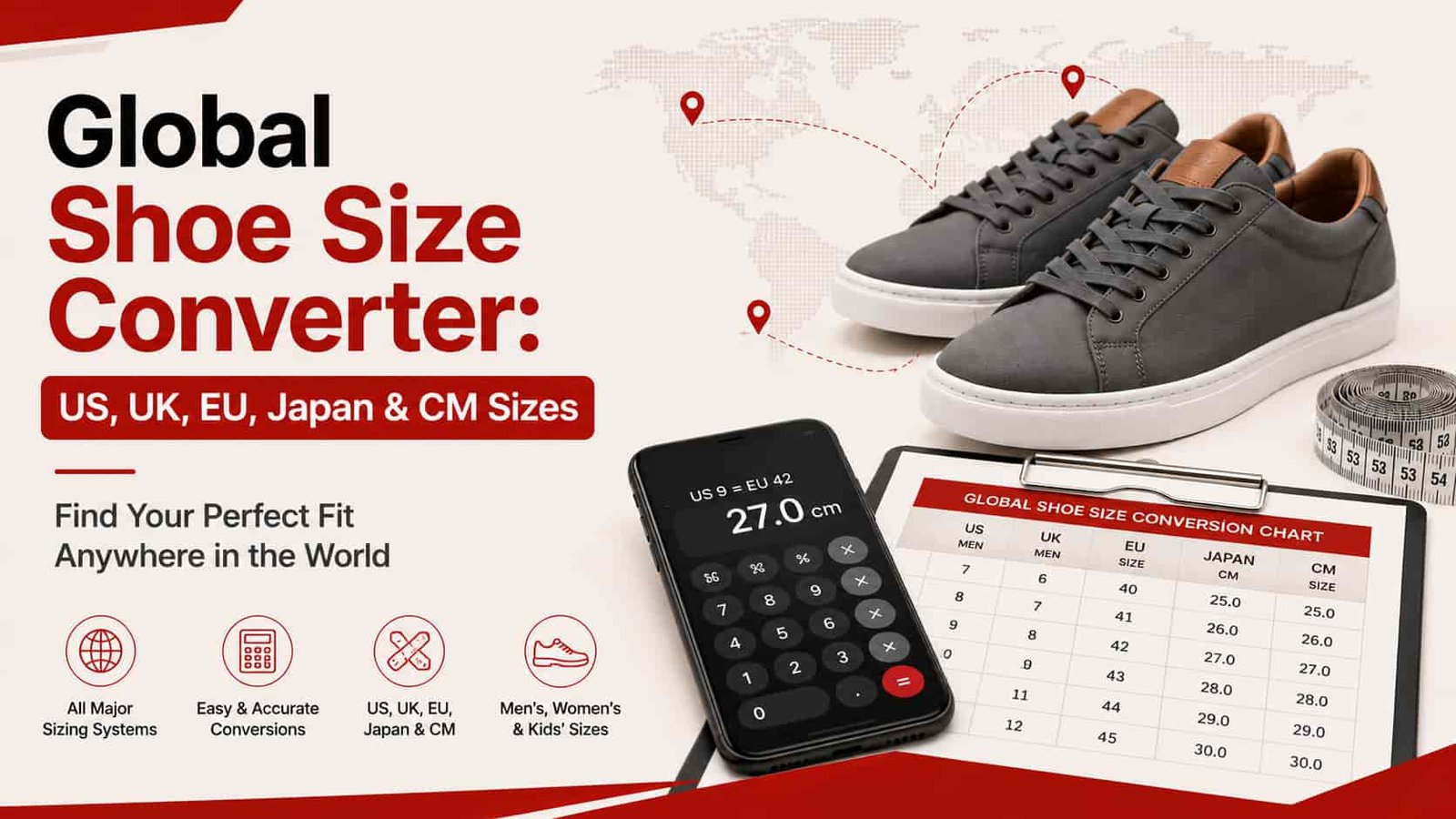
Global Shoe Size Converter: US, UK, EU, Japan & CM Sizes
Quick Answer
- A shoe size is not universal. A US size can correspond to a different number in the UK, EU or Japan.
- The most reliable way to compare international sizes is to check your actual foot length in centimetres.
- Use the converter below to compare US, UK, EU, Japan and CM sizing systems.
- Always check the individual brand’s size chart before ordering because shoe shapes and sizing can vary.
What Is a Global Shoe Size Converter?
A global shoe size converter helps you compare shoe sizes used in different countries and regions. Instead of guessing whether a US size will match a UK, EU or Japanese size, you can use one reference point to understand the approximate equivalent.
The important word is approximate. International shoe sizing is not based on one universal formula. Different sizing systems use different measurements, and brands can also fit differently.
For online shopping, the safest approach is to use a global shoe size converter as a starting point, then compare the result with the manufacturer’s own size chart.
Global Shoe Size Converter
The interactive converter below is designed to make international shoe shopping easier. Select the shoe category, choose the size system you know, enter your size, and select the system you want to compare.
International Shoe Size Converter
Compare US, UK, EU, Japan and centimetre sizing in seconds.
The Major Shoe Sizing Systems Explained
The United States uses a sizing system based on arbitrary numbers that do not correlate to actual foot measurements. A US size 9 represents approximately 10.25 inches or 26 centimeters, but there is no mathematical relationship between the number 9 and that foot length. This system developed through historical shoe manufacturing traditions and remains the standard in North America.
The United Kingdom and India both use the UK sizing system, which is offset from the US system by approximately one full size. A UK size 8.5 is roughly equivalent to a US size 9. The UK system is also based on arbitrary numbers but uses different increments than the US system. India adopted UK sizing during colonial times and continues using it today, making UK and India sizing identical.
The European Union uses the Paris point system, where sizes represent actual measurements based on a mathematical formula. EU sizing roughly corresponds to foot length in centimeters plus one. An EU size 42 fits feet approximately 26 to 27 centimeters long. The EU system is more logical than US or UK sizing because it is anchored to actual measurements.
Japan uses a centimeter-based system where the size number represents actual foot length in centimeters. A Japan size 26 means the shoe accommodates a 26 centimeter foot. This system is completely transparent and leaves no ambiguity about what a size means.
Australia uses UK sizing for historical reasons, making Australian sizes identical to UK sizes. Canada uses US sizing. Most other countries adopt one of these major systems or use centimeter-based sizing similar to Japan.
👟 Did You Know?
There is no international governing body that standardizes shoe sizing. Each country or region independently maintains its sizing system, which is why conversions are necessary at all. The lack of standardization costs the footwear industry billions in returns and customer dissatisfaction annually.
How to Use the Converter
Enter the size you already know, select its sizing system, and then choose the system you want to compare.
Find Your Approximate Shoe Size From Foot Length
Enter your longer foot measurement in centimetres.
This tool provides an approximate starting point. Shoe brands use different lasts and sizing specifications, so always compare your measurement with the manufacturer's size chart.
For example, if you normally wear a US men's size 9 and are looking at a UK shoe, the converter provides an approximate UK equivalent. If the retailer provides a foot-length measurement in centimetres, use that measurement as an additional check.
The converter is most useful for comparing sizing systems. It should not replace the manufacturer's own size chart.
Why Are Shoe Sizes Different Around the World?
Shoe sizes differ because countries developed their own measurement systems instead of adopting one global standard.
The US, UK, European and Japanese systems use different conventions. Even when two sizes look numerically similar, they do not necessarily represent the same shoe length.
For example, a US men's size 9 is not simply a UK 9 or EU 9. The number has meaning only within its own sizing system.
This is why international shoppers should never assume that the same number means the same physical shoe.
The main systems you will encounter
| Sizing system | Commonly seen in | Typical format |
| US | United States and many online retailers | 6, 7, 8, 9, 10 |
| UK | United Kingdom and some Commonwealth markets | 5, 6, 7, 8, 9 |
| EU | Europe and many international retailers | 39, 40, 41, 42 |
| Japan | Japan | 25, 26, 27, 28 |
| CM | International footwear listings | 25.0, 26.0, 27.0 |
These systems are useful reference points, but the actual fit still depends on the shoe.
Global Men's Shoe Size Conversion Chart
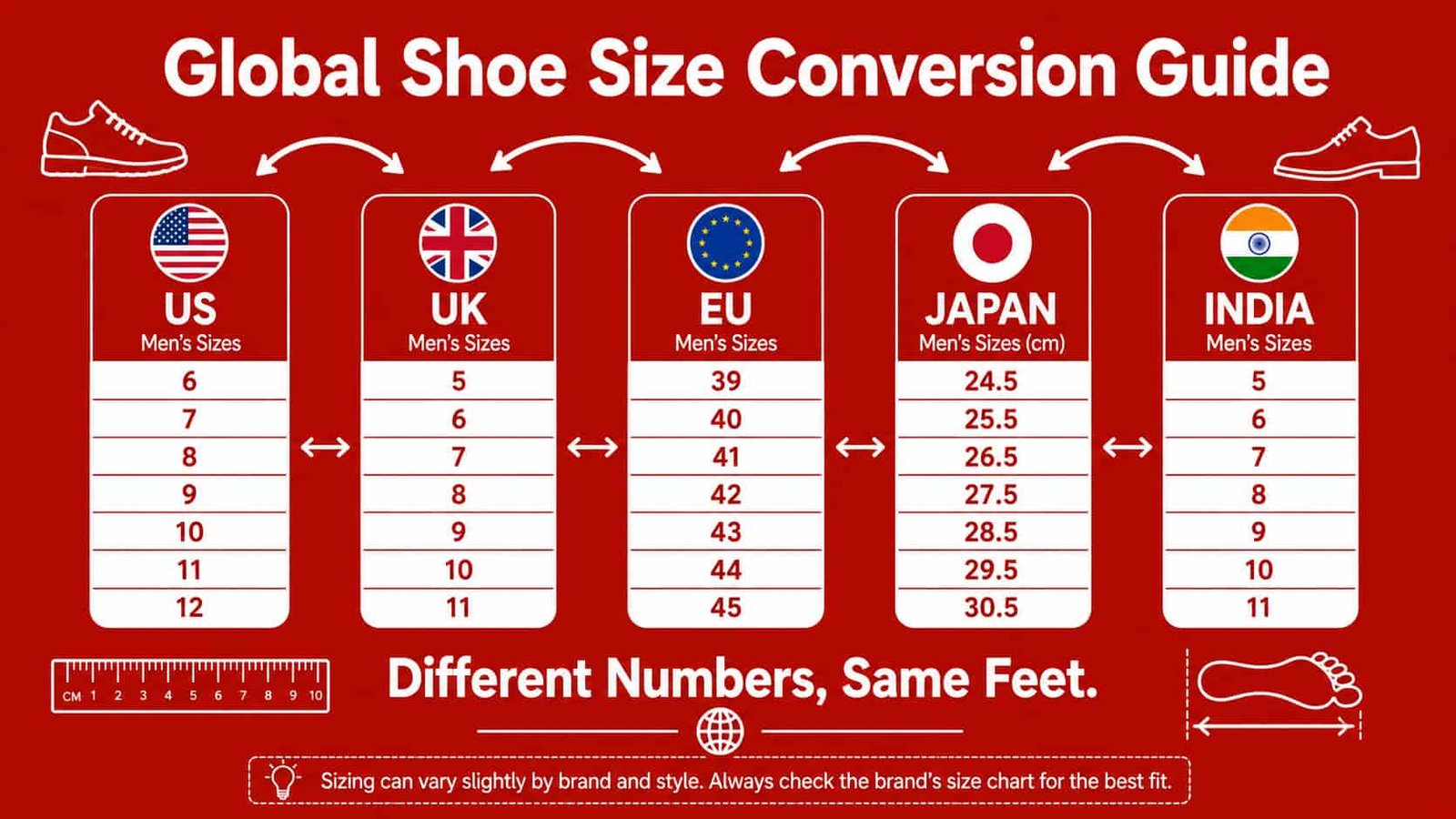
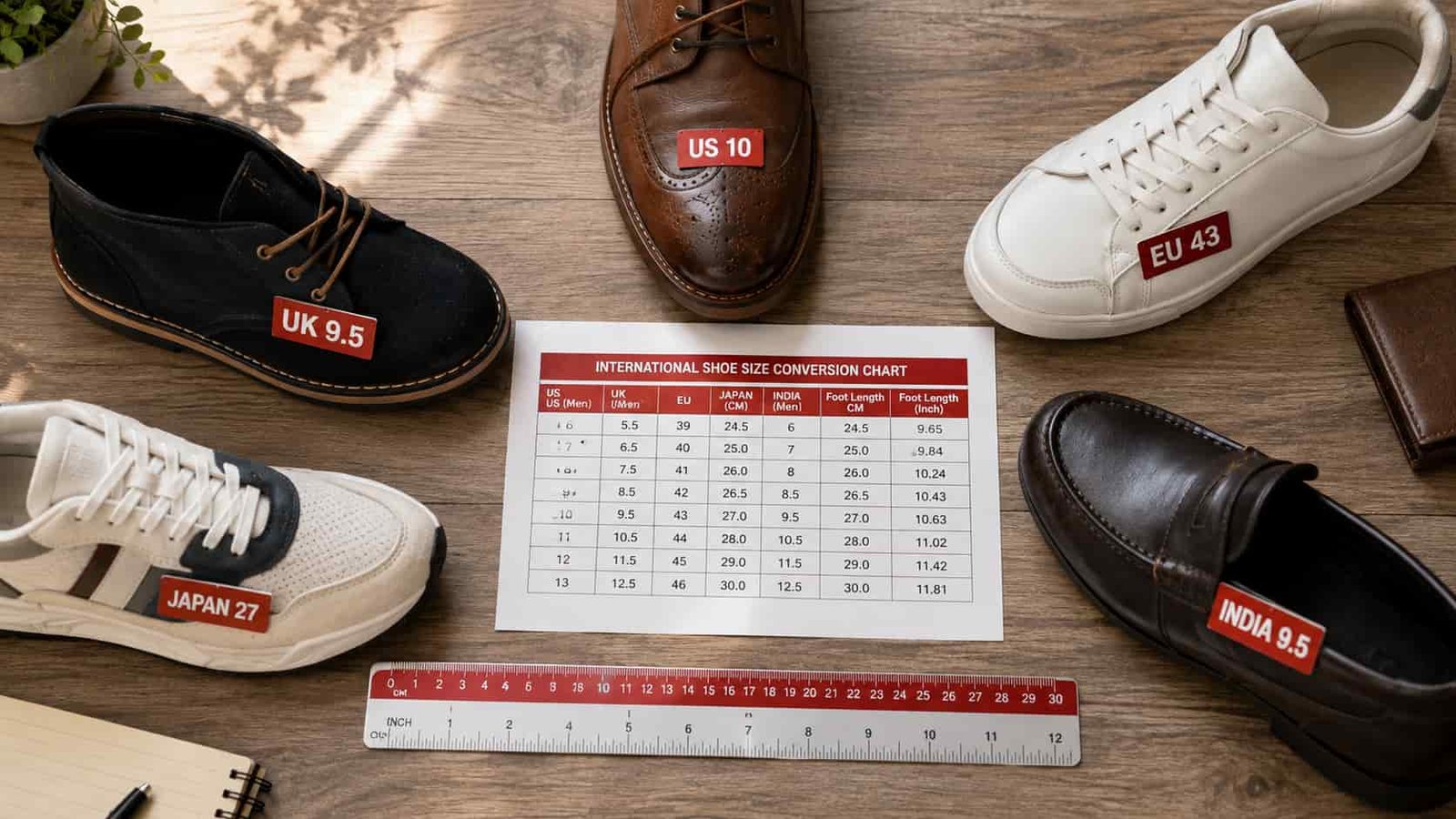
This reference chart shows how all major sizing systems correspond to the same foot length. Use this chart alongside the interactive tools below to verify conversions.
| Foot Length (cm) | Foot Length (in) | US Size | UK Size | EU Size | Japan Size | India Size |
| 24.1 | 9.5 | 6 | 5.5 | 39 | 24 | 5.5 |
| 24.8 | 9.75 | 7 | 6.5 | 40 | 25 | 6.5 |
| 25.4 | 10 | 8 | 7.5 | 41 | 25 | 7.5 |
| 26 | 10.25 | 9 | 8.5 | 42 | 26 | 8.5 |
| 27 | 10.625 | 10 | 9.5 | 43 | 27 | 9.5 |
| 27.9 | 11 | 11 | 10.5 | 44 | 28 | 10.5 |
| 28.6 | 11.25 | 12 | 11.5 | 45 | 29 | 11.5 |
| 29.4 | 11.5 | 13 | 12.5 | 46 | 29 | 12.5 |
| 30.2 | 11.875 | 14 | 13.5 | 47 | 30 | 13.5 |
All conversions are approximate due to slight variations between brands and manufacturing methods. Always verify conversions using the interactive tools and check the specific brand's size chart before ordering.
💡 Expert Tip
Measure your foot in centimeters once and use that measurement as your universal reference. A 27 centimeter foot stays 27 centimeters whether you are ordering from the US, UK, Europe, Japan, or India. This single measurement eliminates conversion confusion entirely.
Important: This is a practical conversion reference, not a universal manufacturing standard. EU and CM values can vary by brand and shoe construction.
If you need a more detailed men's reference, see our men's shoe size chart.
How Does a US Shoe Size Compare With UK and EU Sizes?
A US men's shoe size is generally about one size larger numerically than the corresponding UK men's size.
For example, US men's 9 is commonly around UK 8 and EU 42 to 43, depending on the brand.
The European system works differently because it does not use the same numerical scale as the US and UK systems.
A quick reference:
| US Men's | Approx. UK | Approx. EU |
| 7 | 6 | 40 |
| 8 | 7 | 41 |
| 9 | 8 | 42-43 |
| 10 | 9 | 44 |
| 11 | 10 | 45 |
| 12 | 11 | 46 |
When an international retailer provides both EU sizing and a centimetre measurement, compare the centimetre value with your measured foot length before ordering.
What Does CM Mean in Shoe Sizing?
CM means centimetres and is one of the easiest international measurements to understand because it refers to a physical length rather than a regional shoe-size number.
For example, a listing showing 27.0 CM is giving you a length reference around 27 centimetres.
However, there is an important detail that shoppers often miss. A manufacturer's stated CM size may represent a foot-length recommendation, an internal shoe measurement, or a sizing label based on a particular standard.
That is why you should always check how the retailer defines its CM measurement.
If you want to measure your foot accurately before using the converter, follow our guide to measuring foot size at home.
A Better Way to Convert Your Size
If you are unsure about your international size, measure both feet in centimetres and compare the longer measurement with the retailer's chart. This is usually more dependable than converting a size number from one country to another.
How to Measure Your Foot Before Using a Shoe Size Converter
A converter works best when you start with an accurate size.
You can measure your foot at home with a sheet of paper, a pencil, a ruler or measuring tape.
What you need
- A blank sheet of paper
- A pencil
- A ruler or measuring tape
- The socks you normally wear with the shoes
- A flat wall or solid surface
Measure your foot in a few simple steps
Stand on the paper. Place your heel against a wall while standing naturally.
Mark the longest point. Ask someone to mark the end of your longest toe. Do not assume the big toe is always the longest.
Measure the length. Measure from the edge of the paper at your heel to the longest toe mark.
Repeat for the other foot. One foot is often slightly larger than the other.
Use the larger measurement. Base your shoe-size comparison on the longer foot.
Compare with the retailer's chart. Once you have your measurement in centimetres, compare it with the specific brand's chart.
For a complete step-by-step method, use our how to measure foot size at home guide.
Why Foot Length Is Better Than Converting a Shoe Number
Your current shoe size is useful, but your actual foot measurement gives you another layer of information.
A size 9 from one brand may not feel exactly like a size 9 from another. Different lasts, toe shapes, materials, widths and manufacturing standards can change the fit.
This becomes even more important when you buy shoes from another country.
For example, you might normally buy US sizing but find a European retailer selling only EU sizes. Rather than relying entirely on an online conversion table, compare the EU recommendation with your foot length.
That small extra step can prevent an expensive international return.
Does Shoe Width Change International Size Conversion?
Yes. Shoe width can significantly affect how a shoe feels even when the length conversion is correct.
Two shoes can both be labelled US men's 10, but one may feel comfortable while another feels tight across the forefoot.
Width labels also differ between brands and markets. You may see letters such as:
- B
- D
- 2E
- 4E
- E
- EE
- Extra Wide
If your feet are wider than average, do not automatically go up in length. A longer shoe does not necessarily solve a width problem.
A better approach is to look for the correct width option.
Should You Convert Men's and Women's Shoe Sizes the Same Way?
No. Men's and women's shoe sizing should be treated separately.
A women's US shoe size and men's US shoe size use different scales. Simply entering a women's size into a men's conversion chart can produce an incorrect result.
If you are shopping for women's footwear, use a women's-specific reference such as our women's shoe size conversion chart.
For men's shoes, start with your men's size or foot measurement.
What About Kids' and Baby Shoe Sizes?
Children's footwear uses its own sizing ranges, so adult conversion charts should not be used for children.
A child's foot can also change quickly, making foot measurement particularly important.
For children's international sizing, see our kids' shoe size conversion chart.
For babies and infants, use our baby shoe size conversion chart.
This separation is important because adult, children's and infant sizing systems do not work the same way.
How Often Should You Check Your Shoe Size?
You do not necessarily need to measure your feet every few weeks as an adult, but it is worth checking when something changes.
Consider measuring again if:
- Your shoes suddenly feel tight
- Your feet feel different after standing for long periods
- You are buying from an unfamiliar brand
- You are purchasing shoes from another country
- You are buying a different style of footwear
- You notice one foot is significantly different from the other
- You are unsure between two sizes
Your foot can change over time due to age, activity, weight changes, pregnancy, swelling and other factors.
When Should You Choose the Larger Size?
Choosing the larger size can make sense when your measurement falls between available sizes, but simply buying a much larger shoe for extra room is not a good strategy.
You want enough space for your toes to move naturally without allowing the foot to slide excessively.
A good fitting shoe should provide:
- Comfortable toe space
- Secure heel placement
- Appropriate width
- No painful pressure points
- No excessive movement inside the shoe
If the length is correct but the shoe is tight across the forefoot, look for a wider option instead of automatically increasing the length.
Expert Fit Tip
After years of fitting footwear, one of the most common mistakes we see is treating every sizing problem as a length problem. If the toes have enough room but the sides feel tight, check the shoe's width before going up a full size.
Why International Shoe Conversions Are Not Always Exact
There is no single conversion equation that perfectly translates every shoe size worldwide.
A conversion chart can give you a useful starting point, but the final fit can change because of:
Brand differences: Some brands run large or small.
Shoe construction: Running shoes, dress shoes, boots and sandals can fit differently.
Toe shape: A narrow pointed shoe needs different fitting considerations than a rounded sneaker.
Width: A correct length can still feel uncomfortable if the width is wrong.
Sizing standards: Manufacturers may use different interpretations of international sizing systems.
Manufacturing tolerance: Small variations can occur even within the same size.
This is why the best global shoe size converter should be treated as a decision-support tool rather than an absolute guarantee.
Global Shoe Size Conversion at a Glance
| If You Know | Best Next Step |
| US size | Convert to UK/EU, then check brand chart |
| UK size | Convert to US/EU, then check brand chart |
| EU size | Check CM or foot-length recommendation |
| CM size | Compare directly with the retailer's measurement guide |
| Unsure of your size | Measure both feet first |
| Between sizes | Check width and brand recommendations |
| Buying children's shoes | Use a children's chart |
| Buying women's shoes | Use a women's conversion chart |
The goal is not simply to find a matching number. The goal is to find the size that corresponds most closely to your actual foot and the way the shoe is designed to fit.
Common Mistakes When Using a Global Shoe Size Converter
Assuming every brand follows the same conversion
They do not. A conversion table gives an approximate equivalent, while the manufacturer's chart should have the final say.
Converting men's and women's sizes together
Men's and women's US sizing use different scales. Always select the correct category.
Measuring only one foot
Your feet can differ slightly in length and width. Use the larger foot when deciding your size.
Measuring while sitting
Your feet can lengthen and spread slightly when bearing weight. If possible, measure while standing naturally.
Ignoring width
If your foot is wide, increasing the length may create an unnecessarily long shoe without solving the pressure across the forefoot.
Assuming EU sizing is always exact
EU sizing is useful, but different brands can have slightly different fit characteristics.
Buying solely from an online conversion table
Use conversion tables as a guide. Always check the retailer's own measurements before placing an order.
What Should You Check Before Buying Shoes Internationally?
Before clicking "Buy," take a minute to check five things.
Check the sizing system. Is the listed size US, UK, EU, Japan or CM?
Check the product's size chart. Do not assume the retailer uses the same conversion table you found elsewhere.
Check the width. If width options are available, choose the one that matches your foot.
Check the return policy. International returns can be more complicated and expensive.
Check reviews carefully. Look for comments about whether the shoe runs large, small, narrow or wide.
This is especially useful when purchasing expensive footwear or shoes that cannot easily be returned.
Global Shoe Size Converter vs. Shoe Size Conversion Chart
Both can be useful, but they serve slightly different purposes.
An interactive converter is useful when you already know one size and want to compare it with another system.
A conversion chart is useful when you want to scan several sizes at once.
For a broader reference, use our shoe size conversion chart calculator.
If you want to compare US, UK and European sizing in more detail, see our US vs UK vs Euro shoe size conversion guide.
A Simple International Shopping Example
Imagine you normally wear US men's 10 sneakers.
You find a pair of shoes from a European retailer listed as EU 44.
Instead of asking, "Is EU 44 the same as my US 10?" you should take three steps:
- Compare US 10 with the retailer's suggested EU equivalent.
- Check the retailer's CM or foot-length recommendation.
- Compare that measurement with your own foot.
If all three pieces of information point toward the same size, you have much more confidence in the purchase.
If they disagree, stop and investigate the manufacturer's chart before ordering.
That is a much safer approach than relying on a single conversion number.
Expert Tips for Better International Shoe Shopping
5 Expert Tips
- Measure first: Your foot measurement gives you a reliable starting point.
- Use the larger foot: Fit the shoe around your longer foot.
- Check width: Length alone does not determine comfort.
- Trust the brand chart: A manufacturer's chart should take priority over a generic converter.
- Keep the return policy in mind: Especially when ordering internationally.
Frequently Asked Questions
What is a global shoe size converter?
A global shoe size converter compares shoe sizes used in different regions, such as US, UK, EU, Japan and CM. It gives you an approximate equivalent so you can understand how a size from one market compares with another. Because brands can fit differently, the result should always be checked against the manufacturer's own size chart.
What is the most accurate way to convert shoe sizes?
Measuring your foot in centimetres is usually a better starting point than converting one regional shoe number directly into another. Measure both feet while standing, use the longer measurement, and then compare it with the specific brand's size chart. This approach reduces the risk of errors caused by different international sizing systems.
Is a US men's size 10 the same as a UK men's size 10?
No. US and UK men's shoe sizes use different numerical scales. A US men's 10 is commonly around a UK men's 9, although the exact equivalent can vary by brand. Always check the manufacturer's conversion information before ordering, particularly when buying shoes from an international retailer.
Is EU shoe sizing the same for every brand?
Not always. EU sizing provides a useful international reference, but the physical fit can vary because brands use different shoe lasts, materials and construction methods. If a retailer provides both EU sizing and a foot-length recommendation, compare the two rather than relying only on the EU number.
Is CM the same as foot length?
Not necessarily. A CM value on a shoe listing may be intended as a foot-length recommendation, an internal shoe measurement or a size label based on the manufacturer's system. Check the retailer's explanation before assuming that a listed 27 CM shoe will have exactly 27 centimetres of internal space.
Should I choose a larger shoe if I am between sizes?
If your foot falls between available sizes, the larger size can sometimes be appropriate, but the decision depends on the shoe and its width. You should have enough room for natural toe movement without excessive heel slipping. If the length is fine but the shoe feels tight across the sides, consider a wider shoe instead.
Why does the same shoe size fit differently between brands?
Brands can use different lasts, materials, toe shapes and manufacturing specifications. A running shoe may also fit differently from a formal leather shoe even when both carry the same numerical size. This is why a global shoe size converter is a useful starting point, but the brand-specific size chart is the final reference.
Can I use a men's conversion chart for women's shoes?
No. Men's and women's shoe sizing use different scales, particularly in the US system. If you are buying women's footwear, use a women's shoe conversion chart and check the manufacturer's measurements. Mixing men's and women's conversion values can result in an incorrect size.
What should I do if my feet are different sizes?
This is common. Measure both feet and use the larger foot when selecting your size. If the difference is noticeable, consider the shoe's width and fastening system as well. A lace-up shoe can sometimes provide a more adjustable fit than a slip-on design.
Does shoe width matter when converting international sizes?
Yes. Width can have a major effect on comfort. A correct length does not guarantee a correct fit if the shoe is too narrow or too wide. If your toes have enough length but the shoe feels tight around the forefoot, look for an appropriate width rather than automatically increasing the shoe length.
Should I check the shoe size in the evening?
For a more realistic fit, measuring later in the day can be helpful because feet may expand slightly after normal activity. This is particularly useful when you are choosing between sizes. Wear the socks you expect to use with the shoes and measure while standing naturally.
Can I trust an online shoe size converter completely?
No converter should be treated as a guarantee. International shoe sizing is not perfectly standardized, and individual brands can vary. Use the converter to understand approximate equivalents, then verify the result against your measured foot length and the manufacturer's size chart before buying.
Final Thoughts
A global shoe size converter can make international shopping much easier, but the smartest shoppers do not rely on a number alone.
Start with your actual foot measurement. Compare that measurement with the appropriate US, UK, EU, Japan or CM system, then check the individual brand's size chart.
That extra minute can make a big difference when you are ordering shoes from another country.
If you are still unsure about your size, measure both feet and use the larger measurement as your starting point. Then use the converter above to understand the international equivalent.
For more detailed sizing help, explore our men's shoe size chart and our shoe size conversion chart calculator.