

What Is Blake Stitch Construction? How the Sole Is Joined, and What It Means for Comfort, Water and Resoling
Summarise this guide with AI
Open your preferred assistant and submit the prefilled request. The assistant only reads this page after you submit it.
- How Blake stitch construction joins the sole and upper
- How Blake stitching compares with Goodyear welt for comfort, water resistance and resoling
- Why Blake Rapid and cemented construction are different
- Which buyers should choose a Blake-stitched shoe
Quick answer: A Blake stitch joins the outsole directly to the insole with a single chain stitch that runs through the upper, which keeps the shoe light, flexible and close to the foot. It was invented in 1856 by Lyman Reed Blake. Blake-stitched shoes are generally softer and slimmer than Goodyear-welted shoes, but they usually shed water less well and need a specialist machine to resole.
Key Takeaways
- Blake stitching is a single-stitch method. The outsole is stitched straight to the insole, so the stitch line sits inside the shoe.
- The result is lighter and more flexible. Sources consistently describe Blake-stitched shoes as slimmer, softer and quicker to break in than Goodyear-welted shoes.
- Water resistance is its main trade-off. Most comparison sources rate Blake construction below Goodyear welt for keeping moisture out.
- Resoling is possible but more specialised. Blake soles can be resoled, but many sources note that the work needs a Blake machine.
- Construction is one factor among several. Leather quality, lining and sole bonding also affect durability and water resistance, so check the whole shoe.
What Is Blake Stitch Construction?
If you have turned over a pair of leather shoes and wondered how the sole was attached, you have been looking at a construction method. Construction describes how the upper, the insole and the outsole are joined, and it shapes how a shoe feels, how long it lasts and whether it can be repaired.
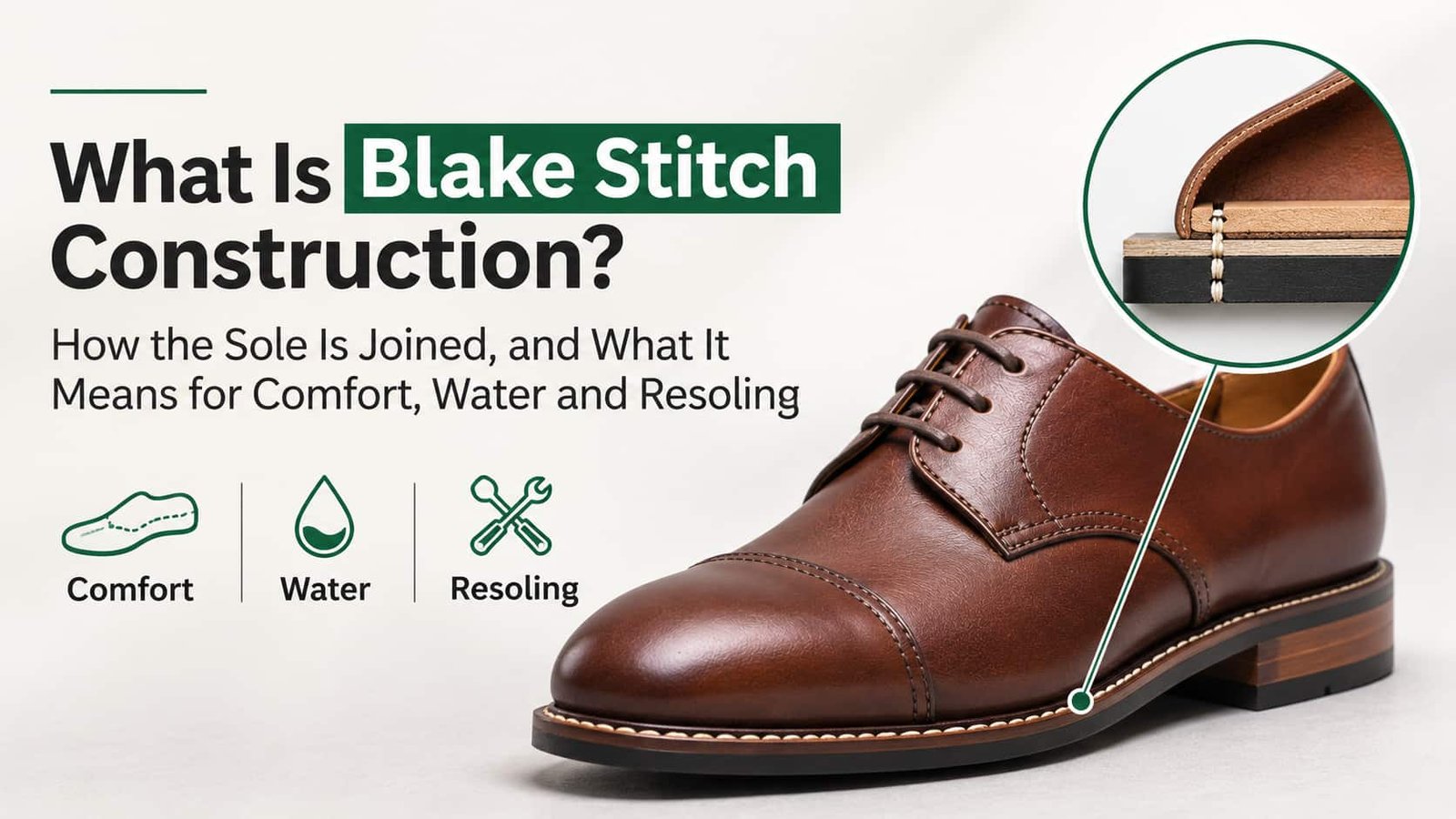
A Blake stitch is one of the oldest and simplest of these methods. Wikipedia’s entry on the method explains that the outsole is directly stitched to the insole with a chain stitch. That single step gives the shoe more flexibility and a lighter weight than the sturdier Goodyear construction, which is more common among British shoemakers.
The key idea is directness. In a Blake stitch, the stitch line runs through the sole, the upper and the insole, so it is visible on the inside of the shoe rather than along the outside edge. That is why many people describe Blake shoes as having a slimmer profile and a softer feel from the first wear.
For a wider view of the parts involved, our anatomy of a shoe guide explains the insole, upper, midsole and outsole, and our shoe construction methods overview compares the main techniques side by side.
A Short History
Blake construction is named after Lyman Reed Blake, who invented the method in 1856, according to Wikipedia. The technique spread through the American and European shoe trades in the decades that followed, and it remains especially popular in Italy, which is a major centre of fine leather footwear.
Blake stitching was valued for its speed and efficiency in factories, because a single stitch could join the sole to the shoe. Later variations sped up the process further, and the method continued to appear in both mass-market and premium footwear.
Two points are worth keeping in mind. First, the date and inventor come from encyclopaedic and historical sources, so they are well established. Second, the method’s popularity has shifted over time, and today it is most associated with shoes that aim for a sleek silhouette and a lighter build.
How a Blake Stitch Is Made
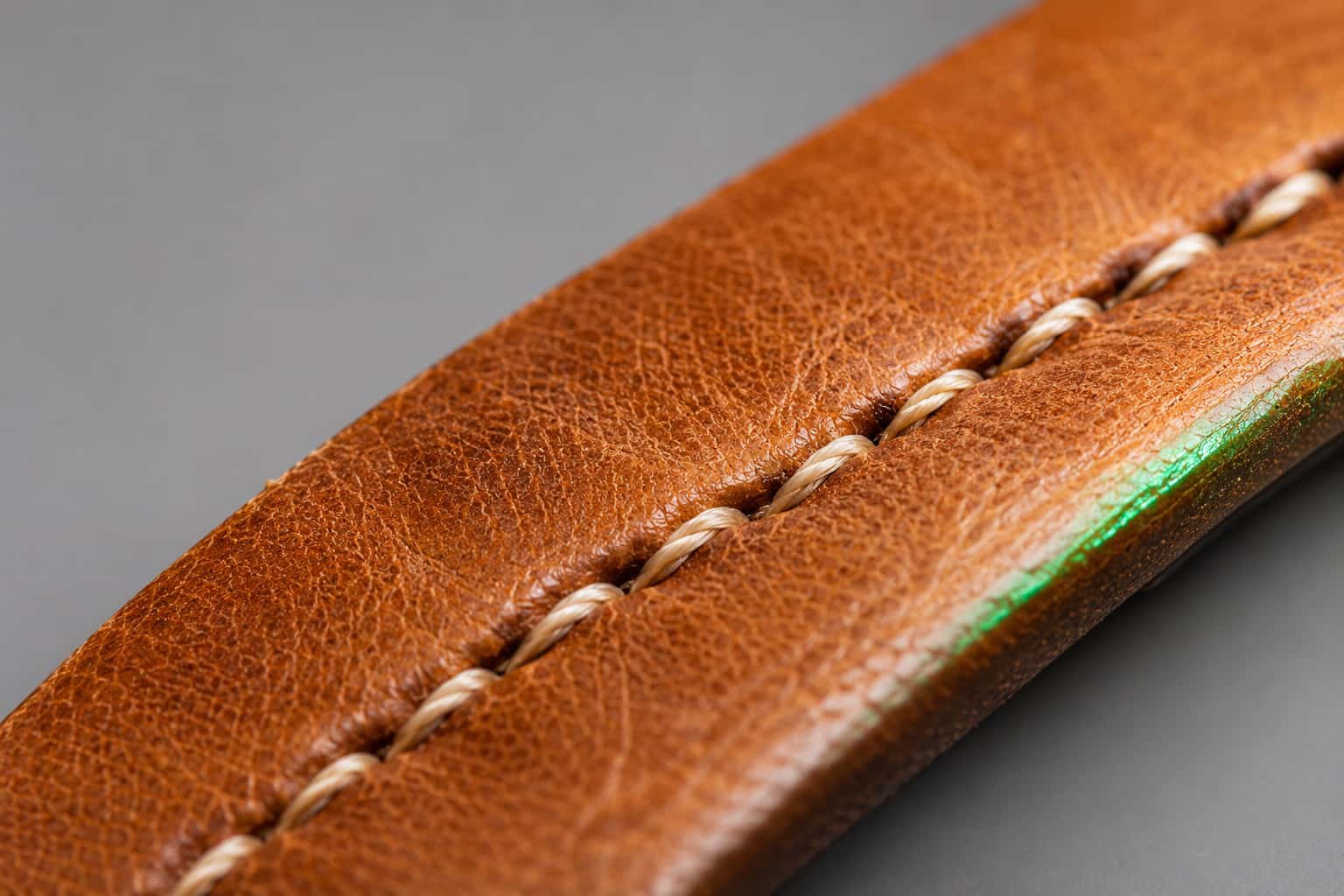
The process is best understood in stages. The upper is attached to a last, the wooden form the shoe is built around. The upper’s edge is then folded over and attached to the insole, which lies beneath the foot. The outsole is positioned underneath, and a single chain stitch passes through the outsole, the upper and the insole to hold the whole assembly together.
Commentators on the method describe the result in similar terms. Permanent Style’s defence of Blake construction, for example, notes that the upper is folded over at the edge and sewn directly onto the sole. Primer Magazine’s guide explains that for a Blake welt, the upper is wrapped around the insole and attached between the insole and outsole, with a single stitch holding everything together.
Because there is no separate welt strip, the stitch line sits in the interior of the shoe. This is the central difference from Goodyear construction, where a leather welt runs around the base and the stitching sits on the outside. Our guide to cemented construction describes another approach that skips stitching altogether.
Blake Stitch, Blake Rapid and Variants
Search results and retailer guides often refer to Blake Rapid as well as Blake stitch. Stridewise, which covers footwear construction, discusses Blake Rapid as a streamlined option that is lighter and more slender in profile, and suggests it may suit readers who want that look.
Bespoke Unit’s comparison table lists Blake/Rapid separately from Blake stitch, rating its durability and water resistance more highly than standard Blake and its resoling as moderate rather than difficult. The table is a retailer’s summary rather than a formal test, so treat its ratings as one perspective.
For buyers, the practical point is that the names do not always mean the same thing. Check the product description for how the shoe is constructed, and ask the seller if the description is unclear. Look for the words “Blake stitched” or “Blake rapid” in the listing, and for any statement about resoling.
Comfort, Flexibility and Break-In
Comfort is where Blake construction tends to win. Because it uses fewer layers than a Goodyear welt, it bends more easily and moves with the foot. The Jones Bootmaker comparison lists lightweight, flexible shoes that break in faster and feel softer on the foot as advantages of Blake stitching.
Realmenrealstyle’s guide to Goodyear welts makes a related point: the stitching sits on the inside of a Blake shoe, and many wearers find that more comfortable against the foot. That observation is a matter of personal experience rather than a measurement, so it is best read as a common view.
Break-in is a practical question. A Blake-stitched shoe often feels comfortable sooner, because the structure is less stiff. A Goodyear welt usually needs more wear before it softens, which some buyers accept in exchange for the structure that follows.
Fit still matters more than construction. A Blake shoe with a poor last will feel uncomfortable, however light it is. Our shoe finder can help you narrow options by use case, and a qualified fitter can assess your foot shape in person.
Water Resistance: The Main Trade-Off
Water resistance is the trade-off most sources highlight. Stridewise’s Goodyear and Blake comparison describes Goodyear as the stronger option for water resistance, and Jones Bootmaker lists poorer water resistance as a disadvantage of Blake stitching because of the internal stitching.
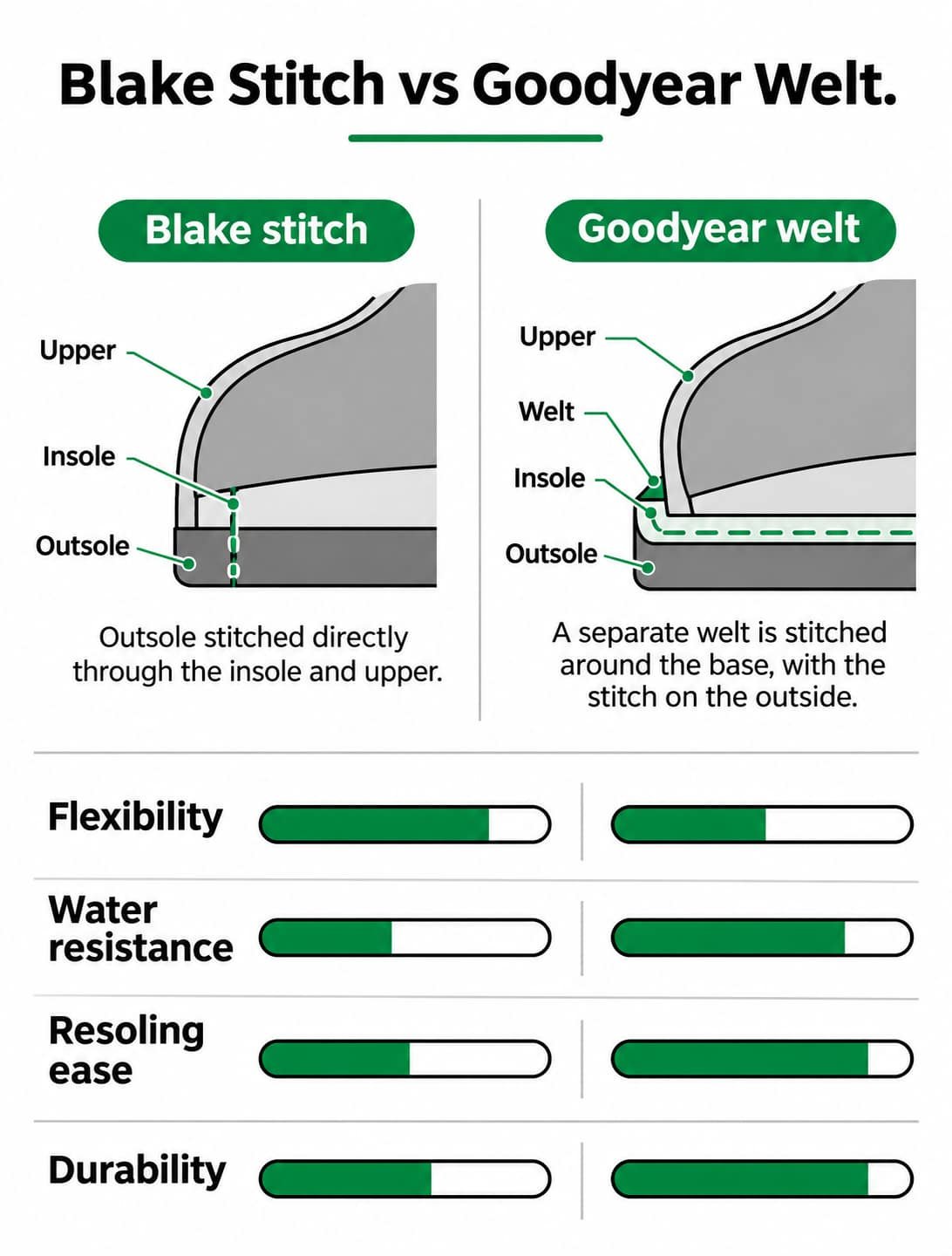
The reasoning is structural. In a Goodyear welt, the welt strip forms a barrier between the outsole and the upper, and the stitching sits outside that barrier. In a Blake stitch, the stitch line runs through to the interior, so there is a potential route for moisture. Primer Magazine and Bespoke Unit describe this in similar terms.
It is worth being precise. Water resistance depends on several factors at once, including the leather, the lining, how the sole is bonded and how the shoe is maintained. Stridewise’s 2024 comparison also notes that construction is only one part of the picture. A well-finished Blake shoe in a sensibly chosen leather can still handle light rain, while a Goodyear welt in a thin leather may not perform as well as expected.
For readers who live in wet climates, or who walk on wet ground often, a Goodyear welt is generally the safer choice. For dry, mild conditions and indoor-leaning use, a Blake stitch can be a comfortable and sensible option. Our guide to how waterproof shoes work explains why water resistance and waterproofing are different.
Durability and Resoling
Durability depends on how a shoe is made, what it is made from and how it is looked after. Bespoke Unit rates Goodyear welt’s durability as excellent and Blake stitch’s as good, and Stridewise’s 2024 comparison describes Goodyear as the stronger option for durability, solidity and longevity. Those are comparative judgements from retail and editorial sources, not measured test results.
Resoling is the strongest argument for both methods. Blake stitching allows resoling once the outsole is worn, and Jones Bootmaker lists the ability to repair and resole with specialist tools as an advantage. Primer Magazine adds the practical catch: a Blake sole needs a Blake machine to be resoled, which makes the process more difficult and, in some cases, more expensive than resoling a Goodyear welt.
Goodyear welts are easier to repair, because the outsole can be removed and a new one stitched to the existing welt. Bespoke Unit describes Goodyear resoling as easy and Blake as difficult, and the difference is largely about tools and the availability of a cobbler who has the right machine.
Practical steps help any shoe last. Rotate pairs, use shoe trees to hold the shape, and have worn soles repaired before the upper is damaged. Our guide to how to resole shoes explains the process and what to ask a cobbler, and our shoe care guide covers leather care.
Blake Stitch vs Goodyear Welt
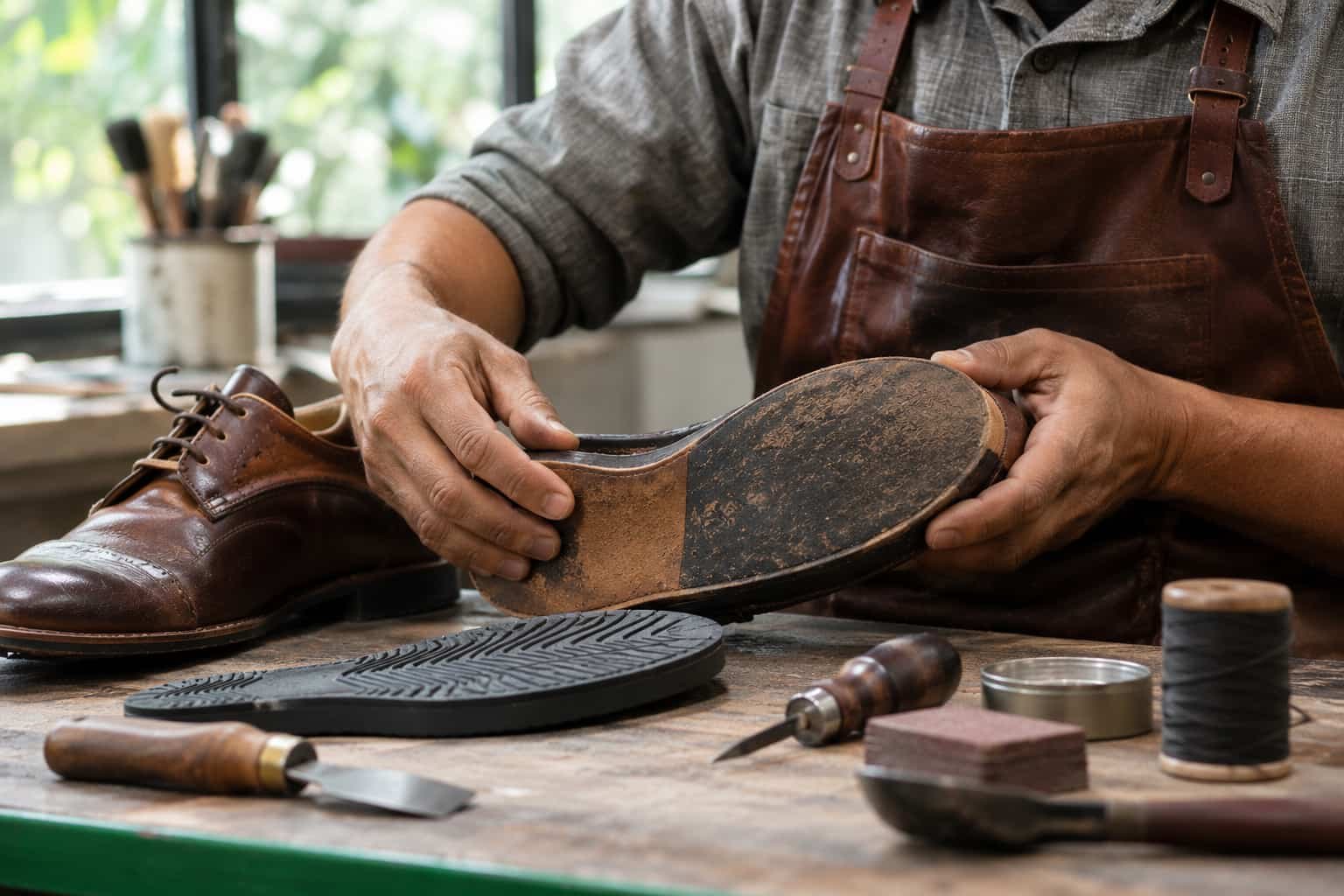
The table below brings together the points the sources agree on. Ratings are relative and drawn from retailer and editorial comparisons, so treat them as a guide rather than a measurement.
| Feature | Blake stitch | Goodyear welt |
|---|---|---|
| How the sole is joined | Single chain stitch through the sole, upper and insole | Stitched to a separate leather welt strip |
| Weight and flexibility | Lighter, more flexible | Sturdier, heavier, less flexible |
| Break-in | Typically quicker | Typically slower |
| Water resistance | Generally rated lower | Generally rated higher |
| Durability | Good (per retailer comparison) | Excellent (per retailer comparison) |
| Resoling | Possible, needs a Blake machine | Easier, standard cobbler work |
| Typical price | Often lower | Often higher, reflecting labour |
The comparison also shows that the right choice depends on priorities. A Blake stitch favours comfort and a sleek profile. A Goodyear welt favours structure, water resistance and ease of repair.
Blake Stitch vs Cemented Construction
Cemented construction is a different approach. Rather than stitching the sole, the manufacturer glues it in place. Bespoke Unit’s comparison rates cemented construction as having poor durability, poor water resistance and no practical resoling, but excellent flexibility. The retailer’s table presents this as a clear trade-off: low cost and light weight in exchange for limited repairability.
Blake stitching sits between the two. It is more durable than cemented construction and can be resoled, but it is less water resistant than Goodyear welt. For readers who want a shoe that can be repaired and kept for years, a Blake stitch is generally a stronger option than a cemented shoe.
Our cemented shoe construction guide covers that method in more depth.
Pros and Cons
Advantages
- Lightweight and flexible, with a slimmer profile
- Breaks in faster and often feels softer from the first wear
- Resoleable, with specialist tools
- Often more affordable than a Goodyear welt
Disadvantages
- Lower water resistance because the stitch runs into the interior
- Resoling needs a Blake machine, which not every cobbler has
- Generally less suited to heavy use or wet conditions
These points are consistent across the sources reviewed. The balance depends on how you use the shoe.
Who Should Choose Blake Stitched Shoes?
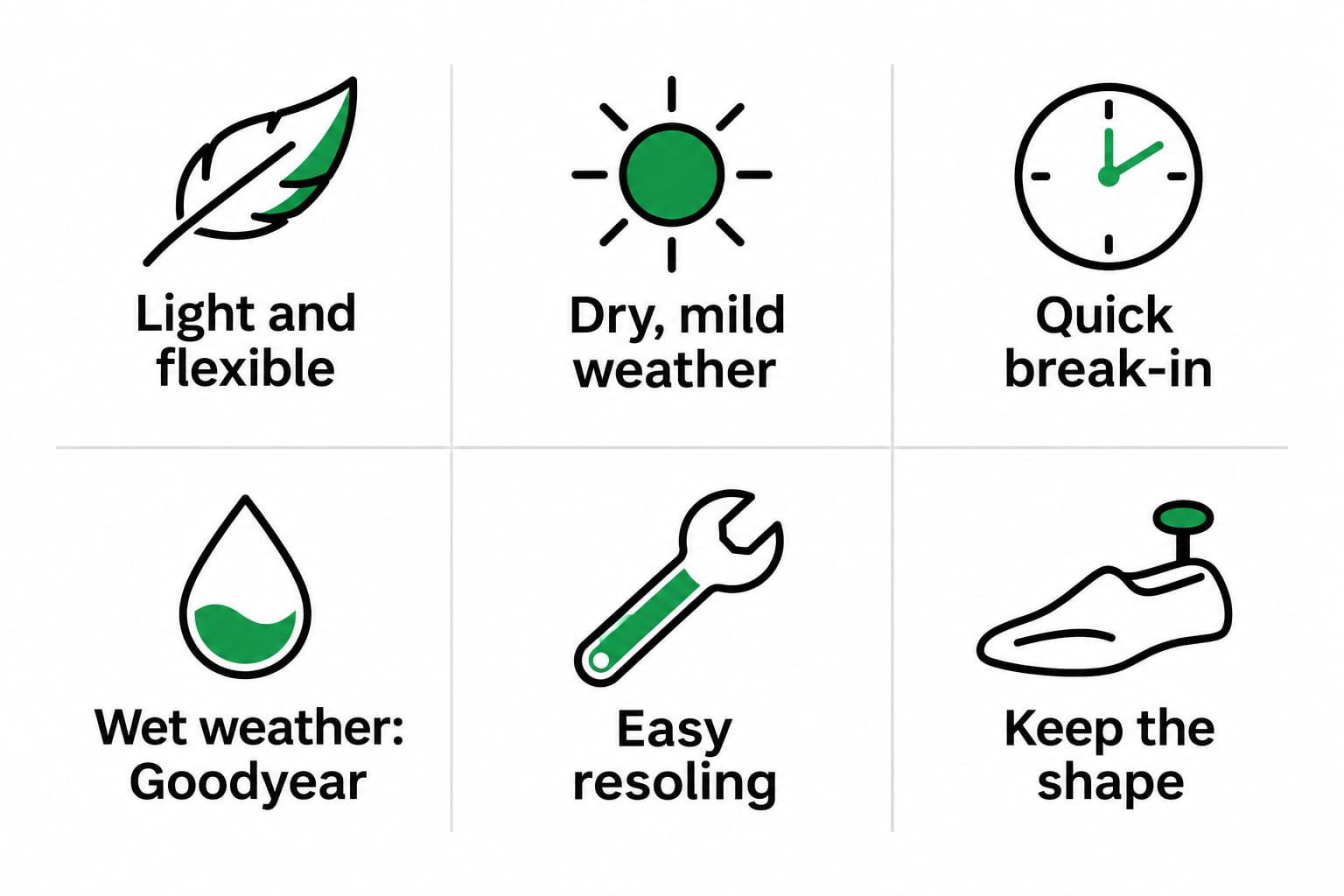
Choose a Blake stitch if you want a slim, flexible shoe for dry or mild conditions, you value a quick break-in, you wear the shoe mainly in smart or indoor settings, or you want a repairable shoe at a lower price than a Goodyear welt.
Choose a Goodyear welt if you walk in rain or on wet ground often, you want the most durable option you can resole with standard tools, or you prefer a structured shoe that will keep its shape over many years.
Consider the sole and leather too. A thin, unlined Blake shoe in a delicate leather will behave differently from a well-made Blake shoe with a bonded sole and a sound lining. Check the materials, and our full-grain versus top-grain guide explains how leather grade affects wear.
Budget carefully. Blake shoes are often cheaper than Goodyear welts, but price alone does not indicate quality. Compare the price per wear you expect, including the cost of resoling.
Anyone with specific foot concerns should consult a podiatrist or qualified shoe fitter before choosing a shoe. This article does not offer medical advice.
For how our comparison content is prepared, see our methodology page.
Common Myths
Myth: Blake stitched shoes cannot be resoled. Sources agree that they can be resoled, though the work needs a specialist machine.
Myth: Blake construction is cheap construction. The method is a long-established, deliberate choice, and Blake shoes are often made by well-regarded makers. Price depends on many factors beyond construction.
Myth: A Blake stitch is always less durable than a Goodyear welt. Retailer comparisons rate Goodyear as more durable, but durability also depends on leather, lining and care.
Myth: Blake stitching is the same as Blake Rapid. Search results and retailer guides treat Blake Rapid as a related but distinct variant, so check the listing.
Myth: Stitch placement makes a shoe waterproof. Stitch placement affects water resistance, but it does not make any shoe fully waterproof. Our waterproof versus water-resistant guide explains the difference.
Frequently Asked Questions
What is Blake stitch construction?
It is a shoe construction method in which the outsole is stitched directly to the insole with a single chain stitch that also runs through the upper. It produces a lighter, more flexible shoe than Goodyear welting.
Who invented Blake stitching?
Wikipedia credits Lyman Reed Blake, who invented the method in 1856.
Are Blake stitched shoes water resistant?
Generally less than Goodyear-welted shoes, because the stitching runs into the interior. Leather, lining and sole bonding also affect performance.
Can Blake-stitched shoes be resoled?
Yes, but the work usually needs a Blake machine, which not every cobbler has. Goodyear welts are generally easier to resole.
Is a Blake stitch more comfortable than a Goodyear welt?
Many wearers find Blake shoes softer and quicker to break in, because they are less stiff. Comfort also depends on fit and the shoe’s last.
What is the difference between Blake stitch and Blake Rapid?
Sources treat Blake Rapid as a related variant, often described as slimmer and more streamlined. Check each product’s description for the construction used.
Is Blake stitching better than cemented construction?
For repairability and durability, Blake stitching generally rates higher than cemented construction, which is typically rated as hard to repair. Cemented shoes are often lighter and cheaper.
Final Verdict
Blake stitch construction joins the outsole directly to the insole with a single chain stitch, producing a lighter, more flexible shoe with a slimmer profile. Its main trade-offs are lower water resistance than Goodyear welting and a more specialised resoling process. For dry conditions, comfort and a quicker break-in, it is a strong choice. For wet weather and the greatest ease of repair, a Goodyear welt is usually the better option.
Before you buy, check how the shoe is constructed, the leather and lining, and whether the seller can recommend a cobbler who can resole it. Choose the construction that matches the way you will wear the shoe, and try the fit before you commit.
Sources
- Wikipedia. Blake construction. en.wikipedia.org/wiki/Blake_construction
- Stridewise. Goodyear Welt vs. Blake Stitch vs. Cement: Which is Best? (updated August 2024) stridewise.com/?p=73
- Bespoke Unit. Shoe Construction Methods at a Glance. bespokeunit.com/shoes/construction
- Jones Bootmaker. Blake Stitch vs Goodyear Welt: What’s the Difference & Which Is Better? (9 May 2025) jonesbootmaker.com/blogs/blake-stitch-vs-goodyear-welt
- Primer Magazine. Understanding Shoe Construction: Goodyear Welt, Blake Stitch & Cementing (2014) primermagazine.com
Comparative ratings come from retailer and editorial sources and are not laboratory measurements.


