
What Is Full Grain Leather? Why It Lasts Longest in Shoes
Short answer: Full grain leather is leather that keeps the hide’s original outer surface, the “grain”, with nothing sanded, buffed or split away. Because the tightest, most water-resistant fibers stay in place, it is the toughest and longest-lasting leather you can put on a shoe. It also breathes, molds to your foot and develops a patina with age. In shoes it usually comes from cattle hide and runs about 1.0 to 2.2 mm thick.
Key takeaways
- Full grain describes the surface, not the whole quality. It means the grain was not sanded off. The tannery, the finish and the shoe’s construction matter just as much.
- It is real leather, and usually cowhide. Bovine hides made up about 75% of the world’s light leather by area in FAO’s market review.
- It is the most durable upper leather because it keeps the full fiber structure, but the grain surface itself is easy to scratch and needs care.
- “Full grain” is not a legal grade. EU and UK shoe labels only say “leather” or “coated leather”. In the US, the FTC says leather type and grade must not be misrepresented, but it does not define “full grain”.
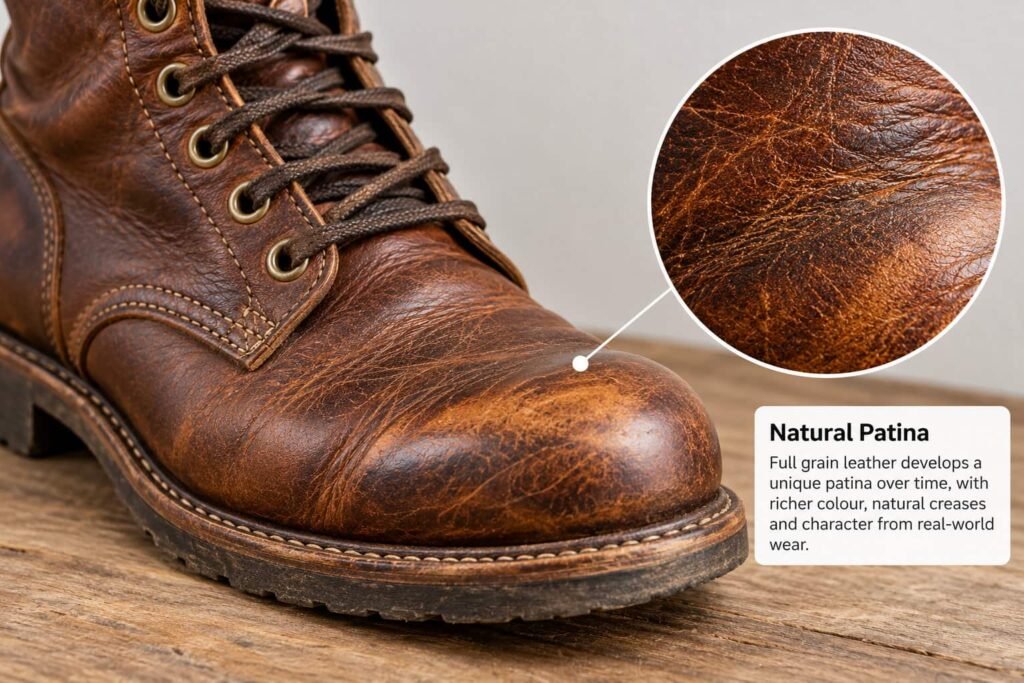
- You can spot it by visible pores, small natural marks, fine creasing and a slight change in color when you press a drop of water onto a hidden spot.
What does full grain leather mean?
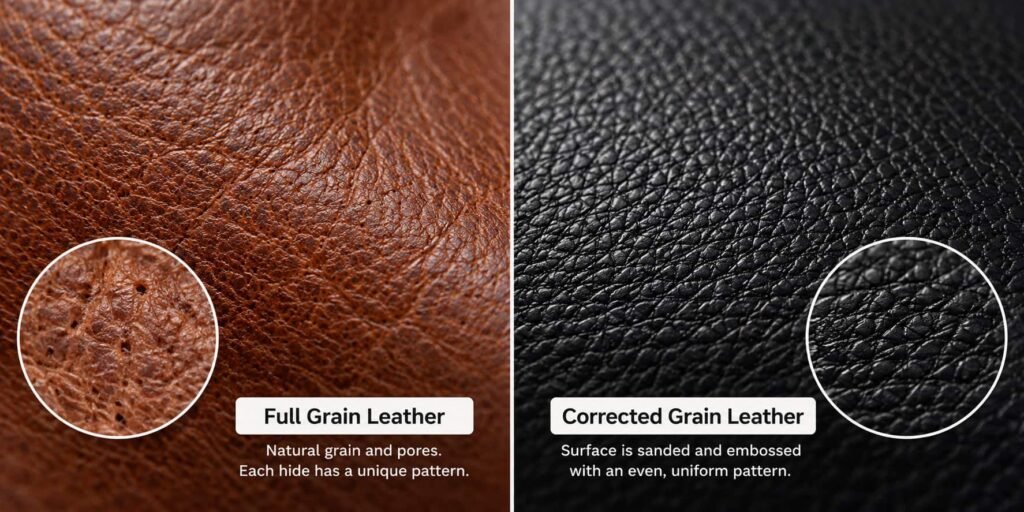
Every hide has layers, a bit like the rings of a tree. The very top, just under where the hair grew, is the grain. It is a thin, dense layer of tightly packed collagen fibers with the animal’s natural pores, wrinkles and marks. Below it is the corium, a thicker layer of looser, interwoven fibers that gives leather its body.
Full grain leather keeps that top grain exactly as nature made it. The hair is removed and the hide is tanned, but the surface is not sanded, buffed or corrected. The industry body Leather Naturally puts it simply: full grain is “leather with the grain (surface) intact” [1].
Compare that with:
- Snuffed or top grain leather: the surface is lightly sanded to even it out and reduce defects [1].
- Corrected grain leather: the surface is sanded more heavily, then usually coated and embossed with an artificial grain pattern [1].
- Split leather: the lower layer cut away from the grain. It becomes suede or is coated to look smooth [1].
So when a shoe says “full grain”, it is telling you one specific thing: nobody sanded off the best part.
Where the grain sits in the hide
| Layer | What it is | What it becomes |
|---|---|---|
| Grain (top) | Dense, tight fibers with pores and natural marks | Full grain leather (kept intact), or top grain and corrected grain (if sanded) |
| Grain and corium junction | Where the tight grain meets looser fibers | Usually kept with the grain on shoe leather |
| Corium (middle) | Thick layer of interwoven fibers, the “body” | Stays attached to full grain, or is split off |
| Flesh split (bottom) | Loosest fibers from the inner side | Suede, finished split, PU-coated split, “genuine leather” goods |
What is full grain leather made of? (Which animal?)
Full grain is a type of cut, not an animal, so in theory it can come from any hide. In practice, most full grain shoe leather is cattle hide. In FAO’s global hides and skins review, bovine leather made up about 13.8 billion of the roughly 18.5 billion square feet of light leather produced each year between 2004 and 2007. That is about 75% [2]. Sheep and goat made up most of the rest.
What you will see on shoes:
| Leather | Animal | Typical use in shoes |
|---|---|---|
| Calfskin | Young cattle | Fine dress shoes. Tight, smooth grain |
| Cowhide / steerhide | Adult cattle | Boots, work boots, casual shoes |
| Kid / goatskin | Goat | Soft, light shoes and linings |
| Pigskin | Pig | Mostly linings (visible pore clusters) |
| Shell cordovan | Horse (rump membrane, not true grain) | Premium dress shoes. See our guide to shell cordovan |
Do animals need to be killed for leather? Cattle hides used for shoes are mainly a by-product of animals raised for meat, which is why hide supply follows meat production rather than leather demand [2]. If you avoid animal products for ethical reasons, look at our guide to vegan leather.
Where full grain sits among leather types (top grain, genuine, bonded)
You have probably seen the “leather grades” ladder: full grain at the top, then top grain, then genuine, then bonded. It is useful as a rough guide to how much of the hide’s surface is left. But it is not an official grading system.
North Star Leather, a US leather goods maker since 1969, points out that you will not find this list “in use by any major tannery, leather trade organization or government entity” [3]. A long-running r/BuyItForLife discussion reaches the same conclusion. Full grain only tells you the hide wasn’t buffed or smoothed. It does not tell you how well it was tanned or finished.
Here is how the common terms compare:
| Term | What was done to the surface | Durability in shoes | Typical shoes |
|---|---|---|---|
| Full grain | Nothing removed | Highest | Quality boots, dress shoes |
| Top grain | Lightly sanded, finished | High | Mid-price dress shoes and sneakers |
| Corrected grain | Heavily sanded, coated, embossed | Medium | Budget dress and uniform shoes |
| Split / suede | Lower layer, no grain | Lower | Suede uppers, linings |
| “Genuine leather” | Real leather, often a finished split | Varies, often low | Budget shoes and belts |
| Bonded leather | Shredded leather fibers glued into sheets | Lowest | Rarely shoes, mostly cheap accessories |
For the full head-to-head, read full grain vs top grain leather. For the lower end of the ladder, see what is genuine leather and what is top grain leather.
From the shop floor: buyers often assume a shiny, perfectly even leather is the expensive one. With full grain it is usually the opposite. A few small marks and visible pores are a sign that the surface is real and was not covered up.
Why full grain leather lasts longest in shoes
1. It keeps the full fiber structure
A shoe upper bends at the toe thousands of times a day. Full grain leather keeps both the dense grain and the full corium underneath. Nothing has been sanded off the top and nothing split from the middle. That complete structure is what lets it flex, crease and recover for years.
2. The grain surface resists water and wear
The grain’s tightly packed fibers shed light rain and dirt better than sanded or split surfaces, which have opened fibers. That is why work boots and hiking boots so often use full grain or oiled full grain.
3. It can outlive several soles
On a stitched shoe, such as a Goodyear welted boot, the sole can be replaced while the upper carries on. Full grain uppers are the reason resoling makes financial sense. A corrected grain upper often cracks or peels around the time the first sole wears out.
4. It is thick enough to hold its shape
Leather Naturally gives typical shoe leather thickness as about 1.0 to 1.4 mm for women’s shoes and 1.4 to 2.2 mm for men’s shoes [1]. Full grain at these thicknesses keeps its shape on the last, the mold the shoe is built on, and molds to your foot instead of stretching out of shape.
The surprising part: the grain is also the most delicate layer
Here is a detail most “full grain is best” articles skip. In a 1996 study in the Journal of Materials Science, researchers tore apart the two layers of cattle leather separately. The grain layer had only about 20% of the tearing energy of the corium beneath it (13.3 vs 63.8 kJ/m²). Cuts in the grain also spread much more easily [4].
What does that mean for your shoes?
- Full grain is strong because the grain and corium work together. Split leather loses that partnership.
- The grain surface is the part that scratches and scuffs, and a deep cut in it can spread. That is why scuff care and conditioning matter so much for full grain shoes. Our guide to fixing scuffed leather shoes covers it step by step.
Full grain leather pros and cons
| Pros | Cons |
|---|---|
| Most durable upper leather, can last for years with resoling | Costs more than top grain, corrected grain or synthetics |
| Breathes, especially with a light or aniline finish | Shows scratches and water marks more easily |
| Molds to your foot over time | Usually needs a short break-in period |
| Develops an attractive patina instead of looking “worn out” | Needs regular cleaning and conditioning |
| Can be repaired, polished and re-dyed | Heavier than mesh, knit or synthetic uppers |
| Natural marks prove authenticity | Not vegan |
Is full grain leather good quality? Usually, yes, but not automatically. A full grain hide from a poor tannery, with heavy defects hidden under thick paint, can perform worse than a well-made corrected grain leather from a top tannery [3]. Look at the brand, the finish and the construction as well as the label.
Full grain aniline, semi-aniline and pigmented: the finish matters
This is the gap in almost every guide. “Full grain” tells you about the surface. The finish tells you how much of that surface you can actually feel. The Leather Research Laboratory at the University of Cincinnati defines the three main finishes [5]:
| Finish | Definition | Feel and look | Breathability | Care |
|---|---|---|---|---|
| Aniline | “Leather that has not received any coating of pigmented finish” | Most natural, shows every mark, deep patina | Best | Highest, stains easily |
| Semi-aniline | Aniline dyed with “a small quantity of pigment” | Natural look with more even color | Good | Medium |
| Pigmented | A finish with pigment particles that make it “completely opaque” | Even, uniform, less patina | Lower | Lowest, wipes clean |
Finishing has a measurable effect. A 2013 study on shoe linings and insoles found that liquid-based and final finishing “deteriorate hygienic properties of natural leather to a great extent” [6]. Those properties include breathability and moisture handling.
Practical takeaway: if you want full grain leather for comfort and breathability, look for full grain aniline or semi-aniline. If you want easy care and stain resistance, a pigmented full grain is fine, but expect less patina.
How to tell if shoes are full grain leather
You don’t need special tools. Use these checks together, not just one.
- Read the label and description. “Full grain leather upper” should be stated clearly. Vague phrases like “leather” or “genuine leather” alone usually mean a lower grade. In the US, the FTC Leather Guides cover footwear and treat misrepresenting the kind or grade of leather as misleading [7].
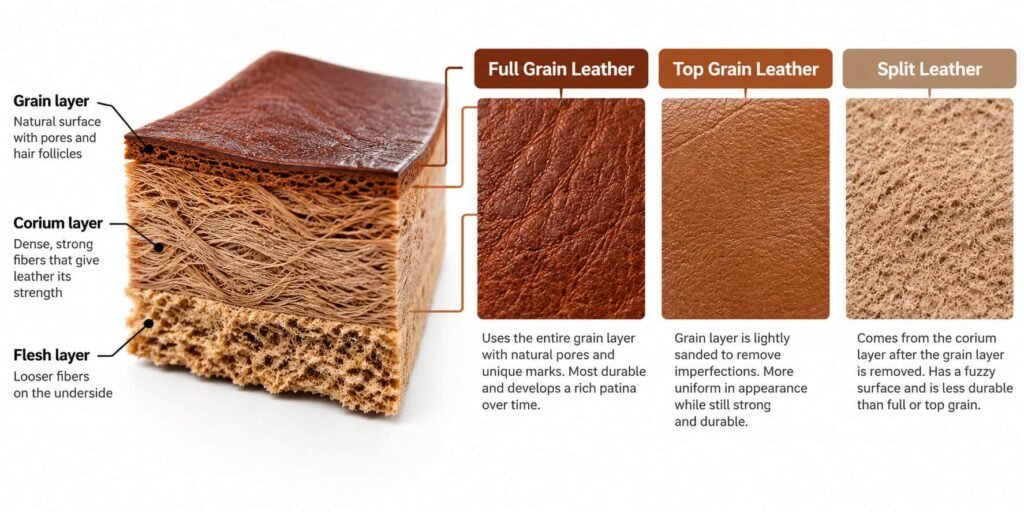
- Look for pores. Full grain shows tiny, irregular pores and small natural marks. A perfectly regular pattern is often embossed corrected grain.
- Check consistency across the shoe. Natural grain varies slightly between the toe, the sides and the heel. Embossed leather looks identical everywhere.
- Bend the toe. Full grain forms fine, soft wrinkles that relax. Heavily coated leather forms sharper creases and can crack along them over time.
- Do the water drop test on a hidden spot. Aniline and lightly finished full grain will darken slightly as it absorbs a small drop. Heavily pigmented or coated leather beads it off. Blot it dry straight away.
- Look at an edge. Inside the collar or around the eyelets, real leather shows a fibrous edge. Synthetics show a fabric backing.
- Rub gently with your thumb. Many aniline full grain leathers show a slight color change or “pull-up” where you press.
For a photo walk-through of these checks, and how to spot fakes, see how to tell if shoes are real leather.
Is full grain leather worth it for your shoes?
It depends on what you wear the shoes for.
| Shoe type | Is full grain worth it? | Why |
|---|---|---|
| Dress shoes for work | Yes | Worn often, polished often, lasts years with resoling |
| Leather boots and work boots | Yes | Best abrasion and water resistance, molds to the foot |
| Everyday leather sneakers | Often | Lasts longer, but top grain is a fine budget choice |
| Running and gym shoes | No | Mesh and knit are lighter and breathe better |
| Kids’ shoes | Usually not | Kids outgrow shoes long before full grain wears out |
| Shoes for occasional events | Optional | Top grain or corrected grain will cope with light use |
| Hot, humid climates | Yes, choose aniline or unlined | Breathes better than coated leathers |
What does a “6 oz full grain leather” mean? Leather thickness is often given in ounces, where 1 oz is about 1/64 inch or 0.4 mm [8]. A 6 oz leather is about 2.4 mm thick, which is boot or belt territory. Most shoe uppers sit around 2.5 to 5.5 oz (1.0 to 2.2 mm), based on the thickness ranges above.
How to care for full grain leather shoes
Full grain rewards care more than any other leather. A simple routine keeps it supple and crack-free.
| When | What to do |
|---|---|
| After every wear | Brush off dust with a horsehair brush. Insert cedar shoe trees. |
| Weekly (daily wear) | Wipe with a damp cloth, let it dry naturally. |
| Monthly | Clean with a leather cleaner, then condition. |
| As needed | Polish for shine and scuff cover. |
| Before wet seasons | Apply a wax or waterproofing treatment. |
| When wet | Stuff with paper and dry at room temperature, never on a heater. |
| Storage | Cool, dry and ventilated, with shoe trees. See how to store leather shoes. |
Common mistakes:
- Drying on a radiator or in direct sun. It shrinks and cracks the grain.
- Over-conditioning. Too much oil softens the leather and attracts dirt.
- Using harsh cleaners or baby wipes with alcohol.
- Wearing the same pair every day. Leather needs about a day to dry out from foot sweat.
Full step-by-step guide: how to clean leather shoes.
Myths about full grain leather
Myth: Full grain means it is the best leather. It means the surface is intact. Quality also depends on the hide selection, the tanning, the finish and how the shoe is built [3].
Myth: Full grain never scratches. The grain is actually the most delicate layer and can scuff easily [4]. The good news is that full grain scratches can usually be buffed out or polished over.
Myth: Full grain is waterproof. It is water resistant, especially with wax or oil, but untreated full grain will soak through in heavy rain.
Myth: Marks and scars mean it is defective. Small natural marks are often proof it is real full grain. Heavy defects are a different matter, so check the high-wear areas like the toe.
Myth: Full grain leather shoes do not need breaking in. Firm full grain often needs a few days of wear to soften and shape to your foot.
Frequently asked questions
Is full grain leather real leather?
Yes. Full grain leather is real animal hide, usually cattle, with its natural outer surface left intact. It is the least processed form of smooth leather.
What is better, full grain or top grain leather?
Full grain lasts longer, breathes better and develops a patina. Top grain is sanded smooth, so it looks more uniform, resists stains better and costs less. For shoes you will wear for years, full grain is usually the better buy. See full grain vs top grain.
What animal does full grain leather come from?
Most often cattle (calfskin, cowhide, steerhide). Goat, sheep and pig skins can also be full grain. Bovine hides made up about three-quarters of the world’s light leather by area in FAO’s market review [2].
What is the highest quality leather?
For shoe uppers, full grain calfskin from a reputable tannery is generally considered the top everyday choice. Shell cordovan, made from horse hide, is a premium specialty leather prized for dress shoes.
What is the difference between full grain leather and genuine leather?
Full grain keeps the hide’s top surface intact. “Genuine leather” only means the product is real leather. In shoes it often refers to a lower layer or a heavily corrected surface, so it is usually lower quality.
How do I tell if my leather is full grain?
Look for natural, irregular pores and small marks, soft fine creasing at the toe, and a slight darkening when a drop of water touches a hidden spot. A perfectly uniform embossed pattern suggests corrected grain.
What are the three grades of leather?
The terms most people mean are full grain, top grain and genuine (sometimes with bonded as a fourth). These are trade descriptions rather than an official grading standard [3].
What is the lowest quality leather?
Bonded leather. It is made from leather scraps and fibers glued or pressed into a sheet. The FTC says bonded leather should not be called leather without disclosing its leather and non-leather content [7].
What is full grain aniline leather?
Full grain leather that is dyed but has no pigmented coating on top [5]. It is the most natural looking and breathable finish, but also the most prone to stains.
What is corrected grain leather?
Leather whose surface has been sanded heavily to remove defects, then usually coated and embossed with an artificial grain [1]. It is cheaper and easier to care for, but less breathable and less long-lasting than full grain.
Is full grain leather good for shoes and boots?
Yes. It is the most durable and breathable leather for uppers, which is why quality boots and dress shoes use it. It needs regular conditioning to stay supple.
Does full grain leather crack?
It can, if it dries out. Heat, sun and lack of conditioning are the main causes. Regular conditioning prevents it. If yours has already cracked, see how to fix cracked leather shoes.
What is 100% leather called?
There is no official “100% leather” grade. In practice, people usually mean the product is real leather throughout, not bonded or synthetic. Full grain is the version where the natural surface is also intact.
Related guides
- Shoe Materials Explained: the complete guide
- Full grain vs top grain leather
- What is top grain leather?
- What is genuine leather?
- How to tell if shoes are real leather
- Chrome vs vegetable tanned leather
- What is nubuck?
Sources
- Leather Naturally, Guide to Leather Making, Part Three: Modern Cow Leather Processing (2023).
- FAO, Global Hides and Skins Market: Review of 2004 to 2007 and Prospects for 2008.
- North Star Leather, The “Grades of Leather” hierarchy you’ve probably read about is a Myth (2018).
- O’Leary, D.N. and Attenburrow, G.E., Differences in strength between the grain and corium layers of leather, Journal of Materials Science 31 (1996) 5677 to 5682.
- Leather Research Laboratory, University of Cincinnati, Aniline, Semi-Aniline and Pigmented Leather.
- Level of Comfort: Artificial and Natural Shoe Materials. A Comprehensive Assessment, Key Engineering Materials (2013).
- eCFR, 16 CFR Part 24, Guides for Select Leather and Imitation Leather Products.
- Tandy Leather, Leather Weights and Thickness Chart.