
International Shoe Size Chart (All Countries)
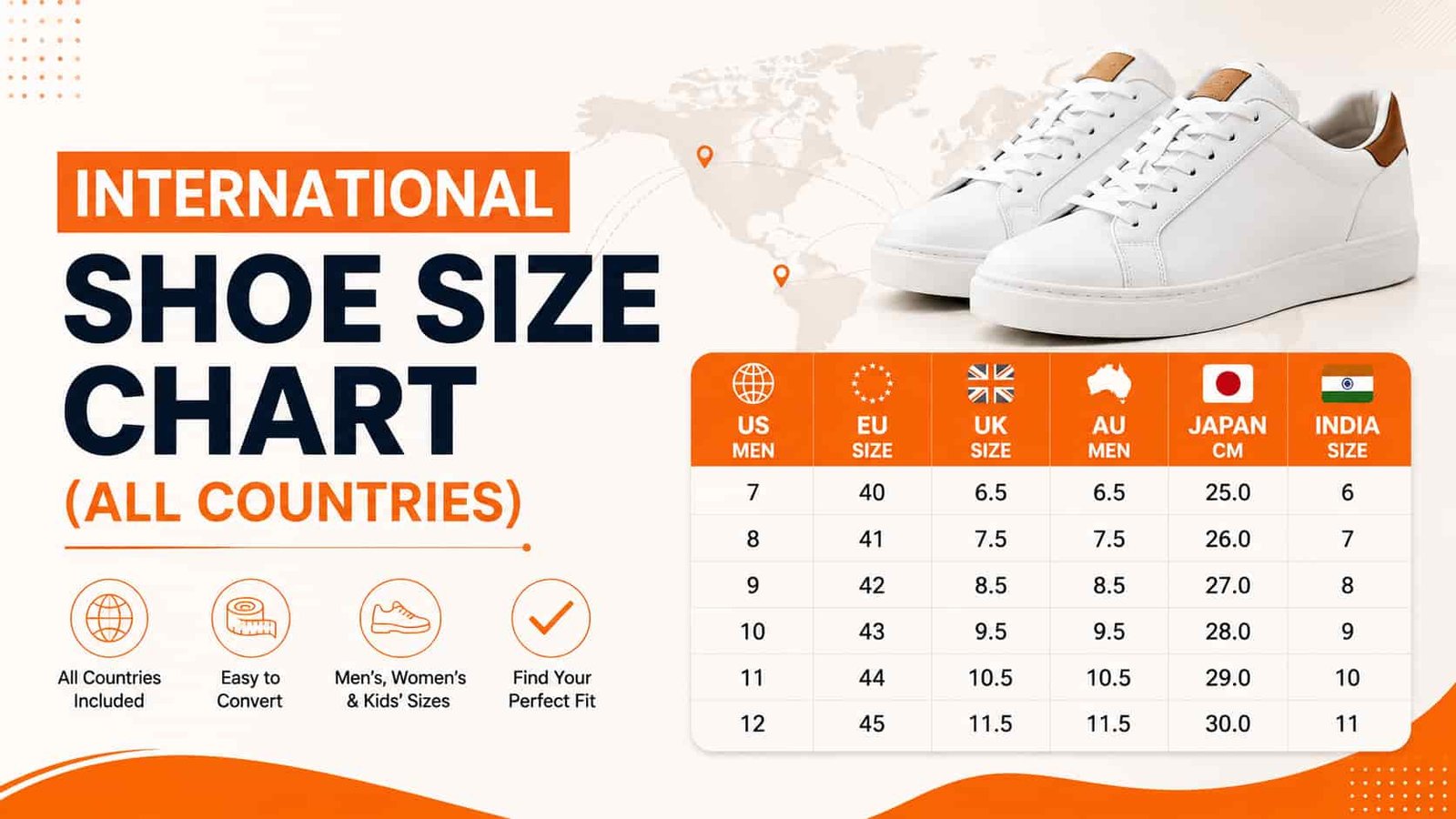
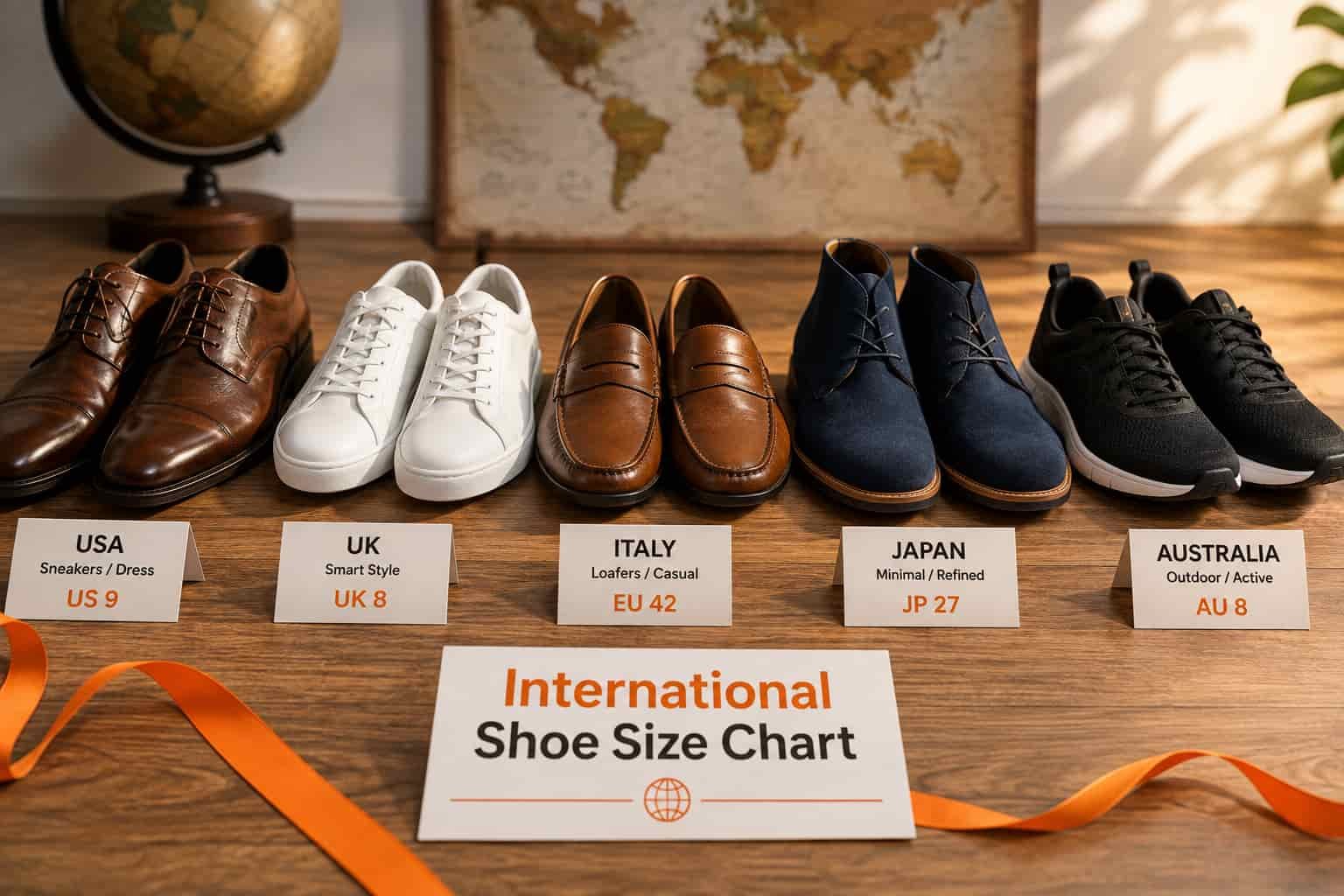
An international shoe size chart lines up US, UK, EU, Japan, Australia, and Mexico sizing side by side so you can convert any number without guesswork. Foot length in inches or centimeters is the one measurement that stays constant across every country, which makes it the most reliable way to check fit before you buy. A US men’s size 9, for example, lines up with a UK 8.5, an EU 42.5, a Japan 27, an Australian 8, and a Mexico 9, all built around roughly the same 10.25-inch foot.
⚡ Quick Answer
- Foot length in centimeters is the same across every country, only the size labels change.
- US and UK sizing are close but not identical, usually about half a size apart.
- EU sizing uses a different scale entirely, so numbers look larger.
- Japan sizes are based directly on centimeters, which makes them easy to double check.
- Always confirm against a brand’s own chart, since lasts vary between manufacturers.
Table of Contents
- What Is an International Shoe Size Chart
- Full International Men’s Shoe Size Conversion Table
- How to Measure Your Foot the Right Way
- Why Shoe Sizes Differ From Country to Country
- Buying Shoes From an International Retailer
- Signs Your International Size Is Wrong
- Common Mistakes When Converting Shoe Sizes
- Expert Tips for Cross Border Shoe Shopping
- Frequently Asked Questions
What Is an International Shoe Size Chart
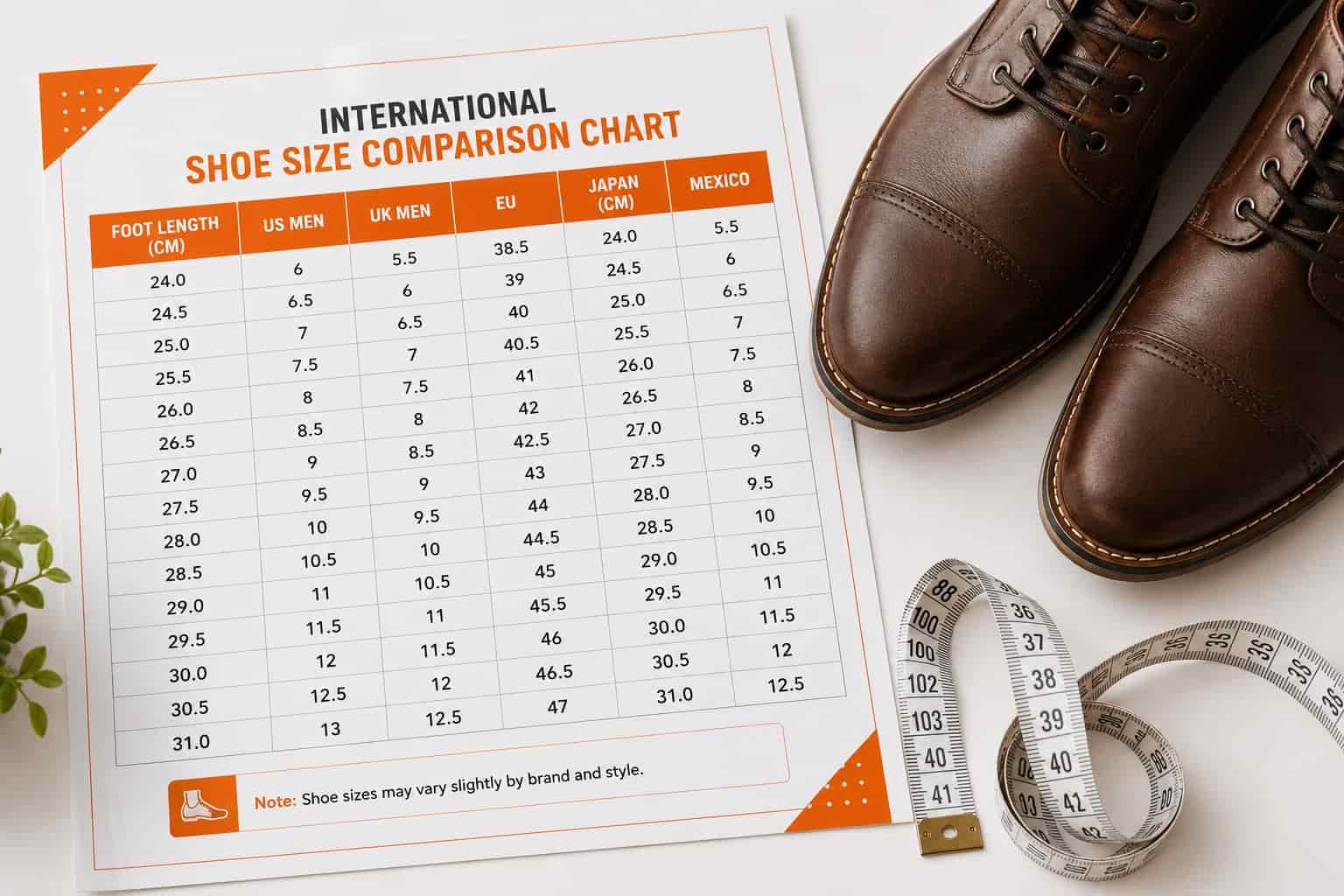
An international shoe size chart is a single reference table that shows how the same foot length is labeled across different countries. It exists because there is no single global standard for shoe sizing, so a foot that wears a US 9 needs a completely different number in the UK, Europe, or Japan.
In our experience fitting thousands of men’s shoes, most fit complaints trace back to one thing: someone assumed their home country size would transfer directly to another region’s chart. It rarely does. A chart like this one removes that guesswork by anchoring every size to actual foot length.
💡 Expert Tip
If you already know your US men’s shoe size, use it as your starting point, then cross check it against the destination country’s column here rather than converting from memory.
Full International Men’s Shoe Size Conversion Table
This table lines up US, UK, EU, Japan, Australia, and Mexico sizing against foot length in inches and centimeters. Use it as your master reference, then confirm against the specific brand you’re buying from, since lasts and shapes vary.
| US Size | UK Size | EU Size | Japan (cm) | Australia | Mexico | Foot Length (in) | Foot Length (cm) |
| 6 | 5.5 | 38.5 | 24 | 5.5 | 6 | 9.25″ | 23.5 cm |
| 6.5 | 6 | 39 | 24.5 | 6 | 6.5 | 9.5″ | 24.1 cm |
| 7 | 6.5 | 40 | 25 | 6.5 | 7 | 9.6″ | 24.4 cm |
| 7.5 | 7 | 40.5 | 25.5 | 7 | 7.5 | 9.75″ | 24.8 cm |
| 8 | 7.5 | 41 | 26 | 7.5 | 8 | 9.9″ | 25.1 cm |
| 8.5 | 8 | 42 | 26.5 | 7.5 | 8.5 | 10.1″ | 25.7 cm |
| 9 | 8.5 | 42.5 | 27 | 8 | 9 | 10.25″ | 26 cm |
| 9.5 | 9 | 43 | 27.5 | 8.5 | 9.5 | 10.5″ | 26.7 cm |
| 10 | 9.5 | 44 | 28 | 9 | 10 | 10.75″ | 27.3 cm |
| 10.5 | 10 | 44.5 | 28.5 | 9.5 | 10.5 | 11″ | 27.9 cm |
| 11 | 10.5 | 45 | 29 | 10 | 11 | 11.15″ | 28.3 cm |
| 11.5 | 11 | 45.5 | 29.5 | 10.5 | 11.5 | 11.3″ | 28.6 cm |
| 12 | 11.5 | 46 | 30 | 11 | 12 | 11.6″ | 29.4 cm |
| 13 | 12.5 | 47 | 31 | 12 | 13 | 11.9″ | 30.2 cm |
International Shoe Size Converter
Slide to your foot length and see your size across major countries instantly.
| US | UK | EU | Japan | AU | MX | In | CM |
|---|
Tip: If your foot measures between two rows, choose the larger size, especially for closed-toe leather styles or boots.
Shopping specifically between US, UK, and European sizing? Our US vs UK vs Euro shoe size conversion guide breaks that comparison down in more detail.
How to Measure Your Foot the Right Way
No matter which country’s chart you’re converting to, foot length is the number that actually matters. Here’s the process we walk every customer through before an international order.
- Place a sheet of paper on a hard floor against a wall.
- Stand on the paper with your heel touching the wall.
- Mark the longest point of your longest toe.
- Measure from the wall edge to the mark in both inches and centimeters.
- Repeat for the other foot and use the larger measurement.
✅ Fit Checklist
- Measure both feet, since one is often slightly longer.
- Measure in the evening when feet are naturally a little larger.
- Wear the socks you’ll actually use with the shoes.
- Round up if your foot falls between two sizes.
- Check the brand’s own size guide, not just this general chart.
Want the exact foot length behind every US size without doing the math yourself? Our men’s shoe size to inches guide lists every size next to its precise measurement.
Why Shoe Sizes Differ From Country to Country
Shoe sizing grew out of different measuring traditions in different regions, which is why the numbers never lined up cleanly. The UK system is based on barleycorn units from centuries ago, Europe’s Paris point system uses a different base unit entirely, and Japan sizes shoes directly by centimeters of foot length. The US system sits closer to the UK scale but still shifts by about half a size at most lengths.
One common issue we notice is shoppers assuming Australia uses the same numbers as the UK, since both are English speaking markets. Australian sizing is actually closer to the US scale for most men’s styles, with only small differences appearing at certain lengths.
👟 Did You Know?
Japan’s shoe sizing is one of the most straightforward systems in the world because the number on the box is the foot length in centimeters. A size 27 shoe is built for a 27 centimeter foot, no conversion chart required.
For a closer look at how Australian sizing lines up specifically against US numbers, our US to Australian shoe size conversion guide covers that comparison in full. If you’re ordering from Japan directly, our US to Japan shoe size conversion article walks through the centimeter based system in more detail. And for shoppers looking at Mexican retailers, our US to Mexico shoe size conversion guide shows how close that scale runs to the US system.
Buying Shoes From an International Retailer
Before you check out on an overseas site, a few quick checks can prevent a costly return. This is the same list we walk customers through before any cross border order.
- Confirm which sizing system the listing actually uses, since some sites mix regional scales on one page.
- Look for a foot length in centimeters, since that number never changes across countries.
- Check whether the retailer accepts international returns and how long shipping takes both ways.
- Read reviews that specifically mention fit rather than general quality.
⚠ Common Mistake
Ordering your home country size without checking which scale the site is using is the single biggest reason for international shoe returns. A size 9 on a European site is not the same shoe as a US size 9, even though the label looks familiar.
Signs Your International Size Is Wrong
Even with a correct chart, individual brands can still run differently. Watch for these signs after your first wear.
- Toes touching the front of the shoe when standing indicates the size is too small.
- Heel slipping with every step usually means the size is too large or the width is off.
- Pinching across the widest part of the foot suggests the width, not the length, needs adjusting.
- A shoe that feels fine standing but tight after walking often means there isn’t enough room for natural foot swelling.
Common Mistakes When Converting Shoe Sizes
We’ve seen many shoppers make the same handful of errors when converting between countries. Assuming every region uses the same scale as their home country is the most frequent one, especially between UK and Australian sizing, which look similar but aren’t identical for most men’s styles.
Skipping the foot measurement step is another common issue, particularly with first time international orders where returns are slow and sometimes expensive. Relying on a size sticker inside a used or secondhand shoe, rather than the brand’s official chart, also leads to mismatched conversions since resellers sometimes mislabel stock.
Expert Tips for Cross Border Shoe Shopping
After years of helping customers navigate international sizing, a few habits consistently prevent mistakes.
- Keep your exact foot length in centimeters saved somewhere, since it works across every country’s chart instantly.
- Size based on your longer foot, not an average of both.
- When a size falls between two numbers on a new country’s chart, size up rather than down.
- Check width sizing separately if the retailer offers it, since narrow and wide feet convert differently across regions.
Want to skip manual lookups entirely for future orders? Our shoe size conversion chart calculator converts US, UK, EU, and other regional sizes instantly.
Frequently Asked Questions
What is my shoe size in other countries?
Your shoe size changes number depending on the country’s sizing system, even though your foot length stays exactly the same. Matching your foot length in centimeters against an international chart is the most accurate way to find your size anywhere in the world.
Is EU shoe size the same as US shoe size?
No, EU sizing uses a completely different numbering system based on the Paris point scale, which is why EU sizes look noticeably larger than US sizes for the same foot. A US size 9 typically converts to roughly an EU 42.5.
How accurate are international shoe size charts?
General charts like this one are a strong starting point, usually accurate within half a size for most people. Individual brands can still run slightly differently, so checking the retailer’s specific size guide alongside this chart gives the most reliable result.
Do Japan shoe sizes use a different system entirely?
Yes, Japan sizes shoes directly in centimeters of foot length, which makes it one of the simplest systems to convert to once you know your measurement. A 26 centimeter foot simply wears a Japan size 26.
Are men’s and women’s international sizes converted the same way?
No, women’s international sizing typically runs about 1.5 sizes different from men’s sizing in the same country, and that gap can shift slightly between regions. This chart is built specifically for men’s sizing.
Why do two countries list the same foot length but different size numbers?
Each country’s sizing system developed from a different historical measuring unit, so the same physical foot length simply gets labeled differently depending on where the scale originated. Foot length in centimeters is the only number that stays consistent everywhere.
Should I always size up when ordering from another country?
Only if your foot measures between two sizes on that country’s specific chart, or if you’re ordering a narrower style like a dress shoe or boot. For most casual and athletic shoes, matching your exact measured foot length gives the best fit.
Can width sizing be converted internationally the same way as length?
Width conversions are less standardized than length conversions, and not every country uses the same width lettering system. When ordering a wide or narrow foot internationally, it’s worth checking the specific brand’s width guide rather than relying on a general chart alone.
Conclusion
An international shoe size chart works best when you treat foot length, not any single country’s number, as your true size. Once you know your exact measurement in inches or centimeters, converting to any country’s chart becomes a quick lookup rather than a guessing game.
Before your next international order, measure your foot and save that number somewhere handy. It will save you time on every future purchase, whether you’re shopping from the UK, Japan, Australia, or anywhere else. For a deeper look at any single region, check out our country specific conversion guides linked throughout this article.