
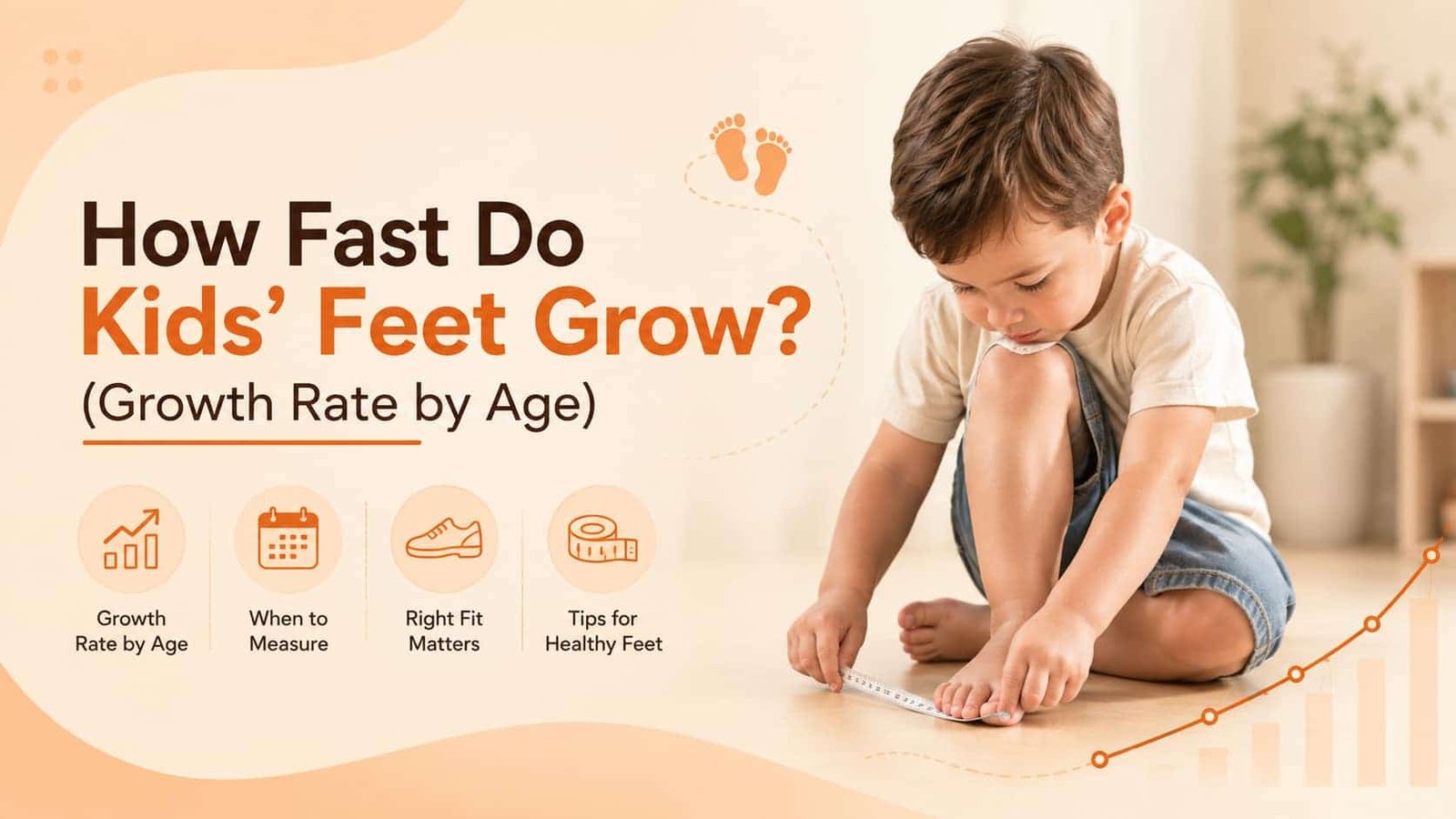
How Fast Do Kids’ Feet Grow? (Growth Rate by Age)
⚡ Quick Answer
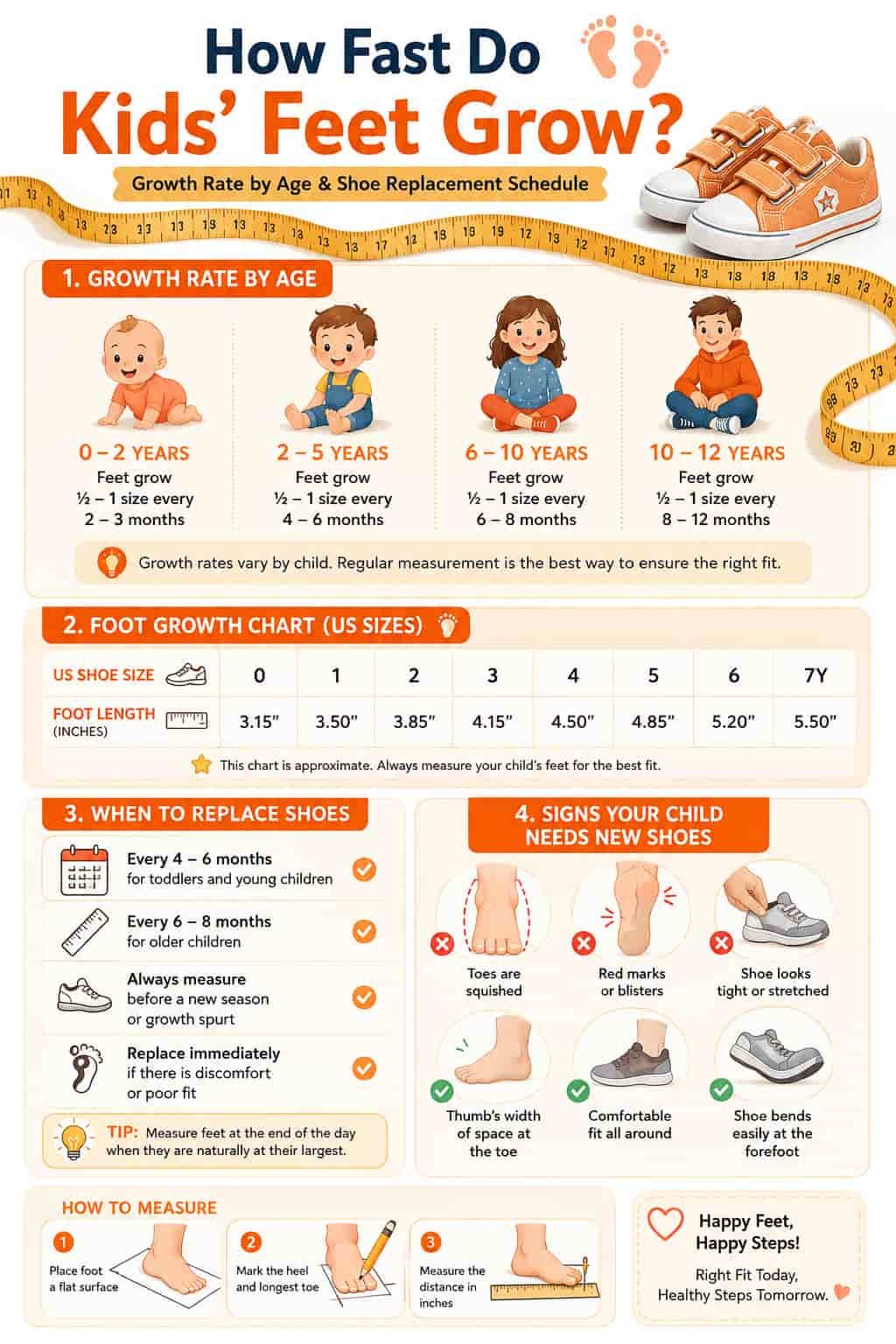
- Kids’ feet grow about half a size every 2 to 3 months during the first year.
- From ages 1 to 3, feet grow about one full size every 4 to 6 months.
- Between ages 3 and 5, growth slows to about one size every 6 to 9 months.
- After age 5, feet grow about one size per year until growth plates close.
- Always measure before buying – age is only a rough guide.
How fast do kids’ feet grow? Children’s feet grow at different rates depending on their age. During the first year, feet can grow half a shoe size every 2 to 3 months. Between ages 1 and 3, growth slows to about one full size every 4 to 6 months. After age 5, most kids’ feet grow about one size per year until they reach their adult foot size.
In our experience fitting thousands of children’s shoes, we have seen parents constantly surprised by how quickly their child outgrows footwear. A shoe that fits perfectly today can feel tight within weeks. Measuring regularly is the only way to stay ahead of growth spurts.
Why Kids’ Feet Grow So Fast
Kids’ feet grow faster than any other part of their body during the early years. This rapid growth is tied to overall development and the body’s need to support increasing height and weight.
👶 Did You Know?
By the time a child reaches age 2, their feet have grown to about half their adult foot length. That means they will go through approximately 6 to 8 shoe sizes before their feet stop growing entirely.
The bones in a child’s foot are still forming and hardening. The arches are developing, and the foot is adapting to weight-bearing activities like standing and walking. This is why proper footwear and regular size checks matter so much.
Foot Growth Rate by Age
Here is the typical growth rate for children’s feet broken down by age group. These are averages, not guarantees. Some kids grow faster or slower than these timelines.
| Age Range | Average Growth Rate | How Often to Check |
| 0-12 months | 1/2 size every 2-3 months | Every 4-6 weeks |
| 1-3 years | 1 size every 4-6 months | Every 6-8 weeks |
| 3-5 years | 1 size every 6-9 months | Every 8-10 weeks |
| 5-10 years | 1 size per year | Every 3-4 months |
| 10+ years | 1 size every 1-2 years | Twice a year |
💡 Expert Tip
Growth doesn’t happen at a steady, predictable pace. Kids often experience growth spurts where feet can jump half a size in just a few weeks. This is why regular measurement is more reliable than following a calendar schedule.
Kids’ Foot Growth Chart (0-12 Years)
This chart shows typical foot length and shoe size progression by age. Use this as a general reference, but always measure your child’s feet before buying.
| Age | Foot Length (inches) | Foot Length (cm) | Kids Size |
| 0-6 months | 3.5 – 4.1 | 9.0 – 10.4 | 1 – 2 |
| 6-12 months | 4.1 – 4.7 | 10.4 – 12.0 | 2 – 5 |
| 1-2 years | 4.7 – 5.5 | 12.0 – 14.0 | 5 – 8 |
| 2-3 years | 5.5 – 6.2 | 14.0 – 15.8 | 8 – 10 |
| 3-5 years | 6.2 – 7.0 | 15.8 – 17.8 | 10 – 12 |
| 5-8 years | 7.0 – 8.5 | 17.8 – 21.6 | 12 – 3Y |
| 8-12 years | 8.5 – 9.5 | 21.6 – 24.1 | 3Y – 6Y |
Note: “Y” denotes youth sizes. These are averages – individual growth varies significantly.
For a complete reference across all ages, our Kids Shoe Size Chart covers the full range from infant to youth sizes.
When to Replace Kids’ Shoes
One of the most common questions we hear is “How often do kids need new shoes?” The answer depends on their age and how fast they are growing.
✅ Parent Checklist
- Check fit every 6-8 weeks for children under 5.
- Look for signs of wear or tightness in current shoes.
- Always measure both feet before buying new shoes.
- If shoes show visible wear on the soles, replace them.
- Never buy shoes “to grow into” – they should fit now.
For babies and toddlers, plan to replace shoes every 2 to 3 months during the first year. Between ages 1 and 3, shoes typically last 4 to 6 months. School-age children often get 6 to 12 months out of a pair of shoes.
Signs Your Child Needs New Shoes
⚠ Common Mistake
Many parents assume shoes still fit because the child doesn’t complain. Children often don’t tell you when shoes are too small – they simply adapt. Watch for signs like constantly pulling at shoes, tripping, or red marks on the feet after removal.
Look for these warning signs that your child needs new shoes:
- Toes touching the front – You should feel a thumb’s width of space.
- Red marks or blisters – Indicates rubbing or pressure.
- Bent or worn soles – Shows uneven wear patterns.
- Child complains about shoes – Or tries to avoid wearing them.
- Blisters or calluses – Form from constant rubbing.
- Walking differently – Changes in gait can signal discomfort.
Growth Spurts: What to Expect
Growth spurts can happen at any time, but they often align with developmental milestones. Here is what to expect:
0-12 months: Rapid growth. Feet can grow half a size in just a few weeks. This is the fastest growth period.
1-3 years: Growth slows slightly but remains steady. Expect one size every 4 to 6 months.
3-5 years: Growth continues but at a slower pace. One size every 6 to 9 months is typical.
5-10 years: Growth slows to about one size per year. This is when shoes often last a full school year.
10+ years: Growth becomes slower and more variable. Some kids stop growing by age 12, others continue until 16.
📏 Size Snapshot
Age: 5 Years
Typical Size: 12 – 13
Foot Length: 7.0 – 7.5 inches
Growth Rate: 1 size per year
How to Measure Kids’ Feet
Measuring your child’s feet at home is simple and accurate. Here is the method we recommend.
What You Need:
- A blank sheet of paper
- A pencil or pen
- A ruler or tape measure
Step-by-Step:
Step 1: Place the paper flat on a hard floor against a wall.
Step 2: Have your child stand on the paper with their heel against the wall.
Step 3: Mark the tip of the longest toe (not always the big toe).
Step 4: Measure the distance from the wall to the mark in inches.
Step 5: Repeat on the other foot and use the longer measurement.
Step 6: Add 0.4 to 0.5 inches for growing room.
Step 7: Match the measurement to a size chart.
For a complete walkthrough, our How to Measure Kids’ Feet guide covers everything in detail.
Common Parent Mistakes
We see the same mistakes come up again and again, even from experienced parents.
Buying shoes to “last longer.” Buying a size up so they last longer causes slipping and affects balance. Shoes that are too big are just as problematic as shoes that are too small.
Waiting for the child to complain. Children often don’t tell you when shoes are uncomfortable. They simply adapt or avoid wearing them. Check fit regularly.
Only measuring one foot. One foot is almost always slightly longer than the other. Always measure both and size to the larger one.
Forgetting about width. Length isn’t the only measurement that matters. If you see red marks on the sides of the foot, consider a wide width option.
Expert Tips for Growing Feet
💡 Expert Tip
Set a recurring reminder on your phone to check your child’s shoe fit every 6 to 8 weeks. A quick measurement takes less than 5 minutes and can save you from buying shoes that are already too small.
Measure regularly, not just when you shop. The best way to stay ahead of growth is to measure feet every few weeks, even if you are not shopping for new shoes.
Buy a sizing tool. For about $10, you can buy a foot measuring gauge that makes sizing quick and accurate. It pays for itself in avoided returns.
Check fit at the end of the day. Feet swell slightly through the day. Measuring in the afternoon or evening gives you a more realistic fit.
Know when to replace. If the shoe shows signs of wear, or if you can’t fit a thumb’s width of space, it’s time to replace.
Consider adjustable closures. Velcro and elastic laces give you more flexibility as feet grow between sizes.
Frequently Asked Questions
How fast do kids’ feet grow?
Kids’ feet grow fastest during the first year, at about half a size every 2 to 3 months. Between ages 1 and 3, they grow about one full size every 4 to 6 months. After age 5, growth slows to about one size per year.
How often should I replace kids’ shoes?
For babies and toddlers, replace shoes every 2 to 3 months. Between ages 1 and 3, replace every 4 to 6 months. School-age children typically get 6 to 12 months from a pair of shoes.
What are the signs my child needs new shoes?
Look for red marks on the feet, toes touching the front of the shoe, worn soles, or your child complaining about discomfort or avoiding wearing shoes.
Can I buy shoes a size up to last longer?
No. Shoes that are too big cause slipping, affect balance, and can lead to blisters. Buy shoes that fit properly now, with only a thumb’s width of growing room.
How much growing room should kids’ shoes have?
Leave about 0.4 to 0.5 inches (the width of your thumb) between your child’s longest toe and the front of the shoe.
When do kids’ feet stop growing?
Most children’s feet reach their adult size by age 12 to 14 for girls and 14 to 16 for boys. Growth plates in the feet typically close around this time.
Do kids’ feet grow at a steady pace?
No. Growth happens in spurts. A child might stay in the same size for months, then jump half a size in just a few weeks.
What if my child’s feet measure between two sizes?
Choose the larger size. A shoe with slightly more room is more comfortable long term than a shoe that fits perfectly today but will be too small next month.
How should I measure my child’s feet at home?
Use the paper tracing method. Place a sheet of paper on a hard floor against a wall, have your child stand with their heel against the wall, mark the longest toe, and measure in inches.
What is the difference between kids and youth sizes?
Kids sizes typically range from 0 to 13. Youth sizes (sometimes marked with a “Y”) start after size 13 and go up to 7Y, which is roughly an adult size 7.
Should I check my child’s shoe fit in the morning or evening?
Measure in the late afternoon or evening. Feet swell slightly through the day, giving you a more realistic fit for when shoes are being worn.
What if one foot is larger than the other?
This is completely normal. Always size shoes to the longer foot. Most people, children included, have one foot that is slightly larger than the other.
Engagement Poll
👟 How Often Do You Buy New Shoes for Your Kids?
Vote on your experience and see how other parents compare.
Related Articles
- Kids Shoe Size Chart – Complete US Sizes by Age
- How to Measure Kids’ Feet at Home
- Kids Shoe Size Conversion Chart (US, UK, EU & CM)
- Shoe Size Conversion Calculator – US, UK, EU & CM
- Is Your Baby Ready for Shoes? The Age Guide Every Parent Needs
- Keeps Slipping Off or Leaving Red Marks? Your Baby Might Need a Different Width
Conclusion
How fast do kids’ feet grow? The answer depends on their age. During the first year, feet can grow half a size every 2 to 3 months. Between ages 1 and 3, growth slows to about one full size every 4 to 6 months. After age 5, most kids’ feet grow about one size per year until they reach their adult foot size.
The key takeaway is simple: regular measurement is the only reliable way to know when your child needs new shoes. Set a reminder to check fit every 6 to 8 weeks, especially for children under 5.
Ready to find the right size? Visit our Kids Shoe Size Chart for a complete size reference, or use our Shoe Size Conversion Calculator to convert between US, UK, and EU sizes.