
Girls Shoe Size Chart (US, UK & EU): Toddler to Youth Sizing Made Simple
Quick Answer
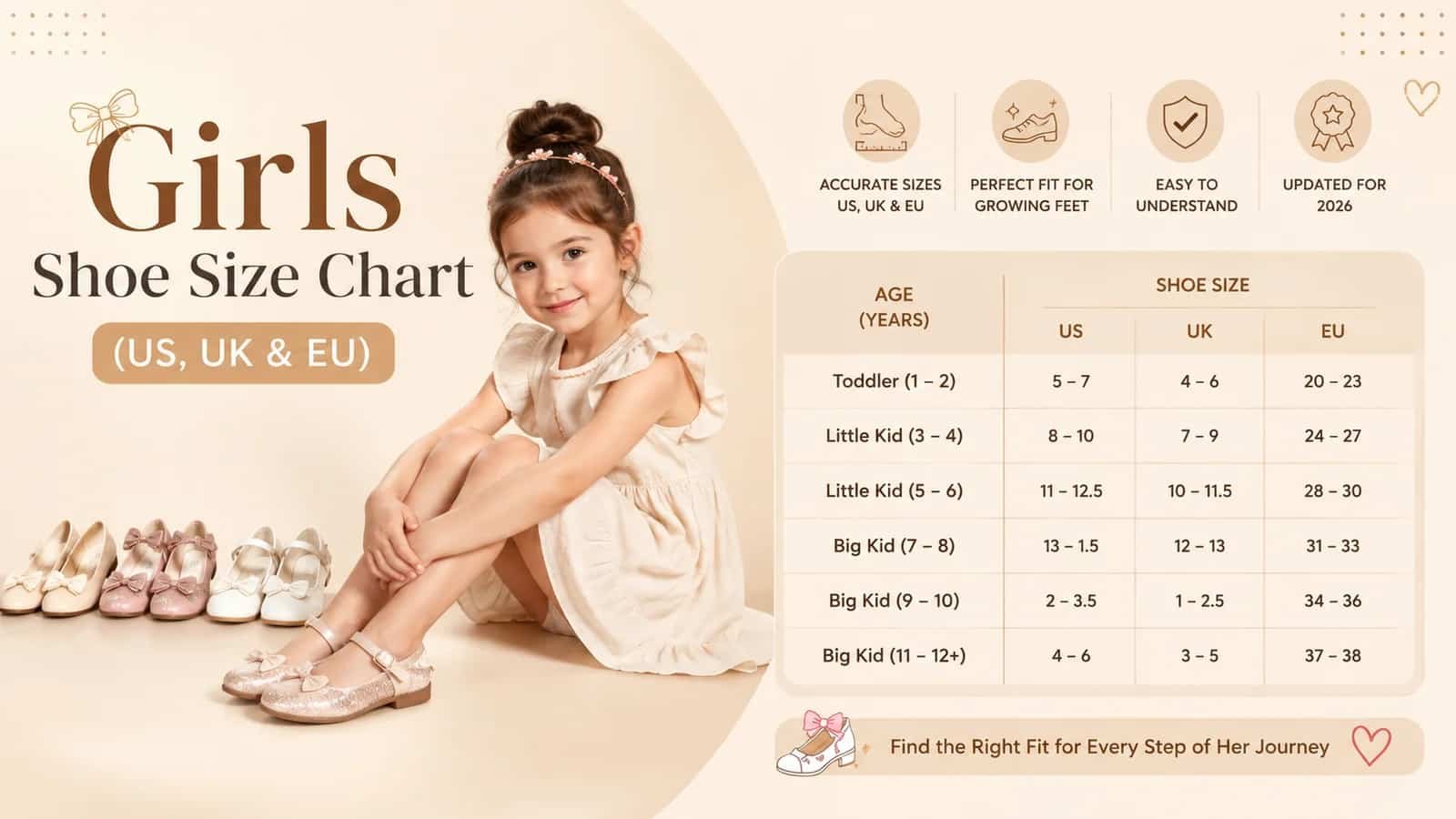
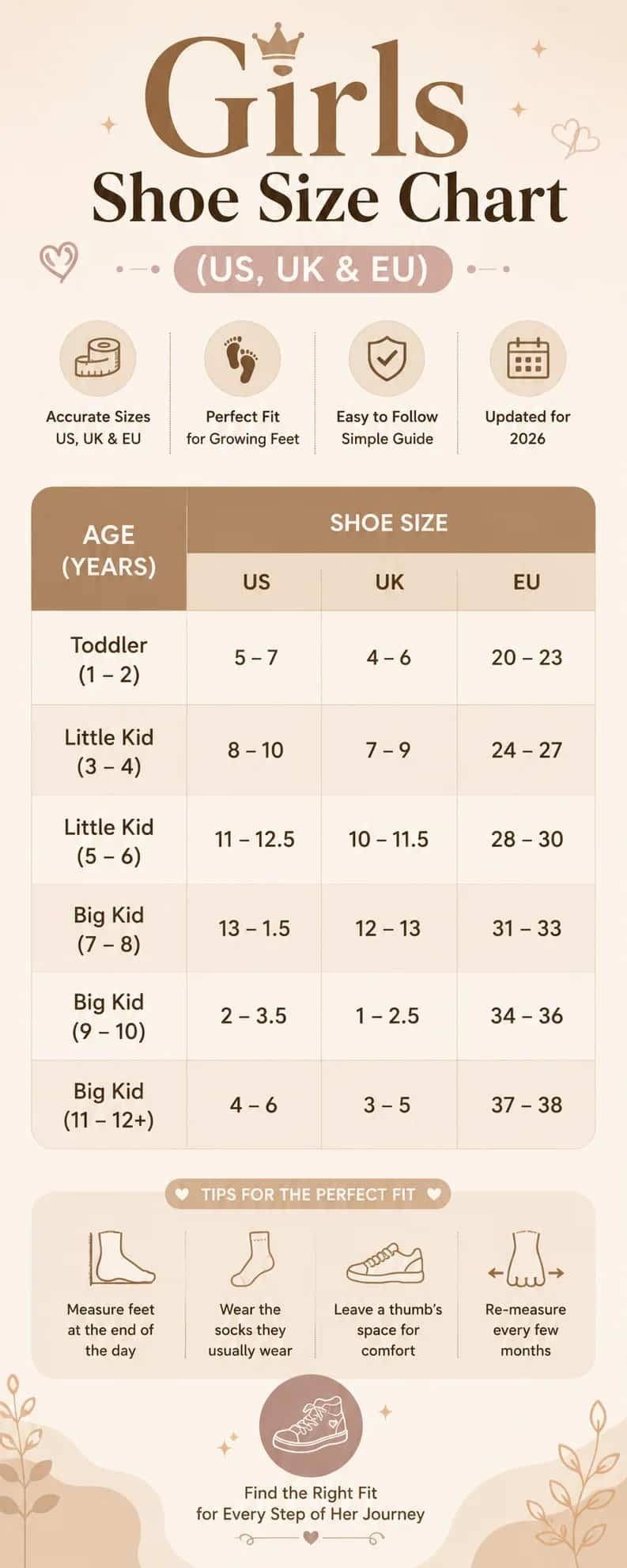
- Girls’ shoe sizes run through three stages: toddler (roughly sizes 4 to 10), little kid (10.5 to 3), and big kid or youth (3.5 to 7).
- Always measure foot length. Age is a rough guide at best, since growth rates vary a lot between kids.
- Leave about 0.4 to 0.5 inches of growing room past the longest toe.
- Once a girl reaches a youth size 5 or 6, she’s close to also fitting into women’s sizes. Add 2 to her youth size to estimate the women’s equivalent.
A girl’s shoe size depends far more on foot length than on age, but as a starting point, toddlers typically wear sizes 4 to 10, little kids wear 10.5 to 3, and big kids or “youth” sizes run 3.5 to 7. Measuring foot length in inches or centimeters gives a far more accurate fit than guessing from age alone, since two girls the same age can differ by a full size or more. Size up whenever a shoe stops leaving that thumb’s-width gap at the toe, and once your daughter reaches a youth size 5 or so, it’s worth checking the women’s section too.
Find Her Exact Shoe Size
Pick her stage, slide to her measured foot length, and we’ll match the row instantly, including a women’s size estimate once she reaches youth sizing.
| US Size | Foot (in) | Foot (cm) | UK Size | EU Size |
|---|
Ranges are typical, not exact. Always size to the larger foot and leave 0.4 to 0.5 inches of growing room.
Girls Shoe Size Chart by Stage
Girls' shoes move through three distinct sizing stages before they land in the adult women's range, and each one uses its own numbering, which is exactly why parents get confused switching from one to the next.
In our experience fitting thousands of children's shoes, most of the sizing mix-ups we see happen right at these handoff points, toddler to little kid, and little kid to youth, not within a single stage. Here's the full picture.
Toddler (roughly 1 to 4 years)
| US Size | Foot Length (in) | Foot Length (cm) | UK Size | EU Size |
| 4 | 4.75 | 12.1 | 3 | 20 |
| 5 | 5.1 | 13.0 | 4 | 21 |
| 6 | 5.4 | 13.7 | 5 | 22 |
| 7 | 5.75 | 14.6 | 6 | 23 |
| 8 | 6.0 | 15.3 | 7 | 24 |
| 9 | 6.4 | 16.3 | 8 | 25 |
| 10 | 6.75 | 17.1 | 9 | 27 |
Little Kid (roughly 4 to 8 years)
| US Size | Foot Length (in) | Foot Length (cm) | UK Size | EU Size |
| 10.5 | 6.9 | 17.5 | 9.5 | 27 |
| 11 | 7.1 | 18.1 | 10 | 28 |
| 12 | 7.4 | 18.8 | 11 | 30 |
| 13 | 7.75 | 19.7 | 12 | 31 |
| 1 | 8.0 | 20.3 | 13 | 32 |
| 2 | 8.4 | 21.3 | 1 | 33 |
| 3 | 8.6 | 21.9 | 2 | 34 |
Big Kid / Youth (roughly 8 to 12+ years)
| US Size | Foot Length (in) | Foot Length (cm) | UK Size | EU Size |
| 3.5 | 8.9 | 22.6 | 2.5 | 35 |
| 4 | 9.1 | 23.0 | 3 | 35.5 |
| 5 | 9.4 | 23.9 | 4 | 36.5 |
| 6 | 9.75 | 24.8 | 5 | 38 |
| 7 | 10.0 | 25.4 | 6 | 39 |
These numbers are a reliable starting point, not a guarantee. If your daughter's foot lands between two rows, size up rather than down; a little extra room at the toe costs nothing, but a cramped shoe can genuinely affect how confidently a kid runs and plays.
Size Snapshot
Stage: Little Kid
Common Size: US 1 to 2
Foot Length: 8.0 to 8.4 inches
Growing Room: 0.4 to 0.5 inches
How to Measure Your Daughter's Feet
Here's the good news: measuring an older kid is usually easier than measuring a baby, since she can stand still (mostly) and even help.
- Stand your daughter on a piece of paper against a wall, heel touching the baseboard.
- Mark the tip of her longest toe with a pencil held straight up and down, not at an angle.
- Measure both feet. It's common for one foot to be slightly longer, and you should always size to the bigger one.
- Measure again in the evening if you can. Feet swell a little by the end of the day, so an evening measurement gives you the truer "worst case" fit.
- Re-measure every 2 to 3 months for younger kids, and every 4 to 6 months once she's past age 6 or 7, since growth slows down some but doesn't stop.
If you want a full walk-through with printable measuring templates, our How to Measure Kids Feet guide covers it step by step.
Expert Tip
Trace onto paper instead of using a soft tape measure. After 25 years in children's footwear, we still find tracing gives the most accurate number, because it captures the actual shape of the foot, including where it's widest, not just a single length reading.
Girls Shoe Size Chart by Age: What to Expect
Age is a rough guide at best, but parents still want a starting point, so here's what we typically see, along with the reason growth isn't steady from year to year.
Ages 1 to 2: Fast growth. A toddler's foot can grow half a size every two to three months in this window, so check fit often.
Ages 3 to 5: Growth slows slightly but is still quick. This is when most kids move from toddler into little kid sizing, which is exactly the handoff point where parents most often buy the wrong size by sticking with the old numbering.
Ages 6 to 8: Growth becomes steadier, usually a size every 4 to 6 months. This is also when girls' shoe styles start to diverge more from unisex kids' designs, which is a good moment to check our Girls Shoe Size Chart against the general Kids Shoe Size Chart if you're comparing to a sibling's sizing.
Ages 9 to 12+: Growth rate varies more from child to child than at any earlier stage. Some girls plateau in youth sizing for a year or more; others jump straight toward adult sizes. This is exactly why the crossover section below matters so much at this age.
For a broader look across all growth stages, our How Fast Do Kids Feet Grow guide breaks down the full timeline with more detail than we can fit here.
Did You Know?
A child's foot reaches close to 90 percent of its adult length by around age 10 to 12, which is one reason sizing gets more unpredictable in the tween years. It's also exactly when the crossover into women's sizing starts to matter.
Girls to Women's Shoe Size Conversion (The Part Most Charts Skip)
One thing parents often miss is that girls' youth sizing doesn't stop at a hard ceiling. It flows directly into women's sizing, and knowing the conversion opens up far more shoe options once your daughter's feet approach adult length.
The standard rule used across most brands is simple: add 2 to the youth size to estimate the women's equivalent.
| Youth (Big Kid) Size | Estimated Women's Size |
| 3 | 5 |
| 3.5 | 5.5 |
| 4 | 6 |
| 4.5 | 6.5 |
| 5 | 7 |
| 5.5 | 7.5 |
| 6 | 8 |
| 6.5 | 8.5 |
| 7 | 9 |
A couple of things worth knowing before you rely on this:
- This only applies to youth (Y) sizes, not toddler (T) sizes. Trying to convert a toddler size into a women's size with the same formula won't work.
- Not every brand uses the same offset. Nike, for example, commonly uses a plus 1.5 rule instead of plus 2, so a youth Nike sneaker can run slightly differently than the same size in another brand.
- Youth shoes are typically built on a slightly wider last than women's shoes, so a converted size can feel roomier through the toe box even at the "same" length. If your daughter has narrow feet, that extra width might mean sizing down half a size from the chart.
This is genuinely useful once your daughter is heading into her tween years: youth sizes are often cheaper than the same shoe in women's sizing, and popular sneaker releases sometimes stay in stock longer in youth sizes than in adult ones.
Signs of a Correct Fit
A properly fitted shoe should check every one of these boxes:
- About a thumb's width of space between the longest toe and the front of the shoe
- No heel slipping when she walks, runs, or jumps
- No red marks or indentation lines after the shoe comes off
- She can wiggle her toes freely inside the shoe
- The shoe bends at the ball of the foot, not somewhere in the middle of the sole
Parent Checklist
- Measure both feet, ideally standing.
- Try shoes on with the socks she'll actually wear.
- Leave 0.4 to 0.5 inches of growing room.
- Re-check fit every 2 to 3 months under age 5, and every 4 to 6 months after that.
- Check for heel slip by having her walk a few steps and watching her heel, not just her toes.
Signs the Shoes Are Too Small
One common issue we notice is parents assuming a kid is just being difficult about shoes, when the real problem is that the shoes no longer fit.
- She resists putting shoes on more than she used to
- Red marks or pressure lines appear on the foot after the shoe comes off
- Toes curl, or there's no gap at all at the front of the shoe
- She complains her feet "hurt" or feel "squished" by the end of the day
- A visible line appears across the top of the foot where the shoe presses down
Signs the Shoes Are Too Big
Shoes that are too big cause just as many problems as shoes that are too small, and sometimes more, since they affect balance and can lead to tripping.
- Visible heel slip while walking
- She shuffles or drags her feet instead of lifting them normally
- The shoe comes off during running or active play
- Extra material bunches up at the toe when you press down gently
Common Mistake
Buying a size up "so it lasts longer" is one of the most common mistakes we see, especially once a child starts running and playing sports. A loose shoe affects balance and can genuinely slow a kid down on the playground, which usually costs more in frustration than the size-up saved in shoe budget.
Buying Guide: What Actually Matters
- Flexible soles. The sole should bend fairly easily at the ball of the foot. A stiff sole restricts the natural foot movement kids need for running and jumping.
- Room in the toe box. Ten toes need to spread out, especially during active play, not be squeezed into a narrow point.
- Breathable materials. Canvas, mesh, and soft leather uppers let feet breathe through a school day or an afternoon outside.
- Secure, adjustable closures. Velcro works well for younger kids who can't manage laces yet; look for adjustable straps rather than a single fixed strap.
- Width, not just length. Many kids have proportionally wide feet at this age. If a shoe feels tight across the widest part even though the length is correct, look for a wide-fit option before sizing up the whole shoe. Our Wide Kids Shoe Size Guide covers this in more depth.
- Grip matters more than cushioning for active kids. A thin, textured rubber sole often performs better on playgrounds than a thick, springy one.
Avoid This
Skip shoes that feel stiff right out of the box "because they'll break in." We've seen many parents make this mistake with special-occasion shoes especially. If a shoe doesn't bend easily at the store, it likely won't be comfortable for daily wear either.
Common Parent Mistakes
- Sizing by age alone, without measuring, even though growth rates vary a lot between kids of the same age
- Skipping the width check and focusing only on length
- Reusing a sibling's old size without re-measuring, since foot shape and growth rate differ between kids
- Missing the toddler-to-little-kid or little-kid-to-youth handoff, and buying based on the old size number
- Assuming youth sizing has a hard ceiling instead of checking the women's crossover once a daughter reaches youth size 5 or so
FAQs
What size shoe does an average 8 year old girl wear? Most 8 year old girls wear somewhere between a little kid size 13 and a youth size 2, but this varies more than most charts suggest. Measuring her foot length is far more reliable than going by age at this stage.
How much growing room should girls' shoes have? Leave about 0.4 to 0.5 inches, roughly a thumb's width, between the longest toe and the front of the shoe. Any less and the shoe crowds growing toes within weeks; any more and the heel tends to slip.
Do girls and boys wear the same shoe sizes? Up through toddler and little kid sizing, girls and boys generally share the same numbering system, since it's based on foot length rather than gender. Sizing itself doesn't diverge, though styles and widths sometimes do. Our Boys Shoe Size Chart uses the identical measurement scale.
When should I switch my daughter from kids' sizes to women's sizes? Once she reaches around a youth size 5 or 6, it's worth trying on women's sizes too, using the youth-plus-2 rule as a starting estimate. Try before you buy though, since the fit through the toe box can differ between youth and women's lasts.
Why does my daughter's shoe size seem different across brands? There's no single regulated standard for kids' shoe sizing across manufacturers, so a size 2 in one brand can measure slightly differently in another. Always check the brand's specific size chart rather than assuming sizes transfer exactly.
Should I buy wide width shoes for my daughter? If her foot looks proportionally wide, or a standard shoe leaves red marks along the sides even at the right length, a wide-width option is worth trying before sizing up the whole shoe.
How often should I measure my daughter's feet? Every 2 to 3 months works well under age 5, since growth is fastest then. After that, every 4 to 6 months is usually enough, though it's smart to check again before any season where she'll wear a lot of one pair.
Is it okay to size up so shoes last longer? Not really. A shoe that's noticeably too big affects balance and can cause tripping or blisters from the foot sliding forward. A half size of extra room is reasonable; a full size or more usually isn't.
What does the "Y" mean on a girls' shoe size tag? "Y" marks a youth or big kid size, distinguishing it from toddler sizes (marked "T" or "C") and from adult sizes that reuse some of the same numbers. Always check for the Y before assuming a size matches across categories.
My daughter's feet are different sizes. Which size should I buy? This is completely normal. Size to the larger foot, and check that the smaller foot isn't left with so much extra room that it causes slipping.
Do socks change what size shoe I should buy? Yes. Always try shoes on with the type of socks she'll actually wear, since thicker socks can quietly eat up the growing room you're trying to leave.
How do I know if her shoes are already too small? Watch for resistance putting shoes on, red marks or pressure lines after they come off, curled toes, or new complaints about her feet hurting by the end of the day.
RELATED ARTICLES
- Kids Shoe Size Chart
- Youth Shoe Size Chart
- Kids Shoe Size by Age
- How to Measure Kids Feet
- Wide Kids Shoe Size Guide
CONCLUSION
The right shoe size for your daughter comes down to her actual foot measurement, not just her age or the size she wore last season. A few minutes spent measuring today can prevent blisters, improve how confidently she runs and plays, and save you a return shipping label.
Measure both feet, leave that thumb's-width of growing room, and if she's getting close to youth size 5 or 6, it's worth trying a few women's styles too. For the next step in sizing, take a look at our Youth Shoe Size Chart, or check Kids Shoe Size by Age for a broader age-based reference.