
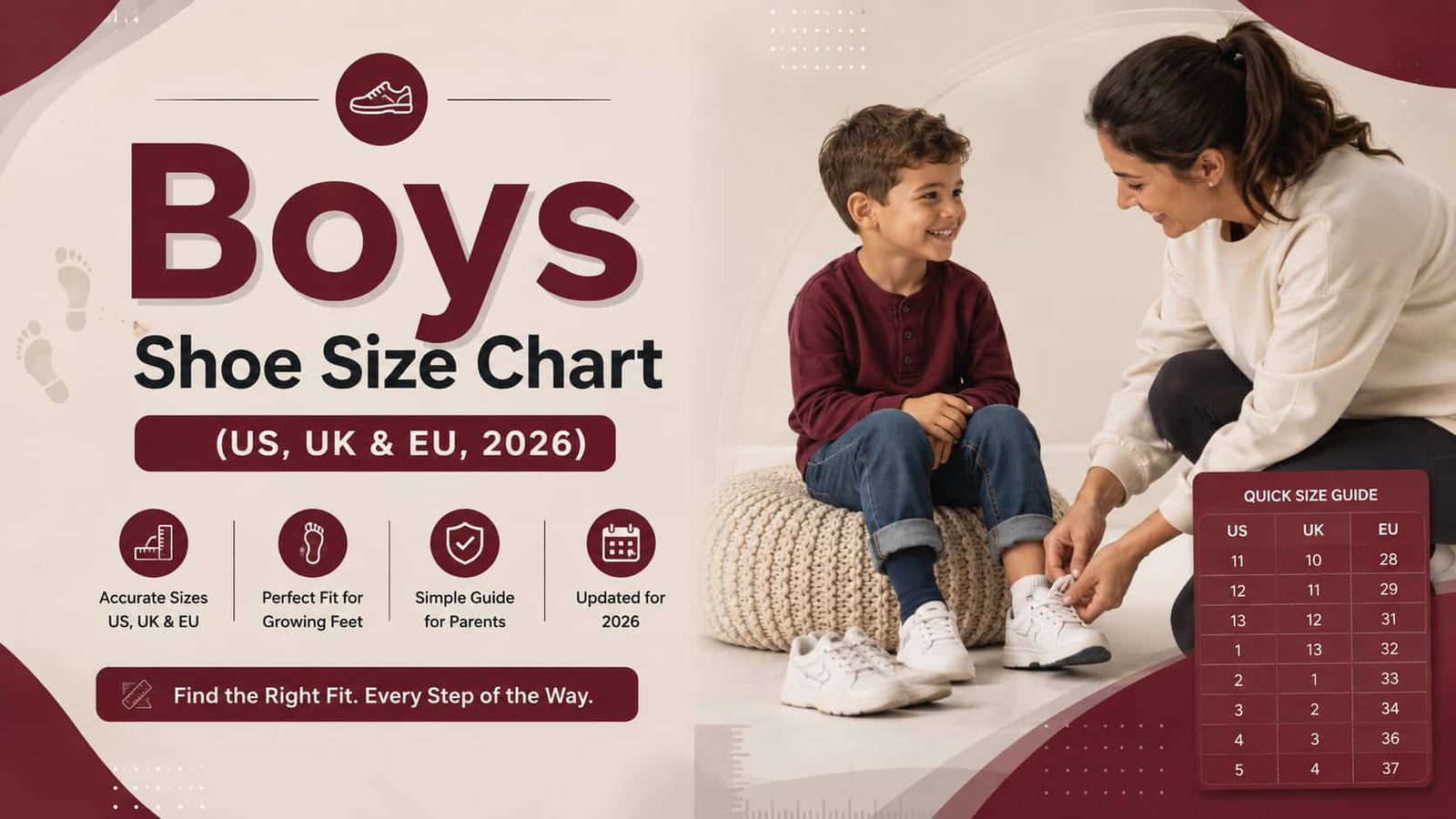
Boys Shoe Size Chart (US, UK & EU, 2026)
⚡ Quick Answer
- Boys shoe sizes follow the same US, UK, and EU scales used for all kids sizing, from about size 0 at birth to a youth 3 to 5 by age 10 to 12.
- Foot length matters far more than gender when it comes to fit. Boys and girls follow very similar growth patterns at the same age.
- Boys’ athletic and sneaker styles often run with a slightly wider toe box than girls’ styles in the same size, so checking width matters too.
- Always measure the actual foot rather than relying on age or shoe size from a previous pair.
- Use the interactive size finder below to check a typical range for your son’s age.
Boys shoe sizes follow the same US, UK, and EU numbering used across all kids footwear, climbing from about a size 0 at birth to a youth size 3 to 5 by age 10 to 12. There isn’t a separate length scale for boys, since foot growth by age tracks very closely between boys and girls at the same stage. What tends to differ is shoe shape, since boys’ sneaker and athletic styles are often built with a slightly wider toe box. Measuring your son’s actual foot length, rather than guessing from age or a previous pair’s size, is still the most reliable way to get a correct fit.
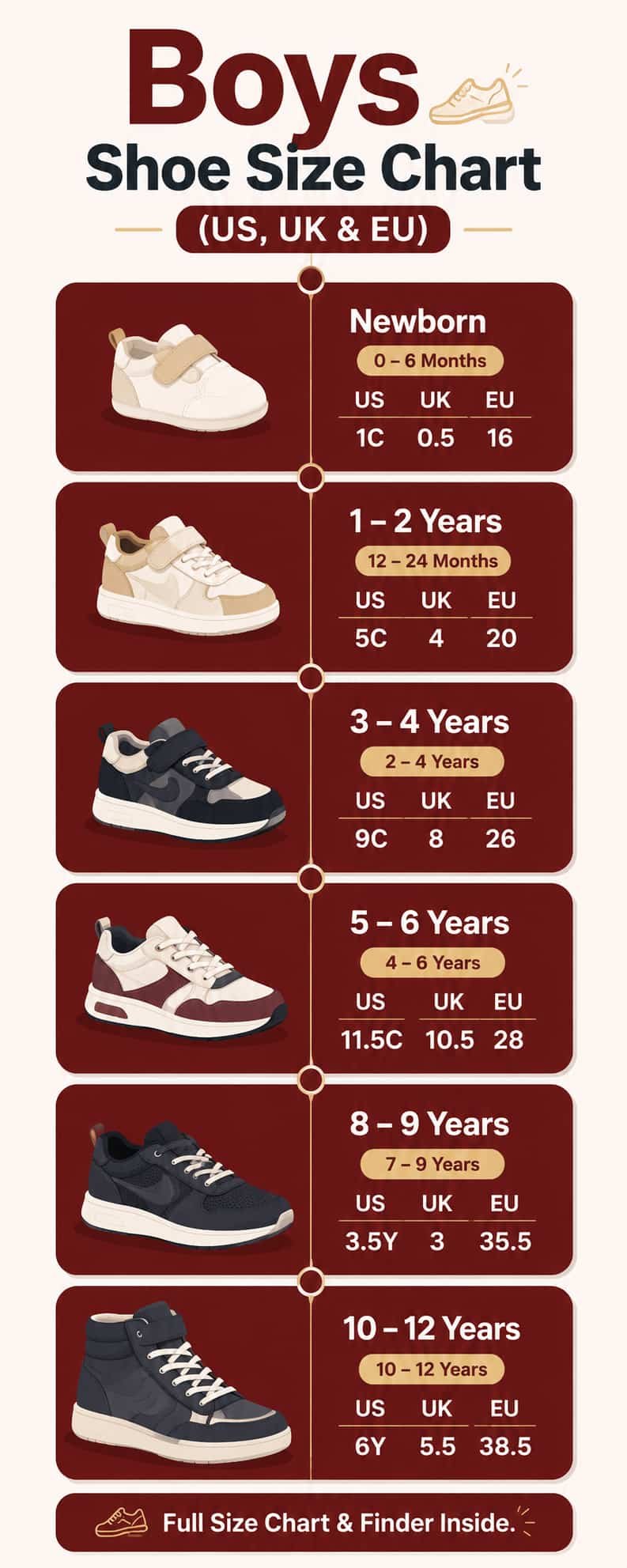
Boys Shoe Size Chart by Age (US, UK & EU)
This chart shows the typical shoe size range for boys at each age, across the three sizing systems most parents shop from. These ranges apply to general foot length by age and work well as a starting point for boys specifically.
| Age | US Size | UK Size | EU Size |
| 0-3 months | 0 – 1 | 0 – 0.5 | 16 – 17 |
| 3-6 months | 1 – 2 | 0.5 – 1 | 17 |
| 6-12 months | 2 – 4 | 1 – 3 | 17 – 19 |
| 1-2 years | 4 – 7 | 3 – 6 | 19 – 23 |
| 2-3 years | 7 – 8 | 6 – 7 | 23 – 24 |
| 3-4 years | 8 – 9 | 7 – 8 | 25 – 26 |
| 4-5 years | 9 – 10 | 8 – 9 | 26 – 27 |
| 5-6 years | 11 – 12 | 10 – 11 | 28 – 30 |
| 6-7 years | 12.5 – 13.5 | 11.5 – 12.5 | 30 – 31 |
| 7-8 years | 1 – 2 (youth) | 13 – 1 | 32 – 33 |
| 8-9 years | 2 – 3 (youth) | 1 – 2 | 33 – 34 |
| 9-10 years | 3 – 4 (youth) | 2 – 3 | 35 – 36 |
| 10-12 years | 4 – 5.5 (youth) | 3 – 4.5 | 36 – 38 |
A quick tip that saves a return trip: boys’ feet tend to run very slightly larger on average once you reach the 5 to 10 year range compared to girls at the same age, though the overlap between the two is still substantial. Always measure rather than assuming based on this general pattern alone.
For a full breakdown across every gender and age combination, our Kids Shoe Size Chart is worth checking too.
👦 Did You Know?
Boys and girls have nearly identical foot growth curves before around age five. Any noticeable average size difference between the two typically doesn’t show up until closer to the school age years, and even then the overlap remains large.
Do Boys and Girls Wear Different Sizes?
Not really, at least not in terms of the length scale itself. US, UK, and EU sizing use the same numbers for boys and girls footwear, so a size 10 toddler shoe is built to the same foot length whether it’s labeled for a boy or a girl.
What actually differs between boys’ and girls’ shoes is usually shape and styling, not the underlying size chart. Boys’ athletic shoes are frequently cut with a slightly wider toe box, while girls’ styles sometimes run a touch narrower through the midfoot. If you’re comparing a boy’s foot against our Girls Shoe Size Chart, the length numbers will track closely, but don’t be surprised if the actual fit feels different between a boys’ and girls’ shoe in the same labeled size.
💡 Expert Tip
If your son has always run wide in boys’ athletic shoes, it’s often a shape issue rather than a length issue. Try the same length in a different width category before assuming he needs a larger overall size.
Interactive Boys Size Finder
Select your son’s age below and this tool will show the typical US, UK, and EU size range for that stage.
Boys Shoe Size Finder
Select your son’s age to see the typical US, UK, and EU size range.
This is a general estimate. Always measure your son’s actual foot length for the most accurate fit.
Once you have a size, our Printable Kids Shoe Size Chart is handy to keep on hand for future shopping trips or to share with grandparents buying a gift.
How to Measure Your Son’s Foot
A quick at-home measurement beats guessing from age or a previous shoe size every time.
Step 1: Trace the foot while standing. Have your son stand on a piece of paper with his heel against a wall or straight edge.
Step 2: Mark the heel and longest toe. Trace around the whole foot, then mark the very back of the heel and the tip of the longest toe.
Step 3: Measure the straight-line distance. Use a ruler to measure heel to toe in inches or centimeters.
Step 4: Measure both feet. Take the larger measurement as your final number, since one foot is often slightly bigger than the other.
Step 5: Add growing room. Add about 0.4 to 0.5 inches before matching the number to the chart above.
✅ Parent Checklist
- Measure both feet while standing.
- Take the larger foot measurement as your final number.
- Leave 0.4 to 0.5 inches of growing room.
- Check width separately if length alone doesn’t solve a fit complaint.
- Remeasure every 6 to 8 weeks for younger boys, every few months for school age.
Signs the Shoe Fits Correctly
A properly fitted shoe should check these boxes regardless of style or brand.
- A thumb’s width of space between the longest toe and the front of the shoe.
- No red marks or pressure lines after a full day of wear.
- The heel stays in place without slipping during walking or running.
- Your son doesn’t complain about tightness or repeatedly try to remove the shoe.
Signs the Shoes Are Too Small or Too Big
Too small and too big both cause real problems, just different ones.
Too small signs: curled or bunched toes, red marks after wear, or reluctance to wear the shoe at all.
Too big signs: heel slipping, tripping more than usual, or the shoe visibly sliding around during active play.
⚠ Common Mistake
Buying boys shoes a size or two larger to survive an active season of sports and rough play is a habit we see often, but it usually backfires. A shoe that’s too roomy affects running stability just as much as one that’s too tight, so stick to a half size to full size up at most.
What to Look for in Boys Shoes
A handful of features matter more for boys’ activity level and shoe wear patterns.
Durable outsoles. Boys’ shoes tend to see heavier daily wear from running and rough play, so a sturdy rubber outsole holds up better over time.
Reinforced toe caps. Extra protection at the toe reduces how quickly the front of the shoe wears through from dragging feet or kicking during play.
Breathable uppers. Mesh or perforated panels help manage foot sweat during high activity levels, which is especially useful for athletic and school shoes.
Secure closures. Velcro for younger boys and proper lacing for school age boys both help keep the shoe snug during active movement.
Common Parent Mistakes
A few habits show up repeatedly when shopping for boys’ shoes specifically.
Hand-me-downs without a fit check. Older siblings’ shoes are tempting to reuse, but foot shape and wear pattern from the first child can affect how the shoe fits a younger sibling.
Ignoring width complaints. Assuming a length increase will fix a fit complaint that’s actually about width, which usually just trades one problem for another.
Skipping remeasurement during sports seasons. Active seasons often coincide with growth spurts, so checking fit more frequently during these periods is worth the extra effort.
Expert Tips for Boys Shoe Shopping
Tip 1. Shop in person for the first pair of a new style or brand, since fit can vary more than parents expect between brands marketed for boys.
Tip 2. Keep a spare pair of the current size on hand during active seasons, since rotating shoes reduces wear and gives you a better read on how a size is actually holding up.
Tip 3. Check width separately from length if your son repeatedly complains about the same spot on his foot across different pairs.
Tip 4. Measure again after any noticeable growth spurt rather than waiting for the usual remeasurement schedule.
FAQs
What size shoe does a 5 year old boy typically wear? Most 5 year old boys wear a US size 11 to 12, a UK size 10 to 11, or an EU size 28 to 30. Actual foot length is more important than age, so measuring your son directly gives the most accurate answer.
Do boys need a different shoe size chart than girls? No, the underlying length scale is the same for boys and girls in US, UK, and EU sizing. What differs is usually shoe shape and width, not the size numbers themselves.
Why do boys’ shoes seem to run wider than girls’ shoes? Many boys’ athletic and sneaker styles are designed with a slightly wider toe box as a stylistic and functional choice, not because boys’ feet are inherently wider at the same age. If width is a concern, checking a brand’s specific width chart helps more than switching size categories.
How often should I check my son’s shoe size? Check every 4 to 8 weeks for babies and toddlers, and every 3 to 6 months for preschool and school age boys. Active seasons like sports can speed up how quickly a shoe starts feeling tight.
Should I size up for growing room in boys shoes? A half size to a full size of extra room is reasonable for growing room. Sizing up further than that affects running stability and balance, which matters especially for active boys.
What’s the best shoe width for boys with wide feet? Look for a brand that explicitly offers a wide width option rather than sizing up in length. A longer shoe with the correct width usually fits better than a properly sized shoe that’s too narrow.
How do I know if my son’s shoes are too small during a growth spurt? Watch for red marks after wear, complaints about tightness, or a reluctance to wear a specific pair. These signs often show up faster during growth spurts than parents expect.
Are boys’ athletic shoes different from boys’ casual shoes in terms of sizing? The length sizing stays consistent, but athletic shoes often run with more structure and a different width profile than casual sneakers or dress shoes. It’s worth checking fit separately for each shoe category rather than assuming the same size works across all styles.
Can I use a hand-me-down pair from an older sibling? It’s fine to reuse hand-me-downs if the fit is checked carefully first, since foot shape and existing wear patterns from the older sibling can affect how the shoe sits on a younger child’s foot.
Do boys typically need new shoes more often than girls? Growth pace is very similar between boys and girls at the same age, so shoe replacement frequency is usually driven more by activity level and wear than by gender.
What should I do if my son’s feet are two different sizes? This is common and normal. Always size to the larger foot, and consider a slightly thicker insole or sock on the smaller foot side if the fit feels loose there.
RELATED ARTICLES
CONCLUSION
Boys shoe sizing follows the same US, UK, and EU scales used across all kids footwear, with the biggest differences usually coming down to shoe shape and width rather than length. A quick measurement at home, matched against the chart above, will get you to the right size faster than guessing from age alone.
Use the interactive size finder above to check a typical range for your son’s current age, and remeasure regularly during active seasons and growth spurts. Our Printable Kids Shoe Size Chart is a handy reference to keep on hand for future shopping trips.