
Kids Shoe Size By Age (2026 Chart, US, UK & EU)
⚡ Quick Answer
- Shoe size climbs from about a US 0, UK 0, EU 16 at birth to around a US youth 3 to 5 by age 10 to 12.
- Foot length matters more than age. Two kids the same age can be a full size or more apart, in any sizing system.
- Growth is fastest in the first two years, then slows into a steadier yearly pace after that.
- Always measure before buying, especially during the toddler and early school years when growth spurts happen often.
- Use the interactive tool below to check a typical size range across US, UK, and EU for any age.
Shoe size climbs steadily from a US size 0 at birth, roughly UK 0 and EU 16, to around a US youth 3 to 5 by age 10 to 12, whatever sizing system your country uses. Age gives a helpful ballpark, but foot length is what actually determines the right fit, since two children the same age can differ by a full size or more. Growth is fastest during the first two years, when a new size is often needed every couple of months. After that, most kids settle into a slower, more predictable pattern of a size change every few months to once a year, regardless of which region’s sizing scale you’re shopping in.
Kids Shoe Size By Age Chart (US, UK & EU)
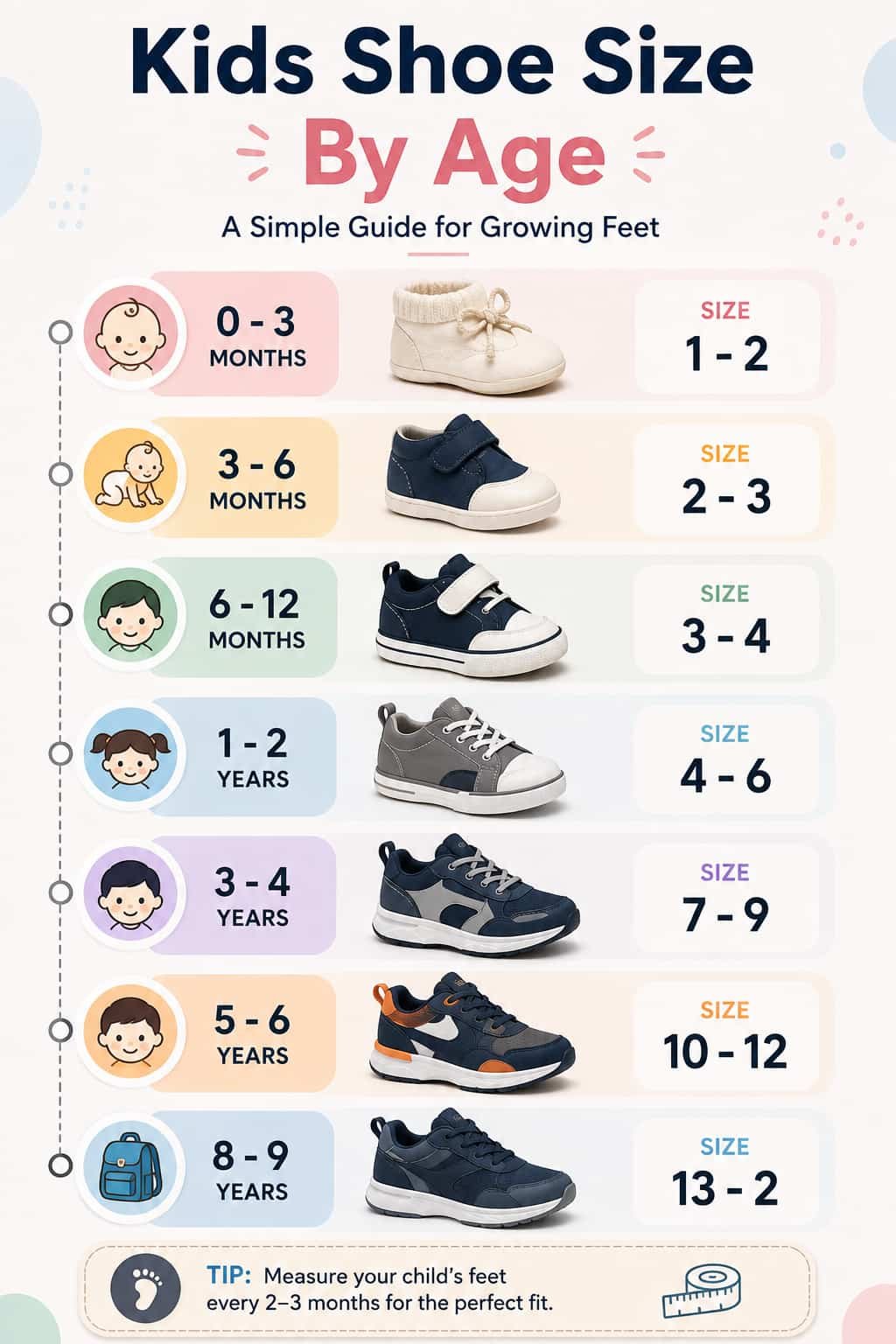
This chart shows the typical shoe size range at each age across the three sizing systems most parents shop from. Ranges overlap on purpose, since foot growth varies more than most parents expect, and this applies no matter which country’s sizing you’re using.
| Age | US Size | UK Size | EU Size |
| 0-3 months | 0 – 1 | 0 – 0.5 | 16 – 17 |
| 3-6 months | 1 – 2 | 0.5 – 1 | 17 |
| 6-12 months | 2 – 4 | 1 – 3 | 17 – 19 |
| 1-2 years | 4 – 7 | 3 – 6 | 19 – 23 |
| 2-3 years | 7 – 8 | 6 – 7 | 23 – 24 |
| 3-4 years | 8 – 9 | 7 – 8 | 25 – 26 |
| 4-5 years | 9 – 10 | 8 – 9 | 26 – 27 |
| 5-6 years | 10.5 – 11.5 | 9.5 – 10.5 | 28 – 29 |
| 6-7 years | 12 – 13 | 11 – 12 | 30 – 31 |
| 7-8 years | 13 – 1 (youth) | 12 – 13 | 31 – 32 |
| 8-9 years | 1 – 2 (youth) | 13 – 1 | 32 – 33 |
| 9-10 years | 2 – 3 (youth) | 1 – 2 | 34 – 35 |
| 10-12 years | 3 – 5 (youth) | 2 – 4 | 35 – 37 |
Notice how the ranges get wider as kids get older. That’s normal in every sizing system. Growth timing spreads out more with age, so a size gap between two same-age kids becomes more common, not less, whether you’re comparing US, UK, or EU numbers.
For a deeper breakdown of the baby stage specifically, our 12-24 Month Baby & Toddler Shoe Size Chart and our full Kids Shoe Size Chart cover each range in more detail than this age overview.
👶 Did You Know?
A child’s foot reaches about half its adult length by around age two, then continues growing at a much slower rate for the next decade. That early rush is part of why sizing changes so often in the baby and toddler years, no matter which country’s sizing chart you’re checking against.
Interactive Age to Size Finder
Select your child’s age below and this tool will show the typical size range across US, UK, and EU sizing for that stage.
Kids Shoe Size By Age Finder
Choose your child’s age to see the typical size range across US, UK, and EU sizing.
This is a general estimate. Measuring your child’s foot directly always gives the most accurate size, and individual brands can run slightly larger or smaller.
If you’d like to convert one specific number across systems rather than browsing by age, our Shoe Size Conversion Calculator covers the full range from baby through big kid sizes.
💡 Expert Tip
Keep a simple growth log, even something as basic as a note in your phone with the date and current size. It makes it much easier to notice the pattern of how quickly your specific child grows, rather than relying on general age charts alone, and it saves time when converting between sizing systems for gifts or overseas orders.
How Fast Shoe Size Changes at Each Stage
Growth speed isn’t constant. It shifts noticeably as kids move through different stages, and this pattern holds true across every country’s sizing scale.
Newborn to 12 months. This is the fastest growth window of all. A new size every 4 to 8 weeks is common, especially in the first six months.
1 to 2 years. Growth is still quick here, often a new size every 2 to 3 months as toddlers move from early walking into steadier, more active movement.
2 to 5 years. The pace slows to roughly every 3 to 4 months. Kids at this age are growing steadily but less dramatically than the baby and toddler years.
5 years and up. Most kids settle into needing a new size every 4 to 6 months, sometimes stretching closer to twice a year once growth evens out further.
Why Age Alone Isn’t Enough
Here’s the part worth repeating even in an age chart article: age tells you what’s typical, not what’s true for your specific child. In our experience fitting thousands of kids across every age range and every sizing system, the spread between same-age children only grows wider as they get older.
A quick foot measurement, whether it’s a paper tracing at home or an in-store fitting, will always beat guessing from an age chart alone. Think of the chart above as a starting point for narrowing down where to look, not a final answer, and always double check against the specific brand or region’s own size guide when it’s available.
📏 Size Snapshot
Age: 4 years
Typical Size: US 8 to 9, UK 7 to 8, EU 25 to 26
Growth Pace: New size roughly every 3 to 4 months
Growing Room: 0.4 – 0.5 inches
Signs It’s Time for a New Size
Watching for these signs matters more than sticking to a strict schedule, since every child grows at their own pace, and this applies whatever size label is on the current pair.
- Toes feel bunched or curled when you press gently on the front of the shoe.
- Red marks or pressure lines appear on the foot after the shoe comes off.
- Your child complains about tight shoes or takes them off frequently at home.
- The shoe looks visibly small compared to how it fit a few months earlier.
- Heels hang slightly off the back of an insole when you check it against the foot.
⚠ Common Mistake
Buying a much larger size “to make it last” is especially common with school-age kids’ shoes, since they cost more than baby sizes. Two full sizes up affects balance and running stability, so one size up at most is the safer trade-off between fit and longevity, in any sizing system.
Common Buying Mistakes by Age
Different mistakes tend to show up at different ages, and a few of these get worse when shopping across sizing systems.
Baby and toddler stage. Relying on age alone without measuring, and skipping remeasurement during fast growth windows.
Preschool stage. Buying based on a sibling’s old shoes without checking if foot shape or width also matches.
Early school stage. Choosing style over fit for the first time, since kids start expressing stronger shoe preferences, sometimes at the expense of proper sizing.
Any age, when ordering internationally. Assuming a US, UK, or EU size number carries over directly without checking the actual foot length or a proper conversion chart.
Buying Guide by Age Stage
What matters in a shoe shifts as kids grow, even though the fit fundamentals stay the same no matter which country’s sizing chart you’re working from.
Newborn to walking age. Soft, flexible soles that support natural foot movement rather than restrict it.
New walkers. Slightly more structure and grip on the sole, without going fully stiff, to support balance during those first independent steps.
Preschool age. Durable materials and secure closures, since activity level increases significantly and shoes take more daily wear.
Early school age. A closer eye on arch and width comfort, since kids at this age are more likely to voice discomfort clearly if something feels off.
✅ Parent Checklist
- Measure both feet, standing whenever possible.
- Check the chart above for a starting size range by age, in whichever system you shop.
- Leave 0.4 to 0.5 inches of growing room.
- Watch for the fit signs above rather than relying only on a fixed schedule.
- Remeasure more often during faster growth stages, less often as growth slows.
Expert Tips for Staying Ahead of Growth
Tip 1. Check fit at the start of each season, since seasonal shoe swaps are a natural, easy reminder to measure again.
Tip 2. Keep last year’s shoe on hand when shopping for a new pair. Comparing the two side by side is often faster than remeasuring from scratch.
Tip 3. Ask your child directly about fit once they’re old enough to describe discomfort clearly, usually starting around the preschool years.
Tip 4. Don’t assume growth pace stays consistent year to year. A child who grew slowly one year can have a faster spurt the next.
Tip 5. When shopping across borders or gifting internationally, convert by foot length in centimeters rather than trusting the size number alone, since scales genuinely differ between regions.
FAQs
What shoe size does a 3 year old typically wear? Most 3 year olds wear a US size 8 to 9, a UK size 6 to 7, or an EU size 23 to 24, though this varies based on individual growth. Measuring your child’s foot directly gives a more accurate answer than the age chart alone.
How often should I check my child’s shoe size? Check every 4 to 8 weeks for babies and toddlers, and every 3 to 6 months for preschool and school age kids. Growth pace slows with age, so the checking frequency can stretch out as they get older, regardless of sizing system.
Why do shoe sizes seem to skip around between baby, toddler, and youth sizing? US shoe sizing uses separate numbering systems for infant, toddler, and youth ranges, which is why the numbers reset partway through childhood instead of climbing in one continuous sequence. UK and EU sizing scales climb more continuously through the same age range, which is one reason parents sometimes find those systems less confusing to track over time.
Is it normal for my child’s foot size to stay the same for six months? Yes, especially once kids pass the toddler years. Growth naturally slows down, so a longer stretch between size changes becomes more common as children get older, in any sizing system.
Should I buy a bigger size to save money on shoes? A little extra room, no more than half a size to a full size, can help stretch the life of a pair. Going beyond that affects balance and comfort, so it isn’t usually worth the tradeoff, whichever sizing scale you’re working in.
Do boys and girls have different shoe size charts by age? Foot length by age is fairly similar between boys and girls in early childhood, and any differences tend to show up more in the school age years. Most general size by age charts, including this one, work as a reasonable estimate for either.
How much does shoe size vary between kids of the same age? It can vary more than most parents expect, especially past the toddler years. Genetics, growth timing, and overall size all play a role, so treat any age chart, in US, UK, or EU sizing, as a starting range rather than an exact answer.
What’s the difference between toddler sizes and youth sizes? In US sizing, toddler sizes generally run from about size 2 through size 13, while youth or grade school sizes pick up from about size 13 through 5 or 6 before transitioning into adult sizing. UK and EU sizing don’t have this same reset, since their numbering runs more continuously across the same age range.
When do kids typically move into adult shoe sizes? Most kids move into adult sizing sometime between ages 10 and 13, though this varies quite a bit based on individual growth. Checking foot length directly is the best way to know when that transition is close, regardless of which sizing system you use.
How do I measure my child’s foot at home? Trace the foot on paper while your child stands, then measure from the heel to the longest toe with a ruler. Add about 0.4 to 0.5 inches for growing room before matching the number to a size chart in whichever system your retailer uses.
Is it better to buy shoes online or in person as kids get older? In-person fitting is generally more reliable, especially during faster growth stages, since sizing can vary between brands and between regions. Online shopping works well once you know a brand runs true to size for your child, and once you’ve confirmed which sizing system a listing is actually using.
RELATED ARTICLES
- Kids Shoe Size Chart
- Shoe Size Conversion Calculator, US, UK, EU & CM (2026)
- 0-3 Month Baby Shoe Size Chart (US Sizes + Foot Length Guide)
- 3-6 Month Baby Shoe Size Chart (2026)
- 6-12 Month Baby Shoe Size Chart (2026)
- 12-24 Month Baby & Toddler Shoe Size Chart (2026
CONCLUSION
Shoe size climbs quickly in the first couple of years, then settles into a slower, steadier pace through the school age years, and that pattern holds true whether you’re shopping US, UK, or EU sizing. The age chart above gives you a solid starting range across all three systems, but a quick foot measurement is still the most reliable way to land on the right size at any stage.
Use the interactive tool above to check a typical range for your child’s current age, and revisit it as they grow into the next stage. For a full deep dive into any specific range, our Kids Shoe Size Chart and our baby-stage guides below cover each window in more detail.)