
What Is Pronation? Overpronation vs Supination Explained + Running Gait Analysis Guide (2026)
Introduction: That Nagging Foot Pain Might Not Be Random
You lace up your shoes, go for a walk or a run — and within twenty minutes, your arches ache, your knees feel weird, or your ankles are just off. Sound familiar?
Most people assume it’s the shoes. Sometimes it is. But often, the real culprit is something happening long before you even pick a shoe — it’s how your foot moves when it hits the ground. That movement has a name: pronation.
I’ve spent years behind a shoe counter watching customers walk in with mystery pain, worn-down insoles, and zero idea why their “perfectly fine” shoes were destroying their feet. The same pattern shows up again and again — they weren’t wearing the wrong brand, they were wearing the wrong type of shoe for their gait.
Whether you’re a casual walker, a weekend runner, or someone who just spends eight hours a day on concrete — understanding what pronation is, what overpronation means, and how supination differs can genuinely change how your feet feel for the rest of your life.
This guide breaks it all down. No jargon overload. Just real, practical insight.
TL;DR — Quick Answer
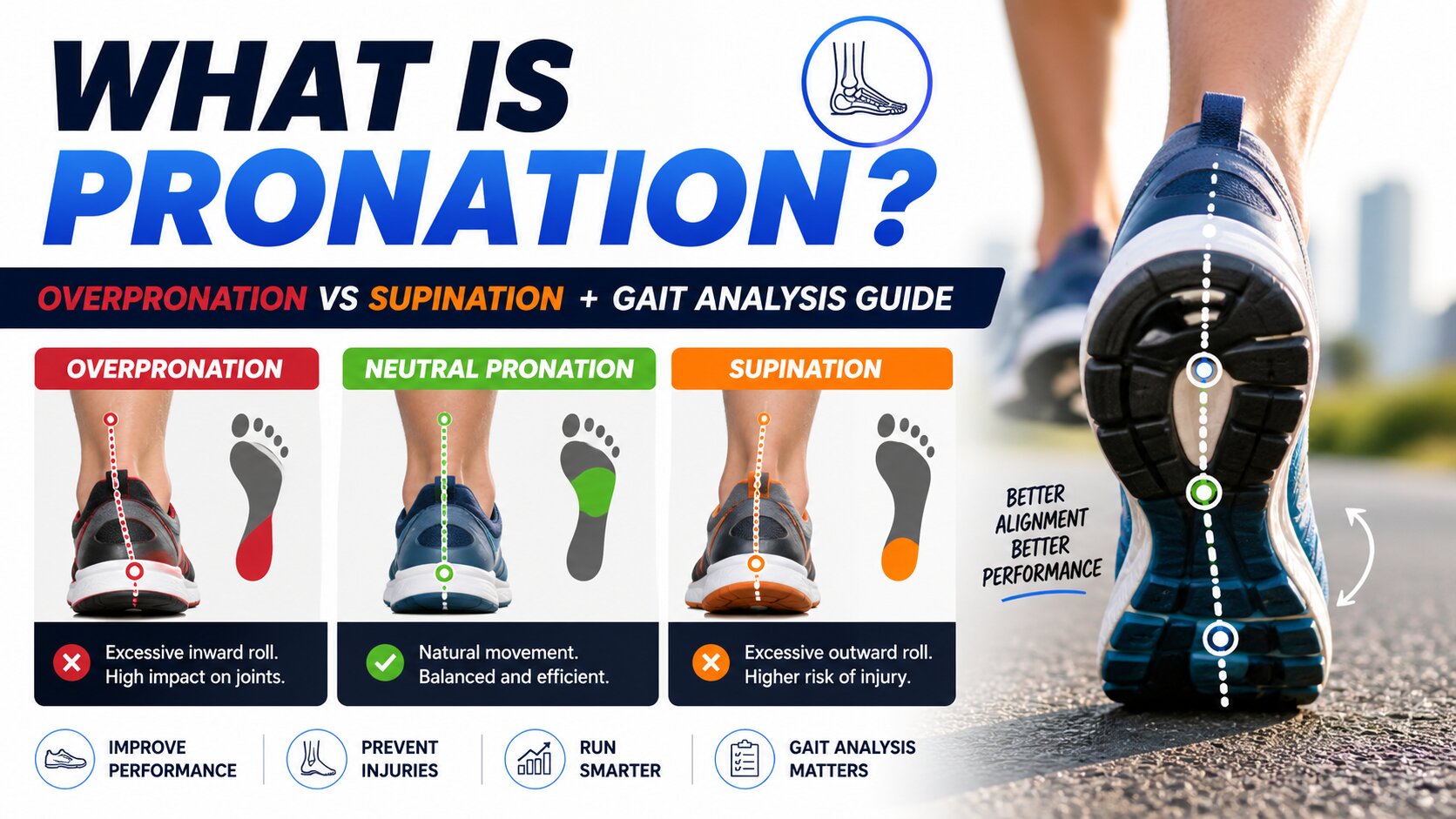
What is pronation? Pronation is the natural inward rolling motion of your foot as it strikes the ground. Overpronation means your foot rolls too far inward, stressing your arches and knees. Supination (underpronation) means it rolls outward instead. Both affect which running or walking shoes your feet actually need — and getting this wrong leads to pain, injury, and wasted money.
Why Pronation Actually Matters More Than Most People Think
Here’s the honest truth: most people shopping for shoes online have absolutely no idea what their gait type is. They pick based on color, brand, price, or a vague “feels comfortable in the store” test — which, by the way, is not the same as how a shoe feels after three miles.
I’ve seen this exact frustration pop up constantly in running communities on Reddit. Someone in r/running posted: “Bought expensive shoes, still getting shin splints — what am I doing wrong?” The top comment? “Did you ever get a gait analysis?” The person had never even heard the term.
And that’s the gap this guide closes.
What Is Pronation of the Foot? (The Real Definition)
Pronation of the foot refers to the natural, biomechanical rolling motion that occurs every time your foot makes contact with the ground. It’s not a flaw — it’s a feature. Your foot is designed to pronate slightly. This motion helps your body absorb the shock of each step, distribute your body weight evenly, and push off efficiently.
Think of pronation as your foot’s built-in suspension system.
When you run or walk:
- Your heel strikes the ground first (usually)
- Your foot rolls inward (this is pronation)
- Your arch flattens slightly to absorb impact
- Your toes push off to propel you forward
This is neutral pronation — the gold standard. Most shoe brands design their standard running and walking shoes around this pattern.
What type of motion is foot pronation? It’s a triplanar motion — meaning it happens across three planes simultaneously: your foot everts (rolls inward), dorsiflexes (ankle bends forward), and abducts (foot turns outward slightly). It’s remarkably complex for something you do thousands of times a day without thinking.
What Is Overpronation? (And Are You an Overpronator?)
Overpronation is when that natural inward roll goes too far. Your arch collapses more than it should, your ankle rolls in excessively, and the entire kinetic chain above it — your shin, knee, hip — has to compensate.
What Does Overpronation Look Like?
If you’re overpronating:
- The inner edge of your shoe sole wears down faster than the outer
- Your ankles appear to tilt inward when you stand or walk
- The back of your heel cup wears unevenly
- You may notice knee pain, shin splints, plantar fasciitis, or flat-looking arches
What does overpronation look like from behind? When someone who overpronates walks away from you, you’ll see their ankles “cave in” — the Achilles tendon won’t run straight down, it’ll bow inward in a slight curve. That’s the visual tell.
If you’re a shoe store person like me, you can spot an overpronator before they even say a word. The wear pattern on their old shoes tells the whole story within seconds.
What Does It Mean to Overpronate? (Breaking It Down)
Overpronation essentially means your foot’s arch collapses too aggressively under load. This causes:
- Flat feet or low arches — the most common structural cause
- Ligament laxity — loose ligaments that can’t hold the arch up under pressure
- Muscle weakness — particularly in the tibialis posterior, which supports the arch
- Excess body weight — adds load that accelerates arch collapse
What does it mean to pronate in the context of running specifically? It means your foot is spending too long in the contact phase, absorbing impact through your arch rather than bouncing through efficiently. This creates repetitive micro-stress on your plantar fascia, Achilles tendon, and medial knee.
The Most Common Overpronation Symptoms
- Arch pain or plantar fasciitis (heel pain)
- Medial knee pain (“runner’s knee”)
- Shin splints
- Hip pain or IT band syndrome
- Lower back ache after long walks or runs
- Calluses forming on the inner ball of the foot
“I used to think my back pain was from my desk job. Turns out I was severely overpronating and wearing flat canvas sneakers every day. One pair of stability shoes later — genuinely life-changing.” — a comment I saw on a Facebook running group that we screenshot’d for our store bulletin board. Not joking.
What Is Supination (Underpronation)? The Opposite Problem
Supination, also called underpronation, is the opposite of overpronation. Instead of rolling inward too much, your foot rolls outward during your gait cycle.
What Is Underpronation of the Foot?
When you underpronate or supinate, your weight stays on the outer edge of your foot. This means:
- Impact isn’t being distributed properly
- Your foot isn’t absorbing shock well
- The outer sole of your shoe wears down faster
What does underpronation mean for your body? It puts excessive strain on the ankle, outer knee, IT band, and lower leg muscles. Supinators are at higher risk of:
- Ankle sprains (the foot tips outward easily)
- Stress fractures (especially in the smaller metatarsals)
- IT band syndrome
- Plantar fasciitis (yes, supinators get it too, just differently)
Supination is less common than overpronation — maybe about 10-15% of the population. But it’s also frequently misdiagnosed or overlooked. People walk into stores complaining of chronic ankle sprains and never connect it to their gait type.
What Is Ankle Pronation vs Supination — Side by Side
| Feature | Neutral Pronation | Overpronation | Supination (Underpronation) |
|---|---|---|---|
| Foot roll direction | Slight inward | Excessive inward | Outward |
| Arch type | Medium arch | Low/flat arch | High arch |
| Sole wear pattern | Heel center + ball of foot | Inner heel + inner forefoot | Outer heel + outer forefoot |
| Injury risk | Low | Moderate-High (medial) | Moderate-High (lateral) |
| Shoe type needed | Neutral cushioning | Stability or motion control | Neutral with extra cushioning |
What Is a Running Gait Analysis? (And Do Runners Really Need One?)
Running gait analysis is the process of evaluating how your foot strikes, rolls, and pushes off during a run — typically filmed on a treadmill and reviewed in slow motion by a trained specialist.
How Does a Gait Assessment for Running Work?
A proper gait assessment running session usually goes like this:
- Barefoot observation — You walk or jog on a treadmill while being filmed from the side and rear
- Slow-motion review — The footage is played back at reduced speed (or frame-by-frame) to identify pronation, heel strike angle, stride length, and cadence issues
- Foot type assessment — Some stores use pressure plates or 3D foot scanners
- Shoe recommendation — Based on the findings, specific shoe categories are recommended
3D gait analysis takes this further — using motion capture markers and pressure mapping to create a precise biomechanical picture. This is more common in sports clinics and podiatry offices than in retail stores.
Do Runners Need a Gait Analysis?
Honestly? If you run more than a few miles per week and have ever dealt with knee, shin, hip, or foot pain — yes, absolutely. Even if you haven’t had pain, it’s worth doing at least once.
I’ve had customers who ran for years in the wrong category of shoe with zero issues… until one day they ramped up their mileage and everything fell apart at once. A prior gait analysis would have been their early warning system.
Gait analysis for running shoes helps you avoid the trial-and-error nightmare of buying multiple pairs before finding the right one. Given that a solid pair of running shoes costs $120–$180+ these days, the time investment in a gait test is worth it.
Where to Get a Running Gait Analysis Near Me
Running gait analysis near me is one of the most-searched terms in footwear, and for good reason. Here are your best options:
- Specialty running stores — This is the gold standard for most runners. Stores focused on running (not just athletic gear generally) typically have staff trained in gait assessment. Many offer it free as part of the shoe-buying process.
- Sports medicine clinics / podiatrists — For a more clinical-grade, professional gait analysis, a sports podiatrist or physiotherapist can provide a full biomechanical analysis of running including video, pressure mapping, and customized orthotics recommendations.
- Running clubs and events — Many local running groups host periodic running gait analysis events, sometimes in partnership with brands like ASICS or Brooks.
Brands like ASICS have historically offered in-store gait analysis at select retailers — the ASICS gait analysis program uses pressure mapping to identify your foot type and match you with the right ASICS stability category. Similarly, Fleet Feet has built its reputation largely on Fleet Feet gait analysis and their 3D foot scanning (the “fit id” system).
Running gait analysis cost varies: free at most specialty running stores, $50–$200 at sports clinics, and $200–$500+ for a full professional gait analysis or biomechanical analysis of running at a sports science lab.
A quick note from a thread I spotted on Instagram fitness communities: someone posted a meme that said “Me walking into a running store expecting to just grab shoes: 👶 / Me leaving after a 45-minute gait analysis with a complete understanding of my foot biomechanics: 🎓” — honestly, that’s exactly how it goes. And it’s worth every minute.
What Pronation Means for Your Shoe Selection
Understanding what pronation means in shoes is the bridge between knowing your gait type and actually shopping correctly.
Running Shoes for Overpronation
The best shoes for overpronation — or the best running shoes for overpronation — fall into two categories:
1. Stability Shoes Designed for mild to moderate overpronators. They feature a medial post (a denser foam on the inner midsole) that slows down excessive inward rolling without locking your foot in place. Examples: ASICS GT series, Brooks Adrenaline GTS, New Balance 860.
2. Motion Control Shoes For severe overpronators or heavier runners. These offer rigid support, a straight last (shoe shape), and a firm medial post. They feel stiffer, but for the right foot type — they’re genuinely transformative.
What are the best insoles for overpronation? If you already love your shoes but need extra arch support, aftermarket insoles from brands like Superfeet, Powerstep, and Currex are excellent. The Superfeet GREEN insole, in particular, is a cult favorite in the running community and actually holds up well in both running and everyday wear.
If you’re also dealing with plantar fasciitis alongside overpronation (common combo), check out our deep-dive on the best shoes for plantar fasciitis and specifically our guide on best running shoes for plantar fasciitis.
Running Shoes for Supination (Underpronation)
The best shoes for underpronation — or best running shoes for underpronation — are neutral shoes with excellent cushioning. Because supinators don’t pronate enough, the last thing they need is a stability shoe pushing their foot further outward.
Look for:
- High stack height, soft responsive cushioning
- Flexible outsole to encourage natural foot motion
- Slightly curved last
- Examples: HOKA Clifton series, New Balance Fresh Foam 1080, Brooks Ghost
What are the best shoes for underpronation? The common thread is maximum shock absorption, because underpronating feet aren’t absorbing impact through arch compression the way neutral or overpronating feet do.
What Are the Best Shoes for Pronation (Neutral)?
If you have neutral pronation, you’re in luck — you can wear almost any well-cushioned neutral running shoe without issue. You’re not restricted to a specific category. Focus on fit, cushioning preference, and your intended activity.
Popular neutral options: Nike Pegasus, Adidas Ultraboost, Brooks Ghost, Saucony Ride.
How to Do a Basic Gait Test at Home (Before Your Gait Analysis)
Can’t get to a running gait analysis store right now? Here are a few DIY tests that give you a rough read:
The Wet Foot Test
Step out of the shower onto a piece of cardboard or paper bag.
- Normal arch: You see a C-shaped curve — heel, outer edge, and ball of foot
- Flat foot (likely overpronator): Almost your full foot is visible
- High arch (likely supinator): Very little of your foot shows — just heel and ball with a narrow bridge
The Old Shoe Test (My Favorite)
Grab a pair of shoes you’ve worn for 200+ miles. Flip them over and look at the sole wear:
- Inner heel/forefoot wear: Overpronation
- Outer heel/forefoot wear: Supination
- Even center/heel wear: Neutral
This is genuinely the fastest, most reliable home test. I’ve used this with hundreds of customers who brought their old shoes in for comparison.
The Video Treadmill Test (DIY Version)
Set your phone up behind a treadmill, run at your normal pace for two minutes, and film your feet and ankles. Watch the footage back in slow motion (most phones can do this). Look at your ankle — does it roll inward? That’s overpronation. Outward? Supination.
This is basically what a gait analysis treadmill setup at a running store does, just with better cameras and a trained eye reviewing it.
Pronation and Foot Health: The Bigger Picture
Understanding what pronation of the foot means isn’t just a shoe-shopping tool — it has real long-term health implications.
Overpronation and Plantar Fasciitis
These two go hand in hand. When your arch collapses excessively, it stretches the plantar fascia (the thick band of tissue along your arch) beyond its ideal range with every step. Over time, this creates micro-tears and inflammation — classic plantar fasciitis.
This is exactly why the best walking shoes for women section of our site emphasizes arch support so heavily. Women, statistically, have a higher prevalence of both overpronation and plantar fasciitis — partly due to Q-angle differences (the angle from hip to knee) and partly due to footwear history (years of unsupportive flats and heels).
For women over 50, this becomes even more relevant as ligament laxity naturally increases and arch support in everyday shoes becomes less of a luxury and more of a necessity. Our guide on best walking shoes for women over 50 addresses this specifically.
Can Overpronation Be Corrected?
Short answer: It can be managed and significantly improved, though “corrected” depends on the root cause.
- Orthotics and insoles — Custom orthotics from a podiatrist or high-quality OTC insoles can dramatically reduce overpronation by supporting the arch and controlling inward roll
- Strength training — Single-leg calf raises, foot arch exercises (like “short foot”), and hip strengthening can reduce overpronation biomechanically
- Stability footwear — Wearing the right shoes consistently gives your feet the external support they need while you work on the internal strength
- Gait retraining — A sports physio or running coach can help alter your stride pattern over time
Pro-Level Shoe Insights: What the Industry Doesn’t Always Tell You
The Medial Post Myth
Not every “stability” shoe is built the same. Some brands use a denser foam medial post, others use a TPU (thermoplastic urethane) guide rail or a dual-density midsole insert. The effectiveness varies wildly. When evaluating stability shoes, physically press your thumb into the inner midsole — it should noticeably resist compression compared to the outer midsole. If both sides compress the same way, the “stability” feature may be mostly marketing.
Motion Control ≠ Best for Everyone With Flat Feet
This is a big one. Many people with flat feet are told to go straight to motion control shoes. But if you have functional flat feet (arches that appear when you’re not weight-bearing), you may actually do better in a mild stability shoe or even a neutral shoe with an aftermarket insole. Over-correcting with a stiff motion control shoe can cause new problems — particularly hip and IT band issues.
Why Shoe Size Changes After Gait Analysis
Running shoe analysis at specialty stores often reveals you’ve been wearing the wrong size. When your arch collapses (overpronation), your foot lengthens slightly under load. This is why running shoes are often recommended in a half-size larger than your casual size. Don’t be surprised if your gait assessment comes with a size recommendation.
For international sizing reference, our shoe size conversion guide covers US, UK, and Euro sizing across major brands.
The Breaking-In Period Is Real
Stability and motion control shoes can feel weird at first — especially if you’ve been running in neutral shoes for years. Your feet and posterior tibial tendon need time to adapt. Start with short sessions in the new shoes rather than immediately doing full-distance runs.
Comparison Table: Overpronation vs Supination vs Neutral
| Category | Overpronation | Neutral | Supination (Underpronation) |
|---|---|---|---|
| Arch height | Low / flat | Medium | High |
| Foot roll | Excessive inward | Controlled inward | Outward |
| Sole wear | Inner heel / forefoot | Central heel / forefoot | Outer heel / forefoot |
| Common injuries | Plantar fasciitis, shin splints, knee pain | Fewer injury patterns | Ankle sprains, IT band, stress fractures |
| Shoe category | Stability / Motion Control | Neutral cushioning | Neutral max-cushion |
| Insole recommendation | High arch support (Superfeet Green, Powerstep) | Standard or low-profile | Cushioned, lower arch height |
| Running cadence impact | Slower push-off | Efficient | Less shock distribution |
Common Mistakes People Make When Buying Shoes Without a Gait Analysis
1. Choosing Shoes Based on How They Look
Every single week I’d have someone bring back a pair of shoes complaining about knee pain — and the culprit was almost always that they’d bought a neutral shoe (sleek, flat, stylish) when they desperately needed stability. Aesthetics are important. But they shouldn’t override biomechanical need.
2. Assuming “Cushioning” Equals “Support”
Cushioning and support are not the same thing. A heavily cushioned shoe can still be terrible for an overpronator if it has no medial post to control inward roll. I’ve seen people buy max-cushion shoes thinking more foam means better arch support. It doesn’t.
3. Relying on Brand Loyalty Alone
“I always wear Nike / Adidas / ASICS, so I just grab the same thing” — I respect brand loyalty, but shoe lines change. A model that was perfect for you two years ago may have been updated in ways that affect the stability features. Always check what’s changed before auto-repurchasing.
4. Not Doing a Gait Test Before Buying Online
Online shoe shopping is great for price comparison and selection. But if you’ve never had a running shoe analysis done — or if it’s been several years — buy from somewhere with free returns, or get your gait assessed first at a local running store before making your purchase.
5. Ignoring the Old Shoe Wear Pattern
Your worn-out shoes are a roadmap of your gait. Bring them to any running gait analysis store appointment. They’ll tell the specialist things you can’t.
Frequently Asked Questions (Everything You Actually Want to Know)
What is pronation in running?
Pronation in running is the natural inward rolling of the foot that occurs as it transitions from heel strike to toe-off. It’s normal and necessary — the problem is when it becomes excessive (overpronation) or insufficient (supination).
What does overpronation mean?
Overpronation means your foot rolls inward too aggressively during each stride, causing arch collapse, ankle instability, and increased stress on the knees and hips. It’s the most common gait deviation and the primary reason stability running shoes exist.
What is supination or underpronation?
Supination (underpronation) is when your foot rolls outward rather than inward during the gait cycle. It’s less common than overpronation and is associated with high arches, poor shock absorption, and a higher risk of ankle sprains and stress fractures.
What does pronation mean in shoes?
In shoe terms, pronation refers to how much your foot rolls inward and which category of footwear you need. Overpronators need stability or motion control shoes. Supinators need neutral shoes with maximum cushioning. Neutral pronators can wear most neutral running shoes.
What are the best shoes for overpronation?
The best shoes for overpronation are stability shoes like the ASICS GT-2000, Brooks Adrenaline GTS, New Balance 860, and Saucony Guide. For severe cases, motion control shoes like the Brooks Beast or ASICS Kayano provide maximum support.
What are the best running shoes for underpronation (supination)?
The best running shoes for underpronation include the HOKA Clifton, Brooks Ghost, New Balance Fresh Foam 1080, and Nike React Infinity. Focus on neutral shoes with high cushioning and a flexible midsole.
Do I need a professional gait analysis?
If you run more than 10–15 miles per week, have recurring lower body pain, or are about to invest in new running shoes — yes. Most specialty running stores offer free gait analysis. It takes 15–30 minutes and can save you months of injury-related frustration.
What is the difference between a gait test and a running gait analysis?
A gait test is typically a quick visual assessment — often done in stores with a short treadmill jog. A full running gait analysis involves slow-motion video, pressure mapping, and biomechanical evaluation by a trained professional. The latter is more comprehensive and usually done at sports clinics.
Can overpronation cause plantar fasciitis?
Yes — overpronation is one of the most common causes of plantar fasciitis. Excessive arch collapse repeatedly stretches the plantar fascia with each step, leading to inflammation and heel pain over time. Stability shoes and supportive insoles are front-line interventions.
How do I know if I overpronate without a gait analysis?
Check the wear pattern on your current shoes. If the inside edge (especially at the heel and ball of foot) is worn down more than the outside, you likely overpronate. Wet footprint tests and at-home treadmill video can also give you a rough indication before visiting a store.
What Reddit, Running Communities & Real People Say About Pronation
Since we’re talking about a topic that generates a lot of online discussion, here are some patterns I see repeatedly across social platforms:
On Reddit (r/running, r/Fitness): The most upvoted advice threads consistently say: “Get a gait analysis before you buy running shoes. Full stop.” People who skip this step post the most “why do my knees hurt” threads, without fail.
On Facebook Running Groups: Common complaint: “My running store told me I overpronate, but the shoes they recommended feel like bricks.” Reality check — stability shoes do feel firmer. That’s the point. Give them 2–3 weeks before judging.
On Instagram Running Reels: There’s a whole genre of “pronation check” videos where people film themselves running from behind. It’s actually super useful for seeing overpronation visually. The meme that kills me every time: “Normal people: looking for cute shoes. Me: checking if my ankles cave in from the treadmill camera footage.” That’s the level of commitment this community has.
On TikTok: Running shoe fitting content blows up regularly. The videos showing before/after gait analysis shoes (someone going from flat neutral trainers to proper stability shoes) consistently rack up millions of views. Because the transformation in posture and comfort is actually visible.
The Trust Section: Why Foot Type Awareness Is Non-Negotiable in 2026
Look — we live in an era where AI is helping people shop for shoes, voice search is asking Siri and Alexa about the best shoes for overpronation, and subscription boxes are sending “personalized” shoes to doorsteps without ever seeing a foot.
That’s convenient. But feet are incredibly individual. Two people can both “overpronate” and need completely different solutions based on their weight, activity level, arch flexibility, injury history, and even leg length discrepancy.
The information in this guide is designed to give you a solid working framework. But nothing replaces an actual running gait analysis done by a trained professional — whether that’s at a running store with gait analysis, a podiatrist’s clinic, or a sports medicine facility.
Think of this guide as your pre-appointment primer. Come in knowing the vocabulary, understanding what you’re looking for, and you’ll get dramatically more value from the experience.
Quick Shopping Reference: Pronation Type → Shoe Category → What to Look For
If You Overpronate:
✅ Look for: Stability or Motion Control shoes ✅ Key features: Medial post, guide rails, firmer inner midsole, straight last ✅ Insoles: High-arch aftermarket insoles (Superfeet Green, Powerstep Pinnacle) ✅ Avoid: Pure cushioning shoes, heavily curved lasts, zero-drop styles (unless transitioning slowly under guidance)
If You Supinate (Underpronate):
✅ Look for: Neutral shoes with high cushioning ✅ Key features: Flexible outsole, high stack height, soft responsive foam, slight curve last ✅ Insoles: Light arch support or cushioned flat insoles ✅ Avoid: Stability shoes, motion control shoes, rigid soles
If You’re Neutral:
✅ Look for: Neutral running shoes matching your activity and cushion preference ✅ Freedom to explore: Most well-constructed neutral trainers will work ✅ Focus on: Fit, breathability, heel-to-toe drop matching your running style
→ Check the best-rated walking shoes on Amazon → Compare top-reviewed stability running shoes → Find the best insoles for overpronation — top picks
(Affiliate disclosure: Links above may be affiliate links. We may earn a small commission at no extra cost to you. We only recommend products we’d actually put in front of a customer.)
Internal Resources Worth Reading Next
- 🦶 Best Walking Shoes for Women (2026 Guide) — arch support and comfort reviewed in detail
- 👟 Best Walking Shoes for Women Over 50 — stability and orthotics-friendly picks
- 🏃 Best Shoes for Plantar Fasciitis — directly connected to overpronation
- 🏃♀️ Best Running Shoes for Plantar Fasciitis — for runners dealing with arch and heel pain
- 📏 US vs UK vs Euro Shoe Size Conversion — essential for online shoe shopping
- 🧽 How to Clean White Sneakers With Toothpaste — because good shoes deserve good care
- 🤎 How to Clean Suede Shoes — keeping specialty materials looking fresh
Final Word: Your Gait Is as Individual as Your Fingerprint
Pronation isn’t a problem to be embarrassed about or a condition to self-diagnose from a single Instagram reel. It’s just a description of how your specific feet interact with the ground — and once you understand it, every shoe purchase you ever make gets smarter.
You stop buying on impulse. You stop returning shoes that hurt after two weeks. You stop wondering why your knees ache after every long walk. And you start building a collection of footwear that actually works for your body.
Whether you’re chasing a marathon PR, putting in 12,000 steps at work, or just trying to make it through a travel day without foot pain — knowing your pronation type is step one of every good shoe decision.
Get that gait analysis. Check your sole wear. Do the wet foot test tonight.
Your feet have been trying to tell you something. This guide just gave you the vocabulary to understand it.
Last updated: 2026 | Written by the team at Urban Style Footwear — footwear specialists with hands-on experience fitting thousands of customers across all gait types.
This post may contain affiliate links. We only recommend products we trust.