
New Balance FuelCell Explained: Foam, Shoes and Performance

New Balance FuelCell: Quick Guide
FuelCell is New Balance’s cushioning technology, designed to provide a propulsive running feel. Different shoe families use different constructions and serve different training purposes.
- Rebel is positioned for everyday running and quicker workouts.
- SuperComp Trainer v3 includes a carbon-fibre plate.
- Not every FuelCell shoe has a plate.
- FuelCell and Fresh Foam X have different brand positioning.
- Choose based on fit, training purpose and comfort.
Summarise this guide with AI
These links open an AI service with a prepared request. The service does not automatically read this article. Review or submit the request after opening it.
New Balance FuelCell is a cushioning technology designed to provide a propulsive, energetic feel during running. It appears in several New Balance shoe families, including Rebel, Propel and SuperComp models. However, not every FuelCell shoe feels the same. Foam formulation, midsole geometry, plates, cushioning and intended use all influence its performance.
Quick summary: What is New Balance FuelCell?
FuelCell is New Balance’s branded midsole cushioning technology. It is associated with a forward-driving sensation and appears in everyday trainers, faster training shoes and carbon-plated performance models.
- FuelCell is a technology family, not one identical foam formulation in every shoe.
- The Rebel is positioned as a lightweight everyday running shoe.
- The SuperComp Trainer v3 uses a carbon-fibre plate and Energy Arc construction.
- Not every FuelCell shoe has a carbon plate.
- The right model depends on fit, running style, comfort and intended activity.
Key takeaways
- FuelCell focuses on a propulsive feel. New Balance describes the technology as helping drive the runner forward.
- Different models use different constructions. The Rebel, Propel and SuperComp families have different purposes.
- The Rebel is not the same as the SuperComp Trainer. Their geometry, weight and construction differ.
- Carbon plates are not included in every FuelCell shoe. Check the exact product specification.
- FuelCell can be considered for walking, but the exact model matters. A performance running shoe is not automatically the best everyday walking shoe.
- Durability varies. No single mileage figure applies to every FuelCell shoe.
Table of Contents
- What Is New Balance FuelCell?
- How Does FuelCell Foam Work?
- What Is FuelCell Made Of?
- New Balance Shoes With FuelCell
- FuelCell Rebel: Is It Good for Everyday Running?
- FuelCell SuperComp Trainer: Does It Have a Carbon Plate?
- FuelCell vs Fresh Foam X: What Is the Difference?
- Comfort and Responsiveness: What Does FuelCell Feel Like?
- Is New Balance FuelCell Good for Walking?
- FuelCell Durability: How Long Does It Last?
- How to Make FuelCell Shoes Last Longer
- Who Should Choose New Balance FuelCell?
- FuelCell Buying Guide: What Should You Check?
- Common New Balance FuelCell Myths
- Frequently Asked Questions About New Balance FuelCell
- Final Verdict: Is New Balance FuelCell Worth Considering?
What Is New Balance FuelCell?
New Balance FuelCell is a proprietary cushioning technology used in the brand’s performance footwear.
The technology is designed to create a propulsive sensation underfoot. In simple terms, the midsole compresses when your foot lands and responds as your weight moves through the shoe. The resulting ride depends on the foam, its geometry and the other components surrounding it.
New Balance describes FuelCell as delivering a propulsive feel to help drive you forward. This is the manufacturer’s description of the technology, not a guarantee that every runner will become faster.
FuelCell appears across multiple shoe categories. Some models are designed for everyday running, others for faster workouts, and certain SuperComp models incorporate additional performance components such as carbon-fibre plates.
This is an important distinction: FuelCell is not one specific shoe, and it does not automatically mean a shoe is a racing shoe.
For a broader introduction to the materials used in midsoles, explore our running shoe foam guide.
How Does FuelCell Foam Work?
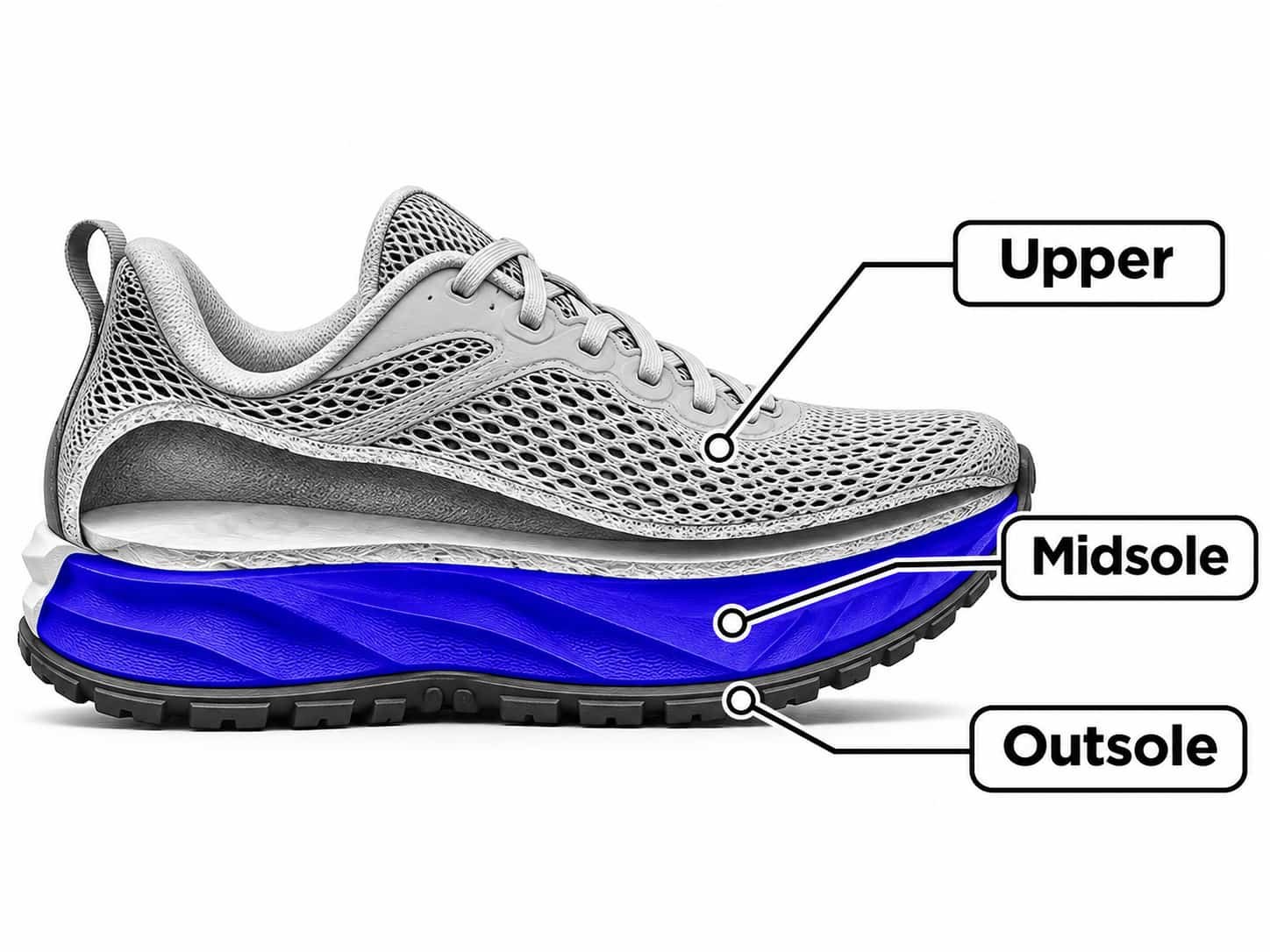
Running shoe cushioning works through compression and recovery.
When your foot contacts the ground, the midsole compresses under load. As your body moves forward and the pressure changes, the material recovers towards its original shape.
The behaviour of this cushioning depends on several factors:
- The polymer and foam formulation.
- The density and cellular structure.
- The thickness of the midsole.
- The shape and width of the platform.
- The stiffness of the shoe.
- Any plate or additional structural component.
FuelCell is designed to produce an energetic, forward-driving sensation. But the feeling you experience depends on the complete shoe rather than the foam name alone.
What does propulsive mean?
A propulsive ride generally describes a shoe that feels energetic as you transition through your stride.
This can come from a combination of foam response, midsole geometry, rocker shape and plate construction.
It is useful to distinguish this sensation from energy return as a laboratory measurement. A shoe that feels lively is not automatically proven to improve running economy or make every runner faster.
Why does the same technology feel different?
A Rebel and a SuperComp Trainer can both use FuelCell but have different construction goals.
A lightweight daily trainer may focus on versatility and quick transitions. A plated training shoe may use a more structured midsole, a plate and a geometry designed for longer training sessions.
That is why the complete model specification matters.
What Is FuelCell Made Of?
This is one of the most common questions about New Balance FuelCell.
The answer is that the exact formulation should be checked at the model level. FuelCell is a brand technology name, and it should not be assumed to describe one identical polymer blend across every generation and shoe family.
For example, New Balance’s official Rebel v5 product information describes a PEBA/EVA foam blend. That specification is relevant to the listed Rebel v5, not automatically to every FuelCell model.
The SuperComp Trainer v3 is described by New Balance as using FuelCell midsole foam with approximately 3% bio-based content. The manufacturer’s product description also identifies Energy Arc construction.
These model-specific examples show why a blanket statement about all FuelCell foam would be inaccurate.
Why do foam materials matter?
Different polymers and formulations can influence:
- Weight.
- Compression.
- Rebound.
- Firmness.
- Temperature response.
- Manufacturing cost.
- Long-term wear characteristics.
For a more detailed explanation of the material families, read Shoe Materials Explained.
FuelCell and supercritical foam are not interchangeable terms
FuelCell is a New Balance technology name. Supercritical foam describes a manufacturing process that uses a supercritical fluid to create a cellular foam structure.
The terms describe different things. Do not assume that every FuelCell shoe is supercritically processed unless the manufacturer identifies that process for the exact model.
Our Supercritical Foam Explained guide covers the process, gas expansion and how it can influence foam structure.
New Balance Shoes With FuelCell
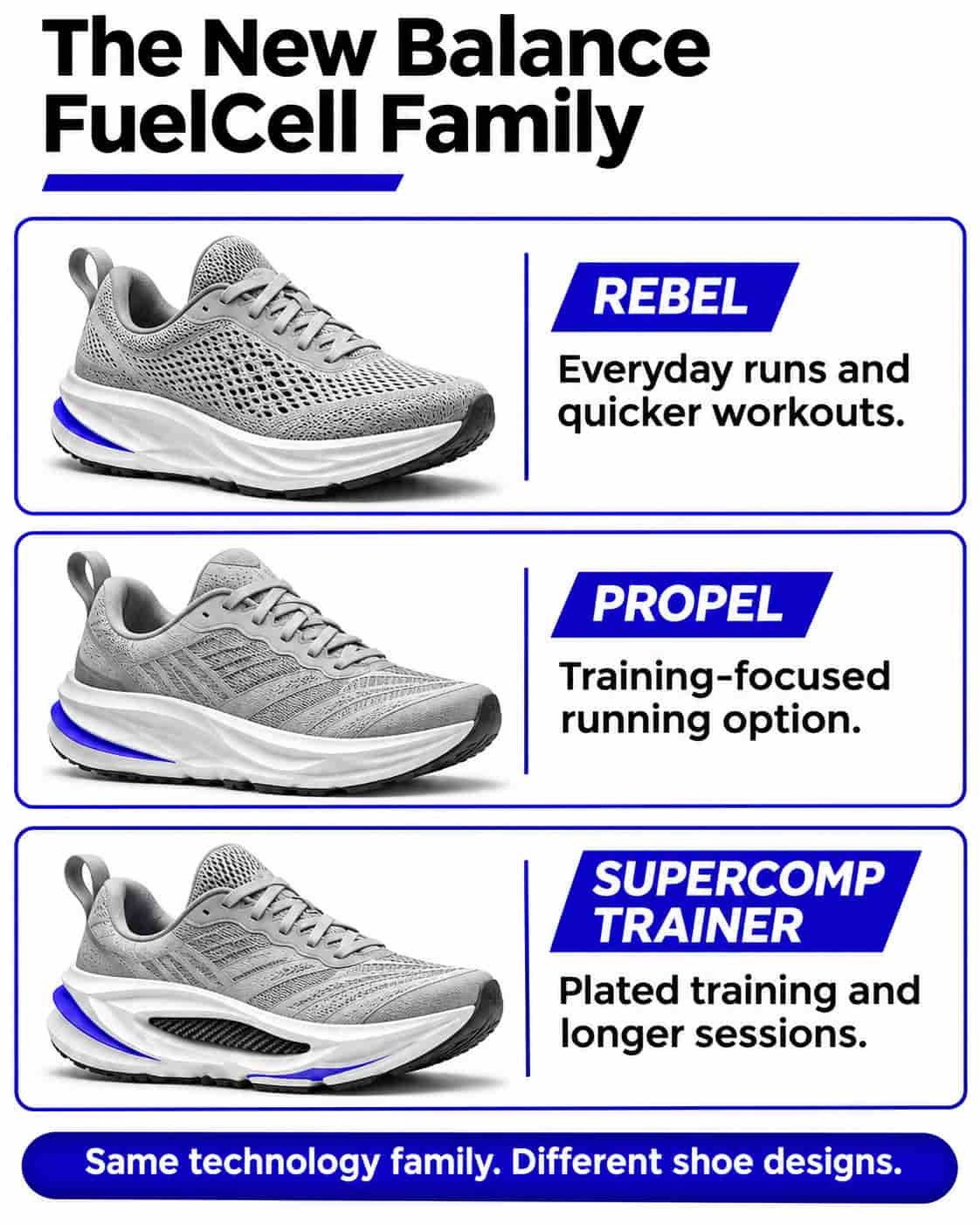
FuelCell is used across several New Balance running shoe families. These models are useful examples of how the technology can be adapted for different running needs.
1. FuelCell Rebel
The Rebel is positioned as a lightweight everyday running shoe with an energetic ride. It is a useful option to consider if you want one shoe for a mixture of regular runs and faster sessions.
The Rebel v4 is relevant to your search data, but it is not the latest version in the current official product results. New Balance’s official Rebel v5 listing describes it as an everyday and quick-run shoe, with a PEBA/EVA foam blend and a propulsive feel.
Potential reasons to consider it:
- You prefer a lighter running shoe.
- You want a shoe that can handle different training paces.
- You enjoy an energetic cushioning sensation.
- You want a versatile daily trainer rather than a dedicated race-day shoe.
What to consider before buying:
- The fit and toe-box space.
- Whether the ride feels sufficiently stable for you.
- Whether you prefer a softer or firmer midsole.
- The specific generation’s construction and weight.
2. FuelCell SuperComp Trainer
The SuperComp Trainer family is designed for performance-focused training. The Trainer v3 is particularly relevant to your search and shopping data.
New Balance describes the SuperComp Trainer v3 as a shoe for half-marathon and marathon training. Its listed features include FuelCell foam, Energy Arc construction and a carbon-fibre plate.
This is a more structured design than a typical unplated everyday trainer.
Potential reasons to consider it:
- You regularly complete longer training runs.
- You are interested in a plated training shoe.
- You prefer a structured and cushioned platform.
- You want a shoe designed around a performance-training purpose.
What to consider:
- The carbon plate changes the shoe’s stiffness and ride.
- It may feel different from a flexible daily trainer.
- The platform and geometry may not suit every runner.
- It is important to try the shoe at your intended pace if possible.
Independent testing of the Trainer v3 by RTINGS also describes its carbon-fibre plate and EVA/PEBA blend, with the review noting that its character favours protection and consistency over maximum versatility.
3. FuelCell Propel
The Propel is another FuelCell running shoe family. It is worth considering when comparing New Balance models intended for everyday training and a more energetic running feel.
Do not assume the Propel has the same plate construction or ride as the SuperComp Trainer. Check the exact version’s product page before making a buying decision.
4. FuelCell SuperComp Elite
The SuperComp Elite is part of New Balance’s race-focused SuperComp family. It is designed around performance running and uses Energy Arc technology in the relevant generations.
It should be compared with other race-day shoes rather than treated as a direct alternative to a general-purpose daily trainer.
The presence of a plate and the shoe’s race-oriented geometry make fit, running experience and intended distance particularly important.
FuelCell shoe family comparison
These are broad product-family distinctions. Check each generation’s specifications because model updates can change the design.
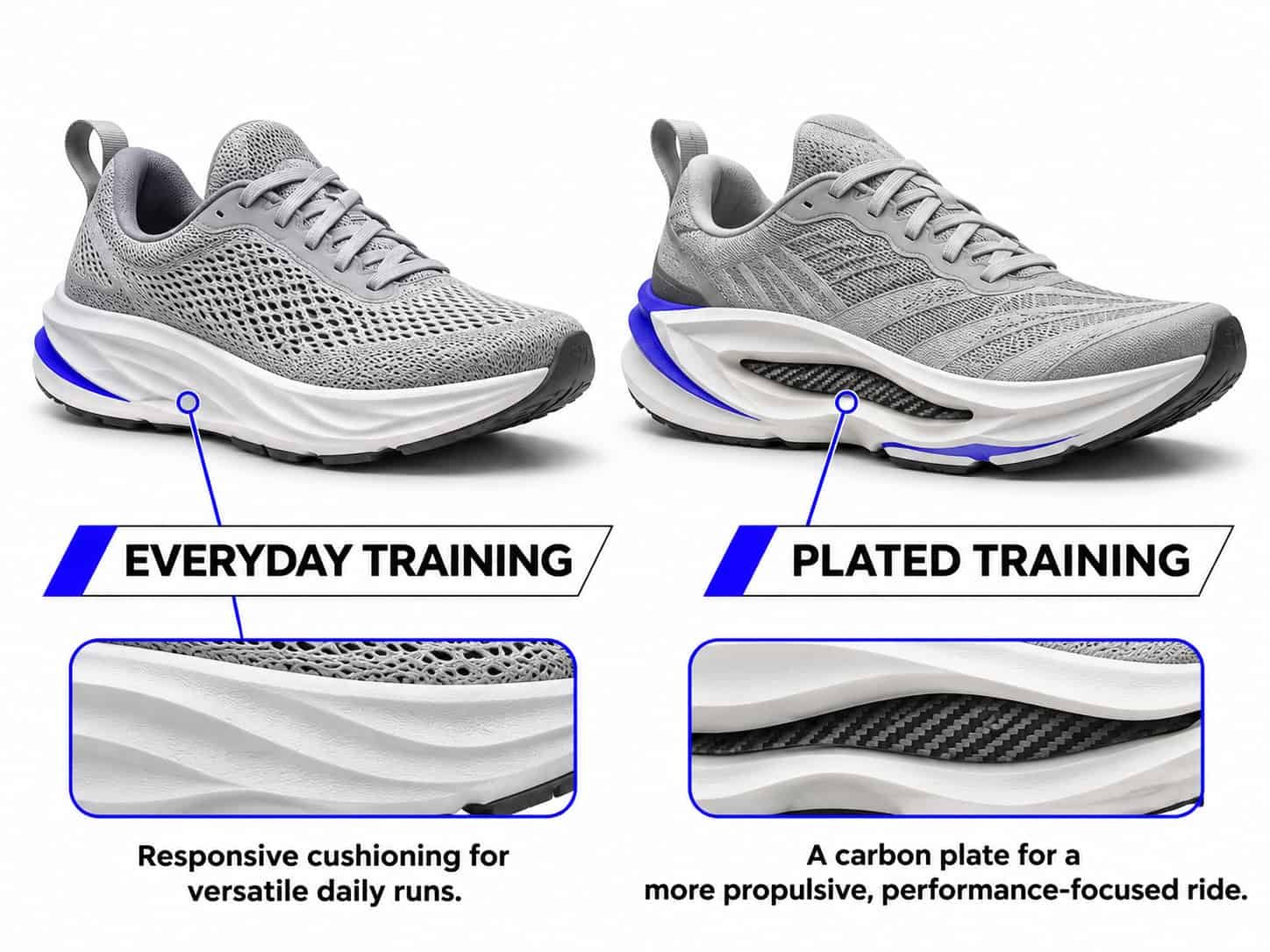
FuelCell Rebel: Is It Good for Everyday Running?
The Rebel is one of the most important FuelCell families for buyers because it targets everyday running while maintaining an energetic feel.
The Rebel v4 has generated search interest, but your article should also explain the newer Rebel v5 so the content does not become outdated.
New Balance describes the v5 as an everyday running and quick-run shoe. Its listed design includes a PEBA/EVA foam blend, an engineered mesh upper and a redesigned outsole.
Rebel v4 vs Rebel v5
| Feature | Rebel v4 | Rebel v5 |
| Model generation | Earlier version | Newer version in supplied official results |
| Intended use | Everyday running and faster sessions | Everyday running and quick runs |
| Cushioning | FuelCell | FuelCell PEBA/EVA blend according to current official listing |
| Buying consideration | Check discounted stock and condition | Check current price, fit and availability |
| Best approach | Compare its ride with current alternatives | Assess the exact fit and updated construction |
Avoid claiming that one generation is automatically better. A previous model can still be a good value if it fits well and suits your needs.
FuelCell SuperComp Trainer: Does It Have a Carbon Plate?
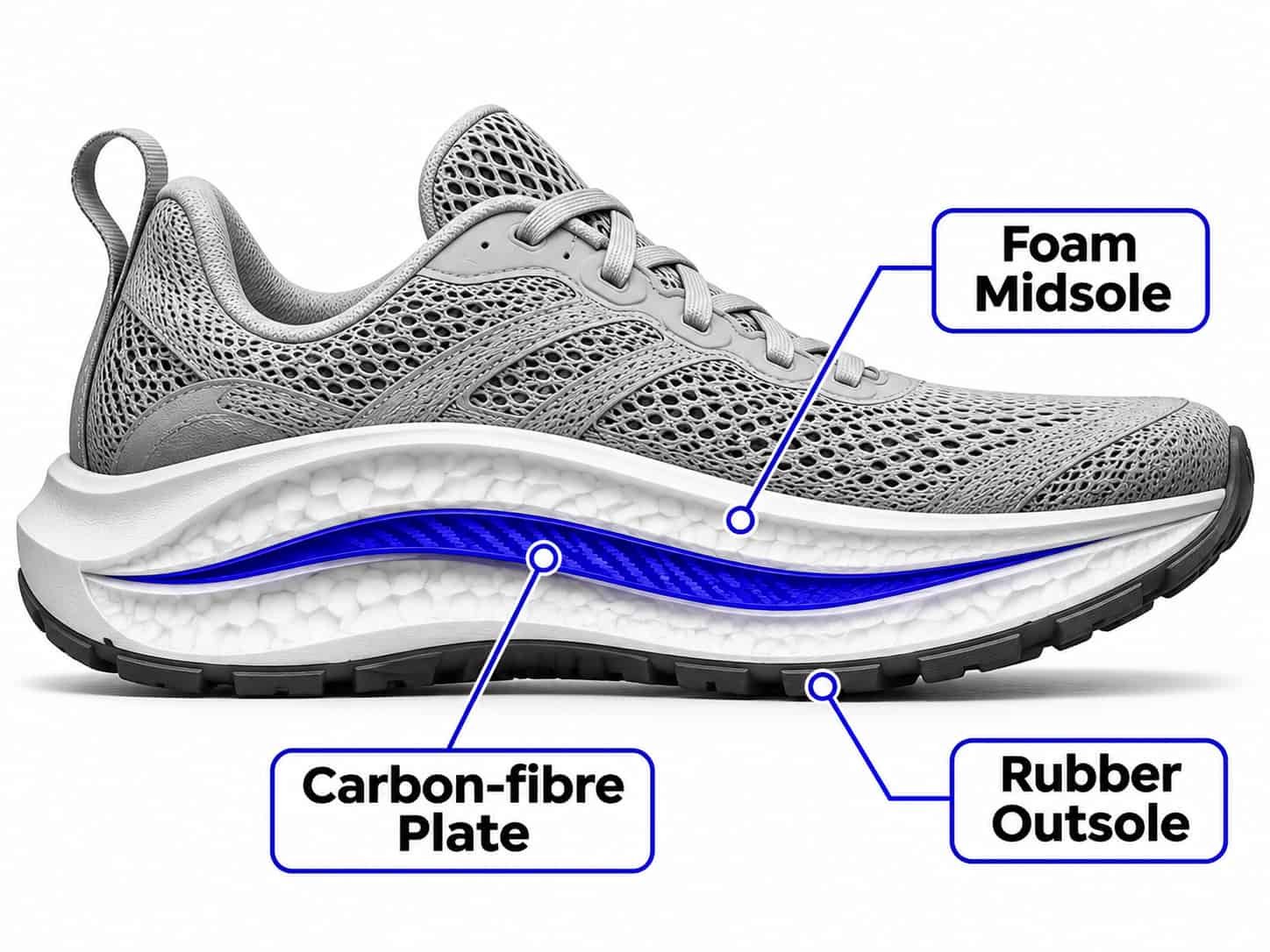
Yes. The New Balance FuelCell SuperComp Trainer v3 uses a carbon-fibre plate as part of its Energy Arc construction.
New Balance explains that Energy Arc combines carbon-fibre plate geometry with strategically positioned midsole voids. The design is intended to increase stored energy and energy return.
The plate is a structural component, not the foam itself.
What does a carbon plate do?
A carbon plate can change the stiffness of a running shoe and influence how it bends during the stride.
In a plated shoe, the plate works with the foam and shoe geometry. It does not operate independently.
The experience can include:
- A stiffer underfoot sensation.
- A more structured transition.
- A different forefoot bending behaviour.
- A ride designed around a particular running purpose.
However, carbon plates do not guarantee faster times for every runner.
Do all FuelCell Rebel shoes have carbon plates?
No. Do not assume the Rebel and SuperComp Trainer share the same plate construction simply because both use FuelCell.
Check the official specification of the exact model and version.
FuelCell vs Fresh Foam X: What Is the Difference?
FuelCell and Fresh Foam X are two different New Balance cushioning technologies.
FuelCell is associated with a propulsive feel. Fresh Foam X is positioned around a cushioning-focused experience.
Neither is universally better.
| Comparison | FuelCell | Fresh Foam X |
| Brand positioning | Propulsive, energetic feel | Cushioned running experience |
| Common buyer interest | Responsiveness and quicker running | Cushioning and comfort |
| Model examples | Rebel, Propel, SuperComp | 1080, 880, Hierro |
| Plate construction | Some SuperComp models use plates | Depends on model |
| Buying priority | Ride, responsiveness and intended pace | Cushioning, fit and intended use |
The Rebel and 1080 are useful comparisons for road running, but they are not necessarily equivalent in ride or intended use.
Read our dedicated New Balance Fresh Foam X guide for a more detailed look at that technology.
Which one should you choose?
Consider FuelCell if you prefer an energetic ride and want to explore New Balance’s performance-oriented running range.
Consider Fresh Foam X if cushioning and comfort are your main priorities.
The best approach is to compare the exact models rather than choosing by technology name alone.
Comfort and Responsiveness: What Does FuelCell Feel Like?
FuelCell is commonly described by New Balance as propulsive. But what does that mean when you actually wear a shoe?
There are several different qualities worth understanding.
Softness
Softness refers to how easily the foam compresses under load. A soft shoe may feel comfortable immediately, but that does not automatically make it the best option for every runner.
Responsiveness
Responsiveness is the sensation of how the shoe reacts as you move through a stride. Some runners prefer a lively sensation, while others prefer a more controlled and stable feel.
Energy return
Energy return describes how much energy is returned by the material or shoe system after compression. It should not be confused with a promise of faster running.
Stability
Stability describes how controlled the shoe feels underfoot. Platform width, foam construction, upper fit and geometry all contribute.
A shoe may have an energetic ride but still not feel stable enough for a particular runner.
Why the complete shoe matters
When comparing FuelCell models, pay attention to:
- Heel and forefoot platform shape.
- Midsole height.
- Shoe weight.
- Outsole grip.
- Upper fit.
- Plate construction, if present.
These factors help explain why two FuelCell shoes can produce different experiences.
Is New Balance FuelCell Good for Walking?
FuelCell shoes can be considered for walking, but the answer depends on the model and your preferences.
A lightweight everyday running shoe such as the Rebel may feel comfortable for some people during walking. A plated SuperComp Trainer, however, is built around a different performance purpose.
Running shoes are not automatically ideal walking shoes.
What should walkers look for?
1. Comfortable fit
Your toes should have enough room, and the heel should feel secure without rubbing.
2. Appropriate cushioning
A comfortable midsole should suit your weight, stride and walking surface. Extremely soft cushioning is not automatically better.
3. Stability
The shoe should feel controlled during ordinary walking and turns.
4. Outsole grip
Consider the surfaces you regularly walk on, especially if you use the shoe outdoors in wet conditions.
5. Weight
A shoe that feels light can be convenient for long periods of walking, but fit and comfort remain more important.
If walking is your main activity, compare FuelCell models with New Balance shoes designed specifically for everyday comfort rather than purchasing a plated running shoe simply because it uses an advanced foam.
FuelCell Durability: How Long Does It Last?
There is no single guaranteed mileage figure for all FuelCell shoes.
Durability depends on the complete shoe and how it is used. Different models can have different foam blends, midsole thicknesses and outsole coverage.
What affects durability?
| Factor | How it affects the shoe |
| Running frequency | More repeated use adds more loading cycles |
| Running surface | Rough surfaces can increase outsole abrasion |
| Runner’s loading pattern | Wear may be concentrated in different areas |
| Outsole coverage | Rubber coverage can protect exposed midsole foam |
| Storage | Excessive heat and poor storage can affect materials |
| Shoe construction | Different models use different materials and designs |
Does FuelCell lose its bounce?
Running shoe cushioning can change with repeated use. You may notice a different sensation as the shoe accumulates mileage.
However, appearance alone is not enough to determine whether the shoe is finished.
Look for:
- A noticeably flatter or harsher ride.
- Uneven midsole compression.
- Significant outsole wear.
- Reduced grip.
- A loose or damaged upper.
- Persistent discomfort that was not present when the shoe was new.
Our guide to how long running shoes last provides broader replacement guidance.
How to Make FuelCell Shoes Last Longer
A few basic habits can help maintain the shoe’s condition.
- Use road shoes primarily on appropriate road surfaces.
- Remove dirt and debris after outdoor sessions.
- Allow wet shoes to dry naturally at room temperature.
- Avoid direct high heat.
- Do not use harsh cleaning chemicals.
- Check the outsole and midsole regularly.
- Rotate shoes if you run frequently and have another suitable pair.
- Keep a simple record of running mileage.
For more detailed instructions, read our shoe cleaning and maintenance guide.
Who Should Choose New Balance FuelCell?
FuelCell is worth considering if you are looking for a running shoe with an energetic cushioning design. The exact model should match your training needs.
| Your requirement | Model family to explore |
| Lightweight daily running | Rebel |
| Daily training | Propel |
| Longer performance training | SuperComp Trainer |
| Race-focused running | SuperComp Elite |
| Walking and everyday use | Try the exact model for comfort and stability |
Who may prefer something else?
You may prefer another shoe if:
- You like a firm, traditional underfoot feel.
- You want a dedicated stability shoe.
- You mainly walk and do not need a performance running shoe.
- You dislike stiff or plated shoe designs.
- The FuelCell model does not fit your foot shape.
Do not choose a shoe solely because a technology is popular. Comfort and fit should decide the final purchase.
FuelCell Buying Guide: What Should You Check?
Before purchasing a New Balance FuelCell shoe, review these points.
1. Confirm the exact model generation
Rebel v4, Rebel v5 and SuperComp Trainer v3 are different products. Their construction and fit should not be assumed to be identical.
2. Check whether it has a plate
A carbon plate is a major design distinction. Confirm the manufacturer’s product specifications.
3. Consider your running purpose
A shoe for daily training may not be the best choice for race day, and a race-oriented shoe may not be ideal for every everyday run.
4. Assess the fit
Try the shoe with the socks you normally wear. Check toe space, heel hold and midfoot comfort.
5. Compare current pricing carefully
Older generations may be discounted. Check seller reputation, return policies and the shoe’s condition before purchasing.
6. Compare similar shoe categories
Compare daily trainers with daily trainers and plated trainers with plated trainers. This creates a more useful buying decision than comparing shoes with different purposes.
Common New Balance FuelCell Myths
Myth 1: Every FuelCell shoe has a carbon plate
Reality: Carbon plates are used in certain SuperComp models. The technology name alone does not mean a plate is included.
Myth 2: FuelCell automatically makes you run faster
Reality: It is designed to provide a propulsive feel, but actual performance depends on the runner, shoe design and conditions.
Myth 3: FuelCell is one identical material in every shoe
Reality: Formulation and construction can vary by model and generation.
Myth 4: Softer foam is always better
Reality: Comfort, responsiveness, stability and fit are different qualities. A softer shoe may not suit every runner.
Myth 5: FuelCell is only for professional runners
Reality: FuelCell appears in models designed for everyday running as well as performance-focused training.
Frequently Asked Questions About New Balance FuelCell
1. What are New Balance FuelCell shoes good for?
FuelCell shoes are designed around a propulsive, energetic running feel. Different families serve different purposes, including everyday running, quicker workouts and performance training.
2. Is New Balance FuelCell good?
FuelCell can be a good choice if you like an energetic cushioning sensation. Whether it suits you depends on the exact shoe, fit, intended use and personal preference.
3. Is FuelCell better than Fresh Foam?
Neither is universally better. FuelCell is positioned around a propulsive feel, while Fresh Foam X is positioned around cushioning. Compare specific shoe models to decide.
4. Does the New Balance FuelCell Rebel have a carbon plate?
Do not assume that it does. The Rebel and SuperComp Trainer have different constructions. Check the exact Rebel generation’s official specification.
5. Does the FuelCell SuperComp Trainer v3 have a carbon plate?
Yes. The SuperComp Trainer v3 includes a carbon-fibre plate as part of New Balance’s Energy Arc construction.
6. Is New Balance FuelCell good for walking?
Some FuelCell models may work for walking if they fit comfortably and feel stable. A plated performance trainer may not be the most practical option for everyday walking.
7. Does FuelCell foam wear out?
Like other running shoe cushioning systems, FuelCell shoes can change with repeated use. Monitor comfort, midsole shape, outsole wear and grip rather than relying on one fixed mileage figure.
8. Which is better, Rebel or SuperComp Trainer?
The Rebel is positioned as a lightweight everyday running shoe, while the SuperComp Trainer is a plated training shoe. The right choice depends on the type of running you do and the ride you prefer.
9. What is the difference between FuelCell and a carbon plate?
FuelCell is the cushioning technology. A carbon plate is a separate structural component used in certain shoe models. They can work together, but they are not the same thing.
10. Are FuelCell shoes suitable for beginners?
Some everyday FuelCell models may suit beginner runners if they fit comfortably and match their needs. Beginners do not need a carbon-plated shoe to start running.
Final Verdict: Is New Balance FuelCell Worth Considering?
New Balance FuelCell is worth exploring if you want a shoe designed around an energetic, propulsive running sensation.
Its most useful feature is the variety of models that use the technology. The Rebel is an everyday running option, the Propel offers another training-focused choice, and the SuperComp Trainer adds a carbon plate and a more structured performance design.
But FuelCell is not a guarantee of speed, comfort or durability. The exact foam construction, shoe geometry, fit and intended activity matter much more than the technology name alone.
Start by identifying how you plan to use the shoe. Then compare the relevant model generations, check whether a plate is included and assess the fit before purchasing.
For more context, continue with our Running Shoe Foam Explained guide, which covers the wider materials and manufacturing processes used in modern running shoes.
The best FuelCell shoe is the one that matches your running needs, fits comfortably and feels appropriate for the way you move.