
How to Clean Velvet Shoes Without Ruining Them: The 2026 Expert Guide (Do’s & Don’ts)
To clean velvet shoes safely, start with dry cleaning: let mud dry completely, then gently brush away dust and dirt in the direction of the nap. For compatible synthetic velvet, a small amount of mild-soap foam can be used for spot cleaning after testing an inconspicuous area. Avoid soaking, aggressive scrubbing, machine washing, direct heat, and unapproved household cleaners. Silk, rayon, vintage, embellished, valuable, or unidentified velvet is better handled by a professional cleaner. Once completely dry, gently brush the nap back into place.
Introduction
Velvet shoes look elegant, but their soft raised surface needs more careful cleaning than leather or ordinary canvas. The biggest mistake is treating velvet like a washable sneaker.
The safest approach is simple: start dry, use as little moisture as possible, avoid aggressive rubbing, and always check the manufacturer’s care instructions first.
Whether you need to remove dust, dried mud, a small stain, a water mark, or a flattened patch, the right method depends on the type of velvet and the condition of the shoe.
In this guide, you’ll learn how to clean velvet shoes at home, how to clean velour shoes, what to do when velvet gets wet, how to restore flattened nap, which cleaners to avoid, and when a professional cleaner is the better choice.
Why Velvet Shoes Need Special Care
Velvet is a pile fabric with short, raised fibers on its surface. These fibers create the soft texture and distinctive light-reflecting appearance that make velvet shoes look different from smooth fabrics.
The direction of these fibers is called the nap.
When velvet is brushed, pressed, wetted, or rubbed unevenly, the nap can change direction. The shoe may then appear darker, lighter, shiny, or stained even when there is little actual dirt present.
That is why velvet should be cleaned gradually.
The three biggest risks are:
- Water marks: Excess moisture can dry unevenly and leave visible rings.
- Crushed nap: Hard rubbing can flatten or damage the raised fibers.
- Color or finish changes: Some dyes, coatings, adhesives, and fabric blends react differently to moisture and cleaning products.
Not every velvet-looking shoe is made from the same material. Check the manufacturer’s description before cleaning. Velvet, velour, suede, nubuck, and flocked synthetic materials should not automatically be treated as identical.
When the material or care instructions are unclear, dry brushing is the safest starting point. For valuable or delicate shoes, professional cleaning is preferable.
Before You Clean: Identify the Material
Before applying water or cleaner, check the shoe’s label, box, product page, or manufacturer’s care instructions.
Look for descriptions such as:
- Polyester velvet
- Cotton velvet
- Silk velvet
- Rayon velvet
- Velour
- Velvet-look or flocked synthetic material
This matters because two shoes can look similar but respond very differently to moisture and cleaning products.
A simple rule
If you cannot identify the material, don’t experiment with a wet cleaning method.
For expensive, vintage, silk, rayon, embellished, or heavily stained velvet shoes, professional cleaning is the safer option.
Manufacturer care instructions should always take priority over a general cleaning guide. Care instructions are intended to specify the cleaning procedures appropriate for the particular product.
What You Need to Clean Velvet Shoes
For basic velvet shoe care, you only need a few simple items:
| Tool | What It Does |
|---|---|
| Soft-bristled brush | Removes dry dust and dirt |
| White microfiber cloth | Helps with controlled spot cleaning |
| Small bowl | Used to create a small amount of cleaning foam |
| Mild clear detergent | For compatible synthetic velvet only |
| Clean dry towel | Absorbs excess moisture |
| Shoe tree or white tissue | Helps maintain the shoe’s shape |
| Fabric protector | Optional, if specifically approved for velvet |
Avoid colored cloths that could transfer dye. Also avoid stiff brushes, abrasive sponges, bleach, acetone, and strong household cleaners.
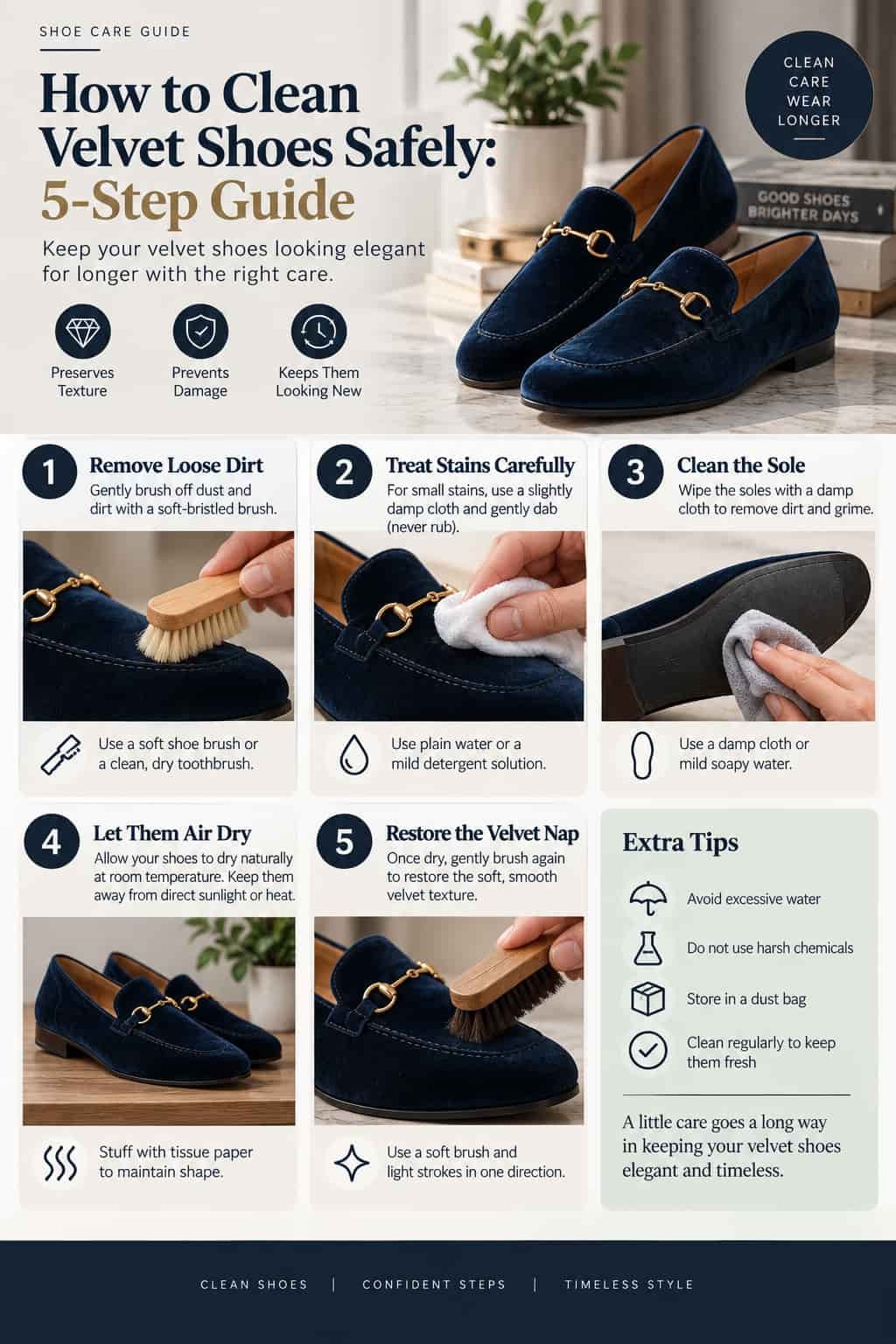
How to Clean Velvet Shoes at Home
Step 1: Remove loose dust first
Start with completely dry shoes.
Use a clean, soft-bristled brush to remove surface dust and loose dirt. Use short, gentle strokes and follow the natural direction of the velvet nap.
Do not press the brush heavily into the fabric.
For everyday care, this dry-brushing step may be all your shoes need.
Step 2: Let wet mud dry completely
If you stepped in mud, resist the temptation to wipe it immediately.
Allow the mud to dry naturally at room temperature. Once dry, gently loosen the dirt with your soft brush.
Trying to wipe wet mud can spread it across the pile and push soil deeper into the fabric.
Step 3: Test the cleaning method
For compatible synthetic velvet, mix a very small amount of mild, clear detergent with cool water and create foam.
Before touching the visible stain, test a tiny amount on an inconspicuous section.
Let the test area dry completely.
Check for:
- Color change
- Dye transfer
- Water rings
- Sticky residue
- Flattened or changed nap
If anything looks different, stop and use professional cleaning.
Step 4: Apply foam, not excess water
If the test is successful, pick up a small amount of foam with a clean white microfiber cloth.
Gently blot the stained area.
Do not pour the cleaning mixture directly onto the shoe.
Do not scrub back and forth.
Work from the outside of the mark toward the center and use a clean part of the cloth as dirt transfers.
Step 5: Remove residue
Use a separate white cloth that has been lightly dampened with plain cool water and thoroughly wrung out.
Gently blot the treated area to remove detergent residue.
The velvet should never become soaked.
Step 6: Dry naturally
Place the shoes in a well-ventilated area at room temperature.
Keep them away from:
- Radiators
- Heaters
- High-heat hair dryers
- Tumble dryers
- Strong direct sunlight
Do not brush or press the velvet while it is still damp.
Allow the shoes to become completely dry before judging the result.
Step 7: Restore the nap
Once the shoes are completely dry, use the soft brush again.
Make very light strokes in the natural direction of the nap.
If the velvet looks different from certain angles, check whether the fibers are simply lying in another direction before assuming the shoe is stained.
How to Clean Velvet Shoes for Different Problems
How to Clean Velvet Shoes From Dust
For ordinary dust, skip water.
Use a clean soft brush and gently sweep in the direction of the nap. A lint roller can also help with loose lint or pet hair, but use light pressure and avoid repeatedly pulling at the fibers.
Regular dry brushing is safer than repeatedly wet-cleaning the shoe.
How to Clean Velvet Shoes With Dried Mud
Let the mud dry completely.
Once hard, gently break up and brush away the dried material. Start with light strokes rather than trying to remove everything in one pass.
If a small mark remains, use the appropriate spot-cleaning method only after checking the material and testing the cleaner.
What to Do If Velvet Shoes Get Wet
If your velvet shoes become wet, don’t rub the surface.
Gently blot excess moisture with a clean absorbent cloth, then allow the shoes to dry naturally at room temperature.
Keep them away from direct heat.
Once completely dry, gently brush the nap and inspect the result.
If a large water ring remains, avoid repeatedly re-wetting the entire shoe. A professional cleaner is safer, especially for natural-fiber or valuable velvet.
How to Clean White Velvet Shoes
White velvet needs extra caution because even a small amount of transferred dye or cleaning residue can become obvious.
Start with dry brushing.
If wet cleaning is appropriate according to the manufacturer’s instructions, patch-test first using a white cloth and a very small amount of approved cleaning foam.
Never use bleach simply because the shoe is white.
How to Clean Black Velvet Shoes
Black velvet can show dust, lint, water marks, and changes in nap direction very clearly.
Start with a soft dry brush.
Avoid excessive moisture because uneven drying can create areas that appear lighter or shinier.
How to Clean Velvet Heels
Remove loose dirt with a soft brush and pay particular attention to the heel edges and seams.
Keep cleaning moisture away from areas where decorative materials, adhesives, or embellishments could be affected.
For expensive or embellished heels, professional cleaning is recommended.
How to Clean Velvet Boots
For velvet boots, clean the upper in small sections rather than soaking the entire boot.
Support the shaft while brushing and drying so the boot maintains its shape.
If the boots contain multiple materials, follow the care instructions for each material separately.
How to Clean Velour Shoes
Velour is often made as a knitted pile fabric rather than traditional woven velvet, so construction can differ.
For general care, start with the same dry-first principle: remove dust with a soft brush, avoid soaking, and patch-test any cleaner before applying it to a visible area.
Always follow the manufacturer’s instructions when they differ from general velvet-care advice.
How to Fix Damaged or Flattened Velvet Shoes
Not every velvet problem is actually a stain.
Sometimes the fibers have simply been flattened by pressure, storage, rubbing, or moisture.
If the velvet is only flattened
First make sure the shoe is completely dry.
Use a clean soft brush with very light strokes to realign the nap.
For delicate velvet, don’t aggressively brush against the pile trying to make it look fluffy again. Excessive brushing can create a larger uneven area.
Can steam restore velvet?
Steam can sometimes help relax flattened pile, but it is not a universal repair method.
Before using steam, check the manufacturer’s instructions. Avoid direct contact between a steamer or iron and the velvet.
If steaming is approved, use minimal steam from a safe distance and allow the material to recover naturally before gently brushing it.
What if there is a bald spot?
If the actual fibers have been worn away, cleaning cannot recreate them.
You may be able to improve the appearance of a small area by gently aligning the surrounding fibers, but a genuinely bald patch may require professional repair or replacement of the affected material.
What if the velvet has a permanent water ring?
Do not repeatedly soak the entire shoe trying to blend the color.
Repeated wetting can make the problem worse.
For a valuable or delicate pair, take the shoes to a specialist cleaner who can assess the fabric, dye, backing, and construction before treating the mark.
What Not to Use on Velvet Shoes
Avoid these common mistakes:
Don’t soak the shoes
Excess water can cause uneven drying, water marks, dye movement, and changes in the nap.
Don’t machine wash them unless the manufacturer explicitly says you can
The agitation, moisture, and movement can damage the pile, adhesives, shape, or other components.
Don’t scrub aggressively
Hard brushing can flatten the pile and make one area look different from the rest.
Don’t use bleach
White velvet is not automatically bleach-safe. Bleach can damage dyes, fibers, and other shoe components.
Don’t use vinegar, alcohol, acetone, or strong household cleaners as universal solutions
A cleaner that works on one material may damage another.
Don’t use direct heat
Avoid radiators, heaters and high-heat dryers. Natural air drying is the safer default unless the manufacturer’s instructions say otherwise.
Don’t experiment on expensive or vintage velvet
For silk, rayon, embellished, vintage, valuable, or unidentified velvet, professional care is the better choice.
Velvet vs. Other Shoe Materials
| Material | General Cleaning Approach | Main Risk |
|---|---|---|
| Velvet | Dry brush first; limited spot cleaning when approved | Flattened nap and water marks |
| Velour | Gentle brushing and material-specific spot cleaning | Flattening and uneven appearance |
| Suede | Use suede-specific products and methods | Water marks and texture damage |
| Nubuck | Use nubuck-specific care products | Surface discoloration and texture damage |
| Canvas | Follow manufacturer’s washing instructions | Shrinkage, dye bleeding, or deformation |
| Leather | Wipe and condition according to leather type | Drying, staining, or finish damage |
Important: The manufacturer’s care instructions should take priority over a general material guide.
How to Protect and Store Velvet Shoes
The easiest velvet shoe to clean is the one that stays clean.
After wearing your shoes:
- Brush away loose dust.
- Let any moisture dry naturally.
- Store them in a breathable shoe bag or suitable box.
- Keep them away from damp areas.
- Avoid stacking shoes directly on top of the velvet.
- Use light internal support if the shoe tends to lose its shape.
A fabric protector can also be useful, but only choose a product whose manufacturer specifically says it is suitable for your velvet material. Always test it on an inconspicuous area first and follow the product directions.
Some shoe-care specialists recommend protective sprays for velvet, but their suitability depends on the particular shoe and material.
How Often Should You Clean Velvet Shoes?
You don’t need to deep-clean velvet after every wear.
A simple routine works better:
- After each wear: Check for dust, lint, or fresh marks.
- When dusty: Use a soft dry brush.
- After mud: Let it dry, then brush it away.
- After a small stain: Spot-clean only if the material and care instructions allow it.
- For persistent stains: Stop experimenting and consider professional cleaning.
- Before long-term storage: Make sure the shoes are completely dry and free from loose dirt.
Avoid unnecessary wet cleaning because repeated moisture and friction can gradually affect the appearance of the pile.
Frequently Asked Questions
Can I wash velvet shoes in a washing machine?
Generally, no. Do not machine-wash velvet shoes unless the manufacturer explicitly says the specific shoe is machine washable. Washing can expose the velvet to excessive moisture, agitation, friction, and deformation.
How do you clean velvet shoes at home?
Start by checking the material and care instructions. Let wet mud dry, brush away dry dirt with a soft brush, and use a small amount of tested cleaning foam only when wet cleaning is appropriate for the material. Air-dry naturally and brush the nap once completely dry.
How do I clean velvet shoes from dust?
Use a clean, soft-bristled brush and gently brush away dust in the direction of the nap. A lint roller can help with loose lint or pet hair, but use light pressure.
How do I clean velvet shoes that got wet?
Blot excess moisture gently with a clean absorbent cloth and allow the shoes to dry naturally at room temperature. Keep them away from direct heat. Once dry, gently brush the nap. Persistent water rings may require professional cleaning.
How do I clean velour shoes?
Start with gentle dry brushing and check the manufacturer’s instructions before using water or cleaner. Velour and velvet can look similar but have different constructions, so don’t automatically assume the same cleaning method is suitable for both.
How do I fix damaged velvet shoes?
If the nap is merely flattened, gentle brushing after the shoe is completely dry may improve its appearance. If fibers are missing, heavily crushed, or permanently discolored, cleaning alone cannot fully restore the material and professional repair may be necessary.
Can I use a velvet shoe cleaner?
You can use a cleaner only when its instructions specifically support the material of your shoes. Always patch-test first. Avoid assuming that a product designed for upholstery, suede, or another fabric is automatically safe for velvet footwear.
Can I use vinegar to clean velvet shoes?
Vinegar should not be treated as a universal velvet cleaner. It may affect dyes, fibers, finishes, or adhesives. Use the manufacturer’s recommended cleaner or a professionally approved treatment instead.
Can I use steam on velvet shoes?
Steam may help some flattened pile, but it is not suitable for every velvet shoe. Check the manufacturer’s care instructions first and never press a hot steamer or iron directly against the velvet.
How do I clean white velvet shoes?
Begin with dry brushing. If wet cleaning is permitted, patch-test a very small amount of appropriate cleaning foam first. Avoid bleach unless the manufacturer specifically states that it is safe.
How do I remove oil from velvet shoes?
Blot excess oil without rubbing. For compatible velvet, a suitable absorbent treatment may help with a fresh spot, but old or deep oil stains are better handled professionally rather than repeatedly applying household chemicals.
How should velvet shoes be stored?
Keep them completely dry and store them where the velvet will not be crushed or rubbed against other shoes. A breathable shoe bag or suitable box can help reduce dust buildup and protect the nap.
Final Thoughts
Cleaning velvet shoes is less about scrubbing and more about protecting the nap.
The safest routine is to start dry, use gentle tools, minimize moisture, test any cleaner first, and let the shoes dry naturally.
For dust and dried mud, a soft brush is usually the best first step. For small stains on compatible synthetic velvet, carefully controlled cleaning foam may help. For silk, rayon, vintage, embellished, expensive, badly stained, or damaged velvet, professional cleaning is often the safer choice.
With the right care, your velvet shoes can keep their texture, color, and elegant appearance without unnecessary cleaning experiments.
For more practical footwear-care advice, explore our guides on how to clean sports shoes and how to remove creases from sneakers.
Related Shoe Care Guides
For broader footwear maintenance, see our complete shoe care guide covering cleaning, drying, protection, storage, and common shoe-care problems.
If your shoes are already wet, our guide to how to dry wet shoes safely can help you avoid common heat-drying mistakes.
For more information about how we evaluate footwear, see our shoe testing and wear-test methodology.
- Best Crocs for Nurses 2026: ASTM-Certified Work Clogs & Reviews
- Best Dansko Nursing Shoes 2026: Professional Clogs Guide
- Best CNA Shoes 2026: 9 Comfortable Picks for Long Shifts
- Best Shoes for Pharmacy Technicians 2026 – Comfort & Slip Resistance
- 11 Best Shoes for Healthcare Workers in 2026: Hospital & Clinical Picks