
Hiking Boots for Plantar Fasciitis: What Podiatry Sources Say to Look For
Quick answer: Outdoor Life names the La Sportiva Ultra Raptor II Mid GTX best overall for plantar fasciitis, quoting an expert on its stable heel counter and torsional rigidity. Balance Foot and Ankle, a podiatry practice, ranks midsole rigidity above cushioning. This is shopping information, not medical advice, so see a podiatrist.
You also get a feature table, named expert advice, insole options and four boots.
Four Boots at a Glance
Four boots that podiatry and outdoor sources name or that match their advice. This is shopping information, not medical advice, and plantar fasciitis is best checked by a podiatrist. Tap a photo or the button to see the boot. For the general list, see our best hiking boots guide.
| Boot | Best for | Price category | Named by | Buy |
|---|---|---|---|---|
 La Sportiva Ultra Raptor 3 Mid GTX (Men’s) | Rigid, stable heel | Premium | Outdoor Life (Raptor II), Treeline Review, OutdoorGearLab | Check on Amazon |
 HOKA Kaha 3 GTX (Women’s) | Cushioned and supportive | Premium | OutdoorGearLab, Trail and Kale | Check on Amazon |
 Salomon X Ultra 5 Mid GTX (Men’s) | Firm chassis, heel lacing | Mid-range | Balance Foot and Ankle (X Ultra 4), CleverHiker | Check on Amazon |
 KEEN Targhee IV Mid Waterproof (Women’s) | Wide toe box | Mid-range | Balance Foot and Ankle (Targhee III), CleverHiker, Switchback Travel | Check on Amazon |
Price category reflects current US listings: budget is roughly under $150, mid-range roughly $150 to $200, premium above $200. Prices change, so confirm on the product page.
What to Look for in a Boot, Per the Sources
Three sources describe what to look for. Balance Foot and Ankle is a podiatry practice, Outdoor Life quotes named experts and the Cleveland Clinic gives general shoe advice.
| Feature | What the source says | Source |
|---|---|---|
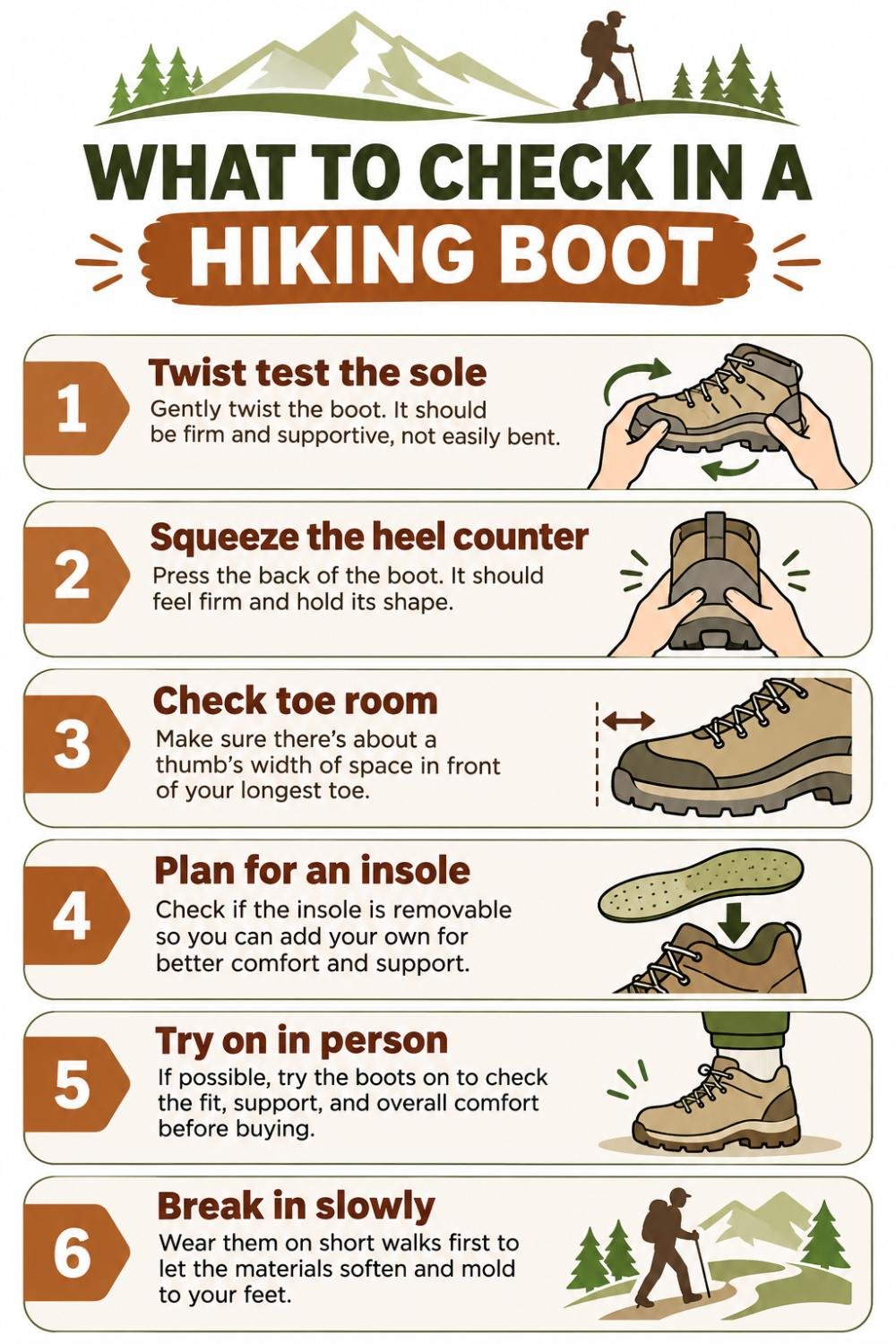
| Rigid midsole | The practice ranks midsole rigidity above cushioning and arch height. A flexible midsole shifts load onto the plantar fascia. It suggests a twist test before buying. | Balance Foot and Ankle |
| Firm heel counter | The heel cup should hold firm when squeezed, which limits heel slippage on descents. | Balance Foot and Ankle, Outdoor Life |
| Stable support and full-contact insoles | The goal is to limit the foot splaying and contracting while the fascia heals. | Outdoor Life |
| Rocker sole | A rocker sole can reduce foot motion and pressure on the plantar fascia. | Outdoor Life, Balance Foot and Ankle |
| Heel cushioning and moderate drop | Substantial heel cushioning and a moderate heel-to-toe drop are recommended. | Balance Foot and Ankle |
| Arch support and cushioning | Choose a supportive footbed and a soft, padded insole. Cushioning spreads weight and reduces strain. | Cleveland Clinic |
| Room for an orthotic and toes | A wide toe box helps because feet swell on long hikes. A shoe that feels tight across the toes is probably not right. | Balance Foot and Ankle, Cleveland Clinic |
| Mid-top height | Mid-top designs are recommended for hikers needing extra stability. | Balance Foot and Ankle |
Who should skip each approach
| Approach | Skip it if | Because |
|---|---|---|
| Zero-drop shoes | You are in an acute flare | Balance Foot and Ankle says the Altra Lone Peak is not advised during an acute flare and needs a gradual transition |
| Soft, flexible shoes | You want a stable platform | Balance Foot and Ankle says a flexible midsole shifts load onto the fascia |
| Ongoing custom orthotics | You have no structural deformity | Dr. Selina Sekulic, quoted by Outdoor Life, advises against daily long-term custom orthotics without one |
| Tight toe boxes | Your feet swell on long hikes | Cleveland Clinic says a shoe tight across the toes is probably not right |
What Named Experts Say
Outdoor Life quotes several named experts, and Balance Foot and Ankle names its doctor. Here is what each says, in their own domains.
| Expert | Role as stated | Advice |
|---|---|---|
| Jesse Angelini | Quoted by Outdoor Life | Likes a stable heel counter and torsional rigidity, and says a rocker sole can reduce foot motion. |
| Dr. Selina Sekulic | Quoted by Outdoor Life | Says to see a podiatrist for diagnosis because heel spurs and stress fractures can mimic plantar fasciitis. Recommends treating tight calves, hamstrings and weak glutes, not just heel pain. |
| Dr. Irene Davis | Quoted by Outdoor Life | Compares continuing supportive footwear after healing to wearing a neck brace after the neck has recovered, and emphasizes strengthening and a gradual return to activity. |
| Dr. Tom Biernacki, DPM | Balance Foot and Ankle | Ranks midsole rigidity first and suggests a firm arch insole such as Superfeet Green or Carbon, or Powerstep Pinnacle Pro for cushioning with arch support. |
This guide cannot diagnose anything. Outdoor Life says to see a podiatrist, and so do we.
Boots That Match the Advice
The sources do not agree on one best boot, so we list four that match their advice, with the caveat each time.
La Sportiva Ultra Raptor 3 Mid GTX (Men’s)
Best for: a stable, rigid boot with a firm heel counter
La Sportiva Ultra Raptor 3 Mid GTX (Men’s)
Price category: Premium
A lightweight GORE-TEX mid boot from La Sportiva.
Check it on AmazonOutdoor Life names the Ultra Raptor II Mid GTX its best overall pick for plantar fasciitis, quoting expert Jesse Angelini on a stable heel counter and torsional rigidity, with a 12 mm heel drop. Angelini says it is his most common recommendation for Pacific Crest Trail thru-hikers recovering from footwear-related injuries and suggests starting with the wide version. The boot sold today is the Ultra Raptor 3 Mid GTX, the newer version of the same line. Treeline Review lists the Raptor 3 at 1 lb 14.2 oz, and OutdoorGearLab measured 2.34 lb in size 14.
What this means for you: one expert-quoted outlet favors this line for stability. Check the sizing and width, because the outlets disagree on the fit.
Fit and sizing: Outdoor Life says it runs narrow and lists a wide version for the Raptor II. OutdoorGearLab and Treeline Review say the Raptor 3 comes in medium width only.
Men’s and women’s versions: Separate women’s version. Switchback Travel lists 1 lb 9.1 oz for the women’s boot, while Treeline Review lists 1 lb 14.2 oz for the men’s.
Watch for: Outdoor Life lists a narrow fit and a high price. OutdoorGearLab says it runs about half a size small and comes in medium width only, and Trail and Kale says to size up half a size.
Skip it if: you want plush cushioning, have wide feet or are on a tight budget.
HOKA Kaha 3 GTX (Women’s)
Best for: a cushioned, supportive boot for long days
HOKA Kaha 3 GTX (Women’s)
Price category: Premium
A cushioned GORE-TEX hiking boot from HOKA.
Check it on AmazonOutdoorGearLab gives the Kaha 3 its Editors’ Choice “Best Overall Hiking Boot” award, calls it “super supportive” with incredible comfort and measured 3.0 lb for a size 14 pair. Trail and Kale also names it best overall and credits the cushioning, at 19.1 oz for a US men’s 9. Balance Foot and Ankle cites HOKA’s Meta-Rocker midsole as a design that reduces plantar fascia tension during push-off, though it does not name the Kaha 3.
What this means for you: a cushioned, supportive boot from a brand a podiatry practice mentions for rocker geometry. The practice does not review this boot.
Fit and sizing: OutdoorGearLab lists regular width only.
Men’s and women’s versions: Separate men’s version. OutdoorGearLab measured 3.0 lb for a size 14 pair and Trail and Kale lists 19.1 oz for a US men’s 9, but neither outlet publishes a women’s weight.
Watch for: OutdoorGearLab says it is a bit bulky for extensive off-trail hiking, needs some breaking in and is not ideal for hot, dry places.
Skip it if: you want a light boot, hike in hot, dry conditions or want to spend less.
Salomon X Ultra 5 Mid GTX (Men’s)
Best for: a firmer chassis and a lacing system that holds the heel
Salomon X Ultra 5 Mid GTX (Men’s)
Price category: Mid-range
A lightweight GORE-TEX mid hiking boot from Salomon.
Check it on AmazonBalance Foot and Ankle recommends the Salomon X Ultra 4 Mid GTX for hikers needing ankle support and a firmer chassis, and notes its Sensifit lacing secures the heel. The X Ultra 5 Mid is the newer version. CleverHiker names the X Ultra 5 Mid its best overall hiking boot at 1 lb 15 oz, citing minimal break-in, excellent traction and stability.
What this means for you: a podiatry practice names the previous version for stability, and CleverHiker names the current one for overall performance.
Fit and sizing: CleverHiker says the forefoot runs narrow and sizing runs a little small. Treeline Review says it fits true to size.
Men’s and women’s versions: Separate women’s version. CleverHiker lists the men’s mid at 1 lb 15 oz, and women’s weights are lower per Switchback Travel.
Watch for: CleverHiker lists less ankle support and a flimsy insert, and says the forefoot runs narrow. Balance Foot and Ankle suggests swapping the factory insole for a firm arch insole.
Skip it if: you carry heavy loads or have wide feet.
KEEN Targhee IV Mid Waterproof (Women’s)
Best for: a wide toe box for feet that swell on long hikes
KEEN Targhee IV Mid Waterproof (Women’s)
Price category: Mid-range
A leather waterproof hiking boot from KEEN with a wide toe box.
Check it on AmazonBalance Foot and Ankle names the KEEN Targhee III for a wide toe box that accommodates swelling, with moderate arch support, and advises an aftermarket insole. The Targhee IV is the newer version. CleverHiker rates the women’s Targhee IV Mid 4.1 out of 5, praising a wide fit and little break-in, and Switchback Travel rates it 4.2.
What this means for you: a roomy boot with room for an insole, but not a firm, rigid one.
Fit and sizing: Switchback Travel says it runs large and suggests going down half a size.
Men’s and women’s versions: Separate men’s version. Treeline Review lists 2 lb 2.6 oz per pair for the women’s boot and 2 lb 8.6 oz for the men’s.
Watch for: OutdoorGearLab says it lacks ankle support and breathes poorly. Balance Foot and Ankle says the arch support is moderate.
Skip it if: you want a stiff, rigid boot or hike technical terrain.
Also named
Outdoor Life also names the Topo Ultraventure 3 trail runner (5 mm drop, wide toe box) and the LOWA Fortux (rocker bottom, thick durable foam, no wide option, 6 mm drop). Balance Foot and Ankle also names the HOKA Speedgoat 6 for cushion-first hikers, the Brooks Cascadia 17 with Superfeet Green suggested, and the Altra Lone Peak 8 with a wide toe box. We have not matched these to current US Amazon listings, so there are no buy buttons.
Insoles and Other Aids
Footwear is only part of the advice. Both Outdoor Life and Balance Foot and Ankle mention insoles and other aids.
| Aid | What the source says | Source |
|---|---|---|
| Superfeet ME3D | A custom 3D-printed insole ordered after a foot scan. Described as affordable and likely to fit well, though it may produce an odor for some people. | Outdoor Life |
| Superfeet Green or Carbon | Firm, durable arch insoles suggested as a swap for factory insoles. | Balance Foot and Ankle |
| Powerstep Pinnacle Pro | Suggested for hikers who want cushioning with arch support. | Balance Foot and Ankle |
| Compression sleeve | Worn with existing shoes to support the arch. Works better for some foot shapes than others. | Outdoor Life |
| Custom orthotics | An option for significant structural problems or high-volume trail use per the practice, but Dr. Sekulic advises against daily long-term use without a structural deformity. | Balance Foot and Ankle, Outdoor Life |
Our Plantar Fasciitis Boot Framework
We turn the sources into five questions to ask in a store or before you order.
- Twist. Does the shoe resist twisting and midfoot bending?
- Heel. Does the heel counter hold firm?
- Room. Is there space for an insole and swelling toes?
- Cushion. Is there heel cushioning?
- Fit. Do you feel pinching or heel lift?
| Boot | Rigid platform | Heel hold | Toe room | Main caveat |
|---|---|---|---|---|
| Ultra Raptor 3 Mid GTX | High per Outdoor Life (Raptor II) | Firm heel counter per Outdoor Life | Narrow | Sizing and price |
| HOKA Kaha 3 GTX | Supportive per OutdoorGearLab | Not stated | Regular width | Bulky, warm |
| Salomon X Ultra 5 Mid GTX | Firmer chassis per Balance (X Ultra 4) | Sensifit lacing per Balance | Narrow forefoot | Less ankle support |
| KEEN Targhee IV Mid | Moderate per Balance (Targhee III) | Not stated | Wide | Moderate arch support |
This table is our reading of what the sources say. It is general advice, not medical advice.
How to Choose, Step by Step
- See a podiatrist first. Outdoor Life quotes Dr. Sekulic saying other conditions can mimic plantar fasciitis.
- Try boots on in person. Outdoor Life suggests doing so with a pedorthist, or buying from a retailer with a good return policy online.
- Do the twist test. Balance Foot and Ankle suggests it before buying.
- Bring your insole. Make sure there is room for it. See how to choose hiking boots.
- Break boots in slowly. See how to break in hiking boots.
- Lighten your pack. Outdoor Life says lighter gear can ease strain on the feet.
- Compare lists. See best hiking boots for wide feet, hiking boots with ankle support, best hiking boots for seniors, best hiking boots for men and best hiking boots for women.
Where the Expert Advice Differs
Rigidity versus cushioning. Balance Foot and Ankle ranks midsole rigidity above cushioning, while the Cleveland Clinic emphasizes shock absorption and a soft, padded insole in walking and running shoes.
Insoles. Balance Foot and Ankle suggests swapping in a firm arch insole, while Dr. Sekulic advises against long-term daily custom orthotics unless there is a structural deformity.
Long-term support. Outdoor Life quotes Dr. Davis comparing continued supportive footwear after healing to wearing a neck brace after recovery, which is a different emphasis from the other sources.
Questions About Hiking Boots and Plantar Fasciitis, Answered
“What are the best hiking boots for plantar fasciitis?”
Outdoor Life names the La Sportiva Ultra Raptor II Mid GTX best overall, and Balance Foot and Ankle names the Salomon X Ultra 4 Mid GTX and KEEN Targhee III among others.
“Should the boot be stiff or soft?”
Balance Foot and Ankle says rigidity matters most. The Cleveland Clinic emphasizes cushioning, so see a podiatrist for what suits your foot.
“Do I need insoles?”
Balance Foot and Ankle suggests swapping the factory insole for a firm arch insole. Dr. Sekulic advises against long-term daily custom orthotics without a structural deformity.
“Can I hike with plantar fasciitis?”
That is a question for a podiatrist. Outdoor Life says to get a diagnosis, because other conditions can mimic it.
“Are zero-drop shoes okay?”
Balance Foot and Ankle says the Altra Lone Peak 8 is not advised during an acute flare and needs a gradual transition from elevated-heel footwear.
Mistakes to Avoid When Buying
- Self-diagnosing. Outdoor Life says heel spurs and stress fractures can mimic plantar fasciitis.
- Choosing a flexible shoe. Balance Foot and Ankle says it shifts load onto the fascia.
- Relying on supportive gear forever. Outdoor Life quotes experts who emphasize strengthening.
- Skipping the break-in. The Cleveland Clinic says to break in new shoes gradually.
- Ignoring tight toes. The Cleveland Clinic says a tight shoe is probably not right.
How we checked this
- UrbanStyleFootwear compared six sources: Outdoor Life, Balance Foot and Ankle, the Cleveland Clinic, OutdoorGearLab, Trail and Kale and CleverHiker.
- We built this guide from what each source wrote about plantar fasciitis and footwear, and matched boots to that advice. Every claim is attributed to the source that published it, and our own reading is labeled general advice. This is not medical advice and the sources are not a substitute for a podiatrist.
- Price categories reflect current US listings.
Frequently Asked Questions
What is the best hiking boot for plantar fasciitis?
Outdoor Life names the La Sportiva Ultra Raptor II Mid GTX best overall.
What matters most in the boot?
Balance Foot and Ankle ranks midsole rigidity first.
Should I use insoles?
Balance Foot and Ankle suggests a firm arch insole, while Dr. Sekulic cautions against long-term daily custom orthotics without a structural deformity.
Do rocker soles help?
Outdoor Life and Balance Foot and Ankle both say a rocker sole can reduce foot motion and fascia tension.
Do I need a wide toe box?
Balance Foot and Ankle says it helps because feet swell on long hikes.
Are zero-drop shoes okay?
Not during an acute flare, per Balance Foot and Ankle.
Should I see a podiatrist?
Yes. Outdoor Life says other conditions can mimic plantar fasciitis.
Where can I compare other boots?
See our best hiking boots guide.
The Short Version
Look for a rigid midsole, a firm heel counter and room for an insole, try boots on in person and see a podiatrist for diagnosis. The four boots here match the advice in different ways.
Keep Reading
Sources
- Outdoor Life: Best hiking boots for plantar fasciitis
- Balance Foot and Ankle: Best hiking shoes for plantar fasciitis
- Cleveland Clinic: Best and worst shoes for problem feet
- OutdoorGearLab: Best hiking boots for men
- Trail and Kale: Best hiking boots
- Treeline Review: Best hiking boots
- Switchback Travel: Best women’s hiking boots
- CleverHiker: Best hiking boots for men
- CleverHiker: KEEN Targhee IV women’s
- Switchback Travel: KEEN Targhee IV
- OutdoorGearLab: KEEN Targhee IV Mid women’s