
Choosing Hiking Boots: Fit, Materials, Weight and Weather Explained
Quick answer: REI says to choose boots by trip length, terrain and pack weight, and OutdoorGearLab calls midweight boots the best starting point for most people. Try boots on late in the day with your hiking socks, and pick waterproofing only if your trails are wet or cold.
You also get a type comparison, material and sole tables, a fit checklist and three example boots.
Three Example Boots at a Glance
This is a buying guide, not a ranking. These three boots show the weight and material choices the guide explains. Tap a photo or the button to see the boot. For ranked lists, see our best hiking boots guide.
| Boot | Best for | Price category | Named by | Buy |
|---|---|---|---|---|
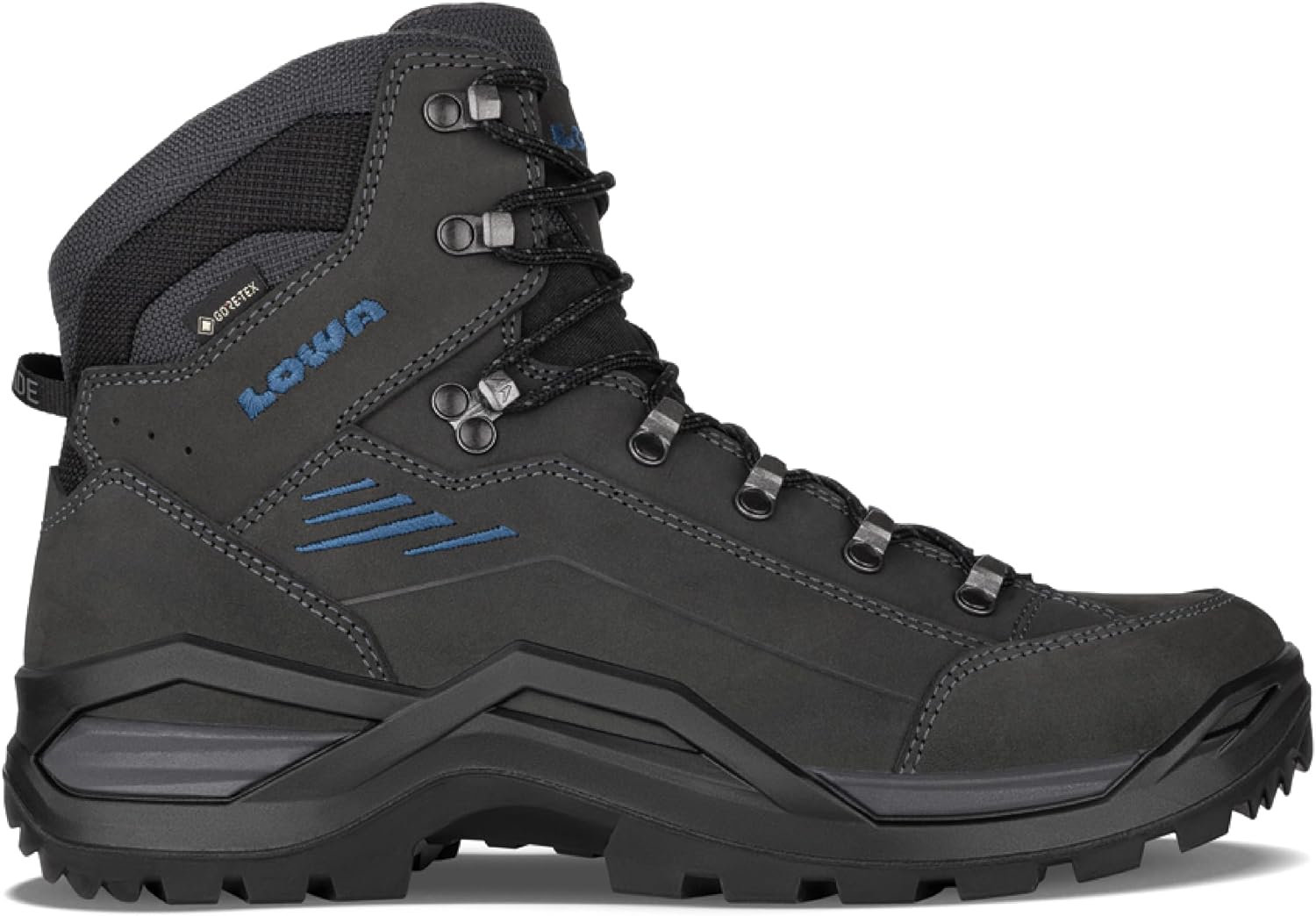 LOWA Renegade EVO GTX Mid (Men’s) | Midweight leather boot | Premium | OutdoorGearLab, Treeline Review | Check on Amazon |
 Merrell Moab 3 Mid Waterproof (Men’s) | Leather and mesh budget boot | Budget | Treeline Review, CleverHiker | Check on Amazon |
 Salomon X Ultra 5 Mid GTX (Men’s) | Lightweight synthetic boot | Mid-range | Treeline Review, CleverHiker | Check on Amazon |
Price category reflects current US listings: budget is roughly under $150, mid-range roughly $150 to $200, premium above $200. Prices change, so confirm on the product page.
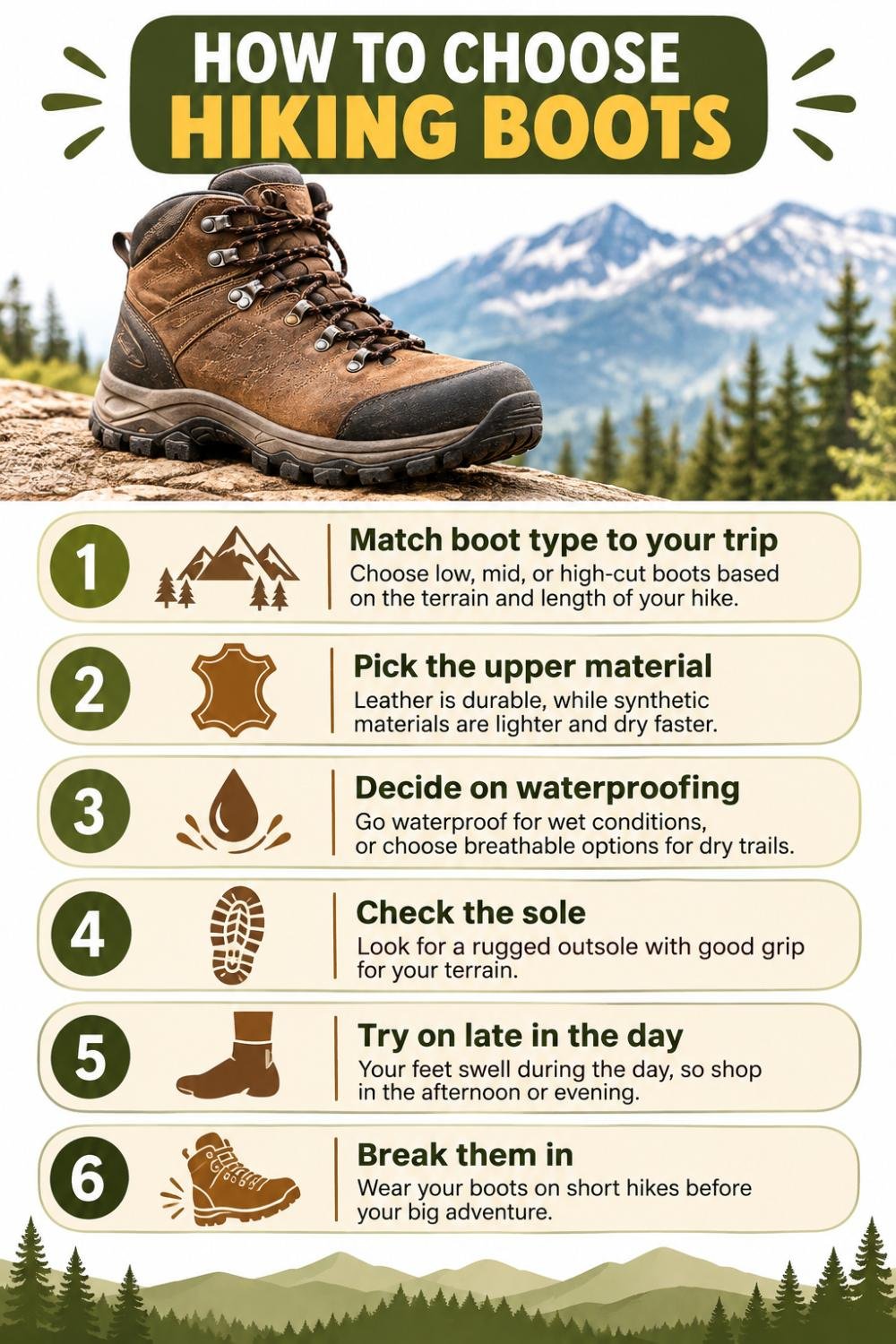
Types of Hiking Boots and Shoes
REI and OutdoorGearLab sort boots differently. Here they are side by side.
| Type | What the source says | Source |
|---|---|---|
| Hiking shoes | Low-cut and light, breathable and quick drying. Suit day hikes and groomed trails at a relaxed to moderate pace. | REI |
| Day hiking boots | Mid- to high-cut, flexible, quick to break in. Suit light to moderate terrain and packs under about 35 liters. | REI |
| Backpacking boots | Stiffer with high collars. Handle multiday trips with packs up to roughly 70 to 75 liters on moderate to rugged ground. | REI |
| Mountaineering boots | The stiffest and most rugged, built for snow, ice and the heaviest loads. | REI |
| Lightweight boots | Low-cut, mostly synthetic, no rigid shank. Suit smooth to moderate day hikes and hikers with strong ankles. | OutdoorGearLab |
| Midweight boots | Higher collars, firmer midsoles and shanks, often leather. The best starting point for most people. | OutdoorGearLab |
| Heavyweight boots | Full-grain leather and stiff TPU midsoles for rough terrain and heavy loads. Becoming less common. | OutdoorGearLab |
Who should skip each type
| Type | Skip it if | Because |
|---|---|---|
| Hiking shoes | You carry heavy loads or hike rough, wet ground | REI says boots suit longer treks, rugged terrain and heavier packs |
| Day hiking boots | You plan multi-day trips with a big pack | REI says backpacking boots are stiffer for heavy loads |
| Backpacking boots | You hike easy day trails | REI says they need extended break-in and suit rugged ground |
| Lightweight boots | You have weak or previously injured ankles | OutdoorGearLab says they suit hikers with strong ankles |
| Heavyweight boots | You want a light, agile boot | OutdoorGearLab says heavier boots trade agility for stability |
Upper Materials: Leather vs Synthetic
The upper is the part of the boot that covers your foot. REI and OutdoorGearLab agree on the trade-off between leather and synthetic.
| Material | Pros | Cons | Source |
|---|---|---|---|
| Full-grain or nubuck leather | Durable, water-resistant, more support | Heavier, needs a long break-in, absorbs water without conditioning | REI, OutdoorGearLab |
| Split-grain leather with nylon or mesh | Lighter and more breathable | Less durable than full-grain | REI |
| Synthetic or mesh | Light, dries fast, little break-in | May show wear sooner and give less support | REI, OutdoorGearLab |
OutdoorGearLab adds that leather needs periodic conditioning and that seam sealer on high-wear stitching helps extend the life of a boot.
Waterproof vs Breathable
Both sources say the same thing: a waterproof membrane, often labeled GTX for GORE-TEX, keeps feet dry in wet and muddy conditions and adds warmth in the cold, but it reduces breathability.
| Choice | What the sources say |
|---|---|
| Waterproof membrane | REI says membranes such as GORE-TEX keep feet dry in the wet but can make feet sweat on hot days. OutdoorGearLab says they add warmth in cold weather. |
| No membrane | OutdoorGearLab says non-membrane boots breathe better and dry faster, which suits hot, dry trails. |
For ranked waterproof boots, see our best waterproof hiking boots guide.
Midsoles, Outsoles and Support
REI breaks the sole into three parts, and each has its own trade-offs.
| Part | What to know |
|---|---|
| Midsole | Sets cushioning and stiffness. EVA is cushier and cheaper, TPU is firmer and more durable, and supercritical foam adds comfort without much weight. Stiffer soles help on long, rocky trails. |
| Outsole rubber | Harder compounds last longer but can be slippery. Softer ones grip better but wear faster. |
| Lugs | Deeper, widely spaced lugs grip rock and mud. Shallower, tightly spaced lugs suit wet, smooth rock. OutdoorGearLab says shallow wide lugs grip smooth rock and deep narrow lugs grip loose ground. |
| Heel brake | Improves control on steep descents. |
| Shank and rock plate | Shanks add stiffness for heavier loads, and rock plates protect against bruising and twisted ankles. |
For more on ankle support, see our hiking boots with ankle support guide.
How to Get the Right Fit
REI and OutdoorGearLab give overlapping fit advice, with a few differences listed in the disagreement section below.
- Get measured. REI says to measure in a store if possible, and OutdoorGearLab recommends a Brannock device.
- Try boots on late in the day. REI says feet are largest then.
- Bring your socks and insoles. REI says to bring custom orthotics and the socks you will hike in, and says synthetic socks are better than cotton, which can cause blisters.
- Check length. REI says to stand on the removed insole and leave about a thumb width between your longest toe and the end. OutdoorGearLab says your toes should touch the front when you slide forward, with about 1/2 to 5/8 inch of heel room.
- Walk around. Check heel lift, pinching and toes hitting the front on inclines.
- Check volume. REI says extra space above the foot under firm laces suggests the volume is wrong.
- Experiment with lacing. Both sources say lacing can reduce heel slip or relieve pressure.
For wide feet, see our best hiking boots for wide feet guide.
How Much Should Hiking Boots Weigh?
OutdoorGearLab says lighter boots feel more agile and reduce fatigue, while heavier boots offer more stability and durability, and recommends choosing the lightest boot that still gives the support you need. The weights below come from the outlets named.
| Boot | Outlet | Weight reported |
|---|---|---|
| Salomon X Ultra 5 Mid GTX | Treeline Review | 1 lb 14.4 oz |
| Salomon X Ultra 5 Mid GTX | CleverHiker | 1 lb 15 oz |
| Merrell Moab 3 Mid Waterproof | Treeline Review | 2 lb 2.9 oz |
| Merrell Moab 3 Mid Waterproof | CleverHiker | 2 lb 4 oz |
| LOWA Renegade EVO GTX Mid | Treeline Review | 2 lb 9.6 oz |
For lighter options, see our best lightweight hiking boots for men and best lightweight hiking boots for women guides.
Example Boots From Each Weight Category
One example for each of the three weight categories, with what the outlets say about it.
Salomon X Ultra 5 Mid GTX (Men’s)
Best for: seeing a lightweight synthetic boot
Salomon X Ultra 5 Mid GTX (Men’s)
Price category: Mid-range
A lightweight GORE-TEX mid hiking boot from Salomon.
Check it on AmazonTreeline Review lists it at 1 lb 14.4 oz with solid lateral stability for a lightweight boot but less ankle support than heavier boots. CleverHiker lists the mid at 1 lb 15 oz.
What this means for you: an example of the lightweight end, where REI says synthetic uppers dry fast and need little break-in.
Fit and sizing: Sources disagree on sizing, so try before you buy.
Men’s and women’s versions: Separate women’s version. CleverHiker lists the men’s mid at 1 lb 15 oz, and women’s weights are lower per Switchback Travel.
Watch for: Treeline Review and CleverHiker both note less ankle support than heavier boots.
Skip it if: you carry heavy loads.
Merrell Moab 3 Mid Waterproof (Men’s)
Best for: seeing a leather and mesh budget boot
Merrell Moab 3 Mid Waterproof (Men’s)
Price category: Budget
A leather and mesh waterproof mid hiking boot from Merrell.
Check it on AmazonTreeline Review lists it at 2 lb 2.9 oz and does not recommend it for heavy loads or long hauls because it offers less rigidity and cushioning. CleverHiker lists it at 2 lb 4 oz and calls it bulky.
What this means for you: an example of a leather and mesh upper, which REI says is lighter and more breathable than full leather but less durable.
Men’s and women’s versions: Separate women’s model. Switchback Travel lists the women’s weight at about 2 lb 0.5 oz for a size 8.5.
Watch for: Treeline Review and CleverHiker both note bulk and limited rigidity.
Skip it if: you carry heavy loads.
LOWA Renegade EVO GTX Mid (Men’s)
Best for: seeing what a midweight leather boot looks like
LOWA Renegade EVO GTX Mid (Men’s)
Price category: Premium
A leather and GORE-TEX mid boot from LOWA.
Check it on AmazonOutdoorGearLab uses the LOWA Renegade EVO GTX as its classic example of a midweight boot, the category it recommends as the best starting point for most people. Treeline Review lists it at 2 lb 9.6 oz with an external polyurethane frame that stabilizes the boot.
What this means for you: a reference point for a boot with a firm midsole, a leather upper and a supportive collar.
Men’s and women’s versions: Separate women’s model. Switchback Travel lists women’s weights at about 2 lb 2.2 oz.
Watch for: Switchback Travel calls it overkill for easy hiking, and CleverHiker lists a medium break-in.
Skip it if: you hike easy trails with a light pack.
Break-In and Care
REI and OutdoorGearLab agree that break-in depends on the boot. REI says flexible shoes and trail runners need little, while burly boots and mountaineering boots need extended wear before a long trip, and that skipping it can lead to blisters or ankle injuries.
| Topic | What the source says |
|---|---|
| Break-in | REI says heavier boots need extended wear before a long trip. |
| Cleaning | OutdoorGearLab says to clean off mud and dry boots slowly away from direct sun. |
| Drying | OutdoorGearLab says never dry boots by a fire or leave them in a hot car. |
| Leather care | OutdoorGearLab says to apply leather treatment periodically. |
| Seams | OutdoorGearLab says to apply seam sealer to high-wear stitching. |
Our Hiking Boot Decision Framework
We turn the sources into five questions you can answer before buying.
- Load. How heavy is your pack?
- Terrain. Groomed, rocky or off-trail?
- Ankles. Do you have a history of sprains?
- Weather. Wet and cold, or hot and dry?
- Fit. Does the toe box and heel match your foot?
| Your situation | Suggested direction | Source |
|---|---|---|
| Pack under about 35 liters, groomed trail | Hiking shoes or day boots | REI |
| Pack over about 30 pounds, rough terrain | A boot, midweight or heavier | OutdoorGearLab, REI |
| Past ankle injuries | A boot with a higher collar | OutdoorGearLab |
| Hot, dry trails | A non-membrane boot | OutdoorGearLab |
| Wet or cold trails | A waterproof membrane boot | REI, OutdoorGearLab |
This table is our reading of what the two outlets say. It is general advice, not a medical or fitting recommendation.
How to Choose, Step by Step
- Start with your trip, not the brand. REI says to choose based on trip length, terrain difficulty and pack weight.
- Start with midweight if unsure. OutdoorGearLab calls midweight boots the best starting point for most people.
- Try before you commit. Both sources say to try on several pairs with your socks.
- Pick the weather feature you need. See best waterproof hiking boots.
- Compare lists. See best hiking boots for men, best hiking boots for women, best hiking boots for beginners and best hiking boots under $100.
- Boots or shoes. See hiking boots vs hiking shoes.
Where the Expert Advice Differs
How to check length. REI says to leave about a thumb width between your longest toe and the end of the removed insole, while OutdoorGearLab says your toes should touch the front when you slide forward in the boot.
Heavy loads. REI puts the line at about 35 liters for day boots, while OutdoorGearLab says boots suit loads over about 30 pounds, so the two use different measures.
Heavyweight boots. REI treats backpacking boots as a standard category, while OutdoorGearLab says heavyweight leather boots are becoming less common.
Questions About Choosing Hiking Boots, Answered
“What should I look for in a hiking boot?”
REI lists the upper material, waterproofing, midsole, outsole and fit. OutdoorGearLab adds weight, ankle strength and pack load.
“Should I go up a size?”
OutdoorGearLab says to go up if you fall between sizes. REI says to leave a thumb width of space ahead of your longest toe.
“Do I need waterproof boots?”
Only for wet or cold trails, per both sources. For hot, dry trails OutdoorGearLab suggests a non-membrane boot.
“Do I need to break in hiking boots?”
REI says burly boots need extended wear before a long trip and flexible shoes need little.
“How do I keep my boots lasting?”
OutdoorGearLab says to clean off mud, dry them slowly away from direct heat, condition leather and seal high-wear seams.
Mistakes to Avoid When Buying
- Buying without trying. Both sources say to try several pairs.
- Wearing cotton socks. REI says cotton can cause blisters.
- Skipping the break-in. REI says that can cause blisters or ankle injuries.
- Drying by a fire. OutdoorGearLab says never to.
- Buying more boot than you need. OutdoorGearLab says to choose the lightest boot that gives the support you need.
How we checked this
- UrbanStyleFootwear compared four outlets: REI, OutdoorGearLab, Treeline Review and CleverHiker.
- We built this guide from what each outlet wrote about boot types, materials, waterproofing, soles, fit, weight and care. Every claim is attributed to the outlet that published it, and our own reading is labeled general advice. Outlets use different categories and tests.
- Price categories reflect current US listings.
Frequently Asked Questions
How do I choose hiking boots?
REI says to base the choice on trip length, terrain difficulty and pack weight.
What type should most people buy?
OutdoorGearLab calls midweight boots the best starting point for most people.
When should I try boots on?
REI says late in the day, when feet are largest.
Should I buy waterproof boots?
Only for wet or cold trails, per REI and OutdoorGearLab.
Should I go up a size?
OutdoorGearLab says to go up if you fall between sizes.
Do hiking boots need break-in?
REI says heavier boots need extended wear before a long trip.
What socks should I wear?
REI says synthetic socks, not cotton.
Where can I see ranked boots?
See our best hiking boots guide.
The Short Version
Start from your trip: pack weight, terrain and weather. Try several pairs on late in the day with your hiking socks, and choose the lightest boot that gives the support you need.