
EVA vs Phylon: What’s the Real Difference in Running Shoe Midsoles?
Editorial Guide | Midsole Foams |
Summarise this EVA vs phylon guide with AI
Open an assistant and submit the prefilled request. The assistant reads the page only after you submit it.
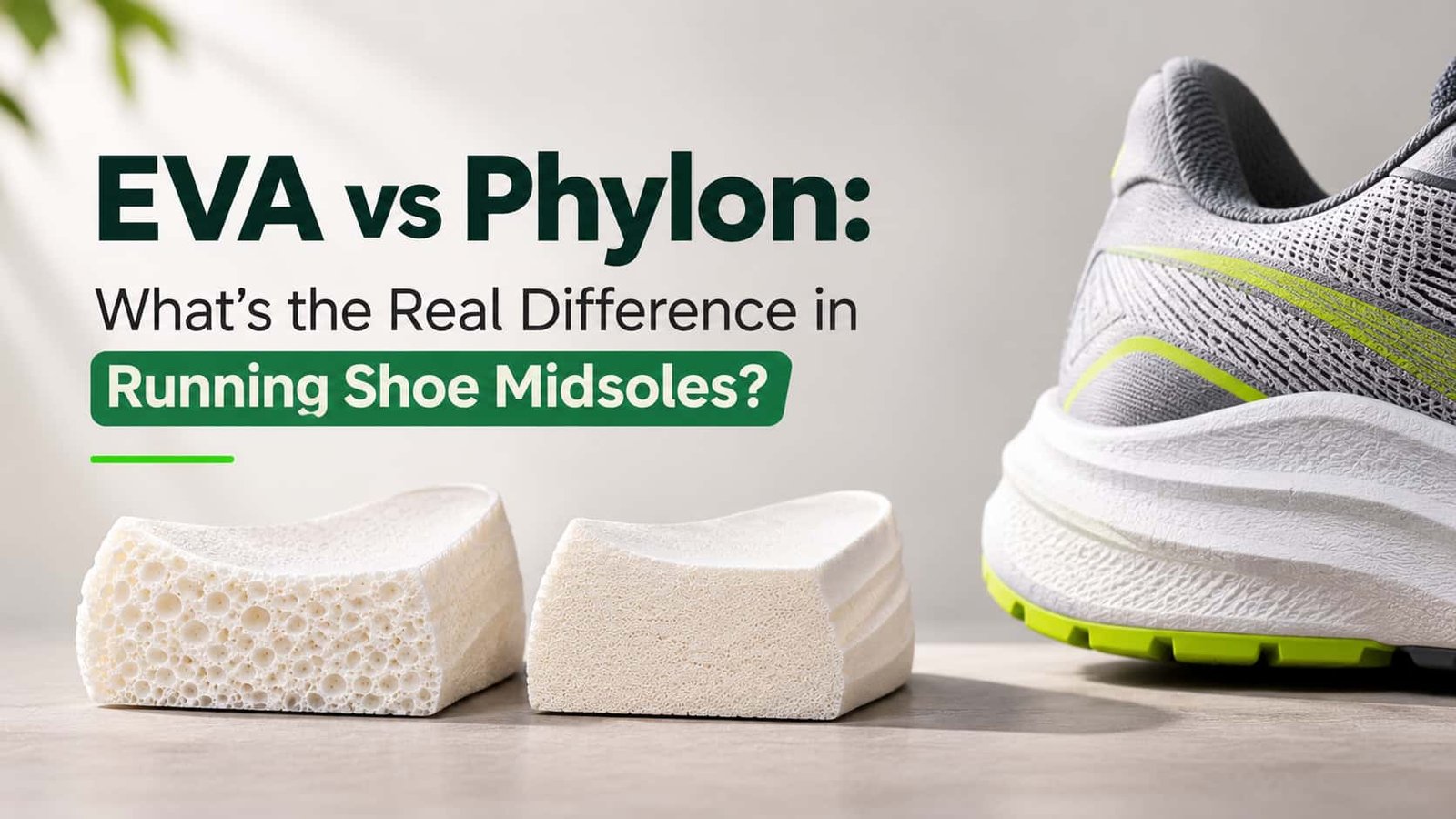
EVA is a closed-cell foam made from ethylene-vinyl acetate, valued for being light, soft, and inexpensive. Phylon is an EVA-based material that is processed differently, usually into a denser, more resilient midsole. Phylon is often described as firmer and more durable, while EVA is usually softer. Neither is universally better; the right choice depends on the shoe.
Key takeaways
- EVA and phylon both start from ethylene-vinyl acetate, but phylon is a processing route that changes density and feel.
- EVA is usually softer and lighter. Phylon is often firmer and more resilient, though results vary by formulation.
- Durability depends on compression, not just the name. Foam that flattens quickly feels worn long before the sole cracks.
- Product listings often use “EVA” and “Phylon” loosely, so the midsole’s real behaviour matters more than the label.
- For most runners, the better choice is the shoe whose cushioning, fit and stability suit your running, not the foam name alone.
Midsole foams sit between the upper and the outsole, and they do most of the work in cushioning. Two terms come up again and again in shoe listings: EVA and phylon. Shoppers see them side by side, sometimes as rivals, and rarely with an explanation of what separates them.
The short answer is that they are related. Phylon is generally described as a processed form of EVA-type material, so the comparison is less about two unrelated chemicals and more about how the foam is made and what that does to its feel, weight and longevity. Understanding that point clears up most of the confusion.
This guide explains what each material is, how it is made, and where the differences show up in cushioning, weight, flexibility and durability. It also covers rubber and TPR outsoles, because those terms often appear in the same listing. If you are new to where midsoles sit in a shoe, our midsole and outsole guide sets out the layers, and our running shoe foam covers the wider family of cushioning materials.
What Is EVA Foam in Shoes?
EVA stands for ethylene-vinyl acetate, a copolymer. Its basic chemistry is well documented; the Wikipedia overview of ethylene-vinyl acetate describes the polymer and its common uses. In footwear, EVA is blended with a blowing agent, heated, and formed into foam. The result is a lightweight material with many small gas-filled cells.
Most EVA midsoles are closed-cell foams, which means the cells are sealed rather than open to one another. That structure helps explain its typical behaviour. It is light, it compresses under load and springs back, and it can be produced at a relatively low cost. Those properties made EVA one of the most common midsole materials in athletic and casual shoes.
EVA’s main limitation is that it does not spring back forever. Under repeated compression, the foam gradually loses thickness and bounce. Engineers call this compression set, and it is the reason a midsole can feel flat long before the upper or outsole shows wear. You can see the effect on the heel and forefoot of older shoes.
Terminology is worth clearing up here. “EVA” describes a polymer family, and the word is used in shoe listings for a foam made from it. Two EVA midsoles can feel quite different because density, additives and manufacturing differ. A listing that says “EVA” tells you the family, not the exact feel.
What Is Phylon Foam?
Phylon is an EVA-based material, but it is made through a different processing route. In the common description, EVA is first foamed and broken into small particles or pellets. Those particles are then heated and compressed in a mould to form a denser, more uniform block. Some manufacturers also use injection methods for phylon-type midsoles, which can change the shape and density they achieve.
The result is typically a foam that feels firmer and more resilient than standard EVA. Manufacturers often describe phylon as more durable, and many shoe makers have used it for everyday and performance footwear over several decades. Phylon’s stiffness and density also mean it can feel less soft underfoot, which is the reason many people describe it as “firm” rather than “plush”.
It helps to be clear about what phylon is not. It is not a separate polymer invented to replace EVA, and it is not a rubber. It is best understood as a processed form of EVA-type foam. Because the name describes a method, two products sold as phylon can still differ in density, colour, additives and shape.
A practical point follows from that. Phylon does not automatically mean a better or worse midsole. It means a specific processing route with predictable tendencies: more compact, often firmer, and typically more stable over time than a very soft standard EVA. Whether that suits you depends on your weight, your running style and what you want from the shoe.
EVA vs Phylon: The Main Differences
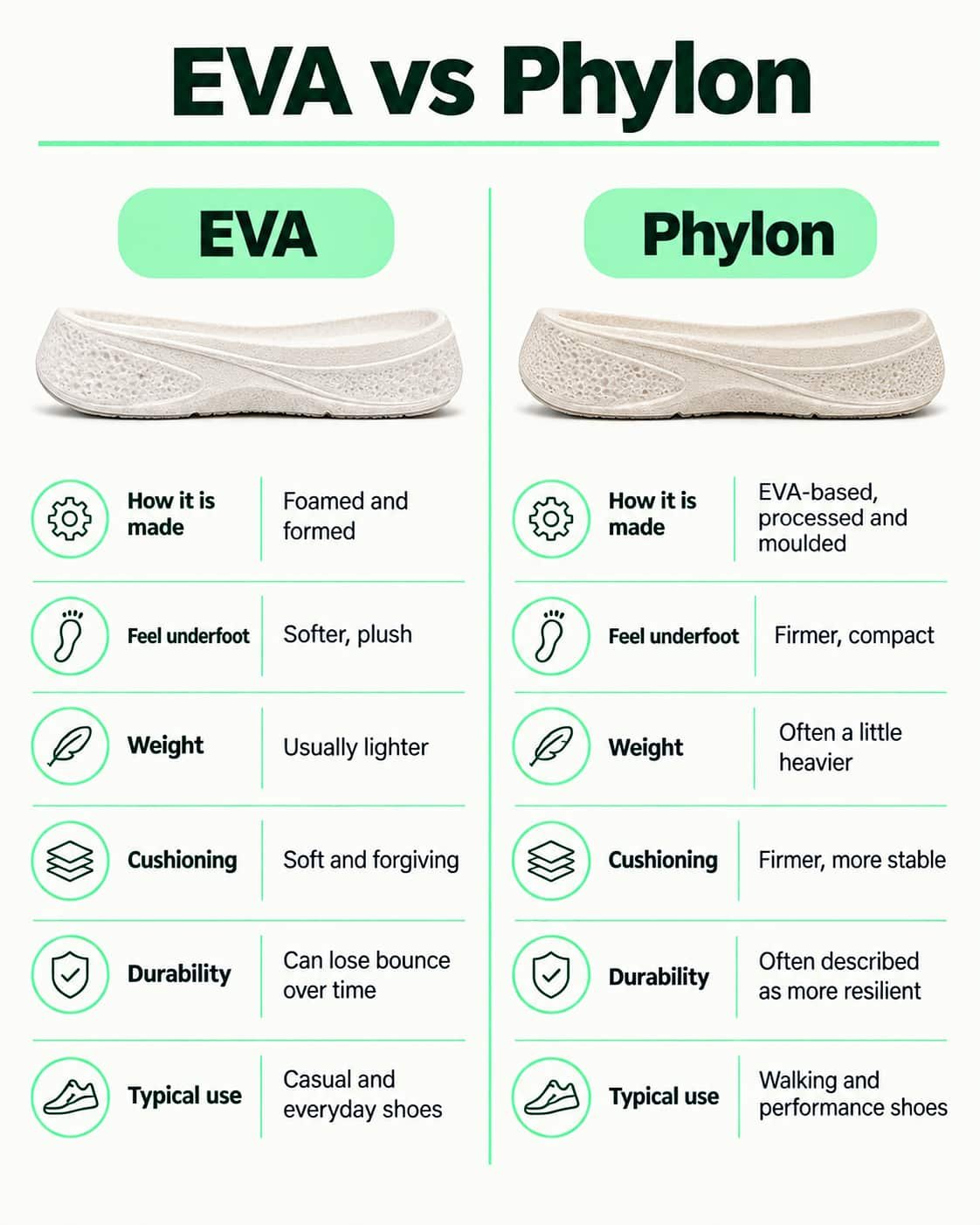
The comparison is easier to read as a table. The entries describe general tendencies, not guarantees for any product.
| Feature | EVA foam | Phylon foam |
| Basic material | EVA copolymer, foamed | EVA-based, foamed and then moulded |
| Typical feel | Softer, springy, plush | Firmer, more compact |
| Weight | Usually lighter | Often a little heavier for the same size |
| Cushioning | Soft and forgiving | Firmer, more stable |
| Durability | Can lose bounce over time | Often described as more resilient |
| Cost | Usually lower | Often higher |
| Common uses | Casual, daily trainers, many running midsoles | Casual, walking and many performance shoes |
Two rows deserve extra attention. Weight depends on density, and a denser phylon midsole can weigh more than a soft EVA midsole of the same size. Cost depends on the shoe as a whole, so the foam is only one part of the price. The table is best used as a starting point, with the shoe’s own specification as the final guide.
For a closer look at the synthetic side of this family, our what is EVA foam guide explains the foam in more detail, and our phylon explainer covers the processing in its own right.
Cushioning and Comfort
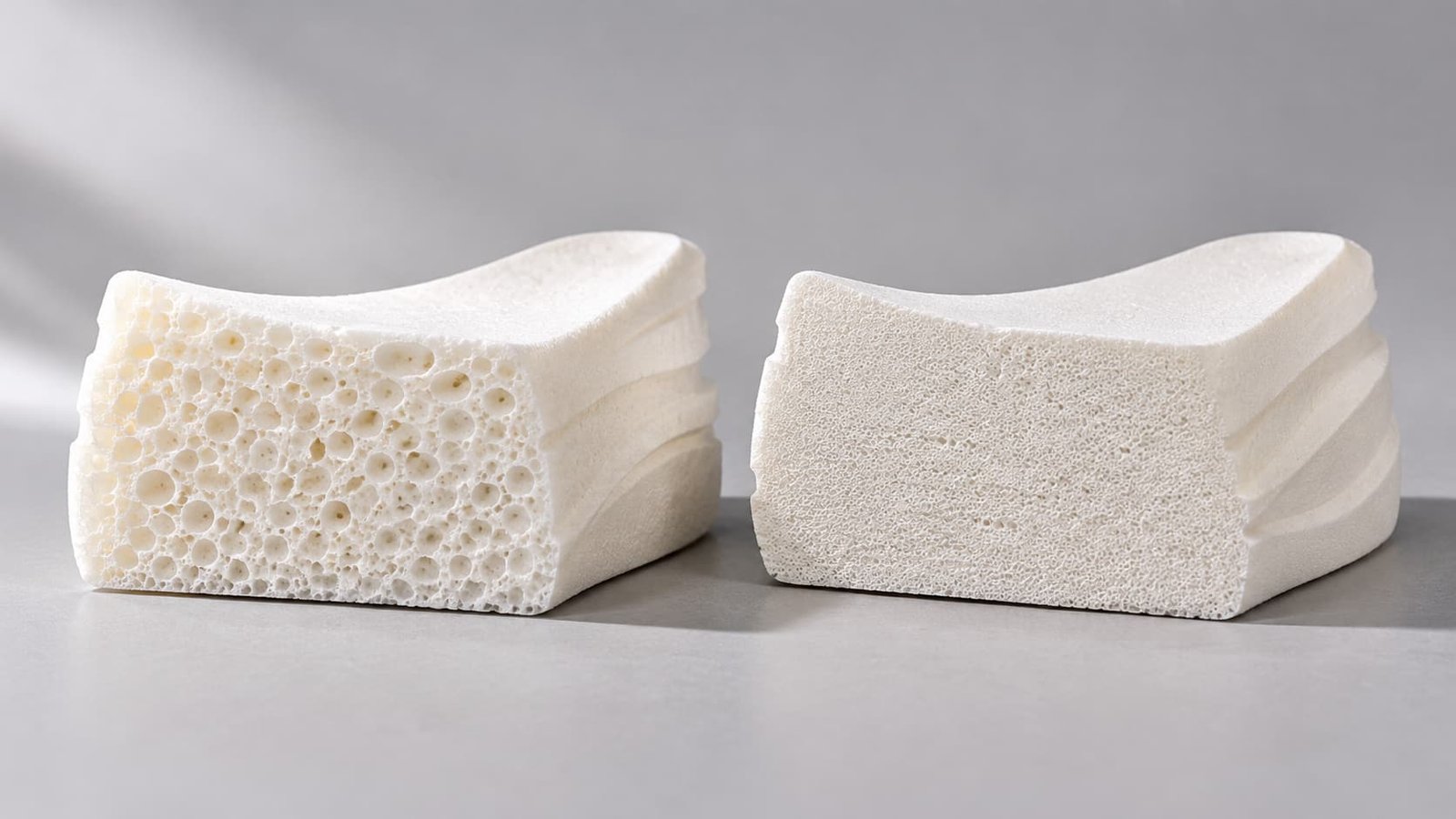
Cushioning is the feature most people care about, and it is where the two materials feel most different. EVA is usually the softer option. It gives a plush, forgiving feel that many people find comfortable on long walks and easy runs. The trade-off is that very soft foam can feel unstable for heavier wearers or on uneven ground.
Phylon usually feels firmer. The midsole gives a more controlled platform, which some runners and walkers prefer, especially in shoes built for stability or daily wear. The firmness can also feel less cushioned in the first few minutes, so a short walk in the shop does not always tell the full story.
Comfort depends on more than foam. Midsole geometry, the shape of the last, the heel-to-toe drop, and the upper’s fit all change how the foam feels. A firm phylon midsole in a well-fitted shoe can feel more comfortable than a soft EVA midsole in a poor fit. Judge the whole shoe, not the foam name alone.
If you walk on hard surfaces for long periods, cushioning matters more. In that case, consider how the foam is designed rather than only which material it is. Our guide to how long running shoes last explains how cushioning changes with use, which is closely tied to durability.
Weight and Flexibility
Weight is a practical concern for runners and anyone who walks a lot. EVA is typically lighter because its density is lower and its structure is more open to gas-filled cells. That is one reason EVA remains common in lightweight trainers.
Phylon can be heavier for a given size because the processing produces a denser block. Some manufacturers offset this with clever shaping or thinner sections, so a phylon shoe is not always heavier overall. Weigh the shoe if weight matters to you, and compare pairs in the same size.
Flexibility is closely linked to firmness. Softer EVA bends easily and can feel flexible under the foot. Firmer phylon resists bending more, which can be helpful for support but may feel stiff for people who prefer a flexible shoe. Flexibility is also shaped by the outsole and the shoe’s construction, so a single material does not decide the whole feel.
Durability and Compression Set
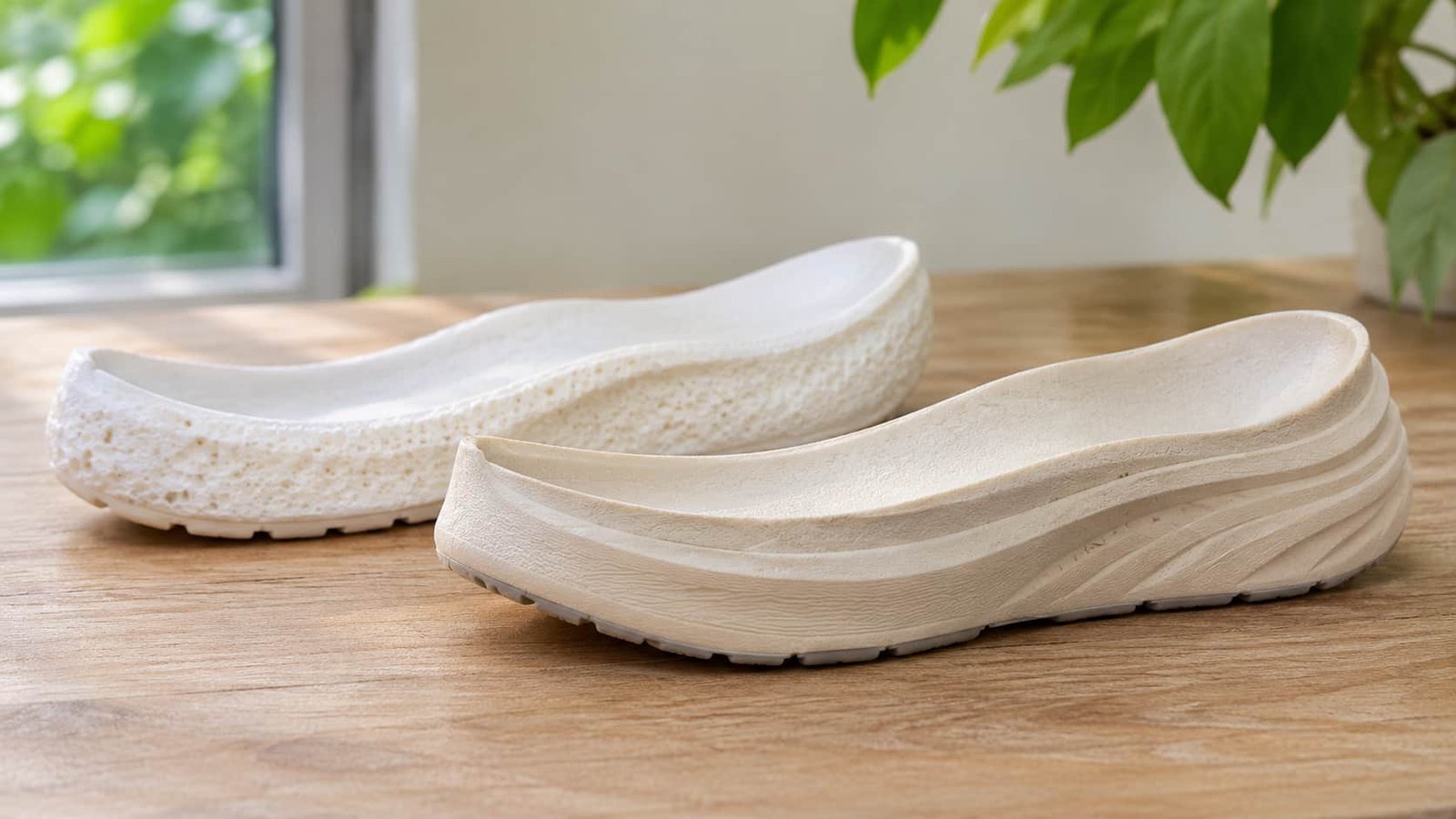
Durability is the question that causes the most confusion. Manufacturers often describe phylon as more durable, and that is a common claim. It is not the whole story. Durability depends on how much compression the foam is asked to take, how often it is used, and how it is stored and cleaned.
The main concept is compression set. When a foam is compressed repeatedly, it can lose thickness and rebound. A softer foam may flatten sooner, while a firmer, denser foam may hold its shape longer. That is the basis for the claim that phylon lasts longer, but the effect varies with the formulation and the shoe.
Signs that a midsole has lost its performance include a flat, packed-down feel, uneven wear across the heel or forefoot, and a new sense of tiredness on long walks. These signs apply to both materials, so they are a better guide than the foam’s name.
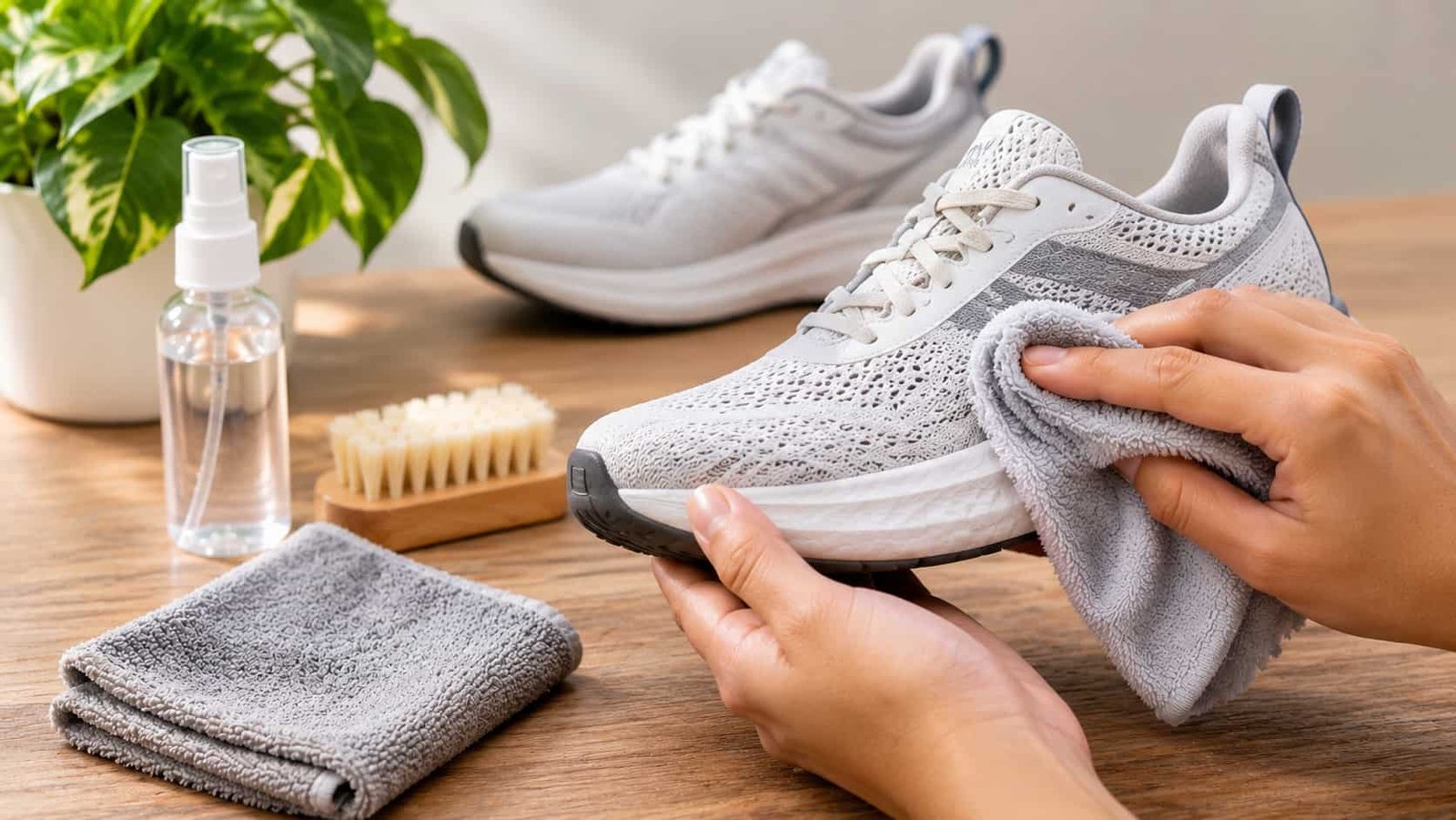
Storage and cleaning matter too. Heat, direct sun and long periods in a hot car can soften or degrade foam faster than normal use. Dry the shoes at room temperature and avoid harsh solvents. Our guide to how to clean shoes and maintain them covers safe general cleaning.
EVA, Phylon and Rubber Soles
A common mix-up is the difference between a midsole foam and an outsole. EVA and phylon usually sit in the midsole, the layer between the upper and the ground. Rubber and TPR usually form the outsole, the layer that touches the ground.
TPR stands for thermoplastic rubber, a family of soft, grippy materials that can be moulded and recycled in some processes. The concept is described on Wikipedia’s thermoplastic elastomer page. In listings, “phylon vs EVA vs TPR” often compares a midsole foam against an outsole material, which is not a like-for-like comparison.
Rubber, the more durable and grippy outsole material, is a different category again. Our rubber shoe soles guide explains rubber outsoles in more detail. A shoe can have a phylon midsole and a rubber outsole at the same time, which is one reason the comparison needs care.
When a listing says “phylon vs EVA vs rubber sole”, read it as two questions. The first is which midsole foam feels better. The second is which outsole suits your surfaces. Answering both gives a clearer choice than comparing three words in one line.
Which Is Better for Running Shoes?
There is no single winner, but there are clear patterns. Softer EVA can suit runners who want a plush, light feel on easy days or who prefer a cushioned ride. Firmer phylon can suit runners who want a more controlled platform, or people who need a stable, long-lasting midsole in a daily trainer.
Consider your body weight, running distance and surfaces. Heavier runners often benefit from a firmer, more supportive midsole, though fit and shoe design matter as much as the foam. Runners on rough trails may prefer a sturdier outsole more than a particular midsole material. Walkers on hard floors may prefer the feel of a stable midsole for long shifts.
Fit is the final test. Try shoes on, walk and jog if you can, and pay attention to heel grip, toe room and how the midsole feels after ten minutes. A shoe that fits well and suits your running will beat a material choice that looks good on paper.
Our shoe finder can help narrow choices by use, and our method page explains how we approach footwear review and comparison: how we test shoes and our methodology.
Common Myths
“Phylon is always better than EVA.” Phylon is often firmer and more resilient, but it is not always better. Comfort, weight and fit depend on the shoe.
“EVA is cheap and therefore poor quality.” EVA is affordable, and affordable foams can be well engineered. Cost and quality are not the same thing.
“A foam name tells you everything.” Density, shape and additives matter. Two products with the same name can feel very different.
“Phylon will never wear out.” All midsole foams compress and age. Phylon is often described as durable, but it still loses performance with use and time.
“EVA and rubber are interchangeable.” EVA is usually a midsole foam, and rubber is usually an outsole. They do different jobs.
Frequently Asked Questions
What is the difference between EVA and phylon?
EVA is a foam made from ethylene-vinyl acetate. Phylon is an EVA-based material processed in a way that usually produces a denser, firmer, more resilient midsole. The difference lies mainly in processing and feel.
Which is better, phylon or EVA?
Neither is better for every runner or walker. EVA is usually softer and lighter. Phylon is often firmer and more durable. Choose by feel, fit and how you use the shoe.
Is Phylon a good material for shoes?
Phylon is widely used in footwear, and many people find it a stable, long-lasting midsole. Its firmer feel suits some users better than others, so trying the shoe on is the best guide.
Is EVA a rubber or a plastic?
EVA is neither rubber nor a traditional hard plastic. It is a copolymer foam, and it behaves more like a soft, closed-cell plastic material in shoe midsoles.
Which lasts longer, EVA or Phylon?
Phylon is often described as more durable, but lifespan depends on compression, use, storage and the shoe’s construction. Neither material lasts indefinitely.
Is phylon better than rubber for the sole?
They are different parts of the shoe. Phylon is typically a midsole foam, while rubber is usually the outsole. A good shoe often uses both.
Do EVA midsoles shed microplastics?
Microplastic shedding is a reasonable question for any synthetic material, and it is discussed in research on footwear and wear. This article does not make a specific claim for either foam, because the evidence for individual midsole types is limited.
How should I care for EVA or phylon midsoles?
Keep shoes out of heat and direct sun, dry them at room temperature, and clean them with mild soap and lukewarm water. Avoid harsh solvents, which can damage foam and adhesives.
Final Thoughts
EVA and phylon are closely related, but they are not the same thing. EVA is the base foam family. Phylon is a processing route that usually gives a firmer, denser, more resilient midsole. Softer EVA is often lighter and more plush, while phylon is often firmer and more stable.
The most useful habit is to read past the label. Look at the shoe’s fit, how it feels after several minutes of walking or running, and how well it suits your surfaces and weight. If you want a broader view of the materials behind these choices, our shoe materials guide is a good next step.
Sources and further reading
- Ethylene-vinyl acetate (the copolymer behind EVA foam)
- Thermoplastic elastomer (the family that includes TPR)
- Arkema: sports footwear, equipment and apparel (manufacturer information on high-performance polymers used in footwear)