
US vs UK vs EU Shoe Size Conversion: Charts, Calculator & Expert Tips
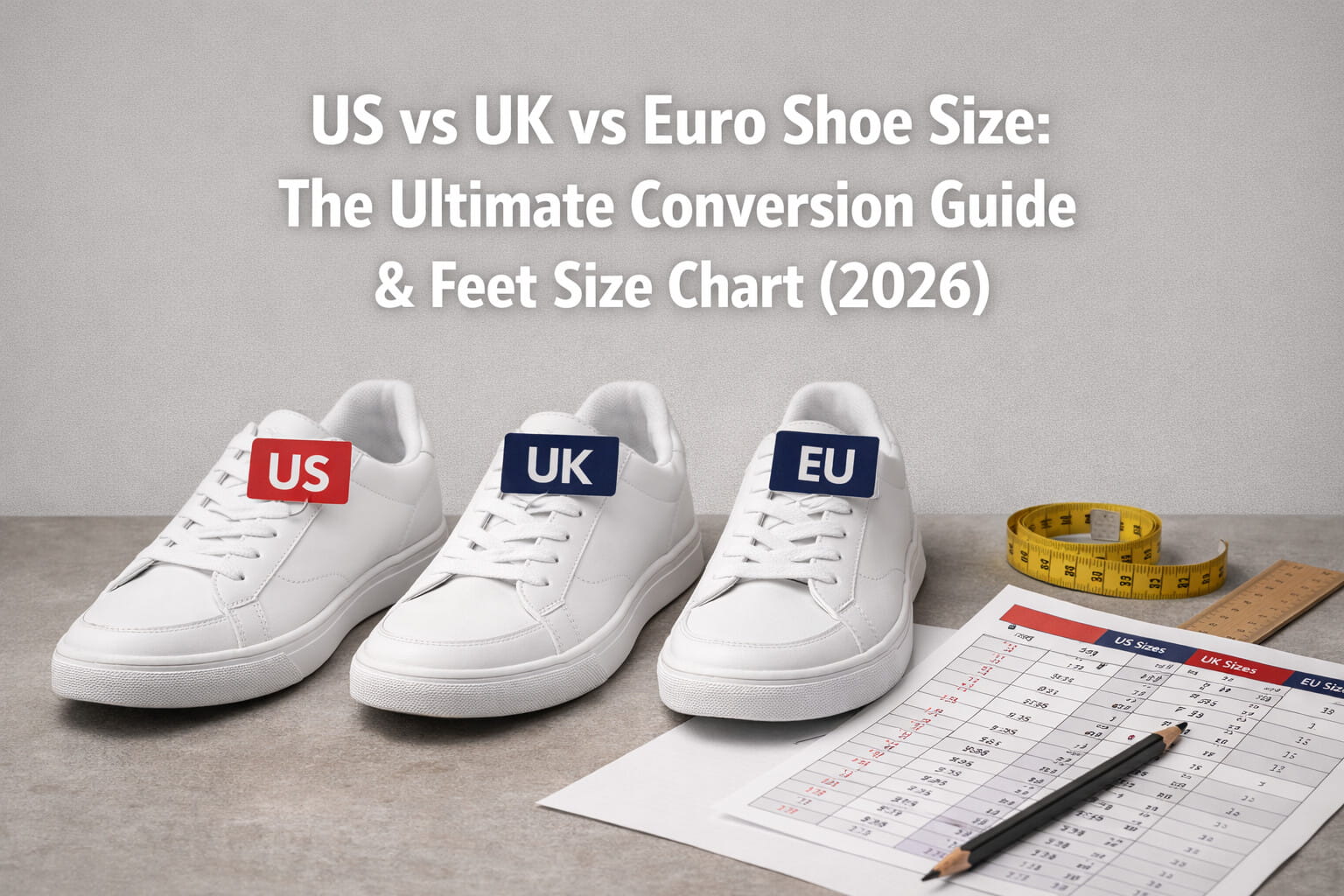
Need to convert US, UK, or EU shoe sizes?
Use our free shoe size conversion chart and calculator to instantly find the correct size for men, women, and kids. Whether you’re shopping from Nike, Adidas, ASICS, Puma, or international retailers, this guide helps you compare US, UK, EU, CM, and India shoe sizes accurately.
Backed by 20+ years of footwear retail experience, we’ve also included expert fitting tips to help you avoid common sizing mistakes.
Quick answer: What is the difference between US and UK shoe size?
US and UK shoe sizes share the same measurement unit (barleycorns) but start counting at different points on the scale:
- Men: US size = UK size + 1 (US 10 = UK 9, US 9 = UK 8)
- Women: US size = UK size + 2 (US 8 = UK 6, US 7 = UK 5)
- EU sizes: Different system entirely — use the charts below
The most reliable way to shop internationally: find your foot length in centimeters — that number works in every country.
Shoe Size Conversion
US to UK & EU Women’s Shoe Size Chart
| US/CA | UK/IN | EU | JP/MX | CN | Inches | CM |
|---|---|---|---|---|---|---|
| 4 | 2 | 34 | 21 | 32 | 8.3″ | 21.2 |
| 5 | 3 | 35 | 22 | 34 | 8.7″ | 22.0 |
| 6 | 4 | 36 | 23 | 36 | 9.0″ | 22.9 |
| 7 | 5 | 38 | 23.5 | 37 | 9.3″ | 23.7 |
| 8 | 6 | 39 | 24.5 | 39 | 9.7″ | 24.6 |
| 9 | 7 | 40 | 25.5 | 41 | 10.0″ | 25.4 |
| 10 | 8 | 41 | 26 | 42 | 10.3″ | 26.2 |
| 11 | 9 | 43 | 27 | 44 | 10.7″ | 27.1 |
| 12 | 10 | 44 | 28 | 46 | 11.0″ | 27.9 |
US to UK & EU Men’s Shoe Size Chart
| US/CA | UK/IN | EU | JP/MX | CN | Inches | CM |
|---|---|---|---|---|---|---|
| 6 | 5 | 38 | 23.5 | 37 | 9.3″ | 23.7 |
| 7 | 6 | 39 | 24.5 | 39 | 9.7″ | 24.6 |
| 8 | 7 | 40 | 25.5 | 41 | 10.0″ | 25.4 |
| 9 | 8 | 41 | 26 | 42 | 10.3″ | 26.2 |
| 10 | 9 | 43 | 27 | 44 | 10.7″ | 27.1 |
| 11 | 10 | 44 | 28 | 46 | 11.0″ | 27.9 |
| 12 | 11 | 45 | 29 | 48 | 11.3″ | 28.8 |
| 13 | 12 | 46 | 29.5 | 49 | 11.7″ | 29.6 |
| 14 | 13 | 48 | 30.5 | 51 | 12.0″ | 30.5 |
US to UK Kids’ Shoe Size Chart (5-12 Years)
| US/CA | UK/IN | EU | JP/MX | CN | Inches | CM |
|---|---|---|---|---|---|---|
| 10.5 | 9.5 | 28 | 17 | 24 | 6.8″ | 17.1 |
| 12 | 11 | 30 | 18.5 | 27 | 7.3″ | 18.4 |
| 13.5 | 12.5 | 32 | 19.5 | 29 | 7.8″ | 19.7 |
| 1 | 13 | 32 | 20 | 30 | 7.9″ | 20.1 |
| 2 | 1 | 33 | 21 | 32 | 8.3″ | 21.0 |
| 4 | 3 | 36 | 22.5 | 35 | 8.9″ | 22.6 |
| 6 | 5 | 39 | 24.5 | 39 | 9.6″ | 24.3 |
| 7 | 6 | 40 | 25 | 40 | 9.9″ | 25.2 |
Introduction: US to UK and Euro Shoe Size Conversions
A US men’s 10 is a UK 9. A US women’s 8 is a UK 6. A Euro 42 is a UK 8 for men — but a UK 7.5 for women.
Those three sentences will solve most conversion questions. But if you’re buying internationally, brand sizing quirks can shift things by half a size in either direction, and that’s where most people get it wrong.
I’ve been running a footwear retail shop in Chennai for over 20 years. In that time I’ve processed thousands of size exchanges — most of them preventable if the buyer had one good chart and understood the difference between the US, UK, and EU sizing systems. This guide gives you both: the exact conversion charts and the insider knowledge behind them.
Use the calculator below for any size, or jump to the section most relevant to you: [Men’s Chart] [Women’s Chart] [EU to UK] [Kids]
Why US, UK, and EU Shoe Sizes Are Different (The 30-Second History)
US and UK sizes both measure feet in barleycorns — an old English unit equal to 1/3 of an inch. They use the same unit but start counting at different points, which is why there’s always a 1-size gap for men and a 2-size gap for women.
European sizes use Paris points — 2/3 of a centimeter — which is why EU sizes don’t convert cleanly to US or UK. There’s no single formula that works for every size; it always involves rounding.
This matters practically because:
- A “true” EU 42 could be a UK 8 or UK 8.5 depending on the brand’s specific mold (called a “last”)
- Italian dress shoes run narrower than American athletic shoes even at the same nominal size
- Buying online without knowing this leads to returns, stretch damage, or foot pain
The safest conversion tool is your foot length in centimeters. That number doesn’t change by country.
The Ultimate Feet Size Chart & Conversion Guide
Below are the standard conversions. However, always treat these as a baseline.
1. US to UK & EU Men’s Shoe Size Conversion Chart
US to UK Men’s Shoe Size Conversion (The 1-Size Rule)
For men, subtract 1 from your US size to get your UK size. US 9 = UK 8. US 10 = UK 9. US 11 = UK 10. No exceptions — this rule is consistent across Nike, Adidas, New Balance, Timberland, and every major brand.
The trap most people fall into: they know their US size but forget that Nike runs narrow. A US 10 in Nike fits like a US 9.5 in New Balance. So even with a perfect conversion, brand-specific fit affects comfort. See the Brand Comparison section below for specifics.
Quick EU conversion for men: subtract 33 from your EU size to get your US size (EU 43 = US 10 = UK 9). Or use the calculator at the top of the page for any size combination.
| US Size | UK Size | Euro Size | Foot Length (approx. CM) |
|---|---|---|---|
| 7 | 6 | 40 | 25.1 |
| 7.5 | 6.5 | 40.5 | 25.4 |
| 8 | 7 | 41 | 25.7 |
| 8.5 | 7.5 | 42 | 26.0 |
| 9 | 8 | 42.5 | 26.7 |
| 9.5 | 8.5 | 43 | 27.0 |
| 10 | 9 | 44 | 27.3 |
| 10.5 | 9.5 | 44.5 | 27.9 |
| 11 | 10 | 45 | 28.3 |
| 12 | 11 | 46 | 28.6 |
| 13 | 12 | 47.5 | 29.4 |
2. US to UK & EU Women’s Shoe Size Chart
| US Size | UK Size | Euro Size | Foot Length (approx. CM) |
|---|---|---|---|
| 5 | 3 | 35.5 | 22.2 |
| 6 | 4 | 36.5 | 23.0 |
| 6.5 | 4.5 | 37.5 | 23.5 |
| 7 | 5 | 38 | 24.1 |
| 7.5 | 5.5 | 38.5 | 24.5 |
| 8 | 6 | 39 | 24.8 |
| 8.5 | 6.5 | 40 | 25.4 |
| 9 | 7 | 40.5 | 25.7 |
| 10 | 8 | 42 | 26.7 |
(Note: Shoe size EU to UK conversions often trip people up here. Notice that a US Women’s 7 is a UK 5, but a US Men’s 7 is a UK 6. Gender plays a massive role in the labeling.) Kids Shoe Size by Age: The Complete 0 to 12 Years Chart
US to UK Women’s Shoe Size Conversion (The 2-Size Rule)
For women, the rule is simple: your US size is always 2 sizes larger than your UK size. US 6 = UK 4. US 8 = UK 6. US 10 = UK 8. This holds true for virtually every brand.
The exception: “unisex” sizing. When a brand labels a shoe unisex, they almost always use the men’s scale — so a “unisex US 8” is built on a men’s last and will be wider than a women’s US 8 even though the label looks the same.
If you're shopping EU brands (Zara, Mango, Birkenstock), add
30–31 to your UK size to get the EU equivalent. A UK 6 is EU
39 or 40 depending on the brand. When in doubt, check your
foot length in CM — it's on the tongue of most shoes you
already own.
How to Measure Your Feet Correctly (The DIY Method)
Most people assume they know their size because “that’s what I’ve always worn.” But did you know your feet can flatten and lengthen as you age? If you haven’t measured your feet in the last three years, do it now.
Here is the step-by-step framework we use in the shop when a Brannock device isn’t available:
- Tape the Paper: Tape a piece of A4 or Letter paper to the floor against a wall.
- Stand Firm: Place your foot on the paper with your heel flush against the wall. Stand upright (don’t sit), as your weight spreads your foot out.
- Trace: Have a friend trace the outline of your toes. (Doing it yourself shifts your weight and ruins the measurement).
- Measure: Measure from the edge of the paper (heel) to the longest toe (usually the big toe or the second toe).
- Add Wiggle Room: Add 0.5cm to 1cm to your measurement. This is your “shoe size” length.
Why CM Is the Only Truly Universal Shoe Size
Every sizing system — US, UK, EU, JP, CN — is ultimately
measuring the same thing: the length of your foot in
centimeters. The size numbers are just different brands of
ruler.
This is why a Nike US 9 (26.2 cm) fits identically to a New
Balance JP 265 (26.5 cm) even though the labels look
completely different. The centimeter doesn’t lie.
How to find your CM size right now
- Place a ruler or tape measure on the floor
- Stand with your heel against a wall
- Measure from the wall to the tip of your longest toe
- Add 0.5 cm (shoes need room for your foot to flex)
- That final number is your CM shoe size — use it everywhere
CM to Shoe Size Reference Table
CM | US Men | US Women | UK Men | UK Women | EU 22.9 | 6 | 7.5 | 5 | 5.5 | 36 23.7 | 6.5 | 8 | 5.5 | 6 | 37 24.6 | 7.5 | 9 | 6.5 | 7 | 38–39 25.4 | 8 | 9.5 | 7 | 7.5 | 40 26.2 | 9 | 10.5 | 8 | 8.5 | 41–42 27.1 | 10 | 11.5 | 9 | 9.5 | 43 27.9 | 11 | 12 | 10 | 10 | 44 28.8 | 12 | — | 11 | — | 45–46
Pro tip: check the tongue of any shoe you own that fits well.
Most running shoes (Nike, Adidas, Asics, Saucony) print the
CM size there. Use that number when ordering any brand
internationally — it’s more reliable than the size number alone.
Material Matters: How Fabric Affects Fit
Even if the feet size chart says you are a 42, the material of the shoe dictates how it feels.
- Full-Grain Leather: Initially feels tight and stiff. It requires a “break-in” period where the leather warms up and molds to your foot shape. Buy these snug, not tight.
- Synthetic Mesh (Running Shoes): These have very little “give.” If they feel tight in the store, they will feel tight on the road. Do not expect them to stretch.
- Canvas: Zero stretch. Fit must be perfect immediately.
- EVA / Rubber (Crocs/Sliders): These can shrink in high heat but generally offer a looser, wider fit.
Pro Insight: In my shop, I often see customers trying to “stretch out” a synthetic hiking boot. It won’t happen. Only natural leather stretches significantly.
UK Shoe Size to EU: Converting for European Purchases
If you know your UK size and need to shop on a European site
(Zalando, About You, ASOS EU), here’s the conversion:
- Men: EU = UK + 33 (UK 9 = EU 42, UK 10 = EU 43)
- Women: EU = UK + 32 (UK 6 = EU 38, UK 7 = EU 39)
One important note: German and Italian brands tend to run
slightly smaller than French brands at the same EU size. If
buying an Italian dress shoe, consider going up half a EU size
from your calculated number.
Most common UK to EU conversions searched:
- UK 6 to EU = EU 39 (men) or EU 38 (women)
- UK 7 to EU = EU 40 (men) or EU 39 (women)
- UK 8 to EU = EU 41–42 (men) or EU 40 (women)
- UK 9 to EU = EU 42–43 (men)
- UK 10 to EU = EU 44 (men)
Common Mistakes to Avoid When Converting Sizes
1. Ignoring Width (The Silent Killer)
A shoe size conversion chart only tells you length. It tells you nothing about volume. If you have wide feet (E or EE width), buying a standard UK size might force you to size up just to get width, leaving you with too much space in the toe box. This causes tripping and heel slippage.
2. Assuming “Unisex” is Universal
A Unisex US 8 is usually a Men’s US 8. If a woman buys a Unisex US 8, it will be wider in the heel than a standard Women’s US 8. Women typically have narrower heels than men.
3. Trusting the Brand Blindly
“I’m a size 10 in everything.” No, you aren’t.
- Nike: Runs narrow and small (often need to size up 0.5).
- Adidas: Runs true to size or slightly large.
- Converse: Notorious for running huge (often need to size down 1 full size).
Comparison Table: Sizing Consistencies by Brand
How strictly do major brands adhere to the standard shoe size EU to UK charts?
| Brand | Fit Tendency | Recommendation |
|---|---|---|
| Nike | Small / Narrow | Go up 0.5 size |
| Adidas | True to Size | Stick to your measured size |
| New Balance | True / Wide Friendly | Great for wide feet, true to size |
| Converse | Very Large | Go down 0.5 to 1 full size |
| Vans | True to Size | Standard fit |
| Puma | Narrow | Go up 0.5 size if you have wide feet |
| Timberland | Large | Go down 0.5 size |
Retailer Pro-Tips: Insider Secrets from the Shop Floor
Over 20 years, I’ve developed a few “hacks” to ensure a customer walks out happy. You can use these at home:
- The “Evening Rule”: Never buy shoes in the morning. Your feet swell throughout the day due to gravity and walking. A shoe that fits at 9 AM might pinch by 5 PM. Always measure or try on shoes in the late afternoon.
- The “Thumb Width” Test: There should be exactly one thumb’s width (about 1-1.5cm) between your longest toe and the end of the shoe. Any less, and you risk black toenails. Any more, and you risk tripping.
- The Sock Factor: Are you buying winter boots? Wear thick wool socks when measuring. Buying loafers? Wear thin liners. Measuring barefoot for winter boots is the #1 recipe for a return.
- Left vs. Right: It is rare to have two identical feet. Most people have one foot slightly larger than the other (usually the dominant side). Always fit the shoe to your larger foot. You can put an insole in the smaller shoe, but you cannot stretch the shoe for the larger foot.
Is a UK size the same as a US size? No. US sizes are generally smaller numbers than UK sizes. A US Men’s 10 is usually a UK 9.
What is EU 42 in UK size? An EU 42 generally converts to a UK Men’s 8 or a UK Women’s 8 (depending on the brand’s specific chart).
Is shoe size determined by height? No. While taller people often have larger feet, there is no direct scientific correlation. Foot size is determined by genetics.
Do feet shrink with weight loss? Yes, they can. Feet contain fat pads. Significant weight loss can reduce the width and volume of your foot, effectively changing your shoe size.
What size is 25cm in shoes? A 25cm foot length usually correlates to a US Men’s 7, US Women’s 8.5, or Euro 40.
Conclusion
Converting between US, UK, and EU shoe sizes doesn’t have to be confusing. While each sizing system follows different standards, the most reliable way to find the perfect fit is by measuring your foot length in centimeters (CM) and comparing it with a trusted conversion chart.
Before purchasing shoes online, always compare your measurements with the brand’s official sizing guide, check whether the model runs narrow or wide, and use the conversion tables above. Spending a few extra minutes choosing the right size can help you avoid uncomfortable shoes, costly returns, and unnecessary exchanges.
Looking for more footwear sizing and buying advice? Explore our expert guides below:
- Shoe Size Conversion Calculator – Convert between US, UK, EU, India, CM, and more instantly.
- Indian Shoe Size vs UK Shoe Size Chart – Understand how Indian shoe sizes compare with UK sizing.
- Nike Shoe Size Chart – Find your perfect Nike shoe size with brand-specific fitting advice.
- How to Measure Foot Size at Home – Learn the easiest and most accurate way to measure your feet before buying shoes online.
- Kids Shoe Size Chart by Age – Complete sizing charts for toddlers, children, and teenagers.
- Best Running Shoes in India – Compare expert-reviewed running shoes with sizing recommendations.
Ready to find your perfect pair?
- Check today’s best-rated walking shoes on Amazon
- Browse top-reviewed sneakers with consistent sizing
- Compare prices on wide-fit footwear
Disclosure: As an Amazon Associate, we may earn a commission from qualifying purchases at no additional cost to you. This helps support Urban Style Footwear and allows us to continue publishing free footwear guides, shoe size charts, and buying advice.
Quick Conversions: Most Searched Sizes
- What is UK 6.5 to EU? A UK 6.5 converts to an EU 40 for men, and an EU 40 or 40.5 for women depending on the brand.
- What is a US vs UK foot size in inches? A US Men’s 10 (UK 9) fits a foot length of approximately 10.3 inches (26.2 CM).
- How do I convert EU shoe size to US? For men, subtract 33 from the EU size (e.g., EU 43 = US 10). For women, subtract 30 or 31 depending on the brand (e.g., EU 39 = US 8).
FAQs: US vs UK vs Euro Shoe Size feet size chart
1. How do I convert US women’s shoe size to men’s? Generally, subtract 1.5 from the US Women’s size to get the US Men’s size. For example, a Women’s 10 is roughly a Men’s 8.5.
2. Is EU shoe size unisex? Yes, the numbering system (38, 39, 40) is unisex, but the width of the shoe built on that size often differs between men’s and women’s models.
3. Why are UK and US shoe sizes different? They both use the “barleycorn” measurement, but they start the count at different points. The UK scale starts its numbering closer to zero than the US scale.
4. What is the most accurate way to find my shoe size online? Ignore the general size number. Look for the “CM” or “JP” (Japanese) size on a pair of shoes you already own that fit well, and order based on that length.
5. Does EU size 40 equal UK 7? Roughly, yes. In most men’s charts, EU 40 is a UK 6-6.5, while in women’s charts, EU 40 is often a UK 7. Always check the specific brand chart.
6. Do shoes stretch over time? Only leather and suede shoes stretch significantly (width-wise). Synthetic materials, plastics, and rubber soles will not stretch.
7. How much room should be in the toe of a shoe? You should have about half an inch (or a thumb’s width) of space between your longest toe and the front of the shoe.
8. Are conversion charts 100% accurate? No. They are approximations. Differences in manufacturing processes, lasts, and quality control mean charts are guides, not rules.
9. What is “Mondopoint” sizing? Mondopoint is an international sizing system based on millimeters (e.g., 270mm). It is mostly used in ski boots and military footwear for precision.
10. Why do my feet hurt even in the right size? You may have the right length but the wrong width (too narrow), or you might have a high arch requiring specialized support that standard insoles don’t provide.