
Mesh vs Knit Shoes: Which Upper Is Better?
Editorial Guide | Footwear Materials |

Summarise this mesh vs knit guide with AI
Open an assistant and submit the prefilled request. The assistant reads the page only after you submit it.
Mesh and knit are the two most common breathable shoe uppers, but they are built differently. Mesh is an open, net-like fabric cut and bonded to the shoe. Knit is yarn worked into a single shaped upper on a machine. Mesh is usually lighter and more open, knit usually hugs the foot more closely, and neither is better for every activity.
Key Takeaways
- The construction is the real difference. Mesh is a fabric panel, while knit is a shaped upper made directly from yarn.
- Both breathe well. Open structures let air through, but the fit and lining affect how much.
- Knit usually fits more closely. Its stretch follows the foot, which suits runners who want a sock-like feel.
- Mesh is often more supportive in structure. Overlays and bonded panels can add shape, although this varies by shoe.
- Choose by activity and fit. Judge by the shoe, not the label alone.
Mesh vs Knit at a Glance
| Feature | Mesh | Knit |
| What it is | Open-weave fabric panel | Yarn worked into a shaped upper |
| How it is made | Cut and bonded into the shoe | Knitted to shape, often as a single piece |
| Breathability | Very good | Very good |
| Stretch | Varies by fabric | Usually high and follows the foot |
| Fit feel | Structured, can feel firmer | Sock-like, closer to the foot |
| Support | Often helped by overlays | Depends on added structure |
| Waste in production | Varies | Often lower, according to manufacturers |
| Typical use | Running, gym, everyday | Running, lifestyle, athletic |
These are typical tendencies. Individual shoes vary widely, so check the product’s material description and construction.
What Mesh Is
Mesh is any fabric with open spaces between its threads. The Wiktionary-style definition is simple: an open fabric of yarn woven at regular intervals, creating small holes across the surface. Textile sources describe mesh as an open, net-like structure that is lightweight and breathable. In shoes, mesh is usually a synthetic fabric, such as polyester or nylon, cut into panels and bonded or stitched to the shoe.
Mesh is not the same as canvas. Canvas is a tight, plain weave with almost no gaps. Mesh is deliberately open. For a fuller look at canvas, see canvas shoes material.
For the broader material picture, the shoe materials guide places mesh and knit alongside leather, suede and synthetics.
What Knit Is
Knit uppers are made from yarn looped together by a knitting machine, rather than woven and then cut. Knitting can shape the upper to the foot’s contours, so the fabric can be stretchy in some zones and firmer in others. Many knit uppers are built as a single piece.
Nike’s Flyknit is the best-known example. Nike describes Flyknit as a digitally engineered knitting process that produces lightweight, form-fitting and virtually seamless uppers, and it says the one-piece construction reduces waste compared with cut-and-sew methods. For a closer look at that technology, see what is Nike Flyknit. Note that Nike’s wording is marketing, and the waste figures are company claims.
Knit is also a broader category. Some knit uppers are relatively dense, while others are very open. The name “knit” tells you how the fabric is made, not how it performs.
How Each Upper Is Made
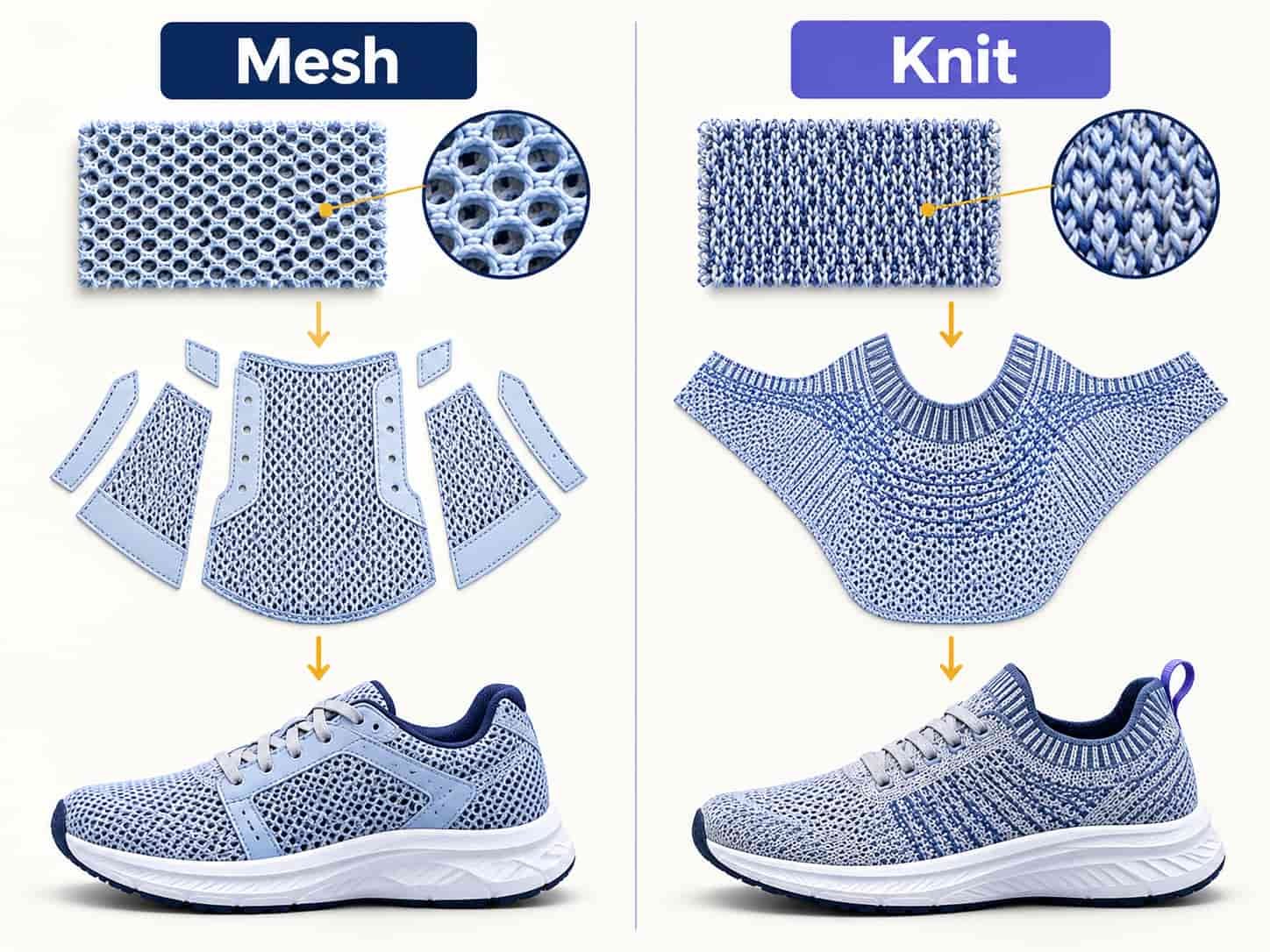
Mesh
- A synthetic yarn is woven or knitted into an open fabric.
- The fabric is cut into panels for the toe box, sides and heel.
- The panels are stitched or bonded to the shoe’s frame, often with overlays for structure.
- The upper is lined and attached to the sole.
Knit
- Yarn is fed into a knitting machine programmed for the upper’s shape.
- The upper is knitted in one piece, with varying density across the foot.
- The knit is often fused or bonded to a supportive midsole or heel counter.
- The finished upper is attached to the sole.
The practical difference is that mesh is assembled from panels, while knit is built to shape. That is why knit usually feels more seamless and mesh often has visible overlays.
Breathability
Both mesh and knit are among the most breathable uppers in everyday footwear. Open structures let air move through, and sweat can escape more readily than through a coated leather or synthetic surface.
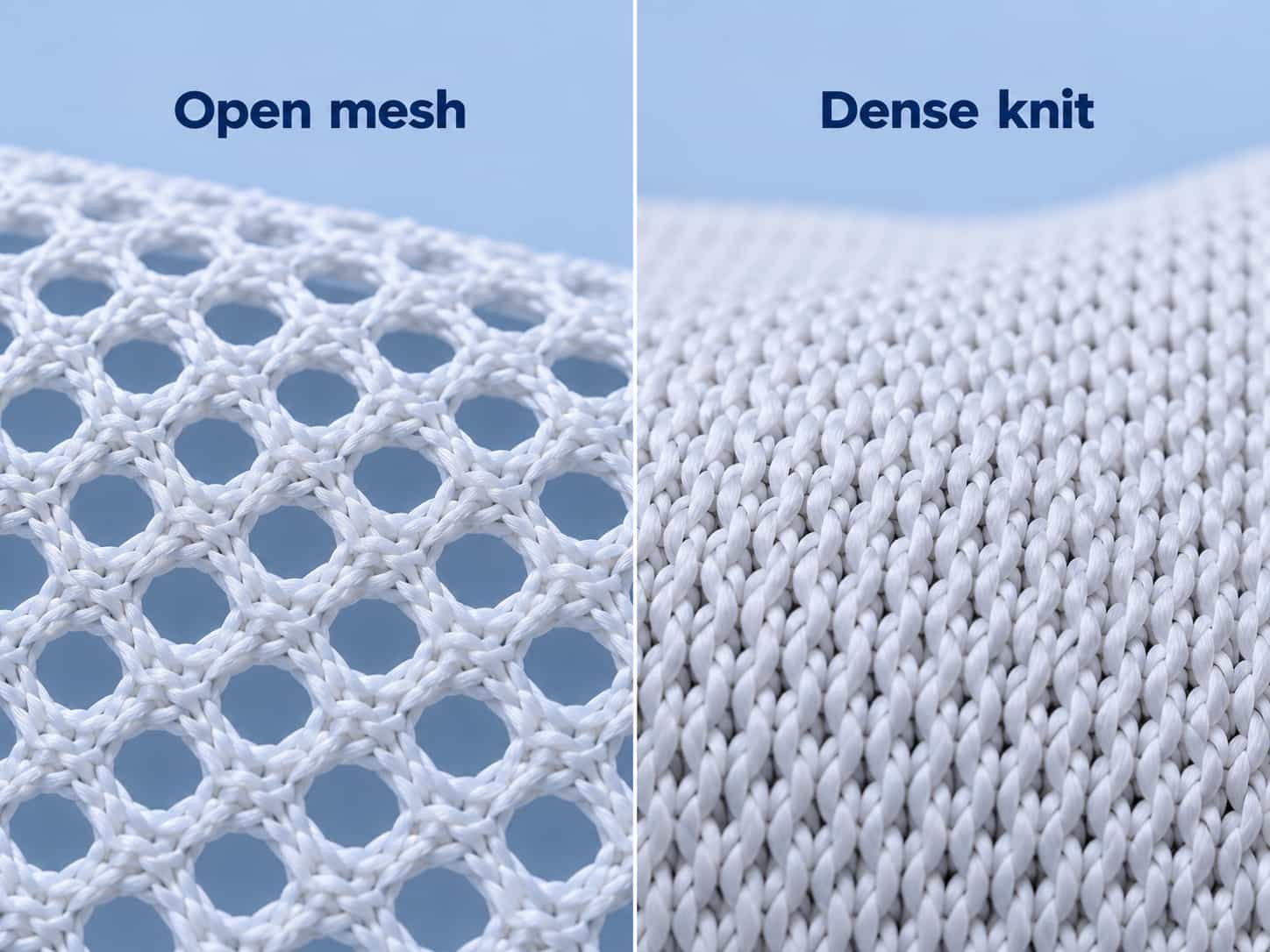
Breathability depends on more than the fabric. The density of the weave or knit, the lining, the insole and the number of overlays all affect airflow. A dense knit can breathe less than an open mesh, and a heavily overlaid mesh can trap heat. Comparing shoes by their label alone can be misleading.
Mesh is often easy to recognise as a very open surface, which suggests strong airflow. Knit can look more uniform, but a close, dense knit may feel warmer. This is an editorial judgment based on how these structures are built, not a standardised test result.
Fit, Stretch and Support
Knit stretches more readily and follows the foot. Because the knit is shaped during manufacture, it can feel snug and secure without a tight lacing system. Many runners describe a sock-like fit, and Nike’s own material describes the aim as a precise, second-skin feel.
Mesh usually has less stretch and more structure. Overlays, heel counters and stitched panels can give mesh shoes more shape and a firmer hold. This can suit people who want a supportive feel from the upper rather than a snug knit.
Neither construction supports the foot on its own. Midsole cushioning, heel counter, arch structure and fit do most of the work. If you need a specific level of arch or heel support, choose a shoe designed for that, rather than relying on the upper.
Durability and Wear
Durability depends on the yarn or fabric, the density of the construction, the bonding or stitching, and how the shoe is used.
Mesh panels can wear through at the toe and at the side, where feet rub or where shoes meet the ground. Overlays and bonding failures are common points of wear. Knit can show wear as pilling, stretching or small snags, and a dense knit usually resists abrasion better than an open one.
In general, a well-made knit or mesh upper with good bonding and reinforced stress points lasts longer than a light, poorly bonded one. There is no reliable fixed lifespan. Some runners replace shoes on mileage rather than appearance, because midsole foam often wears out before the upper does.
Weather and Water
Neither mesh nor knit is waterproof. Both are open structures that let water in and dry relatively quickly. Mesh shoes shed surface water better than soaked canvas, but they will still let water through in heavy rain.
For wet weather, a shoe with a waterproof membrane or a treated, water-resistant upper is more suitable. For the difference between membranes and treatments, see how waterproof shoes work and waterproof vs water resistant shoes.
If mesh or knit shoes get wet, let them dry at room temperature, away from heat, and stuff them with paper to hold their shape. Avoid tumble dryers, which can damage the glue and the knit.
Which Is Better for Running?
For most runners, the answer depends on the shoe, not the upper type. Both mesh and knit are widely used in running footwear, and each has a place.
Knit suits runners who want a close, sock-like fit and a lightweight, flexible upper. It works well for daily training and shoes where a snug, seamless feel matters. Mesh suits runners who want open airflow and a more structured upper, particularly for warm weather or for shoes that need overlays for stability.
If you overheat easily, look for a very open upper and a breathable lining. If your feet slide or you dislike a loose heel, look for a knit with a firm heel counter or a mesh with structured overlays. If you need serious support, look at the midsole and stability features, not only the upper.
Running shoe advice varies, so for foot-specific questions, a podiatrist or qualified running-shoe fitter is the best source. This article does not diagnose foot conditions.
Care Differences
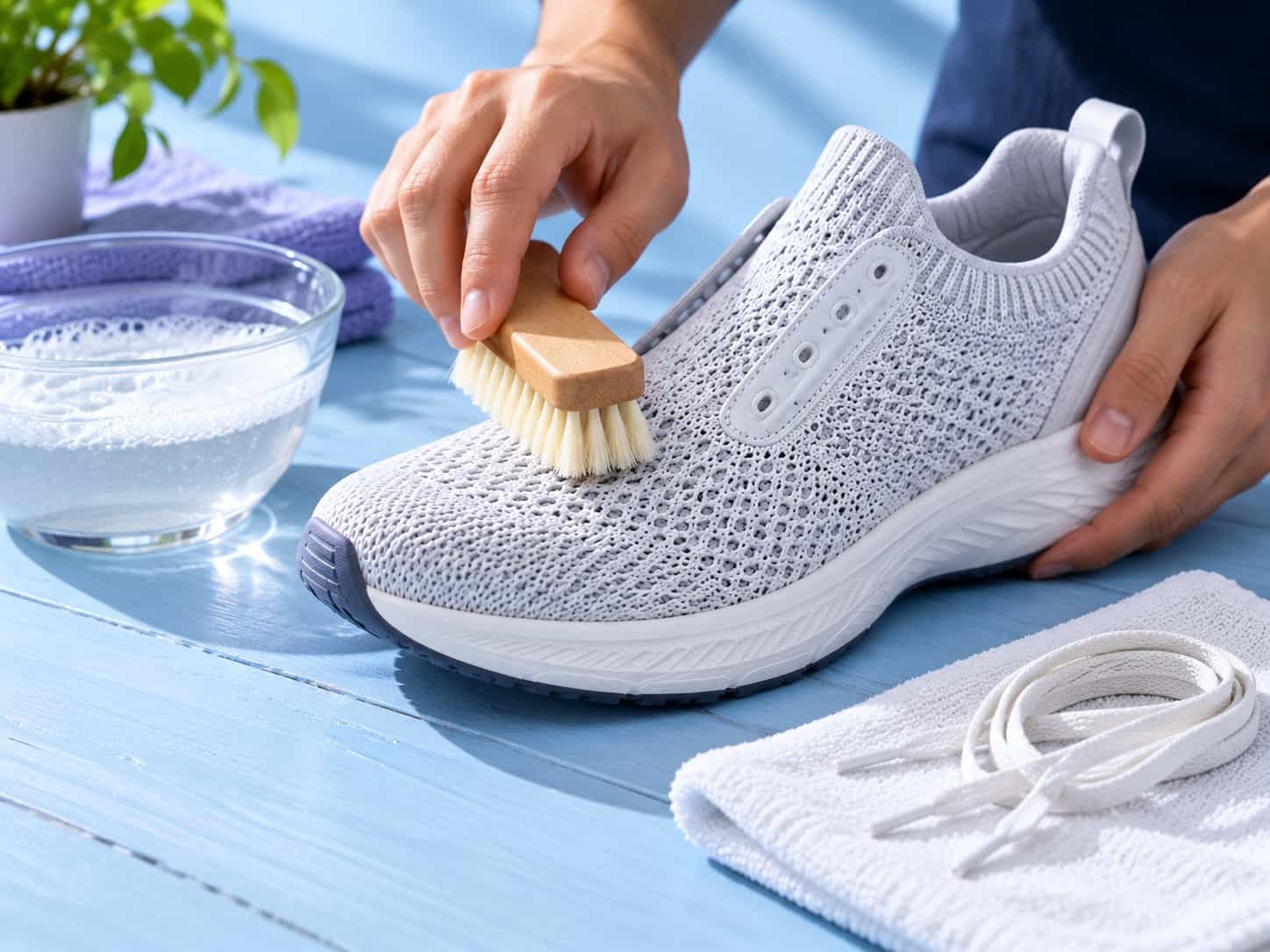
Both mesh and knit are cleaned by hand, using gentle methods. The aim is to lift dirt from the fabric without pushing it deeper or distorting the shape.
- Remove the laces and insoles and wash them separately.
- Brush off dry dirt with a soft brush, moving in the direction of the knit or weave.
- Use mild soap and cool water on a soft brush, and work gently.
- Avoid soaking the whole shoe for long. Keep the upper damp, not flooded.
- Air dry away from heat. Stuff the shoe with paper to keep its shape.
Avoid tumble drying, bleach and harsh solvents, which can damage the fabric and glue. Nike advises against machine washing its knit and mesh shoes, and it recommends hand washing and air drying. For a fuller routine across materials, see how to clean shoes and maintain them.
Choosing Between Them
| Your situation | Knit may suit you if | Mesh may suit you if |
| Activity | You want a sock-like running or training fit | You want open airflow and a structured upper |
| Climate | You are comfortable with a snug, warm-weather upper | You live somewhere hot and want maximum airflow |
| Fit | You want the upper to follow your foot | You prefer a firmer, more structured feel |
| Style | You like a seamless, modern look | You like visible overlays and a technical look |
| Care | You will hand wash and air dry | You will hand wash and air dry |
Myths Worth Dropping
- “Mesh and knit are the same thing.” Mesh is an open fabric. Knit is a construction method that can make fabric or uppers.
- “Knit is always more breathable.” A dense knit can breathe less than an open mesh.
- “Knit shoes are always more durable.” Durability depends on yarn, density, bonding and use.
- “Mesh shoes are waterproof.” They shed surface water but are not waterproof.
- “The upper decides how supportive a shoe is.” The midsole and heel structure matter more for support.
Frequently Asked Questions
What is the difference between mesh and knit shoes?
Mesh is an open-weave fabric panel, usually synthetic, that is cut and attached to the shoe. Knit is yarn worked into a shaped upper, often as a single piece. Mesh tends to feel more structured, and knit tends to follow the foot more closely.
Are knit shoes more breathable than mesh?
Not necessarily. Both are very breathable, but airflow depends on how open the weave or knit is, the lining and the overlays. A dense knit can breathe less than a very open mesh.
Which is better for running, mesh or knit?
Neither is better in every case. Knit suits runners who want a snug, sock-like fit. Mesh suits runners who want open airflow and more structure. The midsole and heel support often matter more than the upper type.
Is mesh waterproof?
No. Mesh sheds surface water but lets water through in heavy rain. For wet conditions, look for a membrane or a water-resistant treatment, and check the product details.
Are mesh shoes durable?
They can be, depending on the yarn, density, bonding and use. Mesh panels can wear at the toe and sides, and bonding can fail. A well-made, well-bonded mesh upper with reinforced stress points lasts longer than a light, poorly made one.
How do you clean knit or mesh shoes?
Remove the laces and insoles, brush off dry dirt, and wash the upper gently with mild soap, cool water and a soft brush. Rinse lightly, avoid soaking, and air dry the shoes away from heat. Avoid bleach and tumble drying.
Is mesh good for hot weather?
Generally yes, because the open structure lets air move through the upper. Choose a breathable lining as well, and check that the insole and heel do not trap heat.
What is Flyknit?
Flyknit is Nike’s name for its digitally engineered knit technology. It produces lightweight, form-fitting, largely seamless uppers. Nike describes it as reducing waste compared with cut-and-sew construction, which is a company claim rather than an independent measure.
Final Thoughts
Mesh and knit are two different ways of making a breathable shoe upper. Mesh is an open fabric panel that usually feels more structured, and knit is a shaped, yarn-based upper that usually fits more closely. Neither is better for every foot or activity, and the midsole, heel and fit often matter more than the upper.
Before you buy, check the material breakdown, try the shoe on, and think about how and where you will wear it. For the wider picture, start with the shoe materials guide, then compare mesh shoes and knit shoes in more detail.
External References
- Wikipedia, “Canvas” (for the plain-weave contrast with open weaves): en.wikipedia.org/wiki/Canvas
- Nike, Flyknit technology overview (search excerpt, company statement): nike.com
- Just Style, “Nike develops Flyknit 360 footwear construction”: just-style.com/news/nike-develops-flyknit-360-footwear-construction
- Nike, “How to clean Flyknit and mesh shoes” (hand wash, air dry): nike.com/a/how-to-clean-flyknit-mesh