
China Shoe Size to US: CN Shoe Size Conversion Chart for Men & Women
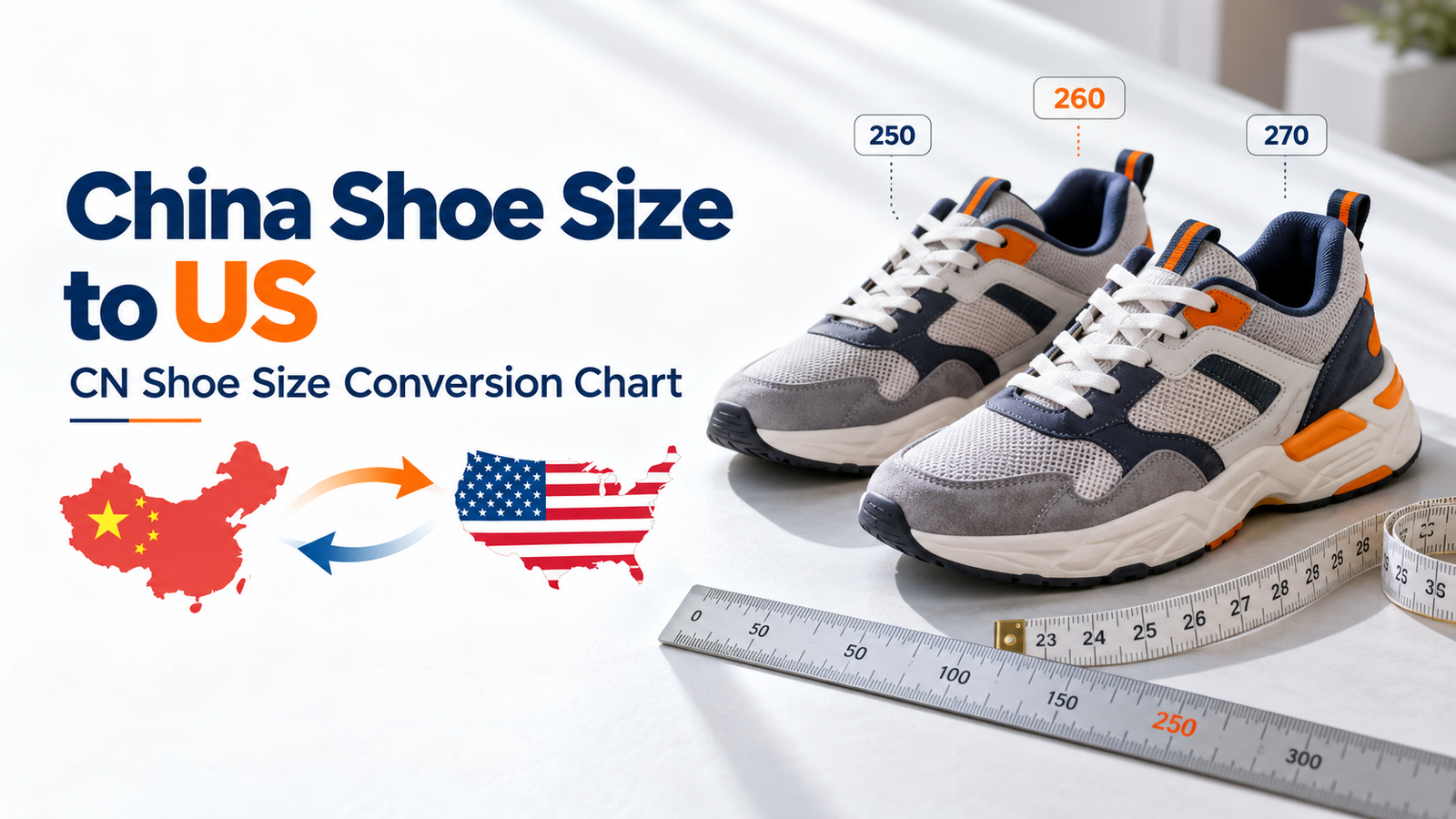
A CN shoe size doesn’t always mean the same thing. Chinese sellers mark shoes two different ways: a retail numeric label like CN 42, which tracks the same numbering as EU sizes, or a metric label like 260, which is simply your foot length in millimeters. These are not interchangeable, and mixing them up is the most common reason a “correct” conversion turns out wrong.
Here’s the short version. If a listing shows CN 42, treat it like an EU 42 and convert from there. If it shows 260, 25.5, or anything written in millimeters or centimeters, that number is your foot length, not a size label, and it converts differently. Measuring your actual foot length in centimeters is the safest starting point either way, because it works regardless of which labeling convention a seller used.
China Shoe Size to US Conversion
The safest way to convert a CN shoe size to US is to start with the foot-length measurement in millimeters or centimeters. Modern Chinese shoe sizing uses metric foot-length measurements, while marketplace listings may also show numeric labels such as CN 40, CN 41, CN 42, CN 43, or CN 44.
Quick China Shoe Size to US Conversion
This table covers the most commonly searched CN retail labels and their foot-length equivalents. CN retail numbers follow the EU scale, which is why they appear here next to EU.
China Shoe Size to US Conversion Table
Chinese footwear sizing is increasingly expressed using foot length in millimeters. Use the measured foot length below as the primary reference, then confirm the seller’s product-specific size chart.
| China / Metric | Foot Length | US Men’s | US Women’s |
|---|---|---|---|
| 230 mm | 23.0 cm | 5 | 6 |
| 235 mm | 23.5 cm | 5.5 | 6.5 |
| 240 mm | 24.0 cm | 6.5 | 7.5 |
| 245 mm | 24.5 cm | 7 | 8 |
| 250 mm | 25.0 cm | 7.5 | 8.5 |
| 255 mm | 25.5 cm | 8 | 9 |
| 260 mm | 26.0 cm | 8.5 | 9.5 |
| 265 mm | 26.5 cm | 9.5 | 10.5 |
| 270 mm | 27.0 cm | 10 | 11 |
| 275 mm | 27.5 cm | 10.5 | 11.5 |
| 280 mm | 28.0 cm | 11 | 12 |
| 285 mm | 28.5 cm | 11.5 | 12.5 |
| 290 mm | 29.0 cm | 12 | 13 |
| 300 mm | 30.0 cm | 13.5 | 14.5 |
Important: Do not assume that a retail label such as CN 40, CN 41, or CN 42 has one universal US equivalent. Chinese footwear listings can use different labeling conventions. For the most reliable result, measure your foot in millimeters or centimeters and compare that measurement with the seller’s own size chart.
Reference conversion values based on foot-length conversion guidance. Actual fit can vary by brand, shoe style, width, and sizing system.
Check Your China Shoe Size
Enter your measured foot length in centimeters. The tool finds the nearest metric China shoe-size reference and shows the corresponding US men’s and women’s sizes.
Measure your foot from the back of the heel to the tip of your longest toe.
Treat this as a technical reference point, not a guarantee. Brand-specific lasts, seller conventions, and whether the listing is actually using the retail label or the metric label all affect the real-world fit. Checking the seller’s own size chart on the product page is still the final word.
What Does CN Mean in Shoe Size?
CN simply stands for China, and it’s used on product listings to flag that the size shown follows Chinese sizing conventions rather than US, UK, or EU. The confusion starts because China doesn’t use just one system. Sellers commonly show either a retail numeric label that mirrors EU numbering, or a metric label based on foot length in millimeters.
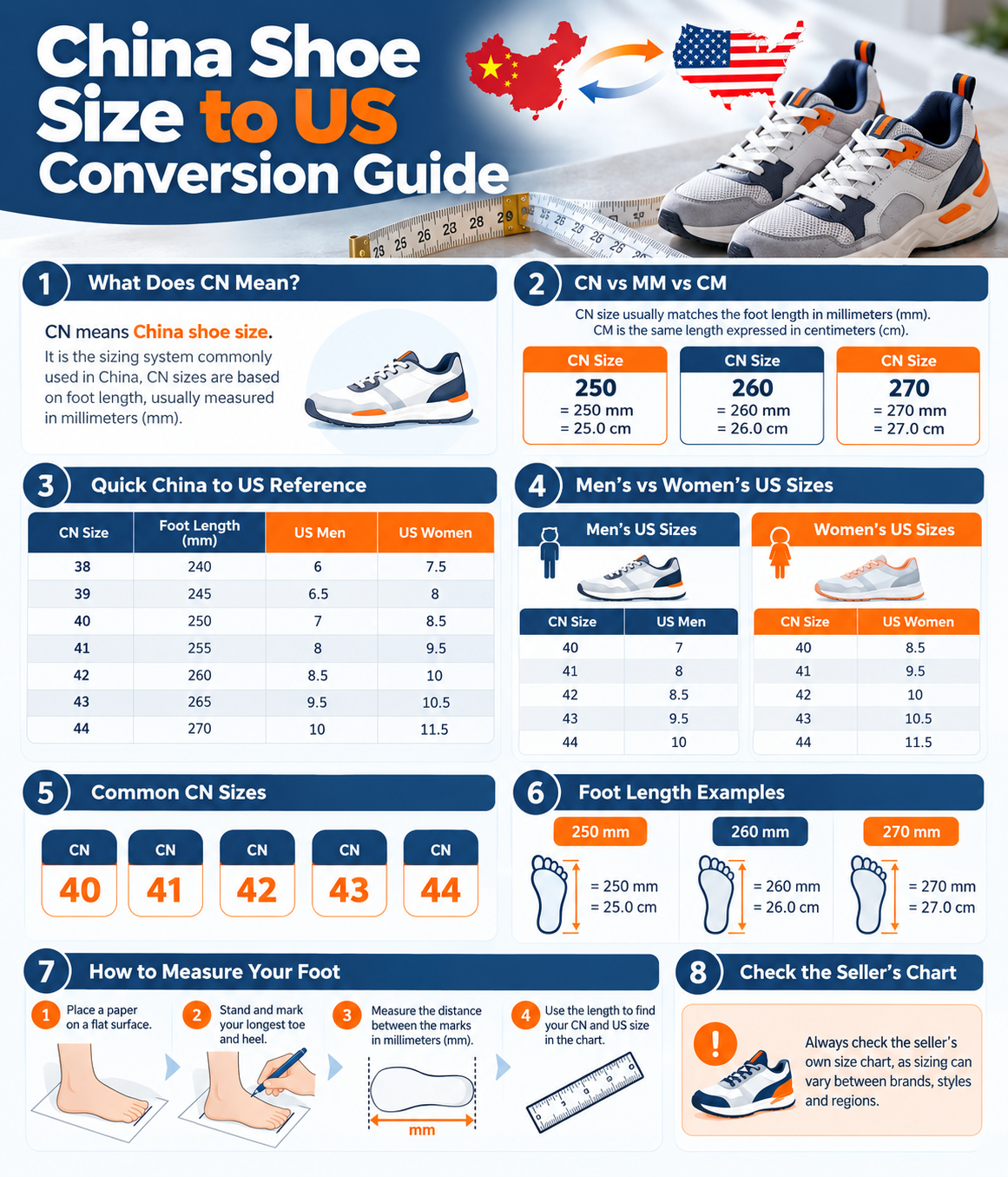
The metric version is straightforward once you know what you’re looking at. A label of 250 means 250mm, which is the same as 25.0cm. A label of 260 means 260mm, or 26.0cm. A label of 270 means 270mm, or 27.0cm. These numbers are describing a foot length directly, the same underlying idea as Mondopoint sizing used in several other countries’ footwear standards.
ISO 19407:2023, the current international standard for footwear sizing conversion, covers exactly this overlap. It provides conversion tables across Mondopoint, EU, UK, China, Japan, Korea, and US systems, all anchored to foot length as the common reference point. The standard exists precisely because these systems were developed independently over decades without a shared format, which is the root cause of the CN confusion shoppers run into today.
CN vs MM vs CM: What Do These Shoe Sizes Mean?
China Shoe Size
A label used on Chinese footwear listings. The exact meaning can depend on the seller or marketplace format.
Millimeters
A metric length measurement. For example, 260 mm represents a 26.0 cm foot-length reference.
Centimeters
The same metric measurement expressed in centimeters. For example, 260 mm equals 26.0 cm.
CN Shoe Size vs China Shoe Size
“CN shoe size” and “China shoe size” are used interchangeably on most marketplaces and refer to the same thing: a size shown using a Chinese sizing convention. Where it gets inconsistent is which convention a specific listing uses. Some sellers label by the EU-style retail number, some label by metric foot length in millimeters, and a smaller number show both side by side on the same size chart image embedded in the listing.
Because there’s no single enforced labeling rule across marketplaces, the practical approach is to check which format the specific listing uses rather than assuming “CN” always means one fixed thing. A seller’s own size chart photo usually clarifies this if you look for whether the numbers run in the high 30s to high 40s (retail/EU-style) or in the low 200s to low 300s (metric millimeters).
CN Number vs Metric China Shoe Size
This is the distinction that causes the most buying mistakes, so it’s worth seeing side by side.
CN 42 is a retail numeric label. It follows the same numbering as an EU 42 and corresponds to roughly a 25.5cm foot in men’s sizing.
260 is a metric label. It means 260mm, which is 26.0cm, a larger foot length than what CN 42 represents.
26.0cm is the same measurement as 260mm, just written in centimeters instead of millimeters. These two describe the identical foot length, unlike CN 42, which uses a different numbering logic entirely.
These three labels can all appear on Chinese shoe listings, and none of them should be assumed equal to each other without checking which one you’re actually looking at. A listing showing “CN 42 (260)” is telling you the seller believes their CN 42 corresponds to a 260mm foot by their own last, which is useful information specific to that product, but it’s still worth verifying against your actual measurement.
CN Numeric vs Metric: Not the Same Label
Example only, not a universal equivalence. Verify against the listing’s own chart.
China Shoe Size to US Men’s Conversion
| CN / EU Label | UK | Foot Length | US Men’s |
| CN 39 | 4.5 | 23.5 cm | 5 |
| CN 40 | 5.5 | 24.5 cm | 6 |
| CN 41 | 6.5 | 25 cm | 7 |
| CN 42 | 7.5 | 25.5 cm | 8 |
| CN 43 | 8.5 | 26 cm | 9 |
| CN 44 | 9.5 | 27 cm | 10 |
| CN 45 | 10.5 | 28 cm | 11 |
| CN 46 | 11.5 | 29 cm | 12 |
| CN 47 | 12.5 | 30 cm | 13 |
| CN 48 | 13.5 | 31 cm | 14 |
| CN 49 | 14.5 | 32 cm | 15 |
Use this table when the listing shows a CN number in the high 30s through high 40s, since that range signals a retail EU-style label rather than a metric one. For a fuller breakdown of how US men’s sizing maps across every major system, the men’s shoe size chart covers US, UK, and EU side by side.
China Shoe Size to US Women’s Conversion
| CN / EU Label | UK | Foot Length | US Women’s |
| CN 35.5 | 3 | 21 cm | 5 |
| CN 37 | 4 | 22 cm | 6 |
| CN 38 | 4.5 | 22.5 cm | 6.5 |
| CN 39 | 5.5 | 23.5 cm | 7.5 |
| CN 40 | 6.5 | 24.5 cm | 8.5 |
| CN 41 | 7 | 25 cm | 9 |
| CN 42 | 7.5 | 25.5 cm | 9.5 |
| CN 43 | 8 | 26 cm | 10 |
| CN 44 | 8.5 | 27 cm | 10.5 |
China Shoe Size to US Men’s and Women’s Sizes
A 260 mm metric reference corresponds to US men’s 8.5 in the ISO reference table.
The same 260 mm metric reference corresponds to US women’s 9.5 in the ISO reference table.
Since the number alone won’t tell you. The women’s shoe size chart has the complete cross-system breakdown.
CN 40 to US
A CN 40 depends on which labeling convention is in use. As a retail numeric label following EU numbering, CN 40 corresponds to roughly a US men’s 6 or a US women’s 8.5, matching a 24.5cm foot. If instead the listing is using a metric label and the number you’re seeing is actually 400 or 40.0cm, that would be an unusually large foot length and likely points to a typo or a different measurement entirely, since no standard adult shoe size runs that large. In practice, CN 40 on footwear almost always refers to the retail EU-style label.
CN 41 to US
As a retail label, CN 41 converts to roughly a US men’s 7 or a US women’s 9, corresponding to a 25cm foot. This is one of the more common sizes to see flagged in marketplace reviews as “runs small” or “runs large,” which usually reflects brand-specific last shape rather than an error in the base conversion.
CN 42 to US
CN 42 is one of the highest-volume searches in this category, and it’s also the clearest example of why the label format matters. As a retail numeric label, CN 42 converts to roughly a US men’s 8 or a US women’s 9.5, based on a 25.5cm foot. If the same listing also shows “260” somewhere on its chart, that 260 is describing a 26.0cm foot, which is a half size larger and converts to roughly a US men’s 9 or US women’s 10.5.
CN 42 Does Not Always Mean One Fixed US Size
A listing that says CN 42 may not provide enough information to determine the correct US size by itself. Different marketplaces and sellers may use different labeling conventions.
CN 43 to US
A CN 43 retail label corresponds to roughly a US men’s 9 or a US women’s 10, based on a 26cm foot. As with CN 42, check whether the listing separately shows a metric value like 265 or 26.5cm, since that would indicate a half size difference from the retail label alone.
CN 44 to US
A CN 44 retail label converts to roughly a US men’s 10 or a US women’s 10.5, corresponding to a 27cm foot. This size sits at the upper end of many women’s Chinese retail charts, so if you’re shopping women’s sizing above a US 10.5, it’s worth checking whether the brand offers an extended size run or whether you’re actually looking at a men’s listing.
China Shoe Size 250 to US
A label of 250 means 250mm, or 25.0cm, measured as foot length. Based on that measurement, it corresponds to roughly a US men’s 6.5 or a US women’s 8. This is a metric label, not the same numbering as a CN 40 retail label, even though both sizes land in a similar foot-length range. If a listing shows 250 without any accompanying CN retail number, treat it as a direct foot-length measurement and compare it to your own measured foot length first.
China Shoe Size 260 to US
A label of 260 means 260mm, or 26.0cm. That foot length corresponds to roughly a US men’s 9 or a US women’s 10.5. This is the metric reading, distinct from CN 42’s retail-label reading of a 25.5cm foot covered earlier. The half-centimeter gap between these two is small on paper but is often enough to shift a shoe from a comfortable fit to a noticeably tight one.
China Shoe Size 270 to US
A label of 270 means 270mm, or 27.0cm, which corresponds to roughly a US men’s 10 or a US women’s 11.5 and above, depending on the brand’s upper size range. At this length, cross-check against the CN 44 retail-label entry above, since both describe foot lengths in a similar range but arrive from different labeling systems.
China Shoe Size to US by CM
| Foot Length (cm) | China/Mondopoint (mm) | US Men’s | US Women’s |
| 23.5 | 235 | 5 | 6.5 |
| 24.5 | 245 | 6 | 8.5 |
| 25 | 250 | 7 | 9 |
| 25.5 | 255 | 8 | 9.5 |
| 26 | 260 | 9 | 10 |
| 27 | 270 | 10 | 10.5 |
| 28 | 280 | 11 | — |
| 29 | 290 | 12 | — |
Measuring in centimeters and working from this table sidesteps the CN-label ambiguity entirely, since foot length doesn’t change based on which numbering convention a seller chose. For US sizing expressed directly against centimeters, the men’s shoe size to CM chart and women’s shoe size to CM chart break this down further by brand category.
Is Chinese Shoe Size the Same as EU Shoe Size?
Not exactly, though the retail CN numeric label is built on the same numbering as EU sizing, which is why the two look identical in most charts, including this one. The underlying systems were developed separately, and China’s official sizing standard is based on metric foot length rather than the Paris Point system EU sizing uses. In practice, this means CN retail labels and EU labels produce the same number for a given foot length, but they aren’t the same system by definition, they just happen to align closely enough that marketplaces treat them as interchangeable.
This alignment is also why confusion spreads so easily. A seller might genuinely believe CN and EU are identical and label a product accordingly, without realizing their own metric measurement differs slightly from what a true EU-sized shoe would use. The safest approach is still to measure your foot and compare against foot length rather than assuming any two country labels are perfectly interchangeable.
How to Convert China Shoe Size to US
- Identify the label format. Check whether the number on the listing is in the high 30s to high 40s range (retail/CN-EU style) or in the low 200s to low 300s range (metric millimeters).
- Find the seller’s own measurement. Many Chinese sellers include a product-specific size chart image with insole length or foot length listed directly. Use this over a generic conversion when available.
- Measure your foot. Get your actual foot length in centimeters using the steps in the next section.
- Convert mm to cm if needed. Divide a millimeter figure by 10 to get centimeters, so 260mm becomes 26.0cm.
- Determine whether you need the men’s or women’s US scale. The same foot length produces different US numbers depending on category.
- Compare against the seller’s chart. If their chart disagrees with the general conversion table, trust their product-specific numbers for that listing.
- Check width and fit notes. Length conversion alone doesn’t account for how narrow or wide a specific shoe runs.
- Confirm the return policy before ordering. International returns can be slow or costly, so this step matters more here than with domestic purchases.
Convert China Shoe Size to US
Enter your metric foot-length measurement to see a reference US men’s and women’s size.
How to Measure Your Feet for Chinese Shoes
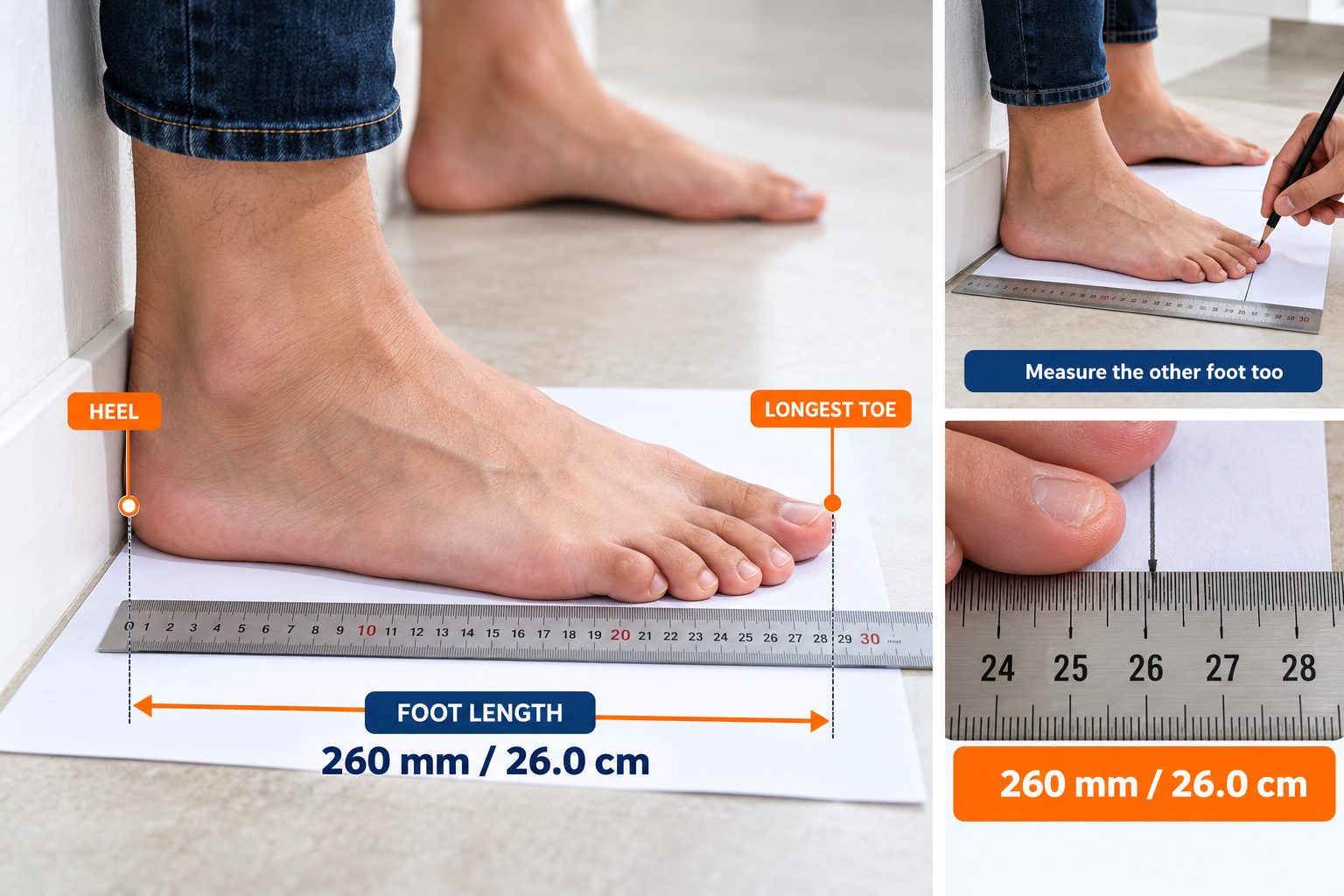
Stand on a sheet of paper on a hard floor with your heel against a wall. Keep your weight evenly distributed and stand naturally, the way you would while wearing the shoes. Mark the tip of your longest toe on the paper, then measure the distance from the wall to that mark in millimeters or centimeters.
Measure both feet, since most people have one foot slightly longer than the other, and use the larger measurement. Measuring later in the day is more accurate, since feet swell slightly over the course of normal activity. For a complete walkthrough with more detail on technique, see how to measure your feet at home.
How to Measure Your Foot for a CN Shoe Size
Stand on paper
Place your foot flat on a sheet of paper while standing normally.
Mark heel and toe
Mark the back of your heel and the end of your longest toe.
Measure the length
Measure the distance between the heel mark and longest-toe mark.
Use the larger foot
Measure both feet and use the larger measurement when choosing your size.
Why China-to-US Shoe Size Charts Can Differ
Different sources sometimes disagree on a CN-to-US conversion by half a size, and there's a specific reason for it. Grading systems, meaning the mathematical steps between sizes, aren't identical across US, EU, and Chinese standards, so rounding at different points in the scale produces small discrepancies. Marketplace sellers also don't all follow the same convention when they label a product, so one seller's CN 42 and another seller's CN 42 can be built on slightly different lasts.
Foot length and internal shoe length aren't the same measurement either. A shoe needs some additional internal room beyond your foot's exact length to be comfortable, and how much room varies by shoe construction, material stiffness, and style. Brand-specific variation compounds all of this, since two brands both labeling a shoe CN 42 may have used different source lasts entirely. None of these factors mean conversion charts are unreliable, but they explain why a chart is a strong starting point rather than a guarantee.
China Shoe Size on Online Marketplaces
Listings on marketplaces frequently show several size systems stacked together, sometimes CN, EU, US, and a millimeter figure all on the same chart image. The CN number is usually the retail-style label, the EU number should match it closely since they share numbering logic, the US number is the seller's own conversion, and the millimeter or centimeter figure is the actual foot length their size is built around.
When these numbers don't align with the general tables on this page, prioritize the seller's own foot-length figure over their US conversion, since errors are more common in cross-system conversion than in a seller reporting their own product's measurement. Sizing conventions and chart formats on individual marketplaces can change, so always check the current listing's own chart rather than relying solely on memory of how a platform used to display sizes.
Does Foot Width Matter?
Length conversion only solves part of the fit question. Foot width, instep height, and toe box shape all affect how a correctly length-matched shoe actually feels. A shoe that matches your foot length precisely can still feel tight across a wide foot or loose around a narrow, low-volume foot.
Chinese shoe listings rarely specify width options the way some US brands do, which means width-sensitive shoppers should pay closer attention to reviews mentioning fit and to any width notes in the product description. A correct length conversion is a necessary step, not a guarantee that the shoe will fit well overall.
What If You Are Between Chinese Shoe Sizes?
There's no single rule that works for every situation. If your measurement falls between two sizes on a retail CN chart, check the seller's specific foot-length figure first, since it may clarify which size is the better match for that particular product. For narrow feet or styles that lace down snugly, the smaller of the two sizes often works. For wider feet, thicker socks, or stiffer materials, the larger size is usually the safer choice.
Reading reviews that mention fit, especially from buyers who note their own measurements, can be more useful than a blanket sizing rule when you're genuinely stuck between two options.
China Shoe Size vs Other International Sizes
If you're also converting between other systems, not just China, the international shoe size chart covers the full picture across US, UK, EU, Japan, and more in one place. For a focused look at how US sizing lines up specifically against UK and EU without the Chinese layer, the US vs UK vs Euro shoe size conversion guide breaks down that relationship in more depth. And if you regularly shop across several countries, the global shoe size converter lets you check any size against every major system at once.
Need More International Size Conversions?
Final Takeaway
Start with the CN label on the listing, measure your foot in centimeters, check whether the seller's own chart shows a matching metric figure, convert using the men's or women's US scale that applies, and factor in width before you buy. None of these steps alone guarantees a perfect fit, but together they catch the most common mistake shoppers make with Chinese sizing, which is treating a retail CN number and a metric mm number as the same thing. For a quick way to check any size across systems at once, the shoe size conversion calculator covers US, UK, EU, and more in a single tool.
FAQs
What is CN shoe size?
CN shoe size refers to a Chinese sizing label shown on footwear listings, which can follow either a retail numeric format based on EU-style numbering or a metric format based on foot length in millimeters.
What is CN 40 in US size?
As a retail numeric label, CN 40 corresponds to roughly a US men's 6 or a US women's 8.5, based on a 24.5cm foot.
What is CN 41 in US size?
As a retail numeric label, CN 41 corresponds to roughly a US men's 7 or a US women's 9, based on a 25cm foot.
What is CN 42 in US size?
As a retail numeric label, CN 42 corresponds to roughly a US men's 8 or a US women's 9.5. If the listing instead shows 260 as a metric label, that's a different, slightly larger foot length converting to roughly a US men's 9 or women's 10.5.
What is CN 43 in US size?
As a retail numeric label, CN 43 corresponds to roughly a US men's 9 or a US women's 10, based on a 26cm foot.
What is CN 44 in US size?
As a retail numeric label, CN 44 corresponds to roughly a US men's 10 or a US women's 10.5, based on a 27cm foot.
What is China shoe size 260 in US?
A label of 260 means 260mm, or 26.0cm of foot length, which corresponds to roughly a US men's 9 or a US women's 10.5.
Is CN the same as EU?
The CN retail numeric label follows the same numbering as EU sizing, so in practice they produce matching numbers, though the two systems were developed independently and China also uses a separate metric format that EU sizing doesn't have.
What does 260 mean in Chinese shoe size?
It means the shoe is built around a 260mm, or 26.0cm, foot length. This is a direct measurement rather than a retail size number.
Are Chinese shoe sizes smaller than US sizes?
Not inherently. Chinese retail labels and US sizes use different numbering entirely, so a given CN number simply represents a different foot length than the same number would in US sizing. Once converted correctly, there's no consistent pattern of Chinese shoes running smaller overall, though individual brands vary.
How do I measure my foot for Chinese shoes?
Stand on paper against a wall, mark your longest toe, and measure heel to mark in centimeters. Measure both feet and use the larger number.
Is Chinese shoe sizing the same for men and women?
No. The CN retail label uses different base numbers for men's and women's categories, so the same CN number converts to different US sizes depending on which category the shoe is listed under.
Compare More International Shoe Sizes
Check US, UK, EU, and CN sizes side by side in one place.
Use the Shoe Size Conversion Calculator