
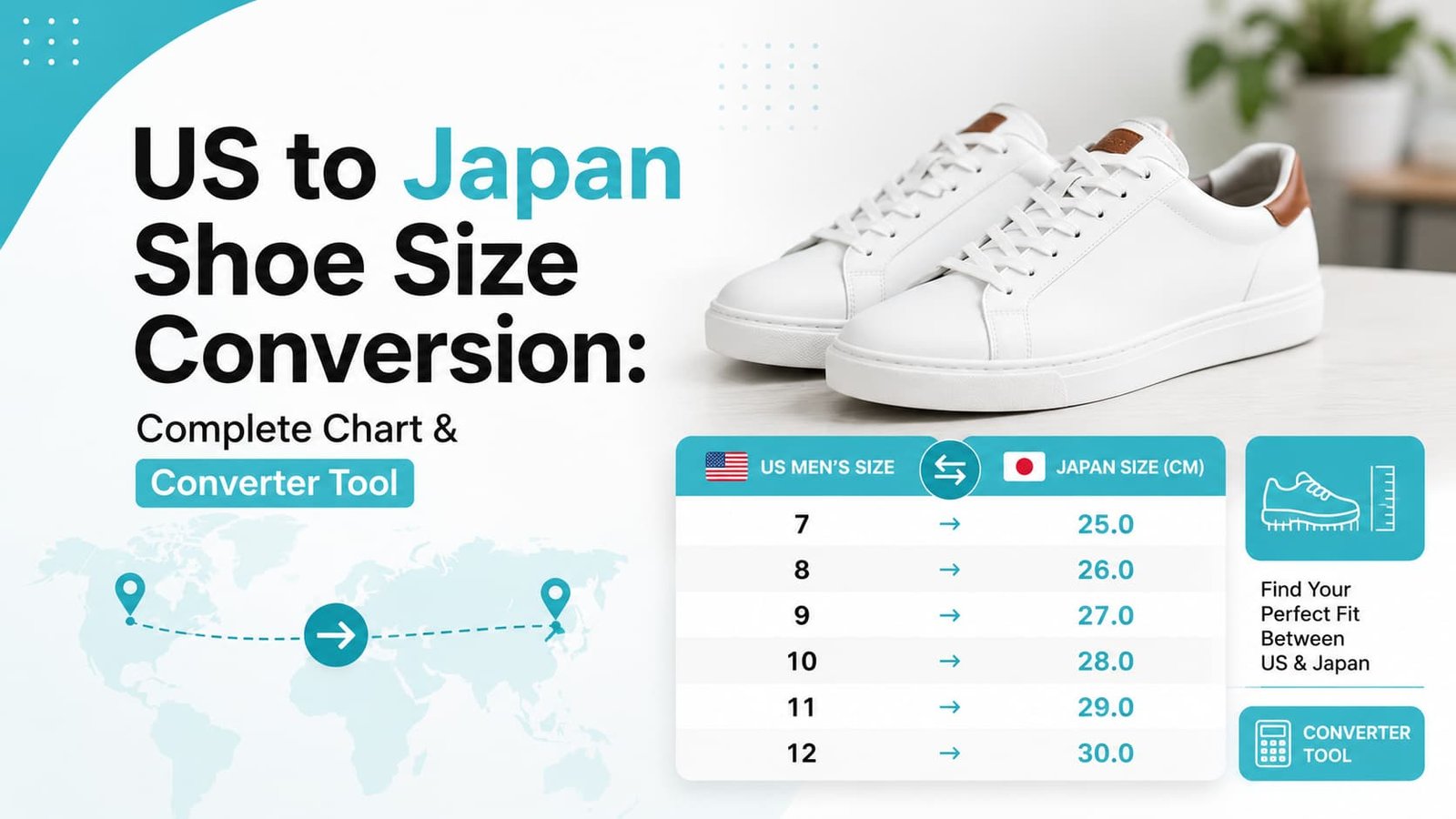
US to Japan Shoe Size Conversion: Complete Chart & Converter Tool
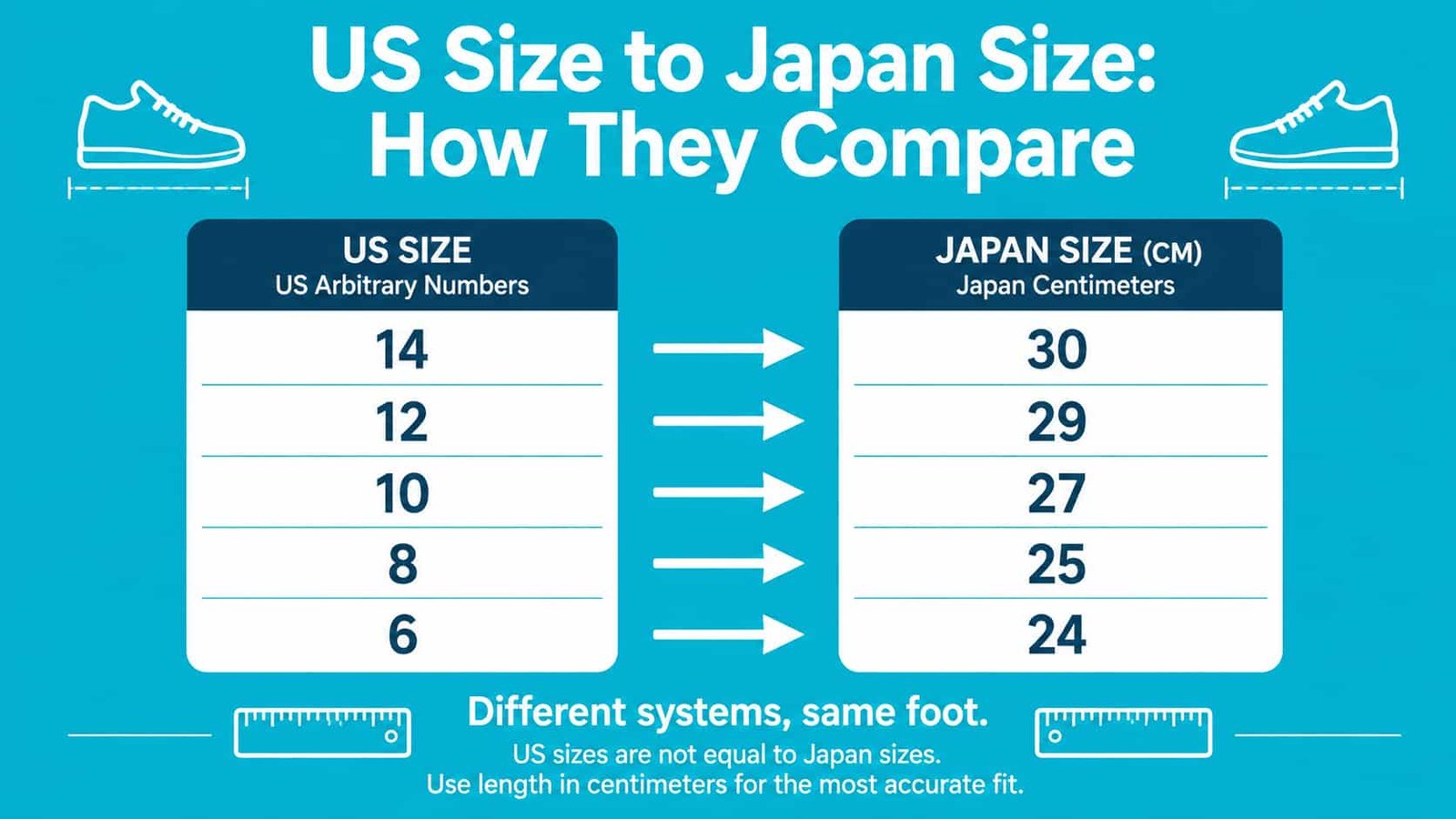
US shoe sizes and Japanese shoe sizes are fundamentally different systems that do not align at matching numbers. A US size 9 is not the same as a Japan size 9. Japan uses centimeter-based sizing, where the size number represents the actual foot length in centimeters. A US size 9 equals approximately 26 centimeters or a Japan size 26. The gap between US size 8 and 10 spans what Japan would consider different centimeter bands. Ordering shoes from Japanese retailers requires understanding this completely different system rather than assuming sizes translate directly. Many men have ordered shoes from Japan expecting a direct size match and received shoes that did not fit because they misunderstood the conversion. After two decades fitting customers ordering internationally, the men who measure their foot length in centimeters before ordering from Japan report nearly zero fit problems, while those who guess based on number correlation face regular sizing issues.
⚡ Quick Answer
- US size 9 equals Japan size 26 centimeters, not Japan size 9.
- Japan sizing is based on foot length in centimeters, not arbitrary numbers.
- Always measure your foot in centimeters before ordering from Japan.
- A US size 10.5 is approximately Japan size 27 centimeters.
How US and Japan Shoe Sizes Differ
The US sizing system uses arbitrary numbers that do not directly correlate to foot length. A size 9 shoe fits feet approximately 10.25 inches long, but there is no mathematical relationship between the number 9 and that measurement. The system developed historically based on shoe manufacturing standards and has no consistent underlying logic.
Japan uses a completely different approach. Japanese shoe sizes are simply the foot length in centimeters. A size 26 shoe means the shoe is designed for a foot 26 centimeters long. A size 27 shoe accommodates a 27 centimeter foot. This centimeter-based system is logical and mathematically consistent, making international ordering theoretically straightforward once you understand your foot length in centimeters.
The problem arises because American buyers are accustomed to thinking in size numbers rather than centimeter measurements. A US size 10 customer rarely knows their foot is 27 centimeters long. They know their size is 10, and when they see a Japan size 27, they assume it is vastly different. In reality, it is the exact same foot length.
The confusion deepens because half sizes exist in the US system but not in Japan. A US size 9.5 falls between Japan size 26 and 27 centimeters. Japanese shoe manufacturers round to whole centimeter increments, so you must decide whether to order size 26 or size 27, rather than having a half size option.
👟 Did You Know?
Many other countries use centimeter-based sizing similar to Japan, including France and several other European nations. Once you understand centimeter sizing, you can order shoes from multiple countries using the same foot measurement.
US to Japan Size Conversion Chart
This chart converts US shoe sizes to Japanese centimeter sizing. Remember that Japanese sizes represent foot length in centimeters, not arbitrary size numbers. Measure your foot in centimeters using our detailed guide, then match that measurement to find your Japan size.
| US Size | Foot Length (in) | Foot Length (cm) | Japan Size | Notes |
| 6 | 9.5 | 24.1 | 24 | Smaller Asian frames |
| 6.5 | 9.625 | 24.4 | 24.5 approx | Round down to 24 |
| 7 | 9.75 | 24.8 | 25 | |
| 7.5 | 9.875 | 25.1 | 25 | Round down |
| 8 | 10 | 25.4 | 25.5 approx | Round to 25 or 26 |
| 8.5 | 10.125 | 25.7 | 26 | |
| 9 | 10.25 | 26 | 26 | Standard fit |
| 9.5 | 10.375 | 26.4 | 26.5 approx | Round to 26 or 27 |
| 10 | 10.625 | 27 | 27 | |
| 10.5 | 10.75 | 27.3 | 27 | Round down |
| 11 | 11 | 27.9 | 28 | |
| 11.5 | 11.125 | 28.2 | 28 | Round down |
| 12 | 11.25 | 28.6 | 29 | |
| 13 | 11.5 | 29.2 | 29 | |
| 14 | 11.75 | 29.8 | 30 |
Japanese shoe manufacturers sometimes round differently. A Japan size 26.5 exists but is rarer than whole sizes. When ordering, you typically choose between whole centimeter sizes. If your measurement falls at 26.5, check the retailer’s specific rounding policy or contact customer service.
💡 Expert Tip
When ordering from Japanese retailers, many provide size charts showing the shoe’s actual length in centimeters. Use this specific measurement rather than trusting the size number alone. A shoe listed as size 26 might actually measure 25.5 or 26.2 centimeters depending on brand standards.
Understanding Japanese Centimeter-Based Sizing
Japanese sizing works because it is anchored to actual foot length measurement. Every size represents an actual distance. Size 26 means a 26 centimeter shoe. Size 27 means a 27 centimeter shoe. This removes ambiguity that plagues the US system, where the same size number can vary between brands by half a size or more.
Japanese shoe manufacturers are more consistent with sizing than US manufacturers because they use this objective centimeter system. A Nike shoe in Japan size 26 should have the same length as an Asics shoe in Japan size 26. This consistency is one reason Japanese athletic shoes are favored by runners who value precise sizing.
The centimeter system also makes width sizing clearer. Many Japanese shoes offer width options labeled as standard width (2E is standard), narrow (E or 2D), or wide (4E or wider). The centimeter number specifies length, and the width letter specifies width, removing the confusion that occurs in the US system where width and length are sometimes entangled.
When you order a Japan size 26 shoe, you are ordering a shoe with an internal length of approximately 26 centimeters. If your foot measures 25.8 centimeters, a size 26 shoe provides about 0.2 centimeters of growing room, which is tighter than the typical 0.4 to 0.5 inch growing room recommended in the US. Japanese shoes tend to run slightly snugger than American shoes, partly because the sizing is so precise.
⚠ Common Mistake
Assuming that a US size 10 customer should order a Japan size 10 is the most frequent error made when ordering shoes internationally. There is no Japan size 10 equivalent to US size 10. US 10 equals Japan 27 centimeters. A Japan size 10 does not exist in men’s shoes.
Interactive US to Japan Converter Tool
Enter your US shoe size or foot length in centimeters to instantly see your Japan shoe size.
🌏 Convert Your Size for Japan Shopping
Enter either your US shoe size or foot length in centimeters to find your Japan shoe size.
Japan Shoe Size Measurements by Category
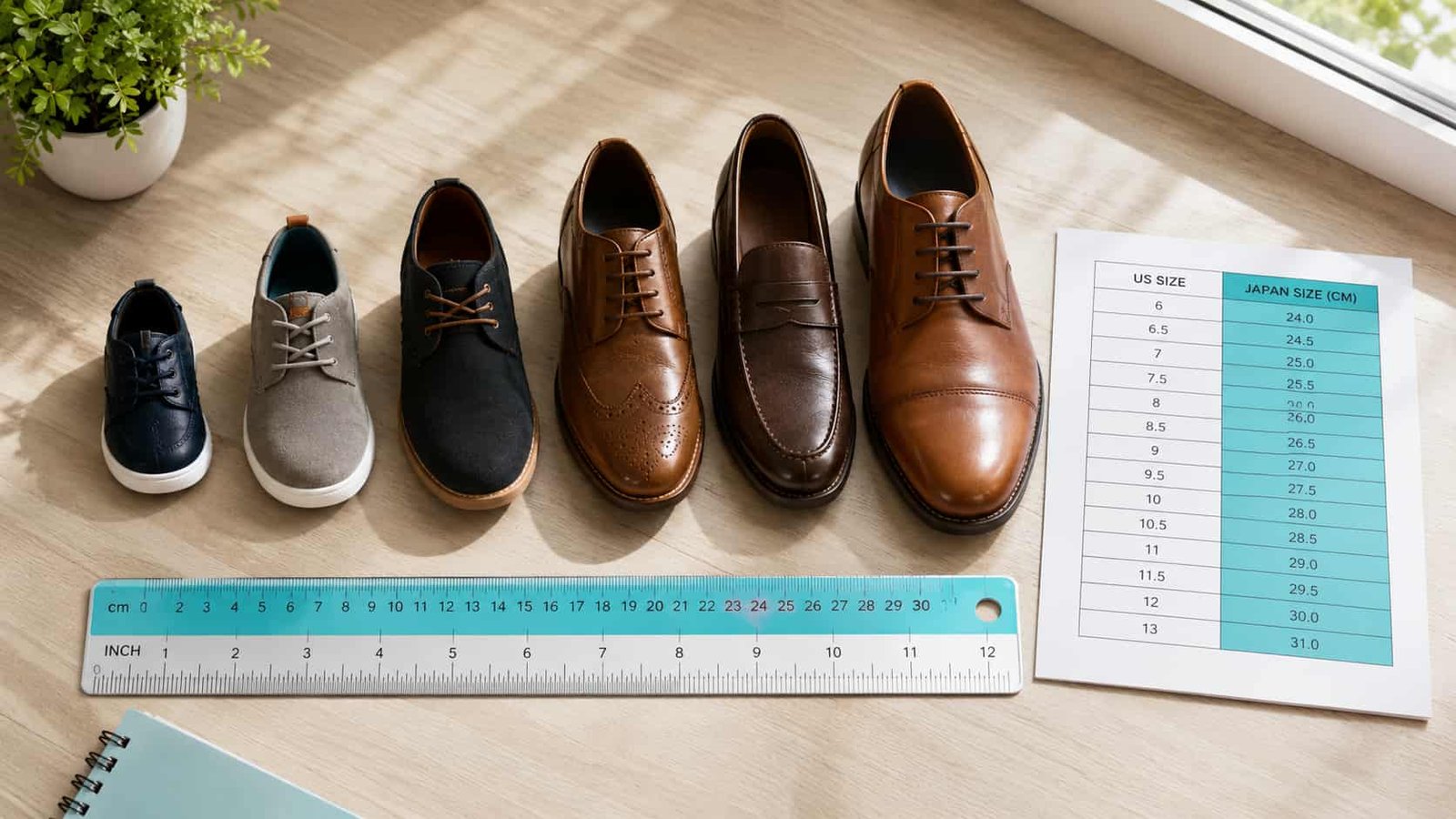
Different shoe types in Japan sometimes use slightly different sizing standards. Athletic shoes tend to run more true to the centimeter sizing system. Dress shoes and formal shoes occasionally run slightly larger. Work boots from Japanese manufacturers often run true to centimeter, but imported brands sometimes deviate.
Japanese children’s shoes use smaller centimeter ranges, starting from size 15 centimeters for toddlers and scaling up. A US child’s size 2 would be Japan size 18 or 19 centimeters. The conversion works identically; you simply measure the child’s foot in centimeters and match to the Japan size.
Women’s shoes in Japan also use centimeter sizing but typically start at smaller sizes like 21 centimeters and go up to around 25 centimeters. The system is identical; only the range differs due to average foot size differences between genders.
Japanese athletic shoe brands like Asics, Mizuno, and New Balance Japan use this centimeter system consistently across all their products. International brands that sell through Japanese retailers sometimes use different sizing, so verify whether you are buying from a Japanese brand using centimeter sizing or an international brand that might use a hybrid system.
✅ Before Ordering from Japan
- Measure your foot length in centimeters using our measurement guide.
- Check the Japanese retailer’s size chart for that specific shoe.
- Note whether the retailer uses Japan centimeter sizing or another system.
- Read customer reviews mentioning sizing for that specific shoe.
- Verify the return policy before ordering in case of sizing mismatch.
- Allow extra shipping time for international returns if needed.
Why Direct Number Conversion Fails
Many people attempt to convert US shoe sizes to Japan sizes by simply translating the number. They assume a US size 9 should equal Japan size 9, or that one number system might be shifted by a fixed amount (like US size plus or minus 2). This approach fails completely because the two systems have entirely different foundations.
The US size 9 represents a historical manufacturing standard that has nothing to do with centimeter measurements. Japan size 9 does not even exist in men’s shoes. If it did exist hypothetically, it would mean a 9 centimeter shoe, which would be impossibly tiny. This fundamental mismatch means any direct number translation is guaranteed to produce an incorrect size.
What compounds the error is that some shoe retailers display both US and Japan sizes on the same product, and these conversions can be wrong or inconsistent. A retailer might list a shoe as US 10 and Japan 29, when the correct Japan size should be 27. Retailers sometimes use approximate conversions or round differently than you would expect. Never trust the retailer’s conversion; measure your foot and verify directly against a centimeter size chart.
The only reliable conversion method is measuring your foot in centimeters and matching that measurement to the Japan size. If your foot measures 27 centimeters, you wear Japan size 27, regardless of what US size that might be. This is the only conversion method that guarantees accuracy.
📝 Correct Conversion Method
- Do measure your foot length in centimeters directly.
- Do use the Japan centimeter measurement as your size.
- Do check the specific shoe’s size chart on the retailer’s site.
- Do read reviews from people who purchased that specific shoe.
- Don’t assume number-to-number conversion works.
- Don’t trust a retailer’s size conversion without verifying independently.
- Don’t order based on your US size number alone.
Ordering Shoes from Japan Retailers
Popular Japanese online retailers that ship internationally include Rakuten, Amazon Japan, and Yahoo Shopping Japan. Many also operate English-language versions, though the selection may be more limited. These sites display prices in yen and ship to most countries, though shipping costs and timing vary.
International shipping from Japan typically takes between 2 to 4 weeks depending on the shipping method selected. Express options are available but cost significantly more. Standard shipping is economical but slower. Factor shipping time into your ordering if you have a deadline.
Return policies from Japanese retailers vary dramatically. Some allow free returns within 30 days, while others do not allow returns at all for international orders. Check the specific retailer’s policy before purchasing. Some retailers offer international returns through a third-party service, though you might pay return shipping from your location to Japan.
Currency conversion adds another layer to ordering from Japan. Prices displayed in yen fluctuate daily. A shoe priced at 8,000 yen today might effectively cost more or less dollars next week depending on exchange rates. Many credit cards and payment services charge foreign transaction fees, so factor this into your cost calculation.
Japanese shoe boxes and packaging are typically excellent, with minimal waste. Shoes usually arrive well-protected. However, international customs clearance occasionally delays packages or triggers import duties depending on your country’s regulations.
💡 Pro Shopping Tips
- Use a credit card that offers currency conversion without excessive fees.
- Compare prices across multiple Japanese retailers before ordering.
- Order during off-peak shipping periods (not right before holidays).
- Save the retailer’s customer service contact for sizing questions.
- Take screenshots of the product page in case of disputes.
- Consider ordering multiple sizes if return is not allowed, then reselling unused pairs.
- Track your package through both the retailer and international carrier.
Common Conversion Mistakes
The biggest mistake is assuming US size 10 equals Japan size 10. Japan does not have a size 10 designation for men’s shoes. This error leads to ordering shoes that are wildly wrong, either too small or too large depending on how the customer rationalized the conversion.
Another frequent error is assuming Japan sizes are shifted by a consistent number from US sizes. Some people think Japan size equals US size plus 1, or US size plus 2. This formula does not work because the systems are not mathematically related. The formula might accidentally work for one or two sizes and then completely fail for others.
Men also frequently ignore the centimeter meaning of Japan sizes and treat the number as just another arbitrary designation. They learn that US 10 equals Japan 27, memorize this, and then assume that all Japan sizes should be similarly “just numbers” rather than centimeter measurements. This leads to confusion when researching shoe specifications or comparing across brands.
Width is often overlooked when ordering from Japan. Many Japanese shoes are designed narrower than US equivalents. A man who wears US 10D (standard width) in the US might need Japan 27 in a wide width option. Failing to account for width creates sizing problems even when the length is correct.
📊 Size Reference Quick Look
Common US to Japan Conversions:
- US 8 = Japan 25 cm
- US 9 = Japan 26 cm
- US 10 = Japan 27 cm
- US 11 = Japan 28 cm
- US 12 = Japan 29 cm
Width Considerations in Japan Sizing
Japanese shoes tend toward narrower widths compared to American shoes. An average US width (D or 2E) in Japan might be considered standard width. Wide width shoes in Japan are labeled as 4E, 3E, or occasionally EE, but these are less common than standard width options.
If you have wide feet, look specifically for Japanese shoes labeled as 4E or wide width when ordering from Japan. Ordering the correct centimeter length but not accounting for width will result in a shoe that is too narrow across the ball of your foot. Conversely, if you have narrow feet, Japan’s standard width options might actually fit better than US equivalents.
Many Japanese athletic shoe brands, particularly Asics, offer multiple width options. When ordering, select both the centimeter size and the width option. A shoe might be available as Japan 27 2E (standard), Japan 27 3E (slightly wide), and Japan 27 4E (wide). Choose based on your actual foot width, not just your foot length.
Width is sometimes not displayed prominently on Japanese retailer websites, especially international-facing English versions. You may need to check the detailed Japanese product page or contact customer service to confirm width availability for a specific shoe.
Width conversions between US and Japan systems are not one-to-one. A US D width is not the same as a Japan 2E width. Always verify the width in the product specifications or reviews from people with similar foot width.
FAQs About Japan Shoe Sizes
Is Japan size 27 the same as US size 10?
Yes, both represent approximately the same foot length of 27 centimeters or 10.625 inches. However, Japan size 27 is more precise because it explicitly states the centimeter measurement, while US size 10 is an arbitrary designation that does not directly indicate foot length.
Do all Japanese shoe brands use centimeter sizing?
Most Japanese brands do, but international brands sold in Japan sometimes use their home country’s sizing system. Always check the specific shoe’s size chart to confirm which system is being used.
Can I order a half size from Japanese retailers?
Half sizes are rare in Japan’s centimeter system. Japanese shoes come in whole centimeter increments. If your foot measures 26.5 centimeters, you must choose between size 26 or 27, or look for a retailer that offers non-standard half-centimeter sizes.
Are Japanese shoes narrower than US shoes?
Generally yes, but it depends on the brand. Asics and many Japanese athletic brands run narrower than comparable US brands. However, some Japanese dress shoe brands are designed with wider profiles. Always check customer reviews and size charts.
How do I know if a Japanese shoe will fit?
Measure your foot in centimeters, check the shoe’s centimeter size, and confirm the width designation. Read reviews from customers who mention fit. Many Japanese retailers provide detailed measurement charts, so use those rather than guessing.
What if a Japanese shoe does not fit when it arrives?
Check the retailer’s return policy before ordering. Some offer free international returns, others do not. If returns are not allowed, you may need to resell the shoe locally or through an online resale platform. This is why verifying sizing before ordering is critical.
Can I return shoes to a Japanese retailer from outside Japan?
Sometimes. Some retailers offer prepaid return labels for international customers. Others require you to pay for return shipping yourself. A few do not accept returns at all for international orders. Always check before purchasing.
Is ordering from Japan more expensive than US retailers?
Not always. Japanese prices can be competitive, especially for Japanese brands. However, you must factor in shipping costs, potential customs duties, and currency conversion fees. Compare total costs including all fees before assuming it is cheaper.
How long does shipping from Japan take?
Standard international shipping typically takes 2 to 4 weeks. Express options are available but cost more. During peak seasons or holidays, shipping may take longer. Plan accordingly if you have a specific deadline.
Are Japanese children’s shoe sizes different from adult sizing?
They use the same centimeter system, just smaller sizes. A child’s Japan size 20 represents a 20 centimeter foot, the same system used for adult sizing.
Can I exchange a shoe in Japan if it does not fit?
International exchanges are rare. Most retailers either allow returns for refund or do not offer returns at all for international orders. Check the policy before ordering if exchange is important to you.
Ordering shoes from Japan can be an excellent option for finding quality athletic shoes and styles not available in the US market. The key is understanding that Japan uses a completely different sizing system based on centimeter measurements rather than arbitrary numbers. Measure your foot in centimeters using our detailed guide, match that measurement to the Japan size, and verify the width option. For more detailed measurement instructions, see our complete foot measurement guide. For international sizing information beyond Japan, check our global shoe size converter and US vs UK vs Euro conversion guide.