
Best Cleaner for Birkenstocks 2026: Ultimate Care & Maintenance Guide

Best cleaner for Birkenstocks: For most standard Birkenstock suede footbeds and uppers, a purpose-made Birkenstock Footbed & Shoe Cleaner, used according to the manufacturer’s instructions, is the safest starting point. For dry surface dirt and suede/nubuck texture, a dedicated suede brush or Birkenstock Footbed & Shoe Dry Cleaner can be useful. For the exposed cork edge, use a cork sealer when the cork begins to look dry.
The important part is not simply choosing a cleaner. Birkenstocks use different materials, including suede, nubuck, smooth leather, oiled leather, synthetic uppers, cork-latex footbeds and EVA soles. Each material needs a different care method.
Quick rule: clean gently, avoid soaking standard Birkenstocks, keep them away from concentrated heat, and use the appropriate product for the material you are treating.
TL;DR: The Quick Answer
If you want the short version, use this approach:
| Birkenstock part | Recommended approach | Avoid |
| Suede footbed | Birkenstock Footbed & Shoe Cleaner or appropriate suede-care product | Heavy soaking and aggressive scrubbing |
| Suede/nubuck upper | Suede/nubuck brush + suitable protector/cleaner | Household cleaners not designed for suede |
| Smooth leather | Leather-specific cleaner/conditioner | Soaking |
| Oiled leather | Leather conditioner designed for oiled leather | Harsh detergents |
| Birko-Flor/Birkibuc | Damp cloth for routine cleaning | Excessive water |
| Exposed cork | Thin coat of cork sealer when it starts drying | Leaving dry cork untreated |
| EVA sole | Water and gentle cleaning | Excessive heat |
Recommended Birkenstock Cleaning Products
Looking for a ready-made solution? These three options cover complete Birkenstock care, suede-focused cleaning and all-in-one sandal maintenance.
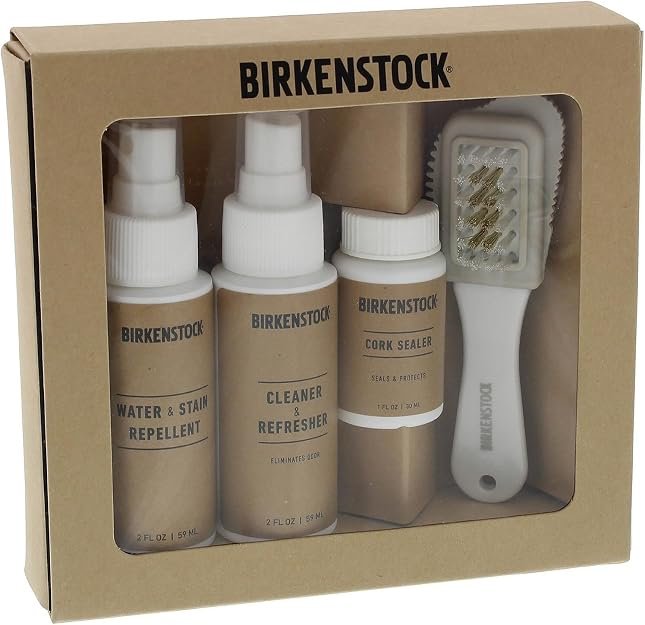
Birkenstock Deluxe Shoe Care Kit
A dedicated Birkenstock care option for owners who want several maintenance tools in one kit.
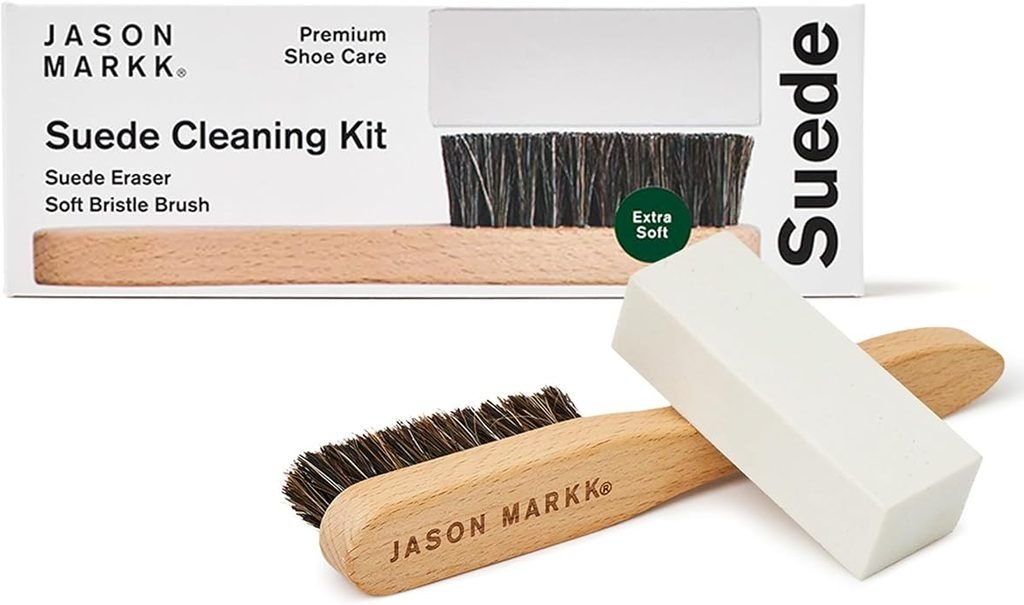
Jason Markk Suede Cleaning Kit
A compact brush and stain-eraser set designed for suede and compatible footwear materials.
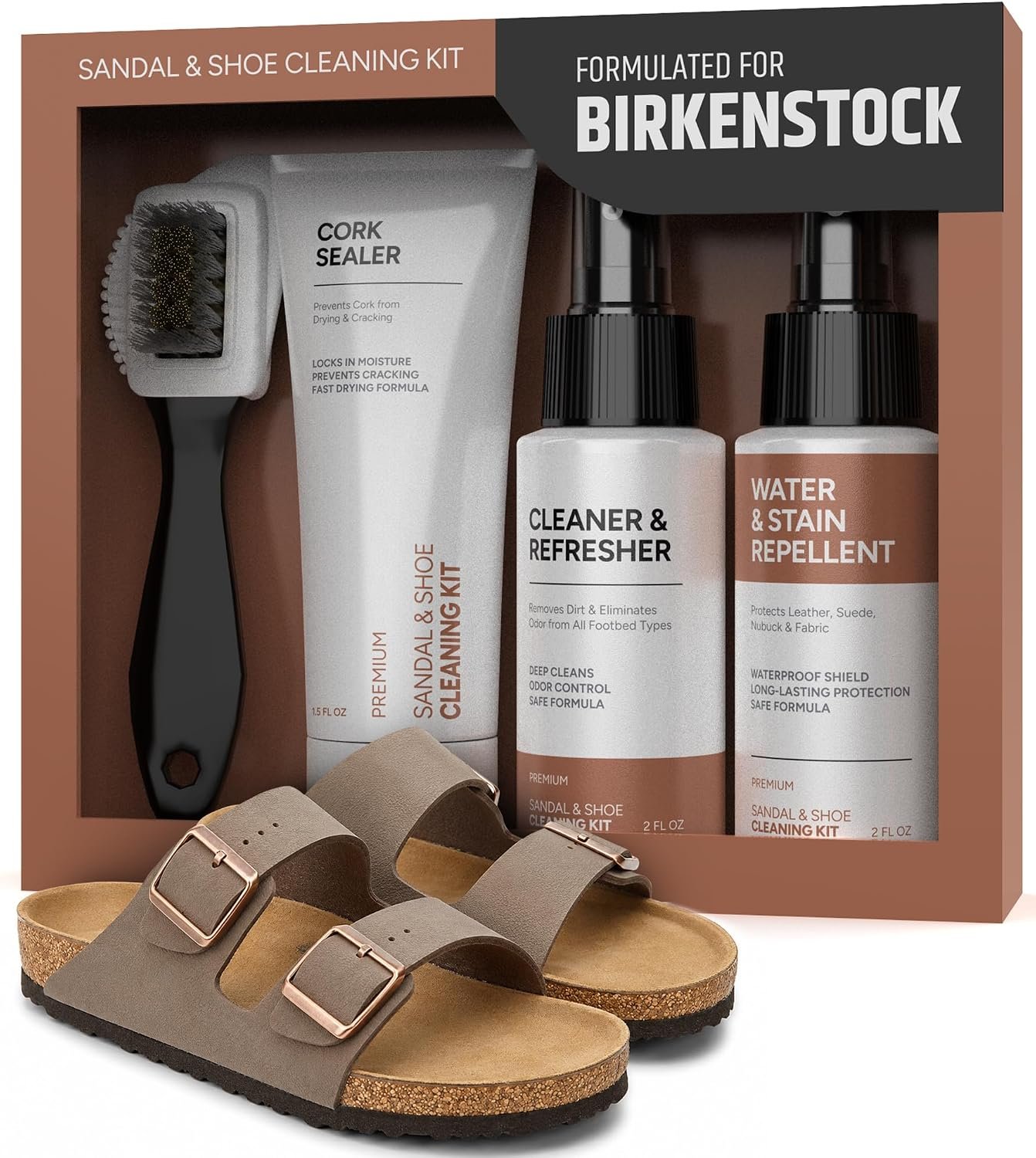
FORTIVO 4-in-1 Sandal & Shoe Cleaning Kit
An all-in-one option supplied with cleaning, protection and cork-care components for footwear maintenance.
Some links on this page are affiliate links. If you purchase through them, UrbanStyleFootwear may earn a commission at no additional cost to you.
BIRKENSTOCK’s own care guidance recommends using its Footbed & Shoe Cleaner for cleaning, a suede/nubuck brush or dry cleaner for suede and nubuck, a leather conditioner for appropriate leather uppers, and cork sealer when exposed cork begins to dry. The company also advises keeping footwear away from extreme heat and avoiding immersion for styles that are not water-friendly.
Introduction
Birkenstocks are designed to develop character with wear. A darker suede footbed does not automatically mean that the sandal is damaged or needs aggressive cleaning.
What matters is the condition of the material.
A little discoloration from regular wear is different from a footbed that has become sticky, heavily soiled or difficult to clean. Likewise, a cork edge that has become dry needs different care from a suede strap covered in surface dirt.
The biggest mistake is treating the entire sandal as if it were made from one material.
This guide explains what cleaner to use for each part of a Birkenstock, how to clean the footbed, how to protect suede and leather, when to reseal the cork, and which products are worth considering.
For a broader cleaning routine, see our guide on how to clean Birkenstocks.
Why Choosing the Right Birkenstock Cleaner Matters
A Birkenstock sandal can contain several different materials in one product.
A typical pair may have:
- A suede footbed lining
- Cork-latex footbed construction
- Suede, nubuck, smooth leather or oiled leather uppers
- Synthetic materials such as Birko-Flor or Birkibuc
- An EVA outsole
That means a cleaner that works on one part may be unsuitable for another.
For example, the exposed cork edge should not be treated like suede. Similarly, a leather conditioner intended for smooth or oiled leather should not automatically be applied to a suede footbed.
BIRKENSTOCK’s current care guidance specifically separates these treatments. Its care range includes a Footbed & Shoe Cleaner, dry cleaner for suede and nubuck, leather conditioner, water and stain repellent, and cork sealer.
Understanding the Materials in Your Birkenstocks
Before choosing a cleaner, identify the material you are working with.
1. Suede Footbed
Many classic Birkenstock footbeds have a suede lining.
This material can darken with regular wear because it comes into contact with your feet. A dark footbed alone is not proof that the sandal is ruined.
The goal of cleaning is to remove excess dirt and buildup without aggressively wearing away the suede.
For routine maintenance, BIRKENSTOCK recommends its Footbed & Shoe Cleaner and also offers a dry cleaner designed to remove dirt and refresh suede or nubuck fibers.
2. Suede or Nubuck Uppers
Suede and nubuck uppers need a gentler approach.
Start with dry brushing to remove loose dirt. If additional cleaning is necessary, use a product intended for the material and follow its instructions.
After cleaning, allow the footwear to dry naturally before brushing the nap back into place.
BIRKENSTOCK also recommends its Water & Stain Repellent for suitable suede and nubuck uppers.
3. Smooth Leather
Smooth leather requires a different routine.
Remove surface dirt first, then use an appropriate leather conditioner when needed. Avoid treating smooth leather with the same products you would use on a suede footbed.
4. Oiled Leather
Oiled leather has a different finish from standard suede.
BIRKENSTOCK recommends its Leather Conditioner for natural and oiled leather as part of its care system.
5. Birko-Flor and Birkibuc
Synthetic uppers are generally easier to maintain.
BIRKENSTOCK advises wiping Birko-Flor and Birkibuc with a damp cloth and using soap and water for stubborn stains where appropriate.
6. Exposed Cork
The cork edge is one of the most important parts of the sandal to inspect.
BIRKENSTOCK says its footwear comes with a light coating of cork sealer on the exposed cork edge. If the cork begins to look dry, the company recommends applying a thin coat of cork sealer.
What Is the Best Cleaner for Birkenstocks?
There is no single cleaner that is ideal for every Birkenstock material.
For a standard pair with a suede footbed, the BIRKENSTOCK Footbed & Shoe Cleaner is the most straightforward starting point because it is specifically designed by the manufacturer for cleaning its footwear materials.
BIRKENSTOCK says the cleaner is intended for cleaning and removing stains and can be used across its materials. Its instructions call for applying the product to a damp sponge, working it into foam, applying it to the upper or insole, and removing the remaining foam with a clean sponge rather than holding the shoe under running water.
For dry cleaning, the BIRKENSTOCK Footbed & Shoe Dry Cleaner uses a firm crepe side for coarse dirt and stains and a softer side for refreshing suede and nubuck fibers.
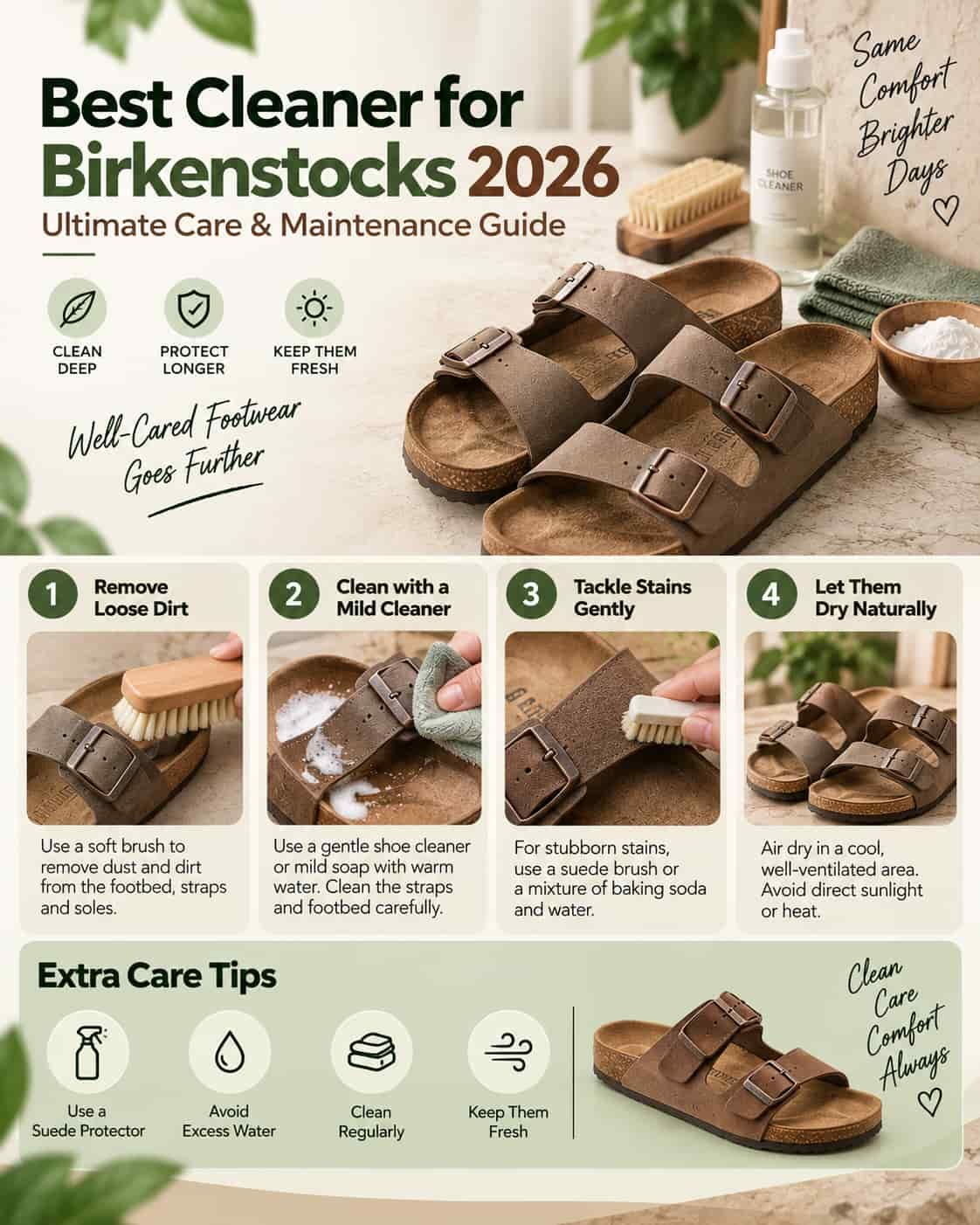
Best options by cleaning job
| Cleaning job | Best starting point |
| General footbed cleaning | BIRKENSTOCK Footbed & Shoe Cleaner |
| Dry surface dirt | BIRKENSTOCK Footbed & Shoe Dry Cleaner |
| Suede texture | Suede/nubuck brush |
| Suede upper protection | Suitable suede/nubuck protector |
| Smooth/oiled leather | Appropriate leather conditioner |
| Dry cork edge | Cork sealer |
| Synthetic upper | Damp cloth |
Our Recommended Birkenstock Cleaning Products
If you want a ready-made product rather than experimenting with household ingredients, these are the options to consider.
1. BIRKENSTOCK Deluxe Shoe Care Kit
The official care kit is useful if you want several maintenance tools in one package.
The supplied product data for the Amazon listing showed a 4.4/5 rating from more than 7,000 reviews at the time of your data capture. Ratings, prices and review counts can change, so check the current listing before purchasing.
Best for: Owners who want a dedicated Birkenstock care setup.
What to look for: Cleaner, brush and protective products suited to your specific Birkenstock materials.
2. Jason Markk Suede Cleaning Kit
The Jason Markk Suede Cleaning Kit is a two-piece brush and stain-eraser set designed for suede and other compatible footwear materials.
The supplied Amazon listing showed 4.2/5 from more than 3,700 reviews at the time of data capture.
Best for: Dry dirt and suede-focused maintenance.
It is particularly useful when you want a brush and eraser rather than a complete cork-care system.
3. FORTIVO 4-in-1 Sandal & Shoe Cleaning Kit
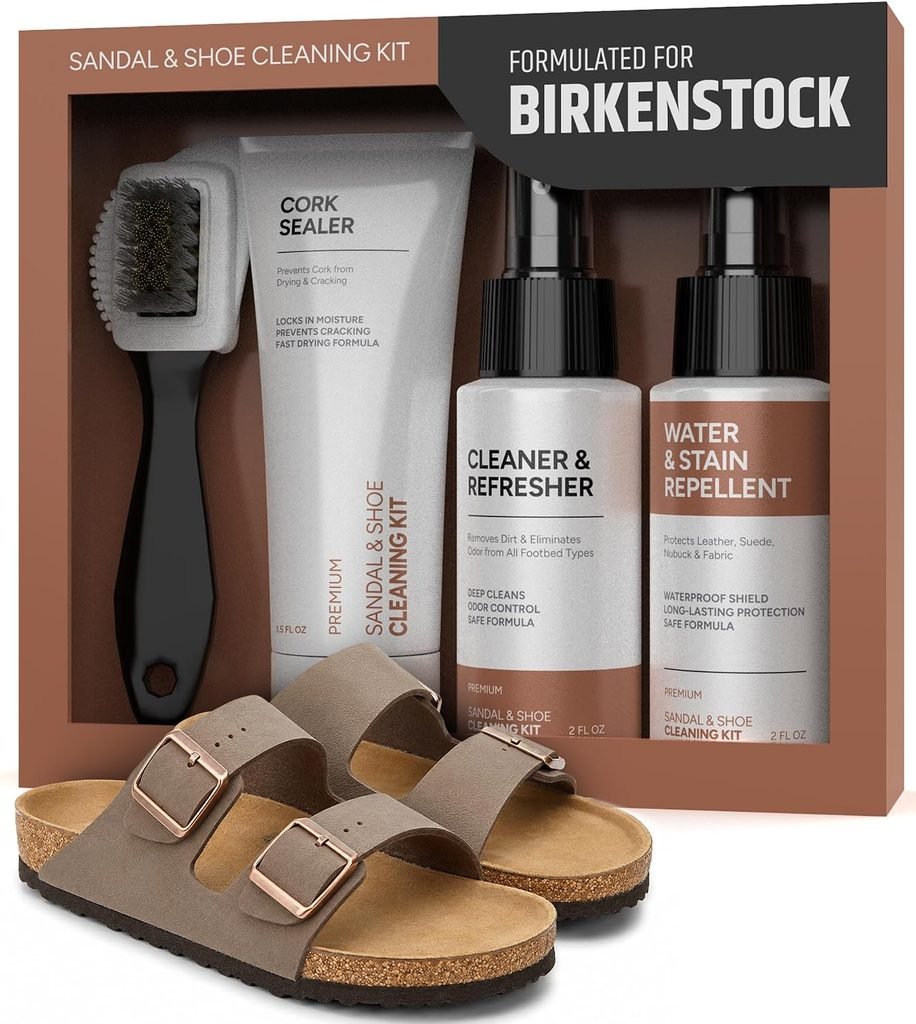
The supplied listing describes this as a four-piece care system containing a cleaner, cork sealer, protector spray and brush.
The Amazon information supplied for this article showed 4.2/5 from 340 reviews at the time of data capture.
Best for: People looking for an all-in-one maintenance kit that includes cork-care equipment.
As with any third-party product, follow the manufacturer’s instructions and confirm compatibility with your exact Birkenstock materials before applying it.
How to Clean a Birkenstock Footbed
The footbed is where most people need the most guidance.
A darkened footbed is normal after regular wear. If yours has accumulated dirt, feels sticky or needs refreshing, clean it carefully rather than trying to make it look brand new in one aggressive session.
Step 1: Remove Loose Dirt
Start with a dry brush.
Remove loose dirt, dust and debris from the footbed and upper before introducing any cleaning product.
This reduces the amount of rubbing needed later.
Step 2: Apply the Appropriate Cleaner
For the official BIRKENSTOCK Footbed & Shoe Cleaner, follow the manufacturer’s application method.
BIRKENSTOCK instructs users to shake the cleaner, prepare lukewarm water, spray the cleaner onto a damp sponge, work it into foam and apply it to the upper or insole. Residual foam should be removed carefully with a clean sponge rather than placing the shoe under running water.
Do not assume that more cleaner means a better result.
Step 3: Work Gently
Use controlled movements rather than aggressive scrubbing.
Pay attention to areas with visible buildup, but avoid repeatedly grinding the same section of suede.
Step 4: Remove Residue
Use the appropriate clean, damp sponge or cloth to remove remaining product according to the cleaner’s instructions.
The goal is to remove the cleaner without flooding the footbed.
Step 5: Air Dry Naturally
Allow the Birkenstocks to dry naturally.
Do not put them next to a radiator, heater or other concentrated heat source.
BIRKENSTOCK specifically warns that extreme heat can damage cork footbeds and EVA soles and recommends slow air drying after footwear becomes wet.
Step 6: Restore the Suede Texture
Once completely dry, gently brush the suede or nubuck to restore the nap.
BIRKENSTOCK’s dry cleaner is specifically designed with different sides for removing dirt and refreshing suede or nubuck fibers.
How to Clean Suede Birkenstock Straps
Suede straps need different treatment from the cork edge and footbed.
Start with a suede/nubuck brush to remove loose dirt.
If a stain remains, use a suitable suede cleaner according to its instructions.
Avoid soaking the strap.
Once dry, brush the nap gently.
For additional protection, BIRKENSTOCK recommends its Water & Stain Repellent for appropriate suede and nubuck uppers.
For a more detailed routine, see our guide on how to clean suede Birkenstocks.
How to Clean Oiled Leather Birkenstocks
Oiled leather should not be treated like suede.
First remove surface dirt with a suitable cloth or brush.
Then use a leather conditioner intended for oiled leather.
BIRKENSTOCK’s own care guidance recommends Leather Conditioner for natural and oiled leather.
If you own this material, our guide to cleaning oiled leather Birkenstocks provides a more focused routine.
How to Clean White Birkenstocks
White and light-colored Birkenstocks show dirt more quickly, so restraint matters.
Start with the least aggressive method that can solve the problem.
For synthetic uppers, a damp cloth may be sufficient. For suede, use a suitable suede brush and cleaner rather than treating it like smooth synthetic material.
See our detailed guide to cleaning white Birkenstocks for color-specific care.
How to Protect the Cork Edge
Cork care is different from footbed cleaning.
You do not need to coat the entire sandal in cork sealer.
Inspect the exposed cork edge periodically. When it begins to look dry, BIRKENSTOCK recommends applying a thin layer of cork sealer.
A simple cork-care routine
- Clean loose dirt from the cork edge.
- Allow the area to dry completely.
- Apply a thin layer of appropriate cork sealer.
- Keep the sealer on the exposed cork.
- Allow it to dry according to the product instructions.
Avoid getting cork sealer onto the suede footbed.
For older pairs, see our guide on how to restore old Birkenstocks.
Should You Use Baking Soda on a Birkenstock Footbed?
Baking soda is frequently recommended online, but it should not be presented as the universal or official Birkenstock cleaning method.
There is also conflicting community advice about household remedies. Some Birkenstock owners use DIY approaches, while others recommend purpose-made suede cleaners or the manufacturer’s products.
For that reason, our recommendation is simple:
If you want the lowest-risk routine, start with a product designed for the material and follow its instructions.
Baking soda can also leave residue or change the feel of a suede surface if used aggressively.
What About Sandpaper?
Fine-grit sanding appears frequently in Birkenstock owner discussions, especially when a footbed has become heavily darkened and the suede nap is flattened.
Some users report using approximately 160 to 220 grit sanding material for this purpose.
However, this is an abrasive restoration technique, not routine cleaning.
Every pass removes some surface material. Repeated sanding can eventually wear through the suede layer.
For that reason, we do not recommend making sandpaper part of your regular cleaning schedule.
If you are dealing with a severely worn footbed, professional repair may be a better option.
Can You Put Birkenstocks in the Washing Machine?
For standard Birkenstock styles, do not use the washing machine as a general cleaning method.
BIRKENSTOCK advises that most styles should not be immersed in water and warns that oversaturation can compromise sealant materials and change the appearance or finish.
The company does have water-friendly EVA footwear, so the material matters.
For standard cork-footbed sandals and clogs, hand cleaning is the safer approach.
You can also read our dedicated guide on washing Birkenstocks in a washing machine before attempting anything involving significant water exposure.
How to Dry Birkenstocks After Cleaning
Drying is just as important as cleaning.
Do:
- Let them air dry naturally.
- Keep them in a ventilated area.
- Keep them away from concentrated heat.
- Give the footbed enough time to dry before wearing.
Don’t:
- Put them in a clothes dryer.
- Leave them in a hot car.
- Place them next to a heater.
- Use a hair dryer on high heat.
- Leave wet Birkenstocks in direct, intense sunlight.
BIRKENSTOCK specifically warns against extreme heat and recommends slow air drying away from direct heat sources.
For a dedicated drying routine, see how to dry Birkenstocks properly.
DIY vs. Commercial Birkenstock Cleaners
| Factor | DIY household method | Purpose-made cleaner |
| Cost | Usually lower | Usually higher |
| Material guidance | Limited | Product-specific |
| Consistency | Depends on mixture and technique | More predictable |
| Footbed cleaning | Can work, but technique matters | Designed for footwear materials |
| Cork care | Separate product usually required | Some kits include cork sealer |
| Best use | Occasional experimentation | Routine maintenance |
The key advantage of a commercial product is not that it automatically produces a better-looking sandal. It is that you know what material the product is designed to work with and how the manufacturer expects it to be applied.
Birkenstock Cleaner Comparison
| Product | Best For | Main Advantage | Consideration |
| BIRKENSTOCK Deluxe Care Kit | Complete maintenance | Brand-specific care system | More expensive than a single brush |
| Jason Markk Suede Cleaning Kit | Suede cleaning | Brush + eraser | Does not replace cork sealer |
| FORTIVO 4-in-1 Kit | All-in-one care | Cleaner, sealer, protector and brush | Follow compatibility instructions |
| BIRKENSTOCK Footbed & Shoe Cleaner | Routine cleaning | Manufacturer-specific cleaner | Use according to directions |
| BIRKENSTOCK Dry Cleaner | Dry cleaning | Designed for suede/nubuck | Not a substitute for deep cleaning |
7 Common Birkenstock Cleaning Mistakes
1. Soaking the Entire Sandal
More water does not mean better cleaning.
BIRKENSTOCK warns against immersing most styles because oversaturation can affect sealants and material finishes.
2. Using Strong Household Cleaners
A household cleaner may be too aggressive for suede, leather or the footbed.
Use a product designed for the material whenever possible.
3. Drying With High Heat
This is one of the easiest mistakes to avoid.
Heat can damage cork and EVA and can affect the shape and finish of footwear.
4. Treating Suede Like Smooth Leather
Suede needs brushing and products designed for its nap.
Do not automatically apply leather conditioner to suede.
5. Applying Cork Sealer to the Footbed
Cork sealer belongs on the exposed cork edge.
Keep it away from the suede footbed.
6. Sanding Too Aggressively
Sanding can remove surface material.
If you use an abrasive restoration method, keep it extremely limited.
7. Cleaning Too Often
A footbed does not need to look factory-new after every wear.
The goal is to remove problematic buildup and maintain the materials, not erase every sign of use.
When Should You Clean Your Birkenstocks?
There is no universal calendar that applies to every owner.
Instead, inspect the footwear.
Consider cleaning when:
- The footbed has noticeable dirt buildup.
- The footbed becomes unusually sticky.
- The suede texture has become heavily flattened.
- The upper has visible dirt or stains.
- Odor becomes a recurring problem.
Some Birkenstock owners report cleaning their footbeds every few months, particularly in humid environments, while others clean much less frequently. Community experiences vary considerably.
Your climate, how often you wear the sandals and how much your feet sweat can all affect how quickly the footbed needs attention.
How to Remove Smell From Birkenstocks
Odor is often connected to moisture, sweat and buildup.
Start with prevention:
- Let the sandals air between wears.
- Keep feet clean and dry.
- Avoid storing damp footwear in enclosed spaces.
- Clean the footbed when buildup becomes noticeable.
Do not try to mask a persistent odor with heavy fragrance.
If odor is your main problem, see our dedicated guide on how to remove smell from Birkenstocks.
Quick Birkenstock Material Guide
Quick Material Match: What Should You Use?
Use a suitable footbed cleaner and gentle brush. Let it dry naturally.
Brush first, then use a material-specific cleaner or protector when necessary.
Use a leather-specific cleaner or conditioner appropriate for the finish.
Inspect regularly and apply a thin cork sealer when the edge starts to look dry.
Quick Care Decision Guide
🧽 Find the Right Birkenstock Care Method
Choose the problem that looks most like yours. This is a practical care guide, not a replacement for the manufacturer’s instructions.
How to Keep Birkenstocks Cleaner Between Deep Cleans
Regular maintenance can reduce the need for aggressive cleaning.
Brush Away Surface Dirt
A quick dry brushing session can remove dust before it becomes embedded.
Let Them Air Out
Give the sandals time to dry between heavy-wear sessions.
Protect Suitable Uppers
For compatible suede, nubuck and leather uppers, a suitable water and stain repellent can help reduce exposure to moisture and dirt. BIRKENSTOCK recommends its Water & Stain Repellent for appropriate materials.
Inspect the Cork
Do not wait until the cork edge is badly deteriorated.
Check it periodically and reseal when it begins to look dry.
Frequently Asked Questions
What is the best cleaner for Birkenstocks?
For standard Birkenstock footwear, a purpose-made product such as the BIRKENSTOCK Footbed & Shoe Cleaner is a sensible starting point. The exact cleaner depends on whether you are treating suede, leather, synthetic material, cork or EVA.
What is the best cleaner for a Birkenstock suede footbed?
A purpose-made footbed cleaner or suitable suede-care product is preferable to experimenting with strong household cleaners. BIRKENSTOCK also offers a dry cleaner specifically designed to remove dirt and refresh suede or nubuck fibers.
Can I use dish soap on Birkenstocks?
Do not make dish soap your default cleaner for the entire sandal. Different Birkenstock materials require different treatments. For compatible synthetic uppers, BIRKENSTOCK says soap and water can be used for stubborn stains, but that guidance does not mean the same method should be applied to every material.
Can I wash Birkenstocks with water?
Most standard Birkenstock styles should not be immersed in water. BIRKENSTOCK recommends avoiding oversaturation because it can affect sealant materials and the finish of the footwear.
Can I use a Magic Eraser on Birkenstocks?
A Magic Eraser is abrasive, so it is not a good universal cleaner for Birkenstock materials. Use material-specific cleaning methods instead.
Can I use vinegar on a Birkenstock footbed?
Vinegar is a popular online DIY suggestion, but it is not the manufacturer’s recommended general footbed-cleaning method. A purpose-made footbed cleaner gives you a more controlled approach.
How do I clean black marks from a Birkenstock footbed?
Start gently. Brush away loose dirt, then use a suitable footbed cleaner according to its instructions. Avoid aggressively sanding the footbed because repeated abrasion can remove the suede surface.
How do I reseal Birkenstock cork?
Clean the exposed cork and allow it to dry. Apply a thin layer of suitable cork sealer to the exposed cork edge according to the product instructions. BIRKENSTOCK specifically recommends cork sealer when the cork begins to look dry.
How often should I clean Birkenstocks?
Clean them when they actually need it rather than following a rigid schedule. Heavy wear, humidity, sweat and dirt can make some pairs need attention more frequently than others.
How do I dry Birkenstocks after cleaning?
Let them air dry naturally away from direct heat. Do not use a clothes dryer, radiator or concentrated heat source.
Can I clean Birkenstock suede straps with the same product as the footbed?
Not automatically. Check the product instructions and the material. Suede and nubuck uppers should be treated with products designed for those materials.
How do I clean white Birkenstocks?
Identify the upper material first. Synthetic uppers can usually be wiped with a damp cloth, while suede and leather require their respective care methods.
When Cleaning Is Not Enough
Sometimes a pair is beyond what home cleaning can reasonably fix.
Consider professional repair when:
- The cork is deeply cracked.
- The sole is separating.
- The footbed has significant structural damage.
- The suede has been worn through.
- The upper has severe leather damage.
- The cork edge is deteriorating extensively.
Cleaning can remove dirt. It cannot rebuild missing material.
For older pairs, see how to restore old Birkenstocks.
If you are considering whether to repair or replace them, our Are Birkenstocks Worth It in 2026? guide can help with that decision.
Where to Buy Birkenstock Care Products
For routine maintenance, look for a care product that matches the material you are treating.
Official Birkenstock Care Products
BIRKENSTOCK currently offers dedicated care products including:
- Footbed & Shoe Cleaner
- Footbed & Shoe Dry Cleaner
- Cork Sealer & Protector
- Leather Conditioner
- Water & Stain Repellent
- Suede/nubuck cleaning tools
Its official care guidance provides application instructions for these products.
Amazon Care Options
If you prefer buying from Amazon, these are the three products compared in this guide:
- BIRKENSTOCK Deluxe Shoe Care Kit
- Jason Markk Suede Cleaning Kit
- FORTIVO 4-in-1 Sandal & Shoe Cleaning Kit
Affiliate disclosure: Some product links on this page are affiliate links. If you purchase through an affiliate link, UrbanStyleFootwear may earn a commission at no additional cost to you.
Final Takeaway
The best cleaner for Birkenstocks depends on what you are cleaning.
For a standard suede footbed, start with a dedicated footbed cleaner and use gentle brushing. For suede and nubuck uppers, use appropriate brushes and protectors. For leather, choose a leather-specific product. For the exposed cork edge, inspect it regularly and apply a thin layer of cork sealer when it begins to dry.
The most important care rules are simple:
Do not soak standard Birkenstocks. Do not use aggressive household cleaners as a universal solution. Do not dry them with concentrated heat. Match the cleaner to the material.
With the right routine, you can keep your Birkenstocks cleaner and better maintained without repeatedly subjecting the materials to unnecessary treatments.