
Average Men’s Shoe Size: US Data, Statistics & International Comparison
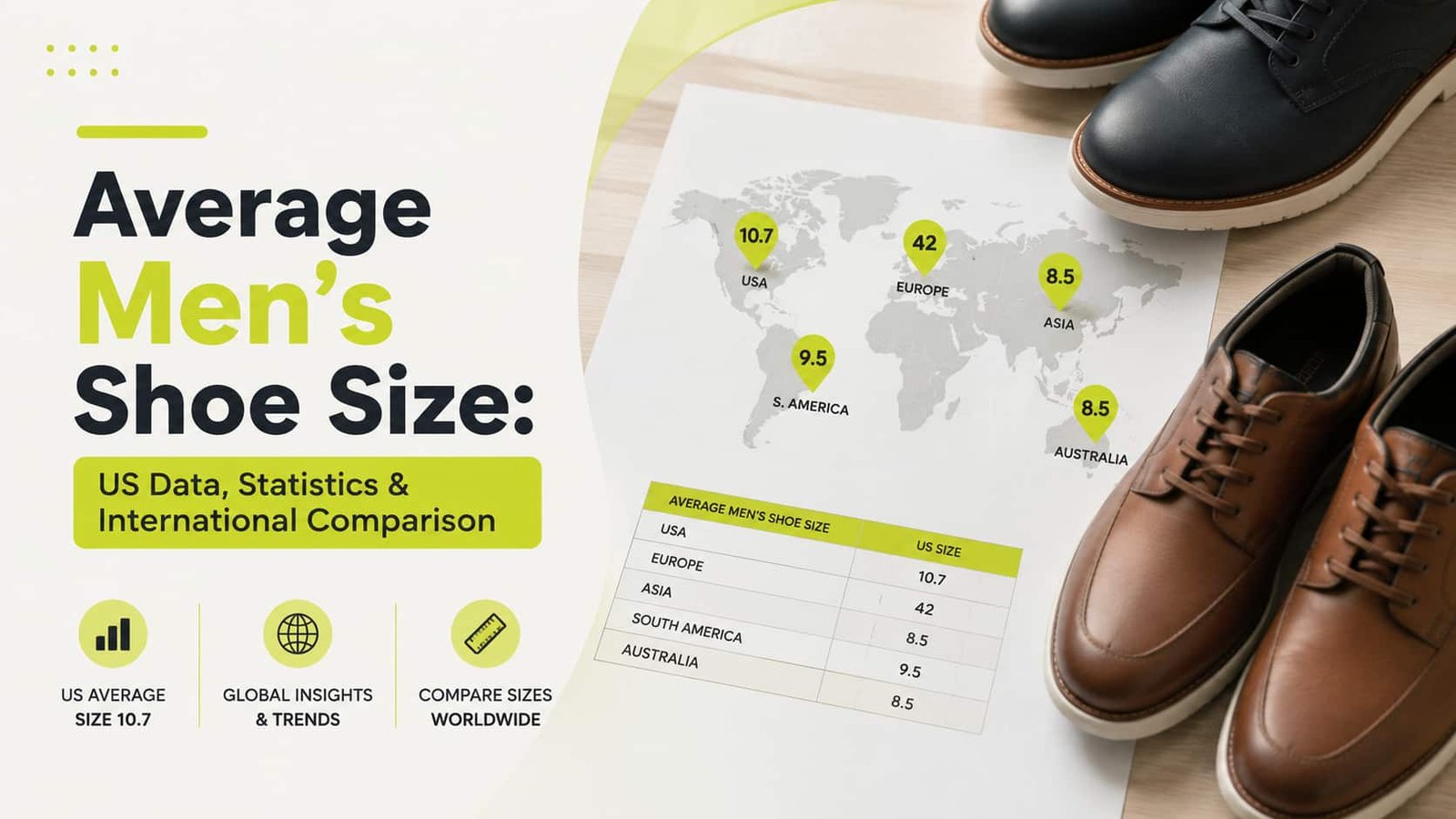
The average men’s shoe size in the United States is between 9.5 and 10.5, with 10 being the statistical center. However, shoe size varies significantly by region, age group, and foot length. In the UK and India, the average hovers around 8.5 to 9. Across Europe, German men average closer to a 44 EU (approximately 10 US), while UK sizing tends smaller. What constitutes “average” depends heavily on the population measured. Since most men do not measure their foot length before purchasing shoes, many wear sizes that do not reflect their actual foot dimensions. Understanding where the average falls helps contextualize your own size within broader population trends, though your individual foot measurement remains the only truly reliable sizing guide.
⚡ Quick Answer
- US average men’s shoe size is between 9.5 and 10.5, with 10 most common.
- UK and India average closer to 8.5 to 9.
- Age significantly impacts average shoe size across populations.
- Your individual foot length matters more than what’s average.
AVERAGE MEN’S SHOE SIZE IN THE UNITED STATES
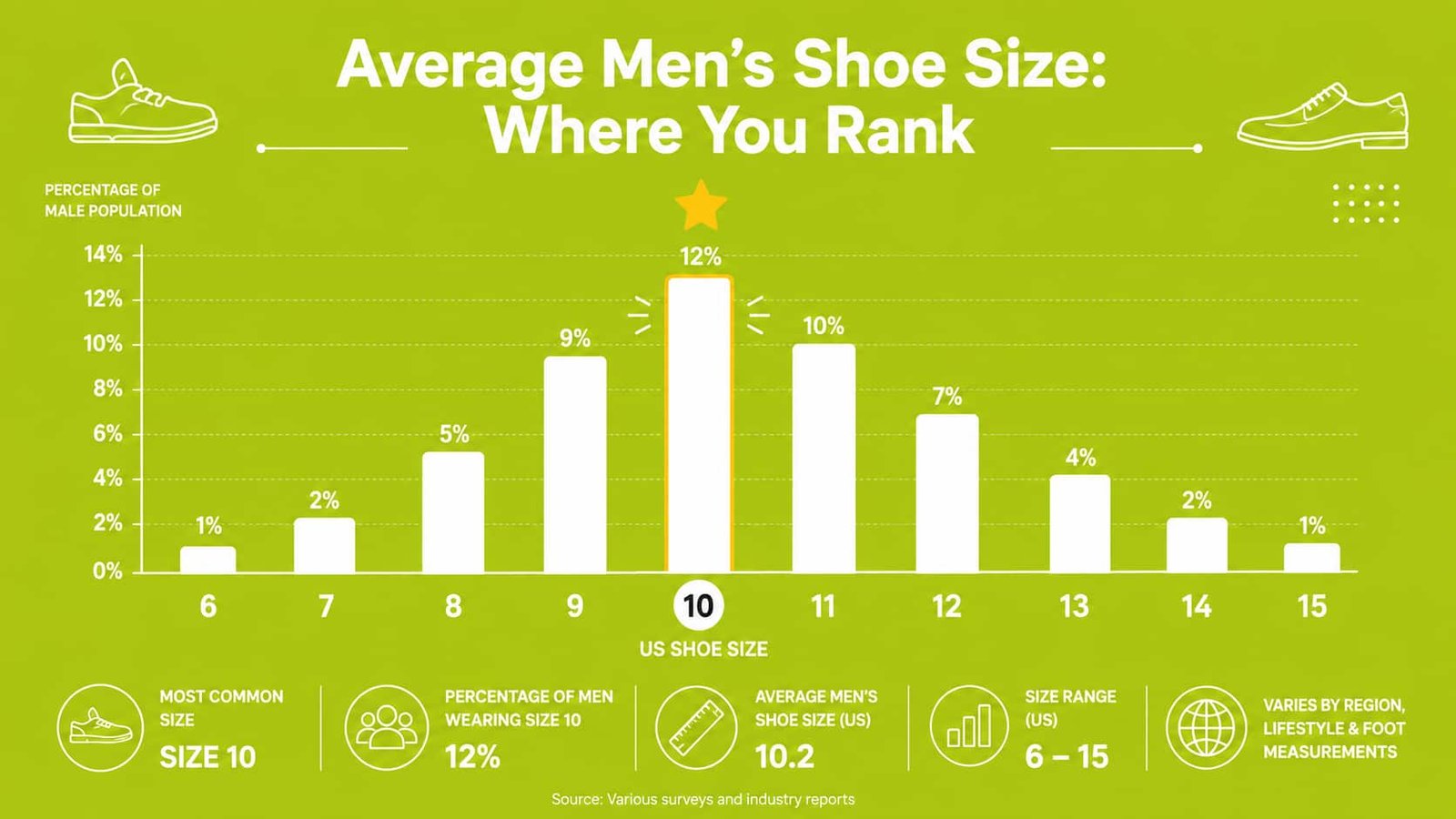
The most frequently purchased men’s shoe size in the United States is size 10. This statistic comes from major footwear retailers, online marketplaces, and shoe manufacturing data spanning the past decade. However, the average is better understood as a range rather than a single number. Most men wear between sizes 9 and 11, with size 10 being the peak of the bell curve. Size 9 and size 11 are equally popular, suggesting that the distribution is fairly balanced around the center.
What makes this number interesting is that the “average” size has slowly shifted over the past 20 years. Men’s feet have become slightly larger on average, likely due to increased average body weight and height across younger generations. A size that was genuinely rare in the 1990s, like a 13 or 14, is now more commonly found in retail inventory, suggesting the distribution is flattening and spreading toward larger sizes.
👟 Did You Know?
Size 10 is so common that shoe manufacturers prioritize it during production runs. This means size 10 shoes are often discounted first during sales and have the largest selection. If you wear size 10, you benefit from this retail reality more than any other size.
HOW THE AVERAGE VARIES BY AGE GROUP
Shoe size follows age-based patterns that most people never consider. Men in their late teens and early twenties tend toward slightly smaller sizes, averaging around 9 to 9.5. This makes sense because growth plates in the feet close around age 20 to 21, and men are still maturing physically during this window. By the early thirties, the average stabilizes at around 10 to 10.5, where it remains relatively consistent through the forties and fifties.
Beyond age 60, average shoe size tends to increase slightly. This counterintuitive finding occurs because feet naturally flatten and spread with age due to loss of arch support and natural stretching of ligaments. Many men discover they need a half size or even a full size larger in their sixties than they wore at thirty. This is not because their feet are growing in the traditional sense, but because gravity and decades of walking are physically changing foot shape.
The other age-related pattern is that very large shoe sizes (14 and above) skew younger. This reflects both the general trend of increased average height in younger generations and the fact that tall men wear large shoes. By contrast, men over 70 wearing size 14 are relatively rare, which suggests either selection bias in retail data or a genuine historical difference in average body size across generations.
💡 Expert Tip
If you are over 55 and your shoes feel tighter than they used to, remeasure your foot length. Do not assume you are simply gaining weight. Foot flattening is a natural aging process, and purchasing your true current size prevents discomfort and foot problems later in life.
INTERNATIONAL SHOE SIZE AVERAGES
Shoe size averages vary significantly across the globe, influenced by genetics, average body size, and sizing system differences.
United Kingdom and India: The average men’s shoe size is 8.5 to 9 UK (since India uses the UK sizing system). This is roughly equivalent to a US size 9.5 to 10. UK sizing tends to run smaller than US sizing because the underlying measurement system is different. A UK 9 is not the same length as a US 9.
France and Germany: European men average around a 44 EU, which translates to approximately a US 10.5. Germany in particular shows slightly larger average sizes, likely reflecting the taller average height of German men compared to global averages.
Australia and New Zealand: These countries use UK sizing for historical reasons, so averages align with the UK at approximately 8.5 to 9 UK, or US 9.5 to 10.
Brazil and Latin America: Brazil uses its own sizing system but data suggests averages lean toward smaller sizes compared to North America and Northern Europe, with most men wearing sizes equivalent to a US 9 to 9.5.
Japan: Japanese men average smaller shoe sizes overall, typically in the range of a US 8 to 9. This reflects both genetic factors and lower average body weight compared to North American and Northern European populations.
⚠ Common Mistake
Assuming that a shoe size is the same across countries is the biggest error when ordering internationally. A size 10 US is not the same length as a size 10 UK. Always measure your foot length in centimeters and verify the specific brand’s size chart, especially when ordering from retailers in different countries.
WHAT CAUSES VARIATION IN AVERAGE SHOE SIZE
Several factors drive differences in average shoe sizes both within and between populations. Genetics plays the primary role. Populations with taller average heights naturally have larger average shoe sizes. Dutch men, for example, are among the tallest in the world and wear the largest average shoe sizes globally, clustering around a 44 to 44.5 EU.
Nutrition and general health also influence foot size. Populations with good childhood nutrition tend toward larger feet. This is why average shoe sizes have shifted upward in developing countries as wealth and nutrition improved over decades. A man born in 1980 in a country with limited childhood nutrition likely has smaller feet than his son born in 2005 in the same country, even if they share the same genes.
Economic factors indirectly shape size averages through measurement bias. Retail data, which is the source for most “average” statistics, reflects only shoes that people purchase. In regions where people frequently wear oversized or undersized shoes due to limited inventory or cost constraints, the “average” size purchased does not reflect the true average of the population’s feet. This is why online measurement data tends to show different averages than brick-and-mortar retail data.
Body weight and composition also correlate with foot size. Men with larger body frames tend to have larger feet. Since average body weight has increased in developed nations over the past 40 years, average shoe sizes have shifted upward accordingly.
📊 Size Snapshot
Most Common US Size: 10
Second Most Common: 9 and 11 (tied)
Average Range: 9.5 to 10.5
Percentage Wearing Size 10: Approximately 10 to 12 percent of adult males
MEN’S SHOE SIZE DISTRIBUTION
Here is how shoe sizes distribute across the male population in the United States. This data reflects sales patterns from major retailers and online platforms.
| Size | Percentage of Male Population | Rank |
| 6 to 7 | 2% | Rare |
| 8 | 5% | Uncommon |
| 9 | 14% | Common |
| 9.5 | 8% | Common |
| 10 | 12% | Most common |
| 10.5 | 9% | Common |
| 11 | 14% | Common |
| 12 | 12% | Common |
| 13 | 10% | Increasingly common |
| 14+ | 14% | Specialty sizes |
The distribution shows a clear peak at size 10, with substantial populations at sizes 9 and 11. Notably, very large sizes (13 and above) account for a much higher percentage than they did 20 years ago, reflecting both increased average height in younger generations and better retail availability of larger sizes.
✅ Key Insight
- Sizes 9 through 12 account for nearly 60 percent of the male population.
- Size 10 is the single most common size but represents only about 12 percent of men.
- Nearly 40 percent of men wear sizes outside the 9 to 12 range.
- Larger sizes (13 and above) are now more common than they were in previous decades.
INTERACTIVE AVERAGE SHOE SIZE CHECKER
Find out how your shoe size compares to the national average and see what percentile you fall into.
📊 Where Do You Rank Nationally?
Enter your shoe size to see how it compares to the national average and what percentile you fall into.
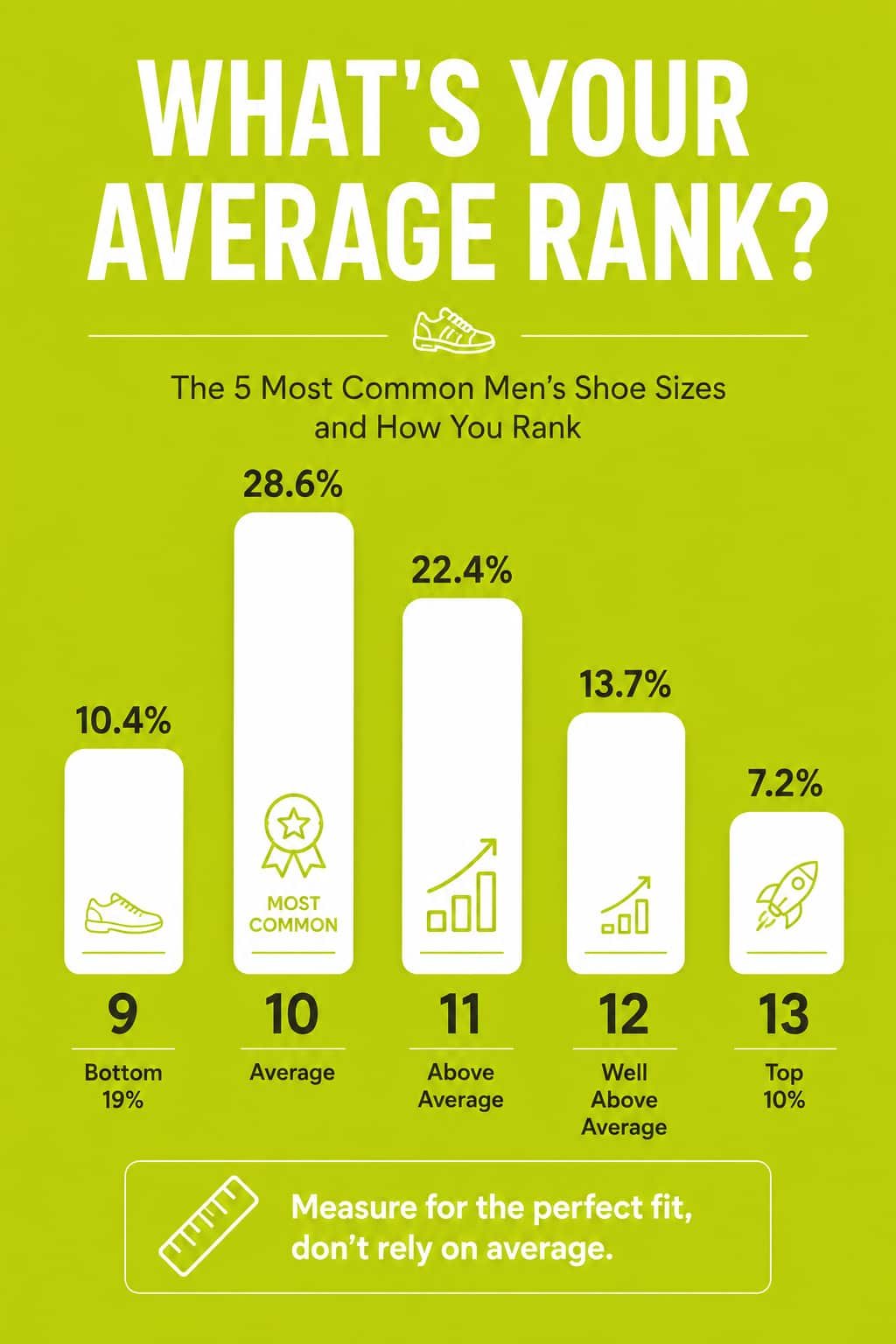
DOES YOUR SIZE REALLY MATTER
Whether your shoe size is above or below average matters far less than whether your shoes actually fit your feet. Many men wear sizes that do not match their foot measurements and suffer discomfort as a result. A man wearing a size 10 D (standard width) when his actual feet measure closer to a 10 EE (extra wide) will experience cramping and pain regardless of how “average” his size number is.
The concept of average is useful for understanding population trends and predicting retail inventory needs, but it is ultimately meaningless for individual shoe shopping. Your foot length in inches or centimeters, combined with your foot width, determines the shoes that will actually fit you comfortably. This is why measurement-based sizing always outperforms size-based shopping.
In our experience fitting thousands of customers over more than two decades, the men who report the highest satisfaction with their shoes are those who took five minutes to measure their feet before purchasing, regardless of where their size fell relative to the national average. A man wearing a size 7 that fits him perfectly is more comfortable than a man wearing an “average” size 10 that pinches his toes.
📝 What Actually Matters
- Your foot length measured in inches or centimeters.
- Your foot width, which varies independently from length.
- The specific brand’s size chart, since sizing is not standardized.
- Whether the shoe feels comfortable on your actual foot, not what the label says.
- How the shoe fits after standing in it for 30 minutes, not just minutes.
COMMON QUESTIONS ABOUT AVERAGE SIZES
Why do men’s shoe sizes vary so much?
Genetics, age, body size, and measurement standards all contribute. Men’s feet range dramatically in both length and width. Population genetics also play a major role. Taller populations have larger average sizes. Younger generations tend toward larger sizes than older generations due to changes in average height and body weight over time.
Is size 10 always the most common?
In the United States, yes, consistently across the past 15 to 20 years. However, this changes by region and age group. In some areas with populations that skew younger or taller, size 11 or 12 may be more common. Internationally, the most common size shifts significantly. In the UK, sizes 8 and 8.5 are more common than in the US.
Does average shoe size predict anything about a person?
Not really. Shoe size correlates with height and body weight, but weakly. Two men of identical height can wear different shoe sizes. Foot shape, width, and individual variation make shoe size a poor predictor of anything beyond the shoe size itself.
How has average shoe size changed over time?
It has increased. Men born in the 1950s averaged smaller sizes than men born in the 1990s. This reflects increased average height and body weight in younger generations. The trend appears to have stabilized in recent years.
Why do some men need to size up as they age?
Feet naturally flatten and widen with age. Loss of arch support and stretching of foot ligaments change the shape of the foot, not the fundamental length. A man who wore size 9 at age 30 might comfortably wear size 9.5 at age 65 due to this natural change.
FAQS
What is the most common men’s shoe size worldwide?
The most common size varies by region, but US size 10 (UK size 9, EU size 43) is the closest to a global average. However, most international markets have their own central tendency. Japan and parts of Asia trend smaller, while Northern Europe trends larger.
Is my size 13 really uncommon?
No longer. Size 13 used to be rare, but now represents about 10 percent of the male population in the United States. This size has become increasingly common over the past two decades and is carried by most mainstream retailers.
Why are size 10 shoes cheaper during sales?
Retailers stock size 10 most heavily because it is the most common size. When they need to clear inventory, size 10 often sees the deepest discounts because there is the largest surplus to move.
Does being taller guarantee a larger shoe size?
Not necessarily. Height correlates with shoe size, but the correlation is not perfect. Some tall men have proportionally smaller feet, while some shorter men have larger feet. Genetics and individual variation matter more than you might expect.
Should I buy shoes based on average sizing or my actual measurement?
Always measure your actual feet. Average sizing is useful context, but your individual foot dimensions are the only reliable guide for purchasing comfortable shoes.
How often do average shoe sizes change?
Measurably? About every 10 to 15 years. Small shifts occur constantly, but noticeable changes in population averages take a generation or two to manifest. The most recent shift upward began in the 1990s and has largely stabilized.
Does my shoe size affect my health?
Only if you wear the wrong size. Wearing shoes that are too narrow, too short, or too loose can cause blisters, nail problems, and foot pain. Wearing your correct size prevents these issues. The size number itself has no health implications.
Can I predict my shoe size based on my height?
Roughly, yes. Very tall men are more likely to wear larger sizes, and very short men smaller sizes. But the correlation is loose enough that prediction is unreliable at the individual level. Direct measurement is always better.
Why do different brands fit differently at the same size?
Each brand uses its own last (the mold the shoe is built on). These lasts vary in length, width, and proportions. A size 10 from Brand A can fit noticeably differently than a size 10 from Brand B, which is why trying on or checking customer reviews is important.
Is there a benefit to wearing average-size shoes?
Only in terms of retail availability and price. Average-size shoes are produced in larger quantities, meaning more styles are available and prices are often lower due to economies of scale. However, if your foot is not average, an “average” size will not fit you well.
What percentage of men wear larger than average sizes?
Roughly 35 to 40 percent of men wear sizes larger than 11. Many of these men struggle to find shoes because retailers do not stock large sizes as heavily as standard sizes. This is why men wearing size 13 and above often have fewer choices and higher prices.
CONCLUSION
The average men’s shoe size in the United States is size 10, but this statistic describes population trends, not individual fit. You now understand where your own size falls in the national distribution, but more importantly, you know that your individual foot measurement matters infinitely more than how your size compares to the average.
If you want to know your precise shoe size, measure your foot length in inches or centimeters using our detailed guide at How to Measure Foot Size at Home. For a full breakdown of available shoe sizes and what each represents, check our complete men’s shoe size chart. Understanding your actual measurements means you will never have to guess at your size again, regardless of where that size ranks nationally.