

On CloudTec vs Helion: What Actually Cushions You?
Summarise this guide with AI
Open your preferred assistant and submit the prefilled request. The assistant only reads this page after you submit it.
- What CloudTec (structure) and Helion (material) are
- How CloudTec Phase differs from standard CloudTec
- How the two combine in On shoes, and what each does for the ride
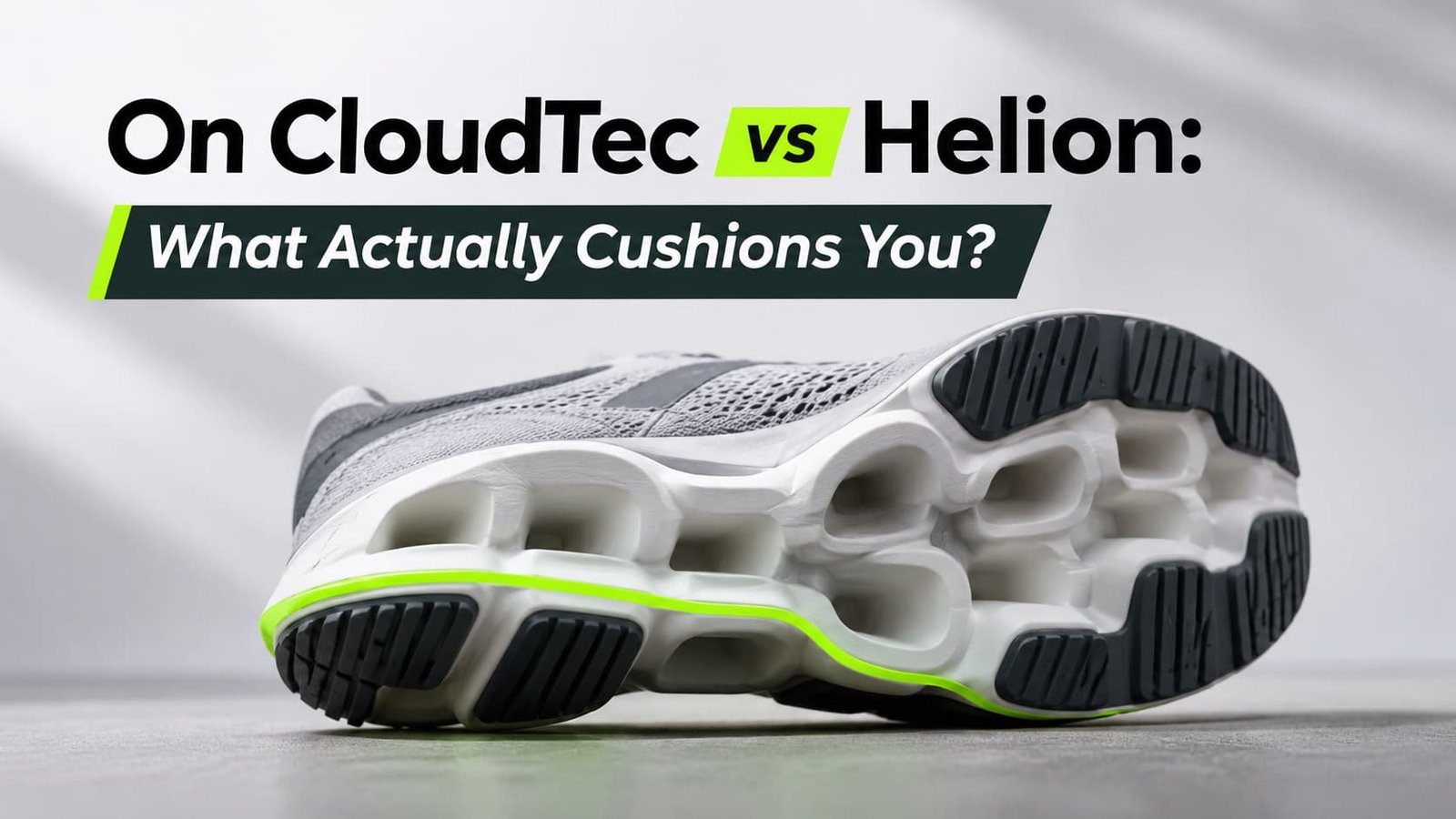
CloudTec is On’s structural cushioning system: foam engineered into pods or “clouds” with specific shapes that compress and rebound. Helion is On’s midsole foam material, with a PEBA-based version called Helion HF for faster shoes. They are not direct rivals. CloudTec describes how the foam is shaped, and Helion describes what the foam is made of. Many On shoes use both together.
Key Takeaways
- CloudTec is structure, Helion is material. Comparing them is like comparing a spring’s shape with the metal it is made from.
- Most On shoes combine the two. Models such as the Cloudmonster 2 and Cloudswift pair Helion foam with CloudTec elements.
- CloudTec Phase adds sequencing. On describes its angled clouds as compressing one after another, which gives a rolling transition from landing to take-off.
- Helion HF is the faster, PEBA-based option. Lab and reviewer results put Helion HF-based racers and super trainers well above standard Helion on energy return.
- Ride feel depends on the whole shoe. Geometry, stack height, plate and upper all change how the same technology feels.
What Is On CloudTec?
Most runners who have looked closely at the bottom of an On shoe have noticed the hollow pods. On calls the system CloudTec and describes it as a structural cushioning system. Its official technology page says the brand engineers foam into a variety of specialised geometries to create a spectrum of sensations, absorb impact and deliver multi-directional support.
That wording matters. CloudTec is not defined by one foam. It is defined by the shape the foam takes. On says the pods compress both horizontally and vertically, which means they react to where your foot lands and how it moves, rather than simply squashing down.
The shape changes by collection. On’s Cloudrunner geometry uses a wide, stable CloudTec layout with precisely engineered cavities. On says these channel energy into the midsole and reduce side-to-side wobble, which suits everyday and stability-oriented running. The Cloudmonster collection uses hexagonal CloudTec pods that load energy on impact and release it at take-off. On describes that as more cushioning and more responsiveness.
For runners new to the idea, a useful picture is a set of small springs under the forefoot and heel. Each spring can be tuned for size and position, so the same technology can feel very different in a daily trainer and a max-cushion shoe.
If you want a broader view of how cushioning sits inside a shoe, our midsole, insole and outsole guide shows where each layer fits. Our anatomy of a shoe article covers the parts that work alongside foam and pods.
What Is Helion Superfoam?
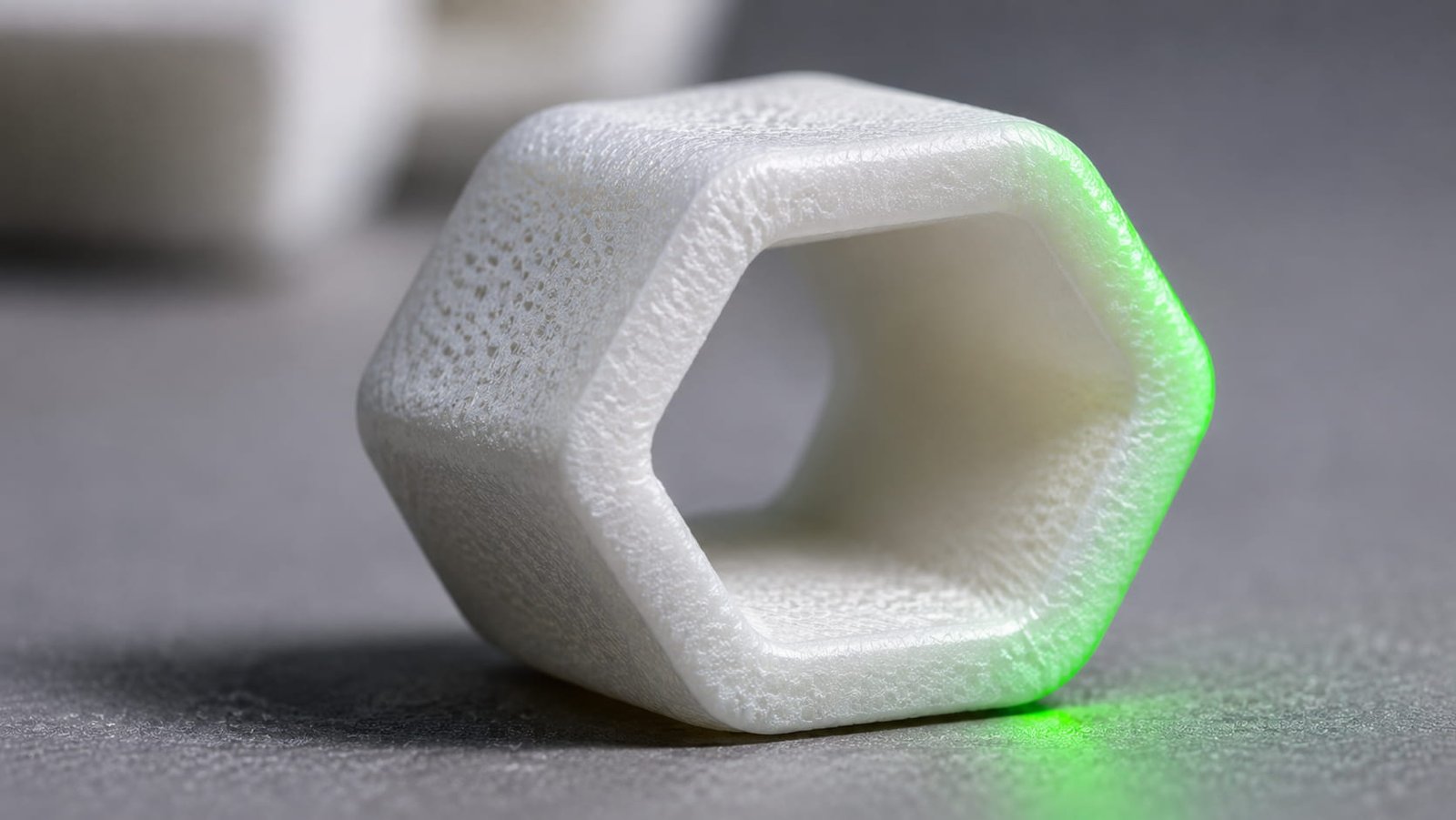
Helion is On’s midsole foam. It sits in the layer between your foot and the CloudTec structure in many shoes, and it is the material that gives the ride its underlying softness and rebound. Guides and reviews describe standard Helion as lightweight, durable and fairly stable across temperatures, with a balance of cushioning and energy return.
The chemistry is less clear than the marketing. One guide describes standard Helion as an EVA and olefin blend, and another lists it as EVA with OBC. On’s own technology pages do not publish the exact formula, so treat any single description as a reviewer’s understanding rather than a confirmed specification. What is well documented is how the foam behaves in use.
Helion HF is the faster sibling. Reviews describe it as a PEBA-based foam, the same family of material found in several premium racing midsoles across the industry. Doctors of Running, reviewing the Cloudmonster Hyper, describes Helion HF as the top layer of a dual-density midsole, with standard Helion beneath it. In the Cloudboom Echo 3, Helion HF is used as the main midsole material, according to a Trail and Kale review.
Helion HF is more responsive than standard Helion but usually comes with a higher price and a different feel. Think of standard Helion as a balanced, everyday material and Helion HF as the lively choice for faster sessions.
For background on how PEBA behaves, Arkema, the company that supplies Pebax, describes the material’s properties on its website.
What Is CloudTec Phase?
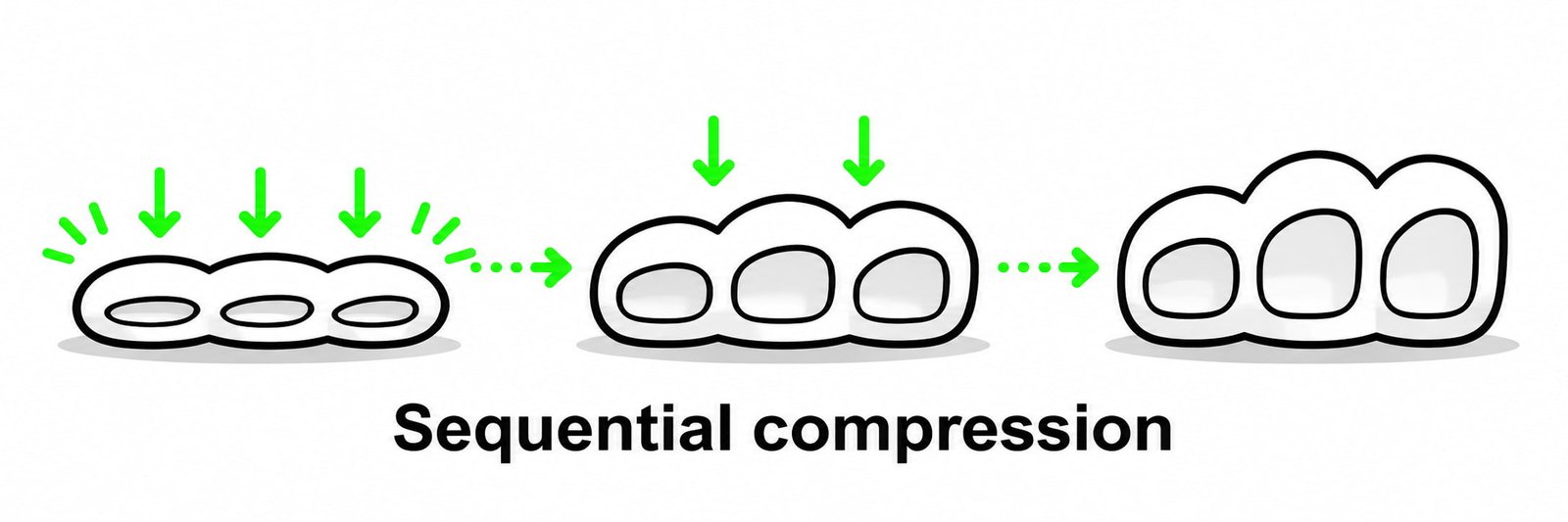
CloudTec Phase is the newer evolution of the CloudTec idea. On describes it as a structural cushioning system with computer-optimised clouds that compress sequentially, like dominoes. The brand says the design was developed with advanced simulation and refined virtually before physical prototyping.
The key change is timing. Instead of every pod compressing at once, the angled clouds are designed to compress one after another. On describes the result as a smooth, rolling transition from landing to take-off, with a softer underfoot sensation. That rolling quality is the main difference you are meant to feel.
On also says CloudTec Phase has moved beyond performance running into its lifestyle collection, positioned as all-day cushioning. That is a useful signal that the technology is being designed for comfort as well as speed.
Several shoe guides describe the Cloudmonster 2 as using CloudTec Phase, which makes it a useful reference point for readers comparing the two systems. As always, check each model’s current product page, because On updates its shoes frequently.
CloudTec vs Helion: Structure Versus Material
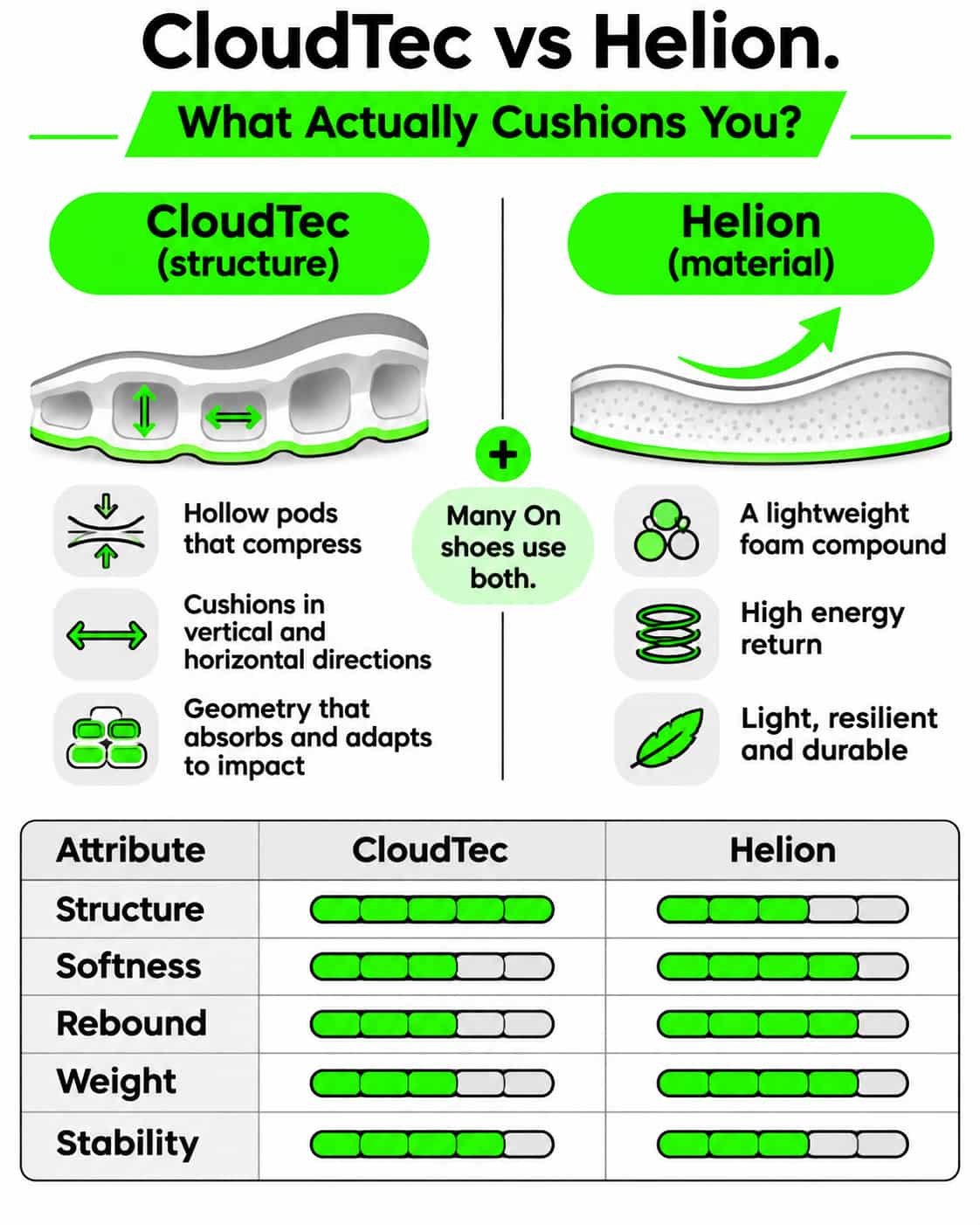
This is the most important idea in the whole comparison. CloudTec and Helion are not two versions of the same thing, and they do not compete in a simple way. One is a shape. The other is a material.
On’s official CloudTec page describes engineering foam into geometries. Helion is the foam. In practice, that means a shoe can have a Helion midsole with CloudTec pods added to the outsole or underside, and many On shoes do exactly that. The Cloudmonster 2, for example, is described by Tom’s Guide as having a Helion top layer and CloudTec pods underneath, with the pods made from a firmer, heavier material than Helion.
That is why a “CloudTec vs Helion” question can be frustrating to answer. The better question is, “Which combination of structure and material suits my running?” The table below sets out the differences in a way that makes the relationship clear.
| Feature | CloudTec | Helion |
|---|---|---|
| What it is | Structural cushioning system (pods and geometry) | Midsole foam material |
| What it controls | Shape, compression direction and support | Softness, rebound, weight and durability |
| Main variants | CloudTec, CloudTec Phase, Cloudrunner geometry, Cloudmonster pods | Standard Helion; Helion HF (PEBA-based) |
| Typical feel | Structured, centred, controlled | Balanced; HF is livelier and more responsive |
| Best match | Stable, all-day and daily running | Balanced daily use; HF for workouts and racing |
Once you see the two as different tools, the comparison makes more sense. A shoe can be built from Helion alone, from CloudTec alone, or from both. Each choice produces a different ride.
CloudTec Phase vs Helion: How They Differ in Practice
Readers searching for “CloudTec Phase vs Helion” are often trying to compare the two most current systems. Again, the answer is that they work at different levels, but the practical difference is easy to explain.
CloudTec Phase is about timing and sequence. Its angled clouds compress one after another, which gives a rolling feel. On’s description emphasises smoothness and a soft underfoot sensation. If your priority is the feeling of moving forward without a sharp transition, Phase is the system to look for.
Helion is about the material beneath. Standard Helion gives a balanced and durable ride, while Helion HF gives a faster and more energetic one. If your priority is responsiveness and push-off, Helion HF is the foam to check.
In a shoe that combines Phase and Helion HF, you get both effects: a rolling structure and a lively material. In a daily trainer with standard Helion and simpler geometry, the ride is likely to feel calmer and more predictable.
The best way to decide is to try both systems. Walk and jog in each shoe, paying attention to how the transition from heel to toe feels, and whether the shoe feels lively or settled.
Cushioning and Underfoot Comfort
Cushioning is where the structure-versus-material difference becomes most noticeable. CloudTec shapes how the sole gives way, while Helion sets how soft and springy the midsole feels in the first place.
CloudTec tends to create a feeling of being held and centred. Because the pods compress in more than one direction, runners often describe a steady, stable platform rather than a soft cushion that sinks. On’s Cloudrunner geometry is designed for that kind of controlled comfort.
Helion gives a more even, cushioned feel, and standard Helion is often described as firmer than ultra-soft foams from other brands. Outdoor Gear Lab, reviewing the Cloudsurfer 2, said the Helion midsole in that version felt a little more bouncy than in the previous one, and that the firmer ride made it better suited to walkers than to some runners. That observation shows how much the feel depends on the specific shoe.
For long standing or walking days, a balanced combination may suit best. For faster running, a lively foam like Helion HF can feel more rewarding. There is no single “most comfortable” answer, because comfort depends on your stride, your body and the purpose of the shoe.
Weight and Responsiveness
Weight is an important part of how a shoe feels over time, and the CloudTec structure can add weight. Tom’s Guide, comparing the Cloudmonster 2 with the Cloudsurfer 2, noted that the CloudTec pods are made from a firmer and heavier material than Helion. The added mass is part of the trade-off for the bouncy, structured ride that the pods provide.
Helion HF helps reduce the weight penalty in faster shoes. Reviewers describe it as lightweight and responsive, and it is used in shoes intended for racing and quality sessions. The Cloudboom Strike, which uses Helion HF, scored strong energy-return results in RunRepeat’s testing, and the same guide notes that the racer does not sacrifice comfort for speed.
Responsiveness depends on both the foam and the structure. CloudTec pods can add a sense of spring at take-off, while Helion HF gives a livelier rebound throughout the stride. A shoe that combines the two can feel quick without being harsh.
If you are comparing weights, check the men’s or women’s figure for your size and the specific model, because On’s lineup covers everything from lightweight trainers to max-cushion models. Heavier does not automatically mean slower, but it does change how a shoe feels over a long run.
Energy Return and Shock Absorption
Energy return and shock absorption are two separate qualities, and it is easy to mix them up. Energy return describes how much of the energy you put into compressing a midsole comes back during the next push-off. Shock absorption describes how well the shoe reduces the impact each step sends through your body. RunRepeat’s energy-return guide notes that these two qualities do not move together in a simple way. Some shoes deliver both, while others focus on one.
RunRepeat’s testing gives useful context for On’s materials. In its roundup of the best On running shoes, the lab reported that the Cloudboom Strike, which uses Helion HF, reached 72.1% energy return in the heel and 73.4% in the forefoot. A different Helion-based daily trainer in the same roundup measured roughly 56% in both areas. The gap between those results shows how much the specific foam and shoe design matter.
RunRepeat’s wider guide also reports that lighter shoes often deliver higher energy return, and that stack height alone does not guarantee bounce. That means a taller On shoe may feel plush without returning more energy than a lower, lighter one.
Be careful with figures from different tests. Lab methods differ, and a number in one guide cannot be compared directly with a number in another. Use these results as a sense of direction rather than a precise ranking.
For readers who want a deeper explanation of how energy return is measured, RunRepeat’s energy return guide explains the method and the common misunderstandings.
Stability and Running Feel
Stability depends heavily on the shape of the platform, which is where CloudTec plays its clearest role. On describes the Cloudrunner geometry as a wide, stable structure with cavities designed to channel energy and reduce side-to-side wobble. That design is aimed at runners who want a confident, planted feel.
Speedboard adds another layer to the story. On’s Speedboard is a plate inside many performance and training shoes. Sports Edit’s review of the Cloud X 4 describes it as an X-shaped Speedboard that helps stabilise lateral movement, and Fleet Feet’s review of the Cloudstratus 3 describes the Speedboard as a springy element working with Helion foam. Speedboard is not part of CloudTec or Helion, but it often sits alongside them and shapes the ride.
Helion’s stability depends on the model. A standard Helion midsole can feel steady and balanced. Helion HF, being softer and more responsive, can feel lively, and some reviewers note that very bouncy foams need careful geometry to keep the shoe feeling secure.
If you overpronate, have a history of ankle instability or are new to a particular shoe style, look for models with a clear stability design and try them on before buying. A physiotherapist or podiatrist can assess your gait and recommend a suitable type of shoe.
Durability and Long-Term Performance
Durability is an area where the public information is limited. On’s official pages describe the performance of CloudTec and Helion but do not publish mileage figures. Independent reviews offer useful observations, but they are based on individual runners and specific models.
Helion is often described as durable and temperature-stable. ModernShoeGuide, an independent shoe guide, describes Helion as designed for durability and consistent behaviour across temperatures, though it is one reviewer’s description rather than a standard test result. Helion HF, being PEBA-based, shares the general pattern seen in other PEBA foams: very lively when new, with some guides suggesting it can lose its peak bounce sooner than EVA foams at high mileage.
CloudTec pods add a different durability question. The pods are part of the outsole structure, so the rubber and pod design influence how the shoe wears. Tom’s Guide’s comparison, noting that the pods are firmer and heavier than Helion, does not address wear directly, so readers should look at each model’s outsole design and reviews to judge longevity.
Practical habits extend the life of any running shoe. Rotate pairs where possible, let shoes dry at room temperature after wet runs and avoid leaving them in hot cars. Our guide to how long running shoes last explains the signs of wear to watch for, and our shoe care guide covers safe cleaning methods.
Which On Shoes Use CloudTec?
CloudTec appears across many On models, and the specific layout changes by collection. The examples below are drawn from On’s technology pages and independent reviews. Always check the current product page for the exact midsole and outsole of the model you are considering.
Cloudmonster collection. On describes the Cloudmonster as using hexagonal CloudTec pods that load energy on impact and release it at take-off. Doctors of Running describes the Cloudmonster Hyper as a dual-density midsole with CloudTec forming the outer layer and underside, surrounding a Helion HF core. Runnerspicks’ comparison describes the Cloudmonster 2 as using CloudTec Phase, with Helion HF foam underneath.
Cloudrunner geometry. On’s Cloudrunner pages describe a wide, stable CloudTec geometry designed to reduce side-to-side wobble. This is the clearest example of CloudTec being used to shape stability rather than just softness.
Cloudswift. Comparison guides describe the Cloudswift as combining Helion superfoam with CloudTec technology, with the cloud design intended to reduce muscle fatigue and adapt to a runner’s style. Its heavier weight and firmer feel are typical of many daily trainers in the range.
Cloudsoma and trail models. On’s trail-oriented designs use variations of the pod concept. RoadTrailRun’s review of the Cloudsoma describes CloudTec Connect, a podular outsole of foam islands designed for trail feel, agility and flexibility. That is a different application of the same principle, adapted for uneven ground.
Which On Shoes Use Helion?
Helion is found in many On models, from everyday trainers to speed shoes. Again, check the current model specs before buying, because On updates midsoles regularly.
Cloudrunner 3. Run4it’s comparison describes the Cloudrunner 3 as using Helion foam throughout the midsole, with the Cloudrunner 3 Max adding a top layer of Helion HF. For readers who want stable everyday cushioning, this is a helpful pair to compare.
Cloudsurfer 2. Outdoor Gear Lab’s review notes that the Helion midsole in the Cloudsurfer 2 feels a little more bouncy than in the previous version, paired with a firmer ride that suits walkers more than some runners.
Cloudstratus 3. Fleet Feet’s review describes the Helion superfoam in the Cloudstratus 3 as combining rigid and flexible elements in one compound, with a Speedboard providing extra spring. The reviewer found the foam soft and smooth without feeling squishy.
Cloudboom Strike and Cloudboom Echo 3. Both use Helion HF in racing and speed contexts. RunRepeat’s testing of the Cloudboom Strike recorded strong energy-return results. The Cloudboom Echo 3 is described in a Trail and Kale review as featuring a PEBA-based Helion midsole.
Cloud X 4. Sports Edit describes the Cloud X 4 as using Helion foam with an X-shaped Speedboard to stabilise lateral movement. That combination illustrates how Helion can sit alongside other On technologies.
Which Technology Should You Choose?
Choosing between On’s technologies is easier if you think about your running and walking habits. Use these questions as a guide.
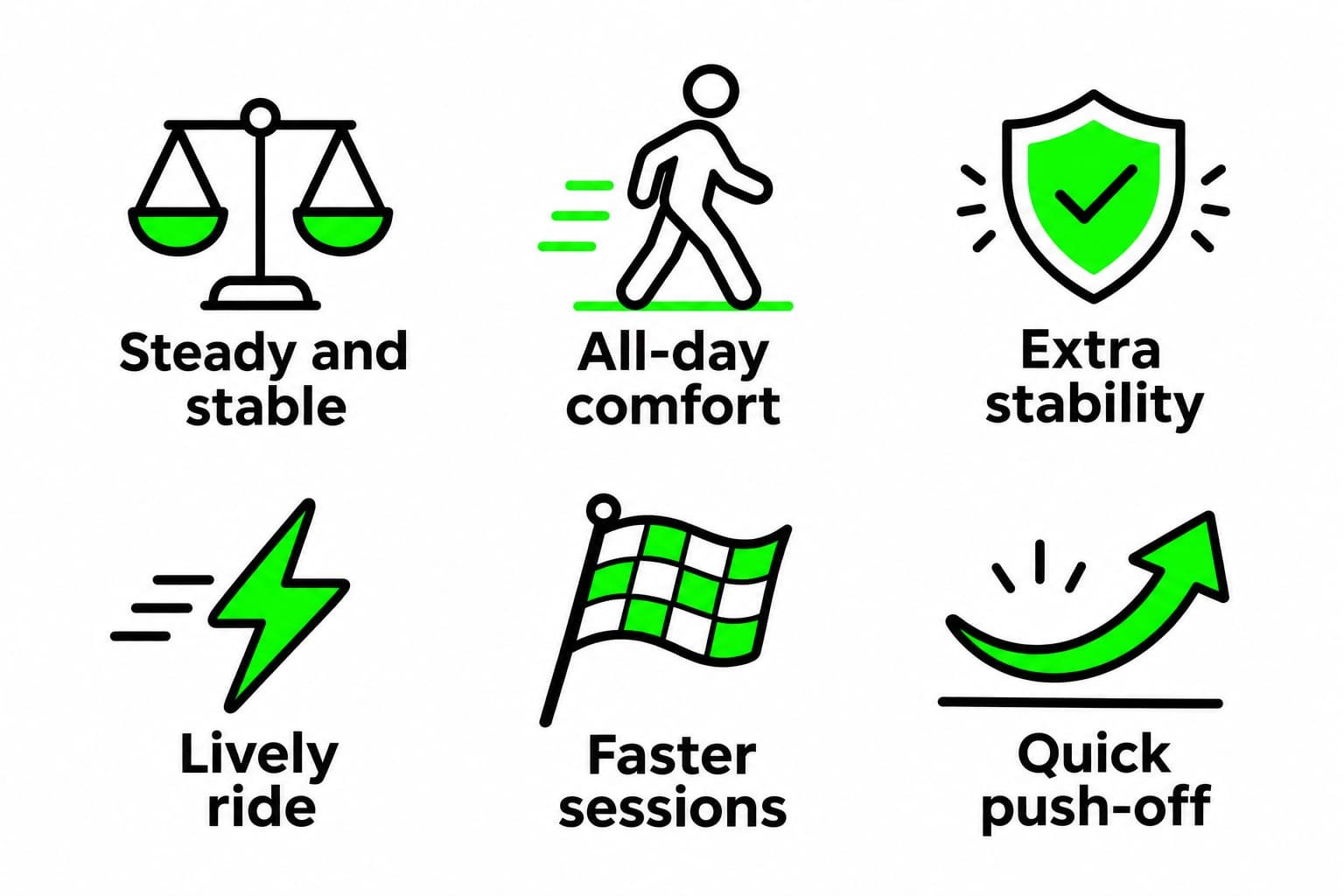
1. What is your main activity? Long walks, standing and daily running suggest a balanced structure with standard Helion or CloudTec. Faster running and racing suggest Helion HF.
2. Do you need extra stability? Look for wide, stable CloudTec geometries or models with a Speedboard. Test the shoe on your usual surfaces before committing.
3. How do you want to feel at push-off? A rolling, sequential feel points to CloudTec Phase. A lively, energetic feel points to Helion HF.
4. How much weight can you tolerate? Lighter shoes suit faster running. Heavier, more structured shoes suit comfort and stability.
5. What is your budget? Helion HF racing and super-trainer models tend to cost more. Standard Helion and CloudTec daily trainers often sit at a lower price point, though prices vary.
6. How much will you use them? High-mileage runners should consider durability and plan to rotate pairs. Racing-style shoes are best kept for quality sessions.
For help narrowing the options, our shoe finder can filter by use case, and our footwear knowledge hub collects guides on materials and fit. If you are also comparing foam families, our PWRRUN vs PWRRUN PB guide explains how a different brand’s PEBA and EVA foams differ, and our running shoe foam overview gives a broader picture. For how our comparison guides are produced, see our methodology page.
Common Myths About CloudTec and Helion
Myth: CloudTec and Helion are competing foams. They are different things. CloudTec is a structure, and Helion is a material. Many On shoes use both.
Myth: The pods make the shoe unstable. Some pods are designed specifically to improve stability. On’s Cloudrunner geometry is built to reduce side-to-side wobble.
Myth: Helion HF is always the better choice. It is livelier and more responsive, but it can cost more and may suit some runners less. Standard Helion is a balanced and durable option.
Myth: Higher stack height means more energy return. RunRepeat’s testing notes that stack height and energy return are not strongly linked, and that lighter shoes often return more energy.
Myth: Every On shoe uses the same technology. The Cloudmonster, Cloudrunner, Cloudswift and trail models all use different combinations of CloudTec, Helion and Speedboard. Always check the specific model.
Frequently Asked Questions
What is the difference between CloudTec and Helion?
CloudTec is On’s structural cushioning system, which shapes the foam into pods or geometries. Helion is the midsole foam material. Many On shoes use both, with Helion as the main foam and CloudTec pods or structure added for shape and support.
Is CloudTec Phase better than CloudTec?
Phase is a newer system with clouds that compress sequentially, giving a rolling feel. Whether it is better depends on your preference. Try both if you can, because the feel is subjective.
Is Helion HF made from PEBA?
Reviews describe Helion HF as a PEBA-based foam. Standard Helion is described as an EVA-based blend, though sources differ on the exact composition. On does not publish the full formula on its technology pages.
Are On shoes good for walking?
Many people wear On shoes for walking and all-day comfort. Models like the Cloudrunner, Cloudsurfer and Cloudswift are often recommended for this, though readers with specific foot conditions should speak to a podiatrist or physician before choosing a shoe.
Which On shoe is best for walking all day?
It depends on your foot shape and how you walk. Stable, balanced models such as those with CloudTec geometry or standard Helion are often suggested. Try them on and walk for at least ten minutes before deciding.
Does CloudTec add weight?
Often, yes. Tom’s Guide notes that the CloudTec pods used in the Cloudmonster 2 are firmer and heavier than Helion. The added weight is part of the trade-off for the structured ride.
Final Verdict
CloudTec and Helion are best understood as two parts of the same design philosophy. CloudTec shapes how the sole compresses and supports you, while Helion provides the foam that gives the ride its softness, rebound and durability. Helion HF adds a livelier, PEBA-based option for faster running, and CloudTec Phase adds a rolling, sequential feel.
If you want stable, balanced comfort for daily running or walking, look for CloudTec geometry or standard Helion. If you want a lively ride for workouts and racing, look for Helion HF. Before buying, check the current model’s specs, read more than one review and try the shoe on if you can. The right technology is the one that matches the way you move.
Sources
- On. “CloudTec: Run on clouds.” https://www.on.com/en-us/explore/technology/cloudtec
- On. “CloudTec Phase: Run on clouds.” https://www.on.com/en-us/explore/technology/cloudtec-phase
- Doctors of Running. “On Cloudmonster Hyper Review (2024).” https://www.doctorsofrunning.com/?p=1171
- Running Warehouse. “On Cloudmonster Hyper Review.” https://www.runningwarehouse.com/Reviews/On-Shoe-Reviews/on-cloudmonster-hyper.html
- Tom’s Guide. “I ran 40 miles with the Cloudsurfer 2 vs. On Cloudmonster 2.” https://www.tomsguide.com/wellness/running/i-ran-40-miles-with-the-cloudsurfer-2-vs-on-cloudmonster-2-which-shoe-should-you-buy
- Outdoor Gear Lab. “On Cloudsurfer 2 review.” https://www.outdoorgearlab.com/reviews/shoes-and-boots/running-shoes-men/on-cloudsurfer-2
- RunRepeat. “Energy return in running shoes explained.” https://runrepeat.com/guides/energy-return-in-running-shoes


