
Under Armour Shoe Size Chart: US, UK, EU & CM Men’s Size Guide
Under Armour Shoe Size Chart: Quick Answer
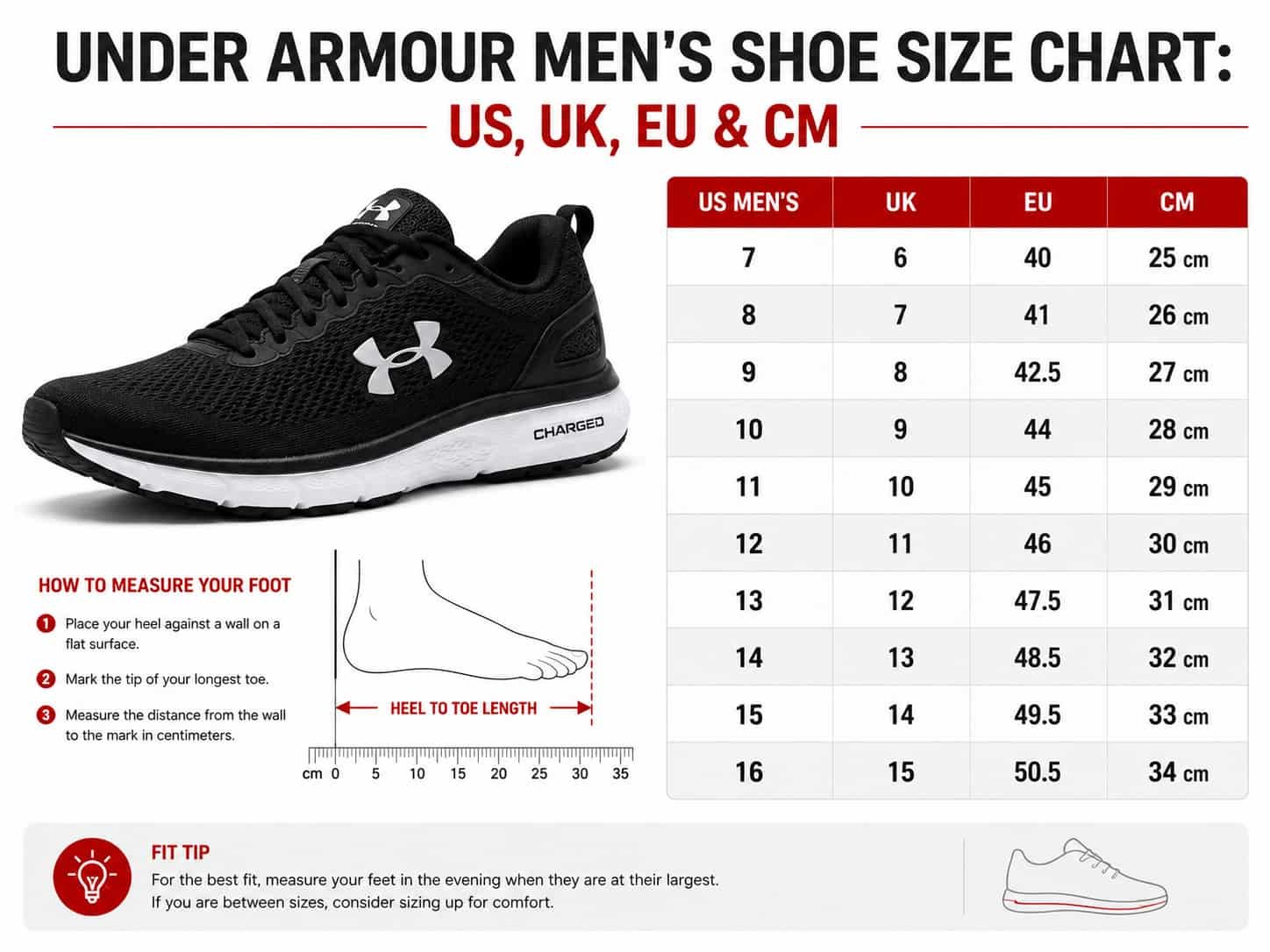
If you are comparing Under Armour men’s shoe sizes, start with your actual foot length in centimetres, then match that measurement to the Under Armour chart. For example, Under Armour currently lists 25 cm as US Men’s 7, UK 6 and EU 40, while 28 cm corresponds to US Men’s 10, UK 9 and EU 44. The chart continues through 34 cm, US Men’s 16, UK 15 and EU 50.5.
Under Armour recommends tracing your foot on paper while putting your full weight on it, measuring from heel to toe, and measuring later in the day. If your measurement falls between chart values, Under Armour recommends choosing the larger size.
The important point is simple: do not choose your Under Armour size from your usual number alone. Measure first, especially when ordering online.
Under Armour Men’s Shoe Size Chart
The Under Armour shoe size chart below shows the brand’s current men’s footwear conversion between US, UK, EU, centimetres and inches. Use the CM measurement as your main reference, then check the corresponding US, UK or EU size.
| US Men’s | UK | EU | CM | Foot Length |
| 7 | 6 | 40 | 25 | 9 11/16 in |
| 7.5 | 6.5 | 40.5 | 25.5 | 9 3/4 in |
| 8 | 7 | 41 | 26 | 9 15/16 in |
| 8.5 | 7.5 | 42 | 26.5 | 10 1/16 in |
| 9 | 8 | 42.5 | 27 | 10 1/4 in |
| 9.5 | 8.5 | 43 | 27.5 | 10 7/16 in |
| 10 | 9 | 44 | 28 | 10 9/16 in |
| 10.5 | 9.5 | 44.5 | 28.5 | 10 3/4 in |
| 11 | 10 | 45 | 29 | 10 15/16 in |
| 11.5 | 10.5 | 45.5 | 29.5 | 11 1/16 in |
| 12 | 11 | 46 | 30 | 11 1/4 in |
| 12.5 | 11.5 | 47 | 30.5 | 11 1/2 in |
| 13 | 12 | 47.5 | 31 | 11 11/16 in |
| 13.5 | 12.5 | 48 | 31.5 | 11 3/4 in |
| 14 | 13 | 48.5 | 32 | 12 in |
| 14.5 | 13.5 | 49 | 32.5 | 12 3/16 in |
| 15 | 14 | 49.5 | 33 | 12 1/4 in |
| 15.5 | 14.5 | 50 | 33.5 | 13 1/8 in |
| 16 | 15 | 50.5 | 34 | 13 1/4 in |
Find Your Under Armour Men’s Size
Enter your measured foot length in centimetres and compare it with the Under Armour men’s size chart.
This tool is a quick reference based on the Under Armour men’s footwear size chart. Always check the product-specific sizing information before purchasing.
The measurements above follow the current Under Armour men’s footwear chart. Because shoe-size systems do not convert perfectly mathematically, the relationship between US, UK, EU and CM sizes should be treated as a brand-specific conversion, not a universal formula.
The easiest way to use this chart
If your foot measures 28 cm, look for 28 cm rather than starting with a guessed US size. The current Under Armour chart maps 28 cm to US Men’s 10, UK 9 and EU 44.
If your foot measures 29.5 cm, the chart maps that measurement to US Men’s 11.5, UK 10.5 and EU 45.5.
That approach is much safer than assuming your Under Armour size must be identical to your size in another brand.
📌 Quick Reminder
Your usual shoe size is a useful starting point, but your measured foot length is the better reference when buying a new Under Armour model online. Check the size chart before placing the order.
Under Armour US to UK Shoe Size Conversion
Under Armour’s men’s footwear chart uses a straightforward relationship between its US Men’s and UK sizes across the listed range. For example, US Men’s 8 corresponds to UK 7, US Men’s 10 corresponds to UK 9, and US Men’s 12 corresponds to UK 11.
| US Men’s | UK |
| 7 | 6 |
| 7.5 | 6.5 |
| 8 | 7 |
| 8.5 | 7.5 |
| 9 | 8 |
| 9.5 | 8.5 |
| 10 | 9 |
| 10.5 | 9.5 |
| 11 | 10 |
| 11.5 | 10.5 |
| 12 | 11 |
| 12.5 | 11.5 |
| 13 | 12 |
| 13.5 | 12.5 |
| 14 | 13 |
| 14.5 | 13.5 |
| 15 | 14 |
| 15.5 | 14.5 |
| 16 | 15 |
If you normally buy shoes using UK sizing, it is still worth checking the corresponding CM value before ordering. This gives you another measurement-based reference instead of relying entirely on the conversion.
Under Armour US to EU Shoe Size Conversion
The EU number can look quite different from the US number, which is why shoppers sometimes order the wrong size when moving between sizing systems.
For example, Under Armour currently lists US Men’s 9 as EU 42.5, US Men’s 10 as EU 44, and US Men’s 12 as EU 46.
| US Men’s | EU |
| 7 | 40 |
| 7.5 | 40.5 |
| 8 | 41 |
| 8.5 | 42 |
| 9 | 42.5 |
| 9.5 | 43 |
| 10 | 44 |
| 10.5 | 44.5 |
| 11 | 45 |
| 11.5 | 45.5 |
| 12 | 46 |
| 12.5 | 47 |
| 13 | 47.5 |
| 13.5 | 48 |
| 14 | 48.5 |
| 14.5 | 49 |
| 15 | 49.5 |
| 15.5 | 50 |
| 16 | 50.5 |
One thing worth noticing is that the EU increments are not always perfectly uniform. That is another reason not to try converting sizes with a simple arithmetic rule.
For a broader comparison across brands and sizing systems, you can also use the global shoe size converter on Urban Style Footwear.
How to Measure Your Feet for Under Armour Shoes
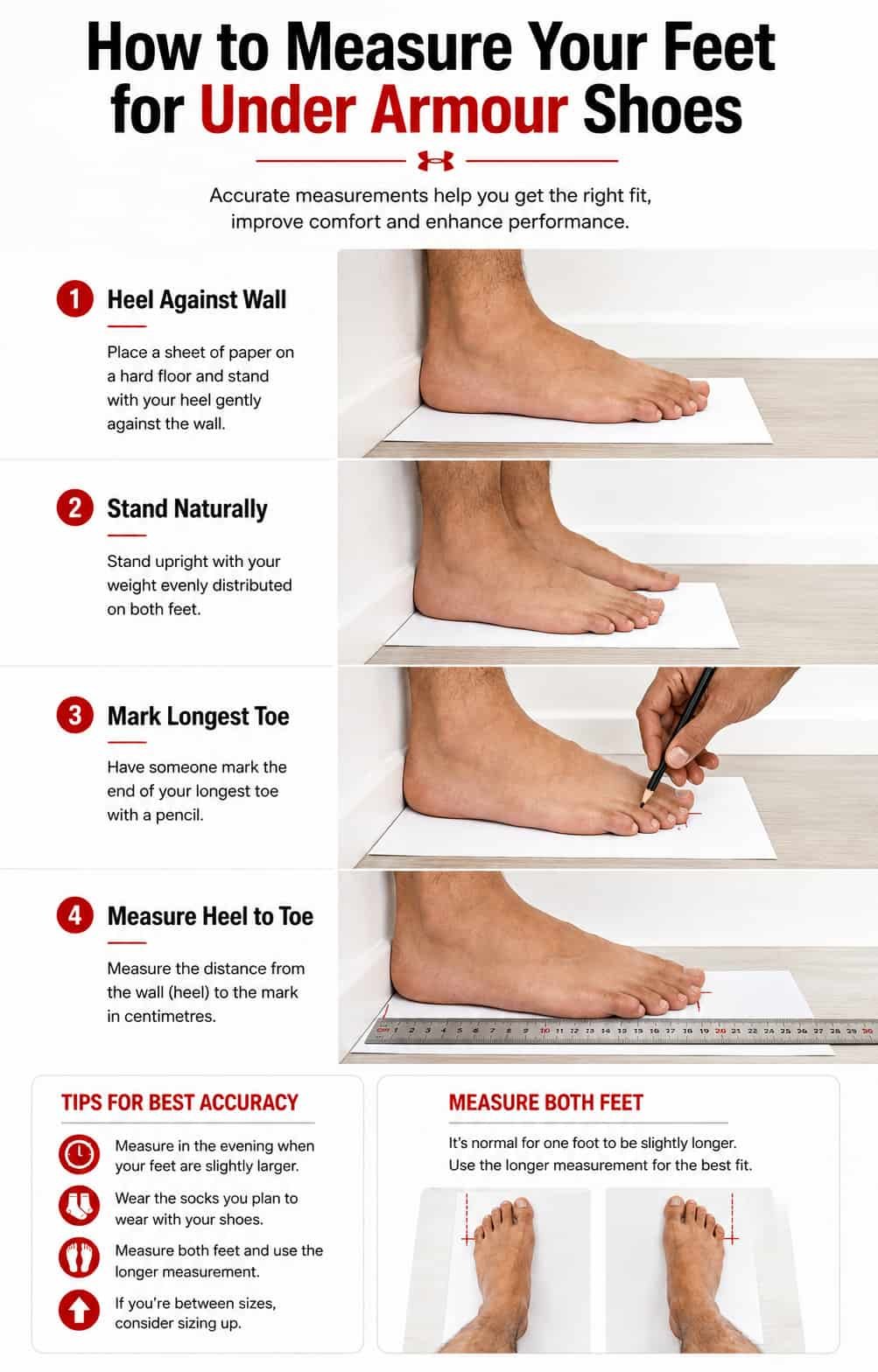
The most reliable Under Armour size conversion begins with a proper foot measurement. Under Armour recommends tracing the entire foot onto paper while putting your full weight on it and measuring from heel to toe. The brand also recommends measuring later in the day for better results.
You do not need specialist equipment. A sheet of paper, pencil, ruler and a wall are enough.
What you need
- A piece of paper larger than your foot
- A pencil
- A ruler or measuring tape
- The socks you normally wear with the shoes
- A flat floor
- A wall
Step 1: Put the paper on a hard floor
Place the paper against a wall on a firm, flat surface.
Avoid measuring on a thick carpet because your foot can sink into the surface and affect the result.
Step 2: Stand naturally
Place your heel gently against the wall and stand normally.
Do not sit down or point your toes forward. Your body weight should be on the foot being measured.
Step 3: Mark your longest toe
Have someone mark the end of your longest toe with a pencil.
Do not assume the big toe is always the longest. Foot shapes vary.
Step 4: Measure heel to toe
Measure the straight distance from the back of your heel to the longest toe.
Record the result in centimetres.
Step 5: Measure both feet
This is an important step that shoppers often skip.
Measure your left and right feet separately. It is common for one foot to be slightly longer than the other.
Use the measurement of the larger foot when choosing your shoe size.
Step 6: Compare your measurement with the Under Armour chart
Now compare the larger foot measurement with the CM column in the Under Armour shoe size chart.
If the measurement falls directly on a chart value, use the corresponding size as your starting point.
If your measurement falls between chart values, Under Armour recommends sizing up.
📏 Measurement Checklist
- Measure on a hard, flat surface.
- Stand with your full weight on the foot.
- Measure from heel to the longest toe.
- Measure both feet.
- Use the larger foot measurement.
- Measure later in the day when possible.
- Compare the result with the Under Armour CM column.
How Much Should You Trust the CM Measurement?
The centimetre measurement is one of the most useful parts of the Under Armour chart because it gives you a physical measurement to compare against your foot.
But there is an important distinction: the CM number in a footwear size chart should not automatically be interpreted as the exact internal length of the finished shoe.
A shoe needs space for your toes, the shape of the upper, the construction of the toe box and your natural movement. The number is best used as a sizing reference, not as a promise that the inside of the shoe measures exactly that number.
This is why measuring your foot and then checking the brand’s own chart is more useful than measuring the insole of a different pair of shoes and trying to transfer that number directly.
Are Under Armour Shoes True to Size?
Under Armour shoes should be selected using the brand’s own size chart and your measured foot length rather than assuming that every model will fit exactly like another brand.
The phrase “true to size” can be misleading because fit depends on more than length. The shape of the shoe, upper construction, toe-box design, intended activity, socks and individual foot shape can all affect how a shoe feels.
A better question is:
Does my foot measurement correspond to the size I am considering, and does that particular shoe provide the right shape and room for my foot?
Under Armour’s official guidance recommends measuring the foot from heel to toe and sizing up if the measurement falls between chart numbers.
So if you normally wear US Men’s 10 in another brand, do not automatically assume you should buy Under Armour US Men’s 10 without checking.
Your existing size is a useful reference. Your measured foot length is the stronger starting point.
How Should Under Armour Shoes Fit?
A correctly sized shoe should feel secure without squeezing your foot.
Your heel should stay reasonably stable when walking, your midfoot should feel supported rather than compressed, and your toes should have enough space to move naturally.
For performance shoes, especially running and training shoes, pay attention to how the shoe feels when you move rather than judging it only while standing still.
A good fit usually feels like this
- Your toes are not pressed against the front.
- Your heel does not repeatedly slip.
- Your midfoot feels secure without painful pressure.
- The widest part of your foot sits comfortably in the shoe.
- Your toes can move naturally.
- There are no obvious pressure points.
- The shoe feels stable when walking.
A poor fit may feel like this
- Toes touch the front while walking.
- Heel movement is excessive.
- The upper presses strongly across the forefoot.
- Your little toe feels squeezed.
- You need to overtighten the laces to keep the shoe on.
- Your foot slides forward inside the shoe.
A shoe does not become a good fit simply because you can force your foot into it.
What If You Are Between Under Armour Sizes?
If your foot measurement falls between the values on the Under Armour size chart, the brand recommends sizing up.
That recommendation is especially useful when ordering online because you cannot physically try the shoe on before purchase.
However, choosing the larger size should not mean buying dramatically oversized footwear.
The goal is to move to the next appropriate size, then check the actual fit of the particular model.
If you are between sizes, also consider:
- Whether you wear thick or thin socks
- Whether the shoe is intended for running or casual use
- Whether your feet tend to swell during activity
- Whether one foot is noticeably larger
- Whether you have a wider forefoot
- Whether the shoe feels secure around the heel
Choosing the Right Under Armour Size for Different Activities
The measurement used to choose your size does not change just because you are buying a running shoe instead of a casual shoe.
What changes is the importance of the fit characteristics around that measurement.
Running
For running shoes, pay close attention to heel security and forefoot comfort.
Your toes should not be forced against the front of the shoe during movement. A shoe that feels acceptable during a quick fitting can feel very different after several kilometres.
Training and gym workouts
Training shoes need a secure fit because you may move laterally, squat, lift or change direction.
Excessive heel movement can become distracting during these activities.
Walking
For walking, comfort over repeated steps matters.
Make sure the heel stays stable and the forefoot does not feel compressed.
Everyday casual use
For casual shoes, your normal socks and daily routine should be considered.
If you wear the shoes for several hours at a time, avoid selecting a size simply because it feels tight and secure for the first few minutes.
💡 Expert Tip
After years of fitting men’s footwear, one of the biggest lessons is simple: do not judge a shoe only by the number printed on the box. Compare the actual foot measurement, then evaluate heel security, forefoot space and overall comfort.
Common Under Armour Sizing Mistakes
Choosing the same size as your old shoes
Your old shoes may be from a different brand, model or sizing system.
Use them as a reference, but do not treat their size as proof that the same number will fit.
Measuring only one foot
One foot can be slightly longer than the other.
Always measure both and use the larger measurement as your reference.
Measuring while sitting
Your foot behaves differently when it is carrying your body weight.
Under Armour specifically recommends putting your full weight on the foot while tracing it.
Measuring at the end of the day only after buying
Feet can change slightly throughout the day.
Under Armour recommends measuring later in the day for the best results.
Assuming EU sizes are universal
An EU 44 is not necessarily going to have exactly the same fit across every brand and model.
Brand-specific charts matter.
Buying oversized shoes for extra comfort
Going too large can create unnecessary movement.
More space is not automatically more comfort.
Ignoring socks
If you normally wear performance socks with your running shoes, measure with those socks on.
The small difference can matter when your fit is already close.
How to Check Your Fit After Receiving the Shoes
Finding the correct number is only half of the process.
When the shoes arrive, try them on with the socks you expect to use.
Walk around indoors first.
Pay attention to your heel, forefoot and toes.
Your heel should not repeatedly lift out of the shoe. Your toes should not be pressed against the front. The shoe should feel secure without requiring you to tighten the laces excessively.
If something feels wrong immediately, do not assume the shoe will automatically become comfortable simply because the size number is correct.
A good size and a good shape have to work together.
👟 Fit Check
- Walk normally rather than standing completely still.
- Check that the heel feels secure.
- Make sure your toes are not touching the front.
- Check for pressure across the widest part of your foot.
- Try the shoes with your normal socks.
- Pay attention to any immediate rubbing or uncomfortable pressure.
Under Armour Shoe Size Conversion: A Practical Example
Imagine your left foot measures 27.8 cm and your right foot measures 28.0 cm.
Use the larger measurement: 28.0 cm.
The Under Armour chart places 28 cm at:
US Men’s 10
UK 9
EU 44
CM 28
That gives you a much stronger starting point than saying, “I usually wear a US 10, so I will order a US 10.”
The difference is subtle but important.
In the first approach, the size is based on your foot.
In the second, the foot is being forced to match a number you already know.
Under Armour Shoe Size Chart vs Your Existing Shoes
If you already own a pair of comfortable shoes, you can use them as a secondary reference.
Look at the size printed on the label.
Then measure your foot separately.
If your existing shoe says US Men’s 10 and your measured foot corresponds to Under Armour US Men’s 10, that is reassuring.
But if your current shoe says US Men’s 10 and your foot measurement points toward another Under Armour size, investigate the measurement rather than automatically copying the old number.
Different brands and different shoe constructions can create different fit experiences.
This is especially important when switching between running shoes, training shoes and lifestyle footwear.
For a broader men’s sizing reference, you can compare your measurement with the men’s shoe size chart before deciding which brand-specific chart to use.
Under Armour Shoes for Wider Feet
Length is only one part of shoe fit.
A person can have a foot that measures correctly for a particular length but still feel uncomfortable because the shoe shape does not provide enough room through the forefoot.
If you have a wider foot, look for signs of pressure across the ball of the foot and around the little-toe area.
Do not solve a width problem automatically by moving several sizes up.
Going longer may create too much space in front of your toes while leaving the width issue unresolved.
The better approach is to find a shoe shape that accommodates your foot.
When Should You Recheck Your Under Armour Shoe Size?
You do not need to measure your feet every time you buy shoes.
But rechecking your measurement can be useful when:
- Your last measurement was several years ago.
- Your usual size suddenly feels uncomfortable.
- You are changing brands.
- You are buying a different type of footwear.
- You notice one foot has changed.
- You are buying expensive performance shoes online.
- Your existing shoes are consistently tight or loose.
A quick measurement can save much more time than dealing with the wrong size after an online order.
Expert Tips for Choosing Under Armour Shoes
Expert Tip 1: Start with centimetres
US and UK numbers are convenient, but the CM measurement gives you a physical reference for comparing your foot with the brand chart.
Expert Tip 2: Measure the larger foot
Do not choose your size from the shorter foot. Measure both feet and use the larger result as your reference.
Expert Tip 3: Measure with your normal socks
If you will wear performance socks with your shoes, include them during the fitting process so the measurement and fit check better reflect real use.
Expert Tip 4: Do not chase extra room
A larger shoe is not automatically a more comfortable shoe. You want enough room for natural movement without creating unnecessary sliding.
Frequently Asked Questions
What size is a 28 cm foot in Under Armour men’s shoes?
A 28 cm foot corresponds to US Men’s 10, UK 9 and EU 44 on the current Under Armour men’s footwear chart. Use the measurement of your larger foot when comparing with the chart, and remember that the CM value is a sizing reference rather than a guarantee of the shoe’s internal length.
What size is US Men’s 10 in Under Armour?
Under Armour currently lists US Men’s 10 as UK 9, EU 44 and 28 cm. If you already know that US 10 is your usual size, it is still worth checking your foot measurement before ordering a new model online.
What size is US Men’s 9 in Under Armour?
US Men’s 9 corresponds to UK 8, EU 42.5 and 27 cm in the current Under Armour men’s footwear chart. If your foot measures differently, use the CM measurement as your primary reference rather than automatically selecting US 9.
What size is US Men’s 12 in Under Armour?
Under Armour lists US Men’s 12 as UK 11, EU 46 and 30 cm. This conversion applies to the current men’s footwear size chart, so it is a useful reference when converting from US to UK or EU sizing.
Are Under Armour shoes the same size as Nike or Adidas?
Not necessarily. Even when two brands use the same US size, their shoe shapes, lasts and fit characteristics can differ. Your usual size in another brand is useful background information, but it should not replace checking the Under Armour chart and measuring your feet.
Should I size up in Under Armour shoes?
Under Armour’s official footwear guidance says that if your foot measurement falls between the numbers on its chart, you should size up. That does not mean choosing a much larger shoe when your measurement falls directly on a chart value.
Is the Under Armour CM size the actual shoe length?
No. Treat the CM figure as the brand’s sizing reference for foot measurement. A finished shoe also has internal construction, toe-box shape and space for movement, so the number should not be interpreted as an exact measurement of the shoe’s internal length.
Should I measure both feet before buying Under Armour shoes?
Yes. Measuring both feet is a smart habit because one foot can be slightly longer than the other. Use the larger measurement when comparing your feet with the Under Armour size chart.
When is the best time to measure my feet?
Under Armour recommends measuring later in the day for the best results. Your feet can change slightly throughout the day, so an evening measurement can provide a more realistic reference for everyday footwear.
How do I measure my feet at home for Under Armour shoes?
Place your foot on paper against a wall, stand naturally with your full weight on the foot, trace or mark the longest point, and measure from the back of the heel to the longest toe. Repeat the process for both feet and compare the larger measurement with the Under Armour CM chart.
What should I do if my Under Armour shoes feel tight even though the size is correct?
Check where the pressure occurs. If the problem is across the forefoot rather than at the front of the toes, increasing length may not solve it. The shoe’s shape and width can be just as important as the numerical size.
Should I buy a larger Under Armour shoe for running?
Do not automatically buy a larger size simply because the shoe is for running. Start with your measured foot length and the Under Armour chart. Then assess heel security, toe clearance and forefoot comfort in the particular running shoe.
Conclusion
Choosing the right Under Armour shoe size does not have to involve guesswork.
The best starting point is your actual foot measurement, particularly the larger of your two feet. Compare that measurement with the Under Armour men’s shoe size chart, then check the corresponding US, UK and EU sizes.
If your measurement falls between chart values, Under Armour recommends sizing up.
Remember that a size number alone cannot tell you whether a shoe will feel perfect. Your foot shape, the shoe’s construction, your socks and the activity you plan to do all influence the final fit.
If you are buying online, take a few minutes to measure your feet before ordering. That small step can make the difference between a shoe that simply fits on paper and one that feels genuinely comfortable when you wear it.
For a wider comparison, you can also check Urban Style Footwear’s men’s shoe size chart or use the shoe size conversion calculator when comparing different sizing systems.
Related Reading
If you are comparing Under Armour with other footwear brands, these guides can help: