
New Balance Shoe Size Chart (US, UK, EU) + CM Conversion Guide
Quick AI-ready summary
Quick Answer
- New Balance men’s shoes use US men’s sizing with corresponding UK, EU and CM measurements.
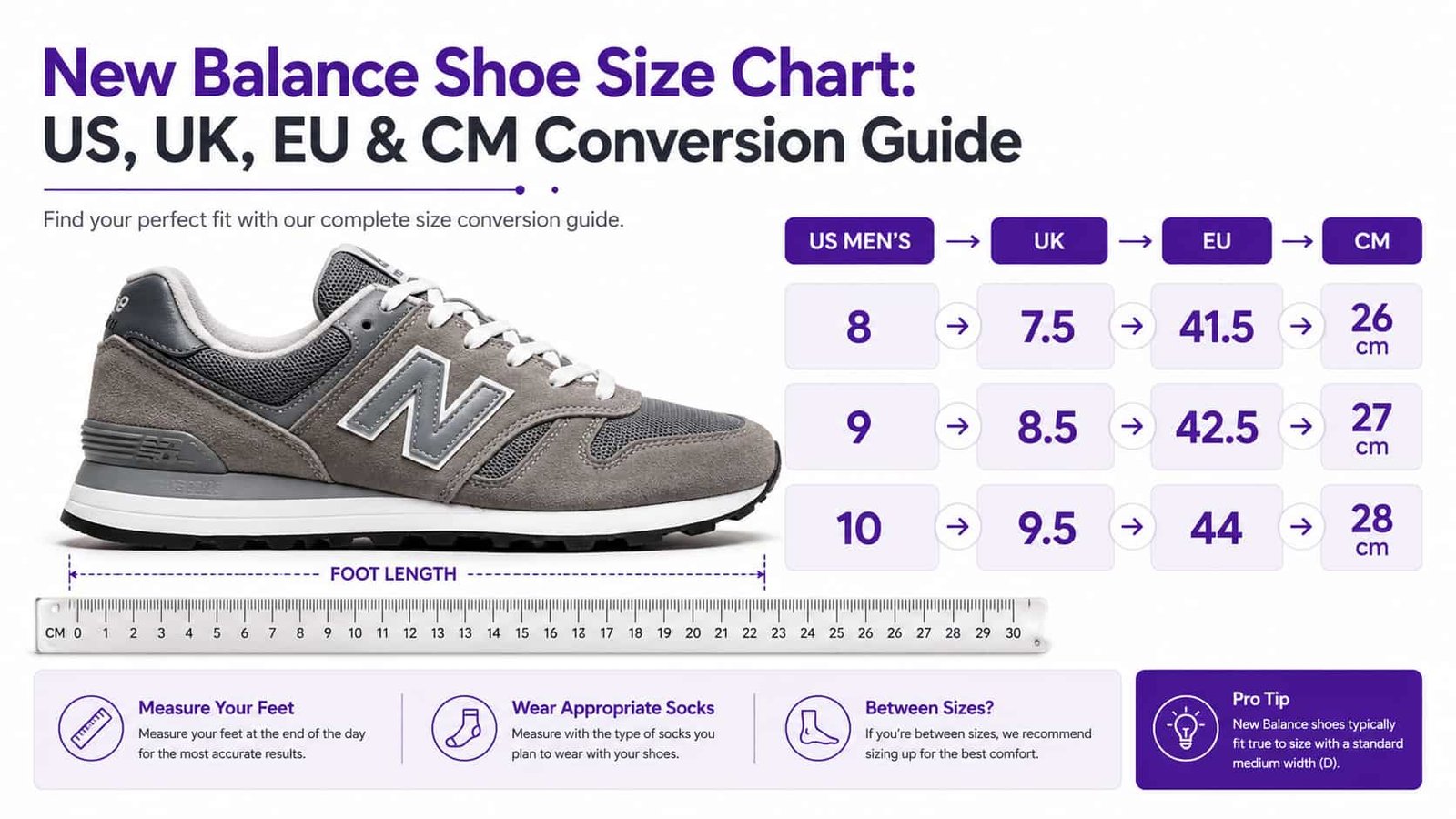
- For example, a New Balance men’s US 9 corresponds to UK 8.5, EU 42.5 and approximately 27 cm.
- New Balance says its shoes generally run true to size, although individual styles can fit differently.
- Measure both feet before ordering and use the longer foot as your reference.
- Do not choose a larger size simply because you want extra room. Check length and width first.
If you’re buying New Balance shoes online, getting the right size starts with foot length and width, not just your usual shoe number. The official New Balance men’s size guide maps US sizes to UK, EU and centimeter measurements, while also providing width options such as Narrow, Standard, Wide and X-Wide.
For example, a New Balance men’s US 8 corresponds to UK 7.5, EU 41.5 and a 26 cm foot length. A US 9 corresponds to UK 8.5, EU 42.5 and 27 cm.
The safest approach is simple: measure both feet, compare the longer foot with the New Balance chart, and consider width as well as length before ordering.
New Balance Men’s Shoe Size Chart
The table below shows New Balance men’s and unisex shoe sizes with their corresponding US, UK, EU and foot-length measurements. These measurements follow the current New Balance sizing information.
| New Balance US Men’s | UK | EU | Foot Length (cm) | Foot Length (in) |
| 4 | 3.5 | 36 | 22 | 8 5/8 |
| 4.5 | 4 | 37 | 22.5 | 8 7/8 |
| 5 | 4.5 | 37.5 | 23 | 9 |
| 5.5 | 5 | 38 | 23.5 | 9 1/4 |
| 6 | 5.5 | 38.5 | 24 | 9 1/2 |
| 6.5 | 6 | 39.5 | 24.5 | 9 5/8 |
| 7 | 6.5 | 40 | 25 | 9 7/8 |
| 7.5 | 7 | 40.5 | 25.5 | 10 |
| 8 | 7.5 | 41.5 | 26 | 10 1/4 |
| 8.5 | 8 | 42 | 26.5 | 10 3/8 |
| 9 | 8.5 | 42.5 | 27 | 10 5/8 |
| 9.5 | 9 | 43 | 27.5 | 10 7/8 |
| 10 | 9.5 | 44 | 28 | 11 |
| 10.5 | 10 | 44.5 | 28.5 | 11 1/4 |
| 11 | 10.5 | 45 | 29 | 11 3/8 |
| 11.5 | 11 | 45.5 | 29.5 | 11 5/8 |
| 12 | 11.5 | 46.5 | 30 | 11 3/4 |
| 12.5 | 12 | 47 | 30.5 | 12 |
| 13 | 12.5 | 47.5 | 31 | 12 1/4 |
| 14 | 13.5 | 49 | 32 | 12 5/8 |
| 15 | 14.5 | 50 | 33 | 13 |
| 16 | 15.5 | 51 | 34 | 13 3/8 |
| 17 | 16.5 | 52 | 35 | 13 3/4 |
| 18 | 17.5 | 53 | 36 | 14 1/8 |
| 19 | 18.5 | 54 | 37 | 14 5/8 |
| 20 | 19.5 | 55 | 38 | 15 |
Find Your New Balance Shoe Size
Enter your measured foot length to get an estimated New Balance size.
Important: New Balance lists sizes in half-size increments across much of its men’s range, so do not assume that a whole-number US size is your only option. Always compare your measured foot length with the chart.
If you are unsure of your overall men’s shoe size before looking at a specific brand, use our men’s shoe size chart for a broader US, UK, EU and CM reference.
📏 New Balance Size Snapshot
US Men’s 8: UK 7.5 | EU 41.5 | 26 cm
US Men’s 9: UK 8.5 | EU 42.5 | 27 cm
US Men’s 10: UK 9.5 | EU 44 | 28 cm
US Men’s 11: UK 10.5 | EU 45 | 29 cm
US Men’s 12: UK 11.5 | EU 46.5 | 30 cm
What Size Is New Balance US 8 in UK and EU?
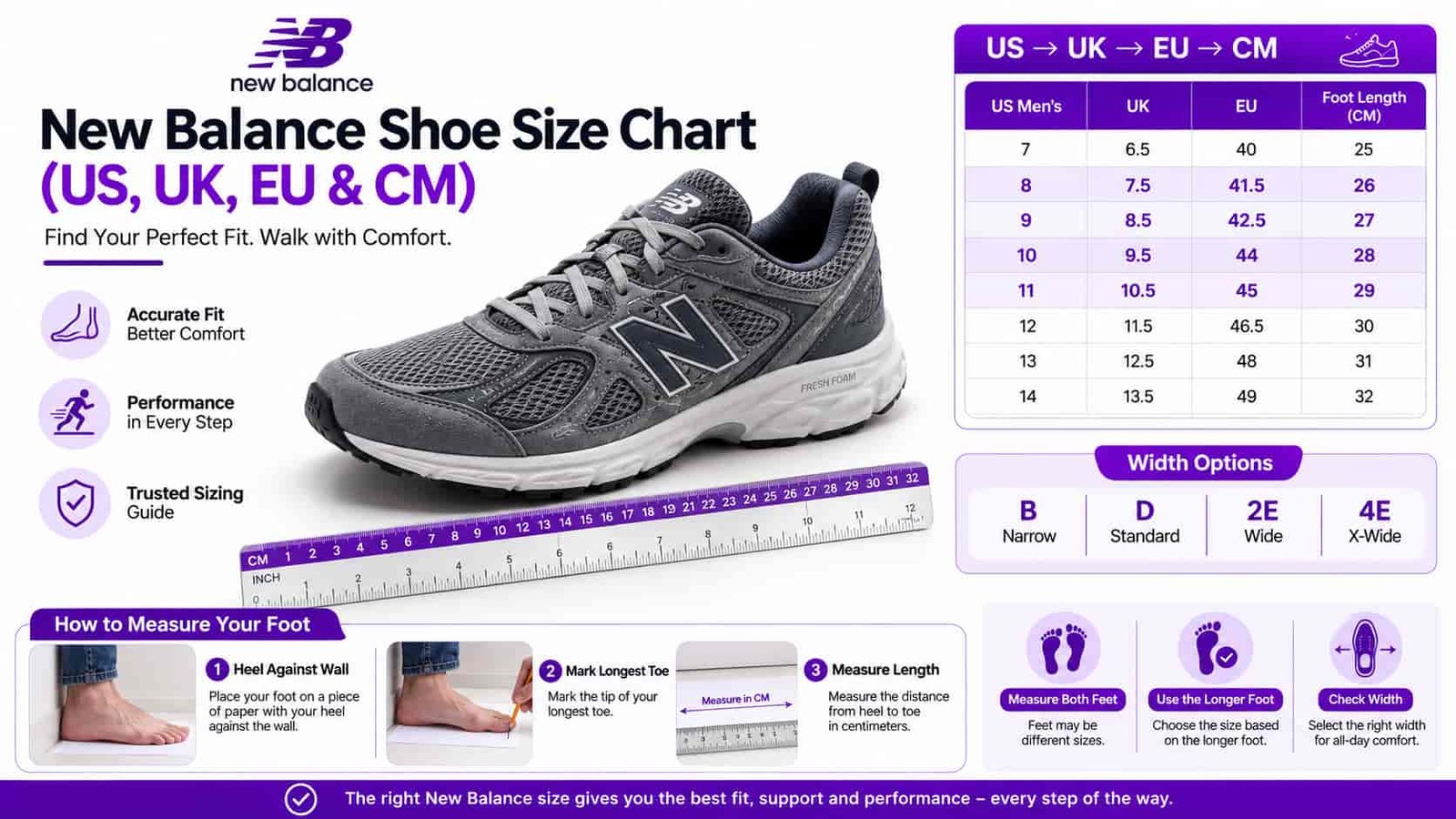
A New Balance men’s US 8 is UK 7.5 and EU 41.5, with a listed foot length of 26 cm.
| New Balance US | UK | EU | CM |
| 7 | 6.5 | 40 | 25 |
| 7.5 | 7 | 40.5 | 25.5 |
| 8 | 7.5 | 41.5 | 26 |
| 8.5 | 8 | 42 | 26.5 |
| 9 | 8.5 | 42.5 | 27 |
| 9.5 | 9 | 43 | 27.5 |
| 10 | 9.5 | 44 | 28 |
This is particularly useful when you’re shopping from a retailer that displays UK or EU sizing instead of US sizing.
How Does New Balance Shoe Size Conversion Work?
New Balance provides direct US, UK, EU and centimeter equivalents, but the conversion is not a simple mathematical formula. The EU number can change by different increments as the US size increases, which is why using a brand-specific chart is safer than applying a generic conversion rule.
For example:
- US 7 = UK 6.5 = EU 40 = 25 cm
- US 8 = UK 7.5 = EU 41.5 = 26 cm
- US 9 = UK 8.5 = EU 42.5 = 27 cm
- US 10 = UK 9.5 = EU 44 = 28 cm
- US 11 = UK 10.5 = EU 45 = 29 cm
- US 12 = UK 11.5 = EU 46.5 = 30 cm
If you regularly switch between American, British and European shoe sizes, our global shoe size converter can make the conversion process easier.
Do not choose a New Balance size simply because it matches the size printed inside your current shoes. Different brands can use different sizing systems. Measure your foot and compare that measurement with the New Balance chart before ordering.
Is New Balance True to Size?
New Balance sizing should be evaluated against the specific model, your foot shape and the width you need rather than assuming every shoe will fit exactly the same.
New Balance provides multiple width options for men’s shoes, including Narrow B, Standard D, Wide 2E and X-Wide 4E in its men’s width guide.
That matters because two people can have the same foot length but need different widths.
For example, someone with a 27 cm foot may both measure for a US 9, but one person may be comfortable in Standard D while another may need Wide 2E.
When shopping, check:
- Foot length
- Foot width
- Intended socks
- Shoe model
- Running or walking activity
- Personal fit preference
The goal is not simply to find a number. The goal is to find the size and width combination that gives your foot enough room without excessive movement.
New Balance Men’s Width Guide
New Balance offers several men’s width options, making width an important part of the fitting process. The current New Balance guide identifies Narrow B, Standard D, Wide 2E and X-Wide 4E options.
| Width | New Balance Width Code | General Description |
| Narrow | B | Narrower fit |
| Standard | D | Standard men’s width |
| Wide | 2E | Wider fit |
| X-Wide | 4E | Extra-wide fit |
Width measurements also vary according to shoe size. For example, at men’s US 9, New Balance lists approximately 10.0 cm for Narrow B, 10.4 cm for Standard D, 10.7 cm for Wide 2E and 11.0 cm for X-Wide 4E.
This is why measuring only the length of your foot may not tell the entire story.
How to Measure Your Feet for New Balance Shoes
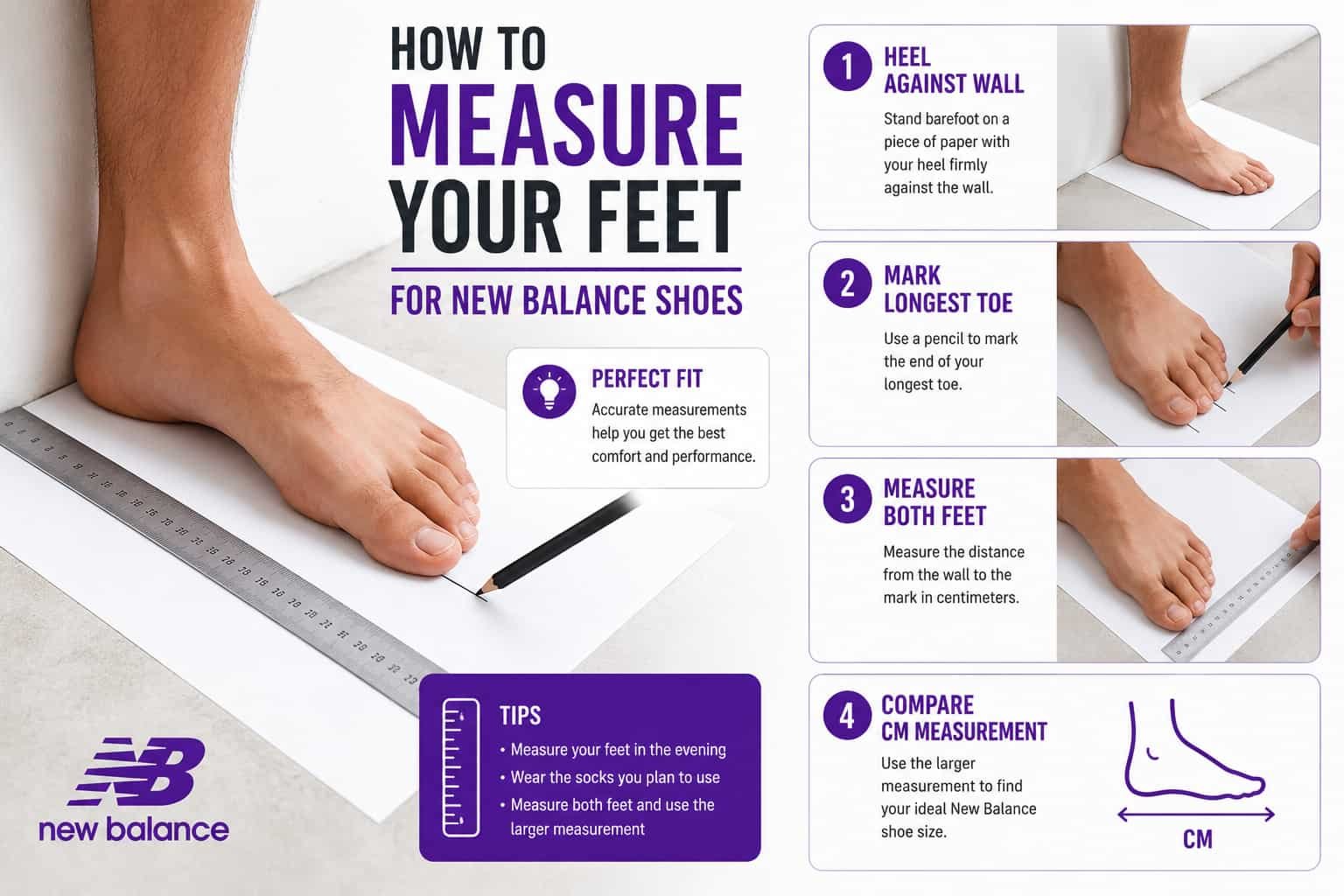
Measuring at home takes only a few minutes and can significantly reduce the chance of ordering the wrong size.
What You Need
- A sheet of paper
- A pen or pencil
- A ruler or measuring tape
- The socks you normally wear
- A flat wall or hard floor
Measure Your Foot
Place the paper on a hard, flat surface with one edge against a wall.
Stand naturally with your heel against the wall. Keep your weight evenly distributed on the foot.
Mark the end of your longest toe. Do not automatically assume the big toe is the longest because some people have a longer second toe.
Measure from the edge of the paper at your heel to the longest toe mark.
Repeat the process for the other foot.
Use the longer measurement when selecting your New Balance size.
New Balance’s current printable sizing tool also recommends measuring in the late afternoon, when feet can be at their largest, and choosing the larger size when between sizes or when one foot is longer than the other.
For a complete visual walkthrough, see our how to measure foot size at home guide.
Measure both feet, record the longer foot in centimeters, then compare that measurement with the New Balance size chart. If you fall between sizes, pay attention to New Balance’s sizing guidance and the fit requirements of the specific shoe.
Why Foot Length Matters More Than Your Usual Shoe Size
Your usual shoe size is a useful starting point, but it is not a measurement.
Feet can change over time. One foot may also be slightly longer or wider than the other.
That is why a person who normally buys a US 9 may discover that a different measurement points toward another size or width in a particular brand or model.
A measured foot length gives you an objective starting point.
For example, if your longer foot measures approximately 27 cm, the New Balance men’s chart corresponds to US 9, UK 8.5 and EU 42.5.
What If You Are Between New Balance Sizes?
Being between sizes is common, especially because feet do not always measure exactly to a half-size.
Start by checking your actual measurement rather than immediately sizing up.
New Balance’s current sizing tool says that if you are between sizes, or one foot is longer than the other, choose the larger size.
However, avoid deliberately buying a much larger shoe just to create extra growing room. Excess space can cause your foot to slide forward and can affect stability.
A better approach is to select the closest appropriate size and then evaluate the width, heel hold and toe-box space.
How Should a New Balance Shoe Fit?
A properly fitting New Balance shoe should feel secure around the heel and midfoot while leaving adequate room for your toes.
Check these areas before deciding the shoe fits:
- Your toes should not be pressed against the front.
- Your heel should stay reasonably secure while walking.
- Your widest part of the foot should not feel squeezed.
- Your toes should have room to move naturally.
- There should not be painful pressure points.
- The shoe should feel comfortable with the socks you normally wear.
Do not confuse a snug upper with a properly fitted shoe. A shoe can feel secure while still being too narrow.
Buying the same New Balance size you have always worn without measuring your feet can be misleading. Your foot length and width are more useful than memory when ordering a new pair online.
How Do New Balance Width Sizes Compare?
New Balance’s width system is one of the most useful things to understand before buying.
For men’s shoes, the current guide identifies:
B = Narrow
D = Standard
2E = Wide
4E = X-Wide
This means the number alone does not always tell you the complete fit.
For someone with a broader forefoot, choosing a wider New Balance option in the correct length can be more appropriate than simply increasing the shoe length.
New Balance Shoe Size Conversion: US to UK
Here are some common men’s conversions from the New Balance chart:
| US Men’s | UK | EU | CM |
| 6 | 5.5 | 38.5 | 24 |
| 7 | 6.5 | 40 | 25 |
| 8 | 7.5 | 41.5 | 26 |
| 9 | 8.5 | 42.5 | 27 |
| 10 | 9.5 | 44 | 28 |
| 11 | 10.5 | 45 | 29 |
| 12 | 11.5 | 46.5 | 30 |
| 13 | 12.5 | 47.5 | 31 |
| 14 | 13.5 | 49 | 32 |
| 15 | 14.5 | 50 | 33 |
If you need more general conversion information, see our shoe size conversion chart and calculator.
New Balance Shoe Size Conversion: US to EU
The New Balance EU equivalent is not always what you might expect from a generic conversion chart.
For example:
- US 7 = EU 40
- US 8 = EU 41.5
- US 9 = EU 42.5
- US 10 = EU 44
- US 11 = EU 45
- US 12 = EU 46.5
- US 13 = EU 47.5
- US 14 = EU 49
- US 15 = EU 50
This is a good reason to use a New Balance-specific chart rather than relying exclusively on a generic US-to-EU calculator.
How Often Should You Recheck Your New Balance Shoe Size?
For adults, foot measurements do not usually need to be checked as frequently as children’s sizes, but they can still change.
New Balance’s current sizing tool recommends remeasuring your feet each year because size and width can change over time.
It is also worth measuring again if:
- Your shoes suddenly feel tighter.
- Your feet have changed shape.
- You are buying a different shoe type.
- You are switching brands.
- Your preferred width has changed.
- You notice pressure around the toes or forefoot.
New Balance Size Chart vs Generic Shoe Size Charts
A generic chart can help you understand basic US, UK and EU conversions, but a brand-specific chart is usually more useful when purchasing a particular brand.
New Balance provides its own length and width information, including centimeter measurements and multiple men’s width options.
That means you should use:
Generic chart: for understanding overall size conversion.
New Balance chart: for choosing New Balance footwear.
Your foot measurement: for making the final size decision.
This three-step approach is much more reliable than simply ordering the size you normally wear.
✓ New Balance Buying Checklist
- Measure both feet.
- Record the longer foot measurement.
- Compare the measurement with the New Balance chart.
- Check US, UK and EU conversions carefully.
- Check whether the model is available in your required width.
- Read the specific product page for model-level fit information.
- Consider the socks you normally wear.
- Check the retailer’s return or exchange policy before ordering.
Frequently Asked Questions
Is New Balance true to size?
New Balance does not have one universal fit that will feel identical across every model and every foot. Your best starting point is to measure your foot and use the New Balance size and width guide. The same length can feel very different depending on whether you need Standard, Wide or X-Wide footwear.
What is a New Balance men’s US 9 in UK size?
A New Balance men’s US 9 corresponds to UK 8.5. The same size is listed as EU 42.5 with a foot length of 27 cm in the current New Balance men’s size guide.
What is New Balance US 8 in EU?
New Balance men’s US 8 corresponds to EU 41.5 and UK 7.5. The listed foot length is 26 cm.
What is New Balance US 10 in centimeters?
New Balance lists men’s US 10 as a 28 cm foot length. The corresponding UK size is 9.5 and the EU size is 44.
Should I measure both feet before buying New Balance shoes?
Yes. Your feet may not be exactly the same length. Measure both and use the longer foot when comparing your measurement with the New Balance size chart. New Balance also recommends choosing the larger size when one foot is longer or when you are between sizes.
What does 2E mean in New Balance men’s shoes?
2E is New Balance’s men’s Wide width designation. It provides more width than the Standard D option. New Balance also offers Narrow B and X-Wide 4E options for men’s footwear.
What does 4E mean in New Balance shoes?
4E is New Balance’s X-Wide men’s width designation. It is intended for feet that require more width than the Standard D or Wide 2E options.
Should I size up in New Balance shoes?
Not automatically. First measure your feet and compare the measurement with the New Balance chart. If you are between sizes, New Balance’s sizing tool recommends choosing the larger size.
Is New Balance sizing the same as Nike or Adidas?
Not necessarily. Each brand can use its own sizing references and fit characteristics. If you are switching from another brand, measure your feet rather than assuming the same US size will produce the same fit.
You can compare brand-specific guides using our Nike shoe size chart and Adidas shoe size chart.
What is the best way to measure feet for New Balance shoes?
Stand on a sheet of paper placed against a wall, keep your heel against the wall, mark your longest toe and measure the distance. Repeat for the other foot and use the longer measurement. Measuring later in the day is recommended by New Balance’s current sizing tool.
Does New Balance offer wide men’s shoes?
Yes. New Balance’s men’s width guide includes Narrow B, Standard D, Wide 2E and X-Wide 4E options. The available width can vary by shoe model, so check the product listing before ordering.
Should I use centimeters or inches when choosing New Balance shoes?
Centimeters are often easier for comparing your actual foot measurement with the New Balance chart. For example, a 27 cm foot corresponds to men’s US 9, UK 8.5 and EU 42.5 in the current New Balance guide.
Find Your New Balance Size With Confidence
The best way to choose a New Balance men’s shoe size is to combine your actual foot measurement with the brand’s size chart and the fit information for the specific model. Your normal shoe size is a useful starting point, but it should not be the only thing you consider.
Measure both feet, use the longer foot as your reference, compare the measurement with the New Balance US, UK and EU chart, and pay attention to width. If you fall between sizes, New Balance recommends choosing the larger size.
A few minutes of measuring before you order can make online shoe shopping much easier and reduce the chances of ending up with a pair that feels too short, too loose or too narrow.