
How to Measure Men’s Feet at Home: The Complete Measurement Guide
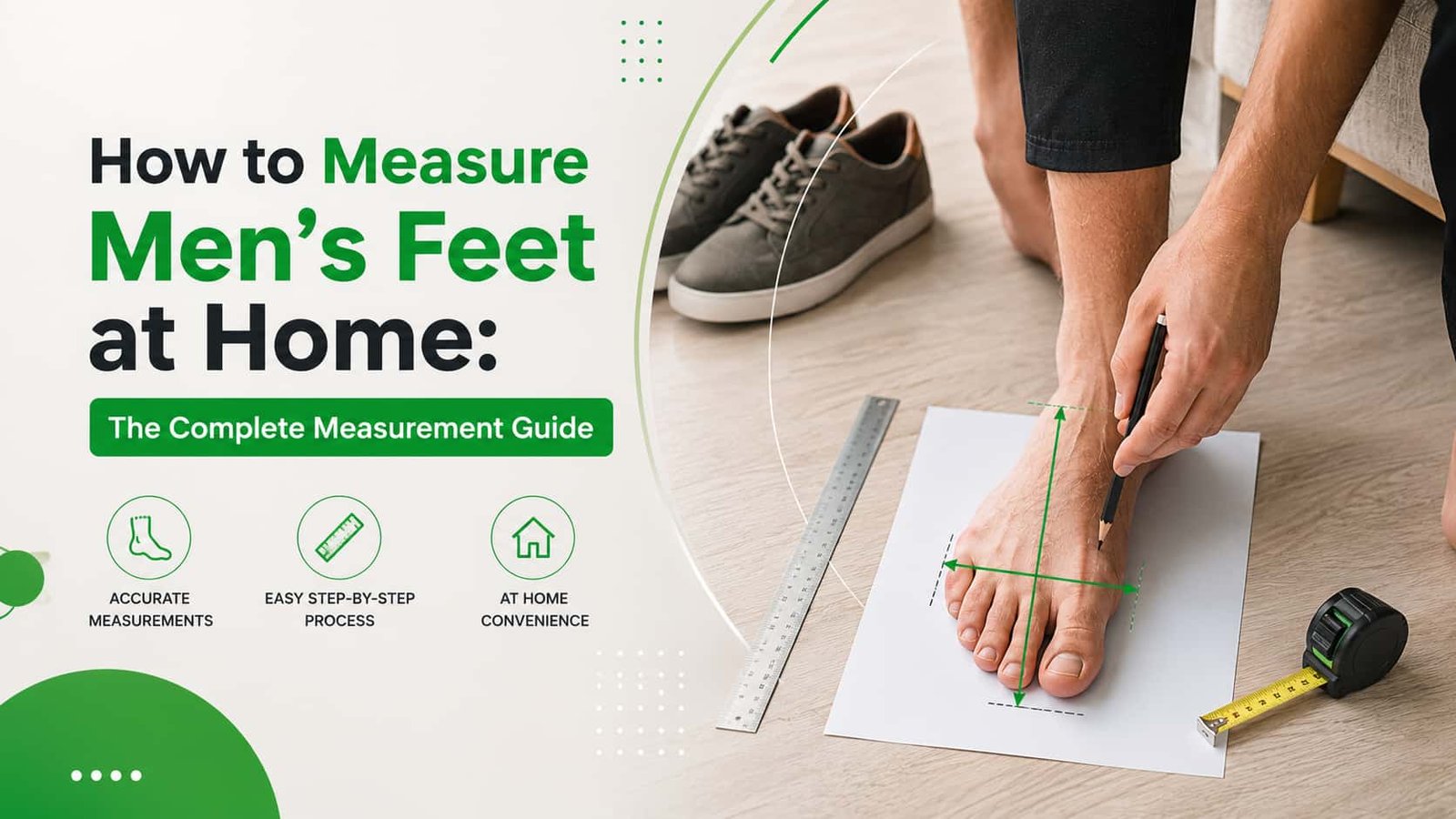
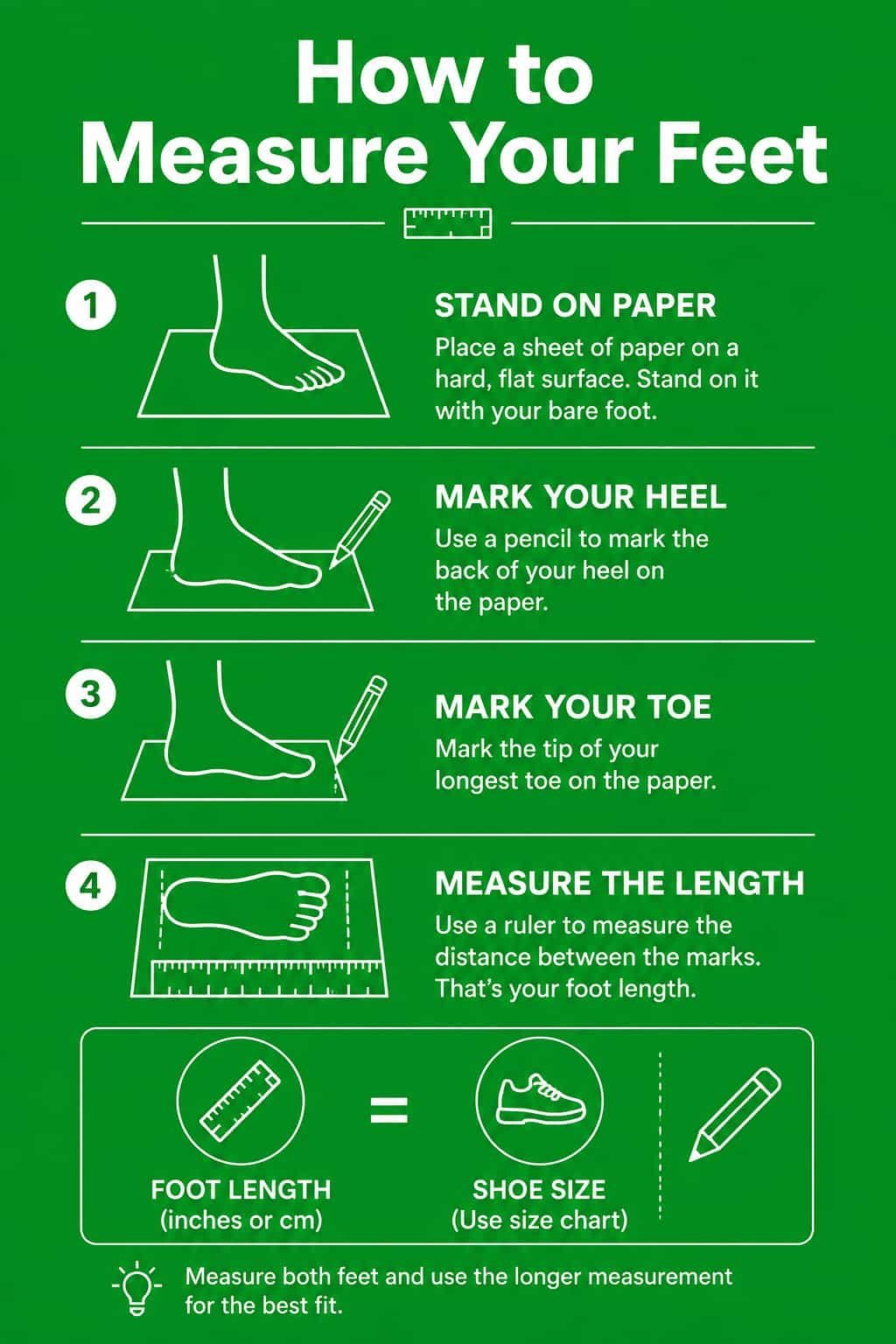
Measuring your feet at home takes five minutes and requires only a ruler, pencil, and sheet of paper. Foot length in inches or centimeters is the most reliable predictor of your shoe size, far more accurate than guessing based on a previous size or relying on what feels comfortable. To measure correctly, you need to stand on paper with your full body weight, mark your heel and longest toe with a pencil, then measure the distance. You should also measure your foot width across the ball of the foot, since width affects fit as much as length. Many men have never measured their feet and discover they have been wearing the wrong size for years. After two decades fitting thousands of customers, the men who report the highest satisfaction with their shoes are those who took five minutes to measure before purchasing, regardless of the final size number.
⚡ Quick Answer
- Measuring foot length is more accurate than trusting a previous size.
- Measure both feet standing up, using a pencil and ruler.
- Take measurements in the evening when feet are naturally larger.
- Measure both length and width for complete shoe sizing accuracy.
Why Accurate Foot Measurement Matters
Every man has unique feet. Shoe sizes are not standardized across brands, and relying on a printed size from another shoe often leads to purchasing shoes that do not fit. A size 10 from one brand can measure up to half a size different from a size 10 from another manufacturer. Measuring your actual foot dimensions removes all guesswork and gives you the one number that does not change: your foot length in inches or centimeters.
Most men have worn the wrong shoe size for years without realizing it. Red marks after an hour of wear, pressure across the ball of the foot, or dark toenails are all signs that shoes are too narrow or too short. Many men accept this as normal and blame their feet as being difficult to fit. In reality, they have simply never measured their true dimensions.
Measuring also helps you understand your shoe size across different sizing systems. A measurement of 10.25 inches translates consistently to a US size 9, UK size 8.5, or EU size 42, regardless of which country you are ordering from. Once you have measured your foot, you can confidently order shoes online from any retailer worldwide.
👟 Did You Know?
Your feet can grow throughout your life, especially if you gain weight or experience hormonal changes. Men in their thirties often need different shoe sizes than they wore at twenty. Remeasuring every two years catches these gradual changes before discomfort sets in.
What You Need to Measure Your Feet
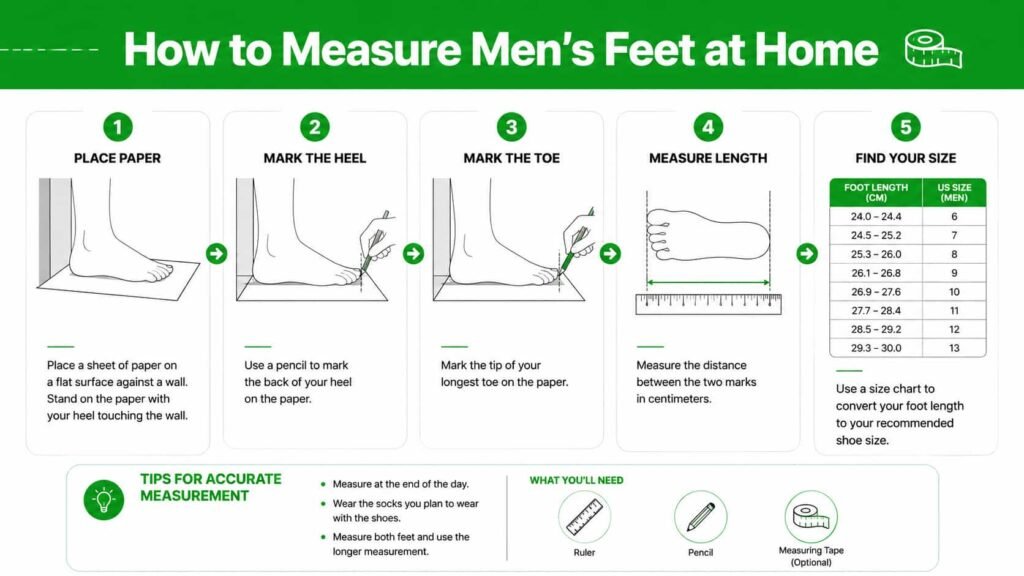
Measuring your feet requires minimal equipment. A blank sheet of paper, a pencil, and a ruler or measuring tape are all you need. You can use either inches or centimeters for measurement, though centimeters are the international standard and work better for online international orders. Make sure your ruler is long enough to measure the full length of your foot. A 12-inch ruler works for most adult men, but men with larger feet might need a longer measuring device.
The surface you measure on must be hard and flat. Carpeting compresses under your weight and gives inaccurate readings. Wood floors, tile, or even a clipboard over carpet work well. The paper should not slide around while you are standing on it, so place it against a wall or secure it with tape if needed.
Lighting matters more than you might think. Good lighting helps you see exactly where your longest toe extends and where your heel is positioned. Measure in a well-lit room, ideally during daytime with natural window light or under bright indoor lighting.
💡 Expert Tip
Measure your feet in the evening after you have been standing or walking for several hours. Feet naturally swell slightly throughout the day due to activity and circulation. An evening measurement captures your foot at its functional largest, ensuring shoes stay comfortable throughout the day.
Step-by-Step Foot Length Measurement
Place the blank sheet of paper on a hard, flat floor against a wall. This is your baseline. Stand on the paper with your full body weight distributed evenly on both feet. Do not lean to one side. Your heel should touch the wall edge, with the paper extending forward under your foot.
Look down at your foot. Your longest toe might be your big toe, but for some men it is the second toe. Position a pencil perpendicular to the paper at the tip of your longest toe and make a clear mark. The mark should be straight across, not angled.
Step off the paper and examine the marks. You should have a clear mark at the wall where your heel touches and another mark at your longest toe. Using your ruler, measure the distance between these two marks in inches or centimeters. Write down this number.
Repeat this process for your other foot. Most men have one foot slightly longer than the other, sometimes by as much as half a size. Use the larger measurement when checking shoe size charts. If your two feet measure 10.1 inches and 10.4 inches, use the 10.4 inch measurement to find your size.
Do this measurement twice and compare your results. If your two measurements for the same foot are within 0.1 inches or 0.25 centimeters, you have achieved good accuracy. If they vary more than that, measure again until you get consistent results.
⚠ Common Mistake
Measuring while sitting down is the most frequent error we observe. Seated feet do not carry body weight and measure up to a quarter inch shorter than standing feet. This leads to purchasing shoes that are actually too small. Always measure while standing with full weight on both feet.
How to Measure Foot Width
Foot width is measured across the ball of the foot, which is the widest part of your foot. This is not at the very bottom of your toes, but rather back where your foot naturally widens.
Place the same sheet of paper on the floor. Stand on it with full body weight. Identify the widest point of your foot by looking down at where the ball of your foot sits. This is typically just behind where your toes connect to your foot.
Have someone stand to the side and lightly mark the outer edge of your foot on both the inside and outside at this widest point. Use your pencil to make two marks on the paper directly at the edges of your foot at the ball.
Step off the paper and measure the distance between the two marks. This is your foot width. Write this number down along with your foot length.
For some men, width matters as much as length. A man with a foot length of 10.25 inches but extra wide feet will need an EEE width shoe, not a standard width, regardless of his length. Measuring width prevents purchasing shoes that pinch across the ball of the foot.
📊 Size Snapshot
Measurement Checklist:
- Foot length from heel to longest toe (inches or cm)
- Foot width across the ball of the foot (inches or cm)
- Measurements taken while standing with full body weight
- Two separate measurements to verify accuracy
- Measurements taken in the evening
Interactive Foot Measurement Converter
Enter your foot measurement and instantly see your shoe size across all major sizing systems.
📏 Convert Your Measurement to Shoe Size
Enter your foot length measurement to find your US, UK, and EU shoe sizes instantly.
Using Your Measurements to Find Your Shoe Size
Now that you have your foot length, you can find your shoe size using any sizing chart. A foot length of 10.25 inches corresponds to a US size 9, UK size 8.5, or EU size 42. Most online shoe retailers provide size charts that convert centimeter measurements to their specific sizing. Check the brand's size chart if available, since some brands run narrow or wide compared to standard sizing.
If your foot length falls exactly between two sizes, choose the larger size. A half size difference may seem small, but it represents the difference between a shoe that fits perfectly and one that pinches your toes. Better to have slightly more room than to squeeze your feet into a shoe that is too small.
Your width measurement should also be considered. A man with a foot length corresponding to size 10 but extra wide feet should look for size 10 EE or EEE shoes, not a size 11. Adjusting the width rather than the length often results in better fit.
Keep your measurements written down or stored in your phone. Foot sizes can change over time due to weight gain, pregnancy in spouses (affecting household shopping), or natural aging. Remeasuring every two years ensures you stay in the correct size.
✅ Measurement Reference
Foot Length to US Size Conversion:
- 9.75 inches / 24.8 cm = Size 7
- 10 inches / 25.4 cm = Size 8
- 10.25 inches / 26 cm = Size 9
- 10.625 inches / 27 cm = Size 10
- 11 inches / 27.9 cm = Size 11
- 11.25 inches / 28.6 cm = Size 12
- 11.5 inches / 29.2 cm = Size 13
Common Measurement Mistakes
The most frequent error is measuring with shoes or socks on. Always measure bare feet. If you always wear thick socks with shoes, add 0.1 inches to your measurement as a margin, but the base measurement should be bare foot.
Another common mistake is measuring at the wrong time of day. Morning feet are slightly smaller than evening feet due to circulation changes and activity throughout the day. Measure in the evening for the most realistic sizing.
Many men measure only the length and ignore width. Foot width is equally important for comfort. A shoe that is the correct length but too narrow will cause cramping across the ball of the foot. Always measure both dimensions.
Leaning to one side while measuring is also frequent. Distribute your weight evenly on both feet. Uneven weight distribution shifts your foot position and throws off the measurement.
Using a curved or stretchy measuring tape instead of a rigid ruler introduces error. Curved tape can sag under its own weight or be pulled tight inconsistently. A straight ruler produces the most accurate reading.
📝 Measurement Do's and Don'ts
- Do measure while standing with full body weight.
- Do measure in the evening after activity.
- Do measure both feet and use the larger size.
- Do measure width across the ball of the foot.
- Don't measure with shoes or thick socks on.
- Don't lean to one side or shift your weight.
- Don't use a curved tape measure.
- Don't measure only length and ignore width.
Measuring Children's Feet
If you are measuring a child's feet, the process is the same as for adults, but children move more. Have them stand still on the paper with their full weight on both feet. Let them look at your face or point at something on the wall to help them stay focused. Do not let them look down at their feet, as this often causes them to shift their weight or adjust their posture.
Children's feet grow rapidly, sometimes a full size every few months under age five. Measure every 4 to 6 weeks during growth spurts. Most parents discover their child needs new shoes only after noticing red marks or complaints of discomfort. Preventive measuring catches outgrown sizes before shoes become painful.
Width matters for children just as much as for adults. Children with wide feet in standard width shoes often develop foot problems from years of wearing ill-fitting shoes. Measuring width early and finding appropriate wide-width options prevents years of discomfort and potential foot issues.
Expert Measurement Tips
After more than two decades fitting customers, I have learned several techniques that improve measurement accuracy. First, have someone else mark your foot if possible. When you are standing, you cannot see exactly where your toes are in relation to the paper. A second person can mark with better visual accuracy than you can mark yourself.
Second, use a pencil rather than a pen. Pencil marks are easier to see precisely, and you can erase if you make a mistake. Pen marks can smudge or blur.
Third, measure on a day when you are not particularly swollen. Do not measure after a long flight, after exercise, or during extremely hot weather, as all of these cause temporary foot swelling. Regular daily conditions are best.
Fourth, if using centimeters, measure to the nearest quarter centimeter (0.25 cm). Do not try to estimate to smaller fractions, as the precision is not that high. Rounding to the nearest 0.5 cm is acceptable.
Finally, if your measurements put you exactly between two sizes, always size up. Half a size may seem insignificant, but the difference in shoe comfort is substantial. A shoe that is slightly roomy is far more comfortable than one that is slightly tight.
💡 Pro Tip
Take a photo of your foot measurement with your phone. Include the ruler and numbers in the frame. This photo serves as permanent documentation of your size and is useful if you need to order shoes from multiple retailers with different size charts.
FAQs About Foot Measurement
How often should I measure my feet?
Measure every two years as a preventive check. Measure more frequently if you experience significant weight changes, during pregnancy for partners, or if shoes that previously fit well suddenly feel tight. Children should be measured every four to six weeks during active growth periods.
Should I measure width for online shoe shopping?
Yes, absolutely. Many online retailers ask for width or provide a width option. Knowing your width prevents purchasing shoes that are technically the correct length but wrong width. Width is often more important than length for overall comfort.
Can I estimate my size without measuring?
Not reliably. Estimates lead to returns and wasted time. Five minutes of measuring saves weeks of shoe discomfort and hassle. Direct measurement is always better than guessing.
What if my foot length falls between two sizes?
Choose the larger size. A shoe that is slightly roomy is far more comfortable than one that pinches. The goal is comfort, not a precise match to a half size.
Do different measurement methods give different results?
Yes. Measuring seated versus standing can vary by a quarter inch. Measuring in the morning versus evening can vary similarly. For consistency, always use the same method. Standing and evening measurements are most reliable because they capture your foot at its functional largest.
Can I trust online shoe size charts?
Yes, if you measure your foot in the units the chart uses. A brand's size chart based on centimeter measurements is reliable if you provide accurate centimeter measurements. Trust the measurements more than the size numbers.
Should I measure both feet every time?
Yes. About 80 percent of people have one foot slightly larger than the other. Your left and right feet can differ by as much as half a size. Always measure both and size to the larger foot.
What if I lose weight and my shoe size changes?
Significant weight loss can lead to smaller feet. Measure again after losing 20 pounds or more. Do not assume your old size is still correct.
Is my foot size the same as my shoe size?
No. Your foot measurement in inches or centimeters is different from your shoe size. A foot of 10.25 inches is a shoe size 9, not a shoe size 10.25. The conversion depends on the sizing system being used.
Can I measure my foot with an app on my phone?
Camera-based measurements are less accurate than physical ruler measurements. If you use an app, verify the results by measuring with a ruler. Physical measurement is the most reliable method.
Now that you have learned the exact technique for measuring your feet, grab a pencil, ruler, and sheet of paper and spend five minutes on this task. Your measurements will remain valid for years, giving you confidence every time you shop for shoes. Knowing your exact foot length in inches or centimeters means you will never have to guess your shoe size again, whether ordering domestically or internationally.
For more detailed sizing information and to see your measurements converted across all major sizing systems, visit our complete men's shoe size chart. If you want to understand how your measurements compare to the national average, check our average men's shoe size guide. For converting your measurements between inches and centimeters, our shoe size conversion calculator handles all the math instantly.