
Men’s Shoe Size Conversion Chart: US, UK, EU & Foot Length Guide
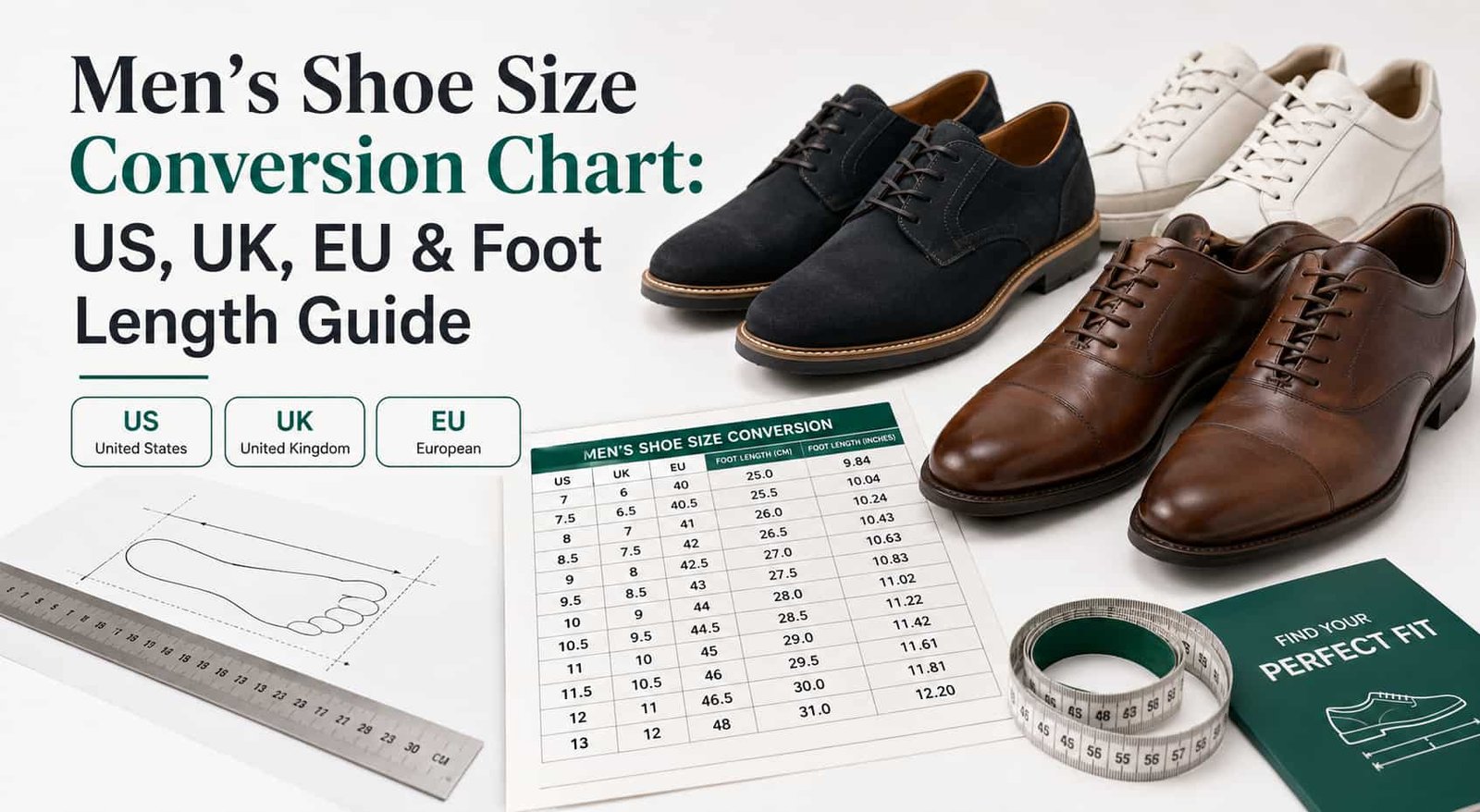
Finding the right men’s shoe size can be confusing because the same foot can be represented by different numbers in US, UK and European sizing systems. A men’s shoe size conversion chart makes the comparison easier, but the most reliable way to choose a size is to start with your actual foot length.
For example, a US men’s size 10 is commonly around UK size 9 and EU size 43, but sizing can vary between brands and shoe styles. Measuring both feet in centimeters or inches before ordering gives you a much better starting point than converting a size blindly.
This guide explains how men’s shoe sizes work, how US, UK and EU sizes compare, how to measure your feet, and what to do when your measurement falls between two sizes.
Quick Answer: How Do Men’s Shoe Sizes Convert?
A men’s US shoe size is commonly about one size larger than the equivalent UK size. European sizing uses a different system, so the conversion is approximate rather than an exact mathematical match.
For example:
- US men’s 8 is commonly UK 7 and EU 41
- US men’s 9 is commonly UK 8 and EU 42
- US men’s 10 is commonly UK 9 and EU 43
- US men’s 11 is commonly UK 10 and EU 44
- US men’s 12 is commonly UK 11 and EU 45
The actual fit depends on foot length, width, shoe shape and the manufacturer’s sizing system.
If you are unsure of your size, start by measuring your feet. Our guide on how to measure foot size at home explains the process step by step.
Men’s Shoe Size Conversion Chart
Compare men’s shoe sizes across US, UK and EU sizing systems and check the corresponding foot length in inches or centimeters.
| US | UK | EU | Foot Length |
|---|
Quick Reference: Men's Shoe Size Conversion
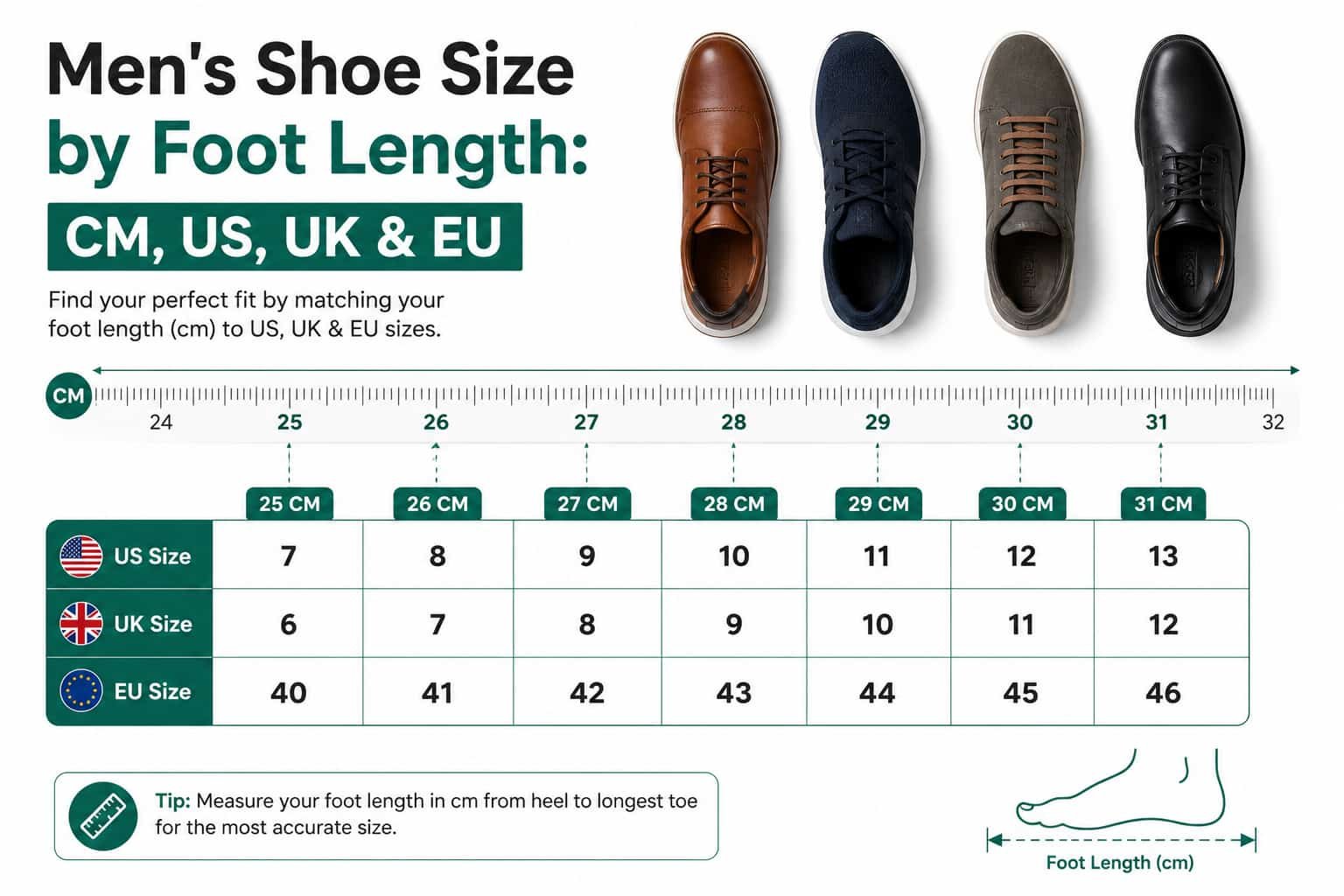
The table below gives commonly used approximate conversions between US, UK and EU men's shoe sizes.
| US Men's Size | UK Men's Size | EU Size | Approx. Foot Length |
| 6 | 5 | 39 | 9.25 in / 23.5 cm |
| 7 | 6 | 40 | 9.63 in / 24.4 cm |
| 8 | 7 | 41 | 9.75 in / 24.8 cm |
| 9 | 8 | 42 | 10.00 in / 25.4 cm |
| 10 | 9 | 43 | 10.25 in / 26.0 cm |
| 11 | 10 | 44 | 10.63 in / 27.0 cm |
| 12 | 11 | 45 | 10.75 in / 27.3 cm |
| 13 | 12 | 46 | 11.00 in / 27.9 cm |
| 14 | 13 | 47 | 11.25 in / 28.6 cm |
| 15 | 14 | 48 | 11.63 in / 29.5 cm |
| 16 | 15 | 49 | 11.88 in / 30.2 cm |
| 17 | 16 | 50 | 12.25 in / 31.1 cm |
These measurements are useful reference points, not universal guarantees. Different brands can use different lasts, sizing standards and shoe shapes.
What Is a Men's Shoe Size Conversion Chart?
A men's shoe size conversion chart shows how shoe sizes from different sizing systems relate to one another.
The three systems you will encounter most often are:
- US men's sizing
- UK men's sizing
- EU sizing
Some retailers also provide foot length in centimeters or inches. This measurement can be particularly useful when shopping online because it gives you a physical reference rather than relying only on a converted size.
A conversion chart is best used as a starting point. Your actual foot measurement should remain the most important reference.
How Does Men's Shoe Size Conversion Work?
Men's shoe sizing does not use one universal international scale.
US and UK men's sizes are relatively similar, with the UK number commonly being about one size lower than the US number. European sizing follows a different scale and is normally expressed using numbers such as 40, 41, 42, 43 and so on.
For example, a commonly used conversion is:
US 10 → UK 9 → EU 43
However, this should not be treated as an exact formula for every brand.
If you regularly buy shoes from different countries, our US vs UK vs EU shoe size conversion guide provides a more detailed comparison of the different systems.
Men's Shoe Size US to UK Conversion Chart
If you know your US men's shoe size and want to find the commonly corresponding UK size, this chart is a useful reference.
| US Men's Size | UK Men's Size |
| 6 | 5 |
| 7 | 6 |
| 8 | 7 |
| 9 | 8 |
| 10 | 9 |
| 11 | 10 |
| 12 | 11 |
| 13 | 12 |
| 14 | 13 |
| 15 | 14 |
| 16 | 15 |
| 17 | 16 |
A simple rule often used for men's sizing is:
UK size ≈ US size minus 1
However, always check the individual brand's size chart before ordering because this relationship is not guaranteed across every manufacturer.
Men's Shoe Size US to EU Conversion Chart
European shoe sizing is different from US sizing, so there is no simple universal subtraction or addition that works perfectly for every size.
| US Men's Size | Approx. EU Size |
| 6 | 39 |
| 7 | 40 |
| 8 | 41 |
| 9 | 42 |
| 10 | 43 |
| 11 | 44 |
| 12 | 45 |
| 13 | 46 |
| 14 | 47 |
| 15 | 48 |
| 16 | 49 |
| 17 | 50 |
These are commonly used conversions. Some brands may list a slightly different EU equivalent.
If a retailer provides both EU sizing and foot length, compare your measured foot length with the retailer's own chart rather than relying solely on the conversion.
How to Convert Men's Shoe Size to Inches
Foot length gives you another way to understand your shoe size.
To measure in inches:
- Place a sheet of paper on a hard, flat floor.
- Stand naturally with your heel against a wall.
- Mark the end of your longest toe.
- Measure from the wall to the mark.
- Repeat the process for the other foot.
- Use the longer measurement when selecting your size.
For a detailed measurement reference, see our men's shoe size to inches guide.
Remember that the measurement of your foot is not necessarily the same as the internal length of the shoe. Shoes need appropriate room for your toes, and their internal shape can vary considerably.
How to Convert Men's Shoe Size to Centimeters
Centimeters can be especially convenient when shopping online because many international retailers use CM measurements.
For example, a foot measuring approximately 26 cm may commonly fall around a US men's size 9 to 10 range depending on the sizing system and brand.
Do not automatically select a size based on a CM number from another brand. Instead, compare your measured foot length with the specific brand's chart.
Why CM Measurements Can Be Helpful
Centimeter measurements can make international shopping easier because they give you a physical measurement rather than only a converted size.
They are particularly useful when:
- Buying shoes from another country
- Comparing multiple brands
- Shopping online
- Converting between US, UK and EU sizes
- Checking whether your current size is still appropriate
How to Measure Your Feet for the Correct Men's Shoe Size
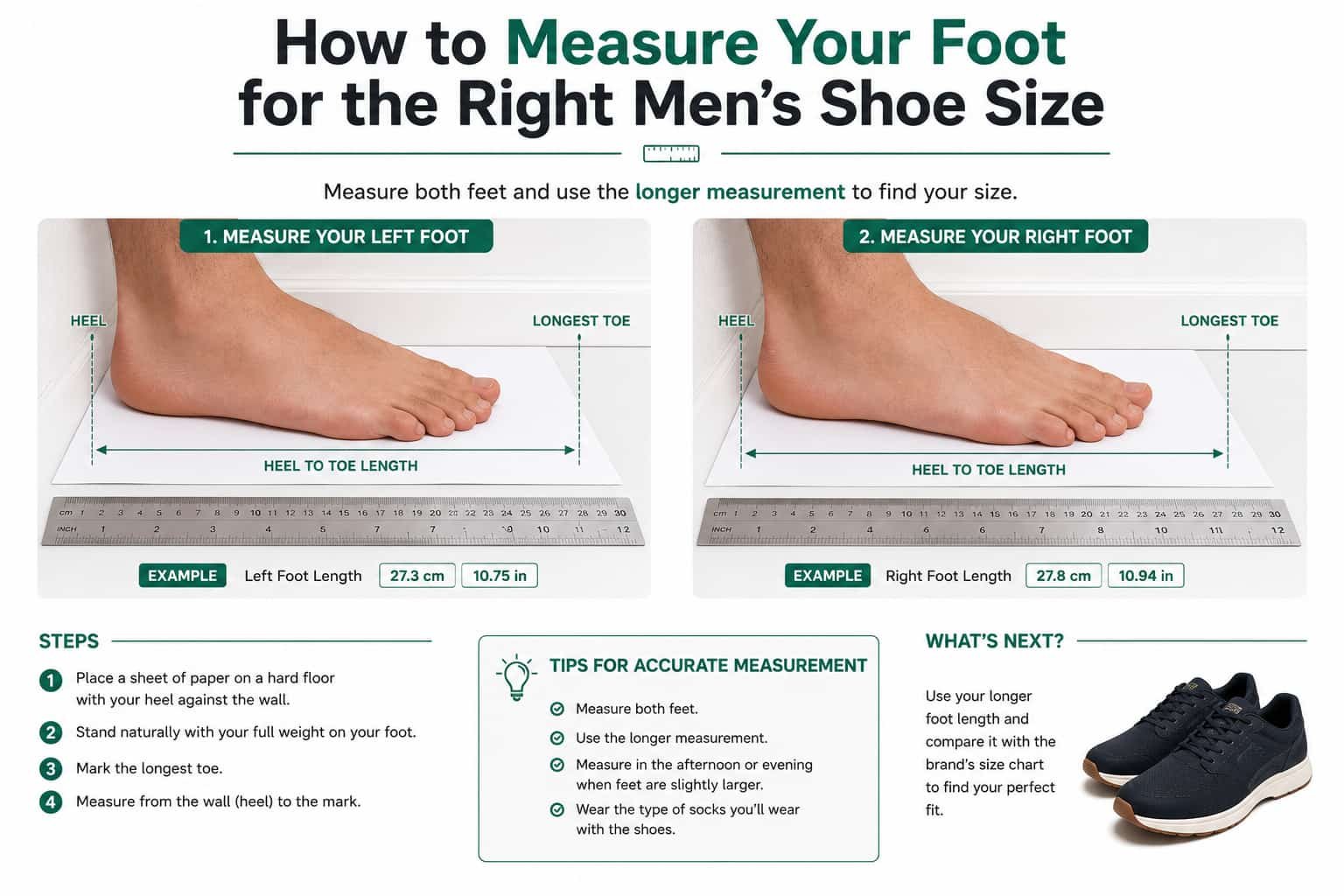
The best shoe size starts with an accurate measurement.
Step 1: Measure at the End of the Day
Feet can become slightly larger during the day. Measuring later in the day can give you a more realistic measurement for everyday footwear.
Step 2: Use a Hard Floor
Avoid measuring on thick carpet. A firm, flat surface gives you a more consistent result.
Step 3: Stand Naturally
Do not sit down while measuring. Stand normally and distribute your weight evenly.
Step 4: Keep Your Heel Against a Wall
Place your heel against a straight wall with your foot flat on the floor.
Step 5: Mark Your Longest Toe
Your longest toe may be your big toe, but this is not true for everyone. Mark whichever toe extends farthest.
Step 6: Measure Both Feet
One foot is often slightly longer or wider than the other.
Step 7: Use the Larger Measurement
If one foot measures 26.0 cm and the other measures 26.3 cm, use 26.3 cm as your primary reference.
Step 8: Compare With the Brand's Chart
This is an important final step. Your measurement should be compared against the sizing information provided by the shoe manufacturer.
Practical Tip
Do not measure only one foot and assume both feet are identical. A small difference between your feet is common. When choosing a shoe, use the longer foot as your reference.
Does Shoe Width Affect Men's Shoe Size?
Yes. Length is only one part of shoe fit.
Two people can have the same foot length but need different shoe widths. A narrow foot may feel loose in a standard or wide shoe, while a wider foot can feel cramped even when the length is correct.
Common width descriptions include:
- Narrow
- Standard or medium
- Wide
- Extra wide
Width terminology can vary between brands, so do not assume that the same width letter has exactly the same fit everywhere.
If a shoe feels tight around the sides but the length seems correct, the problem may be width rather than size.
What Should the Correct Men's Shoe Fit Feel Like?
A properly fitting shoe should feel secure without squeezing your foot.
Look for these signs:
- Your toes can move naturally.
- Your longest toe does not press against the front.
- Your heel stays reasonably secure while walking.
- The sides do not create painful pressure.
- The shoe does not force your toes together.
- Your foot does not slide excessively inside the shoe.
- The upper does not create uncomfortable pressure points.
A new shoe can feel different from an old pair, but it should not require significant pain or pressure before it becomes wearable.
How Much Space Should Be in a Men's Shoe?
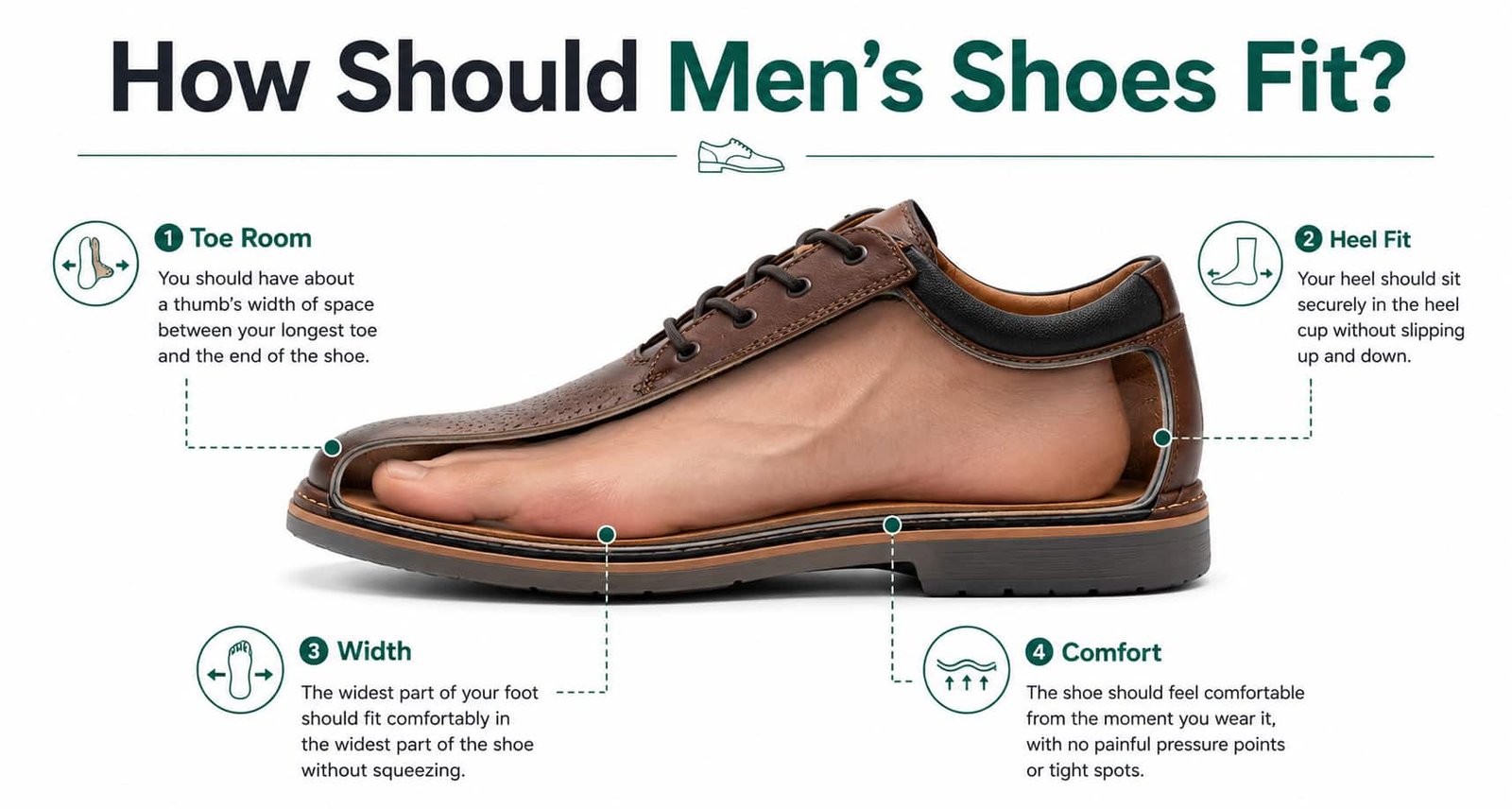
There should be enough room in front of your longest toe for comfortable movement.
A commonly used fitting guideline is around 0.4 to 0.5 inches, or approximately 1 to 1.3 cm, of extra space beyond the longest toe.
The exact amount depends on the shoe type, foot shape and intended use.
For example, a running shoe may require a little more room than a close-fitting formal shoe.
Too little space can cause pressure on the toes. Too much space can allow the foot to move excessively inside the shoe.
What Happens If Men's Shoes Are Too Small?
Shoes that are too small can create pressure in several areas.
Common warning signs include:
- Toes touching the front of the shoe
- Pressure around the toe box
- Pain around the sides
- Numbness or tingling
- Red marks after wearing the shoes
- Toenails repeatedly hitting the front
- Discomfort while walking
If you notice these problems, changing the shoe model or width may be more appropriate than simply trying to force your foot into the shoe.
What Happens If Men's Shoes Are Too Big?
Oversized shoes can also cause problems.
Watch for:
- Heel slipping
- Foot sliding forward
- Excess movement while walking
- Blisters caused by friction
- Difficulty maintaining a stable stride
- Having to tighten the laces excessively
Buying a shoe that is much larger just because you want it to last longer is usually not a good fitting strategy.
Common Mistake
A larger shoe is not automatically a better shoe. Extra length cannot compensate for the wrong width, poor heel security or an unsuitable shoe shape.
Should You Size Up or Down When Between Sizes?
If your foot measurement falls between two sizes, do not immediately choose the larger size.
First check:
- The manufacturer's measurement chart
- The shoe's width
- The shape of the toe box
- Whether you will wear socks
- The type of footwear
- Customer feedback about the specific model
A half-size can make a noticeable difference in some shoes.
If the shoe is already narrow, going up slightly may provide more useful room than choosing the same length in a wider shoe. However, the correct choice depends on the actual shoe design.
Our men's shoe size chart can also be used as a supporting reference when comparing sizes.
Men's Shoe Size Conversion Calculator
If you already know your US men's shoe size, you can use the approximate conversion below as a quick reference.
Quick Men's Size Converter
Enter a US men's shoe size to see an approximate UK and EU equivalent.
The calculator is intended as a quick reference. Always compare the result with the shoe brand's own size chart before purchasing.
For a broader conversion tool, you can also use our shoe size conversion chart and calculator.
Men's Shoe Size Conversion by Shoe Type
The best size can sometimes depend on the type of shoe you are buying.
Running Shoes
Running shoes often need enough room for natural foot movement and swelling during activity. Many runners prefer slightly more space around the toes than they would use in a formal shoe.
Casual Shoes
Casual shoes vary widely. Sneakers, loafers and everyday shoes can have different shapes even when they carry the same size label.
Formal Shoes
Dress shoes can have a more structured upper and narrower toe box. Check the shape of the shoe before assuming that your usual sneaker size will fit identically.
Boots
Boots can require additional consideration because of thicker socks, higher uppers and different construction.
Sandals
Sandals should provide secure support without allowing the foot to extend excessively beyond the sole.
Why the Same Men's Shoe Size Can Fit Differently
A size label does not tell you everything about a shoe.
Fit can change because of:
- Brand
- Shoe model
- Last shape
- Toe box design
- Material
- Width
- Sole construction
- Intended use
- Sock thickness
This is why your US men's size 10 may fit perfectly in one sneaker but feel tight or loose in another size 10.
The number gives you a starting point. The actual construction determines much of the final fit.
Common Men's Shoe Sizing Mistakes
1. Relying Only on Your Old Shoe Size
Your old shoe can be useful as a reference, but it should not be the only information you use.
2. Assuming Every Brand Uses the Same Conversion
A US 10 from one brand may not feel exactly like a US 10 from another.
3. Measuring Only One Foot
Always measure both feet.
4. Ignoring Width
If the shoe is uncomfortable around the sides, length may not be the problem.
5. Buying Based Only on EU Size
EU sizing is useful, but the equivalent can vary between manufacturers.
6. Choosing a Bigger Size to Create More Room
More length does not necessarily mean better comfort.
7. Forgetting Socks
If you normally wear thick socks with a particular shoe, consider them during fitting.
8. Ignoring the Brand's Size Chart
A manufacturer's own chart should usually take priority over a generic conversion table.
Men's Shoe Fit Checklist
- Measure both feet.
- Record the longer foot.
- Measure in cm or inches.
- Check the manufacturer's size chart.
- Consider shoe width.
- Consider the socks you normally wear.
- Check toe room.
- Check heel security.
- Do not rely on conversion alone.
How Often Should Men Measure Their Feet?
Adults do not usually experience the rapid foot growth seen in children, but foot dimensions can still change over time.
Weight changes, age, activity levels, injuries, pregnancy, swelling and changes in foot structure can affect how shoes fit.
It is worth measuring again when:
- Your usual size suddenly feels uncomfortable
- You are buying from a new brand
- You are ordering shoes internationally
- Your feet appear to have changed
- You are replacing an old pair
- You are experiencing repeated pressure or slipping
If your shoes have suddenly become uncomfortable, do not assume that you simply need to go up one size.
International Men's Shoe Sizes: What Should You Trust?
When shopping internationally, use the size system provided by the retailer and compare it with the brand's measurement information.
A retailer may show:
US → UK → EU → CM
For example:
US 10 → UK 9 → EU 43 → approximately 26 cm foot length
The exact relationship can differ by manufacturer.
The safest approach is:
Measure your foot → find the brand's chart → compare the measurement → select the recommended size.
This is more reliable than converting your existing size from one country to another without checking the manufacturer's information.
Measure First, Convert Second
A conversion chart can show you the approximate relationship between US, UK and EU sizes, but your actual foot measurement should guide the final choice. Always compare your measurement with the shoe brand's own sizing information.
Frequently Asked Questions
What is a men's shoe size conversion chart?
A men's shoe size conversion chart compares men's shoe sizes across different sizing systems such as US, UK and EU. It helps you understand approximate equivalents when shopping internationally. However, conversion charts should be used as a reference because brands can use different sizing standards and shoe shapes.
Is a US men's shoe size the same as a UK men's shoe size?
No. A US men's shoe size is commonly about one number higher than the equivalent UK men's size. For example, US men's size 10 is often approximately UK size 9. The exact conversion can vary, so check the manufacturer's chart before ordering.
What is a US men's size 10 in UK sizing?
A US men's size 10 is commonly equivalent to a UK men's size 9. This is a general conversion rather than a universal rule. The shoe manufacturer may recommend a different size depending on its sizing system.
What is a US men's size 10 in EU sizing?
A US men's size 10 is commonly around EU size 43. EU sizing can vary slightly between brands, so your foot measurement and the manufacturer's own chart should be used for the final decision.
How do I know my men's shoe size?
Measure both feet while standing, record the length of each foot in centimeters or inches, and use the longer measurement. Then compare it with the manufacturer's size chart for the shoe you want to purchase.
Should I use my shoe size or foot measurement?
Foot measurement is generally the better starting point. Your existing shoe size can change between brands and styles, while your measured foot length gives you a physical reference for comparing different sizing charts.
Are men's EU shoe sizes the same everywhere?
Not always. EU sizing provides a useful international reference, but individual brands may use different lasts, conversions and fitting standards. Always check the brand-specific chart when possible.
Should I buy a bigger men's shoe if I am between sizes?
Not automatically. Check the manufacturer's recommendation, shoe width, toe box and intended use. A slightly larger size may work in some cases, while another shoe may fit better in the same length with a wider design.
How much room should men's shoes have at the toes?
A commonly used fitting guideline is around 0.4 to 0.5 inches, or approximately 1 to 1.3 cm, between the longest toe and the front of the shoe. The ideal amount can vary depending on the footwear type and foot shape.
Why do the same men's shoe sizes fit differently?
Shoe size is only one part of fit. Different brands and models can have different toe boxes, widths, materials, lasts and construction. This is why the same labeled size can feel different between two pairs of shoes.
Is foot length in centimeters accurate for buying shoes online?
It can be very useful, especially when combined with the manufacturer's size chart. However, centimeter measurements can refer to different things depending on the brand, so check whether the chart describes foot length or shoe length.
Should I measure both feet before buying shoes?
Yes. One foot can be slightly longer or wider than the other. Measure both feet and use the larger measurement as your primary reference when choosing a shoe size.
Final Thoughts
A men's shoe size conversion chart is a useful starting point when comparing US, UK and EU sizing, but it should not be the only factor in your decision.
The most reliable approach is simple: measure both feet, record the longer measurement, check the manufacturer's chart and then consider the shoe's width and shape.
If you are shopping internationally, do not assume that a converted size will fit exactly the same as your usual shoe. A few minutes spent measuring your feet can make online shoe shopping much easier.
For more detailed sizing help, start with our men's shoe size chart, learn how to measure foot size at home, or use our shoe size conversion chart and calculator.