
Kids Shoe Size Conversion Chart (US, UK & EU)
Quick Answer
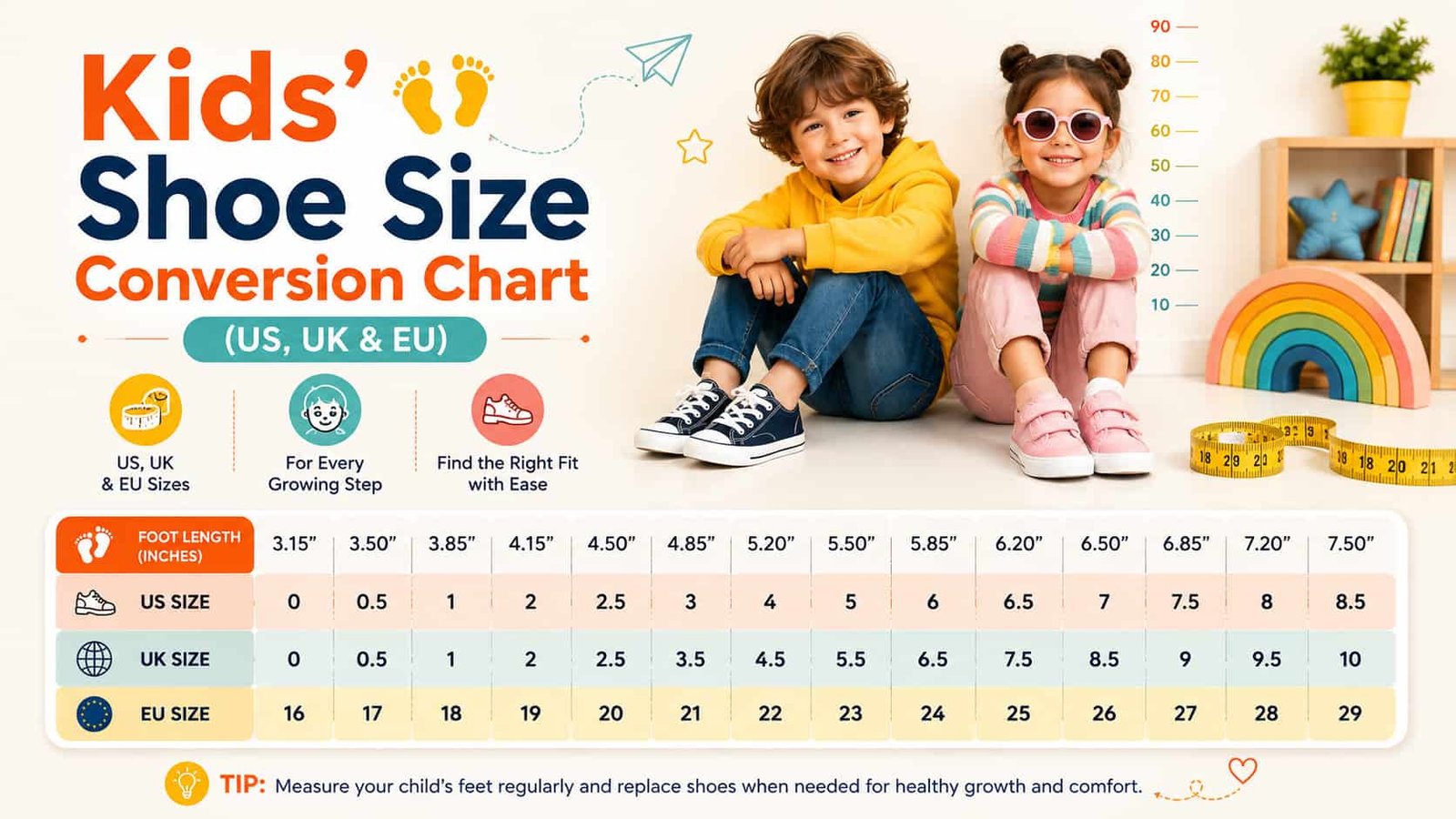
- As a general rule, UK kids shoe sizes run one number smaller than the equivalent US size.
- EU sizes climb differently and don’t follow a simple “add or subtract” rule, so a real conversion table matters more there.
- The rule breaks down at one specific point: where US numbering resets from 13 back to 1 partway through little kid sizing.
- Always confirm with foot length in inches or centimeters, since sizing can vary slightly by brand.
As a general rule, a kids UK shoe size is one number smaller than the equivalent US size, while EU sizes climb on their own separate scale that doesn’t follow a simple add-or-subtract pattern. That “UK is one smaller” rule works well through most of toddler and little kid sizing, but it breaks down right at the point where US sizing resets from 13 back to 1. Foot length in inches or centimeters is the most reliable way to confirm a size across any system, since brands don’t all follow the exact same scale.
Kids Shoe Size Conversion Chart by Stage
Converting a kids shoe size between US, UK, and EU comes down to knowing which of three sizing stages a child falls into, since each stage uses its own number range.
In our experience fitting thousands of children’s shoes, most conversion mistakes happen when a parent applies a rule that’s technically correct for one stage to a size in a different stage. Here’s the full picture across all three, with foot length included so you can double check against an actual measurement rather than a size label alone.
Size Snapshot
Stage: Little Kid
Common Size: US 1 to 2
UK Equivalent: 13 to 1
EU Equivalent: 32 to 33
The Simple Rule (And Exactly Where It Breaks)
Most shoe retailers will tell you that UK kids sizes run one number smaller than US sizes, and for a good stretch of the sizing range, that’s true.
Here’s the good news: that rule holds reliably across all of toddler sizing and most of little kid sizing. A US size 8 toddler shoe is a UK 7. A US size 12 little kid shoe is a UK 11. Simple subtraction works.
One thing parents often miss is where this breaks down. US kids sizing has an unusual quirk: after reaching size 13, it resets and starts counting again from 1, continuing into what’s labeled youth or big kid sizing. UK sizing doesn’t reset the same way, so right at that crossover point, the simple “minus 1” rule stops working and you need the actual conversion table instead. This single detail is the reason online shoppers most often order the wrong UK size for a child around age 6 to 8.
Did You Know?
The reset from US size 13 back to 1 is one of the more confusing quirks in kids shoe sizing, and it happens in the middle of what’s usually still called “little kid” sizing, not at a clean age or stage boundary. It’s part of why a printed size chart, not just a mental rule, is worth keeping on hand.
Toddler Size Conversion (US, UK, EU)
This table covers toddler sizing, roughly ages 1 to 4, where the “UK is one smaller” rule holds consistently.
| US Size | Foot Length (in) | Foot Length (cm) | UK Size | EU Size |
| 4 | 4.75 | 12.1 | 3 | 20 |
| 5 | 5.1 | 13.0 | 4 | 21 |
| 6 | 5.4 | 13.7 | 5 | 22 |
| 7 | 5.75 | 14.6 | 6 | 23 |
| 8 | 6.0 | 15.3 | 7 | 24 |
| 9 | 6.4 | 16.3 | 8 | 25 |
| 10 | 6.75 | 17.1 | 9 | 27 |
Notice the EU column doesn’t move in even steps the way UK does. That’s expected, and it’s covered in more detail further down.
Little Kid Size Conversion (US, UK, EU)
This is the stage where the simple rule holds for most sizes, then breaks right at the US 13 to 1 reset point.
| US Size | Foot Length (in) | Foot Length (cm) | UK Size | EU Size |
| 10.5 | 6.9 | 17.5 | 9.5 | 27 |
| 11 | 7.1 | 18.1 | 10 | 28 |
| 12 | 7.4 | 18.8 | 11 | 30 |
| 13 | 7.75 | 19.7 | 12 | 31 |
| 1 | 8.0 | 20.3 | 13 | 32 |
| 2 | 8.4 | 21.3 | 1 | 33 |
| 3 | 8.6 | 21.9 | 2 | 34 |
Look closely at the jump from US 13 to US 1. The UK size doesn’t reset with it. That’s exactly the break in the simple rule mentioned earlier, and it’s the row most worth double checking before you buy.
If you’d rather browse the full picture across every stage in one continuous chart with foot-length ranges by age, our Kids Shoe Size Chart covers that.
Common Mistake
Applying the “UK is one smaller” rule straight across the US 13 to 1 reset is one of the most common conversion mistakes we see, especially with online orders from UK retailers. A US size 1 little kid shoe is a UK 13, not a UK 0, which trips up a lot of parents doing quick mental math.
Youth / Big Kid Size Conversion (US, UK, EU)
This table covers youth or big kid sizing, roughly ages 8 to 12, marked with a “Y” on the box.
| US Size (Y) | Foot Length (in) | Foot Length (cm) | UK Size | EU Size |
| 3.5 | 8.9 | 22.6 | 2.5 | 35 |
| 4 | 9.1 | 23.0 | 3 | 35.5 |
| 5 | 9.4 | 23.9 | 4 | 36.5 |
| 6 | 9.75 | 24.8 | 5 | 38 |
| 7 | 10.0 | 25.4 | 6 | 39 |
The simple “minus 1” rule is back in effect through this whole range, which makes youth sizing one of the more predictable stages to convert.
Why EU Sizes Don’t Follow a Simple Rule
A quick tip that saves a lot of confusion: EU sizing isn’t based on the same counting system as US and UK sizes at all, so trying to add or subtract a fixed number rarely works.
EU shoe sizes are based on a measurement called the Paris Point system, where each full size represents about two thirds of a centimeter of foot length. That’s why the EU column in the tables above doesn’t climb in neat, even steps the way UK does. It’s also why the most reliable way to shop EU-labeled shoes is to match foot length in centimeters directly, rather than trying to convert from a US or UK number in your head.
Expert Tip
When shopping a European brand, skip the US-to-EU mental math entirely and go straight from your child’s measured foot length in centimeters to the EU size chart. After 25 years in children’s footwear, this is the method we trust most for European brands specifically, since it removes a full step of potential rounding error.
How to Measure Before You Convert
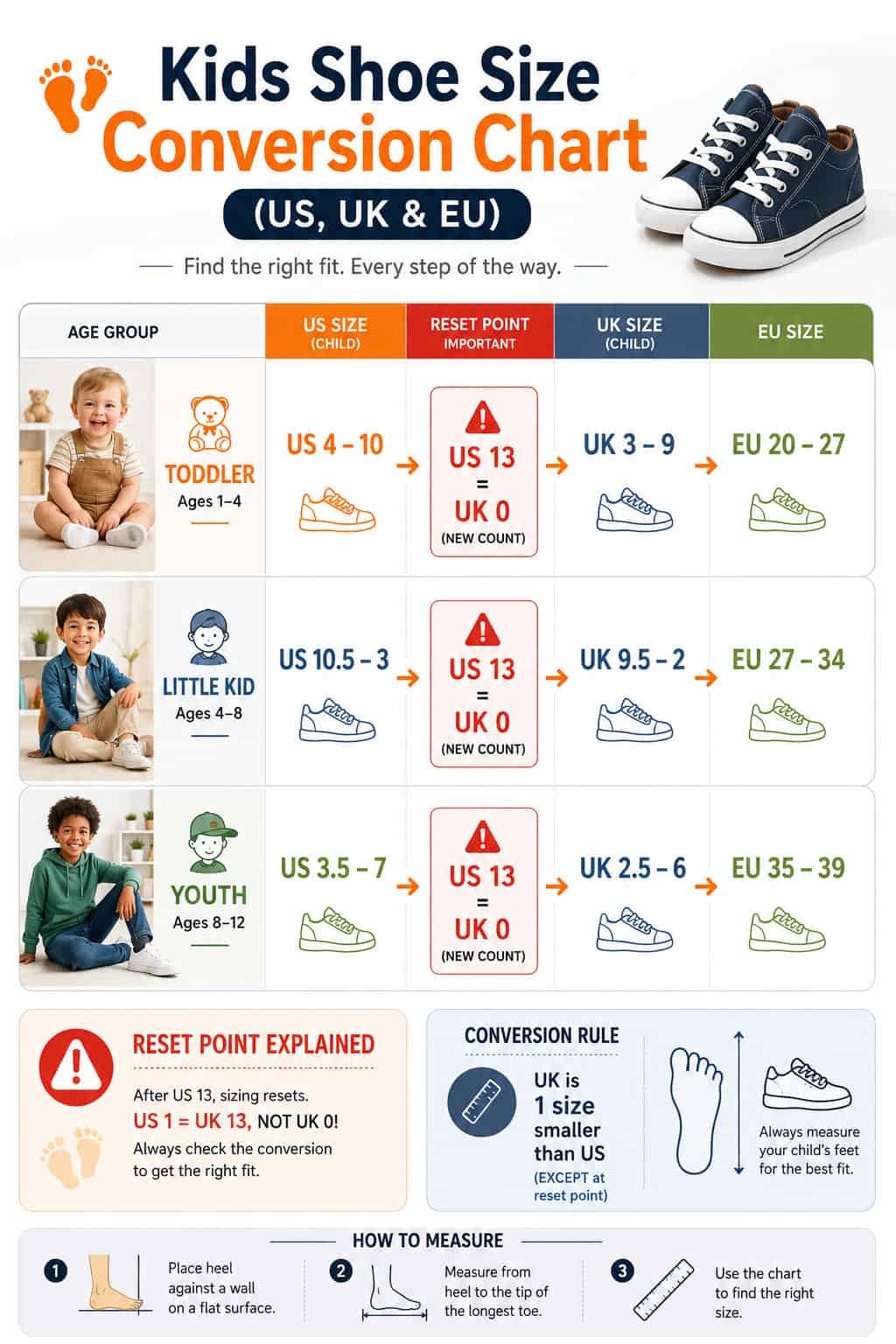
A size conversion is only as accurate as the measurement behind it, so this step matters more than the table itself.
- Stand your child on a piece of paper with their heel against a wall or baseboard.
- Mark the tip of the longest toe with a pencil held straight up and down, not angled.
- Measure both feet. It’s common for one to be slightly longer, and you should size to the bigger one.
- Measure in the evening if you can, since feet swell a little by the end of the day.
- Match the measurement to the foot length column, not just the size number, when converting between systems.
For a full walk-through with printable templates, our How to Measure Kids Feet guide covers the process in more detail.
Parent Checklist
- Measure both feet, ideally standing.
- Match foot length, not just the size number, when converting.
- Double check any size that falls right at the US 13 to 1 reset point.
- For EU sizes, convert from centimeters directly rather than from US or UK.
- Leave 0.4 to 0.5 inches of growing room in the final size you choose.
Common Conversion Mistakes
- Applying the “UK is one smaller” rule straight across the little kid reset point, where it doesn’t hold
- Converting EU sizes by simple subtraction instead of matching foot length in centimeters
- Assuming every brand uses the identical conversion, when sizing can vary slightly by manufacturer
- Skipping a fresh measurement and converting from an old size instead of a current one
- Forgetting that toddler and little kid use separate number ranges even though both fall under “kids”
For the full interactive version of this chart, including every size system in one place, our Shoe Size Conversion Chart Calculator lets you convert instantly without scrolling through tables.
FAQs
Is UK kids shoe size really one smaller than US? For most of toddler and little kid sizing, yes, UK runs one number smaller than the equivalent US size. That rule breaks down at one specific point, right where US sizing resets from 13 back to 1, so it’s worth checking the actual table around that range.
How do I convert US kids shoe size to EU? EU sizes follow a different measurement system than US or UK, so a simple add-or-subtract rule doesn’t work well. The most reliable method is matching your child’s foot length in centimeters directly to the EU size chart.
Why does the US size go from 13 to 1? US kids shoe sizing resets from 13 back to 1 partway through what’s still considered little kid sizing, continuing on into what becomes youth or big kid sizing. It’s an old quirk of the sizing system rather than a marker of a new age stage.
Are kids shoe sizes the same across all brands? Not exactly. There’s no single regulated standard across manufacturers, so a size 2 in one brand can measure slightly differently in another. A conversion chart is a reliable starting point, but always check the brand’s specific chart when possible.
What’s the difference between toddler, little kid, and youth sizing? Toddler covers roughly ages 1 to 4, little kid covers roughly ages 4 to 8, and youth or big kid covers roughly ages 8 to 12. Each stage uses its own number range, and they don’t always convert to UK or EU sizes using the same rule.
Do I need a different chart for boys and girls? No, the size conversion itself is based on foot length and is shared across both. Styles and widths sometimes differ between boys’ and girls’ lines, but the underlying number scale is the same.
How much bigger should I size up when converting between systems? You shouldn’t need to size up just because you’re converting. A correct conversion should land on the same actual foot length, not a larger or smaller one. If a converted size feels off, it’s worth remeasuring rather than assuming you need to round up.
Can I trust an online kids shoe size calculator? A calculator is a good starting point, but it’s still working from standard conversion tables that assume typical sizing. Always confirm against your child’s actual foot length in inches or centimeters, especially for a first order from a new brand.
Why do some UK sites list “infant” and “junior” instead of numbers only? UK retailers often group sizes into infant (roughly matching US toddler) and junior (roughly matching US little kid and youth) as a shorthand, but the underlying numbers still follow the same UK sizing scale shown in these tables.
Does shoe width change between US, UK, and EU sizes? Width labeling varies more by brand than by country system. Some brands offer narrow, medium, and wide options regardless of which size system they use, so check the specific listing rather than assuming width is standardized.
RELATED ARTICLES
CONCLUSION
Converting a kids shoe size between US, UK, and EU comes down to knowing which stage your child is in and where the “UK is one smaller” rule actually holds. It’s reliable through most of toddler and little kid sizing, breaks right at the US 13 to 1 reset, and doesn’t apply at all to EU sizes, which follow their own centimeter-based scale.
Measure your child’s foot length before converting, match it to the table for their current stage, and when in doubt, size to the actual measurement rather than the number alone. For a quick side-by-side comparison of the two most commonly confused systems, our US vs UK vs Euro Shoe Size Conversion guide breaks it down further.