
Baby Shoe Size Conversion Chart (US, UK, EU and CM)
⚡ Quick Answer
- US baby shoe sizes run about half a size to a full size larger than UK sizes.
- EU sizes use a different scale entirely, usually 16 to 23 for the 0 to 24 month range.
- Centimeters are the most reliable way to compare sizes across countries and brands.
- When ordering from a UK or EU site, always check foot length in cm rather than relying on the size number alone.
- Use the interactive converter below to check any size instantly.
A US baby shoe size does not match the same number in the UK or EU. A US size 4 is roughly a UK size 3 and an EU size 19, for example. The safest way to convert between systems is by foot length in centimeters, since sizing scales and rounding rules vary slightly by country and brand. Parents ordering from overseas retailers should always check the foot length listed on the product page rather than trusting the size label alone. In our experience fitting thousands of children, this one habit prevents most cross-border sizing mistakes.
Baby Shoe Size Conversion Chart (US, UK, EU & CM)
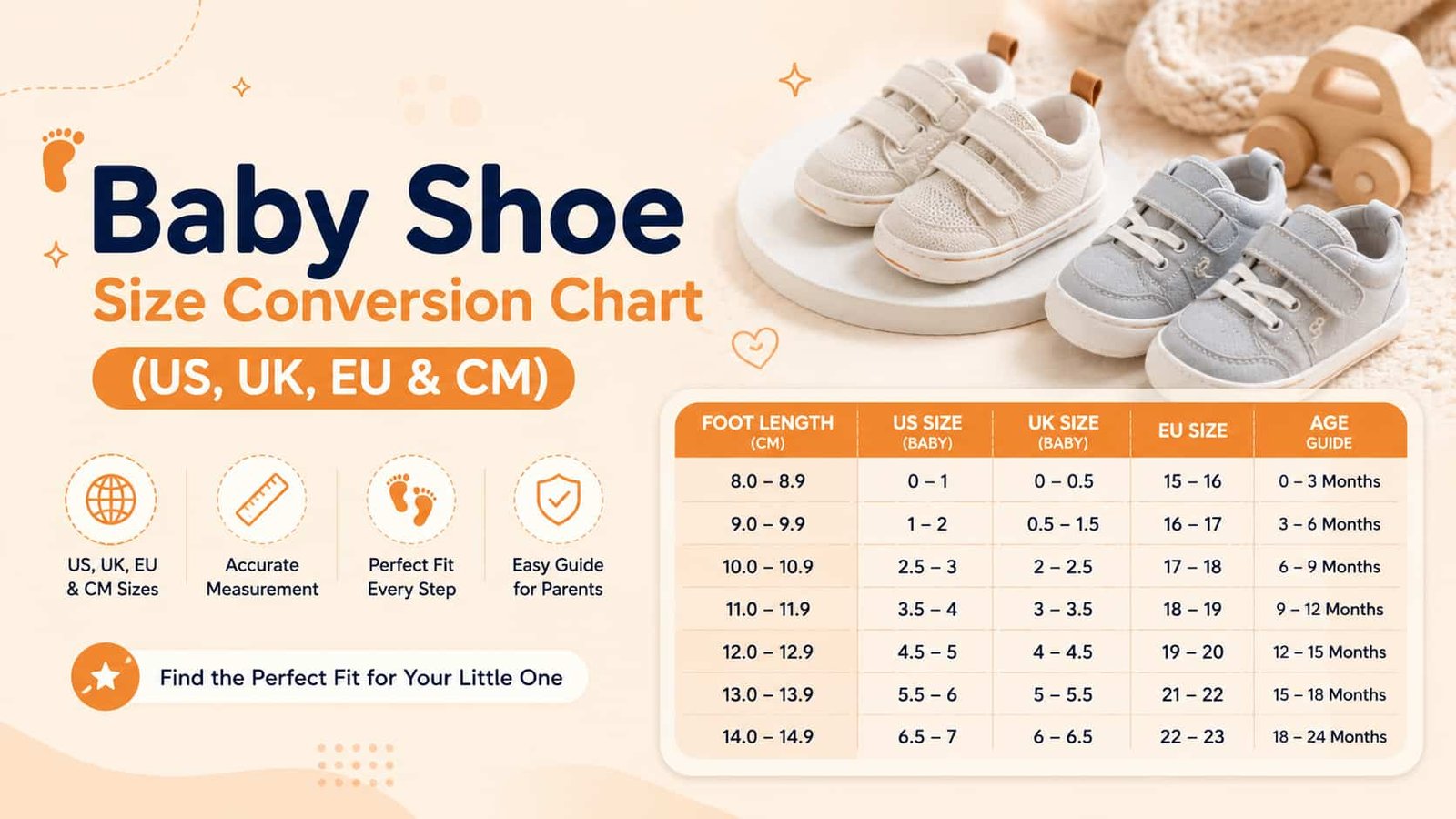
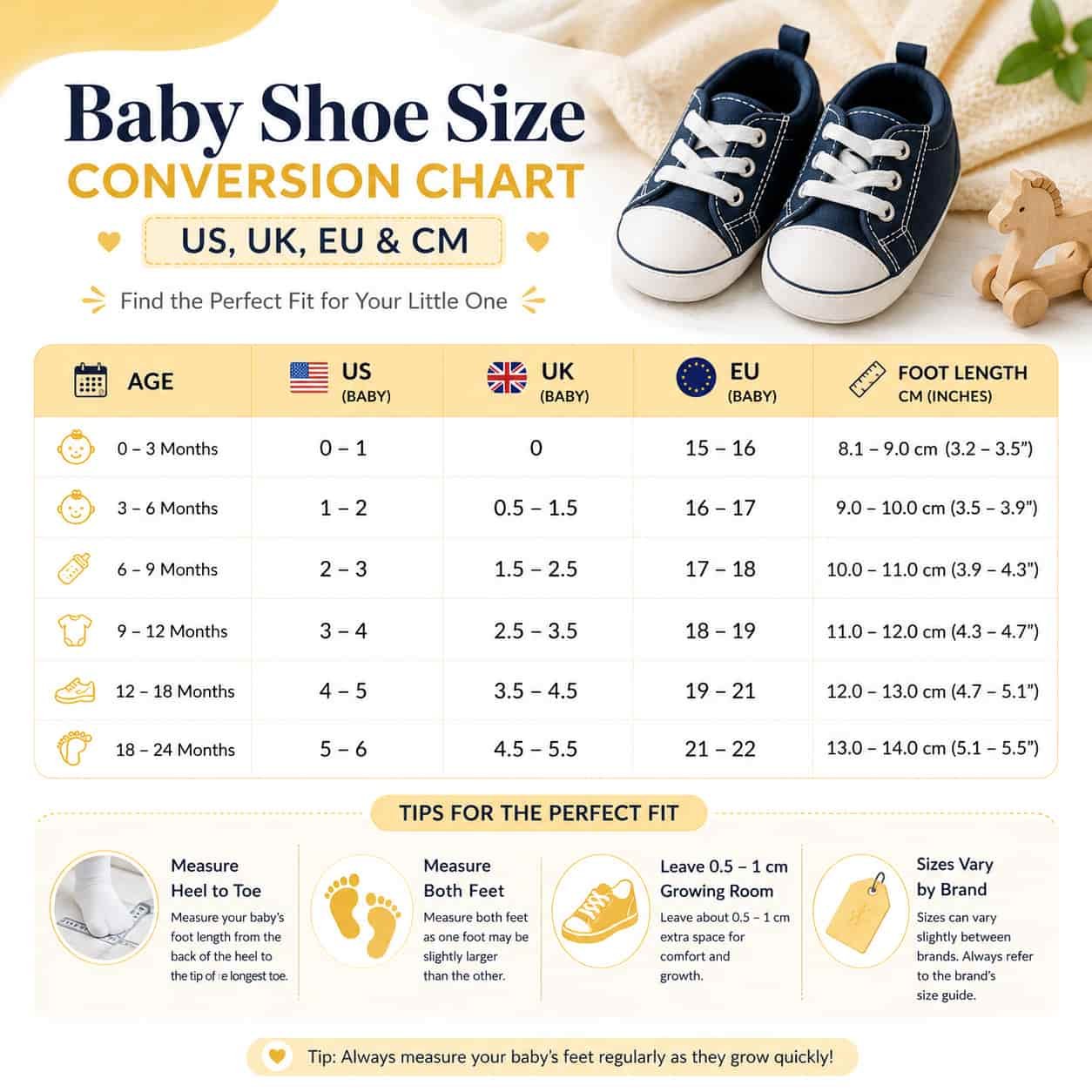
This chart lines up US, UK, and EU baby shoe sizes against foot length in centimeters and inches, covering the 0 to 24 month range. Use it any time you’re comparing a size across two different systems.
| US Size | UK Size | EU Size | Foot Length (cm) | Foot Length (in) |
| 0 | 0 | 16 | 8.3 cm | 3.25 in |
| 1 | 0.5 | 17 | 9.0 cm | 3.5 in |
| 2 | 1 | 17 | 9.6 cm | 3.75 in |
| 3 | 2 | 18 | 10.2 cm | 4.0 in |
| 4 | 3 | 19 | 10.8 cm | 4.25 in |
| 5 | 4 | 20 | 11.4 cm | 4.5 in |
| 6 | 5 | 21 | 12.1 cm | 4.75 in |
| 7 | 6 | 23 | 12.7 cm | 5.0 in |
A quick tip that saves a lot of confusion: EU sizes jump in bigger, less predictable steps than US or UK sizes. Don’t assume a one-to-one match just because two numbers look close on paper.
👶 Did You Know?
The EU sizing scale is based on the Paris point system, where each whole size equals about 6.67 millimeters of foot length. That’s a completely different measuring logic than the US and UK systems, which is part of why the numbers never line up neatly.
Why US, UK, and EU Sizes Don’t Line Up
Here’s the part that trips up a lot of parents shopping internationally: shoe sizing isn’t governed by one universal standard. Each region built its own scale, at different points in history, using different measuring units.
The US and UK systems are both based on inches, but they start counting from different baseline lengths, which is why a US size is usually a half size to a full size larger than the equivalent UK size. The EU system throws in a third variable entirely, since it’s built around a metric unit called the Paris point rather than inches at all.
None of this means one system is more accurate than another. It just means a size 5 in one country was never designed to match a size 5 somewhere else, and treating the numbers as interchangeable is where most ordering mistakes start.
Interactive Size Converter
Pick a size in whichever system you already have, and this tool will show you the matching sizes across the other three.
Baby Shoe Size Converter
Choose the system you already have a size in, then pick the value to see the matching sizes across US, UK, EU, and cm.
Conversions are estimates based on standard sizing charts. Individual brands can run slightly larger or smaller.
If you’d like a version of this tool broken out by every child size range in one place, our Shoe Size Conversion Calculator covers babies through older kids side by side.
💡 Expert Tip
When a product page lists both a size number and a foot length in centimeters, trust the centimeters. Retailers sometimes round size labels differently depending on which country’s version of their site you’re viewing, but a centimeter measurement doesn’t change.
How to Convert Using Foot Length Instead of Size Number
The most reliable conversion method skips size numbers altogether and starts with a real measurement.
Step 1: Measure your baby’s foot length in centimeters. A paper tracing works well for this. Measure from the heel to the longest toe.
Step 2: Find that length on the chart above. Match it to the closest centimeter value in the table.
Step 3: Read across the row. The US, UK, and EU sizes in that row are your closest match across all three systems.
Step 4: Round up if you’re between two rows. As with any baby shoe purchase, a little extra growing room is safer than a size that runs snug.
This method works even if you’ve never seen the specific brand’s own size chart before, since foot length in centimeters stays consistent no matter which country the shoe was designed in.
Signs a Converted Size Fits Correctly
Once the shoes arrive, check for these signs to confirm the conversion worked out.
- There’s roughly a thumb’s width of space past the longest toe.
- The heel stays snug and doesn’t slip when your baby kicks or walks.
- No tight spots or red marks appear after a short trial wear indoors.
- The shoe still bends naturally at the ball of the foot.
- Your baby doesn’t seem to be actively trying to remove the shoe right away.
Common Conversion Mistakes
We see the same handful of ordering mistakes come up again and again with international purchases.
Assuming a matching number means a matching fit: A UK size 4 and a US size 4 are not the same shoe. Always check which country’s sizing a listing is using before you order.
Ignoring the brand’s own size guide: Even within one country, sizing can vary between brands by half a size or more. A general conversion chart is a starting point, not a guarantee.
Skipping the centimeter check: Size labels can be inconsistent, but centimeter measurements on a product listing are usually accurate and worth double-checking before you buy.
Rounding the wrong direction: When a size falls between two rows on a conversion chart, round up rather than down, especially for a growing baby.
⚠ Common Mistake
Ordering multiple sizes at once “just to be safe” without checking the return policy first is a costly habit we see often with cross-border orders. International returns can be slow or expensive, so it pays to convert the size carefully before you ever click buy.
What to Check Before Buying From an International Site
A few checks before checkout can save you a return shipment across an ocean.
Confirm which sizing system the listing uses: Some retailers label sizes as “UK” or “EU” clearly, while others just show a number with no context.
Look for a centimeter or millimeter measurement: Most reputable retailers include this somewhere on the product page, often in a size guide link.
Check the return and exchange policy: International shipping costs can make returns expensive, so it’s worth knowing the policy before you order.
Read recent buyer reviews for fit feedback: Comments mentioning “runs small” or “true to size” are often more useful than the size chart alone.
✅ Parent Checklist
- Measure your baby’s foot in centimeters before ordering.
- Confirm which country’s sizing system the listing uses.
- Match foot length to the chart, not just the size number.
- Round up when a measurement falls between two sizes.
- Check the return policy before completing an international order.
If you’re specifically converting from a UK size 8 toddler shoe, our UK 8 to US Shoe Size Guide walks through that exact conversion in more detail.
Common Parent Mistakes
A few habits show up again and again with parents new to international shoe shopping.
Buying based on a sibling’s old conversion. Foot growth timing is different for every child, so a conversion that worked for an older sibling at a certain age isn’t a safe shortcut for a younger one.
Trusting a size chart from a different product category. A conversion chart built for adult shoes or older kids’ shoes doesn’t reliably apply to baby and toddler sizing, since the scales shift slightly at different size ranges.
Not accounting for brand-specific fit notes. Some brands note that they run narrow or wide. That detail matters just as much as the size conversion itself.
Expert Tips for Cross-Border Shopping
Tip 1. Bookmark the specific brand’s own size chart if you plan to order from them again. Charts can shift over time as brands update their fit.
Tip 2. When in doubt between two converted sizes, choose the larger one and pair it with a slightly thicker sock if needed.
Tip 3. Take a fresh foot measurement before every international order rather than reusing an old one, since baby feet grow quickly enough to change the outcome.
Tip 4. If a retailer offers a live chat or sizing help feature, ask directly about their conversion for your child’s foot length in centimeters rather than relying on the size chart alone.
FAQs
Is a US size 4 the same as a UK size 4? No. A US size 4 is closer to a UK size 3. US baby shoe sizes typically run about one size larger than the equivalent UK size, so matching the numbers directly will usually result in a shoe that’s too small.
Why does the EU size look so different from the US or UK size? The EU system uses a completely different scale based on a metric measuring unit rather than inches. A US size 4 lands around an EU size 19, which looks like a big jump but actually represents a similar foot length.
What’s the most accurate way to convert baby shoe sizes? Foot length in centimeters is the most reliable method, since size numbers can be rounded differently by different retailers. Measure your baby’s foot and match it against a centimeter-based conversion chart for the safest result.
Do all baby shoe brands use the same conversion chart? Not exactly. Most brands follow the general conversion ranges shown here, but small differences of half a size are common. Always check a brand’s specific size guide when one is available.
Should I size up or down when converting between systems? Round up if a measurement falls between two sizes on the chart. A little extra room accommodates growth, while sizing down can leave no room at all.
Can I trust the size shown on an overseas shopping site? Check whether the listing specifies which country’s sizing system it’s using. A number alone, without a country label or centimeter measurement, isn’t enough information to order confidently.
How much does UK and EU baby shoe sizing typically differ from US sizing? UK sizes usually run about a half size to a full size smaller than the matching US size. EU sizes use a different numbering scale entirely, so a direct number comparison isn’t meaningful without a conversion chart.
Is there a difference between infant and toddler size conversions? The conversion logic stays the same across infant and toddler ranges, but the specific size numbers shift as the foot gets longer. Always check the age or size range on the chart you’re using.
What should I do if the converted size still doesn’t fit? Check the brand’s specific reviews for notes about running narrow, wide, small, or large. If the fit is consistently off after following the conversion chart, it may be a brand-specific quirk rather than a conversion error.
Do shoe widths convert the same way as length across US, UK, and EU sizing? Width sizing is far less standardized across countries than length. If width is a concern, it’s best to check the specific brand’s width guide rather than relying on a general conversion chart.
How often should I remeasure before ordering from an international retailer? Measure again if it’s been more than 4 to 8 weeks since your last check, since baby and toddler feet grow quickly enough to shift the conversion in that time.
RELATED ARTICLES
- Shoe Size Conversion Calculator, US, UK, EU & CM (2026)
- UK 8 to US Shoe Size Guide
- 6-12 Month Baby Shoe Size Chart (2026)
- 0-12 Month Baby Shoe Size Chart
- 0-3 Month Baby Shoe Size Chart
CONCLUSION:
Converting baby shoe sizes across US, UK, and EU systems comes down to one habit: trusting foot length in centimeters over the size number alone. A quick measurement and a glance at the chart above will save you from a return shipment and get your baby into the right fit the first time.
Use the interactive converter above before your next international order, and keep a recent centimeter measurement on hand for future purchases. For a broader look across every child size range, our Shoe Size Conversion Calculator covers babies through older kids in one place.