
The Complete Foot Pain Guide: Real Causes, Hidden Footwear Culprits, and Sore Feet Relief for 2026
💡 Quick Answer: The Root of Foot Pain & Relief
Most foot pain stems from improper footwear, repetitive stress on hard surfaces, or unaddressed biomechanical issues like overpronation. The fastest path to sore feet relief is switching to APMA-approved shoes with structural arch support, a rigid heel counter, and targeted cushioning, paired with daily calf and plantar fascia stretching.
INTRODUCTION
If you have ever limped out of bed at 6:00 AM, holding your breath as your heel touches the floor, you already know that foot pain isn’t just a minor physical inconvenience—it is a lifestyle-altering crisis.
For over twenty years on the retail floor, I have watched thousands of customers walk into our store with the same defeated look. They are teachers, nurse practitioners, construction foremen, and retail workers who spend ten to twelve hours a day on unforgiving concrete floors. They come in wearing the latest, trendiest “marshmallow-soft” sneakers, completely baffled as to why their feet are in absolute agony.
They ask me the same burning question every single day: why do my feet hurt so badly when I am wearing expensive shoes?
The truth is, our modern footwear landscape is built on an illusion. We are tricked by clever marketing into believing that instant, pillowy step-in comfort equals long-term foot health. It doesn’t. In fact, that ultra-mushy, unstructured foam sneaker you bought online is often the very thing causing your arches to collapse, your tendons to overwork, and your heels to throb.
This comprehensive foot pain guide is designed to cut through the marketing noise. We are going to break down the exact foot pain causes, identify common foot conditions, and look at the real, practical foot pain treatment strategies that actually work. Whether you are dealing with a sharp stab in your heel, a burning sensation in the ball of your foot, or general aching after a long shift, this guide will give you the practical retail wisdom and biomechanical insights you need to find permanent sore feet relief.
WHY THIS MATTERS: THE AMERICAN FOOTWEAR DILEMMA
We are currently living through an epidemic of foot pain in the United States, and the root cause isn’t our biology—it is our buying habits.
As a veteran shoe fitter, I have noticed three massive shifts over the last two decades that have fundamentally broken how we care for our feet:
1. The Death of the Physical Shoe Fitting
Twenty years ago, buying a pair of shoes was an interactive process. You sat on a bench, an experienced fitter measured both of your feet using a Brannock Device (measuring not just overall length, but width and arch length, too), and you tried on three different structural builds to see how your gait responded.
Today, we buy shoes by tapping an app at 11:00 PM based on a social media influencer’s aesthetic. We receive a box, slide our feet in, and if they don’t pinch our toes immediately, we assume they fit. This lack of personalized, objective measurement is why nearly $80\%$ of the customers I see are wearing shoes that are either too narrow, too short, or completely wrong for their unique foot structure.
2. The Deceptive “Soft Shoe Trap”
When you step into a modern running shoe with a massive stack of ultra-responsive, low-density foam, your brain registers an immediate “wow” factor. It feels like walking on clouds. However, this is the footwear equivalent of eating raw sugar for breakfast.
When your foot sinks deeply into a super-soft foam bed, the stabilizing muscles in your ankles, calves, and soles have to work twice as hard to keep you balanced. Over a 10,000-step day, this lack of structural integrity causes micro-tears in your fascia, over-strains your tendons, and results in severe foot pain after standing all day.
3. The Cheap Manufacturing Shortcut
The global shift toward lightweight knit uppers has been a financial blessing for major footwear brands, but a physical curse for consumers. Knit uppers are cheap to manufacture and require no structural panels or overlays.
While they feel light and breathable, they offer absolutely zero lateral stability. If your foot naturally rolls inward (overpronation), an unstructured knit upper will simply stretch out, allowing your foot to slide off the midsole platform and wreak havoc on your joints.
THE ANATOMY OF FOOT PAIN: WHERE DOES IT HURT?
To find an effective foot pain treatment, we first have to pinpoint the exact location of your discomfort. Foot pain is highly localized, and each region of the foot points to a very specific set of anatomical structures and footwear issues. Let’s look at the four primary zones of pain.
       Zone 1: Heel & Achilles  ───> Plantar Fasciitis, Achilles Tendonitis
       Zone 2: Arch & Midfoot   ───> Flat Feet, High Arches, Pronation
       Zone 3: Forefoot & Toes  ───> Metatarsalgia, Neuromas, Bunions
       Zone 4: Ankle & Lateral  ───> Peroneal Tendonitis, Tarsal Tunnel
ZONE 1: HEEL PAIN (THE MORNING AWAKENING)
Heel pain is the single most common complaint that brings people to my fitting stool. If you are experiencing this, you are far from alone.
Plantar Fasciitis & Heel Spurs
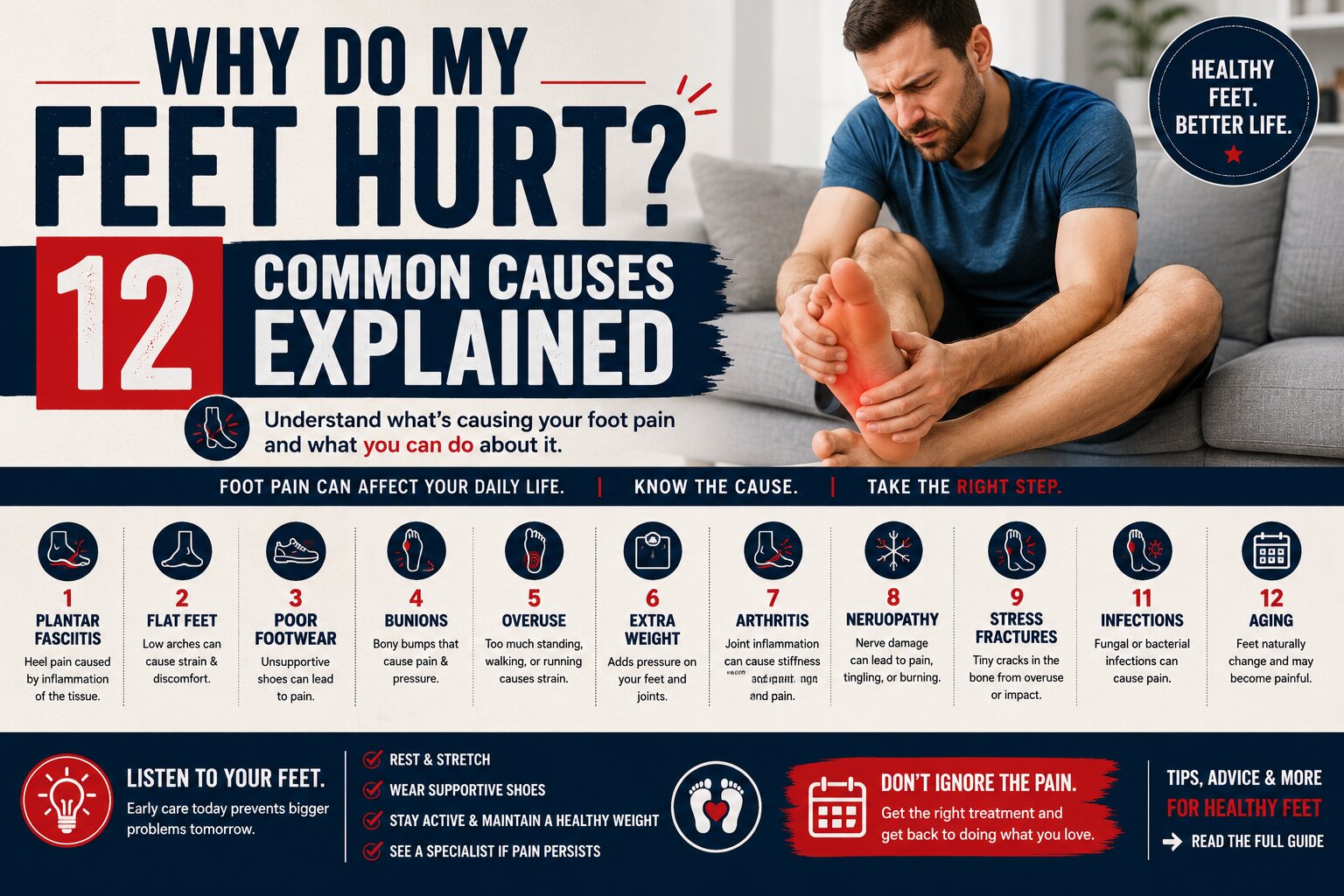
The most infamous culprit here is plantar fasciitis—an inflammation of the thick band of tissue running along the bottom of your foot. If you experience that classic sharp, stabbing sensation when you first step out of bed, you are dealing with the classic symptoms of feet hurt when first wake up. During the night, your plantar fascia contracts and shortens; when you stand up, your body weight abruptly forces it to stretch, causing micro-tears at its attachment point on the heel bone.
Many people confuse this with a physical bone growth, leading to a classic diagnostic debate of heel spurs vs plantar fasciitis. In reality, heel spurs are simply a secondary symptom of long-term calcium buildup caused by the constant pulling of an inflamed plantar fascia. If you are looking for rapid, non-invasive relief, check out our guide on how to relieve plantar fasciitis pain fast for actionable steps you can take at home tonight.
For structural healing over time, the body requires a structured environment. You must understand the typical plantar fasciitis recovery time—which can take anywhere from three to twelve months—and avoid the critical mistakes of what aggravates plantar fasciitis, such as walking barefoot on hardwood floors or wearing worn-out slippers. Incorporating dedicated plantar fasciitis exercises and wearing a supportive night splint for plantar fasciitis to keep the fascia gently elongated while you sleep are foundational pillars of a successful recovery.
Achilles Tendonitis
If your pain is concentrated at the back of your heel where your calf muscle anchors to your heel bone, you are likely dealing with Achilles tendonitis. This condition is incredibly common among gym-goers, runners, and retail workers who wear flat shoes with a low heel-to-toe drop.
When choosing the right shoes to manage this condition, it is vital to select Achilles tendonitis shoes that feature a slightly elevated heel-to-toe drop (usually $10\text{mm}$ to $12\text{mm}$). This slight ramp mechanically shortens the Achilles tendon, relieving the constant tension and allowing the tissue to heal.
Other Heel Conditions
It is highly recommended that you consult a specialist if your pain feels different, because there is always a possibility of experiencing heel pain not plantar fasciitis. Conditions like fat pad atrophy (the wear-down of the natural shock-absorbing cushion under your heel bone) or calcaneal stress fractures require highly specific offloading strategies that go beyond typical arch supports.
ZONE 2: ARCH & MIDFOOT PAIN (THE SUPPORT SYSTEM)
Your arch is your body’s natural leaf spring suspension system. When it fails, every step sends a shockwave directly up your skeletal chain.
       [Overpronation]                  [Supination]
       Arch collapses inward            Arch stays rigid, weight on outer edge
       High ankle strain                Poor shock absorption, lateral tension
Flat Feet & Overpronation
If you have low arches or flat feet, your foot naturally rolls inward with every step—a biomechanical movement known as overpronation. This movement can lead to a long list of flat feet problems, because your ankles, knees, and hips are forced out of alignment. If you are unsure of your standing mechanics, you can easily self-diagnose by reading our guide on do I have flat feet.
The constant inward collapse of the foot stretches the soft tissues under your sole, resulting in sharp arch pain when walking. Furthermore, because the entire lower leg rotates inward when the arch collapses, this biomechanical error frequently travels upward, which explains why so many patients discover that can flat feet cause knee pain and chronic lower back issues. Identifying overpronation symptoms early on is crucial so you can transition into stability shoes with posting (firmer foam under the inner side of the arch) to keep your stride neutral.
High Arches & Supination
On the opposite end of the spectrum are individuals with highly rigid, high arches. This foot type struggles with the exact opposite issue: supination (or underpronation), where the foot fails to roll inward enough, leaving the outer edge of the foot to absorb all of the impact forces.
The primary high arches problems stem from a lack of surface area contact. Because only the heel and the ball of the foot touch the ground, these two areas absorb double the normal impact. If you have high arches, you must seek out specialized supination shoes that offer high levels of shock-absorbing, flexible cushioning to disperse those vertical forces.
ZONE 3: FOREFOOT & TOES (THE POWER-OFF ZONE)
Your forefoot takes the brunt of the load during the “push-off” phase of walking. When this area is compromised, every step becomes a chore.
                    [Forefoot Anatomy & Pain Points]

                      (  ) (  ) (  ) (  ) (  )  <-- Toes
                       ||   ||   ||   ||   ||
                      [  ] [  ] [  ] [  ] [  ]  <-- Metatarsals
                        \   /    |    \   /
                         \ /     |     \ /      <-- Morton's Neuroma
                          V      |      V           (typically between 3rd & 4th)
                                [ ]             <-- Sesamoid Bones (under 1st)
Metatarsalgia & Morton’s Neuroma
If you feel like you are walking on a hard, painful pebble, or if you experience a sharp, burning sensation in the ball of your foot, you are likely dealing with metatarsalgia or Morton’s neuroma. Metatarsalgia is a broad term for inflammation of the metatarsal heads, and finding the right metatarsalgia treatment usually involves introducing a metatarsal pad to your insole, which spreads the metatarsal bones and restores the natural transverse arch of your forefoot.
If that nerve becomes chronically pinched and thickened, it transitions into Morton’s neuroma symptoms, which can include tingling, numbness, or shooting pain into the third and fourth toes. Managing this requires a shoe with a wide, anatomical toe box that allows your forefoot to splay naturally under load.
Bunions & Hammertoes
Bunions (a bony bump that forms on the joint at the base of your big toe) and hammertoes (an abnormal bend in the middle joint of a toe) are almost entirely driven by modern footwear design. Decades of wearing narrow, pointed shoes compress the toes into an unnatural triangular shape.
To achieve long-lasting bunion pain relief, you must stop squeezing your feet into narrow shoes. Look for shoes constructed with foot-shaped lasts and soft, stretchy uppers. Ignoring these issues can lead to chronic complications, such as capsulitis second toe—an inflammation of the ligaments surrounding the base of your second toe caused by it taking on too much weight because the big toe is out of commission.
Sesamoiditis & Toe Pain
Underneath your big toe joint lie two tiny, pea-shaped bones called sesamoids, which act as pulleys for your tendons. When these bones become inflamed, it leads to a condition that requires highly specialized, stiff-soled sesamoiditis shoes to prevent the big toe from bending excessively during walking. Understanding the various toe pain causes is essential to differentiating between simple joint strain, gout, and tight footwear.
ZONE 4: ANKLE & LATERAL FOOT PAIN (THE STABILIZERS)
Pain on the outer borders of your feet or around your ankle joint points to lateral stabilization and tendon issues.
Peroneal & Posterior Tibial Tendonitis
Your peroneal tendons run down the outside of your ankle and help stabilize your foot on uneven terrain. If you are experiencing lateral foot pain, finding high-quality peroneal tendonitis shoes with deep heel cups and rigid lateral support is key to letting those overworked tendons rest.
Conversely, if you experience pain on the inside of your ankle and arch, you may be facing posterior tibial tendon dysfunction (PTTD), which can eventually lead to a completely flat foot if left unsupported. Wearing robust posterior tibial tendon dysfunction shoes is absolutely critical to mechanically hold the arch in place and prevent the tendon from stretching beyond its limit.
Tarsal Tunnel Syndrome
Similar to carpal tunnel in the wrist, tarsal tunnel syndrome involves the compression of the posterior tibial nerve as it passes through a narrow space on the inside of your ankle. This compression leads to burning, tingling, and numbness throughout the bottom of the foot, which is frequently misdiagnosed as plantar fasciitis but requires a completely different approach focused on limiting pronation to decompress the tarsal canal.
THE FOOTWEAR MATERIAL & BUILD QUALITY MATRIX
When customers ask me why one shoe costs $60 and another costs $160, the answer isn’t just brand marketing—it’s the material science inside the midsole and upper. Understanding what goes into your shoe is the key to choosing footwear that supports, protects, and lasts.
       [Midsole Material Lifespan & Performance]

  Compression-Molded EVA  ├───> Light | Cheap | Packs out in 200-300 miles
  Polyurethane (PU)       ├───> Heavy | Resilient | Retains shape for 500+ miles
  Ortholite Footbed       ├───> Breathable | Retains 95% thickness over time
  Standard Memory Foam    ├───> Hot | Bottoms out instantly | No structural support
Let’s demystify the core components of modern shoe construction:
1. Midsole Compounds (The Engine of the Shoe)
The midsole is the thick layer of material between the outsole (the bottom rubber) and the upper. This is where shock absorption and structural stability happen.
- EVA (Ethylene Vinyl Acetate): This is the industry standard for athletic footwear. It is incredibly lightweight, bouncy, and cheap to manufacture. However, there are two types of EVA. Injection-molded EVA is full of tiny air bubbles and feels extremely soft in the store, but it “packs out” (loses its cushioning properties) very quickly—often within $200$ to $300$ miles of wear. Compression-molded EVA (CMEVA) is denser, more supportive, and retains its protective properties significantly longer.
- PU (Polyurethane): This is a much denser, heavier, and more durable polymer. Unlike EVA, PU does not pack out under heavy weight or long-term pressure. This is why high-quality work boots, duty shoes, and premium walking shoes use PU midsoles. If you stand for ten hours a day, PU is your best friend because it keeps your foot properly aligned long after EVA would have flattened into a pancake.
2. Outsoles (The Grip and Wear)
- Carbon Rubber: This is the same material used in car tires. It is dense, heavy, and incredibly resistant to abrasion. You want carbon rubber in high-wear areas like the heel and lateral edge of your shoe.
- Blown Rubber: This is rubber that has been injected with air during manufacturing. It is lighter and softer than carbon rubber, offering excellent traction and a smoother ride, but it wears down much faster on concrete surfaces.
- TPR (Thermoplastic Rubber): Often found in budget-friendly casual shoes, TPR offers decent grip and flexibility but lacks the premium durability and wet-surface traction of high-grade vulcanized rubber.
3. Upper Materials (The Structural Envelope)
- Engineered Mesh / Circular Knits: These materials are fantastic for hot summer days because they allow heat to escape. However, they stretch over time and offer almost zero structural containment. If you are a severe overpronator, avoid completely knit uppers unless they have internal reinforcing straps or external thermoplastic overlays.
- Full-Grain Leather: Leather is the gold standard for durability and foot health. It naturally conforms to the unique shape of your foot over time, is naturally water-resistant, and provides excellent lateral stability. The downside is that it requires a brief break-in period and is heavier than synthetic alternatives.
4. Cushioning and Insoles (The Direct Interface)
- Memory Foam: Many casual shoes boast a thick layer of memory foam. I always warn my customers about the “Memory Foam Trap.” Memory foam is highly heat-sensitive; as your foot warms up, the foam loses all of its resistance and “bottoms out” (squeezes down to paper-thinness), leaving your foot resting directly on the hard rubber beneath it. It also traps heat, leading to sweaty feet.
- Ortholite / Open-Cell Foam: Unlike memory foam, open-cell polyurethane insoles retain $95\%$ of their thickness over time, allowing air to circulate around your foot and providing highly resilient, consistent cushioning.
REAL-WORLD BUYER QUESTIONS: DIRECT FROM THE RETAIL FLOOR
When people sit on my fitting bench, they don’t want to hear clinical medical jargon. They want real, honest, practical answers to the problems they face every single day. Let’s answer the five questions I get asked most often:
1. “Are expensive shoes actually worth it, or am I just paying for a logo?”
The honest answer: Up to a certain point, yes, they are absolutely worth it. When you buy a cheap $50$ shoe, the manufacturer has to make massive compromises. They use cheap, low-density EVA that flattens out in a couple of months, cheap cardboard lasting boards that rot from sweat, and unstructured synthetic uppers that don’t support your foot.
When you move into the $120$ to $160$ price range, you are paying for engineered midsoles (like compression-molded EVA or PU), premium rubber outsoles that don’t slide on wet tile, and orthopedically designed lasts that match the actual shape of a human foot. However, once you go over $200$, you are usually paying for luxury branding, hype, or highly specialized carbon-fiber plates that you don’t need for daily wear.
2. “Will these shoes hurt after walking 10,000 steps?”
The honest answer: Not if they pass the “Torsional Twist Test” (which we will cover below). If you buy a shoe that is incredibly flexible and can easily be twisted like a dishcloth, your feet will hurt after 10,000 steps.
Without a rigid shank in the midfoot, your arches have to flex and flatten with every single step, leading to severe fatigue and soreness. To walk 10,000 steps comfortably on vacation, you need a shoe with a stiff midfoot and a structured heel.
3. “What do most people regret buying online?”
The honest answer: They regret buying shoes based on their “usual size.” Many people do not realize that sizing is completely inconsistent across brands. A size $10$ in one brand might fit like a size $9$ in another.
Furthermore, buying online means people ignore their foot width. They squeeze a wide foot into a standard “D” width shoe, causing their pinky toes to rub, their big toe joint to develop bunions, and their feet to fall asleep due to compressed nerves.
4. “How long should a good pair of walking or running shoes actually last?”
The honest answer: Between $350$ and $500$ miles of walking or running. If you are wearing them for standing all day at work, a good rule of thumb is six to twelve months.
Even if the bottom rubber looks perfectly fine, the microscopic air bubbles inside the EVA midsole have likely collapsed, meaning the shoe has lost its ability to absorb shock. If you start noticing new aches in your knees, hips, or heels, your shoes have likely reached the end of their lifespan.
5. “Do orthotics actually work, or should I just buy a supportive shoe?”
The honest answer: It is a collaborative relationship. Many people ask me, do orthotics actually work if I put them in cheap shoes? The answer is no. An orthotic is only as good as the foundation it sits on.
If you put a high-quality, custom orthotic into a flimsy shoe with a soft, unstable heel counter, the shoe will simply tilt under your weight, rendering the orthotic completely useless. You must pair a supportive insole with a structurally sound shoe to get proper alignment.
PRO TIPS FROM A FOOTWEAR EXPERT: THE 4 FIELD TESTS
Before you take a new pair of shoes to the cash register or keep them from an online delivery, perform these four simple, hands-on tests that we use on the retail floor:
    [The 4-Step Shoe Build Integrity Test]

  1. The Torsional Twist   ───> Twist shoe like a towel. Midfoot must remain rigid.
  2. The Heel Pinch        ───> Squeeze heel cup. Must resist collapsing inward.
  3. The Flex-Point Fold   ───> Push toe upward. Must bend only at the forefoot.
  4. The Insole Extraction  ───> Pull out footbed. Look for structural lasting boards.
Test 1: The Torsional Rigidity Twist
Hold the shoe in both hands—one hand on the heel, the other on the toe. Now, try to twist the shoe as if you were wringing out a wet towel.
- The Verdict: A supportive shoe should resist this twisting motion in the middle. The heel and the forefoot can move slightly, but the midfoot (where your arch sits) must remain completely rigid. If the shoe twists easily into a spiral, it will not protect your arch from collapsing under load.
Test 2: The Heel Counter Pinch Test
Squeeze the very back of the shoe (the heel counter) between your thumb and forefinger. Try to collapse it inward toward the footbed.
- The Verdict: The heel counter should be stiff and structured, usually reinforced with an internal plastic cup. If you can easily crush the heel counter flat with your thumb, the shoe will not keep your heel locked in place, leading to heel slippage, ankle instability, and increased strain on your Achilles tendon.
Test 3: The Flex Point Fold Test
Place the shoe on a flat table. Press down on the toe of the shoe, forcing it to bend upward, or bend the toe of the shoe back with your hand.
- The Verdict: The shoe must bend only at the ball of the foot (where your toes naturally bend). If the shoe folds in half right in the middle of the arch, it is a biomechanical disaster that will cause severe arch pain and plantar fasciitis.
Test 4: The Insole Extraction Check
Reach inside the shoe and pull out the removable insole. Look at what lies beneath it.
- The Verdict: Is there a solid, flat lasting board stitched neatly to the upper, or is it just a thin piece of mesh glued over hollowed-out plastic channels? A premium shoe will have a clean, solid, stitched Strobel construction that provides a flat, stable platform for your foot to rest on.
THE FOOTWEAR MATERIAL & RECOVERY COMPARISON TABLE
To help you choose your next pair of shoes, use this practical reference table based on different shoe builds and foot conditions:
| Midsole Material | Heel-to-Toe Drop | Best Use Case | Shock Absorption | Stability | Durability | Targeted Foot Condition |
|---|---|---|---|---|---|---|
| Denser Polyurethane (PU) | Medium-High ($10\text{mm}$ to $12\text{mm}$) | Standing all day, heavy duty, work environments | High | Maximum | Excellent | Plantar Fasciitis, Achilles Tendonitis, Overpronation |
| Compression-Molded EVA | Medium ($6\text{mm}$ to $8\text{mm}$) | Athletic walking, daily fitness, casual use | Very High | Moderate | Good | Metatarsalgia, General Sore Feet, High Arches |
| Zero-Drop Firm Rubber | None ($0\text{mm}$) | Gym training, weightlifting, natural movement | Low | High | Excellent | Posture correction, calf stretching (not for heel pain) |
| Soft Injection-Molded EVA | Low ($4\text{mm}$ or less) | Short recovery walks, lounge wear | Moderate | Very Low | Poor | Sore feet relief (short-term), recovery post-workout |
LIFESTYLE & USE-CASES: MATCHING THE SHOE TO THE STRUGGLE
No single shoe is perfect for every aspect of your life. To prevent chronic foot pain, you must select your footwear based on the specific activity you are performing.
       [Activity-Specific Footwear Requirements]

  Standing All Day   ───> PU Midsole | Medium-High Drop | Firm Support
  European Vacation  ───> CMEVA Midsole | Breathable Mesh | High Torsional Rigidity
  Gym / Cross-Fit    ───> Low Drop | Lateral Outriggers | Firm Platform
1. The Concrete-Floor Worker (Nurses, Teachers, Retail Workers)
If you spend eight to twelve hours standing on hard, unyielding concrete floors, your feet are subjected to constant, static pressure.
- The Mistake: Wearing highly cushioned, soft running shoes. These shoes are designed for dynamic forward motion, not static standing. The soft foam will compress down under your body weight, leaving your skeletal structure completely unsupported by noon.
- The Solution: You need a shoe with a dense Polyurethane (PU) midsole, structured arch support, and a supportive heel counter. Look for duty shoes, professional clogs, or premium walking shoes that hold your foot in a neutral position and refuse to collapse under pressure.
2. The European Vacation Traveler (The 20,000-Step Vacationer)
If you are planning a trip where you will be walking miles over cobblestone streets, brick paths, and hard asphalt, you need a highly versatile shoe.
- The Mistake: Wearing flimsy canvas slip-ons or brand-new shoes that haven’t been broken in, leading to the dreaded experience of feet hurt on vacation.
- The Solution: Look for an athletic walking shoe featuring a compression-molded EVA midsole, a breathable engineered mesh upper with structured overlays, and a robust rubber outsole. Make sure you buy these shoes at least four weeks before your trip to allow your feet to adapt and to ensure there are no hidden friction points.
3. The Gym and Training Enthusiast
If your routine involves lifting weights, doing HIIT workouts, or running on a treadmill, your footwear needs to adapt to multiple planes of motion.
- The Mistake: Wearing running shoes with a high heel-to-toe drop and massive cushioning for squats, deadlifts, and lateral agility drills. This unstable platform can cause your ankles to roll and put immense strain on your tendons.
- The Solution: Choose a cross-trainer with a lower heel-to-toe drop ($4\text{mm}$ to $6\text{mm}$), a firm, flat outsole platform for lifting stability, and lateral outriggers (rubber that wraps up the side of the shoe) to protect your ankles during side-to-side movements.
COMMON MISTAKES WE SEE ON THE RETAIL FLOOR
Even with the best intentions, it is easy to fall into bad habits that lead to chronic foot pain. Here are the most common shoe-buying mistakes I have witnessed over my career:
1. Choosing Style Over Comfort (The “Aesthetic” Trap)
We all want to look good, but squeezing your feet into shoes that are too narrow, too flat, or completely unsupportive just to match a modern trend is a recipe for physical therapy.
If you love fashion, look for brands that integrate structural orthopedic support into modern, clean silhouettes, rather than sacrificing your physical health for a fast-fashion look.
2. Buying the Wrong Width
Most people assume that if a shoe feels tight, they simply need to go up half a size. This is a massive mistake. Sizing up for length to get more width means the flex point of the shoe will no longer align with the ball of your foot.
This causes the shoe to bend in the wrong place, resulting in arch pain, heel slippage, and premature wear on the shoe’s outsole. If your foot is wide, seek out brands that offer dedicated wide widths (EE for men, D for women) to allow your toes to splay naturally.
3. Trusting Online Reviews Blindly
Many online reviews are written within forty-eight hours of receiving a shoe. They focus entirely on the initial “unboxing” experience and step-in softness.
They do not tell you how the shoe performs after a twelve-hour shift, how the midsole holds up after six months, or how the materials affect your biomechanics over time. Look for long-term reviews written by biomechanical experts, podiatrists, or footwear veterans who understand material longevity.
4. Ignoring the Heel Drop
The “heel-to-toe drop” is the difference in height between the heel of the shoe and the forefoot. If you transition abruptly from a shoe with a $12\text{mm}$ drop to a zero-drop shoe without a transition period, you will put immense, sudden stress on your calf muscles and Achilles tendon.
Understanding how different heel drops affect your body—such as choosing the correct heel drop for plantar fasciitis—is critical to preventing injury. If your muscles are tight, you may also experience tight calves foot pain, which can be managed by wearing a slightly higher drop shoe while gently stretching your calves over time.
RECOVERING AND MAINTAINING YOUR FOOT HEALTH
Finding the right footwear is half the battle, but active recovery is what ensures long-term comfort and mobility.
       [The Dynamic Recovery Trilogy]

  Structural Support <───> Soft Tissue Release <───> Targeted Footwear
   (Orthotics/Insoles)       (Lacrosse Ball Roll)       (PU/CMEVA Midsole)
Soft Tissue Mobilization
In addition to wearing the right shoes, you should actively release the tight tissues under your feet. Rolling your arch over a cold water bottle or a lacrosse ball for five minutes every evening is an excellent way to break up tension.
Knowing Your Biomechanics
Understanding your unique foot type is key to making informed purchases. Are you flat-footed, or do you have rigid arches? Take a look at our self-assessment tool to discover what type of foot do I have so you can shop with confidence. If you struggle with pronation issues, learn how to select the right pronation vs supination insole to customize your fit.
EXTERNAL AUTHORITY REFERENCES
For deep, authoritative research on footwear materials, human biomechanics, and foot health, check out these respected resources:
- The American Podiatric Medical Association (APMA): The leading national organization representing podiatrists in the United States. Look for their “Seal of Acceptance” on footwear brands that promote active foot health.
- The Journal of Foot and Ankle Research: A peer-reviewed scientific journal publishing cutting-edge studies on biomechanics, orthotic design, and lower-limb rehabilitation.
- Footwear Science (International Society of Footwear Biomechanics): The premier research publication focusing on the physical interaction between the human foot and modern shoe materials.
FAQ: 10 HIGHLY SEARCHED QUESTIONS ANSWERED BY A FOOTWEAR VETERAN
Q1: Can bad shoes cause chronic back and knee pain?
Yes. If your shoes lack arch support, your feet will collapse inward (overpronate). This movement forces your lower leg to rotate inward, which misaligns your knees, tilts your pelvis, and puts immense stress on your lower back, demonstrating how can shoes cause back pain and chronic joint fatigue.
Q2: Why do my ankles hurt so much after a simple evening walk?
Ankle discomfort usually points to a lack of lateral stabilization. If you walk in flimsy, unstructured shoes, your ankle joint is forced to work overtime to keep you balanced, explaining why do ankles hurt after walking and how a stiffer heel counter can immediately resolve this issue.
Q3: How do I know if I have a stress fracture or just shin splints?
Shin splints usually cause a broad, aching pain along the inner side of your shin bone that improves once you warm up. A stress fracture is a microscopic crack in the bone that causes sharp, localized pain at a single point, which hurts constantly and worsens under weight, making the distinction of shin splints vs stress fracture a critical diagnostic difference.
Q4: What is the difference between a corn and a callus on my feet?
Calluses are broad, thick patches of dead skin that form on high-friction areas like the heel or ball of your foot to protect it. Corns are smaller, deep, cone-shaped hard spots that usually form on top of or between your toes due to tight, narrow toe boxes pressing them together. Learn the key differences in our guide on corns vs calluses on feet to find relief.
Q5: How do I get rid of painful corns caused by narrow dress shoes?
To resolve this issue permanently, you must eliminate the friction. Switch to shoes with a wider toe box, use protective silicone toe sleeves, and read our comprehensive walkthrough on how to treat corns on feet to safely soften and remove them at home.
Q6: Why do my heels look so dry, cracked, and painful?
Cracked heels are caused by dry skin combined with mechanical pressure. When you walk, the fat pad under your heel naturally expands outward; if your skin is dry and lacks elasticity, it will split under your weight. Understanding the diverse cracked heels causes—such as wearing open-backed shoes or standing for long periods—is the first step toward finding a cure.
Q7: Can wearing tight sneakers cause my toes to bend permanently?
Yes. Wearing narrow, pointed shoes squeezes your toes into a bent, claw-like position. Over time, the tendons in your toes shorten and tighten, leading to permanent deformities. Learn about hammertoe causes to see how proper toe-box design can prevent these skeletal changes.
Q8: Why do my feet hurt so much after wearing brand-new shoes?
New shoes often require a brief adjustment period. The materials in the upper and midsole need to bend and conform to your unique gait pattern, which explains why you might experience temporary foot pain from new shoes during the first few days of wear.
Q9: Why do my feet hurt so badly after wearing fashionable high heels?
High heels force your body weight forward onto your delicate metatarsal heads, compressing your toes into a narrow toe box and shortening your calf muscles. This dramatic structural shift explains why feet hurt in high heels and why you should limit their use.
Q10: Can tight calf muscles cause pain on the bottom of my foot?
Absolutely. Your calf muscles connect directly to your heel bone via the Achilles tendon, which is physically linked to your plantar fascia. When your calves are tight, they pull upward on your heel, putting constant tension on the bottom of your foot and causing severe tight calves foot pain.
CONCLUDING THOUGHTS & THE PATH FORWARD
Foot pain is not a life sentence, nor is it a natural part of growing older. It is a clear, physical warning sign from your body that your footwear is failing to support your natural skeletal structure.
       [Your Footwear Health Checklist]

  ☐ Toss out shoes with completely worn-out outsoles
  ☐ Avoid "marshmallow-soft" shoes for long-term standing
  ☐ Prioritize shoes that pass the Torsional Twist Test
  ☐ Measure your feet yearly to ensure proper sizing
If you are a worker standing on hard concrete floors all day, a traveler planning a 20,000-step vacation, or someone struggling with morning heel pain, prioritize shoe structure over fast-fashion trends. Look for dense, compression-molded midsoles, stiff midfoot shanks, and wide, anatomical toe boxes that allow your feet to function as nature intended. Your feet are the foundation of your entire kinetic chain—treat them with the respect they deserve.
READY TO FIND SORE FEET RELIEF?
Don’t let foot pain hold you back from living your life to the fullest. Take the first step toward pain-free movement today:
- Compare Top-Rated Options: Browse our collection of orthopedic-friendly shoes designed with dense midsoles and structured support.
- Check the Latest Prices Online: Find great deals on expert-recommended footwear brands.
- Explore Expert-Recommended Picks: See our curated list of the best shoes for plantar fasciitis, standing all day, and athletic walking.