
What Is Pronation? Overpronation vs. Supination and How to Tell Your Gait Type
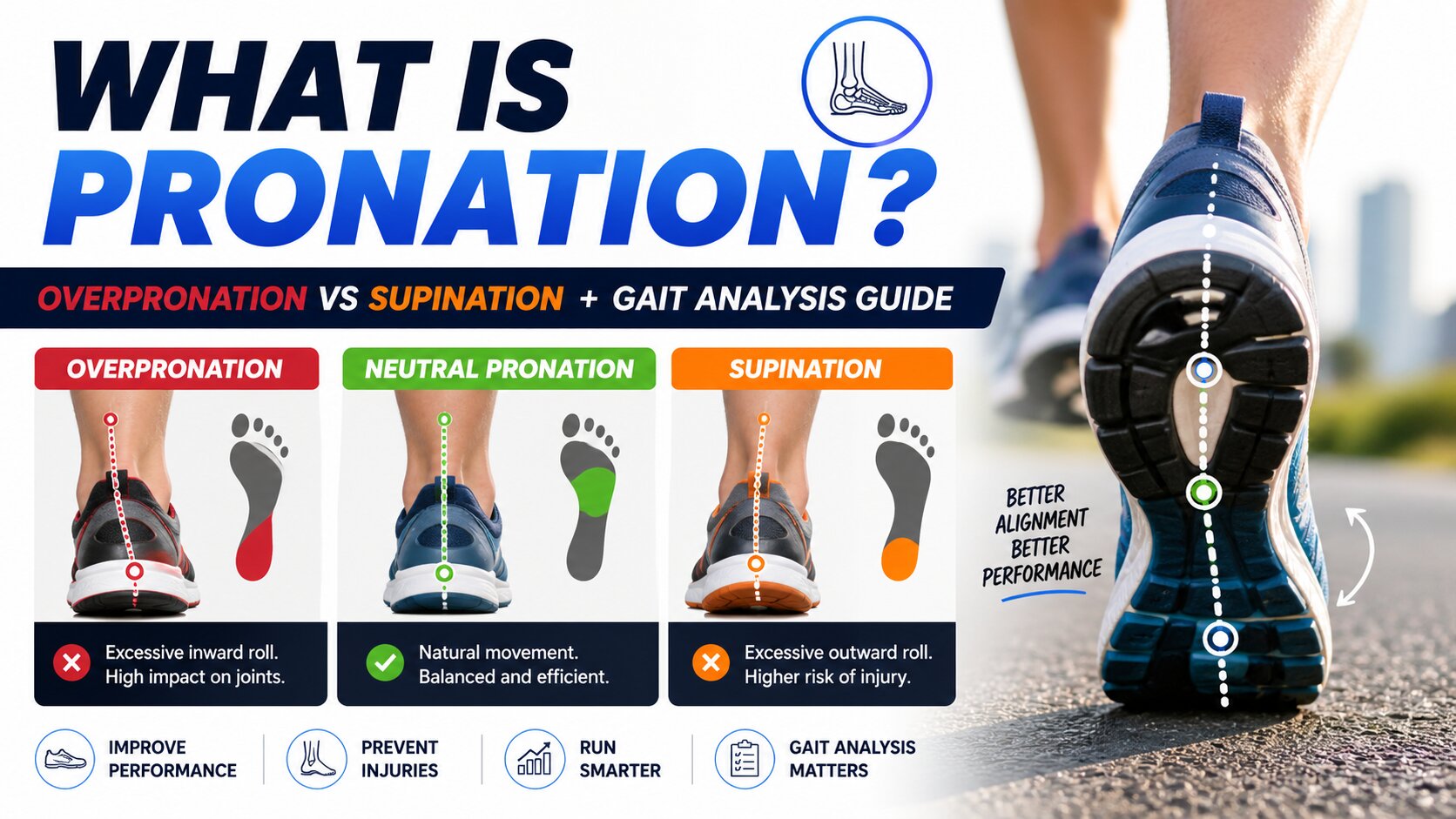
Pronation is a normal part of walking and running. The confusion begins when terms such as overpronation, underpronation, supination, flat feet, high arches, stability shoes, and gait analysis are treated as if they automatically tell you what is wrong with your feet.
They don’t.
Your feet are designed to move when you walk and run. The more useful question is not simply “Do I pronate?” but:
How does my foot move, does that movement cause problems, and what footwear feels comfortable and appropriate for my activity?
This guide explains the difference between pronation, overpronation, and supination, how to look for useful clues at home, what gait analysis can actually tell you, and how to choose footwear without turning a foot-type label into a diagnosis.
TL;DR: Pronation vs Overpronation vs Supination
| Foot pattern | What it means | Useful clue |
| Pronation | Normal inward movement of the foot during gait | Expected during walking and running |
| Overpronation | Greater or more prolonged inward movement | May be visible during gait or reflected in shoe wear |
| Supination / Underpronation | Less inward movement with the foot remaining more toward the outside | Outer-edge loading or shoe wear may be a clue |
| Neutral pattern | Relatively balanced movement | No obvious excessive inward or outward pattern |
The key point: pronation itself is not a problem.
Foot movement exists on a spectrum, and visible pronation does not automatically mean you have an injury or need a corrective shoe.
What Is Pronation of the Foot?
Pronation describes a combination of movements that happens as your foot accepts body weight during walking and running.
In simple terms, the foot moves inward and adapts to the ground during the loading phase. Your arch changes shape, your foot absorbs load, and later in the gait cycle the foot becomes more rigid for push-off.
Think of the foot as a dynamic structure, not a rigid platform.
A typical step involves:
- The foot contacts the ground.
- The foot adapts to the surface.
- The arch changes as body weight moves over it.
- The lower limb continues forward.
- The foot becomes more stable for push-off.
This movement happens automatically thousands of times every day.
Is Pronation Normal?
Yes.
This is one of the most important points in the entire article.
Pronation is normal human movement.
The problem with much online footwear content is that it uses “pronation” as though it automatically means excessive motion or poor biomechanics.
It doesn’t.
A person can pronate and have no pain, no functional limitation and no reason to change their footwear.
What Is Overpronation?
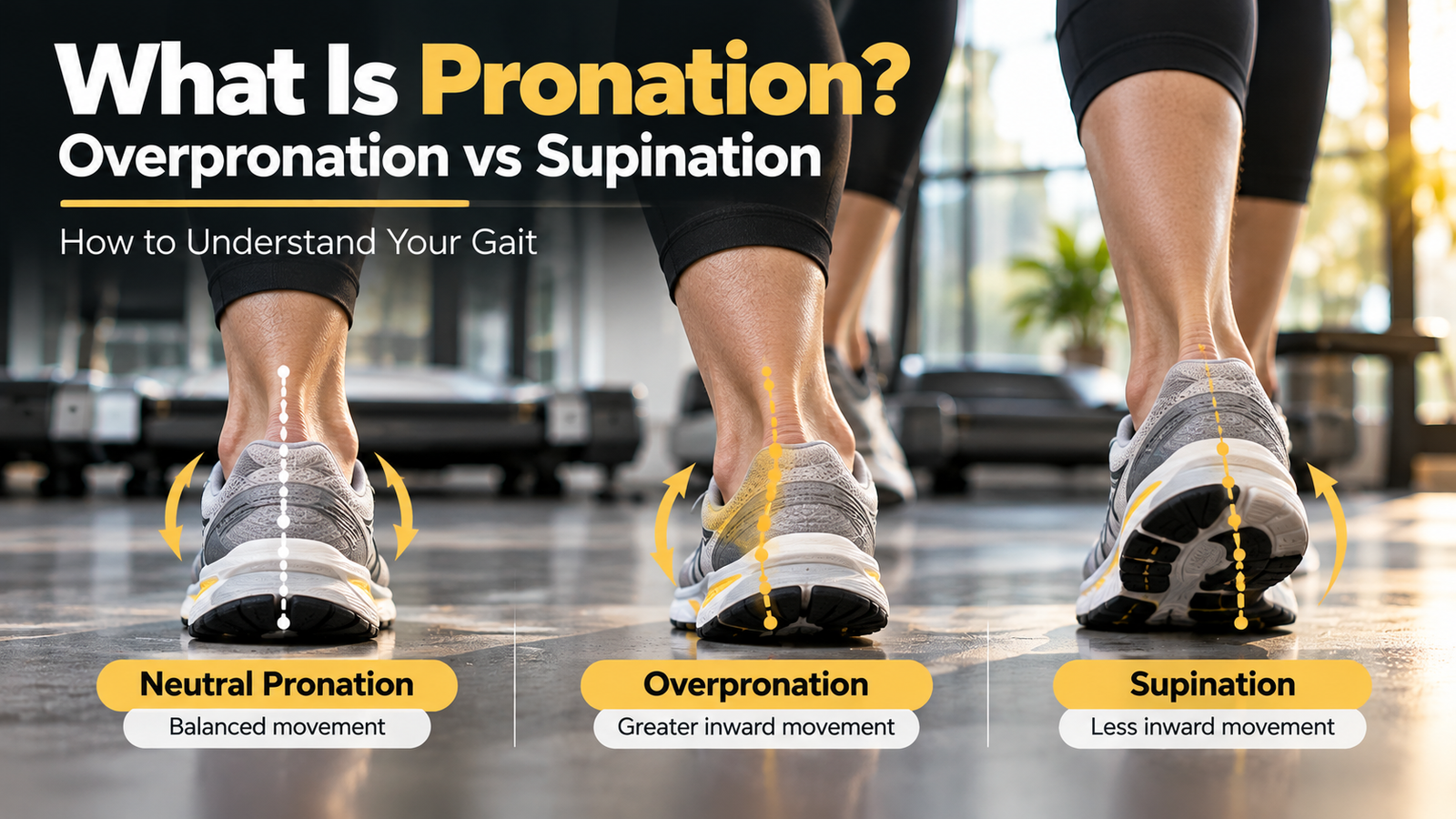
Overpronation generally refers to a greater or more prolonged inward movement of the foot during gait.
You may also see it described as:
- Excessive pronation
- Excessive inward rolling
- Increased medial movement
- Greater arch deformation during loading
But there isn’t one visual feature that can diagnose overpronation.
A low arch does not automatically mean you have problematic overpronation.
Likewise, an obvious arch does not automatically mean you have a neutral gait.
What Does Overpronation Look Like?
If you’re searching for “what does overpronation look like?”, these are some clues worth observing:
- The ankle or heel appears to move inward during walking or running.
- The arch appears to lower noticeably during weight-bearing.
- One foot appears to roll inward more than the other.
- The inside edge of a frequently worn shoe may show greater wear.
- The pattern becomes more obvious during running or when fatigued.
But these are screening clues, not a diagnosis.
Your footwear construction, walking style and activity can also affect outsole wear.
A useful explanation from Banner Health similarly discusses arch movement and shoe-wear patterns as clues while emphasizing that persistent symptoms should be assessed appropriately.
Pronation vs Overpronation: What’s the Difference?
This is the easiest way to remember it:
Pronation = normal movement.
Overpronation = greater or more prolonged inward movement.
So if someone asks:
“Is pronation bad?”
The answer is no.
If someone asks:
“Is overpronation automatically bad?”
Again, not necessarily.
What matters is the individual’s movement, symptoms, activity and functional needs.
What Is Supination?
Supination is the opposite direction of foot movement.
In everyday footwear terminology, underpronation generally refers to a gait pattern where the foot pronates less and remains more toward the outside of the foot.
The terms can be confusing because supination and pronation are actually normal components of foot movement.
The important distinction is the amount and timing of movement, not whether the foot moves at all.
What Does Supination Look Like?
Possible clues include:
- Greater loading toward the outside edge of the foot
- A relatively rigid foot
- Less visible inward movement during gait
- More lateral outsole wear
- A tendency toward repeated ankle instability in some individuals
Again, these clues don’t establish a diagnosis.
If you have recurring pain or injuries, a professional assessment is more useful than trying to assign yourself a label from a shoe sole.
Overpronation vs Supination: Side-by-Side
| Feature | Pronation | Overpronation | Supination / Underpronation |
| Basic movement | Inward foot movement | Greater inward movement | Less inward movement / more lateral loading |
| Automatically a problem? | No | No | No |
| Arch | Can vary | May lower during loading | Often associated with a higher or more rigid arch |
| Shoe wear clue | Variable | May show medial wear | May show lateral wear |
| Foot behavior | Adapts to ground | May remain more mobile/inward | May remain more rigid |
| Footwear approach | Fit and comfort | Stable-feeling footwear may suit some people | Cushioning/flexibility may suit some people |
| Best assessment | Movement + symptoms | Dynamic assessment if needed | Dynamic assessment if needed |
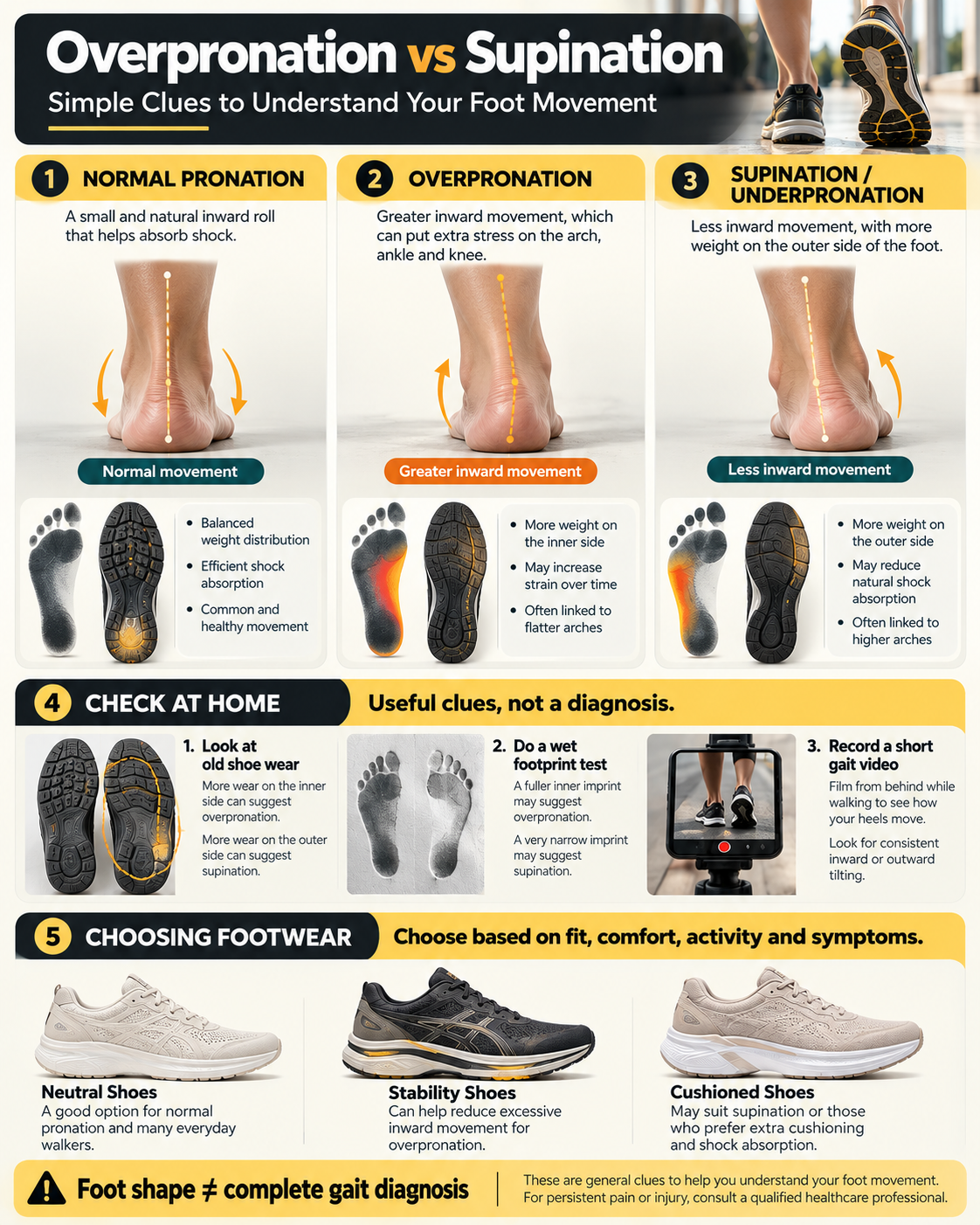
What Is the Opposite of Overpronation?
The simplest answer is:
Supination or underpronation.
But there is an important distinction.
Overpronation refers to excessive inward movement.
Underpronation refers to insufficient inward movement, with the foot remaining more toward the outside.
That’s why searches such as:
- overpronation vs supination
- supination vs overpronation
- pronation vs supination
- overpronate vs supinate
- opposite of overpronation
are all closely related.
How to Tell If You Overpronate at Home
If you’re searching “how to tell if you overpronate,” you can start with three simple observations.
1. Check Your Old Shoes
Look at the outsole of your most frequently worn walking or running shoes.
More medial wear
More wear toward the inside may be a clue that your foot loads more toward the medial side.
More lateral wear
More wear toward the outside may be a clue that your foot remains more toward the lateral side.
Relatively balanced wear
Even wear provides less obvious evidence of a strongly biased loading pattern.
But remember:
Shoe wear is evidence, not a diagnosis.
2. Try the Wet Foot Test
The wet footprint test can give you a basic idea of your static arch shape.
How to do it
- Wet the bottom of your foot.
- Step naturally onto cardboard or another surface that shows the footprint.
- Look at the connection between your heel and forefoot.
- Compare both feet.
A broader footprint through the middle can suggest a lower arch, while a narrower connection can suggest a higher arch.
But there is an important limitation:
Static arch shape does not tell you everything about dynamic gait.
Research comparing static and dynamic foot posture has found relationships between the two, but the relationship is not strong enough to treat a static arch measurement as a complete description of running mechanics.
3. Record Yourself Walking or Running
A phone can provide a surprisingly useful visual check.
Ask someone to record you:
- From behind
- From the side
- At your normal walking speed
- At your normal running speed if you run
Look for:
- Inward ankle movement
- Heel movement
- Arch changes
- Left-right differences
- Changes when you become fatigued
Don’t diagnose yourself from a single frame.
Watch several strides.
Can Flat Feet Automatically Mean Overpronation?
No.
Flat feet and overpronation are related concepts, but they are not identical.
A person can have a low arch and function comfortably.
A person can also have a visible arch and still show substantial movement during walking or running.
Research examining the relationship between foot posture and lower-limb movement has found some associations, but the evidence is not strong enough to treat static foot shape as a complete explanation of gait.
Remember:
Foot shape = what your foot looks like.
Gait = how your body moves.
They are related, but they are not the same measurement.
Does a High Arch Mean You Supinate?
Not automatically.
High arches can be associated with a more rigid foot and underpronation, but your arch height alone cannot tell you exactly how your foot behaves while walking or running.
If you experience:
- Repeated ankle sprains
- Lateral foot pain
- Recurrent running injuries
- Stress-related foot pain
- Significant left-right differences
A dynamic assessment can provide more useful information.
What Is Running Gait Analysis?
Running gait analysis evaluates how your body moves while walking or running.
Depending on the provider, it may include:
- Treadmill observation
- Video analysis
- Foot and ankle movement
- Stride characteristics
- Shoe-wear assessment
- Mobility testing
- Strength assessment
- Pressure measurements
A running-store shoe fitting is not necessarily the same as a clinical biomechanical assessment.
Running Store Assessment
Usually focuses on helping you find a comfortable shoe.
Physical Therapist Assessment
Can look more broadly at movement, strength, mobility and symptoms.
Podiatry / Sports Medicine Assessment
Can evaluate foot structure and symptoms within a clinical context.
This distinction is important because gait analysis is a tool, not a magic answer to every footwear question.
Do You Need a Gait Analysis?
Not everyone does.
It can be useful if:
- You have recurring running injuries.
- One foot consistently hurts.
- Your symptoms return whenever you increase mileage.
- You repeatedly struggle to find comfortable shoes.
- One side moves noticeably differently.
- You’re returning to running after an injury.
- You want a more detailed assessment before changing your footwear.
If you’re comfortable and injury-free, you don’t necessarily need a formal gait assessment every time you buy running shoes.
Gait Analysis vs Shoe-Fitting Assessment
| Assessment | What it can help with |
| Old shoe inspection | Identifying obvious wear patterns |
| Wet footprint | Understanding static arch shape |
| Phone video | Observing basic movement |
| Running-store assessment | Basic gait observation and footwear selection |
| Physical therapy assessment | Movement, strength, mobility and symptoms |
| Podiatry assessment | Foot structure and clinical concerns |
| Instrumented gait analysis | Detailed movement or pressure measurements |
This prevents a common mistake: treating every treadmill video as a medical diagnosis.
Does Overpronation Cause Injuries?
This question needs a nuanced answer.
It’s tempting to say:
“Overpronation causes knee pain, shin splints and plantar fasciitis.”
But the evidence is more complicated.
A systematic review and meta-analysis found evidence linking pronated foot posture with medial tibial stress syndrome, while evidence for other conditions was smaller or inconsistent. The authors concluded that foot posture should be considered as one part of a multifactorial injury-risk profile, rather than as a standalone explanation.
That is a much more useful way to think about pronation.
Your:
- Training load
- Recovery
- Strength
- Mobility
- Previous injuries
- Activity surface
- Footwear
- Movement patterns
can all matter.
What About Pronation and Plantar Fasciitis?
There can be a relationship between foot mechanics and plantar heel pain, but it is too simplistic to say:
“Overpronation causes plantar fasciitis.”
Plantar fasciitis is influenced by multiple factors.
A systematic review of gait deviations in people with plantar heel pain found differences in several gait variables, but the evidence around pronation/supination specifically was limited.
For readers dealing with heel pain, our guide to the best shoes for plantar fasciitis provides a more footwear-focused comparison.
You can also see our heel pain when walking guide if your symptoms are primarily triggered by walking.
For a clinical perspective, the 2023 APTA Heel Pain–Plantar Fasciitis Clinical Practice Guideline covers examination and treatment recommendations for non-arthritic heel pain in adults and is a better reference than treating footwear as the sole solution.
Can Shoes Correct Overpronation?
This is where footwear marketing can become misleading.
A stability or motion-control shoe may influence how the foot interacts with the ground and can provide a more structured or guided feel.
But:
A shoe should not be described as permanently “correcting” your foot.
Research shows that external interventions such as orthoses and motion-control footwear can influence rearfoot eversion, but the appropriate choice depends on individual characteristics, activity and preference.
What Should You Look For Instead?
If you prefer a stability shoe, look for:
- A stable platform
- Secure heel fit
- Comfortable midsole structure
- Appropriate cushioning
- Enough forefoot space
- Good overall fit
The best test is how the shoe performs for you.
Stability Shoes vs Neutral Shoes
| Feature | Stability shoe | Neutral shoe |
| General design | More structured/guided feel | Less corrective structure |
| Useful for | People who prefer additional guidance | People who prefer a neutral ride |
| Required for overpronation? | No | Not necessarily |
| Cushioning | Depends on model | Depends on model |
| Fit importance | Very high | Very high |
| Main test | Comfort + stability | Comfort + stability |
The goal isn’t to force every foot into the same shoe category.
What Shoes Are Best for Overpronation?
Rather than choosing a shoe simply because a test calls you an “overpronator,” look for features that feel appropriate for your activity.
Possible features include:
- Stable platform
- Secure heel
- Structured midsole
- Good torsional stability
- Appropriate cushioning
- Adequate toe room
- Comfortable arch area
If you already know that you prefer stability footwear, you can compare options in our best shoes for plantar fasciitis and related walking-shoe guides.
What Shoes Are Best for Supination?
People who underpronate may prefer neutral shoes with cushioning and a smooth, flexible ride.
Consider:
- Comfortable cushioning
- A secure heel
- Enough forefoot flexibility
- Appropriate width
- Smooth transitions
- Comfortable overall fit
But don’t assume that a high arch automatically means you need maximum cushioning.
Your actual comfort and movement are more important.
What Shoes Are Best for Neutral Pronation?
If you have a comfortable, relatively balanced gait, you have more footwear freedom.
Focus on:
- Fit
- Comfort
- Activity
- Cushioning preference
- Weight
- Breathability
- Traction
- Durability
A normal gait doesn’t need to be “corrected.”
The 5-Minute Pronation Check
The Old Shoe Test: Useful, But Limited
Your old shoes can provide useful clues.
More inner-edge wear
May indicate greater medial loading.
More outer-edge wear
May indicate greater lateral loading.
Balanced wear
Provides less obvious evidence of a strong directional pattern.
But don’t use outsole wear as a diagnosis.
The shoe itself affects how wear develops, and your walking surface and activity also matter.
Why One Foot May Behave Differently
Your two feet do not have to move identically.
Differences may be associated with:
- Previous injuries
- Strength differences
- Mobility
- Foot structure
- Training history
- Habitual movement
- Leg alignment
This is one reason a professional assessment can be useful when one side repeatedly hurts.
Can You Change Your Pronation?
Sometimes gait mechanics can be influenced through:
- Strength training
- Mobility work
- Gait retraining
- Load management
- Footwear
- Orthoses when appropriate
- Physical therapy
But “correct your pronation” is too simplistic.
A 2024 systematic review and meta-analysis examined gait-retraining strategies targeting foot pronation. Some interventions reduced measures of pronation, but the researchers also noted that more research is needed to understand effectiveness and long-term benefits.
So the goal should be:
Improve function and manage symptoms, not chase a perfectly straight-looking foot.
Do Orthotics Correct Overpronation?
Orthotics can alter how forces are distributed through the foot and may be appropriate for some people.
But an orthotic isn’t automatically necessary because you have:
- Flat feet
- A visible arch collapse
- A particular shoe-wear pattern
- A result from an online foot scanner
If symptoms persist, a qualified professional can help determine whether an orthotic is appropriate.
When Should You See a Professional?
Consider seeing a podiatrist, physical therapist or sports medicine professional if you have:
- Persistent foot pain
- Repeated ankle sprains
- Pain that changes your walking or running
- Significant left-right differences
- Recurrent running injuries
- Swelling
- Numbness
- Weakness
- Difficulty bearing weight
- Symptoms that don’t improve after changing activity or footwear
Don’t let an online pronation test become a substitute for proper assessment.
Reddit Question: “Do I Really Need Stability Shoes If I Overpronate?”
This is one of the recurring debates in running communities.
The useful answer is:
Not necessarily.
Runners regularly report different experiences with the same gait classification. Some prefer a structured stability shoe, while others are more comfortable in neutral footwear.
That doesn’t mean gait analysis is useless.
It means a gait result should be interpreted alongside comfort, symptoms, activity and personal response to footwear.
This is also consistent with the broader research approach: foot posture should be considered as one component of a multifactorial assessment rather than treated as the sole explanation for injury.
Reddit Question: “Can I Diagnose Overpronation From My Shoe Wear?”
You can get a clue, but not a diagnosis.
Inner-edge wear may suggest greater medial loading. Outer-edge wear may suggest greater lateral loading.
But shoe design, outsole material, walking habits and activity all affect wear.
Use your old shoes as evidence to discuss with a fitter or clinician rather than treating them as a definitive test.
People Also Ask About Pronation
What is the difference between pronation and overpronation?
Pronation is a normal inward movement during gait. Overpronation describes a greater or more prolonged inward movement.
What is the difference between overpronation and supination?
Overpronation involves greater inward movement, while supination or underpronation describes less inward movement with the foot remaining more toward the outside.
How do I know if I overpronate?
Check your old shoe wear, observe your feet while walking or running and compare both sides. For persistent symptoms, consider professional assessment.
What does overpronation look like?
It may involve visible inward movement of the ankle or heel, a lowering of the arch during loading or greater medial shoe wear.
How do I test pronation at home?
You can check shoe wear, try a wet footprint test and record yourself walking or running. These are screening methods rather than clinical diagnoses.
Is supination the opposite of overpronation?
In common footwear terminology, yes. Overpronation describes excessive inward movement, while underpronation describes less inward movement.
Does flat feet mean I overpronate?
No. A low arch does not automatically mean problematic overpronation.
Does a high arch mean I supinate?
Not automatically. High arches may be associated with a more rigid foot, but dynamic movement matters too.
Do stability shoes fix overpronation?
They can influence foot movement and provide a more structured feel, but they should not be described as permanently correcting your gait.
Are neutral shoes bad for overpronators?
Not automatically. Some people who show inward movement are comfortable in neutral shoes.
Do I need a gait analysis?
It can be useful if you have recurring pain, injuries or major movement differences, but it isn’t necessary for every healthy runner.
Can overpronation cause plantar fasciitis?
Foot mechanics can contribute to plantar loading, but plantar fasciitis has multiple contributing factors. Persistent heel pain deserves appropriate assessment.
What Your Gait Can and Cannot Tell You
A gait test can help answer:
“How am I moving?”
It cannot automatically answer:
“What is wrong with me?”
And it certainly cannot guarantee:
“This shoe will prevent injury.”
That distinction is important.
Your footwear decision should combine:
- Gait observations
- Symptoms
- Activity
- Fit
- Comfort
- Previous footwear experience
- Injury history
- Professional advice when necessary
How We Research Footwear at UrbanStyleFootwear
At UrbanStyleFootwear, our product evaluations combine manufacturer specifications, verified retailer and Amazon listing data, customer feedback, review patterns, and footwear-specific research.
We assess shoes across factors such as comfort, fit, cushioning, support, materials, durability, traction, design, and overall value, using multiple sources to provide balanced, practical, and buyer-focused recommendations.
For a closer look at our evaluation approach, see our shoe testing methodology.
We don’t treat a product’s marketing language, one customer review or one gait measurement as enough to make a universal recommendation.
Pronation, Footwear and Your Next Shoe Purchase
Before choosing your next pair, ask five questions:
1. What am I using the shoe for?
Running, walking, work and travel create different demands.
2. Where does my current footwear feel uncomfortable?
Heel, arch, forefoot, ankle or outside edge?
3. Do I actually need more structure?
Or do you simply need a better-fitting shoe?
4. Does the shoe feel good while moving?
Standing in a store for two minutes isn’t the same as walking for an hour.
5. Can you return it?
This is particularly important when shopping online.
For additional guidance, our best walking shoes for women guide looks at footwear from a broader comfort and walking perspective, while our best walking shoes for women over 50 guide focuses on another common audience looking for supportive everyday footwear.
Final Verdict: Pronation Is Information, Not a Diagnosis
Pronation is a normal part of human movement.
Overpronation and underpronation describe variations in how your foot moves, but neither label automatically means something is wrong.
If you want a useful starting point, check your old shoes, try the wet footprint test and record yourself walking or running.
Then ask the more important questions:
Does it hurt?
Does it affect your activity?
Does one side behave differently?
Does a particular shoe improve or worsen the problem?
Those answers are often more useful than simply calling yourself an overpronator or supinator.
If you have persistent pain, repeated injuries or significant movement differences, move beyond DIY testing and speak with a qualified healthcare professional.
Your goal isn’t to force your feet into a perfect category.
Your goal is comfortable, functional movement that works for your body.
Related Guides From UrbanStyleFootwear
If you’re researching pronation because of discomfort, the next useful step depends on the symptom:
- For heel and arch discomfort, see our guide to the best shoes for plantar fasciitis.
- If your main problem is heel pain while walking, see our heel pain when walking guide.
- If you want everyday walking footwear, compare our best walking shoes for women.
- For older adults looking for everyday support, see our best walking shoes for women over 50.
- To understand how we evaluate footwear, read our shoe testing methodology.
- If you are buying online from different markets, use our US, UK and EU shoe size conversion guide.