

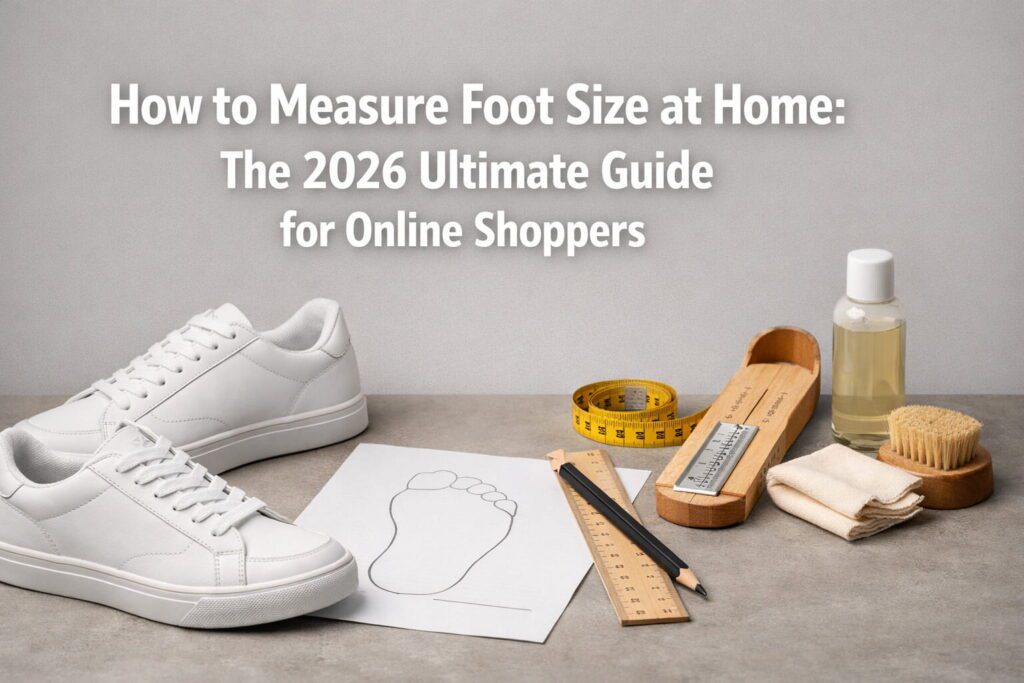
How to Measure Foot Size at Home: The 2026 Ultimate Guide for Online Shoppers
TL;DR: Quick Answer (How to Measure Foot Size)
To measure foot size at home accurately, place a sheet of paper on the floor flush against a wall. Stand on the paper with your heel firmly touching the wall. Trace the outline of your longest toe. Measure the distance from the edge of the paper (heel) to the toe mark in centimeters. Always add 0.5 cm to 1 cm breathing room before comparing your length to a feet sizes chart.
Shoe Size Conversion
Women’s Shoe Size Chart
| US/CA | UK/IN | EU | JP/MX | CN | Inches | CM |
|---|---|---|---|---|---|---|
| 4 | 2 | 34 | 21 | 32 | 8.3″ | 21.2 |
| 5 | 3 | 35 | 22 | 34 | 8.7″ | 22.0 |
| 6 | 4 | 36 | 23 | 36 | 9.0″ | 22.9 |
| 7 | 5 | 38 | 23.5 | 37 | 9.3″ | 23.7 |
| 8 | 6 | 39 | 24.5 | 39 | 9.7″ | 24.6 |
| 9 | 7 | 40 | 25.5 | 41 | 10.0″ | 25.4 |
| 10 | 8 | 41 | 26 | 42 | 10.3″ | 26.2 |
| 11 | 9 | 43 | 27 | 44 | 10.7″ | 27.1 |
| 12 | 10 | 44 | 28 | 46 | 11.0″ | 27.9 |
Men’s Shoe Size Chart
| US/CA | UK/IN | EU | JP/MX | CN | Inches | CM |
|---|---|---|---|---|---|---|
| 6 | 5 | 38 | 23.5 | 37 | 9.3″ | 23.7 |
| 7 | 6 | 39 | 24.5 | 39 | 9.7″ | 24.6 |
| 8 | 7 | 40 | 25.5 | 41 | 10.0″ | 25.4 |
| 9 | 8 | 41 | 26 | 42 | 10.3″ | 26.2 |
| 10 | 9 | 43 | 27 | 44 | 10.7″ | 27.1 |
| 11 | 10 | 44 | 28 | 46 | 11.0″ | 27.9 |
| 12 | 11 | 45 | 29 | 48 | 11.3″ | 28.8 |
| 13 | 12 | 46 | 29.5 | 49 | 11.7″ | 29.6 |
| 14 | 13 | 48 | 30.5 | 51 | 12.0″ | 30.5 |
Kids’ Shoe Size Chart (5-12 Years)
| US/CA | UK/IN | EU | JP/MX | CN | Inches | CM |
|---|---|---|---|---|---|---|
| 10.5 | 9.5 | 28 | 17 | 24 | 6.8″ | 17.1 |
| 12 | 11 | 30 | 18.5 | 27 | 7.3″ | 18.4 |
| 13.5 | 12.5 | 32 | 19.5 | 29 | 7.8″ | 19.7 |
| 1 | 13 | 32 | 20 | 30 | 7.9″ | 20.1 |
| 2 | 1 | 33 | 21 | 32 | 8.3″ | 21.0 |
| 4 | 3 | 36 | 22.5 | 35 | 8.9″ | 22.6 |
| 6 | 5 | 39 | 24.5 | 39 | 9.6″ | 24.3 |
| 7 | 6 | 40 | 25 | 40 | 9.9″ | 25.2 |
1. Introduction: The Universal Struggle of Buying Shoes Online
We have all been there. You spot the perfect pair of sneakers online, the price is right, and the reviews are glowing. You select your “usual” size, wait three days for shipping, and the moment you slide your foot in—disappointment. It’s tight at the toes, or your heel is slipping out like a Cinderella nightmare.
In my 20+ years of running a physical shoe store in Chennai, I have personally measured thousands of feet. If there is one thing I have learned, it is that “Size 9” is a myth. A size 9 in a Nike running shoe fits differently than a size 9 in a leather Chelsea boot.
Buying footwear online is convenient, but without a physical try-on, you are relying entirely on data. If that data (your measurement) is wrong, the shoe will be wrong. This guide isn’t just about reading a ruler; it is about understanding how your feet change, how materials behave, and how to navigate the complex web of feet sizes US to EU conversions so you never have to pay return shipping fees again.
2. Why This Topic Matters
Why is it so hard to get the right fit? Because the global footwear industry lacks a singular, unified standard.
- Manufacturing Variances: A shoe made in Vietnam might use a slightly different “last” (the mold used to shape the shoe) than one made in Italy.
- Vanity Sizing: Some brands intentionally label shoes smaller or larger to flatter the customer.
- The “India” vs. “UK” Confusion: Many buyers looking for a shoe size chart India often don’t realize that India typically follows the UK sizing system, which is one full size smaller than the US system.
I have seen customers walk into my shop swearing they are a size 42, only to measure them on a Brannock device and find they are actually a 43 wide. When you shop online, you lose the expert eye of the retailer. You have to become the expert. This guide gives you the retail-level knowledge to measure your feet with professional accuracy using items you already have at home.
3. The Golden Rule: How to Measure Foot Size (Step-by-Step)
Do not hold a ruler up to the bottom of your foot. That is the number one mistake I see people make. Your foot is three-dimensional; it spreads when you stand. Here is the only method I trust for home measurement.
Tools You Need:
- A blank piece of paper (A4 or Letter size).
- A pencil or pen.
- A ruler or measuring tape (preferably with Millimeters/Centimeters).
- A wall with a flat baseboard.
- The socks you intend to wear with the shoes.
The “Wall Method” Protocol
- Sock Up: Put on the socks you plan to wear. Do not measure for hiking boots while barefoot; do not measure for loafers wearing thick wool socks.
- The Setup: Place the paper on the floor so the short edge is flush against the wall. Tape it down if you can so it doesn’t slip.
- The Stance: Stand on the paper with your back to the wall. Your heels must be touching the wall lightly (don’t push too hard, or you’ll compress the heel fat pad).
- Weight Distribution: Stand with equal weight on both feet. Your feet spread when bearing weight. Measuring while sitting will result in a shoe that is too tight.
- The Mark: Have a friend mark the tip of your longest toe on the paper.
- Pro-Tip: For 70% of people, the second toe is actually longer than the big toe (Morton’s Toe). Mark the longest point, whichever toe it is.
- The Measurement: Step off. Use your ruler to measure the straight line from the edge of the paper (where your heel was) to the mark you made.
- Repeat: Measure the other foot. It is extremely common for one foot to be larger than the other. Always buy for the larger foot.
4. Understanding the Measurements: The Math of Comfort
Once you have your raw measurement in centimeters (CM), the job isn’t done.
If your foot measures exactly 25 cm, you should not buy a shoe that is exactly 25 cm long inside. You need “toe box clearance.”
- The Clearance Rule: Add 0.5 cm to 1 cm to your measurement.
- Example: If your foot is 26.5 cm, your ideal insole length is 27 cm to 27.5 cm.
Width Matters
In my shop, I’d say 40% of fit issues aren’t length—they are width. If you have marked your foot on the paper, measure the widest part of your foot (usually the ball of the foot). If your foot looks significantly wider than the standard “D” width on charts, you may need to size up by a half size in standard shoes to accommodate the volume.
5. Navigating Global Charts: Feet Sizes US to EU & More
This is where online shoppers get confused. Different regions scale differently.
The Shoe Size Chart India / UK Connection
If you are looking for a shoe size chart India utilizes, you are generally looking for UK sizing. Most major brands sold in India (Bata, Nike India, Adidas India) list UK sizing as the standard.
Feet Sizes US to EU Conversion
The jump between US and EU sizes is tricky because EU sizes are based on “Paris points” (2/3 of a centimeter), whereas US sizes are based on barleycorns (1/3 of an inch). They rarely line up perfectly.
General Reference Table (Adults):
| CM Length (Foot + Clearance) | US Men’s | US Women’s | UK / India | EU Size |
|---|---|---|---|---|
| 23.5 cm | 5.5 | 7 | 5 | 37.5 |
| 24.5 cm | 6.5 | 8 | 6 | 39 |
| 25.4 cm | 7.5 | 9 | 7 | 40-41 |
| 26.0 cm | 8 | 9.5 | 7.5 | 42 |
| 27.0 cm | 9 | 10.5 | 8 | 43 |
| 27.9 cm | 10 | 11.5 | 9 | 44 |
| 28.6 cm | 11 | 12.5 | 10 | 45 |
(Note: Always check the specific brand’s brand-specific size chart, as a Nike EU 42 is different from a Puma EU 42.)
6. How to Measure for Kids: Infant Shoe Measurement Chart
Measuring children’s feet is a sport in itself. Infants curl their toes, making it hard to get an accurate read.
The “Squirmy Baby” Method:
- Use String: Instead of a ruler, use a piece of non-stretchy string.
- Touch Points: Gently hold the string at the baby’s heel and extend it to the big toe while the foot is flat (even if you have to press it gently against your palm).
- Measure the String: lay the string against a ruler.
Infant Shoe Measurement Chart (Approximate):
| Age (Average) | Foot Length (Inches) | Foot Length (CM) | US Size | UK Size | EU Size |
|---|---|---|---|---|---|
| 0-3 Months | 3.5″ | 8.9 cm | 1 | 0.5 | 16 |
| 3-6 Months | 3.75″ | 9.5 cm | 2 | 1 | 17 |
| 6-9 Months | 4.13″ | 10.5 cm | 3 | 2 | 18 |
| 9-12 Months | 4.5″ | 11.4 cm | 4 | 3 | 19 |
| 12-18 Months | 4.75″ | 12.1 cm | 5 | 4 | 20 |
Retailer Insight: Kids’ feet grow in spurts. For infants and toddlers, check fit every 2 months. A tight shoe can actually damage soft cartilage in developing feet.
7. Pro-Tip Section: Insider Secrets from the Shop Floor
After handling footwear for two decades, here are three secrets brands won’t tell you on the product page.
- The “Evening Swell” is Real: Never measure your feet in the morning. Gravity causes fluids to accumulate in your feet throughout the day. Your feet can be up to half a size larger at 6 PM than they were at 8 AM. Always measure in the evening.
- Material Memory: Leather remembers; synthetic forgets. If you buy genuine leather, it will stretch and mold to your foot width over time. If you buy synthetic mesh or plastic-based sneakers, the fit you feel out of the box is the fit you are stuck with.
- The Insole Hack: If you receive a pair of shoes and aren’t sure if they fit, take the insole out of the shoe. Stand on the insole. If your toes are spilling over the edge or touching the very tip of the foam, the shoe is too small. You should see a finger’s width of foam ahead of your toes.
8. Common Mistakes to Avoid
- Assuming athletic shoes and dress shoes are the same size. They are not. Athletic shoes usually have thick padding, requiring you to size up (e.g., US 10 in Nikes, US 9 in dress boots).
- Ignoring the heel-to-ball measurement. If you have short toes but a long arch, measuring just length might result in the shoe bending at the wrong place, causing foot fatigue.
- Trusting the “Universal” Chart. There is no universal chart. Always look for the specific size guide link on the product page you are viewing.
9. Comparison: Measuring Methods
| Method | Accuracy | Difficulty | Best For |
|---|---|---|---|
| Wall & Paper | High | Medium | Online Shopping |
| Tracing Foot | Medium | Medium | Wide Feet Check |
| Direct Ruler on Foot | Low | Low | Rough Estimate |
| Brannock Device | Very High | Low | In-Store Fitting |
| Mobile App Scans | Variable | Low | Tech-Savvy Users |
10. How to Measure Foot Size at Home
How do I know my shoe size without a Brannock device? You can replicate a Brannock measurement by tracing your foot on paper against a wall and measuring the length in centimeters, then converting it using a brand-specific chart.
Is shoe size based on foot length or insole length? Shoe size is technically based on the foot length the shoe is designed to fit. However, the physical insole will always be 0.5cm to 1cm longer than the foot size listed.
Do feet change size as you get older? Yes. As we age, the ligaments in our feet loosen and the fat pads thin out, causing the foot to spread and become longer and wider.
Should my toes touch the end of my shoes? No. There should be about a thumb’s width (roughly 1.2 cm) of space between your longest toe and the front of the shoe.
What is the average shoe size for men and women? Globally, the average measurement hovers around US 9-10 for men and US 7-8 for women, though this average is slowly increasing.
11. Conclusion & Next Steps
Measuring your foot size at home isn’t rocket science, but it does require precision. By following the “Wall Method” and understanding how feet sizes charts differ across borders, you can confidently order footwear from anywhere in the world.
Remember, comfort is subjective, but fit is mathematical. Don’t force your foot into a shoe that doesn’t respect your measurements.
Ready to find your perfect fit?
- [Check today’s best-rated walking shoes on Amazon]
- [Compare prices on measuring devices for kids]
- [Browse top-reviewed wide-fit sneakers]
12. Frequently Asked Questions
1. How do I measure my foot size accurately?
Use the “Wall Method.” Stand with your heel against a wall on a piece of paper. Mark your longest toe, measure the distance in CM, and add 0.5cm for clearance.
2. Is Shoe Size Chart India same as UK?
Yes, in 90% of cases, the shoe size chart India follows UK sizing standards. If you are a UK 8, you are likely an India 8.
3. How do I convert feet sizes US to EU?
There is no perfect calculation, but generally, a US Men’s size plus 33 equals the EU size (e.g., US 9 + 33 = EU 42). However, referencing a specific feet sizes US to EU chart is safer.
4. What time of day is best to measure feet?
Always measure your feet in the late afternoon or evening. Feet swell during the day, and measuring in the morning can lead to buying tight shoes.
5. How much space should be at the toe of a shoe?
You should have approximately a thumb’s width, or 0.5 cm to 1.2 cm, of empty space between your longest toe and the end of the shoe.
6. How do I use an infant shoe measurement chart?
Measure the baby’s foot in centimeters using a string or tape. Match that length to the chart, but always size up if they are between sizes to allow for rapid growth.
7. Does foot width affect shoe size?
Yes. If you have wide feet, you may need to buy a half-size larger in standard shoes or specifically look for “E” or “EE” wide-fit options.
8. Why are my feet two different sizes?
This is natural asymmetry. It is very common for the dominant foot to be slightly larger. Always buy shoes to fit your larger foot.
9. Can I measure my foot by tracing it?
Yes, tracing works, but keep the pen perpendicular (straight up) to the floor. If you angle the pen inward, you will trace a smaller outline than your actual foot.
10. Do sizes vary by brand?
Absolutely. A Nike US 10 might feel tighter than a Skechers US 10. Always look for the brand’s specific “CM” or “JP” (Japan) measurement for the most accurate comparison.
Pingback: US vs UK vs Euro Shoe Size: Ultimate Conversion Guide (2026)
Pingback: How to Whiten Yellow Soles on Sneakers (2026 Guide): Remove Stains & Restore Your Kicks
Pingback: Can You Wash Skechers in a Washing Machine? 2026 Safe Care Guide
Pingback: How to Fix Scuffed Leather Shoes: Expert Repair Guide (2026)