
ASICS FlyteFoam vs GEL: What Each One Does
FlyteFoam vs GEL: Quick Summary
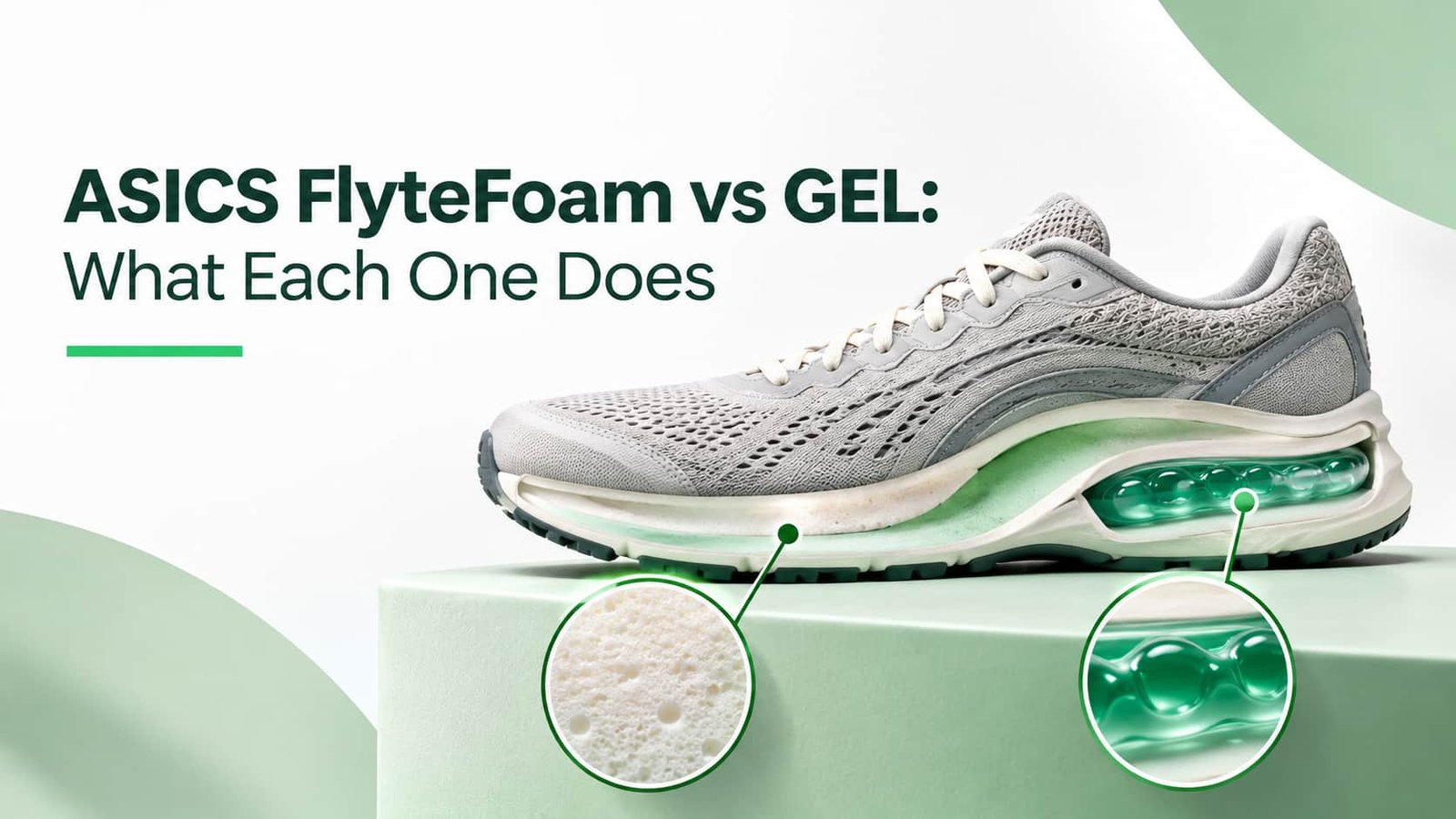
FlyteFoam is an ASICS midsole foam family. GEL is a cushioning technology placed in selected areas. PureGEL is an updated GEL technology. Some ASICS shoes combine these technologies.
- FlyteFoam and GEL are not equivalent materials.
- Different FF formulations can have different ride characteristics.
- PureGEL is described by ASICS as approximately 65% softer than its previous GEL technology.
- Compare complete shoe models, fit and intended activity.
Explore this article with an AI assistant
ASICS FlyteFoam and GEL are different cushioning technologies that serve complementary roles. FlyteFoam is a family of lightweight midsole foams designed to provide cushioning and a particular underfoot ride, while GEL is a strategically placed cushioning technology intended to help absorb impact. PureGEL is an updated version of GEL. Some ASICS running shoes combine both technologies rather than using only one.
Quick Answer: Is FlyteFoam Better Than GEL?
Neither is automatically better because they do different jobs. FlyteFoam forms part of the shoe’s midsole cushioning platform, while GEL is positioned in selected areas to help manage impact. If a shoe includes both, the foam and GEL work together as parts of one cushioning system.
If you are comparing two ASICS shoes, look beyond the technology names. Consider the exact foam formulation, GEL placement, midsole geometry, stability, outsole, fit and intended activity.
For a broader introduction to the materials used in footwear, start with our Shoe Materials Explained guide. It explains how different shoe components and materials contribute to the overall construction.
Key Takeaways
- FlyteFoam is a family of ASICS midsole foam technologies, not one identical foam formulation.
- GEL is a cushioning technology used in selected areas of some ASICS shoes.
- PureGEL is an updated GEL technology that ASICS describes as approximately 65% softer than its previous GEL technology.
- FF BLAST, FF BLAST PLUS and FF BLAST MAX are different formulations within the wider FlyteFoam family.
- Some ASICS shoes combine FlyteFoam and GEL.
- The best shoe depends on the complete construction, fit and intended activity, not just the cushioning technology name.
What Is ASICS FlyteFoam?
FlyteFoam is the name ASICS uses for a family of proprietary midsole foam technologies. Developed by the ASICS Institute of Sport Science, the original FlyteFoam technology was introduced in 2016. Its purpose was to provide a lightweight midsole while retaining useful cushioning and responsiveness.
The important word is family. FlyteFoam does not describe one unchanging foam recipe. ASICS has introduced several formulations over time, each with its own intended characteristics.
According to the manufacturer’s FlyteFoam technology explanation, the family includes variations such as FF BLAST, FF BLAST PLUS, FF BLAST MAX, FF TURBO PLUS, FF TURBO SQUARED and FF LEAP.
These formulations are not interchangeable. A shoe with standard FlyteFoam may feel different from one using a newer FF BLAST or FF TURBO formulation.
What Is FlyteFoam Made From?
ASICS’ original FlyteFoam explanations discuss its lightweight midsole construction and material development. However, the composition of every current FF formulation should not be assumed to be identical.
Some footwear technologies use EVA-based compounds, blends or other proprietary formulations. Manufacturers do not always publish the complete chemical composition of their proprietary foams.
To understand how common midsole materials differ, read our guide to running shoe foam, including EVA, TPU and PEBA. It explains the material families behind many modern running-shoe cushioning systems.
A useful way to understand FlyteFoam is to separate three elements:
- Material formulation: The foam compound and its physical properties.
- Midsole construction: The thickness, shape, density and layers of foam.
- Shoe design: How the midsole works with the upper, outsole and other components.
All three influence the final underfoot experience. The foam name is only one part of the explanation.
Common FlyteFoam Variations
| Technology | General ASICS positioning | What to understand |
| FLYTEFOAM | Lightweight midsole foam family | Broad technology family |
| FF BLAST | Balanced comfort and bounce | One formulation within the FF family |
| FF BLAST PLUS | Lighter and bouncier evolution of FF BLAST | A distinct formulation |
| FF BLAST MAX | Soft and springy with responsive energy return | Used in selected models |
| FF TURBO PLUS | Racing-oriented energy return and lower weight than FF BLAST foams | Performance-oriented formulation |
| FF TURBO SQUARED | High-performance foam with increased bounce, according to ASICS | Check the specific shoe |
| FF LEAP | Described by ASICS as its lightest and bounciest advanced FlyteFoam formulation | Product placement and performance depend on the shoe |
These descriptions represent ASICS’ technology positioning. They are not independent laboratory rankings or a guarantee that every runner will experience the same sensation.
Why this matters: Someone searching for “FlyteFoam vs GEL ASICS” may be comparing a shoe with one FlyteFoam formulation against another shoe with GEL cushioning. They may also be comparing two shoes that use both technologies. Identifying the exact shoe models is essential before drawing conclusions.
What Is ASICS GEL Technology?
ASICS GEL is a cushioning technology used in selected areas of footwear. It is designed to help absorb impact and contribute to the shoe’s cushioning experience.
Unlike FlyteFoam, which refers to midsole foam formulations, GEL is not the name of the entire midsole foam platform.
GEL technology has appeared in ASICS footwear for decades. Its construction and placement have changed over time, and different models can use different GEL configurations.
For an overview of how ASICS positions its footwear technologies, see the manufacturer’s ASICS technology information.
Where Is GEL Placed in a Running Shoe?
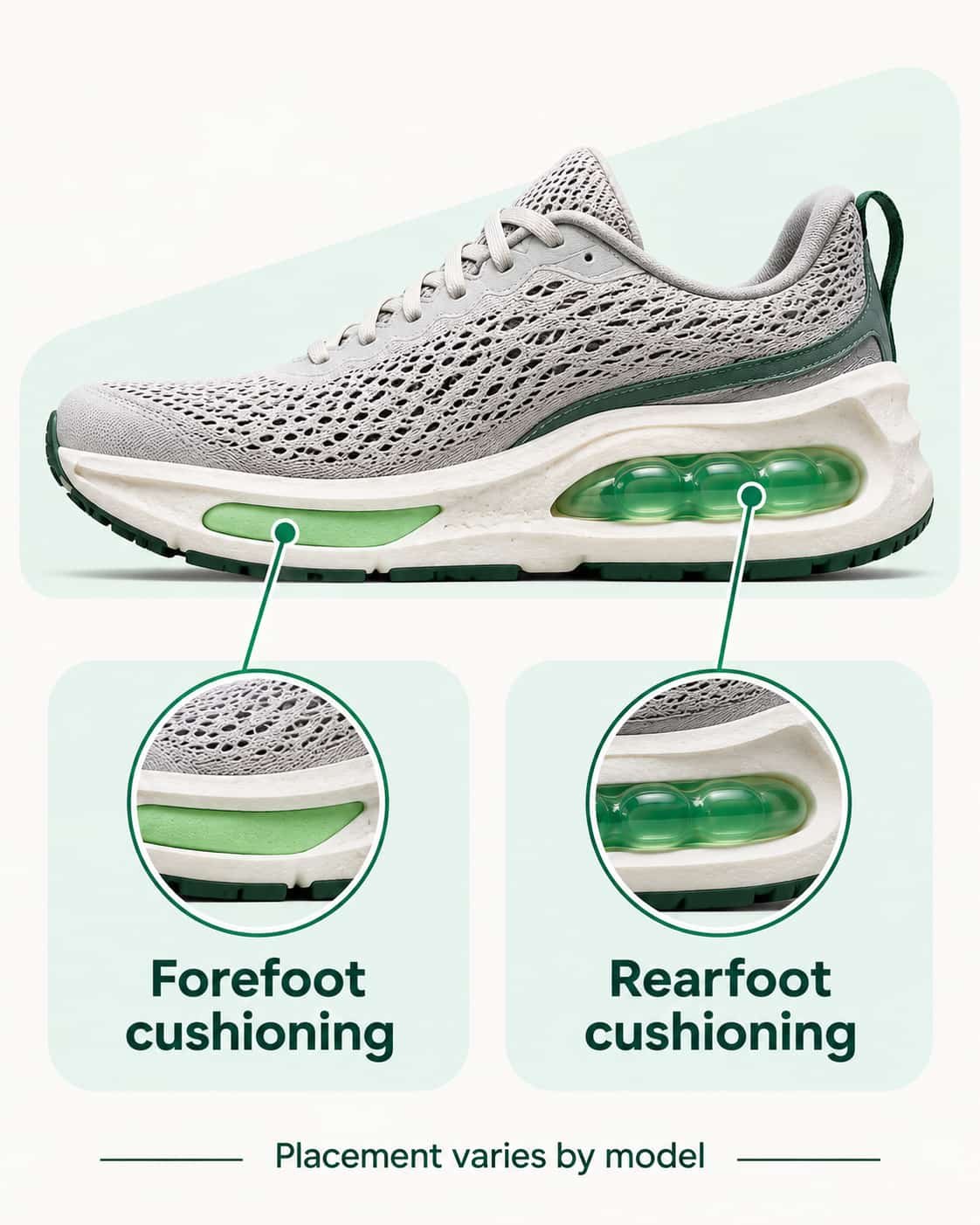
Depending on the shoe, GEL may be positioned in areas such as the rearfoot or forefoot. A rearfoot placement can contribute to cushioning during heel contact, while a forefoot placement may influence the feel during the later part of a stride.
However, not every ASICS shoe uses the same arrangement. Some models have visible GEL components, while other implementations are integrated into the shoe’s construction.
The midsole’s thickness, geometry, foam density and outsole can also influence how the cushioning feels.
To understand where the midsole sits in the overall shoe structure, see our guide to shoe anatomy and its individual components.
GEL Is Not the Same as a Full-Length Foam Midsole
This is the central distinction in the FlyteFoam vs GEL comparison.
A foam midsole generally occupies a substantial part of the space between the upper and outsole. GEL is a cushioning technology placed strategically within the shoe.
Think of it this way:
- FlyteFoam helps form the midsole cushioning platform.
- GEL contributes cushioning in selected locations.
- The shoe’s geometry and construction determine how these elements work together.
That is why an ASICS shoe can include both technologies.

What Is PureGEL?
PureGEL is an updated version of ASICS GEL technology. ASICS describes it as approximately 65% softer than its previous GEL technology.
The manufacturer says PureGEL is strategically positioned alongside FlyteFoam in some running shoes to balance soft landings with responsive toe-offs.
PureGEL should not be confused with a new FlyteFoam formulation. It belongs to the GEL technology family.
PureGEL vs Traditional GEL
| Feature | GEL technology | PureGEL technology |
| Technology category | Cushioning technology | Updated GEL cushioning technology |
| Main role | Helps absorb impact | Provides a softer cushioning experience |
| Placement | Depends on the shoe | Depends on the shoe |
| Manufacturer description | Impact absorption and cushioning | Approximately 65% softer than previous GEL technology |
| Relationship with FlyteFoam | Can be used alongside foam | Can be positioned alongside FlyteFoam |
The 65% figure is ASICS’ comparison with its previous GEL technology. It does not mean that a complete shoe will feel 65% softer. The experience also depends on the foam, the amount and placement of PureGEL, the midsole shape and individual preferences.
Does PureGEL Replace FlyteFoam?
No. They have different roles. PureGEL is a cushioning technology, while FlyteFoam is a midsole foam family.
A shoe can use PureGEL with a FlyteFoam formulation as part of a combined cushioning system. If a product page lists both, that is not a contradiction.
FlyteFoam vs GEL: Main Differences
The easiest way to compare the technologies is to look at their purpose, construction and position in the shoe.
| Comparison point | FlyteFoam | GEL |
| Technology type | Midsole foam family | Cushioning technology |
| Main role | Forms part of the midsole cushioning platform | Helps manage impact in selected areas |
| Coverage | Can form a substantial part of the midsole | Strategically positioned, depending on model |
| Variations | Multiple FF formulations | GEL and updated PureGEL implementations |
| Feel | Depends on foam formulation and shoe design | Depends on placement and surrounding midsole |
| Weight effect | Depends on formulation, volume and construction | Depends on the component and integration |
| Can they be combined? | Yes | Yes |
| Best way to compare | Check exact foam version and shoe construction | Check GEL type, placement and shoe construction |
Which One Is Softer?
There is no universal answer.
A shoe with a soft FlyteFoam formulation may feel more cushioned than a different shoe using GEL. That does not prove FlyteFoam is always softer.
PureGEL is described by ASICS as softer than its previous GEL technology. This is a comparison within the GEL family, not a direct comparison with every FlyteFoam formulation.
Which One Is Lighter?
It is not useful to declare one technology lighter without comparing actual shoes.
FlyteFoam is developed with lightweight midsole construction in mind, but final shoe weight depends on foam volume, outsole rubber, upper materials, support components, plates and shoe size.
GEL’s contribution to total weight depends on its design and placement. A shoe with GEL can still be light, while a shoe without GEL can be relatively heavy.
Which One Gives More Energy Return?
Energy return is influenced by the complete cushioning system and how it deforms and recovers.
Some FlyteFoam variations are positioned by ASICS as bouncy or responsive. GEL is primarily described as a cushioning and impact-management technology.
For a broader explanation of why softness and energy return are different properties, see RunRepeat’s independent running-shoe foam guide. Its discussion explains why a softer midsole does not automatically deliver greater energy return.
How FlyteFoam and GEL Work Together
A useful way to understand ASICS cushioning is to imagine the midsole as a system rather than a single material.
The foam platform supports the foot and deforms under load. A GEL or PureGEL component can be positioned in a selected area to contribute additional cushioning. The outsole provides ground contact and traction, while the shoe’s geometry influences how the foot moves through each stride.
This means that the same technology label can produce different experiences in different shoes.
A Simple Example
Imagine two running shoes:
- Shoe A: Uses a FlyteFoam-based midsole with a particular thickness and geometry.
- Shoe B: Uses a related FlyteFoam formulation plus a strategically placed GEL component.
Shoe B is not automatically better. It may feel different because of the added cushioning component, but the overall result depends on the foam formulation, GEL placement, midsole dimensions, outsole and fit.
A third shoe may use PureGEL with a newer FF BLAST formulation. Its ride may feel different again.
Why Placement Matters
A cushioning component placed near the heel does not necessarily create the same sensation as one placed in the forefoot.
Runners also differ in how their feet contact the ground. The location of cushioning and the shoe’s geometry can influence which parts of the platform are most noticeable.
This is why technology comparisons should include product-specific details rather than assuming every GEL-equipped shoe feels the same.
FF BLAST vs GEL: What’s the Difference?
The keyword “FF BLAST vs GEL” is worth addressing because it is a likely follow-up search. However, it still compares two different kinds of technology.
FF BLAST is a foam formulation within the FlyteFoam family. GEL is a cushioning technology. A more useful question is how a particular FF BLAST midsole performs in a shoe that does or does not include GEL.
FF BLAST and Its Variants
ASICS describes FF BLAST as a lightweight foam designed to provide a balance of comfort and bounce.
FF BLAST PLUS is positioned as a lighter and bouncier evolution, while FF BLAST MAX is described as soft and springy with responsive energy return.
These are manufacturer descriptions. They explain the intended role of each formulation, but they do not establish that one version will suit every runner better.
How to Compare FF BLAST with GEL in Real Shoes
Use this checklist:
- Identify the exact FF BLAST version listed on the product page.
- Confirm whether the shoe includes GEL or PureGEL.
- Check where the GEL component is positioned.
- Compare midsole height and geometry.
- Compare the complete shoe weight in the same size.
- Consider the shoe’s intended purpose, such as daily training, long-distance running or faster workouts.
- Try the shoes if possible and assess fit, comfort and stability.
The distinction is important for search accuracy too. Do not write that FF BLAST is simply better than GEL because the two labels do not describe equivalent materials.

Cushioning and Comfort
Comfort is personal. Two runners can wear the same shoe and describe it differently because of differences in foot shape, body mass, running technique, pace, training history and preference.
FlyteFoam variations can produce different underfoot sensations. A model using a softer formulation may feel more forgiving, while another may feel firmer or more controlled. GEL placement can add cushioning in selected areas, but it does not determine the comfort of the entire shoe.
What Should Runners Look For?
When comparing comfort, consider:
- Initial step-in feel: Does the shoe feel comfortable when standing and walking?
- Running feel: Does the cushioning remain comfortable after several minutes of movement?
- Pressure points: Does the shoe create discomfort around the heel, arch, forefoot or toes?
- Stability: Does the platform feel controlled when turning or changing pace?
- Fit: Is there enough room in the toe box, and does the heel stay secure?
Do not choose a shoe only because its midsole feels soft in a shop. A very soft sensation is not automatically more comfortable over a long run.
Softness Is Not the Same as Energy Return
A soft foam compresses readily under load. Energy return describes how much mechanical energy is returned as the material recovers. These are related but different properties.
A shoe can feel soft without feeling particularly springy. Another shoe can feel firmer but provide a more energetic sensation.
RunRepeat’s running shoe foam research and comparisons offer useful independent context for understanding these differences.
Weight and Responsiveness
FlyteFoam was introduced with a focus on lightweight cushioning. ASICS’ corporate history describes the original 2016 FlyteFoam launch as approximately 55% lighter than its traditional EVA midsole materials.
This is a historical manufacturer comparison, not a statement that every current FlyteFoam shoe is 55% lighter than every competing shoe.
Newer FF formulations have their own intended performance characteristics. Some are designed for everyday comfort, while others are aimed at higher-performance running.
GEL’s effect on weight depends on the amount and construction of the cushioning component. A shoe that includes GEL can still be light, and a shoe without GEL can still be relatively heavy.
For the original product-history statement, see the ASICS corporate history.
How to Compare Shoe Weight Accurately
Use the same shoe size and category. Comparing a men’s size 9 with a women’s size 7, for example, can create a misleading impression. Also check whether the listed weight refers to one shoe or a pair.
When possible, use manufacturer specifications for the exact model and corroborate them with an independent review that identifies the tested size.
Responsiveness in Practical Terms
Responsiveness is the sensation of how a shoe reacts as you load and unload the midsole. It is affected by the foam, its thickness, the shape of the platform and the shoe’s flexibility.
A lightweight shoe may feel quick, but low weight alone does not guarantee a responsive ride. Likewise, a shoe with GEL cushioning is not necessarily slow. The complete design matters.
Shock Absorption and Impact Management
ASICS describes GEL technology as helping reduce impact and improve cushioning. The location of the component is intended to make it useful during specific stages of movement.
FlyteFoam also contributes to cushioning because it forms part of the midsole. Its formulation and geometry influence how the shoe compresses and recovers.
What Does Shock Absorption Mean?
When your foot contacts the ground, the shoe’s cushioning system deforms. This deformation changes how forces are transmitted through the shoe and how the landing feels.
Shock absorption is not the same as injury prevention. No foam or cushioning technology can guarantee that a runner will avoid pain or injury. Running load, training progression, strength, recovery, fit and individual biomechanics all matter.
Heel and Forefoot Considerations
A heel striker may notice cushioning around the rearfoot more than a runner who lands farther forward. A forefoot striker may pay closer attention to the forefoot platform.
These are useful considerations, but foot-strike pattern alone should not determine a shoe choice.
Look at the actual GEL placement and the full midsole design. Do not assume every model has identical cushioning in the heel and forefoot.
Durability and Long-Term Wear
It is tempting to assume that a foam with a premium technology name will last longer. That is not a reliable rule.
Durability depends on the foam formulation, midsole density, shoe construction, outsole rubber, running surface, runner weight, mileage and care.
ASICS describes durability as one of the design considerations behind FlyteFoam, but the company does not provide one universal lifespan for every FlyteFoam or GEL-equipped shoe.
Signs That a Running Shoe May Be Wearing Out
Look for a combination of signs:
- The outsole tread is visibly worn or uneven.
- The midsole has permanent creases or compression.
- The shoe feels noticeably different from when it was new.
- The upper no longer holds the foot securely.
- The shoe develops an uneven or unstable feel.
- You experience repeated discomfort that appears linked to the shoe.
No single visual sign gives a precise replacement date.
How to Extend Shoe Life
- Rotate shoes if you run frequently and have more than one suitable pair.
- Let wet shoes dry naturally at room temperature.
- Avoid high heat when drying footwear.
- Clean dirt from the outsole and upper using material-appropriate methods.
- Store shoes away from prolonged direct sunlight and excessive heat.
- Use running shoes for their intended activity.
For more information about how materials behave and wear, explore the wider Shoe Materials Explained guide.
ASICS GEL Dedicate 8 vs GEL Resolution
The AnswerThePublic report includes searches such as “ASICS FlyteFoam vs GEL Dedicate 8” and “ASICS FlyteFoam vs GEL Resolution.” These phrases suggest that some readers are not only comparing cushioning technologies; they are trying to understand the names of specific ASICS shoes.
This distinction deserves care because GEL Dedicate and GEL Resolution are tennis-shoe model families. A model name containing GEL does not mean that the shoe is directly comparable with a running shoe based only on its midsole technology.
GEL Dedicate 8
The ASICS GEL-DEDICATE 8 product page describes it as a baseline tennis shoe for entry-level players.
ASICS highlights its stability and flexible feel, along with synthetic leather overlays, a TRUSSTIC support unit and a wrap-up outsole. These features relate to court movement and support, not simply cushioning.
GEL Resolution
The GEL-RESOLUTION line is also designed for tennis. It is commonly positioned around support and stability for court movement. The exact features vary by generation, so consult the official product page for the version being discussed.
Why This Matters
A running shoe and a tennis shoe can use different combinations of cushioning and support technologies because they are designed for different movements.
Tennis involves lateral movement, braking and quick changes of direction. Running shoes are generally designed around forward movement.
A fair comparison should identify:
- The exact model and generation.
- The intended sport.
- The midsole technologies listed by the manufacturer.
- The outsole and traction design.
- The support and stability features.
- The fit and upper construction.
Do not assume that the word GEL in a model name tells you the complete cushioning specification.
Which ASICS Technology Should You Choose?
Instead of choosing between two labels, choose the shoe that matches your activity and comfort needs.
| Your priority | What to examine | Practical direction |
| Lightweight daily running | Full shoe weight, foam version and fit | Compare models using the same size |
| Soft landings | Foam feel, GEL or PureGEL placement, midsole geometry | Try the shoe at running pace if possible |
| Responsive training | Exact FF formulation and complete midsole design | Do not rely on the FlyteFoam name alone |
| Long-distance comfort | Fit, stability, cushioning and outsole durability | Assess comfort over a longer trial |
| Tennis or court movement | Lateral support, court outsole and secure fit | Compare tennis models with tennis models |
| Balanced everyday use | Comfort, fit, stability and price | Prioritise the complete shoe rather than one feature |
Choose a FlyteFoam Shoe If…
You are considering an ASICS model whose particular FlyteFoam formulation, fit and overall construction match your needs. The family includes different versions, so check the specific FF name rather than assuming every model feels the same.
Consider a GEL-Equipped Shoe If…
You prefer the cushioning arrangement and overall ride of a model that uses GEL. Check where the cushioning is placed and how it works with the foam platform.
Consider a Shoe with Both
There is no reason to treat FlyteFoam and GEL as mutually exclusive. ASICS uses them together in some models. If the combination feels comfortable and the shoe suits your intended activity, both technologies can contribute to the design.
What If You Cannot Try the Shoes On?
Check the return policy before purchasing. Compare the exact model, width, size chart, weight and intended use. Read independent reviews that identify the model generation and explain how the shoe was assessed.
How to Compare Two ASICS Shoes
Use this practical checklist when comparing two models in a store or online.
Step 1: Confirm the exact model names. ASICS often updates shoe designs while retaining familiar names. A new generation may use a different foam formulation or construction.
Step 2: Check the technology specification. Look for FlyteFoam, FF BLAST, FF BLAST PLUS, FF BLAST MAX, FF TURBO, GEL or PureGEL.
Step 3: Check the placement. Determine whether GEL or PureGEL is used in the rearfoot, forefoot or another specific area.
Step 4: Compare the complete shoe. Examine weight, stack height, heel-to-toe drop, outsole, upper, width options and intended use.
Step 5: Assess fit and movement. A shoe should feel secure without uncomfortable pressure. Walk and jog in it if the retailer permits.
Step 6: Read independent testing carefully. Check the review date, model generation, tested size and methodology. Do not treat one reviewer’s preference as a universal result.
For more detail about how footwear testing can be structured, read How We Test Shoes: Our Lab and Wear-Test Methodology. Use that page to understand the site’s stated approach to evaluating footwear, but do not interpret this educational technology guide as a first-hand test of the ASICS models.
Step 7: Make the decision based on your activity. A comfortable road-running shoe is not automatically the right tennis shoe, and a court shoe is not a substitute for a road-running model.
Common Myths About FlyteFoam and GEL
Myth 1: FlyteFoam and GEL Are Two Types of Foam
Reality: FlyteFoam is a midsole foam technology family. GEL is a cushioning technology. They are different categories and can be combined.
Myth 2: GEL Is Always Softer Than FlyteFoam
Reality: Softness depends on the particular formulation, placement and shoe design. PureGEL is described by ASICS as softer than its previous GEL technology, but that does not establish a universal ranking against every FlyteFoam version.
Myth 3: Every FlyteFoam Shoe Feels the Same
Reality: ASICS has developed multiple formulations. Midsole geometry and the rest of the shoe also influence the ride.
Myth 4: A Shoe with Both Technologies Must Be Better
Reality: More technology does not automatically mean a better fit or a more suitable shoe. The complete design must match the runner’s needs.
Myth 5: More Cushioning Always Means Better Protection
Reality: Cushioning feel and injury prevention are not interchangeable. No midsole technology guarantees injury prevention.
Myth 6: The Name GEL Tells You Everything About the Shoe
Reality: It identifies a technology or product family, not the complete specification. Check the exact model and current product information.
Frequently Asked Questions
Is FlyteFoam Better Than GEL?
Neither is universally better. FlyteFoam is a midsole foam family, while GEL is a cushioning technology. Compare complete shoe models and consider fit, comfort, stability and intended use.
What Is the Difference Between ASICS GEL and FlyteFoam?
FlyteFoam refers to foam formulations used in the midsole. GEL is a cushioning technology placed in selected parts of some shoes to help absorb impact. They can work together in the same shoe.
Is PureGEL Better Than FlyteFoam?
They are not direct alternatives. PureGEL is an updated GEL technology, while FlyteFoam is a foam family. ASICS says PureGEL is approximately 65% softer than its previous GEL technology, but this is not a direct comparison with every FlyteFoam formulation.
What Is the Difference Between FlyteFoam and FF BLAST?
FF BLAST is one of the formulations within ASICS’ broader FlyteFoam technology family. The exact feel and intended use depend on the version and the shoe in which it is used.
What Does FF BLAST vs GEL Mean?
It compares a foam formulation with a cushioning technology. A more useful comparison identifies the exact shoe models and evaluates how FF BLAST and GEL contribute to each shoe’s overall ride.
Do ASICS Running Shoes Use Both FlyteFoam and GEL?
Yes. ASICS describes some shoes as using GEL or PureGEL alongside FlyteFoam. The combination and placement depend on the model.
Is GEL Dedicate 8 a Running Shoe?
No. GEL-DEDICATE 8 is a tennis shoe. Its court-oriented design should be evaluated for tennis movement, fit, lateral support and traction rather than compared with a road-running shoe as if the two served the same purpose.
Does GEL Prevent Running Injuries?
No shoe technology can guarantee injury prevention. GEL is designed to contribute to cushioning and impact management. Training load, recovery, strength, running technique, fit and individual factors also matter.
How Do I Know Which FlyteFoam Version My ASICS Shoe Uses?
Check the official product page for the exact model and generation. Look for the full technology name, such as FF BLAST, FF BLAST PLUS or FF BLAST MAX. Do not assume that a general FlyteFoam label identifies every formulation detail.
Can I Choose an ASICS Shoe Based Only on Its Midsole Technology?
It is better not to. Fit, upper construction, outsole grip, stability, weight and intended activity all matter. The cushioning technology is one part of the shoe.
Final Verdict
The most accurate answer to “FlyteFoam vs GEL” is that they do different jobs. FlyteFoam is an ASICS midsole foam family, while GEL is a cushioning technology used in selected areas of the shoe. PureGEL is an updated version of GEL, and ASICS combines these technologies in some models.
If you are choosing running shoes, compare the exact model generation, foam formulation, GEL placement, fit, weight, stability and intended use. Do not select a shoe simply because one technology name sounds more advanced.
The best shoe is the one that fits comfortably, supports your activity and feels appropriate during movement. Start with the complete shoe, then use its technology specifications to understand why it may feel the way it does.
For more footwear material explanations and related comparisons, explore the Shoe Materials hub and the Running Shoe Foam guide.
Sources and Further Reading
- ASICS: What Is FLYTEFOAM? – Manufacturer explanation of FlyteFoam variations and PureGEL.
- ASICS Corporate History – Historical information about the original FlyteFoam launch.
- ASICS GEL-DEDICATE 8 – Official product information for the tennis shoe.
- RunRepeat: The Ultimate Guide to Running Shoe Foams – Independent context on running-shoe foam characteristics and testing.
- Urban Style Footwear: Running Shoe Foam Explained – Related internal guide to midsole materials.