
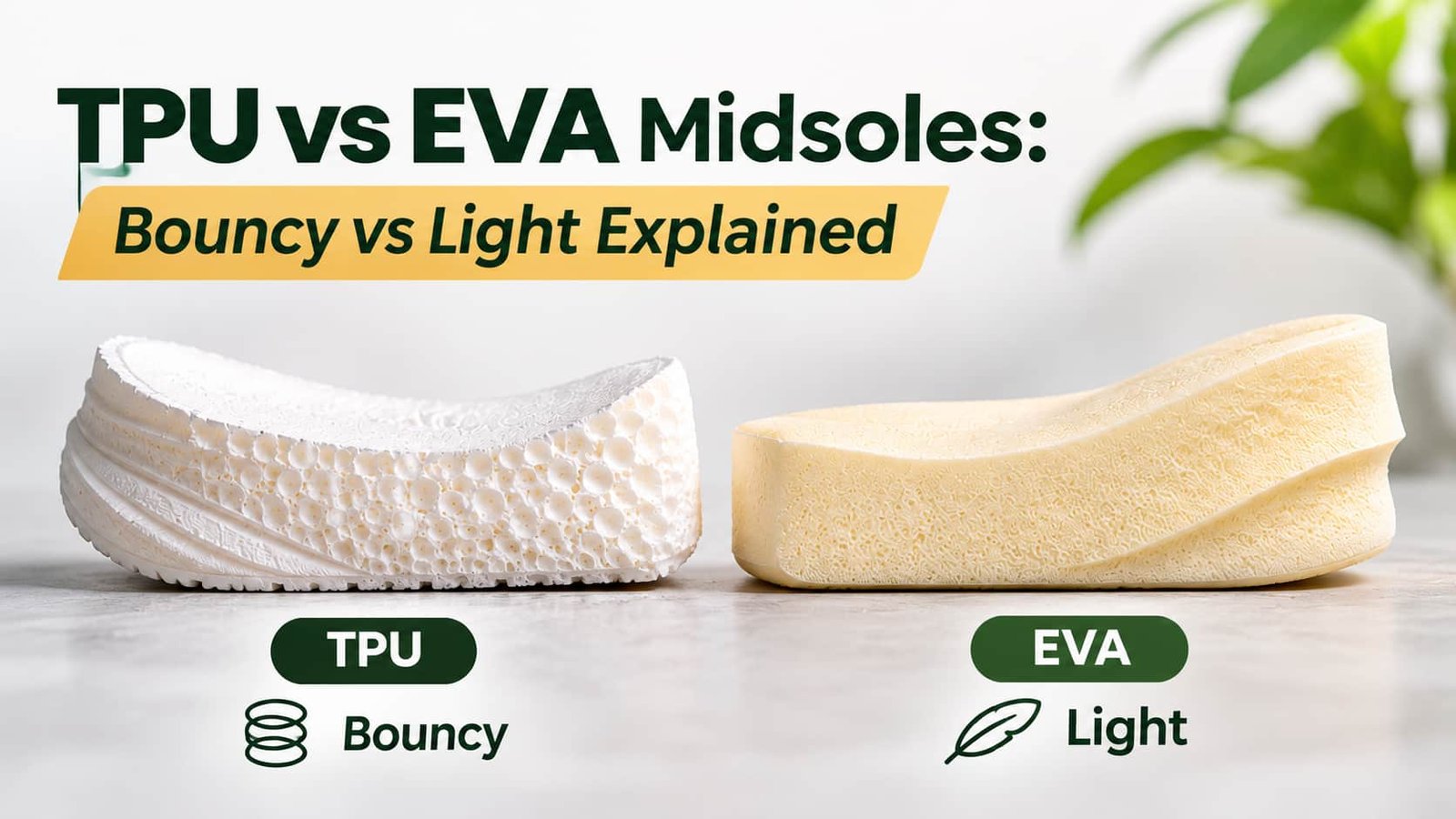
TPU vs EVA Midsoles: Bouncy vs Light Explained
Summarise this TPU vs EVA guide with AI
Open an assistant and submit the prefilled request. The assistant reads the page only after you submit it.
Quick answer: EVA is a lightweight, soft foam that suits everyday comfort and budget-friendly shoes. TPU is a tougher, more resilient material, usually heavier and firmer, which many shoes use where bounce, durability or support matter more than lightness. Neither is better in every case. The right choice depends on whether you want a soft, light ride or a firmer, more resilient base, and on how the shoe will be used.
Key takeaways
- EVA is usually the lighter and softer option, and it is common in comfort, casual and entry-level footwear.
- TPU is generally tougher and more resilient, and it is often heavier and firmer than EVA.
- “Bouncy” depends on the design, not only the material. A TPU midsole and an EVA midsole can both be made to feel springy or plush.
- Neither material should be assumed to last a specific number of kilometres. Wear depends on load, surface, storage and care.
- Check the midsole and any TPU overlays or structural parts separately, because many shoes combine both materials.
- Choose by use: comfort and lightness point toward EVA, while structure and resilience point toward TPU.
What EVA and TPU Are
EVA stands for ethylene-vinyl acetate. It is a foam made by blending a copolymer with additives and a blowing agent, then expanding it into a cellular structure. The foam is light, easy to shape and inexpensive to produce, which is why it is so widely used in midsoles. Our EVA foam guide covers the material in more depth.
TPU stands for thermoplastic polyurethane. It is a tough, flexible polymer that is known for resilience and abrasion resistance. In footwear it is used in several forms: as a solid component, as an overlay or structural element, and sometimes as a foam midsole. The TPU guide explains those uses in detail.
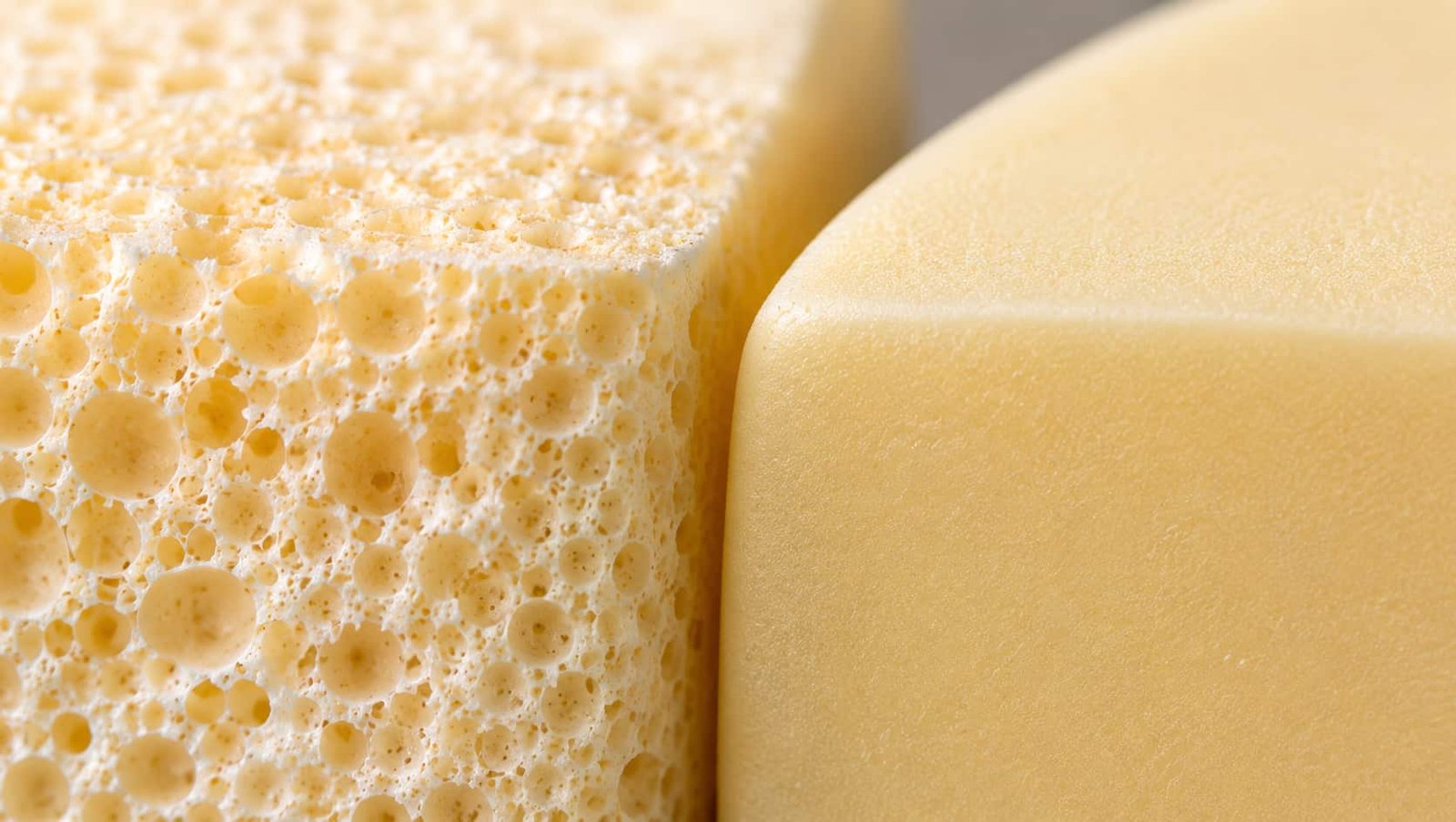
The difference between them is structural as well as chemical. EVA is typically a soft, expanded foam. TPU is typically a denser, tougher material that holds its shape under repeated load. That difference drives most of the comparison that follows.
Because the two materials appear in different parts of the same shoe, readers sometimes see both names on one product page. The insole, midsole and outsole guide explains where each layer sits, which helps when reading a materials list.
Bouncy Versus Light: What the Words Really Mean
Shoe marketing often uses “bouncy” to mean energy return, and “light” to mean low weight. These are different properties, and they do not always move together.
Bounce describes how much of the energy from a compression is returned as the foot leaves the ground. It depends on the material, the density and cell structure, and the thickness and geometry of the midsole. A well-designed foam can feel springy without being heavy, and a poorly tuned one can feel flat even when it is light.
Lightness describes weight, which depends on density and the total volume of material. Expanded EVA is typically light, while denser or more solid TPU structures usually weigh more.
Softness describes how the foam feels on the first contact. It is not the same as bounce. A soft foam can feel plush but still return little energy, and a firm foam can rebound more.
The practical point is that “TPU is bouncy” and “EVA is light” are useful shorthand, but they are not guaranteed. Compare the specific shoe’s weight, feel and stated materials rather than relying on a general rule. For a broader guide to how foam families compare on these traits, see the running shoe foam guide.
TPU vs EVA Side by Side
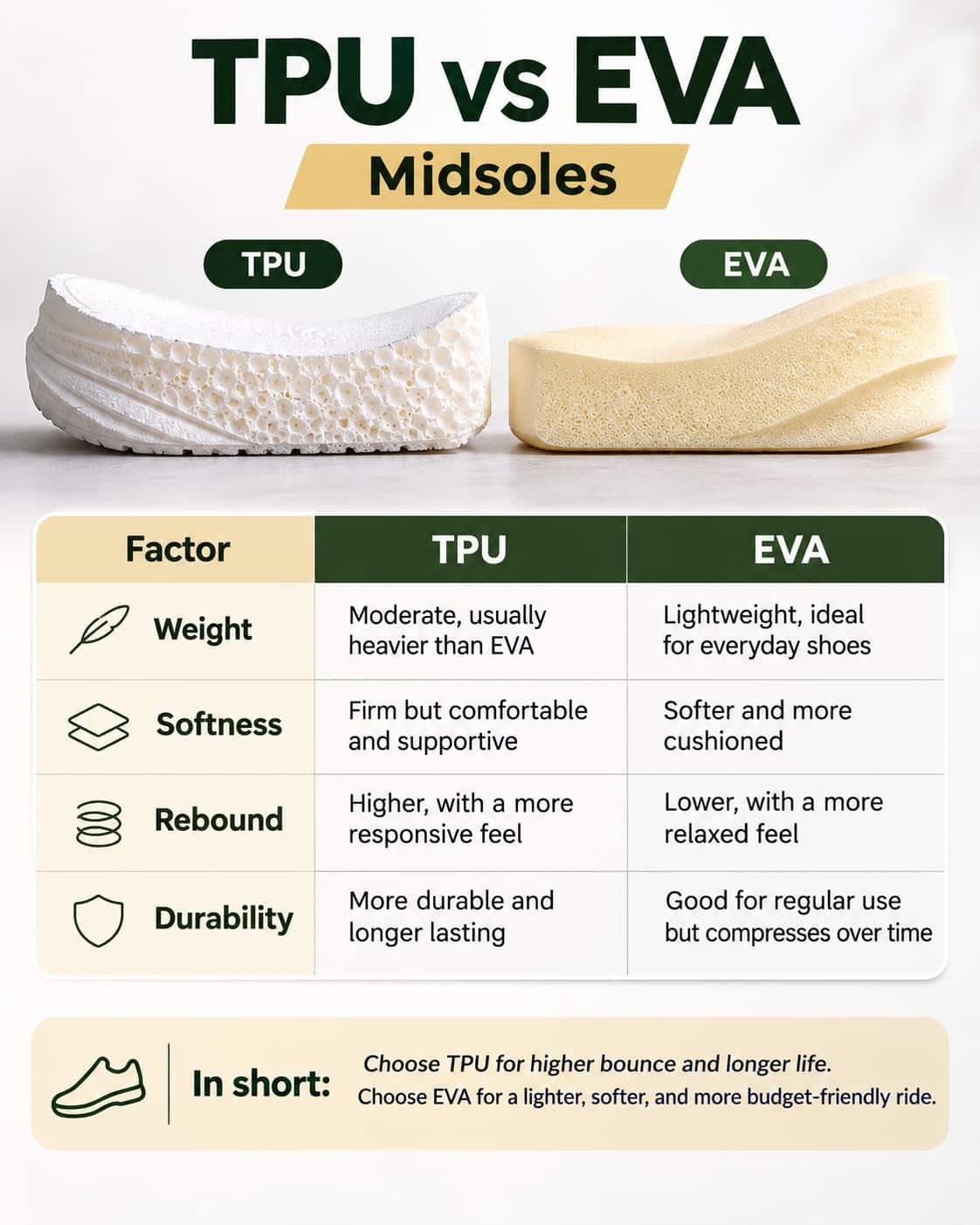
The table below compares the two materials in general terms, based on how they are typically used in footwear. It is an editorial summary, not a set of measurements.
| Factor | EVA | TPU |
|---|---|---|
| Structure | Expanded, soft foam | Tough, resilient polymer, solid or foamed |
| Weight | Typically lighter | Typically heavier |
| First-touch feel | Soft and cushioned | Firmer and more structured |
| Rebound | Moderate, varies by density | Often more resilient, varies by design |
| Resilience under load | Can compress more over time | Generally holds shape well under repeated load |
| Abrasion resistance | Good for everyday use | Typically strong |
| Cost | Usually lower | Usually higher |
| Best suited to | Comfort, casual and everyday shoes | Structure, support and durability-focused designs |
The table shows tendencies, not guarantees. A soft, dense EVA can feel firmer than a lightly built TPU. Use the table to frame the choice, then check the specific shoe.
Weight and Comfort
Weight matters most on long walks, long standing shifts and runs where every gram adds up. EVA is usually the lighter of the two, which is one reason it dominates in comfort and casual footwear.
Comfort is not only about weight. The ideal feel depends on your stride, body weight, and whether you want a plush, cushioned ride or a firmer, stable one. A lightweight EVA shoe can feel comfortable for everyday walking but may feel less supportive for someone who needs more structure. A TPU-based shoe may feel stable and secure but firmer on the first few steps.
Two practical checks help:
- Weigh the pair if the listing gives a figure. Compare weights for the same size, since weight varies with size.
- Walk for at least ten minutes in the shop, or do a short test run where returns are allowed. First impressions can differ from how the shoe feels after a while.
People with specific foot concerns should seek professional advice rather than relying on a general comparison. The American Podiatric Medical Association publishes general foot health guidance that can help frame those conversations.
Durability and Wear
TPU is generally described as more resilient than standard EVA, which means it tends to hold its shape under repeated loading. EVA is durable enough for most everyday use, but it can compress more over time, which reduces cushioning.
No source reviewed for this article gives a verified lifespan in kilometres or months for either material. Any figure you see online should be treated as an estimate unless it cites a specific test method and a source. Wear depends on several things: body weight, the surface you walk or run on, how often you wear the shoe, and how you store it.
Signs the midsole is wearing out:
- The shoe feels flatter or less responsive than when new.
- The heel or forefoot feels unevenly cushioned.
- Visible creasing or compression lines appear across the midsole.
- New aches appear after walks or runs that used to feel comfortable.
These are prompts to assess the shoe, not diagnoses. Persistent pain warrants a visit to a qualified clinician or podiatrist.
For a general guide to when to replace shoes, the running shoe lifespan guide covers the wider picture.
Wet Conditions, Slip Resistance and Cleaning
Many readers ask what happens to EVA in wet conditions and whether it is slippery. Two points are worth separating.
Water. EVA is a closed-or-open cell foam, and water can soak into the foam, especially if the shoe is repeatedly wet or left damp. Prolonged wetness can weaken adhesives and encourage odour. TPU is generally more resistant to water absorption, but the shoe’s upper and construction determine overall water resistance. For the difference between waterproof and water-resistant shoes, see the waterproof versus water-resistant guide and the how waterproof shoes work explainer.
Slip resistance. Slip resistance comes mainly from the outsole tread and rubber compound, not from the midsole foam. A soft midsole does not automatically make a shoe slippery, and a firm one does not automatically grip. Check the outsole design and the product’s stated purpose. The rubber shoe soles guide explains how outsoles differ.
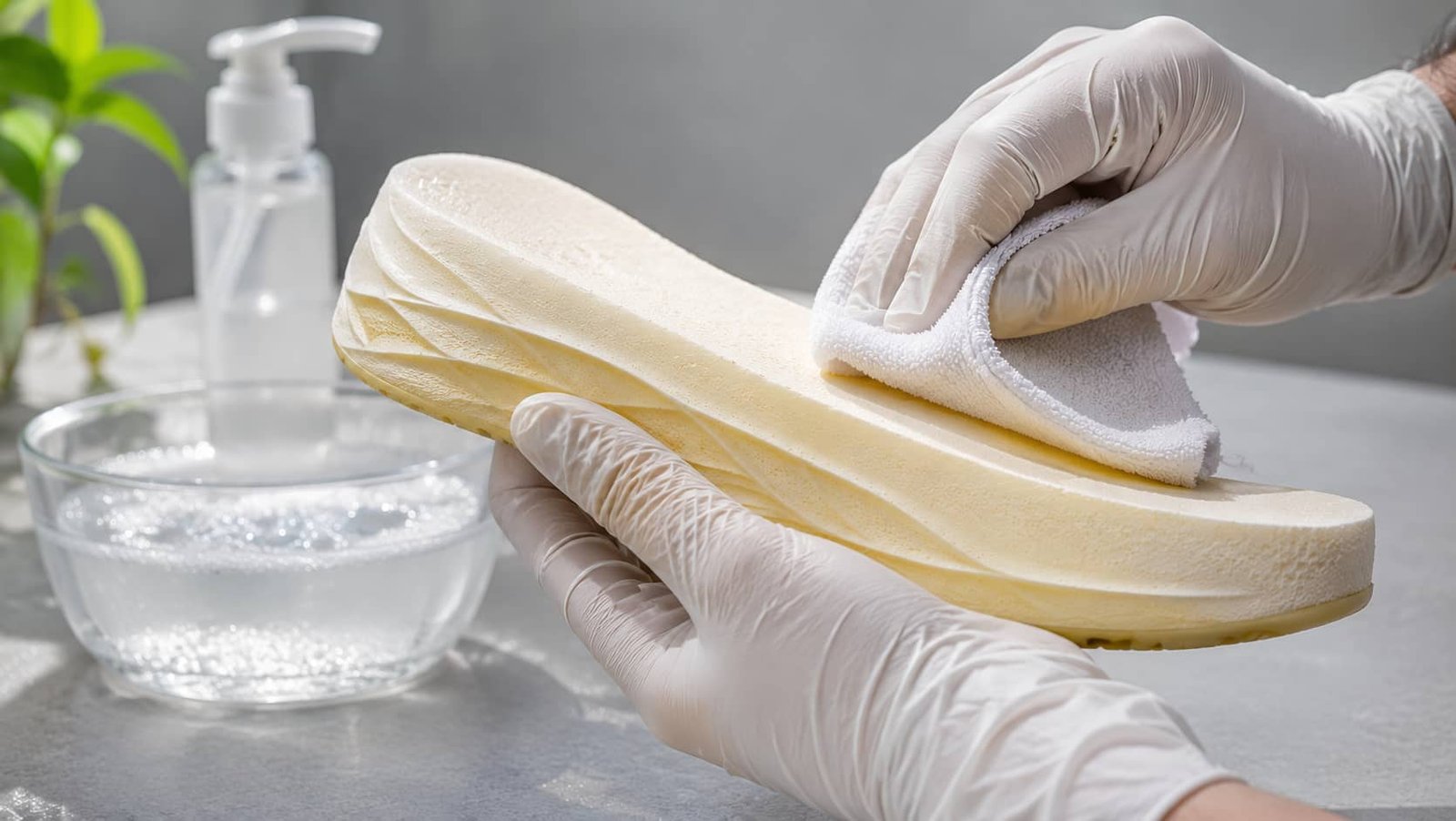
Cleaning. Both materials are cleaned the same way: gently, without heat or soaking.
- Remove the insoles and laces.
- Brush off dry dirt with a soft brush.
- Use mild soap and lukewarm water on a cloth. Do not soak the shoe.
- Wipe off residue and air-dry at room temperature, away from radiators and direct sun.
The shoe cleaning and maintenance guide gives steps for other materials.
Is EVA Plastic, Rubber or PVC?
EVA is a copolymer, which is a type of plastic. It is not natural rubber, and it is not PVC. Many people confuse the three because all can be used in soles.
- EVA is a foamed copolymer, typically light and soft.
- Rubber can be natural or synthetic and is usually denser and more abrasion-resistant. It is common in outsoles.
- PVC is polyvinyl chloride, a different plastic that can be flexible or rigid depending on its formulation.
TPU is also a polymer, specifically a polyurethane-based plastic. Its chemistry differs from EVA’s, which is why the two behave differently.
Because these are different polymers, do not assume that one can be swapped for another without changing the shoe’s feel, weight or durability.
TPR and the Three-Way Comparison
Searchers often ask about EVA, TPU and TPR together. TPR stands for thermoplastic rubber, a flexible material commonly used in outsoles. It is a different category from TPU, although the names are similar and often confused.
This article keeps its focus on the two midsole materials in the title. For the three-way question, the practical framing is:
- EVA is usually the lightest and softest of the three in midsole use.
- TPU is usually the most resilient and structural.
- TPR is usually an outsole rubber, chosen for flexibility and grip rather than for midsole cushioning.
Because TPR is typically an outsole material and TPU and EVA are typically midsole materials, comparing all three directly can mislead. A shoe may use all three in different layers. Read the materials section and check which layer each material occupies.
Where Each Material Appears in Shoes
EVA is common in midsoles across casual, comfort and entry-level footwear, and in many sandals and sneakers. Its low weight and low cost make it a default choice in many categories.
TPU appears in several parts of a shoe. It can be a structural element such as a heel counter, a support overlay, a stability element or a foam midsole. Its strength and resilience make it useful in places where the shoe needs to hold its shape.
Many shoes combine both. An EVA midsole may be paired with a TPU heel counter, or a TPU overlay may sit on an EVA upper. That is why the materials list on the product page matters more than the brand name or the shoe’s style.
For the heel counter and its role, the heel counter guide may be useful. For a comparison of how foam families appear across brands, see the running shoe foam guide.
A Practical Decision Guide
Use this sequence to decide between a TPU-led and an EVA-led shoe.
- Start with your use. Walking, standing and casual wear favour EVA’s lightness and comfort. Structure, support and durability-focused use favour TPU.
- Check the materials list. Note whether the midsole is EVA, TPU, a blend, or a foam with a TPU element.
- Consider your weight and stride. Heavier wearers may want more structure, and lighter wearers may prefer a softer, lighter feel. This is a general consideration, not a fitting rule.
- Think about your budget. EVA shoes are often the most affordable, while TPU-led designs usually cost more.
- Try the shoe on. Walk on hard floors and check the heel and forefoot.
By reader type:
- Budget-conscious everyday walkers: EVA, for lightness and value.
- People who stand all day: Consider a shoe with added structure, which may include TPU elements, and check the fit.
- Those who want structure and durability: TPU-led or TPU-supported designs.
- Lightweight casual wearers: EVA-led designs.
The shoe finder tool can narrow choices by activity, and the how we test shoes methodology page explains how we approach footwear evaluation. We have not lab-tested these materials for this article, and we do not claim first-hand testing.
Myths Worth Dropping
Myth: TPU is always bouncier than EVA. Bounce depends on the design as well as the material. A well-tuned EVA can feel springy, and a firm TPU can feel stiff.
Myth: EVA is always the lightest option. Usually, yes, but the total weight of a shoe depends on the whole construction, including the upper and outsole.
Myth: EVA and TPU are the same material. They are different polymers with different structures and properties.
Myth: EVA is a rubber. EVA is a copolymer foam. Rubber is a separate material category.
Myth: TPU and TPR are interchangeable. TPU is a polyurethane-based polymer, while TPR is a thermoplastic rubber. They are used differently and behave differently.
Myth: A material name guarantees performance. Materials set the starting point. Density, thickness, geometry and the rest of the shoe determine the ride.
Frequently Asked Questions
What is the main difference between TPU and EVA?
EVA is typically a lighter, softer expanded foam. TPU is a tougher, more resilient polymer that is usually heavier and firmer. Both can appear in midsoles, and many shoes use both in different parts.
Which is better, TPU or EVA?
Neither is better in every case. EVA suits comfort, lightness and budget. TPU suits structure, resilience and durability-focused designs. The right choice depends on your use and preferences.
Is TPU bouncier than EVA?
Often TPU feels more resilient, but bounce depends on the design, density and thickness. Do not rely on the material name alone.
Is EVA plastic or rubber?
EVA is a plastic copolymer, not natural rubber. It is a foamed material, while rubber is a separate category.
What happens to EVA when it gets wet?
Water can soak into the foam, especially if the shoe stays damp. Let the shoe dry fully at room temperature and avoid heat, which can damage the material.
Is EVA slippery?
Slip resistance comes mainly from the outsole tread and compound, not the midsole foam. Check the outsole design for the surfaces you use.
Are EVA soles durable?
EVA is durable enough for most everyday use, though it can compress more over time than some denser materials. No verified lifespan figure applies to all shoes.
What is TPR, and how does it differ from TPU?
TPR is thermoplastic rubber, usually used in outsoles for flexibility and grip. TPU is a polyurethane-based polymer used in structural and midsole parts. They are not the same material.
Verdict
EVA and TPU are two different answers to the same design problem. EVA gives you lightness and a soft, familiar feel at a lower cost. TPU gives you resilience, structure and a firmer base, usually at a higher weight and price. Bounce is a property of the whole design, so the material name is a starting point, not a verdict.
Before you buy, read the materials list, note whether a shoe uses EVA, TPU or both, and try it on for the way you will wear it. For more on the foam families, begin with the running shoe foam guide. For the wider family of footwear materials, the shoe materials pillar is the best starting point.
Sources
American Podiatric Medical Association. Foot health and footwear guidance. https://www.apma.org/ and Brand technology and product pages for specific shoes.