
Extra Wide Men’s Shoe Size Chart: Complete EEE & EEEE Width Guide
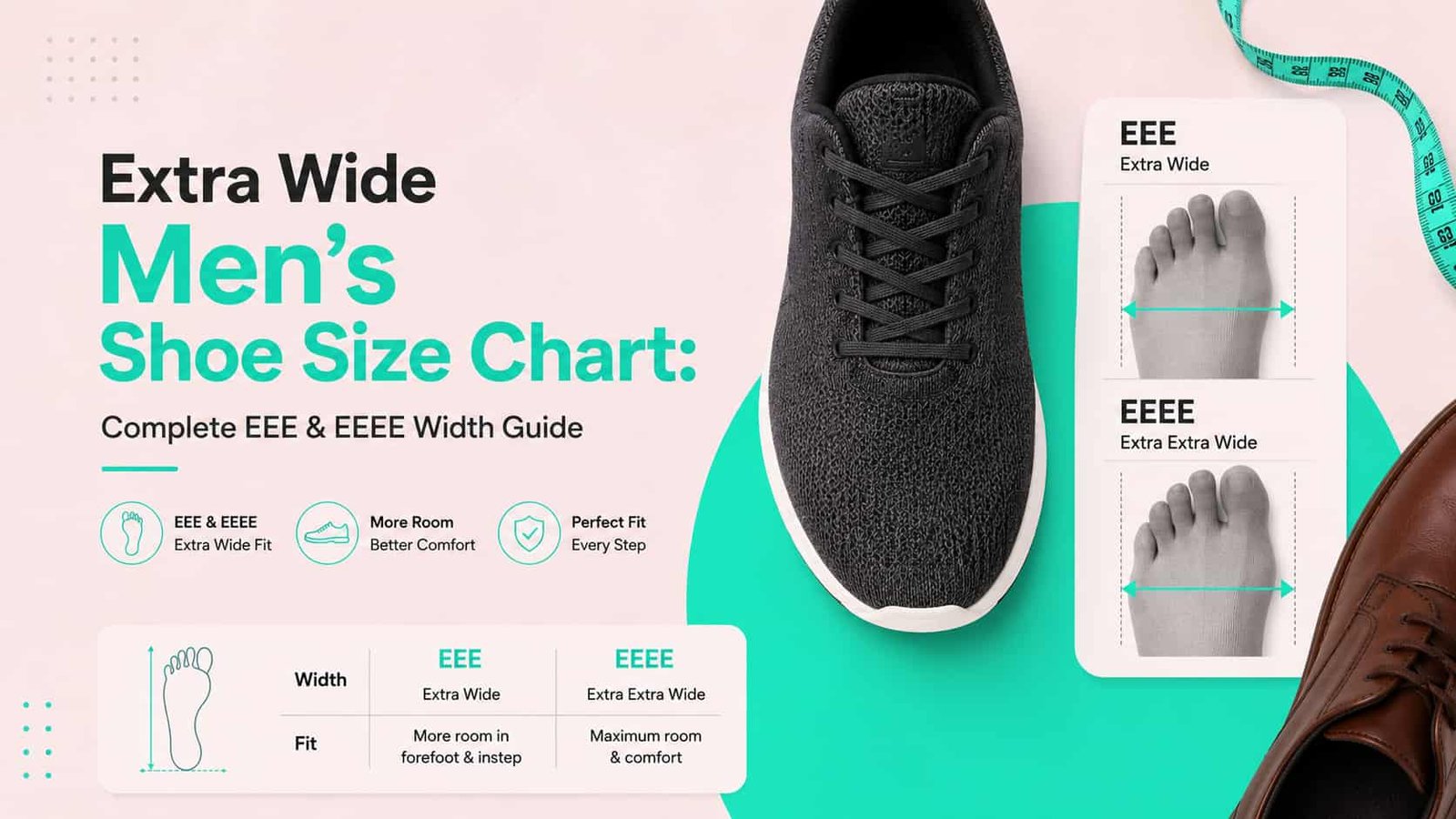
Extra wide men’s shoes are measured by width, not just length. A standard width is typically denoted as D or M, while extra wide sizes are labeled EEE (triple E) or EEEE (quad E). Foot width in inches or centimeters is the most reliable measurement because width varies as much as length between individuals. A size 10 EEE is significantly wider than a size 10 D, even though both carry the same length designation. Most men with wide feet discover their true width only after years of discomfort in standard-width shoes. Measuring your foot width is as critical as measuring length, and taking time to do so prevents years of cramping and blistering.
⚡ Quick Answer
- EEE and EEEE are extra wide shoe widths for men with broad feet.
- Foot width in inches is as important as foot length.
- Measure width across the ball of the foot while standing.
- Most men discover they need wide shoes after years of discomfort.
Extra Wide Men’s Shoe Width Chart
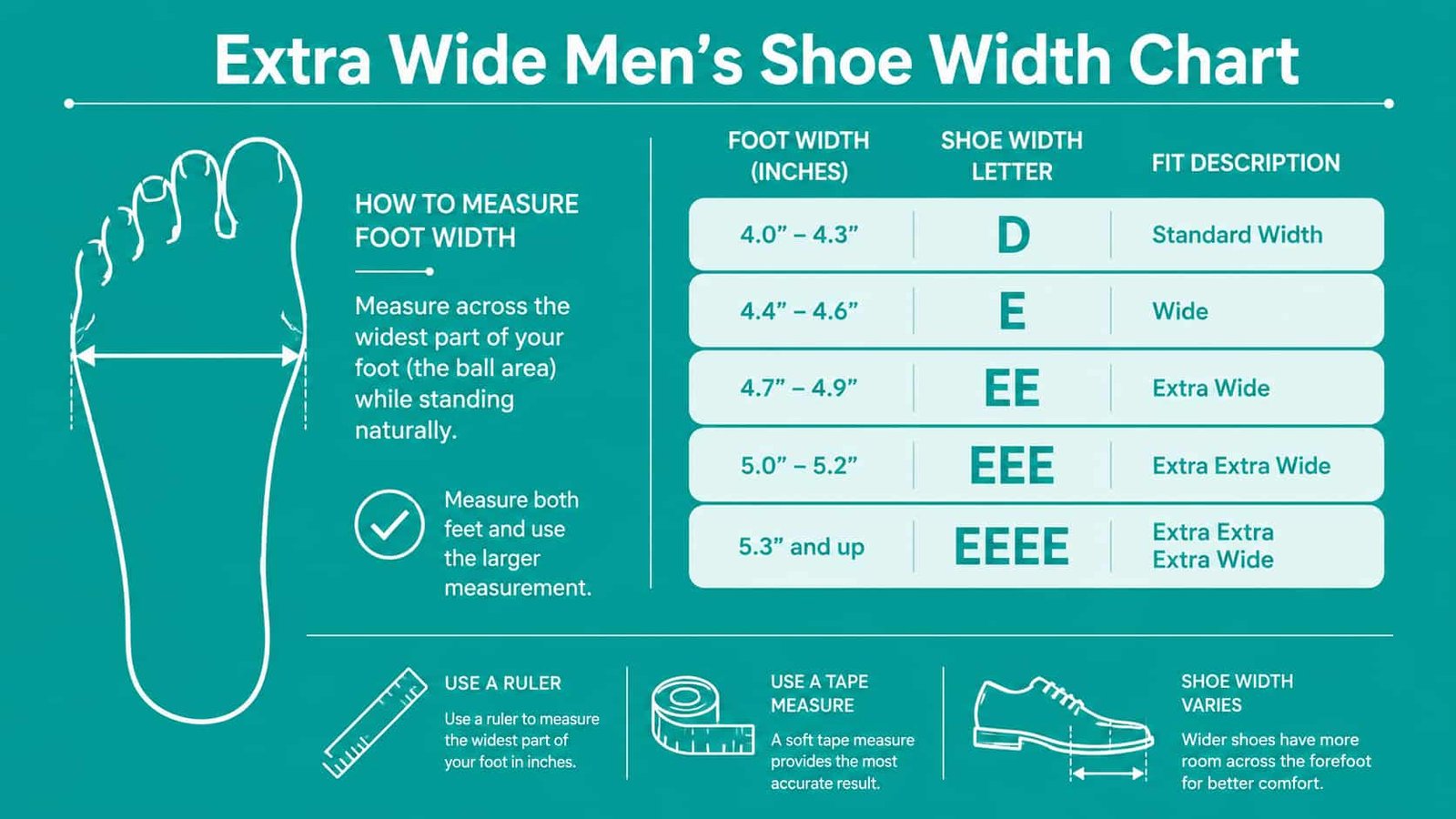
Shoe width is measured across the ball of the foot (the widest part). This chart aligns foot width measurements with width designations and corresponding length/width combinations for common US sizes.
| Foot Width (in) | Foot Width (cm) | Width Designation | Common Lengths | Notes |
| 3.8-4.0 | 9.7-10.2 | B (Narrow) | 6-13 | Less common for men |
| 4.0-4.3 | 10.2-10.9 | D (Standard) | 6-13 | Most common men’s width |
| 4.3-4.6 | 10.9-11.7 | E (Wide) | 6-13 | First wide category |
| 4.6-4.9 | 11.7-12.4 | EE (Extra Wide) | 6-13 | Significantly wider |
| 4.9-5.2 | 12.4-13.2 | EEE (Extra Extra Wide) | 6-13 | Very few brands carry |
| 5.2+ | 13.2+ | EEEE (Extra Extra Extra Wide) | Limited | Rare, specialty order only |
Width designations are not standardized globally. A D width from one brand can fit narrower or wider than a D from another manufacturer. This is why direct measurement remains the most dependable reference point.
👟 Did You Know?
Nearly 30 percent of men have wide feet, yet most shoe stores stock primarily standard width shoes. This mismatch is why so many men spend years in shoes that are technically too narrow.
Understanding Shoe Width Designations
Width letters were originally derived from shoe manufacturing lasts. A D width last is narrower than an E width last, and so on. However, because manufacturers source lasts from different suppliers and adjust them for their own brand identity, a D width shoe from Brand A can fit differently than a D width shoe from Brand B. This variance is especially pronounced in extra wide categories (EEE and EEEE), where fewer brands produce inventory, meaning limited standardization across manufacturers.
Width sizing also varies by shoe type. Dress shoes tend to run narrower than athletic shoes. Work boots often run wider than casual sneakers from the same brand. This is another reason direct measurement of your foot width is essential before purchasing.
How to Measure Your Foot Width
Accurate width measurement takes just one minute and requires a ruler or measuring tape.
- Place a blank sheet of paper on a hard floor.
- Stand on the paper with your full body weight on both feet.
- Have someone mark the outer edges of your foot at the ball of the foot (the widest point, usually below your toes).
- Remove your foot and measure the distance between the two marks in inches or centimeters.
- Repeat for the other foot. Width can differ between feet just as length does.
- Use the larger measurement when checking the chart above.
The key detail many men miss is measuring at the right spot. The ball of the foot is not at the very bottom of your toes, but rather slightly back where your foot naturally widens. If you measure too close to the toes or too far back, the reading will be inaccurate.
💡 Expert Tip
Measure foot width in the evening after a full day of standing or activity. Feet swell naturally throughout the day, and an evening measurement captures your foot at its functional widest point, ensuring shoes stay comfortable regardless of the time of day you wear them.
Width to Shoe Size Converter
📐 Foot Width to Shoe Width Converter
Enter your foot width in inches or centimeters to find your shoe width designation and EEE/EEEE compatibility.
EEE vs EEEE: What's the Difference
The difference between EEE and EEEE is roughly 0.3 inches (about 8 millimeters) of additional width. While this may sound small, it represents a significant difference in how a shoe fits. A man with EEEE feet wearing an EEE shoe will experience pinching at the sides and pressure across the ball of the foot. Conversely, a man with EEE feet wearing EEEE shoes often encounters too much loose material, which can cause the shoe to shift during walking.
The practical issue is that EEEE shoes are extremely rare in standard retail. Most shoe stores do not stock them, and online ordering becomes necessary. This is why many men with EEEE feet resort to custom or bespoke shoe makers, or they work with specialty wide-foot retailers who maintain deeper inventory.
⚠ Common Mistake
Buying a narrower width and hoping to stretch it over time is one of the biggest mistakes wide-footed men make. Shoe leather or fabric does stretch, but rarely widens noticeably. A shoe that is too narrow at purchase will remain too narrow after weeks of wear, and attempting to force fit causes permanent damage to the shoe structure.
Signs Your Shoes Are Too Narrow
Narrow shoes announce themselves quickly. Red marks appear on the sides of your feet within minutes. After an hour, pressure across the ball of the foot becomes uncomfortable. Toenails may darken over time from repeated pressure. Many men ignore these signals for years, assuming their feet are simply "difficult to fit." In our experience, the vast majority of men with narrow-shoe complaints simply have never measured their foot width.
Signs Your Shoes Are Too Wide
Wide shoes create a different set of problems. The shoe moves around on your foot during walking, causing friction blisters on your heels and toes. Your foot slides forward inside the shoe, and you end up with black toenails from repeated impact. The lacing system has excessive slack no matter how tight you pull. Your arch does not receive proper support because the shoe is not shaped to match your foot.
✅ Fit Checklist
- No red marks on the sides of your feet after 30 minutes of wear.
- Slight pressure across the ball of the foot, but not tightness.
- Heel stays in place without lifting when you walk.
- Toes have a little wiggle room but do not slide forward.
- Lacing is snug at medium tension, not too tight or too loose.
Best Brands for Extra Wide Feet
After two decades fitting wide-footed customers, several brands consistently deliver quality EEE and even EEEE widths. New Balance manufactures in multiple width options and their EEE shoes are nearly as available as standard widths. Rockport dress shoes offer excellent width selection for professional settings. SAS (San Antonio Shoemakers) focuses on comfort and carries wide widths extensively. Thorogood work boots are available in EE and EEE. However, availability varies by season and specific style, so direct communication with customer service before ordering is always recommended.
Common Width Mistakes
The most frequent error we observe is men confusing shoe size with shoe width. A size 10 EEE is not a half size smaller than a size 10 D. It is an entirely different width. Width and length are independent measurements, and conflating them causes men to buy shoes that are either still too narrow or unnecessarily large. Another common mistake is buying online without confirming the specific width available. A product listing may show "wide available," but the exact width options must be verified before checkout.
Expert Width Tips
📝 Before You Order
- Measure your foot width at the ball of the foot while standing.
- Cross-reference your width against this chart to find your designation.
- Verify the specific shoe model carries your width before ordering.
- Check customer reviews specifically mentioning width fit.
- Consider brand-specific width quirks noted in reviews.
- Remeasure your foot width every 12 to 18 months.
After more than two decades in footwear retail, the single biggest shift I have seen is wide-footed men finally accepting their true width and stopping the cycle of buying shoes that are too narrow. The relief on a customer's face when they put on properly fitted wide shoes after years of discomfort is remarkable.
FAQs
What does EEE shoe width mean?
EEE stands for triple E and is a width designation indicating extra extra wide shoes. An EEE shoe is significantly wider across the ball of the foot than standard (D) or wide (E) widths. Foot width measurements of approximately 4.9 to 5.2 inches typically correspond to EEE sizing.
Are EEE and EEEE shoes available in all shoe types?
No. EEEE shoes are extremely limited in retail availability and are mostly available through specialty retailers or custom orders. EEE widths are more common but still not carried by every brand or every retail location.
Can I stretch narrow shoes to fit wider feet?
Leather shoes stretch somewhat with wear, but they stretch lengthwise more than widthwise. A narrow shoe may stretch slightly wider over months of wear, but it will never become truly wide. Starting with the correct width is always better than hoping for stretch.
How do I know if I have wide feet?
If you frequently experience red marks on the sides of your feet after wearing shoes, pressure across the ball of your foot, or dark toenails, you likely have wide feet. The only reliable way to confirm is to measure your foot width in inches or centimeters using the method described in this article.
Is shoe width the same across all brands?
No. Shoe width standardization is inconsistent. A D width from Brand A can fit narrower or wider than a D width from Brand B. This is why customer reviews mentioning fit are valuable, and why direct communication with brand customer service before ordering is recommended.
Do wide shoes cost more than standard width shoes?
Not necessarily. EEE and EEEE shoes often cost more because they require different manufacturing lasts and are produced in lower volumes, which raises per-unit costs. However, many brands charge the same price for all widths.
What if one foot is wider than the other?
This is common. Size shoes to the wider foot to ensure both stay comfortable throughout the day.
Should I measure width with socks on or off?
Measure with bare feet. If you always wear thick socks, you can add approximately 0.1 to 0.15 inches to your measurement as a margin, but bare foot is the standard measurement method.
Can I use an online width calculator instead of measuring?
Online calculators are convenient but less accurate than direct measurement. Always measure yourself for the most dependable result.
How often should I remeasure my foot width?
Remeasure every 12 to 18 months. Significant weight gain or loss, aging, or changes in activity level can affect foot width over time.
What is the difference between wide and extra wide shoes?
Wide shoes (E width) are moderately broader across the ball of the foot. Extra wide shoes (EE width) are noticeably wider. Extra extra wide (EEE) and extra extra extra wide (EEEE) are progressively wider, with EEEE being the broadest category available through most manufacturers.
CONCLUSION
Finding shoes that fit your actual foot width is not a luxury; it is essential for comfort and foot health. EEE and EEEE widths exist specifically because millions of men have feet broader than standard widths, yet retail availability remains limited. Now that you know how to measure your foot width and understand the width designations, you can confidently shop across brands and order online without guesswork.
Take five minutes to measure your foot width using the guide above, then use the interactive width converter to find your designation. For a more comprehensive understanding of overall shoe sizing including length and width together, see our complete men's shoe size chart. For detailed measurement instructions with photos, visit our how to measure men's feet guide.