
Newborn Shoe Size Guide: First Shoes & Sizing (2026)
⚡ Quick Answer
- Most newborns wear a US size 0 to 1, with a foot length between 3.0 and 3.9 inches.
- Newborns don’t need walking shoes yet. Soft, sock-like footwear is the better choice before they’re standing.
- Always measure the actual foot rather than guessing from a birth weight or age alone.
- Leave a small amount of growing room, since newborn feet grow fast in the first few months.
- Prioritize soft soles and easy on and off design over anything with a rigid structure.
A newborn typically wears a US shoe size 0 to 1, which matches a foot length of about 3.0 to 3.9 inches. Newborns aren’t walking yet, so the goal isn’t a stiff, supportive shoe, it’s something soft that keeps tiny feet warm and covered without restricting natural movement. Measuring your baby’s actual foot length is far more reliable than guessing from their weight or birth size, since foot length and overall size don’t always track together. Most families won’t need a true walking shoe until their baby is standing and taking steps on their own.
Do Newborns Actually Need Shoes?
Not for walking, no. A newborn’s feet are still developing bone structure, and they won’t need real support until they’re pulling up, cruising, or taking their first steps.
That said, most parents still dress newborns in soft booties or sock-style shoes, mainly for warmth and to keep loose socks from sliding off during diaper changes and outfit swaps. Our When Should Babies Wear Shoes? guide covers the full walking timeline if you want to know exactly when to move into a real walking shoe.
For now, think of newborn footwear as more of an outfit piece than a functional shoe. Soft, flexible, and easy to remove matters far more than arch support or a firm sole at this stage.
👶 Did You Know?
A newborn’s foot is roughly half cartilage rather than solid bone. That cartilage doesn’t fully turn to bone until well past the toddler years, which is part of why stiff, structured shoes aren’t recommended before a baby is walking independently.
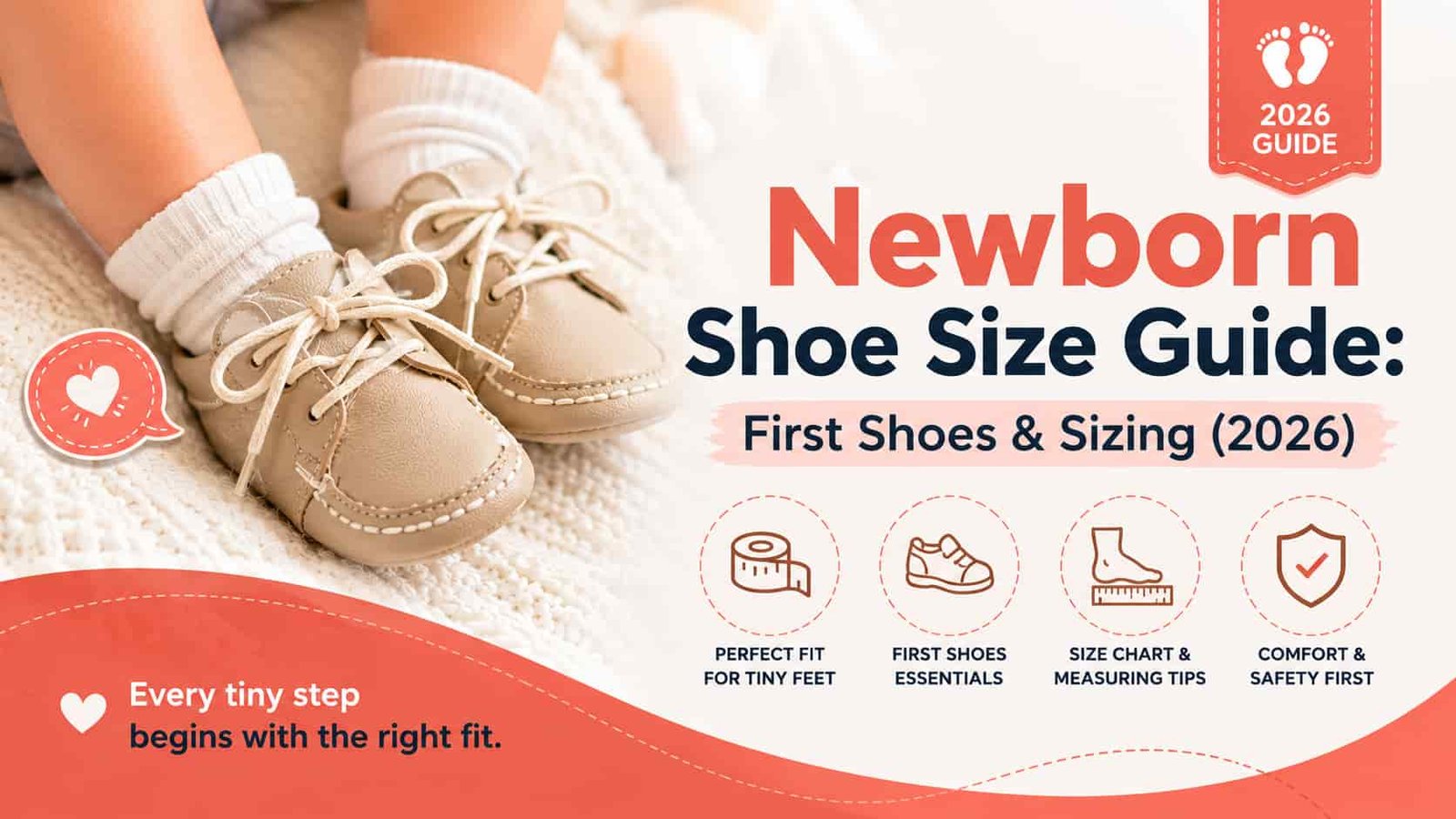
Newborn Shoe Size Chart
This chart shows the typical foot length and matching US size for babies in the newborn stage, from birth through three months.
| Age | Foot Length (inches) | Foot Length (cm) | US Size |
| 0-1 month | 3.0 – 3.4 in | 7.6 – 8.6 cm | 0 |
| 1-2 months | 3.4 – 3.6 in | 8.6 – 9.1 cm | 0 – 1 |
| 2-3 months | 3.6 – 3.9 in | 9.1 – 9.9 cm | 1 |
These numbers are a starting point, not a rule. We’ve fitted plenty of newborns who ran a size larger or smaller than what their age alone would suggest, so treat the chart as a guide to check your measurement against, not a substitute for it.
Interactive Newborn Size Finder
Enter your newborn’s foot length below and this tool will show the closest US size right away.
Newborn Shoe Size Finder
Enter your newborn’s foot length to get an instant US size estimate for their first shoes.
This tool gives an estimate for soft newborn footwear sizing. Always measure both feet and choose the larger measurement.
If you're also shopping from an international retailer, our Shoe Size Conversion Calculator converts this same measurement into UK and EU sizes as well.
💡 Expert Tip
Measure a newborn's foot while they're calm, ideally right after a feeding when they tend to be more settled. A wiggling, upset newborn makes for a stretched or inaccurate tracing almost every time.
How to Measure a Newborn's Foot
Newborn feet are trickier to measure than an older baby's, mostly because they naturally curl and rarely hold still.
Step 1: Lay your newborn on their back. A changing table or soft flat surface works well.
Step 2: Place a piece of paper under one foot. Gently support their leg so the foot rests flat against the paper.
Step 3: Press lightly to flatten the curl. Newborn toes often curl under. Use one finger to gently flatten the foot without stretching it.
Step 4: Trace around the foot. Hold the pencil straight up and down, not at an angle, to avoid adding extra length to the tracing.
Step 5: Measure heel to longest toe. Use a ruler to measure the straight-line distance between the two points.
Step 6: Repeat on the other foot. Take the larger of the two measurements as your final number.
✅ Parent Checklist
- Measure both feet while your newborn is calm.
- Gently flatten any natural toe curl before tracing.
- Hold the pencil upright, not angled, while tracing.
- Remeasure every 4 to 6 weeks in the first few months.
- Choose soft, flexible materials over anything stiff.
What Makes a Good First Shoe
A newborn's first pair of shoes should support natural foot movement, not restrict it.
Soft, flexible soles. A newborn's foot needs to move and flex freely. A rigid sole can actually interfere with healthy foot development at this stage.
Easy on and off design. Snap closures, wide stretchy openings, or simple slip-on styles are much easier to manage during frequent outfit and diaper changes than laces or small buckles.
Breathable, soft fabric. Cotton, soft knit, or lightweight fleece keep tiny feet comfortable without overheating.
No hard seams or embellishments inside. Anything stiff or textured on the inside of the shoe can rub against delicate newborn skin.
Signs the Shoe Fits Correctly
Even at this soft, sock-like stage, a properly sized first shoe should meet these checks.
- The shoe stays on without needing to be pulled up constantly.
- There's no red line or indentation around the ankle or foot after wear.
- Your newborn's toes have room to move and aren't visibly bunched at the end.
- The fabric doesn't pinch or dig in anywhere when your baby kicks.
Signs the Shoe Is Too Small or Too Big
Too small and too big cause different problems, even in soft newborn footwear.
Too small signs: visible red marks after removal, toes curled or pressed against the fabric, or your newborn seeming fussy specifically during dressing.
Too big signs: the shoe slides off during normal movement, excess fabric bunches around the ankle, or the shoe rotates out of position as your baby kicks.
⚠ Common Mistake
Buying a stiff, structured "first walking shoe" for a newborn who isn't standing yet is one of the most common gift-buying mistakes we see. Save the supportive walking shoe purchase for closer to your baby's first steps, and stick with soft booties for now.
Common Mistakes First-Time Parents Make
A handful of habits come up again and again with first-time parents shopping for newborn shoes.
Choosing style over function. Cute details are fine, but stiff soles, hard buckles, or narrow toe boxes aren't ideal for a newborn's developing foot.
Buying based on birth weight instead of foot length. A larger birth weight doesn't always mean longer feet. Measure directly rather than assuming.
Skipping remeasurement. Newborn feet grow quickly in the first months. A size that fit at one month can be tight by two months.
Overdressing the feet in warm weather. Thick booties in hot climates can cause overheating. Lighter, breathable fabric is worth prioritizing seasonally.
Buying Guide for First Shoes
When you're ready to shop, a few practical details make the biggest difference.
Stretchy or snap closures make dressing faster, especially during those frequent early outfit changes.
A slightly wider toe box accommodates natural newborn foot shape better than a narrow, pointed design.
Machine washable fabric is worth prioritizing, since newborn footwear gets dirty faster than you'd expect.
A size up rather than exact fit gives a small buffer for the rapid growth typical of this stage, without going so large that the shoe slips off constantly.
📏 Size Snapshot
Age: 2 months
Typical US Size: 0 to 1
Foot Length: 3.4 - 3.6 inches
Growing Room: 0.3 - 0.4 inches
Expert Tips for the Newborn Stage
Tip 1. Keep a couple of sizes on hand if you're gifting shoes for a baby shower, since exact newborn sizing can be hard to predict before birth.
Tip 2. Choose soft sole styles over anything marketed as a "walking shoe" until your baby shows signs of standing or cruising along furniture.
Tip 3. Remeasure monthly during the newborn stage rather than waiting the usual 6 to 8 weeks used for older babies, since growth can be faster and less predictable this early.
Tip 4. If a shoe includes a rigid insert or arch support, it's likely designed for an older, walking-age child rather than a true newborn.
FAQs
What size shoe does a newborn wear? Most newborns wear a US size 0 to 1, with a foot length between about 3.0 and 3.9 inches. Since newborn growth varies, measuring your baby's foot directly gives a more accurate answer than relying on age alone.
Do newborns really need shoes at all? Not for walking. Newborns aren't standing or walking yet, so shoes at this stage are mainly for warmth and outfit purposes rather than foot support. Soft booties or sock-style shoes work well until your baby is closer to walking age.
How do I measure a newborn's foot if they won't stop kicking? Try measuring right after a feeding, when babies tend to be calmer. Having a second person gently hold the leg steady while you trace can also make the process faster and more accurate.
What's the difference between a newborn shoe and a walking shoe? A newborn shoe is typically soft, flexible, and designed mainly for warmth and coverage. A walking shoe has more structure and grip, built to support a baby who is actively standing, cruising, or taking steps.
How often does a newborn's shoe size change? Newborn feet can grow noticeably within just a few weeks. Checking the fit monthly during the first three months is a safer habit than waiting the usual 6 to 8 week window used for older babies.
Should I buy newborn shoes before the baby is born? It's fine to have a pair or two on hand, but avoid stocking up heavily before birth, since foot size at birth can vary more than parents expect. Waiting until after birth to buy the bulk of newborn footwear is usually the safer approach.
Are soft sole shoes as good as socks for a newborn? Soft sole shoes and warm socks serve a similar purpose at this stage. Soft sole shoes tend to stay on better during active kicking, while socks can be simpler and easier to layer under a onesie.
What material is best for newborn shoes? Soft cotton, knit fabric, or lightweight fleece are generally the most comfortable choices. Avoid stiff synthetic materials or anything with hard seams on the inside that could irritate delicate newborn skin.
Is it bad for a newborn's foot development to wear shoes all the time? Soft, unstructured newborn shoes generally don't interfere with foot development, but going barefoot or sock-only at home when possible is a common and reasonable choice many parents make. The concern mainly applies to stiff, structured footwear, not soft newborn styles.
Can I use a newborn's birth length to estimate shoe size? Birth length gives a rough starting point, but it isn't a reliable substitute for measuring the actual foot. Foot length doesn't always scale directly with a baby's overall birth size.
When should I switch from soft newborn shoes to real walking shoes? Once your baby is pulling up, cruising along furniture, or taking early independent steps, it's time to consider a proper walking shoe with more sole grip and structure. Our When Should Babies Wear Shoes? guide covers this transition in detail.
RELATED ARTICLES
- When Should Babies Wear Shoes? Expert Guide (2026)
- 0-3 Month Baby Shoe Size Chart (US Sizes + Foot Length Guide)
- Shoe Size Conversion Calculator, US, UK, EU & CM (2026)
- UK 8 to US Shoe Size Guide
CONCLUSION:
Newborn shoe sizing comes down to measuring the actual foot and choosing soft, flexible footwear over anything structured. A size 0 to 1 covers most newborns, but a quick measurement at home will tell you exactly where your baby falls.
Use the interactive size finder above to check your newborn's measurement right now, and remeasure monthly during these fast-changing first few months. Once your baby is closer to standing and walking, our When Should Babies Wear Shoes? guide will walk you through choosing that next pair.