
PEBA (Pebax) Foam Explained: The Super Shoe Foam
Editorial Guide | Midsole Foams |
Summarise this PEBA foam guide with AI
Open an assistant and submit the prefilled request. The assistant reads the page only after you submit it.
PEBA, short for polyether block amide and often sold under the Pebax name, is a thermoplastic elastomer used to make light, springy midsole foam. It combines rigid and soft blocks in one polymer, which gives it high energy return and a bouncy feel. It usually costs more than EVA and TPU, and it is most common in racing and premium running shoes.
Key takeaways
- PEBA is a polymer built from rigid polyamide blocks and soft polyether blocks. That mix is the source of its bounce and lightness.
- Reviewers commonly rate PEBA’s energy return higher than EVA’s. Those ratings are subjective and depend on the test, so treat them as a guide.
- PEBA’s bounce is generally considered to fade with use. One review describes a limited peak-bounce window of roughly 100 to 200 miles, so racing shoes are usually worn for a shorter time.
- PEBA usually costs more and is typically found in premium or performance shoes.
- Choose PEBA for responsive, light running on a shoe you can afford to replace sooner. Choose a more durable foam for everyday, high-mileage wear.
Few shoe terms have changed the market as fast as “super foam”. Within a few years, shoe listings moved from EVA and standard rubber to a set of premium foams, and PEBA became one of the most talked-about. You will see it written as “PEBA”, “PEBAX” or “Pebax”, often next to a claim that the shoe is bouncier, lighter or faster.
The name is an abbreviation, and the material is a specific polymer. Its bounce comes from its chemistry and structure, not from a marketing label. This guide explains what PEBA is, how it is made into foam, how it compares with EVA and TPU, where its bounce comes from, and where its limits appear. It finishes with a plain decision guide and care tips.
For the wider family of cushioning materials, start with our running shoe foam. If you are still sorting out where a midsole sits, the midsole and outsole guide sets out the layers.
What Is PEBA Foam?
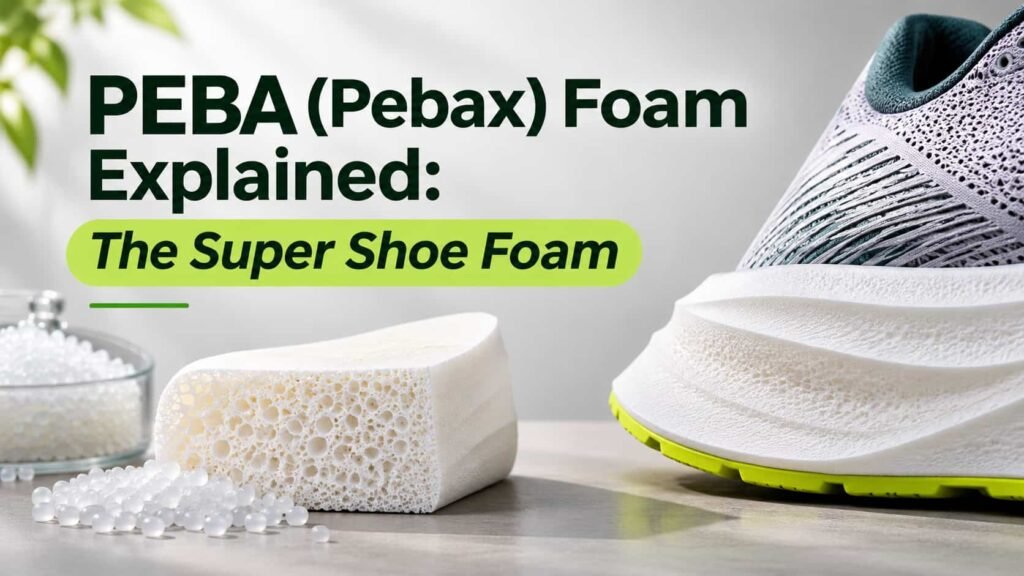
PEBA stands for polyether block amide. It is a thermoplastic elastomer, which means it behaves like rubber when stretched or compressed but can be melted and reshaped, like a plastic. Its structure is built from two kinds of blocks joined together. The polyamide blocks are rigid and give the polymer strength and structure. The polyether blocks are soft and flexible, and they help the material bend and recover.
Pebax is the trade name most people encounter. It is a family of polyether block amide products made by Arkema, and many shoe and foam makers buy PEBA under that name. Because “Pebax” is a brand, you will see it used loosely in listings, and not every product called Pebax-based uses the same grade or process. The brand name tells you the material family, not the exact feel.
Why does a polymer with rigid and soft blocks bounce so well? The short answer is that the rigid blocks hold the structure, while the soft blocks stretch and recover quickly. When the foam is compressed by a footstrike, it stores energy, then releases it as the foot lifts. That quick recovery is what runners call energy return.
It helps to keep the terms straight. “PEBA foam” describes midsole foam made from this polymer. “Pebax” describes the family of products from one supplier. “PEBA-type” or “PEBA-based” describes foam that uses the same family of chemistry. None of these names guarantees a particular density, weight or price.
How PEBA Foam Is Made
PEBA is usually foamed in one of a few ways, and the method changes how the midsole feels. Understanding the process explains why two PEBA shoes can differ.
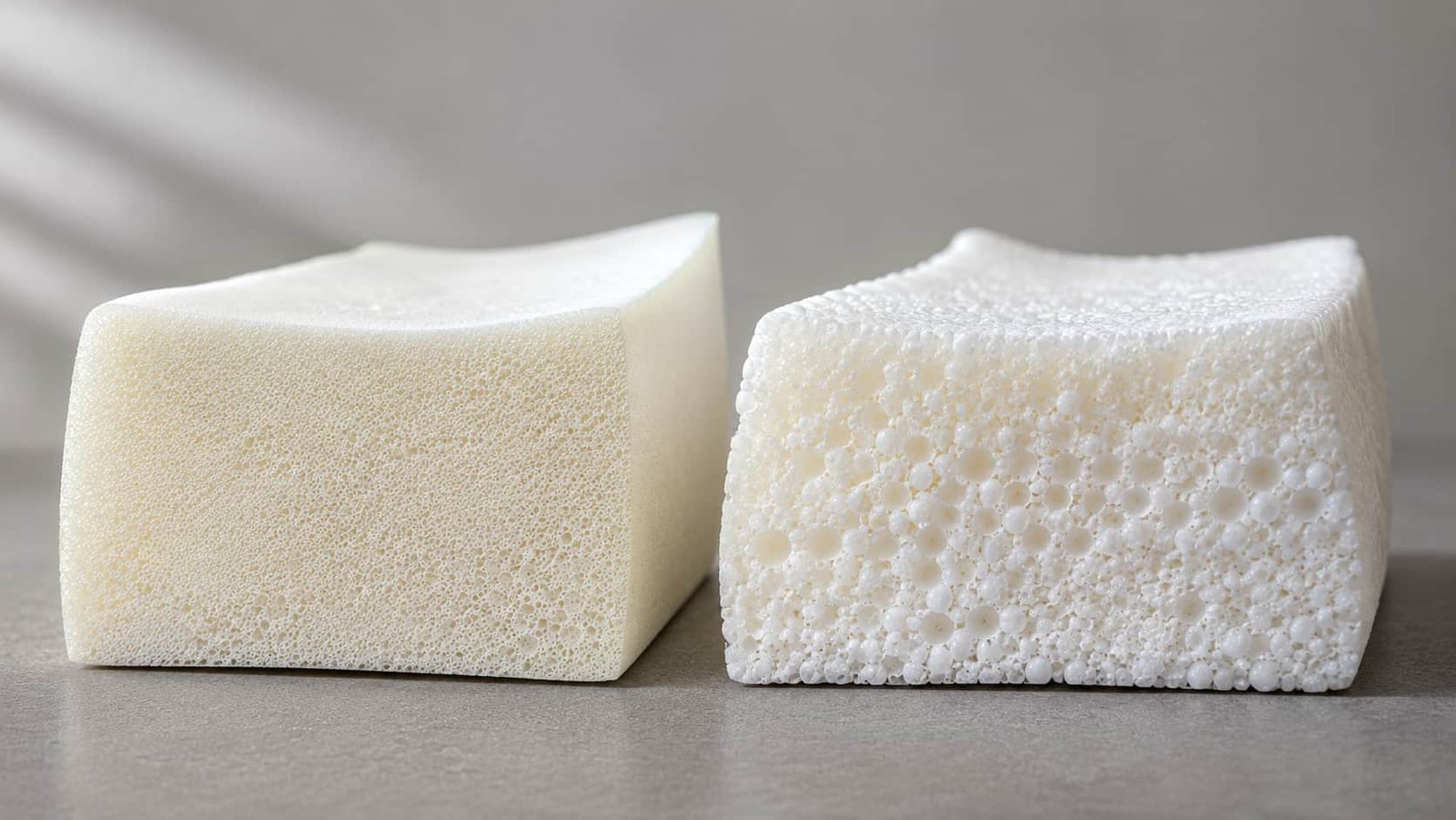
One method is gas foaming, in which a gas is dissolved into the molten polymer under pressure and then released as the material expands. A common version uses a supercritical fluid, a state of gas that flows like a liquid, to produce a fine, even cell structure. Our supercritical foam guide explains the method in more detail. The result is typically a light foam with many small gas cells.
Another method is bead or particle moulding. Small foam beads are made first, then fused in a mould using heat and steam. The beads give a particular look and feel, and the process can produce midsoles with different shapes and density zones. Some listings describe this as a “bead foam” or an “expanded” foam.
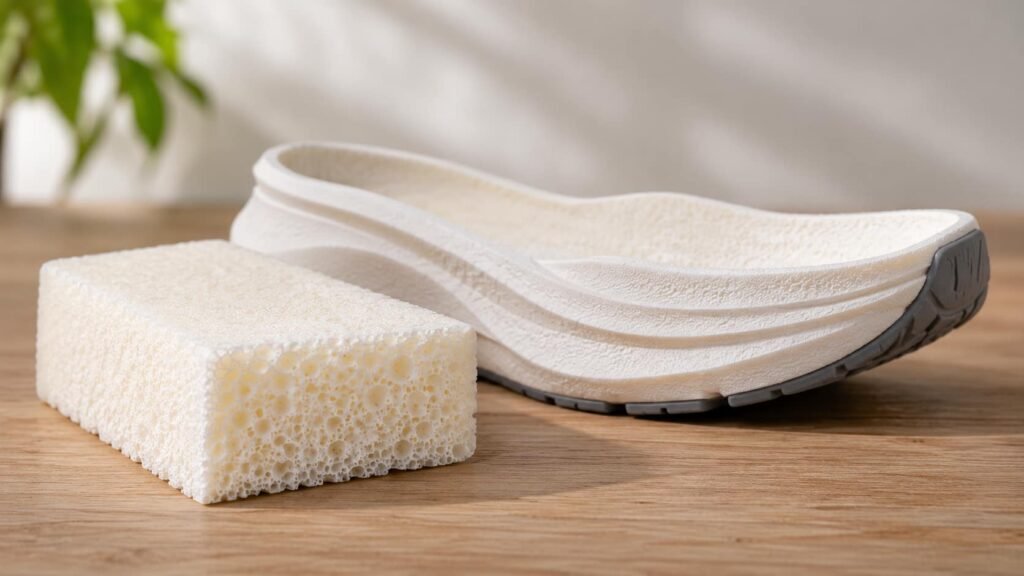
A third route is sheet foam. Sheets are cut, moulded or used as stock material in shoes, sports goods and other products. Some sellers offer PEBA foam sheets for DIY and craft projects. Sheet products can differ in density and thickness, so read the supplier’s technical sheet before buying one for a project.
The process matters for buyers because density and cell structure set how much the foam compresses, how quickly it recovers and how it holds up over time. A well-made PEBA foam and a poorly made one can feel very different, even though both carry the same name.
PEBA vs EVA: The Main Differences
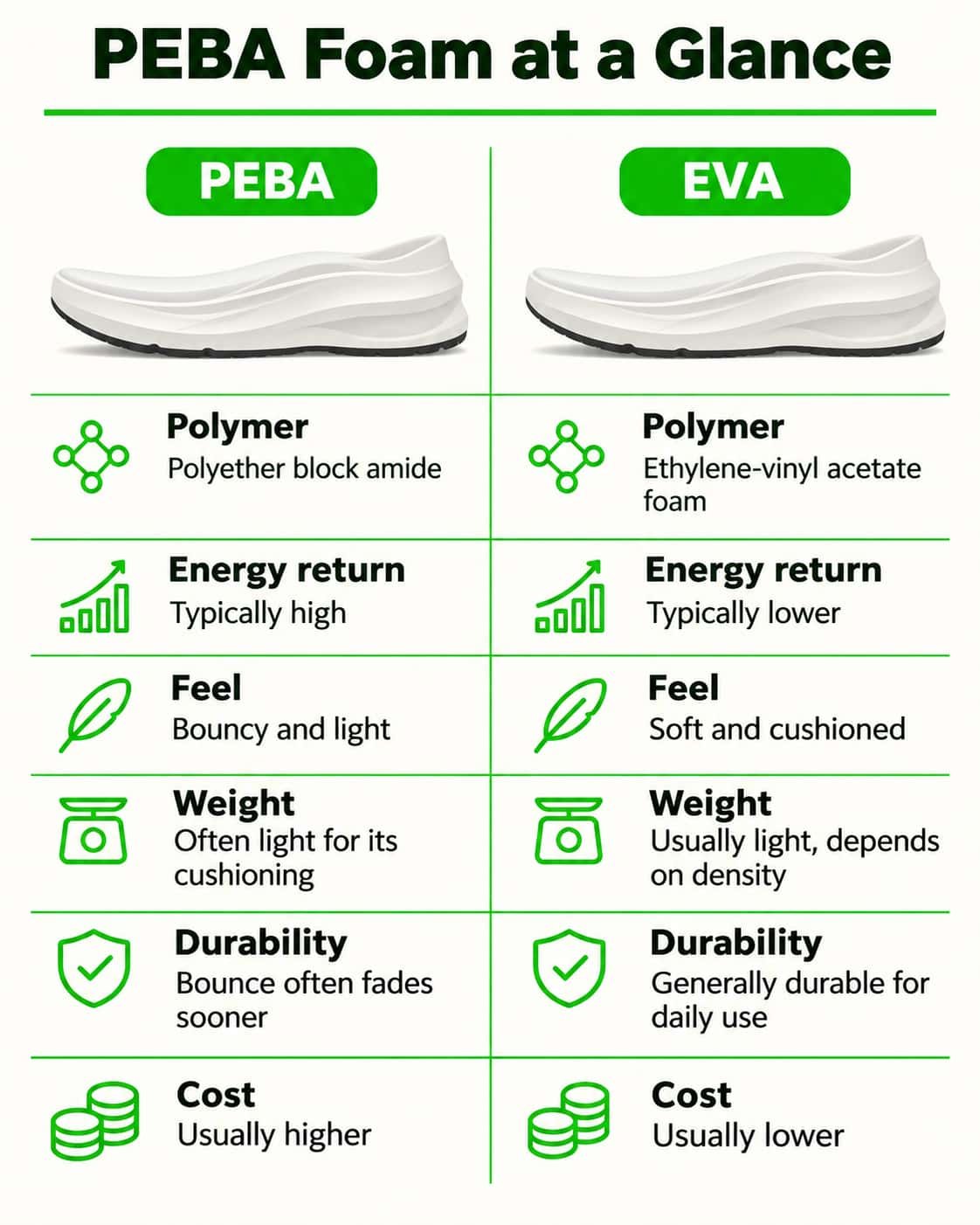
EVA is the most widely used midsole foam, so it is the natural comparison. The table below describes general tendencies. It is not a guarantee for any single shoe.
| Feature | PEBA foam | EVA foam |
| Polymer type | Thermoplastic elastomer (polyether block amide) | Ethylene-vinyl acetate copolymer foam |
| Energy return | Typically high | Typically lower |
| Feel | Bouncy, springy, soft and light | Soft, cushioned, sometimes firmer when dense |
| Weight | Often light for its cushioning | Usually light, depends on density |
| Durability | Often described as having a limited bounce window | Generally durable for everyday use, but can flatten over time |
| Cost | Usually higher | Usually lower |
| Common use | Racing and premium performance shoes | Everyday trainers, casual shoes, many entry-level and mid-range shoes |
Two rows need extra care. Energy return is often rated higher for PEBA, but the rating depends on the test and the shoe’s geometry. Durability is where many buyers are caught out. PEBA’s bounce is generally considered to fade sooner than the bounce in a well-made EVA, so the premium price buys responsiveness, not longevity.
For a closer look at EVA, our what is EVA foam guide explains its structure and common uses. If you are also comparing EVA with its processed cousin, our EVA vs Phylon guide covers that difference.
Energy Return and Bounce
Energy return is the reason PEBA is marketed as a “super” foam. The idea is simple. A foam that compresses and springs back with more of the energy it received gives the wearer a sense of lift. Runners often describe this as a responsive or “pop” feel at toe-off.
RunRepeat’s running shoe foam guide, which we opened for this article, rates PEBA “high” for energy return. In the same cheatsheet it rates TPU “mid” and EVA “low”. The guide also describes premium foams as going over 70 percent in its energy return test, against a typical 40 to 65 percent range for standard foams. These are reviewer ratings and test figures, not a universal standard. The guide does not describe its test conditions in the excerpt we read, so treat the numbers as indicative.
What does that mean in practice? A high-energy-return midsole can feel lively on a fast run or a tempo session, and it can help some runners feel less tired at speed. It does not make every run easier, and comfort on slow miles depends on fit and the rest of the shoe. The bounce is also most noticeable when the foam is new.
Two cautions apply. First, a high rating does not mean a shoe will suit you. A bouncy midsole can feel unstable for some runners, especially in a narrow or poorly fitted shoe. Second, energy return and cushioning are different things. A shoe can be highly responsive and still feel firm, and a soft foam can feel plush without returning much energy.
Our energy return running shoes guide explores this in more depth, and it is worth reading alongside this article.
Weight and Feel
PEBA is often described as light and soft, and it is also described as bouncy. The guide we read calls PEBA foam “bouncy, soft and light at the same time”. That combination is part of its appeal. A foam that is soft to the touch but returns energy quickly can feel light on the foot without feeling flat.
Weight still depends on density, shape and the rest of the shoe. A PEBA midsole with a generous stack height can weigh more than a lower-stack EVA midsole. Compare shoes in the same size, and look at the full weight rather than the foam name. A light shoe with a responsive midsole can be an excellent choice for racing or fast training, but the total weight of the shoe matters more than the foam alone.
Feel is subjective, so try shoes on if you can. Walk, then jog if the shop allows. Notice whether the heel feels secure, whether the forefoot feels stable, and whether the midsole feels too springy for your stride. PEBA’s bounce can be exciting, but it may not suit every runner or every type of run.
Durability: The Honest Trade-Off
Durability is the question that decides whether PEBA is right for you. The honest answer is that PEBA’s bounce is generally considered to fade sooner than the bounce in many EVA and TPU midsoles.
RunRepeat’s guide rates PEBA “mid” for durability, while it rates EVA and TPU “high”. It describes a limited peak-bounce window, which it puts at around 100 to 200 miles, and it says PEBA often feels flat after roughly 150 to 200 miles. The guide also reports a 2023 study that found PEBA and EVA shoes “nearly indistinguishable” after 450 km, and a 2024 study that suggested PEBA keeps its performance over extensive use. We did not read those studies directly, so take them as the guide’s summary. The results suggest that the picture is not uniform across products or testing methods.
The practical lesson is that PEBA works best as a shoe for a defined purpose. A racing shoe or a fast-session trainer is used for a limited number of miles, so the foam’s peak performance window fits the shoe’s job. A daily trainer that covers high mileage may suit a more durable foam better.
Ageing and storage matter too. Heat, direct sun and long periods in a hot car can soften or degrade foam faster than normal use. Dry shoes at room temperature, avoid harsh solvents and keep them out of direct light. Our guide to how long running shoes last explains how wear and mileage shape the lifespan of a shoe, and the same principles apply to PEBA.
PEBA vs TPU and TPEE
TPU is a thermoplastic polyurethane, and it is another premium foam option. The guide rates TPU “mid” for energy return and “high” for durability, which is a different balance from PEBA. For a direct comparison, read our TPU vs EVA foam guide and our what is TPU in shoes article.
TPEE, a thermoplastic polyester elastomer, is sometimes compared with PEBA. It is a different polymer family, so the two are not interchangeable. Listings sometimes group them under similar marketing terms. When a product says “PEBA” or “TPEE”, the important question is what the midsole actually feels like and how long it is expected to last, not the abbreviation alone.
The practical takeaway is to compare the foam on the basis of its performance, not its name. Ask for the density, the expected lifespan and the use case, and compare the shoe as a whole.
Which Shoes Use PEBA, and How to Spot It
Many running shoes list their foam in the product description, often in the midsole section. Look for “PEBA”, “Pebax” or a named foam technology from the brand. If the description is vague, use the shoe’s technical specification, or ask the seller directly.
Be careful with “PEBA-style” or “PEBA-inspired” wording. It can describe a foam that is similar in feel but made from a different material. The best sign is a clear material statement from the manufacturer, not a marketing phrase.
Shopping listings also mix PEBA foam with other terms, such as “foam filament” or “foam sheet”. Foam filament is used in 3D printing, and foam sheets are used in DIY projects. They are not shoe midsoles, so check the product type before comparing prices.
Who Should Choose PEBA Foam?
The right choice depends on what you need from the shoe.
Good fit: runners who want a responsive, lively feel for fast sessions, races or tempo runs, and who are happy to replace the shoe sooner. Walkers or everyday wearers who want a light, springy shoe for short periods of use may also find PEBA pleasant.
Poor fit: people who want the longest possible life from one pair, high-mileage daily trainers, and anyone who prefers a firm, stable platform. People on a tight budget may find EVA or TPU a better value.
Budget: PEBA usually costs more. Work out the cost per mile by dividing the price by the miles you expect to run before the shoe loses its bounce. A premium shoe used for racing may be good value, while the same shoe used for daily miles may not be.
Common Myths About PEBA Foam
“PEBA is always better than EVA.” PEBA is often more responsive, but it is not always more comfortable, durable or affordable.
“PEBA lasts as long as any other foam.” The guide we read describes a limited bounce window, so a PEBA shoe may lose its bounce sooner than a durable EVA or TPU midsole.
“Pebax and PEBA are different materials.” Pebax is a brand name for polyether block amide. The material family is the same.
“A higher energy-return rating means a faster shoe.” Energy return helps some runners feel lively, but speed depends on fitness, form and the whole shoe.
“Any foam labelled PEBA performs the same.” Density, processing and additives change the feel. Two products with the same name can differ.
Frequently Asked Questions
What is PEBA foam?
PEBA foam is midsole foam made from polyether block amide, a thermoplastic elastomer with rigid and soft blocks. It is known for light weight and high energy return, which gives a bouncy feel.
Is PEBA the same as Pebax?
Pebax is a brand name for polyether block amide made by Arkema. Many products called PEBA or Pebax use the same polymer family, but grades and processes differ.
Is PEBA foam better than EVA?
It is often more responsive, while EVA is usually more affordable and often more durable for everyday use. Neither is better for every runner. Choose by use, budget and feel.
Does PEBA foam last?
PEBA’s bounce is generally considered to fade sooner than the bounce in many EVA and TPU midsoles. The guide we read describes a limited bounce window of roughly 100 to 200 miles, so it suits shoes you expect to replace sooner.
Which running shoes use PEBA foam?
Many premium and racing shoes list PEBA-based foam in their specifications. Check the product’s midsole description, since the wording varies by brand and model.
What is a PEBA foam sheet used for?
PEBA foam sheets are sold for DIY, craft and product projects. Check the supplier’s density and thickness details before use, because sheet products differ.
Is PEBA foam worth the price?
It can be, if you value responsiveness for fast runs and accept a shorter lifespan. For high-mileage daily wear, a more durable foam may offer better value.
How should I care for PEBA foam shoes?
Dry them at room temperature, keep them out of heat and direct sun, and clean the upper and midsole gently with mild soap and lukewarm water. Our guide to how to clean shoes and maintain them covers this in more detail.
Final Thoughts
PEBA is a polymer built from rigid and soft blocks, and it is prized for light weight and high energy return. That bounce is its main strength. Its main limit is that the bounce is generally considered to fade with use, so PEBA suits shoes you expect to replace sooner.
If you want a responsive shoe for fast running, PEBA is worth considering, provided you understand the trade-off. If you want a shoe for everyday, high-mileage wear, a more durable foam may serve you better. For a wider view of the materials behind these choices, read our shoe materials guide.
Sources and further reading
- RunRepeat: Running shoe foams guide (the energy return, durability and foam-comparison ratings quoted in this article)