
Goodyear Welt Explained: Why These Resolable Shoes Last Forever (2026 Guide)
We’ve all been there. You buy a sleek pair of dress shoes or some rugged-looking boots for work, travel, or daily commuting. They look fantastic out of the box. But six months later? The front toe starts to separate, and suddenly your shoe is “talking” to you with every step you take.
I saw a meme on Instagram the other day featuring a guy frantically supergluing the sole of his dress shoe back together in a coffee shop bathroom, five minutes before a major job interview. It’s funny because it’s a universal struggle. We rely heavily on our footwear to get us through long office hours, urban commutes, and global travel, yet we routinely settle for shoes that are fundamentally built to fail.
As someone who has spent over two decades examining, repairing, and fitting footwear in a busy physical shoe shop in Chennai, I’ve seen exactly how humidity, rough pavements, and daily wear absolutely destroy poorly made shoes.
The secret to breaking this cycle? Goodyear welt construction. If you’re tired of replacing your footwear every year and want to understand why true footwear aficionados swear by premium, resolable shoes, you’re in the right place.
TL;DR: The Quick Answer
Goodyear welt construction is a traditional shoemaking method where a strip of leather (the welt) is stitched to both the shoe’s upper and the insole, and then separately stitched to the outsole. This two-level stitching makes the shoes highly water-resistant and entirely resolable, meaning a cobbler can replace the bottom without damaging the top, allowing the shoes to last for decades.
Why This Topic Matters: The Global Disposable Shoe Crisis
Online shoe shopping is convenient, but it has created a massive quality blind spot. Modern brands have become incredibly good at making cheap, cemented (glued) shoes look like premium luxury items in photos.
What most buyers regret after buying cheap shoes online is the rapid degradation. The upper materials might be decent, but the foundation is weak. When the glue dries out or encounters heavy rain, the shoe is effectively dead. You can’t replace the sole easily without destroying the upper.
On Reddit’s footwear communities, you’ll frequently see users lamenting their $150 designer shoes splitting after one season. The consensus is always the same: Stop buying glued shoes and invest in Goodyear welted or stitch down construction. Let’s dive into exactly what this means, how it works, and how to choose the right pair for your lifestyle.
What is Goodyear Welt Construction?
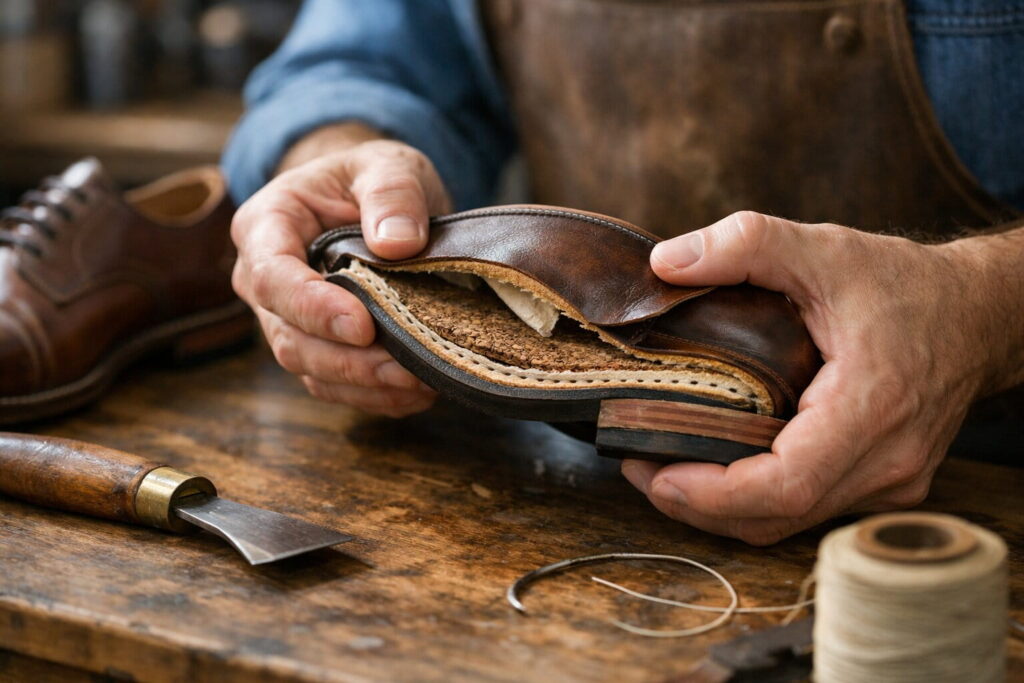
Invented in 1869 by Charles Goodyear Jr., this method mechanized a previously painstaking hand-sewn process. Here is how the anatomy of a Goodyear welted shoe breaks down:
- The Upper: The visible top part of the shoe (usually full-grain leather or suede).
- The Insole: The layer your foot rests on. A canvas “rib” is attached to the bottom of this insole.
- The Welt: A strip of material (usually leather) that acts as the anchor.
- The First Stitch: A hidden stitch sews the Upper, the Insole Rib, and the Welt together.
- The Cork Filling: The void created by the rib is filled with cork. This is crucial—cork provides insulation and, over time, molds perfectly to the unique shape of your foot.
- The Second Stitch: The outsole is stitched directly to the Welt.
Because the outsole is stitched to the welt and not the upper, a cobbler can easily cut the bottom stitch, remove the worn-out sole, and sew on a brand new one.
Goodyear Welt Construction vs. The Stitch Down Method
While shopping for high-quality boots, you’ll likely encounter another term: the stitch down method. How do they compare?
- Goodyear Welt Construction: The upper is folded inward under the insole and stitched to the welt. It creates a slightly more refined, sleeker profile perfect for dress shoes, office wear, and sleek boots. It’s highly water-resistant because the stitching doesn’t go straight through to the footbed.
- Stitch Down Method: The upper is flaired outward and stitched directly to the midsole/outsole. Think of classic desert boots or heavy-duty Pacific Northwest logging boots. It’s incredibly rugged, keeps water out exceptionally well, and generally allows for a slightly wider, more flexible fit out of the box.
Both methods yield incredibly durable, resolable shoes. Your choice depends largely on the aesthetic you prefer.
Comfort vs. Durability: The Infamous Break-In Period
“Is this actually comfortable for all-day wear?”
This is the number one question I get when handing a customer a heavy, welted shoe. The honest answer? Not on day one. There’s a running joke in the raw denim and heritage boot communities about the “bloody heel phase.” Because Goodyear welted shoes use thick, full-grain leathers, rigid leather insoles, and solid cork footbeds, they start off stiff.
The Trade-Off: Cheap shoes use EVA (Ethylene-Vinyl Acetate) foam insoles. They feel like walking on clouds on day one, but compress to paper-thin pancakes by month three, leading to knee and back pain.
Goodyear welt construction uses a cork footbed. It takes about 10 to 15 wears for the heat and pressure of your foot to compress the cork. Once it does, you effectively have a custom-molded orthotic. A well-broken-in welted shoe offers superior, firm arch support that prevents foot fatigue during long travel days or standing shifts.
Core Materials: Beyond the Leather Upper
To get the most out of your investment, pay attention to the sole materials attached to the welt.
- Leather Soles: The classic choice for formal wear. Sleek, breathable, and elegant. However, they lack grip and wear down faster on wet pavement.
- Rubber (Vibram / Dainite): The modern commuter’s best friend. Many premium brands now stitch low-profile rubber studded soles onto their welts. They offer the elegance of a dress shoe with the grip and durability of a hiking boot.
- TPR & PU: Thermoplastic Rubber and Polyurethane are lighter, flexible materials often found on more casual welted options. While durable, true purists often stick to hard rubber or leather for maximum longevity.
Real-World Insights: Quality Checks & Pro-Tips
In my years inspecting footwear shipments and handling thousands of customer repairs, I’ve learned how brands cut corners. Here are some insider tips to protect your wallet:
1. Beware the “Fake Welt” (The Molded Stitch) Fast-fashion brands are notorious for molding fake stitches into cheap rubber soles to mimic the look of Goodyear welt construction.
- The Test: Look closely at the stitches on the top edge of the sole. Do they look like actual thread with slight, natural tension, or do they look like a continuous piece of molded plastic? If you check the bottom of the sole and there is no stitch track, it’s fake.
2. Check the Insole Reach inside the shoe. If the insole feels squishy and you can peel it back to see white fabric and glue underneath, it’s likely cemented. A true welted shoe usually features a hard leather insole that you cannot lift up.
3. The Flex Test A brand new Goodyear welted shoe should be quite difficult to bend in half. If you can easily fold the toe back to the heel with two fingers, the shoe lacks the internal structuring (shank and cork) of a high-quality build.
Comparison: Footwear Construction Methods
| Feature | Cemented (Glued) | Blake Stitch | Goodyear Welt Construction |
|---|---|---|---|
| Attachment | Glued directly | Stitched through the insole to the outsole | Stitched via an external welt |
| Water Resistance | Low (glue fails when wet) | Medium (water can seep up through stitches) | High (stitching is external) |
| Resolable? | Rarely (often damages upper) | Yes (requires specialized machine) | Yes (easiest and cleanest to resole) |
| Flexibility | High (out of the box) | High | Low initially, molds over time |
| Lifespan | 6 – 18 months | 3 – 10 years | 10 – 30+ years |
Common Mistakes Buyers Make
Even with premium footwear, you can ruin your investment if you aren’t careful. Avoid these global pitfalls:
- Choosing the wrong size hoping they “stretch”: Leather stretches in width, never in length. If your toes are hitting the front of the shoe, they are too small. No amount of break-in will fix a shoe that is fundamentally the wrong length.
- Wearing them two days in a row: Leather absorbs foot sweat. If you don’t let the shoes rest for 24 hours between wears, the moisture will rot the leather from the inside out, deteriorating the welt.
- Ignoring shoe trees: Cedar shoe trees absorb moisture and keep the toe box from developing deep, permanent creases. They are mandatory for expensive shoes.
- Waiting too long to resole: Don’t wear the sole down until you are walking on the welt itself. Once the welt is damaged, the cobbler has to rebuild the entire shoe, which costs significantly more.
Need-to-Know Footwear Facts
Are Goodyear welt shoes waterproof? They are highly water-resistant, but not 100% waterproof like rubber rain boots. Puddles and rain won’t penetrate the sole easily, but water can eventually get through the leather upper if not properly conditioned.
How much does it cost to resole a shoe? Globally, a quality resole job ranges from $80 to $150, depending on the materials used (e.g., premium Vibram rubber vs. basic leather) and the cobbler’s expertise.
Why are Goodyear welted shoes so heavy? The weight comes from the solid materials: full-grain leather, a thick leather insole, a steel or wooden shank for arch support, cork filling, and a heavy-duty outsole. This density is exactly what gives them their longevity.
Can sneakers have a Goodyear welt? Yes! While rare, a few ultra-premium heritage brands are now creating luxury sneakers using traditional welt construction, allowing you to resole a casual sneaker.
Is Blake Stitch just as good? Blake stitch is excellent for sleek, flexible Italian-style loafers and dress shoes. However, it is less water-resistant and slightly harder to resole than a Goodyear welt.
Finding Your Next Pair
Investing in resolable shoes is a shift in mindset. You are moving away from the fast-fashion treadmill and stepping into sustainable, long-term style. A $350 pair of boots worn for 10 years costs you $35 a year. A $70 pair of glued boots replaced every year costs you $700 over the same decade. The math simply makes sense.
If you’re ready to upgrade your footwear game, don’t just buy the first expensive brand you see. Look for trusted names known for their construction standards.
Compare prices from leading online stores and check today’s top-rated Goodyear welt shoes on platforms like Amazon or specialized heritage footwear retailers. Look closely at customer reviews regarding sizing, as traditional lasts (the foot molds used to shape the shoe) often run half a size large compared to modern running sneakers.
fQs
1 .What does Goodyear welt mean? It is a construction method where a leather strip (the welt) is sewn to the shoe upper and insole, and then the outsole is sewn to that welt, allowing for easy sole replacement.
2 .Are resolable shoes worth the money? Yes. While the upfront cost is higher, the cost-per-wear over a decade is significantly lower than constantly replacing cheap, glued footwear.
3 .How many times can a Goodyear welt be resoled? With proper upper leather care, a Goodyear welted shoe can typically be resoled 3 to 5 times, effectively lasting 10 to 20 years or more.
4 .Do Goodyear welt shoes hurt to break in? They can be stiff for the first 1-2 weeks as the thick leather softens and the internal cork footbed compresses to match the shape of your foot.
5 .What is the difference between cemented and welted shoes? Cemented shoes use chemical glue to attach the sole to the upper, which degrades over time. Welted shoes use physical stitching, creating a permanent, repairable mechanical bond.
6 .Is the stitch down method better than Goodyear welt? Neither is objectively better; stitch down is typically wider, more rugged, and highly water-resistant (great for heavy work boots), while Goodyear welt is sleeker and perfect for versatile daily wear.
7. How do I care for the leather welt? When polishing or conditioning your shoes, apply a small amount of leather conditioner to the welt and the exposed stitching to keep the thread from drying out and snapping.
8.Can a cobbler change a leather sole to a rubber sole? Absolutely. One of the best benefits of resolable shoes is customization. A cobbler can easily swap a slippery leather sole for a grippy rubber Dainite or Vibram sole.
9.Why do my new welted shoes slip at the heel? Because the thick sole hasn’t flexed yet, it forces your heel to lift out of the shoe. Once the sole breaks in and bends with your foot, the heel slip will disappear.
10. Are all expensive shoes Goodyear welted? No. Many high-end designer brands use cheap cemented construction, charging purely for the logo. Always check the construction method before paying premium prices.