
What is Full-Grain Leather vs. Top-Grain? The Ultimate 2026 Guide to Leather Quality Grades
TL;DR
Full-grain leather uses the outermost hide layer, keeping its natural texture to maximize durability and lifespan. Top-grain leather is sanded down to remove imperfections, making it softer and more flexible, but slightly less tough. Avoid “genuine leather,” which is heavily processed, lower-quality scrap material.
We’ve all been there. You buy a beautiful pair of leather shoes online. They look fantastic right out of the box, but fast forward three months of office wear and commuting, and they’re peeling like a bad sunburn. You check the tag inside the tongue, and it proudly says: “Genuine Leather.” If you’ve ever spent time on Reddit’s r/goodyearwelt or r/malefashionadvice, you’ve probably seen the memes and the collective groans about this exact scenario. The internet is full of frustrated shoppers realizing that not all leather is created equal.
Whether you’re buying casual sneakers for weekend travel, dress shoes for the boardroom, or boots for daily walking, understanding the difference between full grain vs top grain leather is the secret to buying footwear that lasts years, not months.
Today, we’re breaking down the leather quality grades, busting the genuine leather myth, and showing you exactly how to shop for your next favorite pair of shoes at Urban Style Footwear.
Why This Topic Matters (And Why Online Shopping is Tricky)
Buying shoes online is incredibly convenient, but it comes with a major blind spot: you can’t smell, feel, or flex the material through a screen.
Over the last two decades of analyzing footwear and fitting thousands of customers in our shop, I’ve noticed a universal trend. Most people choose shoes based purely on aesthetics and price, completely ignoring the material composition. The most common regret I hear from buyers worldwide is spending $100+ on shoes that lose their shape or crack at the flex points within a year.
Brand marketing has muddied the waters. Terms are thrown around loosely to make budget materials sound premium. If you want comfort, longevity, and value for your money, you need to understand exactly what you are paying for.
Decoding Leather Quality Grades: The Big Three
To understand what you’re buying, you need to know how a hide is split. Animal hides are thick—too thick for a single pair of shoes. So, they are sliced into different layers. Here is how those layers translate into the leather quality grades you see in stores.
1. What is Full-Grain Leather?
Full-grain leather is the absolute top of the food chain. It uses the very outermost layer of the hide, right below the hair.
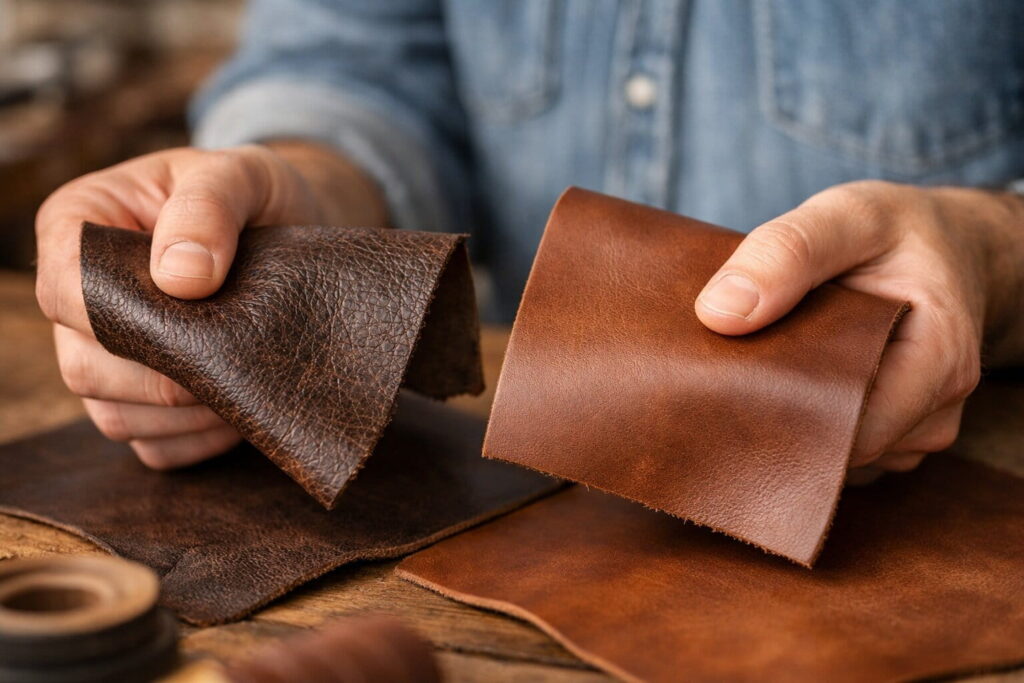
- The Look: It retains the natural grain, meaning you might see slight imperfections, scars, or variations in the texture.
- The Feel: It starts out stiff but molds beautifully to your foot over time.
- The Superpower: It develops a rich, dark “patina” as it ages, absorbing oils and looking better year after year. It is incredibly strong and moisture-resistant.
2. What is Top-Grain Leather?
Top-grain is the second-highest tier. It’s still the top layer of the hide, but the very top surface has been sanded, buffed, or “snuffed” to remove the natural imperfections.
- The Look: Very uniform, smooth, and pristine. A finish coat is usually applied.
- The Feel: Softer and more flexible right out of the box compared to full-grain.
- The Trade-off: Because the strongest outer fibers are sanded away, it sacrifices a bit of durability and breathability for that flawless, comfortable finish.
3. The “Genuine Leather” Myth Exposed
Here is the biggest secret the fast-fashion industry doesn’t want you to know. “Genuine Leather” doesn’t mean “good leather.” It simply means technically made of leather. Usually, genuine leather is made from the bottom layers of the hide (suede) that have been heavily processed, stamped with an artificial grain texture, and painted to look like full or top-grain. It lacks structural integrity, which is why it stretches out, cracks, and peels quickly.
Full Grain vs Top Grain: How to Choose for Your Lifestyle
So, which one should you buy? The answer depends entirely on your daily routine. Here is a breakdown of the comfort vs. durability trade-offs.
For the Daily Commuter & Office Worker
Winner: Top-Grain Leather If you want a sleek dress shoe or a minimalist leather sneaker that feels comfortable on day one, top-grain is your best bet. It’s flexible, requires almost zero break-in period, and looks incredibly sharp.
- Shoe Anatomy Match: Pair a top-grain upper with a lightweight EVA (Ethylene Vinyl Acetate) or TPR (Thermoplastic Rubber) sole. This combination gives you a cloud-like walking experience perfect for office floors and city pavements.
For the Traveler & Heavy Walker
Winner: Full-Grain Leather If you are logging serious miles traversing cobblestone streets in Europe or navigating unpredictable weather, full-grain is essential. Yes, it will take a few weeks to break in, but it will eventually contour to the exact shape of your foot, providing custom support.
- Shoe Anatomy Match: Look for full-grain leather paired with a durable Rubber or high-density PU (Polyurethane) outsole. This combo handles heavy friction and protects your foot from impact.
Is it actually comfortable for all-day wear?
- Top-grain is comfortable immediately.
- Full-grain is initially stiff but becomes the most comfortable shoe you own after a month of wear.
Pro-Tip: How to Spot the Difference in the Wild
After years of handling shipments from global brands, we use a few quick tests to verify leather quality. You can do these at home:
- The Wrinkle Test: Press your thumb firmly into the leather. Real full-grain and top-grain leather will wrinkle and crease naturally around your thumb, much like human skin. Heavily processed genuine leather will often just depress rigidly without natural wrinkling.
- The Smell Test: Premium full and top-grain leathers have an earthy, rich, natural smell. Cheaper grades often smell like chemicals or plastic due to the heavy synthetic coatings.
- The Edge Check: Look at the exposed edges of the leather (like around the tongue or collar). Full-grain looks solid and dense. Cheaper leathers often look fibrous, fluffy, or have painted edges to hide the layers.
Comparison: Leather Grades at a Glance
| Feature | Full-Grain Leather | Top-Grain Leather | Genuine Leather |
|---|---|---|---|
| Source | Outermost hide layer (intact) | Outermost hide layer (sanded) | Inner/bottom hide layers |
| Durability | ⭐⭐⭐⭐⭐ (Highest) | ⭐⭐⭐⭐ (High) | ⭐⭐ (Low) |
| Flexibility | Stiff initially, molds over time | Flexible and soft immediately | Flaps/creases easily |
| Aging | Develops a rich patina | Remains mostly unchanged | Cracks and peels |
| Best For | Heavy boots, premium belts | High-end sneakers, soft bags | Budget fast-fashion |
Common Mistakes Buyers Make Online
- Choosing Looks Over Support: Don’t buy a beautiful full-grain boot if it has a flat, unsupportive inner sole. Always check if the shoe has a proper footbed or room for an orthotic insert.
- Ignoring Sole Composition: A premium leather upper is useless if the sole is cheap, hollow rubber that wears out in three months. Ensure the sole material (EVA, TPR, Rubber) matches your intended use.
- Falling for the Genuine Leather Myth: Thinking you got a “steal” on $40 genuine leather shoes. You will likely buy them three times over the course of the time a single $150 full-grain pair would have lasted.
Quick Answers for Smart Shoppers
What are the 4 levels of leather? The four main levels, from highest to lowest quality, are full-grain, top-grain, genuine (or corrected-grain), and bonded leather.
Is full-grain leather good for shoes? Yes, it is the absolute best material for durable shoes. It offers unmatched longevity, breathability, and water resistance, naturally molding to your feet over time.
What are the disadvantages of full grain leather? It is usually more expensive, heavier, and requires a break-in period before it becomes fully comfortable. It can also show natural scars from the animal.
What is the lowest quality of leather called? Bonded leather is the lowest quality. It is essentially leather dust and scraps glued together with polyurethane, akin to particleboard in woodworking.
How can I tell if leather is full grain? Look closely at the surface; you should see natural pores and slight imperfections. It will also feel thick, smell natural, and absorb leather conditioner easily.
From the Expert’s Desk: Our Footwear Philosophy
When you spend over two decades analyzing footwear, testing materials, and listening to the foot-pain complaints of thousands of customers, you learn to see past the marketing fluff. We don’t just look at shoes; we look at biomechanics. We know that a breathable mesh lining combined with a top-grain leather upper can save a commuter’s arches, just as we know that full-grain leather is non-negotiable for serious workwear. We advocate for buying better, buying less, and treating your feet with the respect they deserve.
Ready to Upgrade Your Footwear?
Stop wasting money on shoes that peel after a single season. Now that you understand the full grain vs top grain debate and the genuine leather myth, you are ready to make an informed investment.
- Check today’s best-rated full-grain and top-grain shoes on Amazon.
- Compare prices from leading online stores to find the perfect balance of style and durability.
- Browse top-reviewed options from trusted brands that transparently list their materials.
Invest in your feet—they carry you everywhere.
Top 10 Search Queries Answered
1. Does full-grain leather stretch? Yes, full-grain leather naturally stretches and conforms to the exact shape of your foot over time, providing a highly customized and comfortable fit.
2. Is top-grain leather waterproof? No leather is entirely waterproof without heavy treatment, but top-grain leather is highly water-resistant, especially due to the protective finish coats applied during manufacturing.
3. Which leather is best for daily wear? For immediate comfort and sleek style in a casual or office setting, top-grain leather is best. For heavy-duty use and maximum longevity, full-grain is superior.
4. Does genuine leather peel? Yes, “genuine leather” frequently peels and cracks. This happens because the artificial polyurethane coating separates from the weak, underlying split-leather base.
5. Why is full-grain leather so expensive? It is expensive because it requires the absolute best hides with the fewest natural defects. It is also harder to work with and stitch due to its thickness.
6. Can you polish top-grain leather? Yes, you can polish top-grain leather using standard shoe creams and waxes to maintain its smooth, uniform finish and protect it from the elements.
7. How long does top-grain leather last? With proper care, conditioning, and occasional polishing, a good pair of top-grain leather shoes can easily last 5 to 10 years.
8. Does full-grain leather crack? Full-grain leather is highly resistant to cracking, provided it is properly conditioned. If it dries out completely, it can crack, so regular moisturizing is required.
9. Is full-grain leather heavy? Yes, because it contains the dense, tightly packed outer fibers of the hide, full-grain leather is noticeably heavier and thicker than top-grain or genuine leather.
10. What leather do luxury brands use? Most luxury fashion houses use high-end top-grain leather for handbags and sneakers to achieve a flawless look, while premium heritage shoemakers strictly use full-grain leather.