
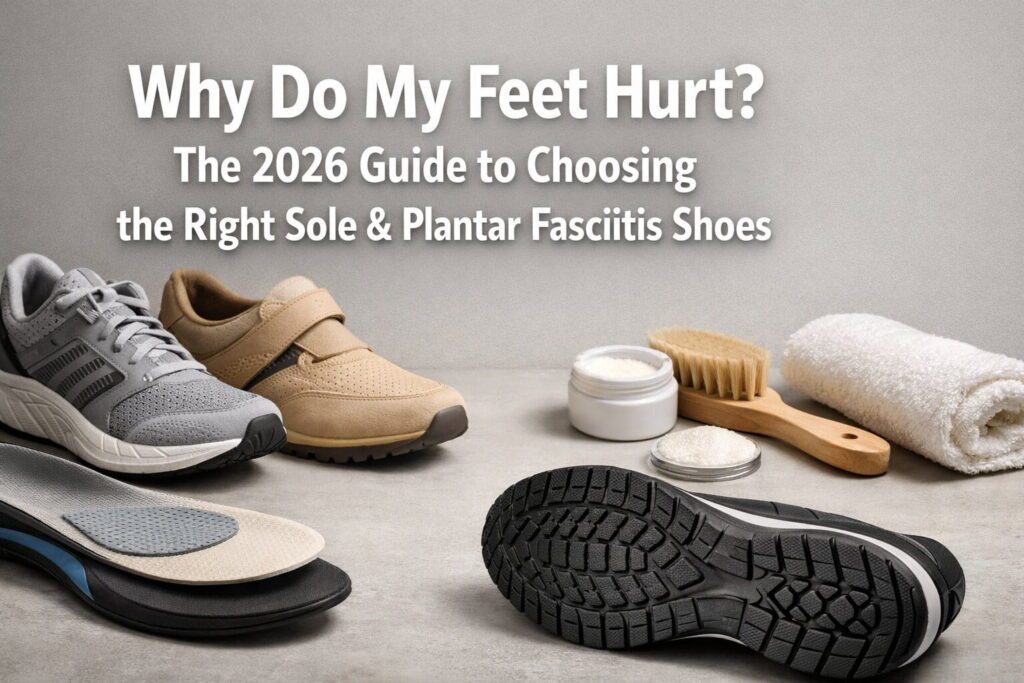
Why Do My Feet Hurt? The 2026 Guide to Choosing the Right Sole & Plantar Fasciitis Shoes
Introduction: The Universal Language of Foot Pain
If you are reading this, you probably know the feeling. You step out of bed in the morning, and a sharp, stabbing pain shoots through your heel. Or perhaps you’ve finished a long shift at work, and your arches feel like they are on fire.
You are not alone. In my 20+ years of running a physical shoe store—handling thousands of pairs of shoes and listening to just as many customer complaints—I have learned one universal truth: Most people buy shoes for their eyes, but they end up paying with their feet.
Whether you are walking the streets of New York, commuting in London, or navigating the humidity of Chennai (where I cut my teeth in this industry), the laws of physics and biology remain the same. The barrier between you and the concrete is your shoe’s sole. If that sole isn’t doing its job, your body takes the hit.
This guide isn’t just about selling you a sneaker; it’s about engineering comfort. We are going to break down the mechanics of foot pain, specifically regarding the proper support for plantar fasciitis shoes, and help you stop wasting money on footwear that hurts.
TL;DR: The Quick Answer (What You Need to Know)
What are the best shoes for foot pain? If you have heel pain (plantar fasciitis), avoid completely flat shoes (like canvas slip-ons) and overly soft “marshmallow” memory foam. You need structural integrity. The best doctor recommended shoes for plantar fasciitis feature a firm heel counter, moderate arch support, and a midsole that absorbs shock without “bottoming out.” Look for materials like firm EVA or PU (Polyurethane) midsoles and a slight heel lift (8mm–12mm drop) to relieve tension on the Achilles tendon and plantar fascia.
Why This Topic Matters (And Why Experience Counts)
In the era of online shopping, buying shoes has become a gamble. You see a 5-star review, you like the color, and you click “Buy.” Two days later, you’re wearing them, but two weeks later, they are sitting in the back of your closet because they hurt.
From my experience on the shop floor, I can tell you that 70% of the people who walked into my store complaining of back or knee pain were wearing the wrong shoes. They assumed that “soft” equaled “comfortable.”
That is the biggest myth in the footwear industry.
When you buy online, you can’t squeeze the heel counter or twist the sole to check for stability. You rely on descriptions. This guide bridges that gap. I’m going to teach you how to read a shoe’s specs like an expert, ensuring you find the best work boots for plantar fasciitis or the perfect walking shoe without ever trying them on first.
The Anatomy of Pain: Understanding Plantar Fasciitis
Before we look at the soles, we have to look at the source. The plantar fascia is a thick band of tissue connecting your heel bone to your toes. Think of it as the shock absorber or the bowstring of your foot’s arch.
When you wear shoes with poor support, that “bowstring” gets stretched too tight, causing micro-tears. That is the morning pain you feel.
The “Goldilocks” Zone of Soles
Finding relief isn’t about immobilization; it’s about support.
- Too Hard: Walking on concrete with thin leather soles sends shockwaves up your leg.
- Too Soft: Super-plush foam collapses under your weight, forcing your foot to work harder to balance.
- Just Right: A firm but responsive midsole that cradles the heel.
How to Choose: The “Doctor Recommended” Criteria
When a podiatrist suggests doctor recommended shoes for plantar fasciitis, they aren’t usually talking about a specific brand; they are talking about a specific structure. Here is the checklist I used to run through with every customer who limped into my shop.
1. The Heel Counter Test
The back part of the shoe (that wraps around your heel) should be stiff. If you can smash the back of the shoe down with your thumb effortlessly, it offers zero stability. A stable heel prevents overpronation (rolling inward), which is a major cause of plantar fasciitis.
2. Midsole Density (The Secret Sauce)
The midsole is the layer between the inner liner and the tread. This is where the magic happens.
- EVA (Ethylene Vinyl Acetate): The standard white foam on sneakers. Lightweight and cushioned. Great for casual use.
- PU (Polyurethane): Heavier, denser, and more durable. Often found in the best work boots for plantar fasciitis. It doesn’t compress over time.
- Dual-Density: The best of both worlds. A harder foam on the inside (arch side) for support, and softer foam on the outside for cushioning.
3. Torsional Rigidity
Grab a shoe by the toe and the heel. Try to twist it like a wet towel.
- Can you wring it out? Put it back. That shoe will tire your feet out in an hour.
- Is it stiff in the middle? Good. That protects your arch.
Best Use-Cases: Matching the Sole to the Activity
For the Daily Walker: Casual Support
If you are looking for everyday plantar fasciitis shoes, look for “Rocker Bottom” soles. These soles are curved slightly at the heel and toe. They physically roll your foot forward, taking the strain off the plantar fascia so the shoe does the work, not your foot.
- Key Material: High-rebound EVA.
- Look For: Removable insoles (so you can add custom orthotics if needed).
For the 9-to-5 Grind: Work Boots & Safety Shoes
This is where I see the most damage done. Standing on concrete floors for 8+ hours kills feet. The best work boots for plantar fasciitis usually feature a steel shank or a fiberglass shank embedded in the sole. This acts as a spine for the shoe, ensuring the arch doesn’t collapse under heavy loads.
- Key Material: PU Midsoles and Rubber outsoles.
- Feature to Check: “Anti-Fatigue” technology.
CTA: Are your work boots killing your back? Check the latest prices on top-rated orthopedic work boots on Amazon.
Material Deep Dive: What Are You Actually Standing On?
In my shop, I used to cut old shoes in half to show customers what was inside. Here is what you need to know about materials to make an informed global purchase.
1. Phylon (Compressed EVA)
This is what you find in mid-range running shoes. It is light and responsive.
- Pros: Great shock absorption.
- Cons: Can wrinkle and compress (“bottom out”) after 6–8 months of heavy use.
2. TPR (Thermoplastic Rubber)
Common in casual shoes and loafers. It looks like rubber but is lighter.
- Pros: Flexible and affordable.
- Cons: Often lacks the deep arch support needed for medical conditions unless paired with a great footbed.
3. Polyurethane (PU)
The heavy lifter.
- Pros: Incredible durability. A PU sole can last 2–3 years without losing its shape.
- Cons: Heavier than foam.
Comparison Table: Choosing Your Weapon
| Sole Material | Shock Absorption | Durability | Support Level | Best For |
|---|---|---|---|---|
| Standard EVA | High | Low | Low-Medium | Gym, Short Walks |
| Firm PU | Medium | High | High | Work Boots, Standing All Day |
| Memory Foam | Very High (Initial) | Very Low | Low | House Slippers |
| Rubber + Shank | Medium | Very High | Very High | Heavy Duty Work |
| Cork/Latex | Medium | High | Very High | Sandals (like Birkenstocks) |
Pro-Tips: Retailer-Only Insights
After fitting thousands of feet, here are three secrets brands rarely tell you:
The “Afternoon Swell” Rule Never buy shoes online based on the size of your current shoes measured in the morning. Your feet swell by about 5-8% throughout the day. Always size for your “afternoon foot.” If you are buying plantar fasciitis shoes, you need that extra volume to avoid compression pain.
The Insole Swap Most shoe manufacturers, even the expensive ones, spend money on the outside of the shoe and put a 10-cent piece of foam on the inside.
- Pro Move: Buy a solid, supportive shoe with a removable insole. Immediately throw away the factory insole and replace it with a dedicated orthopedic insert. This transforms a $60 shoe into a $150 comfort shoe.
The “Drop” Matters For heel pain, avoid “Zero Drop” (perfectly flat) shoes unless you have trained for them. A 10mm heel-to-toe drop (where the heel is higher than the toe) relieves tension on the Achilles tendon, which directly pulls on the plantar fascia.
Common Mistakes to Avoid
- Chasing “Pillow Softness”: I cannot stress this enough. Walking on a pillow feels great for 5 minutes and terrible for 5 hours. Your foot needs a stable platform, not a trampoline.
- Ignoring Width: If the ball of your foot feels squashed, your toes can’t splay. This destabilizes your arch. Look for “Wide” or “2E” sizing options if you feel pressure on the sides.
- Keeping Shoes Too Long: Just because the tread isn’t worn down doesn’t mean the support is still there. If the midsole has clear wrinkles or feels hard as a rock, the shock absorption is dead. Replace your daily shoes every 500 miles (or roughly every 8-10 months).
PAA: Common Questions (People Also Ask)
Can shoes cure plantar fasciitis? No shoe can “cure” it instantly, but doctor recommended shoes for plantar fasciitis can reduce strain by 70-80%, allowing the inflammation to heal naturally over time.
Are memory foam shoes good for plantar fasciitis? Generally, no. While comfortable initially, memory foam lacks the structural resistance needed to support the arch all day, leading to foot fatigue.
Do I need a hard or soft sole for heel pain? You need a firm midsole with a soft heel crash pad. A totally soft sole destabilizes the foot, while a firm sole bridges the arch and protects the fascia.
What are the best work boots for plantar fasciitis? Boots with a steel or fiberglass shank, a defined heel, and a removable footbed (to accommodate orthotics) are the best option for industrial work.
Does walking barefoot help plantar fasciitis? Usually, it makes it worse. Walking barefoot on hard surfaces (tile, wood, concrete) exposes the unsupportive arch to immense strain. Stick to supportive house shoes.
FAQs
Q: I work in a warehouse on concrete. What should I look for? A: You need shock absorption combined with stability. Look for wedge-sole boots or shoes with “Max Cushioning” but ensure they have a wide base so you don’t roll your ankles.
Q: Are expensive shoes always better for foot pain? A: Not necessarily. I’ve seen $300 designer sneakers with zero support. However, investing in the $100–$160 range usually gets you better midsole materials (like high-grade PU) that last longer and support better than budget options.
Q: Can I just buy Dr. Scholl’s inserts? A: Inserts help, but only if the shoe structure is sound. Putting a good insert into a flimsy, worn-out sneaker is like putting a new engine in a car with a rusted chassis. It won’t work.
Q: How do I know if a shoe has good arch support online? A: Look for photos of the medial side (the inner side) of the shoe. If the foam looks thicker under the arch or if the description mentions a “TPU Shank” or “Motion Control,” it likely has good support.
Final Thoughts: Invest in Your Foundation
Your feet are the foundation of your entire body. Knee pain, hip misalignment, and lower back issues often start at the ground level. Whether you are searching for the best work boots for plantar fasciitis or just a casual sneaker that won’t leave you limping, remember the lessons from the shop floor: Structure over softness. Fit over fashion.
Don’t let pain dictate your day. Make the switch to supportive footwear and feel the difference in your first step.
Ready to find relief?
(Note: Always consult with a podiatrist for persistent foot pain. This guide is based on retail expertise and material science, not medical diagnosis.)